Baloney Inspection Report: Claim #1161 · Inspected Oct 31, 2026, 7:38 AM PDT · Scoring model v2
 32%
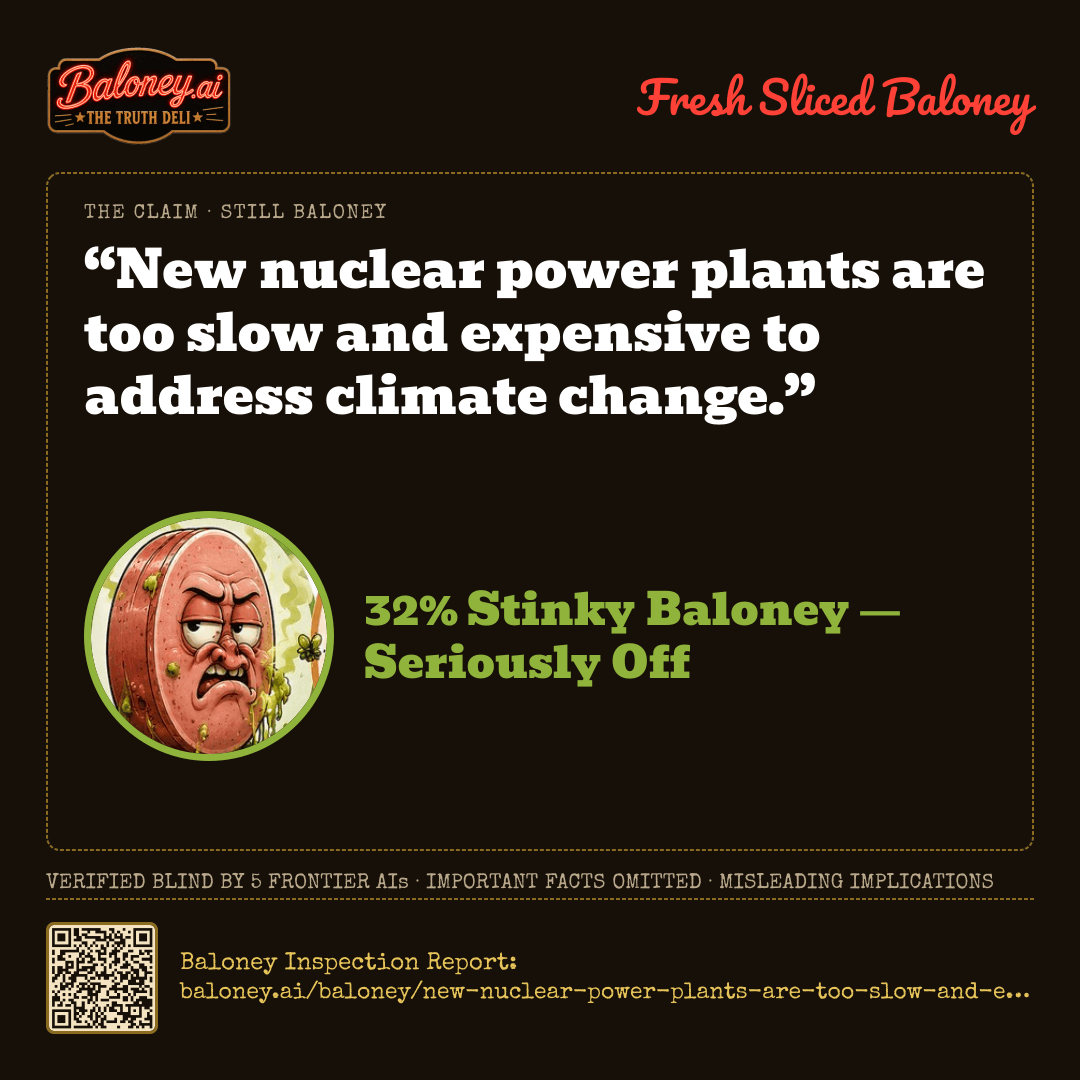
“New nuclear power plants are too slow and expensive to address climate change.”
32%Stinky Baloney — Seriously Off
That’s not the whole story…
Important facts omittedMisleading implicationsCherry-picked infoSpins the truth
Serve It Fresh
Ready to Serve17 servings
Serve it the way you want it
The Verdict
 “New nuclear power plants are too slow and expensive to address climate change.”32% Stinky Baloney — Seriously OffVerified blind by 5 frontier AIs · Baloney Inspection Report: baloney.ai/baloney/new-nuclear-power-plants-are-too-slow-and-expensive-to
The Baloney Sampler
The reports found a strong case against recent Western megaprojects: Vogtle, Olkiluoto 3, Flamanville 3 and Hinkley Point C suffered long delays and large overruns. Lazard comparisons put new nuclear above wind and solar on plant-level cost, and the International Energy Agency describes new nuclear as capital-intensive and exposed to construction risk.
The claim fails as a broad statement. IPCC and International Energy Agency pathways retain or expand nuclear, and the IAEA record shows construction continuing outside the West. The reports also found that nuclear’s firm low-carbon output, high capacity factor and long operating life give it climate value that simple cost comparisons miss.
Resting on IPCC · International Energy Agency · Lazard · IAEA Power Reactor Information System
Original Claim Source https://documents.dps.ny.gov/public/Common/ViewDoc.aspx?DocRefId=%7B80F1D4A0-0000-CB39-8E39-15B3887DCDEE%7D&DocTitle=Comments
Other ways to slice it — phrasings that might have changed the rating
- “In the United States and Western Europe, recent large nuclear power plants have been too slow and expensive to serve as a primary source of emissions cuts before 2030.” The reports repeatedly cite Vogtle, Hinkley Point C, Flamanville 3 and Olkiluoto 3 as delayed and over budget, while faster low-carbon options are more relevant to the 2030 window.
- “New nuclear power plants can still contribute to climate mitigation in countries with standardized designs, stable institutions and long-term decarbonization needs.” The reports cite China, South Korea, the UAE and France as evidence that nuclear construction performance varies by country and program, and that plants built for the 2030s and beyond can reduce cumulative emissions.
- “New nuclear power plants are usually more expensive than new utility-scale wind and solar on plant-level LCOE comparisons.” The reports cite Lazard and other cost assumptions showing higher plant-level costs for new nuclear, while also noting that LCOE omits nuclear’s firm power and grid-system value.
Written from the panel’s reports by OpenAI · gpt-5.5. Nothing here changed the score.
The Order Ticket
14:38:06CLAIM RECEIVED — QUEUED FOR INSPECTION✓
14:39:18claude-opus-5 REPORTED — SCORE 33, CONFIDENCE 74✓
14:39:05gpt-5.5 REPORTED — SCORE 32, CONFIDENCE 86✓
14:38:35gemini-3.1-pro-preview REPORTED — SCORE 35, CONFIDENCE 95✓
14:38:12sonar-pro REPORTED — SCORE 18, CONFIDENCE 88✓
14:40:00grok-4.6 REPORTED — SCORE 14, CONFIDENCE 72✓
14:40:50PRIMARY MASTER CHATGPT — SCORE 30✓
14:40:20BLIND VALIDATION GROK — SCORE 29✓
14:41:24AGREEMENT CONFIRMED — DELTA 3✓
14:41:24SCORING MODEL V2 — MEDIAN OF 5 COUNTED LAB SCORES: 33, 32, 35, 18, 14 → 32.✓
14:41:24SOURCE RULE — LABS CITED 34 SOURCES: 0 DISCARDED FOR HAVING NO URL, 0 DISCARDED AS DEAD LINKS (404/410), 19 COULD NOT BE OPENED BY US AND ARE MARKED UNVERIFIED.✓
14:41:24SOURCE RULE — PRIMARY MASTER RULED ON 20 SOURCES: 0 DISCARDED FOR HAVING NO URL, 0 DISCARDED AS DEAD LINKS, 10 MARKED UNVERIFIED, 10 VERIFIED.✓
How This One Was Sliced
Station 1 · Blind Inspection — Five Graders, Zero Peeking
Each lab scored the claim independently, without seeing the others. Open a breakdown for its evidence, its sources, and how sure it was.
Anthropic · EQUAL WEIGHT · 71.3s
claude-opus-5
33%BALONEY
ROUND-1 BREAKDOWN
Evidence offered for the claim- Recent Western new-builds have run massively over budget and schedule: Vogtle Units 3 and 4 in Georgia — the only new US reactors in a generation — were originally budgeted near $14bn with 2016/2017 start dates, but entered service in 2023 and 2024 at a total project cost above $30bn, roughly seven years late.
- Europe's flagship EPR projects show the same pattern: Finland's Olkiluoto 3 took about 18 years from construction start (2005) to commercial operation (2023); France's Flamanville 3 began construction in 2007 and only reached grid connection in late 2024, at roughly four times its original budget; the UK's Hinkley Point C has slipped to the 2029-2031 window with costs re-estimated far above the original £18bn figure (the UK National Audit Office flagged the deal's poor value for consumers as early as 2017).
- Levelized-cost comparisons from Lazard consistently put unsubsidized new nuclear far above onshore wind and utility-scale solar per MWh in the US market, even before accounting for financing risk from long build times.
- Capital is locked up for a decade or more before a single tonne of CO2 is avoided, whereas wind, solar and storage projects are typically built in 1-3 years, so a given dollar deployed in renewables displaces emissions sooner — a real consideration given IPCC findings that global emissions must fall sharply by 2030 to keep 1.5C in reach.
- The global nuclear fleet has grown only marginally in two decades; IAEA/IEA data show construction starts concentrated in a handful of countries, and in liberalized Western markets supply-chain and workforce atrophy, first-of-a-kind engineering, and regulatory re-work have repeatedly produced cost escalation rather than the learning-by-doing seen in solar and batteries.
- Several cancelled projects (e.g., V.C. Summer in South Carolina, abandoned in 2017 after ~$9bn spent) delivered zero electricity and zero emissions reductions, demonstrating real completion risk.
Evidence against the claim- Build times are not universally slow: median global construction duration is closer to 6-8 years, and China has repeatedly completed reactors in roughly 5-6 years; the UAE's Barakah plant went from first concrete (2012) to four operating APR1400 units (2020-2024), now supplying about a quarter of the country's electricity — comparable to or faster than building equivalent firm low-carbon capacity.
- Historical precedent shows nuclear can decarbonize fast at scale: France built most of its 56-reactor fleet within about 15 years in the 1970s-80s and cut its grid carbon intensity to among the lowest in the industrialized world — still one of the fastest national decarbonizations on record.
- Essentially every major 1.5C/net-zero scenario — IPCC AR6 WGIII, the IEA Net Zero Roadmap — retains or expands nuclear; the IEA calls for roughly a doubling of nuclear capacity by 2050, which would be incoherent if nuclear were simply 'too slow and expensive' to matter.
- LCOE understates nuclear's system value: with capacity factors above 90% (vs ~25% solar, ~35% wind), nuclear supplies firm, weather-independent power, and system-cost studies (e.g., MIT's Future of Nuclear Energy in a Carbon-Constrained World) find that excluding firm low-carbon sources raises the total cost of deep decarbonization.
- Lifecycle emissions are among the lowest of any source (IPCC AR6 median ~12 gCO2-eq/kWh, comparable to wind), and 60-80 year operating licences spread high capital cost over far more lifetime output than the 20-30 years typical of wind/solar.
- Climate change is a multi-decade problem: plants ordered now operate from the 2030s through the 2090s, a period in which deep decarbonization is still required; judging nuclear only against a 2030 deadline is a framing choice, not a physical fact.
- Cost is policy-contingent rather than intrinsic — financing structure (regulated asset base vs merchant), serial construction of standardized designs, and stable regulation have produced far lower costs in Korea and China, indicating the Western cost problem is institutional and partly fixable.
How sure this lab was74/100 — the lab’s own confidence in the score above, not a second reading of the claim.
SourcesIPCC AR6 Working Group III, Chapter 6 (Energy Systems)journal · 97 · International Energy Agencygov · 93 · International Energy Agencygov · 92 · International Energy Agencygov · 92 · Lazard (LCOE+ analysis)other · 80 · IAEA Power Reactor Information Systemgov · 92 · UK National Audit Officegov · 93 · MIT Energy Initiativeedu · 88 · NREL Annual Technology Baselinegov · 90 · US Energy Information Administration (capacity factors)gov · 93 · US Department of Energy, Pathways to Commercial Liftoffgov · 80 · Our World in Dataedu · 85
OpenAI · EQUAL WEIGHT · 58.1s
gpt-5.5
32%BALONEY
ROUND-1 BREAKDOWN
Evidence offered for the claim- Large recent projects in liberalized Western markets support the claim: Reuters reported Vogtle Unit 3 entered commercial service years late after costs for the two-unit expansion rose above $30 billion, and Reuters reported Hinkley Point C’s expected cost rising to as much as £46 billion with possible completion in 2029-2031.
- Cost comparisons also support the claim in many settings: Lazard’s LCOE+ analysis reports new nuclear as far more expensive per MWh than new utility-scale solar or onshore wind, and EIA capital-cost assumptions show nuclear among the highest-upfront-cost generation options.
- The IEA says recent nuclear projects in advanced economies have often faced long delays and large cost overruns, reflecting high upfront capital requirements, complex regulation, and construction risk.
- For urgent 2030 emissions cuts, projects that require a decade or more from planning to operation are generally slower than deployable efficiency, wind, solar, storage, grid, and demand-side measures; IPCC AR6 notes rapid cost declines and deployment for solar, wind, and batteries, while nuclear has not seen comparable cost reductions.
Evidence against the claim- The statement is too categorical: the IEA concludes nuclear can contribute to net-zero pathways by providing firm low-emissions electricity, reducing reliance on fossil backup, and helping with energy security; it does not find that all new nuclear is too slow or expensive to matter.
- IPCC AR6 treats nuclear as a low-carbon mitigation option included in many modeled pathways; that contradicts the idea that new nuclear cannot address climate change at all, even if it has economic and deployment barriers.
- Performance varies strongly by country and project. A peer-reviewed Energy Policy study by Lovering, Yip, and Nordhaus found nuclear construction costs did not follow one universal pattern; costs rose sharply in some countries such as the U.S. but were stable or declined in others.
- The IAEA database shows many reactors under construction globally, especially in Asia, indicating that new nuclear deployment is continuing rather than being inherently impossible; plants completed in the 2030s and 2040s can still affect cumulative emissions and grid decarbonization, even if they are less useful for near-term 2030 targets.
- A more accurate statement would be: 'In many Western countries, new large nuclear plants have often been too slow and costly to be a primary near-term climate solution compared with faster low-carbon options, but new nuclear can still contribute in some countries and timeframes.'
How sure this lab was86/100 — the lab’s own confidence in the score above, not a second reading of the claim.
SourcesReutersnews · 88 · Reutersnews · 88 · Lazardother · 78 · U.S. Energy Information Administrationgov · 90 · International Energy Agencyother · 92 · Intergovernmental Panel on Climate Changeother · 96 · Energy Policy / Elsevierjournal · 88 · International Atomic Energy Agencyother · 91
Google · EQUAL WEIGHT · 28.8s
gemini-3.1-pro-preview
35%BALONEY
ROUND-1 BREAKDOWN
Evidence offered for the claim- Recent nuclear construction projects in Western countries, such as Plant Vogtle in the U.S., Flamanville 3 in France, and Olkiluoto 3 in Finland, have faced massive cost overruns and severe delays, often taking 10 to 15 years to complete and costing tens of billions of dollars.
- Economic analyses, such as Lazard's Levelized Cost of Energy (LCOE), consistently show that the unsubsidized per-megawatt-hour cost of new nuclear power is currently significantly higher than that of newly built utility-scale wind and solar power.
- Given the urgent nature of near-term climate targets (such as 2030 emissions reductions goals), critics argue that the decade-plus lead times required for traditional nuclear deployment make it an impractical primary solution for rapid decarbonization.
Evidence against the claim- Major global energy and climate authorities, including the International Energy Agency (IEA) and the Intergovernmental Panel on Climate Change (IPCC), explicitly include expanded nuclear power in their primary pathways for reaching global net-zero emissions, stating that excluding it makes the transition harder and more expensive.
- Unlike wind and solar, nuclear power provides 'firm' (dispatchable) baseload low-carbon electricity, which experts consider critical for maintaining grid reliability during long periods of low wind or sunlight without relying on unproven grid-scale battery storage.
- The premise that all new nuclear is 'too slow and expensive' is heavily Western-centric; countries like China and South Korea routinely build new large-scale nuclear reactors in 5 to 7 years. Additionally, the industry is developing Small Modular Reactors (SMRs) designed for factory assembly to reduce both cost and deployment time.
How sure this lab was95/100 — the lab’s own confidence in the score above, not a second reading of the claim.
SourcesInternational Energy Agencyother · 95 · MIT Energy Initiativeedu · 90 · Lazardother · 85
Perplexity · EQUAL WEIGHT · 6.0s
sonar-pro
18%BALONEY
ROUND-1 BREAKDOWN
Evidence offered for the claim- Recent U.S. projects support the claim: Vogtle Units 3 and 4 took about seven years longer than scheduled and cost roughly $15,000 per kilowatt, making new nuclear substantially more expensive than many competing clean-energy options.[2]
- The IEA says nuclear projects are capital-intensive, technically complex, financially risky, and subject to long construction lead times; it also says first-of-a-kind projects have reported capital costs around $9,000 per kilowatt, versus an aspirational target of $5,000 per kilowatt.[3]
- The IEA estimates that new nuclear would need construction costs of roughly $2,000-$3,000 per kilowatt to compete directly with solar and wind for capacity added around 2030, indicating that current new-build economics are often unfavorable.[10]
- Long construction periods increase financing costs and can delay emissions reductions, while solar, wind, efficiency, storage, and grid investments can often be deployed incrementally.
Evidence against the claim- Nuclear is a low-carbon source that has avoided approximately 55-60 gigatonnes of carbon-dioxide emissions over the past 50 years, demonstrating that nuclear deployment can materially reduce emissions.[1]
- The IEA concludes that excluding nuclear would make clean-energy transitions more difficult and require about $1.6 trillion in additional electricity-sector investment in advanced economies through 2040.[1]
- Existing nuclear plants provide firm, low-carbon electricity, and extending their operation is generally much cheaper than building new plants; the IEA estimates life-extension costs of roughly $500-$1,100 per kilowatt and levelized costs generally below $40 per megawatt-hour.[3]
- The claim is too categorical because construction performance varies by country, project design, financing, and whether a standardized reactor fleet is being built. The IEA identifies modular designs as having potential to reduce construction times, although this potential is not yet equivalent to a demonstrated large-scale commercial record.[7]
- Climate mitigation pathways generally benefit from a portfolio of technologies rather than excluding nuclear categorically; nuclear can provide firm low-carbon generation where renewable integration, storage, transmission, or land constraints make a renewables-only strategy more difficult.
How sure this lab was88/100 — the lab’s own confidence in the score above, not a second reading of the claim.
SourcesInternational Energy Agencygov · 95 · MIT Climate Portaledu · 92 · International Energy Agencygov · 95 · International Energy Agencygov · 95 · International Energy Agencygov · 95
xAI · EQUAL WEIGHT · 113.8s
grok-4.6
14%BALONEY
ROUND-1 BREAKDOWN
Evidence offered for the claim- Large conventional reactors in the US and Western Europe routinely take 10–20+ years from decision/construction start to commercial operation, with Vogtle (US), Hinkley Point C (UK), Flamanville (France) and Olkiluoto (Finland) all experiencing multi-year delays and costs several times original estimates.
- Widely cited LCOE studies (Lazard and others) show new nuclear well above unsubsidized utility-scale solar and onshore wind; high overnight capital costs and long construction make financing difficult without large public subsidies or loan guarantees.
- IPCC and IEA timelines for peaking and rapidly cutting emissions this decade imply plants ordered today often cannot contribute meaningful generation until the mid-2030s or later, after the most time-critical window for 1.5 °C pathways.
- First-of-a-kind and FOAK-plus Western projects have shown poor cost and schedule learning, raising questions about whether a large new-build program can scale fast enough to be a primary near-term climate tool in OECD countries.
Evidence against the claim- IPCC AR6 mitigation pathways that limit warming to 1.5 °C or 2 °C almost all include substantial growth in nuclear generation; IEA Net Zero and similar scenarios likewise treat nuclear as a necessary firm low-carbon source alongside renewables.
- Nuclear’s high capacity factor and dispatchability reduce the overbuild, storage and transmission needed for very high renewable shares, lowering full-system costs of deep decarbonization even if plant-level LCOE looks high.
- Historical programs (France 1970s–80s, Sweden, South Korea) and current Chinese construction demonstrate that nuclear can be built at scale in under a decade when supply chains, regulation and political commitment align; current Western delays are not an immutable physical limit.
- Once operating, plants run 60–80 years with very low lifecycle emissions, so even delayed units still deliver large cumulative climate benefit; existing fleets already avoid large volumes of CO2 annually.
- SMRs, advanced reactors and factory fabrication are explicitly intended to cut construction time and cost; several countries are licensing and ordering them as a response to the very problems cited in the claim.
How sure this lab was72/100 — the lab’s own confidence in the score above, not a second reading of the claim.
SourcesIPCCother · 96 · International Energy Agencygov · 92 · Lazardother · 84 · Our World in Dataedu · 90 · MIT Energy Initiativeedu · 88 · U.S. Energy Information Administrationgov · 93
Station 2 · The Masters
Primary Master · drawn at random
gpt-5.5
30% BALONEY
I weighted the claim as a broad, categorical statement about new nuclear power plants, not just about recent Western megaprojects or the 2030 emissions window. The evidence strongly supports the narrower point that many recent large reactors in the U.S. and Western Europe have been very slow and expensive, with Vogtle, Olkiluoto 3, Flamanville 3 and Hinkley Point C repeatedly cited as examples. Lazard-style LCOE comparisons and IEA comments on capital intensity also support the claim that new nuclear is often costly relative to wind and solar, especially when financing risk is included. But the statement goes further by saying new nuclear is too slow and expensive to address climate change at all. That broader implication is not supported by the panel record: IPCC and IEA pathways include expanded nuclear, IEA reports say excluding nuclear makes clean-energy transitions harder, nuclear provides firm low-carbon power with high capacity factors, and construction outcomes vary substantially by country and by program. Evidence from France, South Korea, China and the UAE undermines the idea that slow Western first-of-a-kind or restart projects define nuclear everywhere. The best-supported correction is that new nuclear is often a poor near-term, primary decarbonization tool in many Western markets, but it can still contribute to climate mitigation in some countries and timeframes.
All five evaluators agreed that recent Western nuclear projects have suffered serious cost overruns and delays, and that new nuclear is usually more expensive than new wind or solar on simple project-level cost comparisons. They also agreed that the categorical version of the claim omits important counterevidence: major climate pathways still include nuclear, firm low-carbon generation has system value, and construction costs and schedules vary by country. The main disagreement was degree: Reports 1 and 5 judged the statement closer to substantially true but overbroad, while Reports 2, 3 and 4 placed more weight on the categorical wording and scored it as more misleading.
Blind Validation Master · never saw the Primary’s work
grok-4.6
29% BALONEY
The claim correctly notes that recent large Western reactors (Vogtle, Hinkley Point C, Flamanville, Olkiluoto) have taken a decade-plus with multi-fold cost overruns, that unsubsidized LCOE is typically higher than utility-scale wind/solar, and that plants ordered today will miss most of the 2030 emissions window. Those facts are real. It is nevertheless too categorical. IPCC AR6 and IEA net-zero pathways retain or expand nuclear as firm low-carbon generation; excluding it raises system cost. Construction times of 5–8 years are routine in China, South Korea and the UAE, and France’s 1970s–80s program shows rapid fleet-scale decarbonization is possible under different institutions. High capacity factor, 60–80-year life and avoided overbuild of storage/transmission give nuclear system value that plant-level LCOE omits. The statement therefore omits material geographic, temporal and system-level evidence and implies nuclear cannot contribute, which the cited authorities contradict.
AGREEMENT TEST PASSED — MASTERS SCORED 30% AND 29% · BLIND VALIDATION CONFIRMED THIS SCORE · NO RE-EVALUATION REQUIRED
How the number was reached · scoring model v2 · how our models work
- Median of 5 counted lab scores: 33, 32, 35, 18, 14 → 32.
The Evidence
Evidence offered for the claim
- Western delays Recent large reactors in the U.S. and Western Europe have often taken far longer and cost far more than planned. Evaluators cited Vogtle Units 3 and 4, Olkiluoto 3, Flamanville 3 and Hinkley Point C as major examples of decade-scale schedules, multi-year delays and large cost overruns.
- High project costs Lazard LCOE comparisons and other cost references put new nuclear well above new utility-scale solar and onshore wind in many markets. High overnight capital costs, long construction periods and financing risk make nuclear difficult without public support, regulated financing or guarantees.
- Near-term timing problem For urgent 2030 emissions targets, a reactor ordered today will often arrive too late to do much in the most immediate emissions-cutting window. That supports the claim if it is read as a warning against relying on new large nuclear plants as the main near-term climate tool.
- Completion risk The panel cited V.C. Summer as an example of a nuclear project cancelled after billions of dollars were spent, producing no electricity and no emissions reductions. Such cases show that delay and overrun risks can become outright delivery risks.
- Universal slowness DEBUNKED — The claim implies new nuclear is inherently too slow everywhere. The panel found that overbroad: median global construction times are shorter than the worst Western examples, and China, South Korea and the UAE show that standardized programs can build reactors faster than recent U.S. and European projects.
Evidence against the claim
- Climate pathways include nuclear IPCC and IEA net-zero and 1.5°C scenarios generally retain or expand nuclear power. The IEA says excluding nuclear would make clean-energy transitions more difficult and more expensive, which conflicts with the idea that new nuclear cannot address climate change.
- Firm low-carbon value Nuclear plants provide high-capacity-factor, weather-independent low-carbon electricity. Evaluators noted that simple LCOE comparisons do not capture system value, such as reducing the need for storage, transmission expansion, renewable overbuild or fossil backup.
- Country differences Construction performance is not uniform. The panel cited France’s 1970s-80s buildout, South Korea, China and the UAE’s Barakah project as evidence that nuclear can be deployed faster and more systematically when supply chains, regulation, financing and political commitment align.
- Long operating life Once completed, nuclear plants can run for 60 to 80 years with very low lifecycle emissions. Even plants that arrive after 2030 can affect cumulative emissions and grid decarbonization through the 2030s, 2040s and beyond.
- SMRs are uncertain, not decisive Small modular and advanced reactors are intended to reduce construction time and cost through standardization and factory fabrication, but the evaluators treated this as potential rather than proven large-scale commercial evidence.
Sources · Reliability · Why Accepted or Discounted
| Source | Type | Reliability | Ruling |
|---|
| IPCC | other | 96 | ACCEPTED — Authoritative climate assessment source for mitigation pathways and the role of nuclear among low-carbon options. |
| International Energy Agencyunverified | gov | 92 | ACCEPTED — Directly relevant institutional assessment of nuclear costs, risks, energy security and clean-energy transition pathways. |
| Lazard | other | 80 | ACCEPTED — Useful for market-facing LCOE comparisons, though interpreted with the caveat that LCOE does not capture full system value. |
| Our World in Data | edu | 85 | ACCEPTED — Reliable background data source for nuclear energy trends and historical context. |
| MIT Energy Initiativeunverified | edu | 88 | ACCEPTED — Relevant expert analysis on nuclear economics and the system costs of deep decarbonization. |
| U.S. Energy Information Administration | gov | 93 | ACCEPTED — Reliable government background source on nuclear power operations and characteristics. |
| IPCC AR6 Working Group IIIunverified | journal | 97 | ACCEPTED — Authoritative chapter-level source on energy systems in mitigation pathways. |
| International Energy Agencyunverified | gov | 93 | ACCEPTED — Relevant scenario source for how nuclear is treated in global net-zero pathways. |
| International Energy Agencyunverified | gov | 92 | ACCEPTED — Directly addresses recent nuclear prospects, costs and deployment challenges. |
| International Energy Agencyunverified | gov | 92 | ACCEPTED — Highly relevant assessment of nuclear's role in clean electricity systems and the consequences of excluding it. |
| IAEA Power Reactor Information System | gov | 92 | ACCEPTED — Primary international database for reactor construction and operating information. |
| UK National Audit Office | gov | 93 | ACCEPTED — Credible public audit source for Hinkley Point C value-for-money and financing concerns. |
| NREL Annual Technology Baselineunverified | gov | 90 | ACCEPTED — Reliable technical and cost assumptions source for electricity technologies. |
| U.S. Energy Information Administration | gov | 93 | ACCEPTED — Reliable government data source for generator capacity factors. |
| U.S. Department of Energyunverified | gov | 80 | ACCEPTED — Relevant for U.S. policy and commercialization targets, while treated as partly aspirational rather than demonstrated performance. |
| Lazard | other | 85 | ACCEPTED — Useful for recent LCOE comparisons, with the same limitation that LCOE is not a full grid-system cost measure. |
| Reutersunverified | news | 88 | ACCEPTED — Credible reporting on the Vogtle project timeline and cost escalation. |
| Reutersunverified | news | 88 | ACCEPTED — Credible reporting on Hinkley Point C revised cost and schedule estimates. |
| U.S. Energy Information Administration | gov | 90 | ACCEPTED — Reliable government source for power plant capital cost assumptions. |
| Intergovernmental Panel on Climate Change | other | 96 | ACCEPTED — Authoritative summary source for mitigation options and decarbonization timing. |
Every link was opened when this claim was inspected. A dead link was discarded before publication; “unverified” means the site refused our automated check and the link is the one the panel cited. A source without a URL was never kept.
Serve It Fresh
Ready to Serve17 servings
Serve it the way you want it
The Verdict
“New nuclear power plants are too slow and expensive to address climate change.”32% Stinky Baloney — Seriously OffVerified blind by 5 frontier AIs · Baloney Inspection Report: baloney.ai/baloney/new-nuclear-power-plants-are-too-slow-and-expensive-to