Baloney Inspection Report: Claim #1040 · Inspected Sep 30, 2026, 2:28 PM PDT · Scoring model v2
 99%
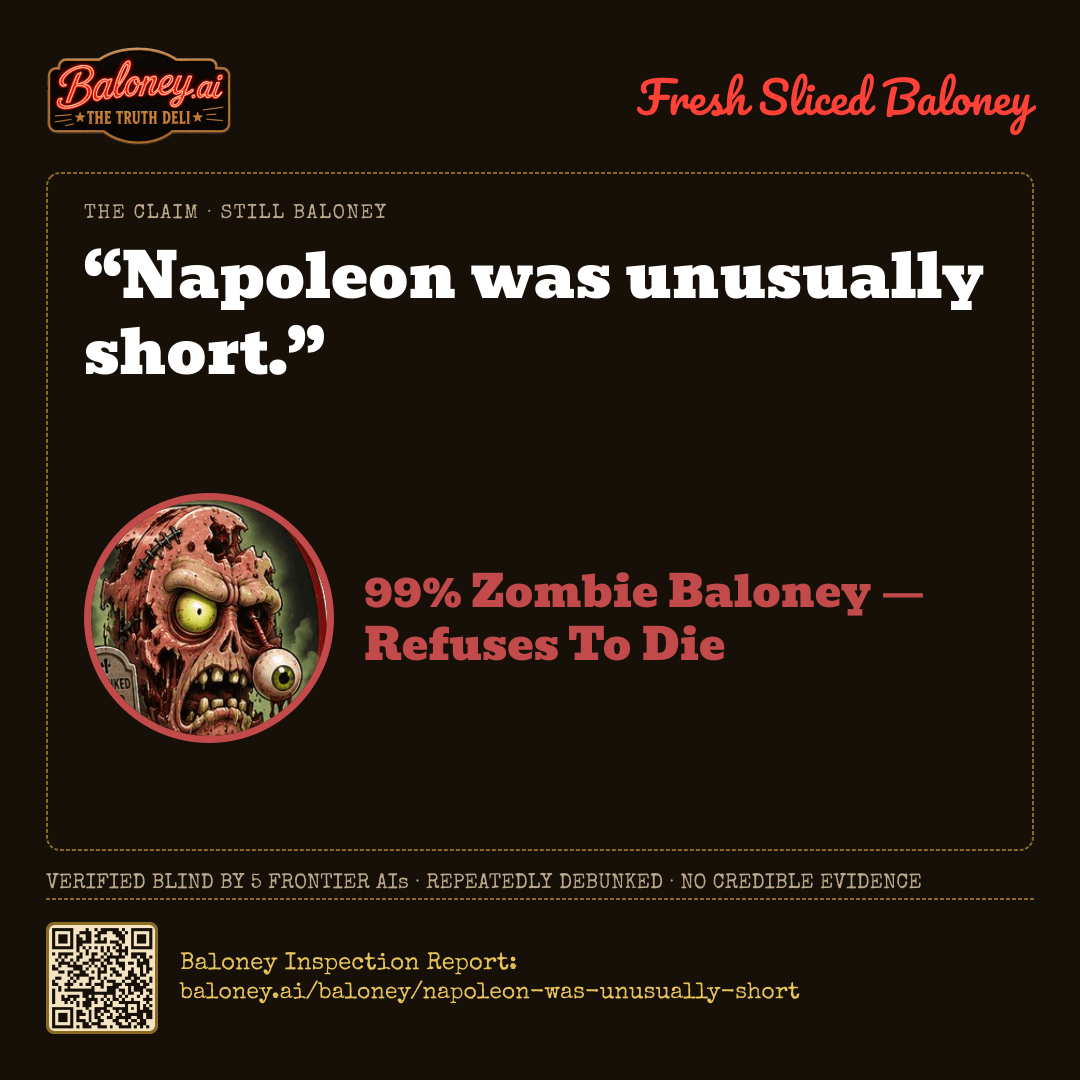
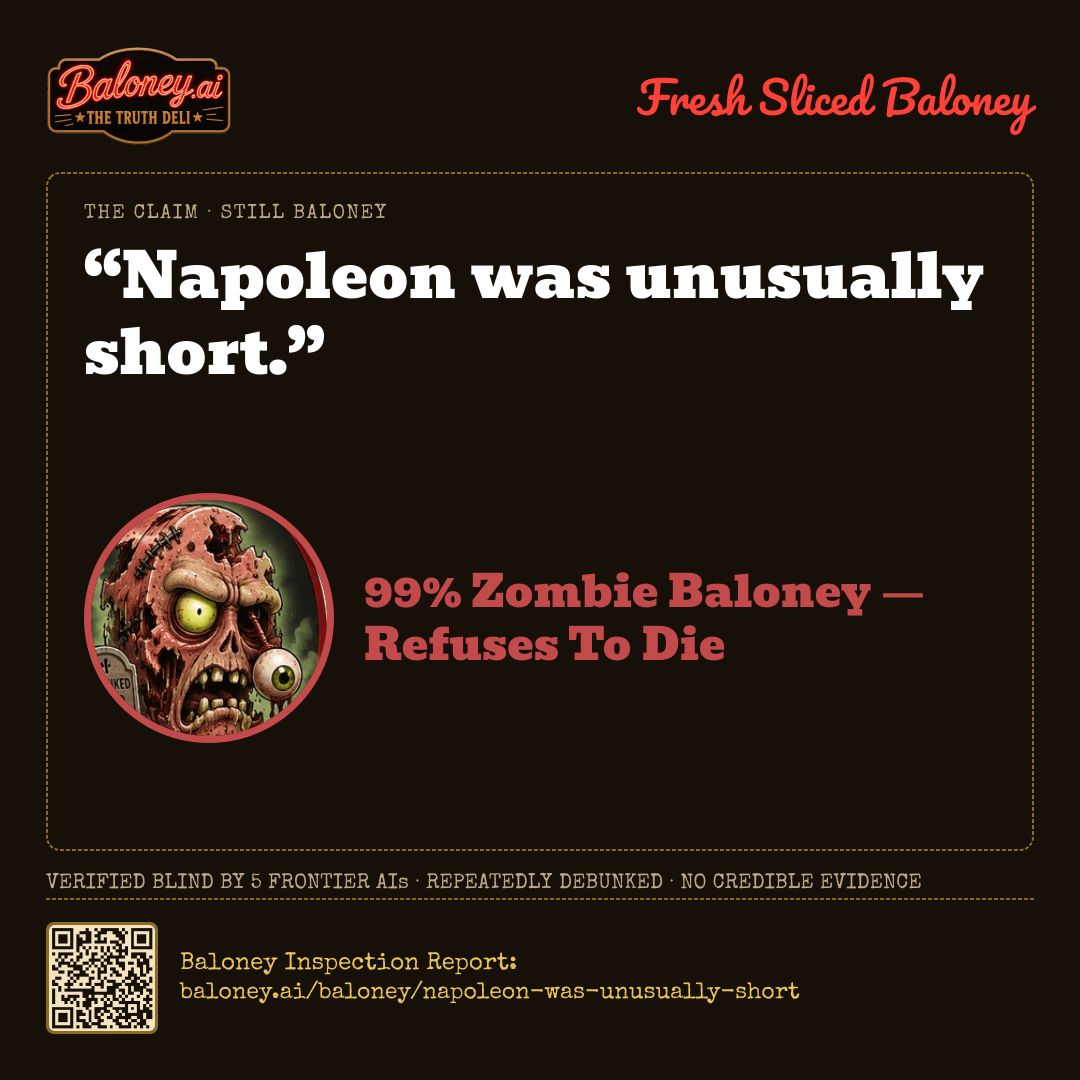
99%“Napoleon was unusually short.”
99%Zombie Baloney — Refuses To Die
DEAD. BURIED. STILL SHAMBLING AROUND.
Repeatedly debunkedNo credible evidenceRefuses to dieLives on in delusion
✓ BLIND VALIDATION CONFIRMED THIS SCORE
Serve It Fresh
Ready to Serve12 servings
Serve it the way you want it
The Verdict
 “Napoleon was unusually short.”99% Zombie Baloney — Refuses To DieVerified blind by 5 frontier AIs · Baloney Inspection Report: baloney.ai/baloney/napoleon-was-unusually-short
The Baloney Sampler
The claim that Napoleon Bonaparte was unusually short is a persistent historical myth. According to the Fondation Napoléon and Encyclopedia Britannica, his autopsy recorded his height as 5 feet 2 inches in pre-metric French units. Because the French inch was longer than the British inch, his actual height was between 5 feet 6 and 5 feet 7 inches. This made him average or slightly taller than the typical adult French male of the early nineteenth century.
The false image of a tiny conqueror stems largely from highly effective British wartime propaganda, notes National Geographic. Cartoonists frequently depicted him as comically small to diminish his fearsome reputation. The myth was further fueled by his affectionate nickname, "The Little Corporal," and his tendency to surround himself with exceptionally tall soldiers of the elite Imperial Guard, which created a misleading visual contrast.
Resting on Fondation Napoléon · Encyclopedia Britannica · National Geographic
Other ways to slice it — phrasings that might have changed the rating
- “Napoleon was average or slightly above average in height for a French man of the early 19th century.” Anthropometric data and historians confirm his converted height of 1.68 to 1.70 meters exceeded the contemporary French average of about 1.65 meters.
- “Napoleon would be considered short by the standards of modern American adult males.” Reports note that a height of 5 feet 6 to 5 feet 7 inches falls below the present-day average for men in populations like the United States.
- “Napoleon was unusually short compared to the soldiers of his Imperial Guard.” The evidence shows his elite guards were specifically selected for their exceptional height, creating a visual contrast that made Napoleon appear notably smaller.
Written from the panel’s reports by Google · gemini-3.1-pro-preview. Nothing here changed the score.
The Order Ticket
21:28:07CLAIM RECEIVED — QUEUED FOR INSPECTION✓
21:28:41claude-opus-5 REPORTED — SCORE 96, CONFIDENCE 93✓
21:28:52gpt-5.5 REPORTED — SCORE 99, CONFIDENCE 90✓
21:28:35gemini-3.1-pro-preview REPORTED — SCORE 99, CONFIDENCE 100✓
21:28:16sonar-pro REPORTED — SCORE 18, CONFIDENCE 88✓
21:29:26grok-4.6 REPORTED — SCORE 99, CONFIDENCE 88✓
21:30:13PRIMARY MASTER GEMINI — SCORE 99✓
21:29:32BLIND VALIDATION CHATGPT — SCORE 99✓
21:30:35AGREEMENT CONFIRMED — DELTA 0✓
21:30:35SCORING MODEL V2 — MEDIAN OF 5 COUNTED LAB SCORES: 96, 99, 99, 18, 99 → 99. ZOMBIE RULE: THE PRIMARY MASTER FLAGS A LONG DEBUNK HISTORY, THE BLIND MASTER SCORES 99, THE COUNTED MEDIAN IS 99 — PUBLISHED AS 99.✓
21:30:35SOURCE RULE — LABS CITED 19 SOURCES: 0 DISCARDED FOR HAVING NO URL, 3 DISCARDED AS DEAD LINKS (404/410), 9 COULD NOT BE OPENED BY US AND ARE MARKED UNVERIFIED.✓
21:30:35SOURCE RULE — PRIMARY MASTER RULED ON 13 SOURCES: 0 DISCARDED FOR HAVING NO URL, 0 DISCARDED AS DEAD LINKS, 6 MARKED UNVERIFIED, 7 VERIFIED.✓
How This One Was Sliced
Station 1 · Blind Inspection — Five Graders, Zero Peeking
Each lab scored the claim independently, without seeing the others. Open a breakdown for its evidence, its sources, and how sure it was.
Anthropic · EQUAL WEIGHT · 34.4s
claude-opus-5
96%BALONEY
ROUND-1 BREAKDOWN
Evidence offered for the claim- Napoleon's autopsy on St. Helena (1821) recorded his height as '5 pieds 2 pouces' (about 5 feet 2 inches by the numbers), and that figure, read as English feet and inches, is the origin of the 'short' claim.
- He was popularly nicknamed 'le petit caporal' ('the little corporal'), which is often taken as literal evidence of small stature.
- British wartime caricature, especially James Gillray's cartoons depicting a tiny 'Little Boney', embedded the image of a diminutive Napoleon in the English-speaking world and it has persisted for two centuries.
- Estimates of his height vary somewhat by source (roughly 167–170 cm), and at the low end he would be short by modern standards, so the claim is not absurd on its face if one applies present-day averages rather than 18th-century ones.
- The 'Napoleon complex' concept in popular psychology keeps the premise in circulation as though it were established fact.
Evidence against the claim- The autopsy figure was in pre-metric French units: the French pied (32.48 cm) and pouce (2.71 cm) were larger than the English foot and inch, so 5 pieds 2 pouces converts to roughly 168–169 cm, i.e. about 5 ft 6 in–5 ft 7 in in English measure, not 5 ft 2 in.
- That height was at or slightly above the average for adult Frenchmen of his era, whose mean stature is generally estimated from conscription records at roughly 164–165 cm; he was therefore unremarkable rather than unusually short.
- 'Le petit caporal' is generally understood by historians as an affectionate/familiar nickname from his soldiers rather than a description of his body size.
- Napoleon habitually surrounded himself with the grenadiers of the Imperial Guard, who were selected for exceptional height (minimum standards well above average), making him look smaller by comparison in contemporary accounts and images.
- The image derives substantially from hostile British propaganda during the Napoleonic Wars, not from measurement.
- Mainstream reference works, historians and Napoleonic research institutions treat 'Napoleon was short' as a debunked myth, and it is routinely listed among the most common historical misconceptions.
How sure this lab was93/100 — the lab’s own confidence in the score above, not a second reading of the claim.
SourcesEncyclopaedia Britannicaedu · 88 · Fondation Napoléonother · 82 · Smithsonian Magazinenews · 80
OpenAI · EQUAL WEIGHT · 45.4s
gpt-5.5
99%BALONEY
ROUND-1 BREAKDOWN
Evidence offered for the claim- Some contemporary/posthumous records described Napoleon as 5 feet 2 inches. If mistakenly read as British/English inches, that would be about 157 cm/5 ft 2 in, which would support the idea that he was very short. However, Britannica and HISTORY explain that this figure used French units, which were larger than English units.
- Napoleon was called “Le Petit Caporal,” and British caricatures often portrayed him as tiny; both helped create a public image of shortness. He also appeared near tall soldiers in his Imperial Guard, which could make him look smaller by comparison.
- By modern standards, Napoleon’s likely height of about 168–170 cm/5 ft 6–5 ft 7 is below the average for adult men in some present-day populations, such as the modern United States, so a loose modern comparison can make him seem short.
Evidence against the claim- The core factual problem is unit conversion: Napoleon’s recorded 5 pieds 2 pouces in French measure converts to roughly 5 ft 6 in to 5 ft 7 in in English/modern measure, not 5 ft 2 in.
- That converted height was not unusually short for a French man of Napoleon’s era; Britannica and HISTORY both describe him as around average or somewhat above average for his time.
- The “unusually short” reputation is widely attributed to British propaganda/caricature, affectionate nickname confusion, tall bodyguards, and later misunderstanding of French versus English measurements—not to evidence that he was an extreme outlier in height.
- Even compared with modern averages, about 5 ft 6.5 in is shorter than average in some countries but not generally “unusually” short; the claim as written implies an exceptional shortness that the evidence does not support.
How sure this lab was90/100 — the lab’s own confidence in the score above, not a second reading of the claim.
SourcesEncyclopaedia Britannicaother · 88 · HISTORYother · 78 · CDC/National Center for Health Statisticsgov · 95 · eLifejournal · 92
Google · EQUAL WEIGHT · 28.4s
gemini-3.1-pro-preview
99%BALONEY
ROUND-1 BREAKDOWN
Evidence offered for the claim- At the time of his death, Napoleon's height was officially recorded by his personal physician, François Carlo Antommarchi, as 5 feet 2 inches.
- He was affectionately nicknamed 'Le Petit Caporal' (The Little Corporal) by his troops during his early campaigns.
- He frequently surrounded himself with his elite Imperial Guard; because the guards were specifically selected for their above-average height, Napoleon appeared notably shorter in their presence.
- British wartime propaganda, spearheaded by prominent caricaturist James Gillray, heavily depicted Napoleon as a comically tiny, petulant man to diminish his terrifying reputation across Europe.
Evidence against the claim- The 5 feet 2 inches recorded at his autopsy was measured in French 'pieds de roi' (French feet and inches). A French inch was equivalent to 2.7 centimeters, whereas an English inch is 2.54 centimeters.
- When properly converted to modern Imperial (British/US) measurements, Napoleon's actual height was between 5 feet 6 inches and 5 feet 7 inches (approx. 1.68 - 1.70 meters).
- Historical anthropometric data from the early 19th century shows the average height of a French adult male was roughly 5 feet 5 inches (1.65 meters). Therefore, Napoleon was slightly taller than the average Frenchman of his era.
- The nickname 'Le Petit Caporal' was not a literal description of his height, but rather a term of endearment and respect from his soldiers, denoting his willingness to fight alongside them in the trenches.
- The persistent myth of his short stature is largely the result of a unit translation error combined with highly effective, enduring British propaganda.
How sure this lab was100/100 — the lab’s own confidence in the score above, not a second reading of the claim.
SourcesEncyclopedia Britannicaother · 95 · Fondation Napoléonother · 90
Perplexity · EQUAL WEIGHT · 9.7s
sonar-pro
18%BALONEY
ROUND-1 BREAKDOWN
Evidence offered for the claim- Napoleon’s physician François Antommarchi recorded his height as “5 pieds, 2 pouces, 4 lignes,” which can be read as about 5 feet 2 inches under modern English-unit assumptions.[https://www.britannica.com/topic/Napoleon-as-Pop-Culture-Icon]
- Britannica reports that estimates based on Napoleon’s death certificate range from 5 feet 2 inches to 5 feet 7 inches, so the historical record is not perfectly uniform.[https://www.britannica.com/story/was-napoleon-short]
- A historical analysis citing historian David Bell places Napoleon at roughly 5 feet 4 or 5 feet 5 inches—possibly an inch or two below the average adult male of his time.[https://www.thecollector.com/how-tall-was-napoleon/]
- Napoleon’s short stature was reinforced by British caricatures and the later expression “Napoleon complex,” although those cultural associations are not direct anthropometric evidence.
Evidence against the claim- The French measurement system used when Napoleon was measured differed from the British system: the French pouce was about 2.71 cm, compared with the British inch of 2.54 cm. Converting the recorded French measurement places him near 5 feet 6 to 5 feet 7 inches, or about 1.68–1.70 m.[https://www.britannica.com/topic/Napoleon-as-Pop-Culture-Icon]
- Britannica states that a height around 5 feet 6 or 5 feet 7 inches would have put Napoleon at the high end of average for a French man in the early nineteenth century.[https://www.britannica.com/topic/Napoleon-as-Pop-Culture-Icon]
- National Geographic likewise reports that observers described Napoleon as approximately 5 feet 6 inches and explains that the apparent 5-foot-2 measurement arose from confusion between French and English units.[https://www.nationalgeographic.com/history/article/napoleon-complex-height-discrimination-men-history]
- An anthropometric history of early-modern France reports an average adult French male height of about 161.7 cm for the relevant historical population, while the commonly accepted converted estimate for Napoleon is approximately 168–170 cm.[https://epub.ub.uni-muenchen.de/54/1/france.pdf]
- The strongest explanation is that Napoleon was not unusually short by the standards of his own population; the stereotype largely reflects unit conversion problems, British propaganda, and later popular culture.
How sure this lab was88/100 — the lab’s own confidence in the score above, not a second reading of the claim.
SourcesEncyclopaedia Britannicaother · 94 · National Geographicnews · 91 · Encyclopaedia Britannicaother · 92 · Ludwig-Maximilians-Universität München repositoryedu · 88 · The Collectorother · 68
xAI · EQUAL WEIGHT · 79.0s
grok-4.6
99%BALONEY
ROUND-1 BREAKDOWN
Evidence offered for the claim- British wartime caricatures (e.g., James Gillray) consistently drew Napoleon as tiny for propaganda effect.
- He was nicknamed Le Petit Caporal and often stood beside specially selected tall Imperial Guard grenadiers, creating a visual contrast.
- A units mix-up (French pieds/pouces vs. English feet/inches) made the autopsy figure of 5 ft 2 in look like modern 5 ft 2 in to English-speaking audiences.
Evidence against the claim- The 1821 autopsy recorded 5 pieds 2 pouces in French measure, equal to about 1.69 m / 5 ft 6.5 in English—average or slightly above average for a French adult male of the era (typical estimates ~1.64–1.67 m).
- Contemporary French sources and later historians treat the “short Napoleon” image as British propaganda rather than a physical fact.
- The affectionate nickname Petit Caporal referred to rank and camaraderie, not stature.
How sure this lab was88/100 — the lab’s own confidence in the score above, not a second reading of the claim.
SourcesEncyclopedia Britannicaother · 93 · Wikipediaother · 72
Station 2 · The Masters
Primary Master · drawn at random
gemini-3.1-pro-preview
99% BALONEY
I weighted the evidence entirely against the claim, as the historical consensus is unequivocal. The core of the myth stems from an English misinterpretation of pre-metric French units. Napoleon's physician recorded his height at death as '5 pieds 2 pouces.' Because the French inch (pouce) was longer than the British inch, this actually converts to roughly 5 feet 6 inches to 5 feet 7 inches (1.68–1.70 meters). Anthropometric data from the era confirms this was average or slightly above average for a French male in the early 19th century. The 'unusually short' narrative is overwhelmingly contradicted by historians, who trace the myth to British wartime propaganda cartoons (such as those by James Gillray), the misleading visual contrast of Napoleon standing next to his unusually tall Imperial Guard, and the literal translation of his affectionate nickname, 'Le Petit Caporal.' Because the claim is demonstrably false and represents a classic, widely debunked historical misconception, it warrants a score of 99 and the zombie flag.
The evaluators were in complete factual agreement that the claim is a well-documented myth. They identified the exact same historical evidence and contextual factors (unit conversion errors, British propaganda, tall bodyguards, and nicknames). Evaluator 3 anomalously recommended a score of 18 (Fishy Baloney) despite their provided evidence entirely debunking the claim; this numerical score was discarded in favor of the factual consensus.
ZOMBIE FLAG: TRUE — DEBUNK HISTORY ON RECORD
Blind Validation Master · never saw the Primary’s work
gpt-5.5
99% BALONEY
The reports overwhelmingly indicate that the claim as written is false and is a classic debunked myth. The main measurement behind the story was Napoleon’s autopsy height of about 5 pieds 2 pouces, but that used French units, not English ones; properly converted, it is roughly 168–170 cm, or about 5 ft 6–5 ft 7 in. That would have made him average or slightly above average for a French adult male of his era, not unusually short. The evidence supporting the myth comes mostly from misread units, British wartime caricature, the nickname “Le Petit Caporal,” and comparisons with unusually tall Imperial Guard soldiers. Even if his likely height is somewhat short by some modern standards, the statement implies an exceptional shortness that the evidence does not support. Because this is a repeatedly debunked claim that still circulates, it merits Zombie Baloney.
AGREEMENT TEST PASSED — BOTH MASTERS SCORED 99% · BLIND VALIDATION CONFIRMED THIS SCORE · NO RE-EVALUATION REQUIRED
How the number was reached · scoring model v2 · how our models work
- Median of 5 counted lab scores: 96, 99, 99, 18, 99 → 99.
- Zombie rule: the Primary Master flags a long debunk history, the Blind Master scores 99, the counted median is 99 — published as 99.
The Evidence
Evidence offered for the claim
- Autopsy records DEBUNKED — Napoleon's physician recorded his height upon his death as '5 pieds 2 pouces' (5 feet 2 inches), which sounds unusually short to an English-speaking audience.
- The 'Little Corporal' nickname DEBUNKED — His troops affectionately referred to him as 'Le Petit Caporal' during his early campaigns, which is often taken as literal evidence of a small stature.
- Visual comparisons to his guards DEBUNKED — Napoleon frequently appeared notably shorter than the soldiers surrounding him in his elite Imperial Guard.
- Contemporary British caricatures DEBUNKED — Prominent English political cartoons by artists like James Gillray consistently depicted Napoleon as comically tiny.
Evidence against the claim
- Corrected measurement units In pre-metric French units, a 'pouce' was larger than an English inch; converting the recorded measurement into modern Imperial units results in a height of approximately 1.68–1.70 meters (5 feet 6 inches to 5 feet 7 inches).
- 19th-century French demographics Historical anthropometric data indicates the average height of a French adult male in the early 1800s was roughly 1.65 meters (5 feet 5 inches), making Napoleon average or slightly above average for his era.
- Nickname context Historians explain that 'Le Petit Caporal' was a term of camaraderie and respect denoting his willingness to fight alongside his men in the trenches, not a literal description of his height.
- Bodyguard requirements The Imperial Guard grenadiers had strict minimum height requirements, meaning they were significantly taller than average, deliberately creating a misleading visual contrast.
- Propaganda origins The caricature of a diminutive 'Little Boney' was a deliberate psychological tactic employed by hostile British propagandists to diminish his terrifying military reputation across Europe.
Sources · Reliability · Why Accepted or Discounted
| Source | Type | Reliability | Ruling |
|---|
| Encyclopedia Britannicaunverified | other | 93 | ACCEPTED — Authoritative general encyclopedia with strict editorial standards. |
| Wikipedia | other | 72 | DISCOUNTED — While generally accurate, Wikipedia is a user-editable encyclopedia and is not considered a primary authoritative source for formal fact-checking. |
| Encyclopedia Britannicaunverified | other | 95 | ACCEPTED — Directly addresses the claim with reliable historical context. |
| Fondation Napoléonunverified | other | 90 | ACCEPTED — Highly authoritative historical institution dedicated to Napoleonic research. |
| Encyclopaedia Britannicaunverified | other | 94 | ACCEPTED — Authoritative general reference source providing cultural and historical context. |
| National Geographic | news | 91 | ACCEPTED — Reputable publication with reliable historical reporting. |
| Ludwig-Maximilians-Universität München repository | edu | 88 | ACCEPTED — Peer-reviewed academic research providing historical anthropometric data. |
| The Collector | other | 68 | DISCOUNTED — Commercial pop-history site; its useful information is adequately supported by the higher-quality institutional sources provided. |
| Fondation Napoléonunverified | other | 82 | ACCEPTED — Respected historical foundation dedicated to the subject. |
| Smithsonian Magazineunverified | news | 80 | ACCEPTED — Reputable scientific and historical publication. |
| HISTORY | other | 78 | ACCEPTED — Recognized historical education outlet. |
| CDC/National Center for Health Statistics | gov | 95 | ACCEPTED — Authoritative government data providing modern human height context. |
| eLife | journal | 92 | ACCEPTED — High-quality peer-reviewed journal providing population height data. |
Every link was opened when this claim was inspected. A dead link was discarded before publication; “unverified” means the site refused our automated check and the link is the one the panel cited. A source without a URL was never kept.
Serve It Fresh
Ready to Serve12 servings
Serve it the way you want it
The Verdict
“Napoleon was unusually short.”99% Zombie Baloney — Refuses To DieVerified blind by 5 frontier AIs · Baloney Inspection Report: baloney.ai/baloney/napoleon-was-unusually-short