Station 1 · Blind Inspection — Five Graders, Zero Peeking
Each lab scored the claim independently, without seeing the others. Open a breakdown for its evidence, its sources, and how sure it was.
Anthropic · EQUAL WEIGHT · 31.8s
claude-opus-5
80%BALONEY
ROUND-1 BREAKDOWN
Evidence offered for the claim
There is a real observable phenomenon behind the saying: when people stop training, previously well-developed muscles shrink (disuse atrophy) while body fat often increases, so the same body part can go from firm and large to softer and still large, creating the visual impression of a 'conversion.'
Detraining research shows measurable losses in muscle cross-sectional area, strength, and mitochondrial/oxidative capacity within weeks of stopping training, and concurrent increases in fat mass and relative body-fat percentage in many subjects (e.g., Mujika & Padilla's detraining reviews in Sports Medicine).
The mechanism that makes the saying feel true is metabolically real: muscle tissue and training raise total daily energy expenditure; when training stops and calorie intake stays the same, the resulting energy surplus is stored as adipose tissue, so muscle loss and fat gain frequently occur together.
Some evidence suggests inactivity promotes intramuscular and intermuscular fat deposition (fat infiltration within and between muscle groups), which literally results in fat appearing where muscle tissue used to dominate — though this is displacement/infiltration, not transformation.
Evidence against the claim
Skeletal muscle and adipose tissue are histologically and developmentally distinct tissues with different cell types (multinucleated myofibers vs. adipocytes). A mature muscle fiber cannot transdifferentiate into a fat cell; there is no known physiological pathway for this conversion in humans.
Muscle atrophy occurs by reduction in myofibrillar protein content (protein breakdown exceeding synthesis) and shrinkage of fiber size, with amino acids recycled or oxidized — not by cells morphing into adipocytes.
Fat gain occurs independently, by storage of excess dietary energy as triglycerides in existing (or newly differentiated) adipocytes. The two processes are causally linked only through energy balance and hormonal/activity changes, not by tissue conversion.
The converse myth — that fat turns into muscle during training — is equally false, which underscores that the popular framing is a folk description of body-composition change rather than a biological process.
Mainstream clinical sources (Mayo Clinic, Cleveland Clinic, Harvard Health, ACSM) explicitly state that muscle does not turn into fat and describe the simultaneous-but-separate mechanism instead.
How sure this lab was
95/100 — the lab’s own confidence in the score above, not a second reading of the claim.
If the claim is interpreted loosely rather than literally, stopping exercise can produce the same visible/body-composition pattern people describe: muscle size and strength can decline with detraining or disuse, while body fat may increase if calorie intake is not reduced.
Medical and exercise-science sources describe inactivity/disuse as a cause of muscle atrophy, and reviews of detraining report declines in muscular characteristics after training stops.
Government weight-management guidance notes that physical inactivity lowers energy expenditure; if food intake stays the same, excess energy can be stored as body fat.
Evidence against the claim
Taken literally, the claim is false: skeletal muscle tissue does not biologically transform into adipose tissue. They are different tissues/cell types.
When exercise stops, muscle fibers can shrink or be lost through atrophy/detraining; fat gain, when it occurs, results from energy imbalance and storage of triglycerides in adipose tissue, not from muscle converting into fat.
The more accurate statement is: stopping exercise can lead to loss of muscle and gain of fat, but one tissue does not turn into the other.
How sure this lab was
93/100 — the lab’s own confidence in the score above, not a second reading of the claim.
When individuals stop exercising, they often lose muscle volume (atrophy) while simultaneously gaining body fat, creating the visual illusion that muscle is physically turning into fat.
Stopping an exercise routine reduces daily energy expenditure. If dietary calorie intake is not lowered to match this decreased activity, the resulting caloric surplus leads to the expansion of fat cells, often in the same areas where muscle tone is being lost.
Evidence against the claim
Muscle and fat are entirely distinct types of biological tissue. Muscle is made of myocytes (muscle cells), while fat is made of adipocytes (fat cells). Biologically and chemically, one cannot transmute into the other.
When physical training ceases, muscle fibers undergo atrophy (they shrink in size due to a lack of mechanical stimulus), but they remain muscle cells.
Fat accumulation is driven by a caloric surplus and involves the storing of lipids in existing fat cells, a process completely independent of muscle cell atrophy.
How sure this lab was
95/100 — the lab’s own confidence in the score above, not a second reading of the claim.
People who stop exercising often observe that previously firm, muscular areas of their body become softer, larger, and more fatty over time; this *appearance* change can create a strong subjective impression that muscle has "turned into" fat, even though the underlying tissues are changing separately.[2][3][8]
When training stops, **muscle atrophy** (loss of muscle size and tone) can occur at the same time as **fat gain** (expansion of adipose tissue) if calorie intake is not reduced, so visually it can look like one tissue is being replaced by another, reinforcing the folk claim.[1][3][7][9]
Inactivity can increase **fat deposition within and around muscles** (intramuscular and intermuscular fat), so a once-lean muscle can become infiltrated with fat, which may be misinterpreted as the muscle itself turning into fat.[1]
Evidence against the claim
Exercise scientists and physicians consistently state that **muscle and fat are different tissues with different cell types and cannot biologically transform into one another**, so muscle does not literally turn into fat when you stop exercising.[2][3][6][9][10]
Expert commentary explains the true process: when you stop exercising, **muscle fibers shrink (atrophy) while fat cells expand or become more numerous if you are in a caloric surplus**, producing the illusion that muscle has been converted to fat.[1][2][3][7][8][11]
Fact‑style health mythbusters explicitly label the claim that muscle turns into fat when you stop training as **false**, noting there is *no biochemical pathway or mechanism* for a muscle cell to become a fat cell.[5][10][12]
Medical sources emphasize that these are "two different kinds of tissues" with "no interchangeability" possible, meaning the premise of muscle turning into fat is described as "untenable" and a "total myth".[2][6][13]
Health and fitness organizations state that muscle is primarily protein, amino acids, and water, whereas adipose tissue is fat; they note that the human body cannot "magically turn one tissue into another," directly rejecting the claim.[9][10][14]
How sure this lab was
95/100 — the lab’s own confidence in the score above, not a second reading of the claim.
People who stop resistance training often lose muscle definition while gaining visible fat if calories are not reduced, creating a perceptual impression of conversion.
Pathological fatty infiltration of muscle (e.g., in some myopathies or advanced sarcopenia) can make muscle appear replaced by fat on imaging, which some lay explanations loosely analogize to detraining.
Evidence against the claim
Skeletal muscle fibers and adipocytes are distinct, terminally differentiated tissues; myocytes do not transdifferentiate into fat cells when training stops.
Detraining produces muscle atrophy via reduced protein synthesis and fiber-size loss, which is independent of adipose expansion driven by energy surplus.
Energy expenditure falls with inactivity, so unchanged diet produces fat gain as a separate process, not conversion of existing muscle.
Standard exercise physiology and clinical sources treat literal muscle-to-fat conversion as a myth.
How sure this lab was
82/100 — the lab’s own confidence in the score above, not a second reading of the claim.
The statement as written is false: muscle does not turn into fat when exercise stops. The panel’s strongest consensus was that detraining commonly causes two separate changes at once — muscle atrophy and fat gain — which can create a visual impression of conversion, but no evaluator identified a biological mechanism for muscle cells becoming fat cells. I weighted the medical, government, and mainstream clinical sources most heavily because they directly address tissue biology, atrophy, and energy balance; I discounted lighter news/expert-interview and commercial sources when they mainly explained the appearance effect rather than the underlying physiology. The score is near the top of the false range because the claim is a widely repeated but incorrect simplification with a long public debunk trail, while not being a literal impossibility that would justify the maximum only if it were also a classic zombie claim in the strict sense.
All five evaluators agreed that the literal claim is false and that stopping exercise can coincide with muscle loss and fat gain, creating the illusion of conversion. They differed mainly on emphasis: some framed it as a nearly perfect myth-busting case, while others gave more weight to the appearance-based interpretation and fat infiltration examples. The main disagreement was the score, not the substance; report 1 and report 3 pushed highest, report 2 and report 4 were somewhat lower because they foregrounded the colloquial interpretation, and report 5 sat in between.
Blind Validation Master · never saw the Primary’s work
gpt-5.5
99% BALONEY
As written, the claim is false. The reports consistently agree that skeletal muscle and adipose tissue are distinct biological tissues made of different cell types, and muscle fibers do not biologically transform into fat cells when exercise stops. What can happen is that stopping training leads to muscle atrophy from reduced mechanical stimulus, while lower energy expenditure can lead to fat gain if calorie intake is not reduced. These simultaneous but separate processes can make the body look softer or less muscular, creating the illusion that muscle has turned into fat. Some fat may also accumulate within or around muscle, but that is infiltration or deposition, not conversion. Because this is a repeatedly debunked fitness myth that survives despite clear evidence, it fits the Zombie Baloney category.
AI EVALUATORS SHOWED MODERATE DISAGREEMENT — MASTERS SCORED 98% AND 99% · REVIEW THE EVIDENCE CAREFULLY
The Evidence
Evidence offered for the claim
People see a conversion-like changeDEBUNKED — When training stops, muscles can shrink while body fat rises, making formerly muscular areas look softer and larger, which creates the appearance of muscle turning into fat.
Fat may appear in muscle areasDEBUNKED — Inactivity can promote fat deposition within and around muscles, which can make it look as if muscle has been replaced by fat, but this is infiltration/displacement rather than tissue transformation.
Evidence against the claim
Different tissue types Muscle and fat are distinct tissues made of different cell types, so a mature muscle fiber cannot become an adipocyte.
Atrophy is the real process When exercise stops, muscle fibers shrink because of disuse/atrophy; they remain muscle cells rather than turning into fat cells.
Fat gain is separate If calorie intake is not reduced after activity drops, the resulting energy surplus is stored as body fat, independently of muscle loss.
No known conversion pathway The evaluators described the claim as false, a myth, or untenable because there is no biochemical or physiological pathway for muscle to transdifferentiate into fat.
Sources · Reliability · Why Accepted or Discounted
Source
Type
Reliability
Ruling
The New York Times
news
90
DISCOUNTED — Used in report 1 as a source for the appearance-based explanation, but it is not a primary medical source and the report provided no specific article details.
MedlinePlus / U.S. National Library of Medicine
gov
92
ACCEPTED — Authoritative medical reference cited for muscle atrophy and the distinction between muscle loss and fat gain.
Medicine & Science in Sports & Exercise
journal
90
ACCEPTED — Relevant peer-reviewed exercise-science source for detraining and muscle changes after stopping training.
National Institute of Diabetes and Digestive and Kidney Diseases
gov
93
ACCEPTED — Strong government source for the energy-balance explanation of fat gain after reduced activity.
National Cancer Institute
gov
92
ACCEPTED — Credible medical/government source cited for body composition and energy-storage distinctions.
National Cancer Institute SEER Training Modules
gov
86
ACCEPTED — Accepted as a supporting educational medical source, though less direct than the core NIH references.
Nine.com.au
news
80
DISCOUNTED — Used as an expert-interview vehicle rather than a primary medical authority.
Piedmont Healthcare
gov
85
ACCEPTED — Healthcare source used to support the claim that muscle and fat are different tissues.
The Indian Express
news
75
DISCOUNTED — News health coverage with expert commentary; useful context, but not as strong as direct medical or journal sources.
InBody
other
75
DISCOUNTED — Commercial body-composition company; relevant but not independent or primary medical evidence.
Topend Sports
other
70
DISCOUNTED — General fitness reference, less authoritative than medical and journal sources.
Strictly Science
other
70
DISCOUNTED — Secondary explanatory source without the authority of clinical or government references.
Fit&Well
news
70
DISCOUNTED — Lifestyle/news source; useful for public-facing explanation but not the strongest evidence base.
TempoLife
other
65
DISCOUNTED — Lower-authority source compared with NIH, CDC, or peer-reviewed exercise science.
Mayo Clinic
other
93
ACCEPTED — Highly credible clinical source explicitly used by multiple evaluators to reject literal muscle-to-fat conversion.
Cleveland Clinic
other
88
ACCEPTED — Reliable clinical source supporting the separate atrophy-and-fat-gain explanation.
Harvard Health Publishing
edu
90
ACCEPTED — Trusted academic medical source reinforcing that muscle and fat are different tissues.
Mujika I, Padilla S. Detraining: loss of training-induced physiological and performance adaptations. Part I. Sports Medicine, 2000
journal
92
ACCEPTED — Peer-reviewed detraining review directly relevant to loss of muscle adaptations after stopping training.
National Institute on Aging
gov
93
ACCEPTED — NIH source supporting age- and inactivity-related muscle loss concepts.
American College of Sports Medicine
other
88
ACCEPTED — Major professional organization with relevant exercise-physiology guidance.
Serve It Fresh
Ready to Serve11 servings
Serve it the way you want it
The Verdict
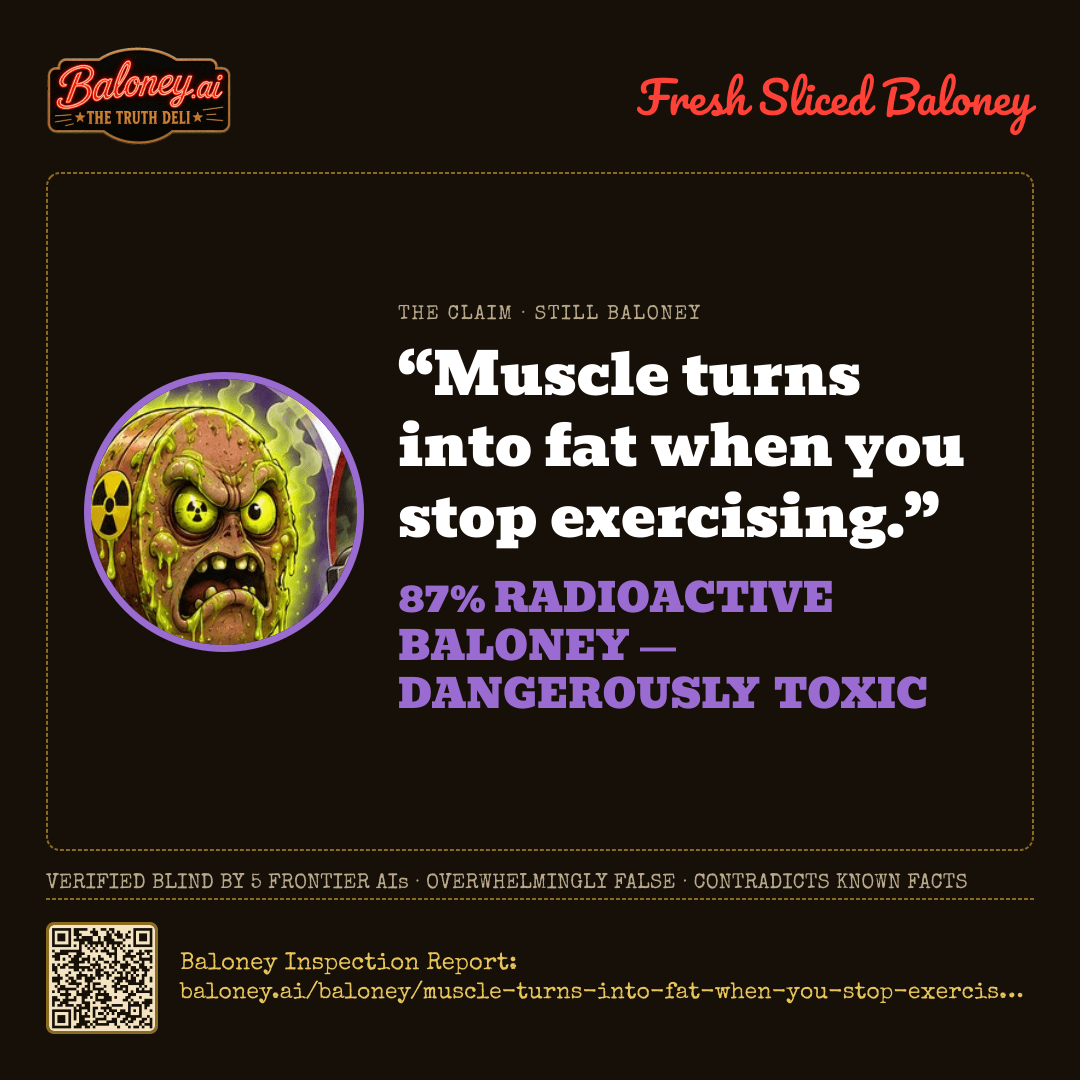
“Muscle turns into fat when you stop exercising.” 87% RADIOACTIVE BALONEY — DANGEROUSLY TOXIC Verified blind by 5 frontier AIs · Baloney Inspection Report: baloney.ai/baloney/muscle-turns-into-fat-when-you-stop-exercising