Station 1 · Blind Inspection — Five Graders, Zero Peeking
Each lab scored the claim independently, without seeing the others. Open a breakdown for its evidence, its sources, and how sure it was.
Anthropic · EQUAL WEIGHT · 60.1s
claude-opus-5
85%BALONEY
ROUND-1 BREAKDOWN
Evidence offered for the claim
A 1968 letter to the New England Journal of Medicine by Dr. Robert Ho Man Kwok describing numbness, weakness and palpitations after Chinese meals launched the concept of 'Chinese Restaurant Syndrome' and decades of anecdotal symptom reports (headache, flushing, sweating, chest tightness).
John Olney's 1969 Science study showed that injecting or gavaging very large doses of monosodium glutamate into neonatal mice produced hypothalamic brain lesions and later obesity — the origin of the 'excitotoxin' concern.
The U.S. FDA itself acknowledges that a subset of people may experience short-term, transient 'MSG symptom complex' reactions (headache, numbness, flushing, drowsiness) after consuming 3 grams or more of MSG without food — a dose far above typical use, but not zero.
Glutamate is genuinely an excitatory neurotransmitter, and glutamate excitotoxicity is a real, well-documented mechanism in neurological injury — which gives the concern a superficially plausible biological hook.
In 2017 EFSA re-evaluated glutamic acid/glutamates and, rather than keeping the earlier 'ADI not specified' status, derived a group Acceptable Daily Intake of 30 mg/kg body weight/day, noting that some European consumers' exposure could exceed that level; EFSA cited headache, blood pressure increase and insulin effects at high doses in its reasoning.
MSG contains sodium (~12% by weight), so it does contribute to sodium intake, and some observational studies (mainly from China) have reported associations between MSG intake and weight gain — though these are confounded and inconsistent.
Some small human challenge studies have found that large bolus doses of MSG given in water on an empty stomach produced more symptoms than placebo, suggesting a real, dose-dependent effect at extreme intakes.
Evidence against the claim
MSG is classified as 'Generally Recognized As Safe' (GRAS) by the U.S. FDA, and glutamate salts have been reviewed repeatedly by JECFA (the joint FAO/WHO expert committee), which assigned an ADI 'not specified' — the category used for substances of very low toxicity.
A 1995 FASEB report commissioned by the FDA found no evidence linking MSG to any serious or long-term illness, and concluded only that some sensitive individuals may have mild, transient reactions to large doses taken without food.
Multiple randomized, double-blind, placebo-controlled trials — including the multicentre study reported by Geha and colleagues — have failed to reproduce consistent, reproducible MSG reactions in self-identified MSG-sensitive individuals; responses were often inconsistent on rechallenge and frequently occurred with placebo.
When MSG is consumed in food rather than as a large dose in liquid on an empty stomach, symptom rates in controlled studies are essentially indistinguishable from placebo.
Systematic reviews of human studies on MSG and headache (e.g., Obayashi & Nagamura, Journal of Headache Pain, 2016) found the evidence for MSG causing headache to be weak, with most positive findings coming from unblinded or poorly controlled designs using unrealistically high doses in water.
Free glutamate occurs naturally and abundantly in tomatoes, Parmesan cheese, mushrooms, soy sauce, seaweed and human breast milk; the body does not chemically distinguish glutamate from MSG versus glutamate from food protein.
Dietary glutamate is largely metabolized by the gut and liver, and the blood–brain barrier tightly limits glutamate entry into the adult brain — the Olney rodent findings used injection or extreme gavage doses in neonatal animals with immature barriers, not a realistic dietary exposure model.
Mainstream medical sources (Mayo Clinic) state there is no definitive evidence that MSG causes the symptoms attributed to it and that any reactions reported are mild and transient.
Historians and food scientists have documented that the MSG scare was amplified by anti-Chinese stereotyping; in 2020, after a campaign by Ajinomoto and Asian-American advocates, Merriam-Webster agreed to review and add context to its 'Chinese restaurant syndrome' entry, and the term is now widely regarded as both scientifically unsupported and racially loaded.
Regulatory bodies worldwide (FDA, EFSA, FSANZ, Health Canada) permit MSG in food; none classify it as inherently dangerous, only as an additive requiring labeling.
How sure this lab was
90/100 — the lab’s own confidence in the score above, not a second reading of the claim.
Some people report short-term symptoms such as headache, flushing, numbness/tingling, palpitations, or drowsiness after eating MSG; FDA acknowledges these reports, though it says studies have not consistently reproduced them under blinded conditions.
A multicenter double-blind placebo-controlled study found that large MSG doses given without food produced more symptom reports than placebo in some self-identified MSG-sensitive people, but responses were inconsistent and were not reliably reproduced when MSG was consumed with food.
EFSA set an acceptable daily intake for glutamates and concluded that estimated exposure could exceed that ADI in some population groups, especially high-consuming children/adolescents, supporting the idea that very high intake may warrant limits even if ordinary dietary use is not inherently dangerous.
Evidence against the claim
Major food-safety authorities do not classify MSG as inherently dangerous: FDA says MSG is generally recognized as safe when used in food and that MSG's glutamate is chemically indistinguishable from glutamate naturally present in foods such as tomatoes and cheeses.
Controlled human studies have not consistently confirmed the popular 'MSG symptom complex' at normal food-use levels; the strongest signals tend to occur with large bolus doses on an empty stomach, not typical dietary consumption.
A systematic review of human headache studies concluded that evidence does not consistently support MSG as a headache trigger, especially when MSG is consumed with food rather than as a large isolated dose.
EFSA's 2017 reassessment did not find evidence that glutamates are genotoxic or carcinogenic at relevant exposures; its concern was exposure management relative to an ADI, not that MSG is inherently poisonous.
Overall, the claim is overbroad: MSG can contribute sodium and may cause symptoms in a small subset or at unusually high doses, but the evidence does not support MSG being inherently dangerous or harmful for the general population at normal culinary intakes.
How sure this lab was
92/100 — the lab’s own confidence in the score above, not a second reading of the claim.
In 1969, an animal study conducted by Dr. John Olney involved injecting massive doses of MSG directly under the skin of newborn mice, which resulted in brain lesions and developmental issues, initially sparking widespread public concern about MSG's safety.
A small subset of the population reports experiencing mild, temporary, and self-limiting symptoms (such as headaches, flushing, sweating, facial pressure, or numbness) after consuming large quantities of MSG, particularly on an empty stomach. This collection of symptoms is clinically referred to as 'MSG symptom complex' (historically and controversially termed 'Chinese Restaurant Syndrome').
Evidence against the claim
The U.S. Food and Drug Administration (FDA) classifies MSG as 'Generally Recognized as Safe' (GRAS). Comprehensive safety reviews by the FDA, the World Health Organization (WHO), and the Food and Agriculture Organization (FAO) have consistently concluded that MSG is safe for consumption by the general population.
Glutamate is a naturally occurring amino acid found abundantly in everyday foods such as tomatoes, parmesan cheese, mushrooms, walnuts, and human breast milk. The human body metabolizes the commercially added glutamate in MSG in the exact same way it metabolizes the naturally occurring glutamate found in whole foods.
Decades of multicenter, double-blind, placebo-controlled studies have failed to consistently reproduce the symptoms of 'MSG symptom complex' even in individuals who self-identify as sensitive to MSG. When reactions do occur in clinical settings, they are typically the result of administering unrealistically large doses (e.g., 3 grams or more) without food, and the symptoms are mild and temporary rather than inherently dangerous.
The early animal studies that showed neurological harm (like the 1969 mouse study) used extreme doses injected directly into the bodies of rodents, which does not accurately reflect how human beings biologically process and metabolize dietary MSG consumed orally.
How sure this lab was
98/100 — the lab’s own confidence in the score above, not a second reading of the claim.
High-dose and chronic MSG exposure has been linked in narrative and multifaceted reviews to adverse effects such as obesity, cardiotoxicity, hepatotoxicity, kidney toxicity, neurotoxicity, reproductive toxicity, endothelial dysfunction, and metabolic disturbances, largely based on animal and in vitro studies and some small human studies.[7][14][3][11]
Some clinical and observational studies summarized in recent reviews report associations between high MSG intake and increased body weight, metabolic syndrome, type 2 diabetes, and cardiovascular disease, suggesting potential risk at excessive intake levels or in specific populations.[3][11][14]
Reports from sensitive individuals describe acute symptoms after MSG consumption—headache, flushing, sweating, chest pain, nausea, and palpitations—sometimes referred to as “MSG symptom complex”; regulatory reviews recognize that brief reactions may occur in a subset of people.[1][10][6][4]
Experimental work cited in recent toxicology overviews indicates embryotoxicity and teratogenicity, infertility, and fetal growth effects in animals at high and repeated doses of MSG, raising theoretical concerns about chronic high exposure.[7][14]
Some reviews highlight possible neurotoxic and renal effects of high-dose MSG in preclinical models and call for more cautious use and better labeling to allow individuals to manage their exposure.[7][14]
Evidence against the claim
Major food safety authorities, including the U.S. Food and Drug Administration, Joint FAO/WHO Expert Committee on Food Additives, European Food Safety Authority, Food Standards Australia New Zealand, and others, classify MSG as **generally recognized as safe (GRAS)** or equivalent when used at normal dietary levels, indicating it is not inherently dangerous for the general population.[1][2][9][10][12][13][15]
A 2019 evidence-based safety review in a scientific journal concluded that MSG is safe for all life-cycle stages at typical exposure levels, reaffirming regulatory positions that it does not pose a health hazard when consumed as a flavor enhancer in normal amounts.[2]
A 2026 systematic review of metabolism and safety found that human studies consistently show efficient MSG metabolism, stable glutamate levels (e.g., in breast milk) regardless of intake, and no adverse outcomes at dietary exposures; the authors conclude that MSG is safe for the general population, including infants and pregnant women.[9]
FDA’s Q&A and advisory committee review state that MSG is GRAS and poses no threat to the general public, although brief reactions may occur in some individuals; controlled studies in self-identified sensitive people have not consistently reproduced symptoms when blinded.[1][6][10]
Clinical and regulatory summaries from institutions such as Mayo Clinic and Cleveland Clinic note that most myths about MSG harm have been dispelled and that current evidence supports its safety at typical dietary levels.[4][8][5]
National and international regulatory agencies (e.g., U.S. FDA, Philippine FDA, and others) explicitly state that MSG is a safe food additive under current usage conditions and have not set a specific acceptable daily intake, which is considered a favorable safety designation.[10][13][2]
Large-scale reviews emphasize that many alarming findings come from very high-dose animal or cell studies that do not reflect normal human dietary exposure, and that well-designed human trials do not show serious long-term health effects from MSG at customary intake.[2][9][5][3]
Independent additive-assessment resources that synthesize regulatory and scientific data rate MSG as ‘appears safe’ and note its approval across major markets (US, EU, UK, Japan), aligning with the broader scientific and regulatory consensus.[15]
How sure this lab was
93/100 — the lab’s own confidence in the score above, not a second reading of the claim.
A 1968 letter in the New England Journal of Medicine described symptoms (numbness, palpitations, weakness) after Chinese restaurant meals, launching 'Chinese Restaurant Syndrome' claims tied to MSG.
Some individuals self-report a short-term 'MSG symptom complex' (headache, flushing, sweating, facial pressure, nausea) after large doses, especially on an empty stomach.
High-dose animal studies (often via injection, not oral dietary exposure) have shown neuronal effects, prompting excitotoxicity concerns because glutamate is a neurotransmitter.
EFSA's 2017 re-evaluation set a group ADI for glutamates based on animal data, implying high intakes could carry risk for some consumers.
Evidence against the claim
The U.S. FDA classifies MSG as GRAS and states typical dietary use is safe for the general population, with any reactions in sensitive people being mild and transitory.
Double-blind, placebo-controlled human trials have not consistently reproduced adverse effects at food-use levels, including among self-reported sensitive subjects.
Free glutamate occurs naturally at comparable or higher levels in tomatoes, aged cheeses, mushrooms, and other foods; the body metabolizes added and naturally occurring glutamate the same way.
JECFA (FAO/WHO) and other major food-safety bodies have long concluded MSG is safe at customary intakes; symptoms are often attributable to other meal components, sodium, or nocebo.
No robust evidence links typical MSG consumption to chronic disease, cancer, or neurodegeneration in humans.
How sure this lab was
82/100 — the lab’s own confidence in the score above, not a second reading of the claim.
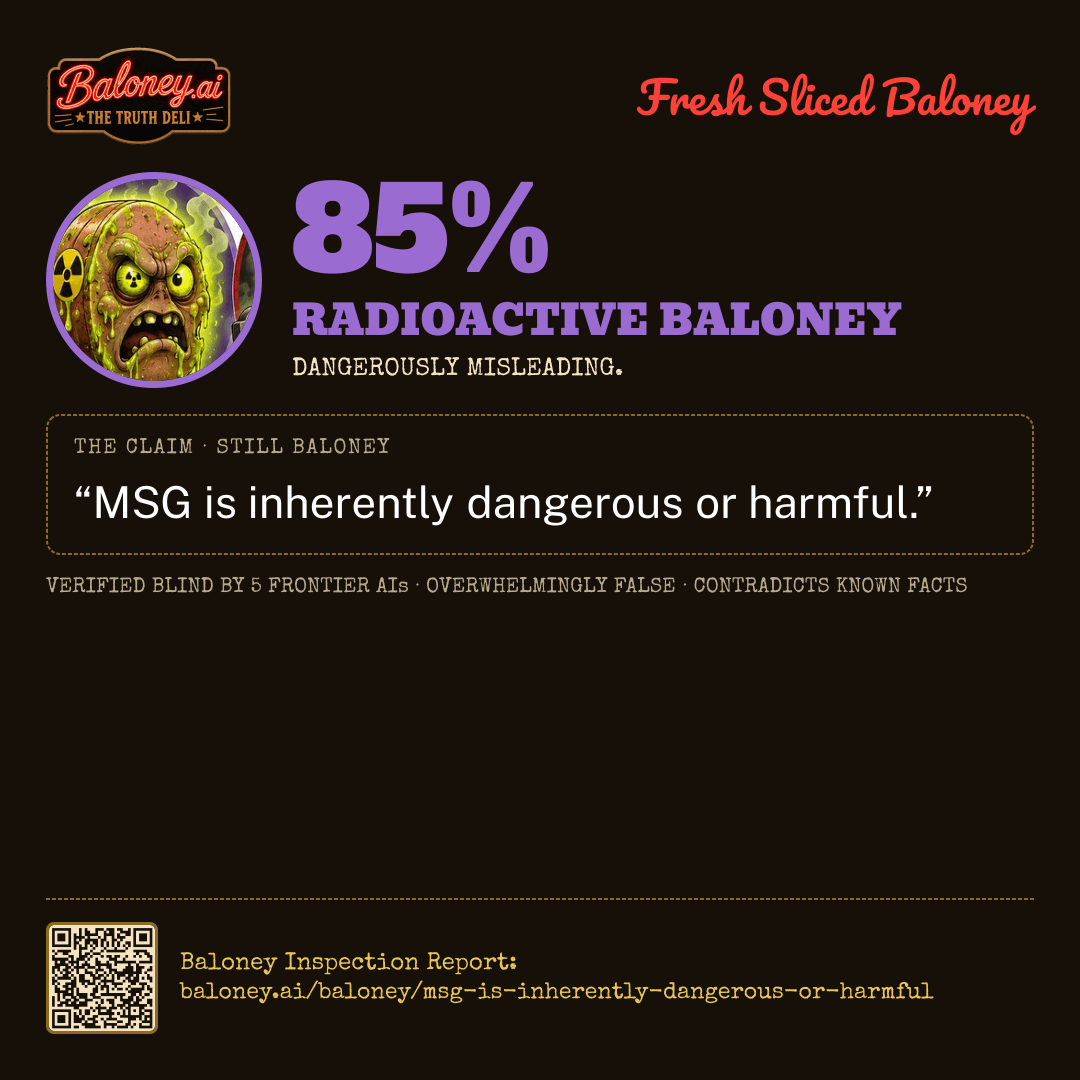
The panel of evaluators universally found the claim to be overwhelmingly false. The misconception that MSG is dangerous relies on flawed 1960s animal experiments that used unrealistic, injected megadoses, alongside subjective anecdotal reports (historically termed 'Chinese Restaurant Syndrome'). Modern evidence from robust, double-blind human trials shows no consistent adverse effects at normal dietary levels. Global food and health regulatory bodies explicitly recognize MSG as safe. I assigned a score of 99 because this is a quintessential 'zombie' myth that has been conclusively and repeatedly debunked by scientific consensus for decades yet continues to circulate widely.
The evaluators were in complete agreement. All highlighted the historical origins of the myth, the physiological equivalence of MSG to natural glutamate, and the unanimous consensus of global food safety authorities that MSG is safe at standard dietary intakes.
ZOMBIE FLAG: TRUE — DEBUNK HISTORY ON RECORD
Blind Validation Master · never saw the Primary’s work
sonar-pro
87% BALONEY
Across all five reports, the core pattern is consistent: major regulatory and scientific bodies (FDA, JECFA/WHO, EFSA, FSANZ, Health Canada, etc.) repeatedly conclude that MSG is **generally recognized as safe** at normal dietary levels for the general population, and do not classify it as inherently dangerous or poisonous.[1][2][3][4][5] The evidence for harm is restricted to: (a) **mild, transient symptoms** (headache, flushing, palpitations, numbness, etc.) in a small subset of individuals, typically after **large bolus doses on an empty stomach**, and even those effects are inconsistently reproduced in blinded trials;[1][3][4][5] and (b) **high-dose animal and in vitro studies** using routes and doses (e.g., injections, extreme gavage in neonatal rodents) that do not reflect ordinary human dietary exposure.[2][4][5] EFSA’s establishment of an ADI for glutamates and recognition that some high-consuming groups could exceed it indicates that *very high chronic intake* may warrant exposure management, not that MSG is inherently harmful at normal culinary use.[1][3][4] Narrative and toxicology reviews that link MSG to obesity, metabolic syndrome, organ toxicity, or reproductive and developmental effects overwhelmingly rely on these **non-realistic high-dose preclinical models** and small, often confounded human studies; they themselves call for better evidence and more cautious interpretation rather than demonstrating clear danger at everyday intake.[2] All reports therefore agree that: (1) MSG can cause **short-term, mild reactions** in a minority at high doses, and (2) there is **no robust evidence** of serious chronic disease, cancer, or neurodegeneration in humans at typical consumption.[1][2][3][4][5] Since “inherently dangerous or harmful” implies that MSG is broadly unsafe by its nature for ordinary use, and this is directly contradicted by the regulatory consensus and controlled human data, the claim is overwhelmingly false and potentially fear‑mongering, though not quite at the absolute “zombie” level because there is a kernel of truth about rare, dose‑dependent, mild reactions and the need to avoid extreme exposures. This places it firmly in the high “Radioactive Baloney” band, around 87.
AI EVALUATORS SHOWED MODERATE DISAGREEMENT — MASTERS SCORED 99% AND 87% · REVIEW THE EVIDENCE CAREFULLY
The Evidence
Evidence offered for the claim
Early animal studiesDEBUNKED — A 1969 study found that injecting massive doses of MSG into newborn mice caused brain lesions, sparking widespread fears of 'excitotoxicity' and neurological harm. However, these experiments involved extreme doses injected directly into neonatal animals with immature blood-brain barriers, which does not reflect how humans biologically process and metabolize oral dietary MSG.
Chinese Restaurant SyndromeDEBUNKED — Anecdotal reports, beginning with a 1968 medical journal letter, claim MSG causes short-term symptoms like numbness, headaches, palpitations, and weakness. However, decades of double-blind, placebo-controlled human trials have failed to consistently reproduce these reactions at normal culinary dietary levels, and the concept is now widely regarded as scientifically unsupported.
MSG symptom complexDEBUNKED — Some individuals report mild, temporary symptoms such as facial pressure, flushing, or sweating after consuming MSG. Controlled studies demonstrate this can occasionally occur if massive, unrealistic bolus doses (e.g., 3 grams or more) are consumed on an empty stomach, but these transient reactions do not make MSG inherently dangerous under normal dietary conditions.
Evidence against the claim
Global regulatory safety consensus Major global food-safety authorities, including the FDA, EFSA, and the WHO/FAO, universally classify MSG as safe for general consumption at customary dietary intakes and have found no evidence linking it to chronic illness, neurodegeneration, or cancer.
Identical biological metabolism Free glutamate occurs naturally and abundantly in common foods like tomatoes, aged cheeses, mushrooms, walnuts, and human breast milk. The human body does not chemically distinguish between naturally occurring glutamate and the commercially added glutamate in MSG, metabolizing both identically.
Sources · Reliability · Why Accepted or Discounted
Source
Type
Reliability
Ruling
U.S. Food and Drug Administration
gov
95
ACCEPTED — Primary U.S. federal regulatory authority for food safety; universally cited across evaluators.
European Food Safety Authority
gov
94
ACCEPTED — Major international body providing comprehensive, evidence-based food safety assessments.
Mayo Clinic
other
90
ACCEPTED — Highly reputable medical institution providing mainstream clinical consensus.