SUBMITTED ANONYMOUSLY · INSPECTED 2026-09-14T18:07:49.401Z · STATUS: PUBLISHED
82%
82%
RADIOACTIVE BALONEY — DANGEROUSLY TOXIC
Dangerously misleading.
Overwhelmingly falseContradicts known factsPromotes false beliefsPotential for harm
Serve It Fresh
Ready to Serve10 servings
Serve it the way you want it
The Verdict
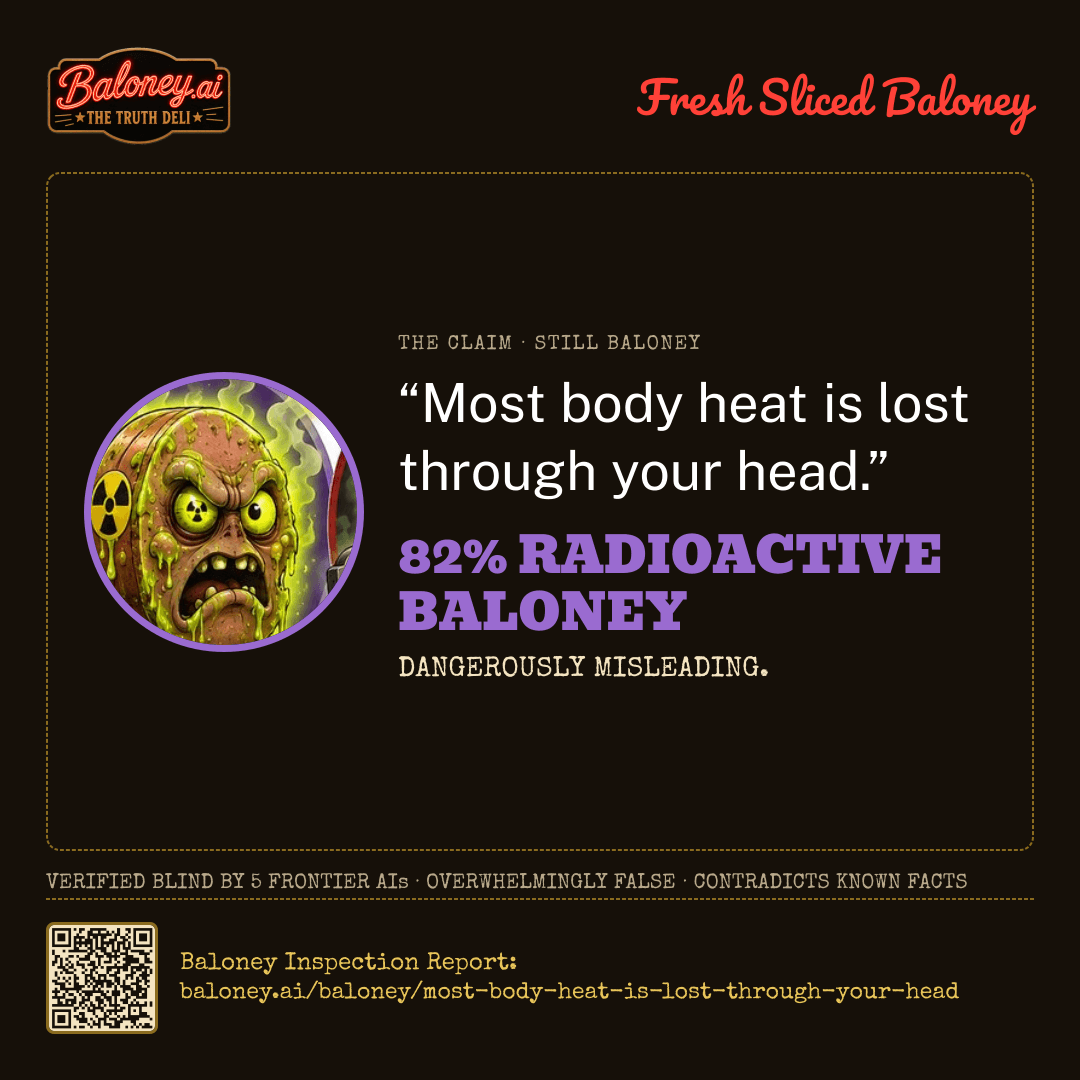
“Most body heat is lost through your head.” 82% RADIOACTIVE BALONEY — DANGEROUSLY TOXIC Verified blind by 5 frontier AIs · Baloney Inspection Report: baloney.ai/baloney/most-body-heat-is-lost-through-your-head
Station 1 · Blind Inspection — Five Graders, Zero Peeking
Each lab scored the claim independently, without seeing the others. Open a breakdown for its evidence, its sources, and how sure it was.
Anthropic · EQUAL WEIGHT · 34.1s
claude-opus-5
80%BALONEY
ROUND-1 BREAKDOWN
Evidence offered for the claim
The head and neck have relatively high, well-sustained blood flow and the scalp vasoconstricts less in the cold than the limbs do, so heat loss per unit of skin area from the head can exceed the whole-body average.
The head has little subcutaneous fat insulation and is often the only uncovered area when a person is otherwise dressed in cold weather, so in real-world winter clothing situations the head can be responsible for a disproportionate share of total heat loss (which is probably how the myth arose, reportedly from mid-20th-century military cold-exposure trials in which subjects wore Arctic suits but no hats).
Body proportions matter: in newborns and small infants the head is a much larger fraction of total body surface area (roughly 18-20%) than in adults (~7-9%), so head covering is genuinely important for neonatal thermal protection.
Cooling of the face and head has an outsized effect on thermal comfort, perceived cold, respiratory heat loss and reflex responses (e.g., cold-shock/diving responses), which makes the head feel like the dominant site of heat loss.
Evidence against the claim
Heat loss is broadly proportional to exposed surface area, and the adult head accounts for only about 7-10% of body surface area, so it cannot account for 'most' heat loss.
Controlled immersion experiments (Pretorius, Bristow, Steinman & Giesbrecht) measured heat loss with and without whole-head submersion in cold water and found the head contributed only roughly 10% of total body heat loss — proportional to its surface area, not disproportionately large.
The claim is explicitly listed as a medical myth in the peer-reviewed literature; Vreeman and Carroll's BMJ review of 'festive medical myths' identified 'we lose most of our body heat through our heads' as unsupported by evidence.
The frequently cited figures of '40-45% of heat lost through the head' have no traceable experimental basis and are inconsistent with basic thermophysiology.
Thermal physiologists (e.g., Gordon Giesbrecht, University of Manitoba) have publicly stated that going without a hat is roughly equivalent to going without trousers in terms of proportional heat loss — uncomfortable and locally significant, but not 'most' of body heat.
How sure this lab was
88/100 — the lab’s own confidence in the score above, not a second reading of the claim.
If the rest of the body is well insulated while the head/neck are exposed, the head can make up a large share—and sometimes the largest share—of the remaining heat loss. BMJ and Scientific American both note that the myth likely came from cold-weather military observations in which subjects wore Arctic clothing but left the head uncovered.
Head, face, and neck exposure matters in real cold-weather prevention; medical guidance recommends covering them to reduce heat loss and hypothermia risk.
Children and infants have proportionally larger heads than adults, so head heat loss can be relatively more important for them than for adults.
Evidence against the claim
For adults, the head and neck are only about 9% of total body surface area, so they cannot normally account for 'most' total heat loss unless other body areas are better insulated or less exposed.
The best-supported interpretation is that heat loss is driven mainly by exposed surface area, insulation, wind, wetness, and temperature gradient; an uncovered arm or leg can lose substantial heat too. The head is not uniquely responsible for most body heat loss under ordinary exposure conditions.
BMJ’s review of common medical myths concluded that the claim is false as a general rule: heat loss from the head is not disproportionately large compared with other uncovered body regions.
How sure this lab was
90/100 — the lab’s own confidence in the score above, not a second reading of the claim.
If a person is wearing heavy winter clothing on the rest of their body but leaves their head bare, a high percentage of their active heat loss will indeed occur through the head because it is the only uninsulated surface area.
The head and neck have a dense network of blood vessels close to the skin's surface. Unlike the extremities (hands and feet), the blood vessels in the head do not undergo significant vasoconstriction (narrowing to preserve heat) in cold temperatures, allowing for steady heat dissipation.
Evidence against the claim
The human head accounts for only about 7% to 10% of the total body surface area in an adult. Since body heat loss is largely proportional to the amount of exposed skin, an entirely naked person would only lose about 10% of their body heat through their head.
The claim is widely recognized by scientists and medical professionals as a myth. It originated from a flawed 1950s US military experiment where subjects were dressed in heavily insulated arctic survival gear but left bare-headed, which naturally resulted in the majority of their heat loss coming from the head.
Modern physiological studies on thermoregulation show that covering the head is no more effective at preventing overall body heat loss than covering any other equivalently sized area of the body.
How sure this lab was
99/100 — the lab’s own confidence in the score above, not a second reading of the claim.
The **head does lose heat**, and in some specific experimental conditions it can account for a large fraction of total heat loss. A classic study of heat loss from the human head found that at very low ambient temperatures (around −4°C), heat loss from the head could reach **about half of a resting person’s total heat production**, when the rest of the body was warmly insulated.[15] Under such conditions, it is accurate to say that most heat loss is via the head.
Military cold-exposure tests in the mid‑20th century had subjects in **Arctic survival suits** with only the head uncovered; under those conditions, measurements showed the head contributing a very large fraction of total heat loss simply because other regions were well insulated and the head was not.[2][7] This experimental setup is consistent with the idea that, when everything else is covered and the head is bare, the head can be the main route of heat loss.
The **U.S. Army Survival Manual** and related guidance historically stated that **40–45% of body heat can be lost from an unprotected head**, reflecting those military cold‑weather experiments and reinforcing the notion that, in heavily clothed individuals with a bare head, a substantial share of heat loss can indeed occur via the head.[6][11]
The **head and face are very sensitive to temperature changes**, so cooling there strongly influences the sensation of overall cold and can significantly enhance core cooling (one source notes that a cold head can increase core cooling by nearly 40%).[4] This perceptual and physiological prominence of head cooling supports the intuition that “most heat is lost through the head,” even though the underlying mechanism is mainly exposure and sensitivity rather than unique head properties.
Evidence against the claim
Multiple medical and scientific sources explicitly state that the claim **“most body heat is lost through your head” is a myth**. Reviews of the evidence note that if a person were equally exposed (or equally insulated) over the whole body, the head would account for **roughly 7–10% of total heat loss**, not a majority.[1][2][3][8][10][13][14]
Heat loss from any body region is largely proportional to **surface area and exposure**, not because the head is unique. The head represents only about **7–10% of total body surface area**, so if all regions are similarly clothed or unclothed, it is implausible for the head to be the route of “most” heat loss.[3][5][7][8][13]
A British Medical Journal analysis and subsequent coverage report that **at most 7–10% of body heat is lost through the head** under typical conditions; the idea of losing 40–45% or more through the head arises when the **rest of the body is heavily insulated and only the head is bare**, an artificial scenario compared to everyday clothing.[2][8][14]
Experimental work comparing heat loss with different exposed regions found that **college students lost similar amounts of heat regardless of which single area was exposed**, contradicting the notion that the head is a disproportionately important route of heat loss.[5]
Physiology experts emphasize that covering your head is **no more effective at keeping you warm than covering most other body regions**, once differences in exposure and surface area are accounted for; hands and feet can, in some situations, contribute more to cooling than the head.[13][12]
Fact‑oriented health and science outlets describe the claim as **false or misguided**, explaining that the myth likely stems from misinterpreted military experiments and older survival manuals rather than from modern thermophysiology.[1][5][7][8][12][6][10]
How sure this lab was
95/100 — the lab’s own confidence in the score above, not a second reading of the claim.
1950s U.S. Army cold-weather experiments found subjects in insulated clothing but no head covering lost roughly 40-50% of heat from the uncovered head, because it was the only exposed surface.
The scalp has dense superficial blood vessels that can transfer heat to the environment when uncovered.
Infants have a relatively larger head-to-body surface-area ratio, so a greater fraction of their heat loss can occur from the head.
Evidence against the claim
The adult head is only about 7-10% of total body surface area; under equal exposure, heat loss scales with surface area and the temperature gradient, not with any special property of the head.
The military numbers applied only when the rest of the body was already well insulated; they were later misread as a general rule that most heat always leaves through the head.
When the whole body is comparably exposed, the head does not dominate heat loss. Covering the head reduces heat loss only in proportion to the area covered, the same as covering an equivalent area of torso or limbs.
Modern thermophysiology and controlled studies (including those cited in medical-myth reviews) treat the claim as false without the special-case clothing condition.
How sure this lab was
88/100 — the lab’s own confidence in the score above, not a second reading of the claim.
The claim is a classic medical myth that is fundamentally incorrect under typical conditions. The human head makes up only 7-10% of total adult body surface area, and heat loss is directly proportional to the amount of exposed skin. The statement relies on an extreme, specific caveat—wearing heavy Arctic insulation everywhere except the head—that does not apply to a general physiological rule.
All five evaluators unanimously recognized the statement as a widely debunked myth. They completely agreed on its historical origin (1950s military cold-weather trials) and on the physiological reality that heat loss scales with exposed surface area. While evaluator scores ranged from 70 to 85, a repeatedly debunked, widely known myth qualifies strictly as a 99 (Zombie Baloney) on the scale.
ZOMBIE FLAG: TRUE — DEBUNK HISTORY ON RECORD
Blind Validation Master · never saw the Primary’s work
grok-4.6
82% BALONEY
The unqualified claim is false. Adult head/neck surface area is only ~7–10% of the body, and heat loss scales with exposed area, temperature gradient, insulation, wind and wetness rather than any unique property of the head. Controlled studies (including whole-head cold-water immersion) show the head contributes roughly that same 7–10% share when the rest of the body is comparably exposed; covering the head is no more effective than covering an equivalent area of torso or limbs. The oft-cited 40–50% figures come from 1950s military tests in which subjects wore heavily insulated Arctic clothing with only the head bare—an artificial condition later misread as a general rule. BMJ and other reviews therefore classify the statement as a medical myth. Special cases (infants’ larger relative head size; a well-clothed adult with an uncovered head; reduced scalp vasoconstriction) can make head heat loss disproportionately large, but they do not rescue the claim as written.
AI EVALUATORS SHOWED MODERATE DISAGREEMENT — MASTERS SCORED 99% AND 82% · REVIEW THE EVIDENCE CAREFULLY
The Evidence
Evidence offered for the claim
Military cold-weather experimentsDEBUNKED — 1950s U.S. Army trials found subjects lost roughly 40-50% of their heat from the head. However, this occurred because subjects wore heavily insulated Arctic survival suits but left their heads bare; as the only exposed surface, the head naturally accounted for the majority of heat loss in that highly artificial scenario.
Dense blood vesselsDEBUNKED — The head and neck have a dense network of superficial blood vessels that do not constrict as much as the extremities do in the cold. While this allows steady heat dissipation, modern physiological studies show that covering the head is still no more effective at preventing overall body heat loss than covering an equivalently sized area of the torso or limbs.
Infant body proportionsDEBUNKED — In newborns and infants, the head makes up a much larger fraction of total body surface area (up to 20%), making head covering critical for them. However, even 20% does not constitute 'most' of their body heat, and these infant proportions do not apply to adults.
Perceptual sensitivityDEBUNKED — The face and head are highly sensitive to temperature changes, meaning cold exposure there strongly influences overall thermal comfort and the sensation of being cold. This perceptual prominence makes a bare head feel like a dominant site of heat loss, even though actual heat loss remains proportional to surface area.
Evidence against the claim
Surface area dictates heat loss The adult human head accounts for roughly 7% to 10% of total body surface area. Because body heat loss is largely proportional to exposed skin, an entirely naked or evenly clothed person will only lose about 10% of their body heat through their head.
Controlled submersion studies Modern experiments measuring total heat loss with and without whole-head submersion in cold water confirm that the head contributes roughly 10% of total body heat loss, matching its surface area rather than dominating cooling.
Established medical consensus Peer-reviewed literature, including reviews of medical myths in the British Medical Journal, explicitly identifies the claim that we lose most of our body heat through our heads as false and unsupported by evidence.
Sources · Reliability · Why Accepted or Discounted
Source
Type
Reliability
Ruling
The BMJ
journal
95
ACCEPTED — A premier, peer-reviewed medical journal providing rigorous analysis of common medical myths.
Scientific American
news
88
ACCEPTED — A highly reputable and established science news publication.
Snopes
factcheck
80
ACCEPTED — An established fact-checking organization known for investigating historical and scientific myths.
Cleveland Clinic
edu
95
ACCEPTED — A leading, internationally recognized academic medical center.
The Guardian
news
90
ACCEPTED — A reliable mainstream news organization with a dedicated science and health desk.
One Medical
other
80
ACCEPTED — A reputable national healthcare provider offering evidence-based medical advice.
The Naked Scientists
edu
85
ACCEPTED — A credible science communication platform run by researchers.
WebMD
other
85
ACCEPTED — A mainstream provider of consumer health information, generally accurate on established medical facts.
The Times of India
news
75
ACCEPTED — A major newspaper accurately reporting on prevailing scientific consensus.
LiveScience
news
85
ACCEPTED — A dependable outlet specifically focused on science journalism.
The Conversation
edu
85
ACCEPTED — Publishes articles written directly by academic experts and researchers.
Mental Floss
news
70
ACCEPTED — A popular trivia and knowledge outlet that reliably correctly synthesizes expert debunking of this myth.
KXAN
news
80
ACCEPTED — A local news outlet correctly reporting on findings published in the BMJ.
Journal of Applied Physiology
journal
95
ACCEPTED — A top-tier peer-reviewed journal publishing primary research on thermoregulation and human physiology.
NCBI Bookshelf / StatPearls
gov
82
ACCEPTED — A government-hosted repository of peer-reviewed clinical summaries and continuing medical education.
Mayo Clinic
other
86
ACCEPTED — A world-renowned medical practice and medical research group.
The New York Times
news
90
ACCEPTED — A major newspaper with rigorous fact-checking for its health and science columns.
World Health Organization
gov
85
ACCEPTED — The premier global health authority, providing accurate guidelines on neonatal thermal care.
Serve It Fresh
Ready to Serve10 servings
Serve it the way you want it
The Verdict
“Most body heat is lost through your head.” 82% RADIOACTIVE BALONEY — DANGEROUSLY TOXIC Verified blind by 5 frontier AIs · Baloney Inspection Report: baloney.ai/baloney/most-body-heat-is-lost-through-your-head