Baloney Inspection Report: Claim #1165 · Inspected Oct 31, 2026, 7:44 AM PDT · Scoring model v2
 18%
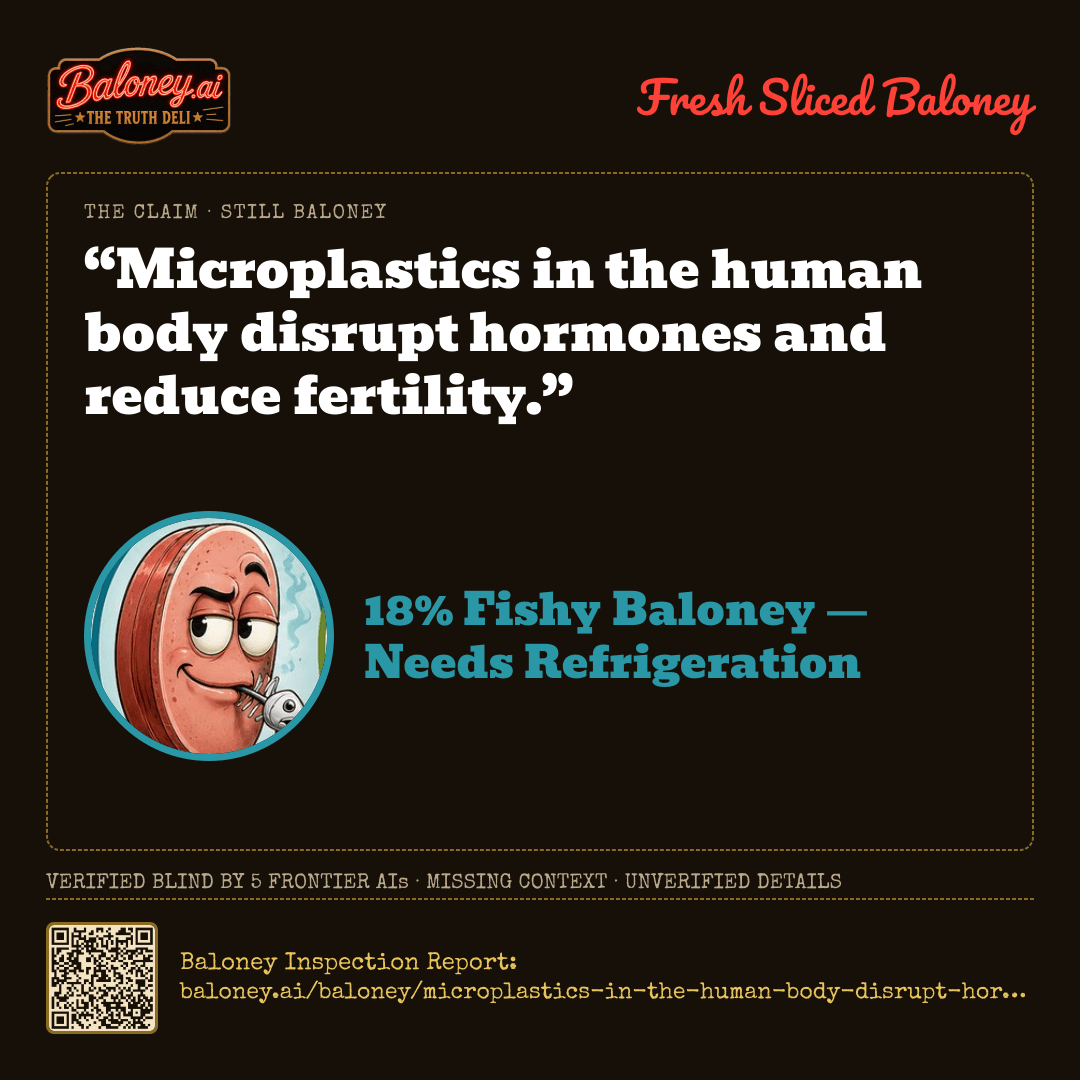
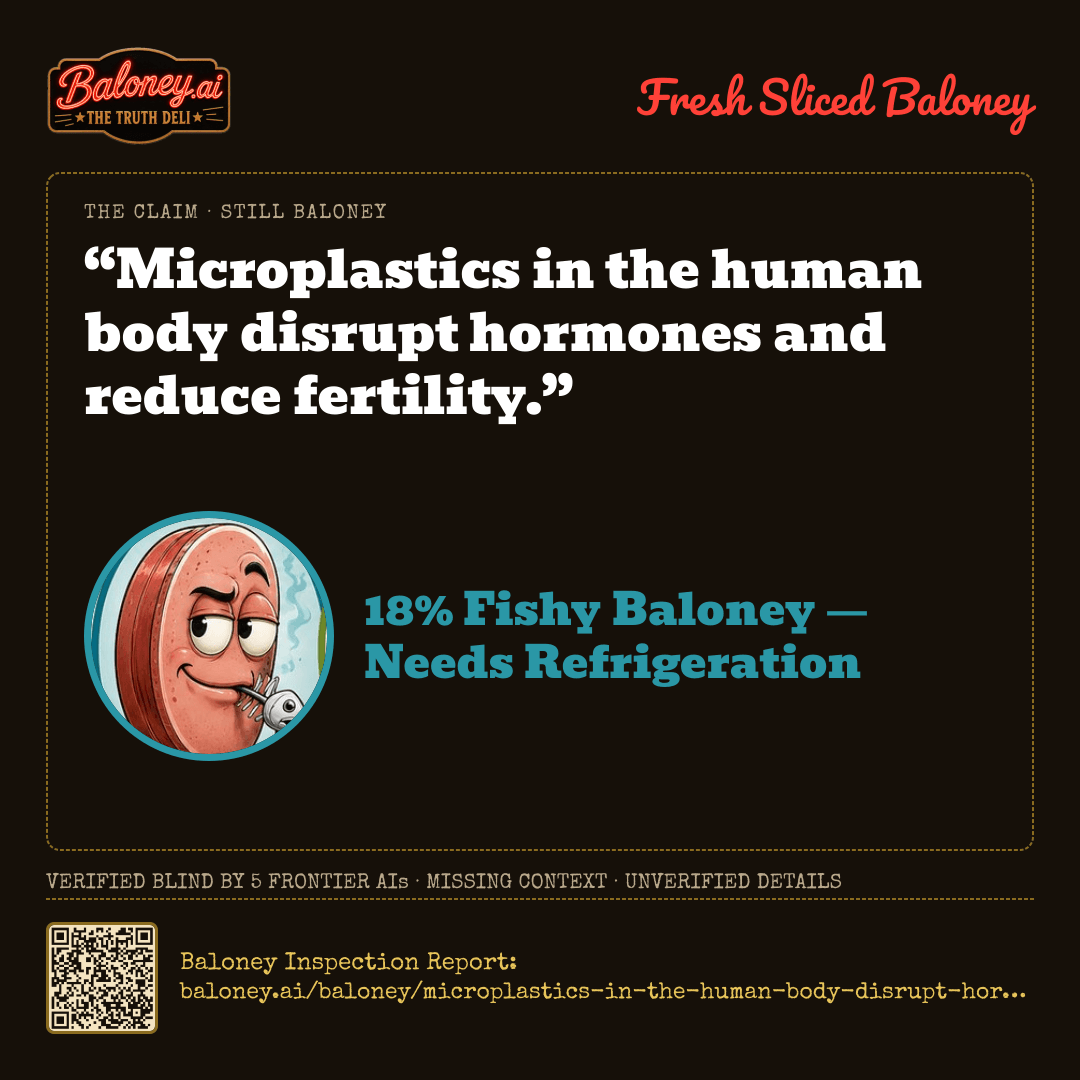
“Microplastics in the human body disrupt hormones and reduce fertility.”
18%Fishy Baloney — Needs Refrigeration
Something smells off…
Missing contextUnverified detailsSuspicious framingMay be exaggerated
Serve It Fresh
Ready to Serve13 servings
Serve it the way you want it
The Verdict
 “Microplastics in the human body disrupt hormones and reduce fertility.”18% Fishy Baloney — Needs RefrigerationVerified blind by 5 frontier AIs · Baloney Inspection Report: baloney.ai/baloney/microplastics-in-the-human-body-disrupt-hormones-and-reduce
The Baloney Sampler
The reports found the claim overstates the evidence. Microplastics and nanoplastics are genuinely found inside people, including reproductive tissues, and plastic-associated chemicals such as BPA and phthalates are recognized endocrine disruptors. Animal, cell and early human observational work raises plausible fertility concerns.
The gap is causation in humans. World Health Organization and European Food Safety Authority found the human risk evidence too limited for a firm risk assessment; National Institute of Environmental Health Sciences and Endocrine Reviews support endocrine effects mainly for plastic-associated chemicals, not particle burden itself. Human studies are small, cross-sectional or suggestive, while animal and in-vitro studies often use doses or particles unlike ordinary exposure.
Resting on World Health Organization · European Food Safety Authority · National Institute of Environmental Health Sciences · Endocrine Reviews
Original Claim Source https://www.reddit.com/r/pakistan/comments/1v7ufqi/public_health_hazard/
Other ways to slice it — phrasings that might have changed the rating
- “Microplastics and nanoplastics have been detected inside human blood, placenta, testes, semen, arterial plaque, and brain tissue.” The accepted detection studies support internal human exposure, but detection alone does not establish hormone disruption or infertility.
- “Plastic-associated chemicals such as BPA and phthalates can disrupt hormones and are linked to poorer reproductive measures in humans.” The strongest endocrine evidence in the reports concerns additives and leachable chemicals, not necessarily the microplastic particles themselves.
- “Microplastic exposure may contribute to hormone disruption or reduced fertility in humans, but this has not been proven.” Animal, cell, and early observational studies make the concern plausible, while WHO, EFSA, and the masters found human causal evidence still insufficient.
Written from the panel’s reports by OpenAI · gpt-5.5. Nothing here changed the score.
The Order Ticket
14:44:13CLAIM RECEIVED — QUEUED FOR INSPECTION✓
14:45:12claude-opus-5 REPORTED — SCORE 30, CONFIDENCE 76✓
14:44:49gpt-5.5 REPORTED — SCORE 28, CONFIDENCE 78✓
14:44:50gemini-3.1-pro-preview REPORTED — SCORE 4, CONFIDENCE 90✓
14:44:18sonar-pro REPORTED — SCORE 18, CONFIDENCE 86✓
14:45:43grok-4.6 REPORTED — SCORE 14, CONFIDENCE 68✓
14:46:32PRIMARY MASTER CHATGPT — SCORE 26✓
14:45:58BLIND VALIDATION CLAUDE — SCORE 19✓
14:46:56AGREEMENT CONFIRMED — DELTA 8✓
14:46:56SCORING MODEL V2 — MEDIAN OF 5 COUNTED LAB SCORES: 30, 28, 4, 18, 14 → 18.✓
14:46:56SOURCE RULE — LABS CITED 29 SOURCES: 0 DISCARDED FOR HAVING NO URL, 2 DISCARDED AS DEAD LINKS (404/410), 14 COULD NOT BE OPENED BY US AND ARE MARKED UNVERIFIED.✓
14:46:56SOURCE RULE — PRIMARY MASTER RULED ON 20 SOURCES: 0 DISCARDED FOR HAVING NO URL, 0 DISCARDED AS DEAD LINKS, 12 MARKED UNVERIFIED, 8 VERIFIED.✓
How This One Was Sliced
Station 1 · Blind Inspection — Five Graders, Zero Peeking
Each lab scored the claim independently, without seeing the others. Open a breakdown for its evidence, its sources, and how sure it was.
Anthropic · EQUAL WEIGHT · 58.7s
claude-opus-5
30%BALONEY
ROUND-1 BREAKDOWN
Evidence offered for the claim- Microplastic and nanoplastic particles have been documented inside human tissues and fluids, including blood (Leslie et al., Environment International 2022), placenta (Ragusa et al., 'Plasticenta', 2021), arterial plaque (Marfella et al., NEJM 2024), and brain tissue (Nihart et al., Nature Medicine 2025) — establishing that internal human exposure is real and widespread, a prerequisite for the claim.
- Studies published in 2023–2024 reported microplastics in human semen, testes, and ovarian follicular fluid, and some found inverse associations between particle concentrations and sperm concentration/motility — consistent with (though not proof of) a reproductive effect.
- Plastics carry and leach well-established endocrine-disrupting chemicals — bisphenols, phthalates, alkylphenols, certain flame retardants and PFAS. Human epidemiology and the Endocrine Society's EDC-2 scientific statement link these to altered sex-hormone levels, reduced semen quality, anogenital distance changes in boys, and reduced fecundability. Microplastics act as a vector for these compounds.
- Rodent and in vitro studies consistently show that polystyrene micro/nanoplastics can cross the blood–testis and placental barriers, induce oxidative stress and inflammation in gonads, lower testosterone, disrupt spermatogenesis, and reduce oocyte quality at the doses tested.
- Global declines in sperm counts (Levine et al. meta-analyses) coincide with the plastics era, and many researchers consider plastic-associated chemical exposure a plausible contributing driver.
- Multiple national and international bodies (WHO, NIEHS, EU/EFSA) have flagged micro- and nanoplastics as an emerging concern requiring urgent research into reproductive and endocrine endpoints.
Evidence against the claim- No study has demonstrated that microplastic particles themselves cause hormone disruption or infertility in humans. Human data are cross-sectional and correlational; reverse causation and confounding (smoking, obesity, diet, co-exposures) are not excluded.
- WHO's assessments of microplastics in drinking water (2019) and its 2022 follow-up concluded the evidence base is limited and of low quality, with no confirmed human health hazard established at current exposure levels — explicitly calling the risk assessment inconclusive rather than demonstrated.
- The strongest endocrine-disruption evidence concerns plastic-associated chemicals (phthalates, BPA), not the plastic particles. The claim conflates 'microplastics' with the chemical additives, which have separate exposure pathways (diet, personal care products) and separate regulatory handling.
- Animal studies showing reproductive harm typically use doses and particle types (uniform virgin polystyrene spheres, often mg/kg/day) far above and chemically unlike realistic human environmental exposures; extrapolation is contested.
- Methodological problems plague the field: airborne plastic contamination of lab samples, inconsistent detection methods (µFTIR, Raman, Py-GC/MS), and lack of standardized quantification have produced results varying by orders of magnitude. Several high-profile estimates (e.g., 'a credit card a week') have been criticized as unreliable.
- Population-level fertility outcomes are driven overwhelmingly by social and behavioral factors; no study has quantified any attributable fraction of human infertility to microplastics. The claim's flat assertion of 'reduce fertility' states as settled fact what researchers describe as a hypothesis under investigation.
How sure this lab was76/100 — the lab’s own confidence in the score above, not a second reading of the claim.
SourcesEnvironment International (Leslie et al., 2022) — microplastics in human bloodjournal · 90 · Environment International (Ragusa et al., 2021) — 'Plasticenta': microplastics in human placentajournal · 88 · New England Journal of Medicine (Marfella et al., 2024) — micro/nanoplastics in atheromasjournal · 95 · Nature Medicine (Nihart et al., 2025) — bioaccumulation of microplastics in human brain tissuejournal · 90 · Endocrine Reviews — EDC-2: Endocrine Society Scientific Statement on endocrine-disrupting chemicalsjournal · 93 · US National Institute of Environmental Health Sciences — Endocrine Disruptorsgov · 92 · World Health Organization — Dietary and inhalation exposure to nano- and microplastics and potential implications for human health (2022)gov · 92 · World Health Organization — Microplastics in drinking-water (2019)gov · 90
OpenAI · EQUAL WEIGHT · 36.1s
gpt-5.5
28%BALONEY
ROUND-1 BREAKDOWN
Evidence offered for the claim- Microplastics have been detected in human blood, placenta, and reproductive tissue, so internal exposure is real rather than hypothetical; however, detection alone does not prove harm.
- A 2024 Toxicological Sciences study found microplastics in human and dog testes; in dogs, higher PVC levels were negatively associated with testis weight and sperm count, which is suggestive but not direct proof of reduced human fertility.
- Many plastics contain or carry endocrine-active chemicals such as phthalates and bisphenol A; major endocrine reviews and NIEHS identify these chemicals as capable of interfering with hormone signaling and reproductive biology.
- Reviews of microplastics note plausible mechanisms for endocrine/reproductive effects, including leaching of additives, adsorption of pollutants, oxidative stress, and inflammation; animal and cell studies are more supportive than human studies.
Evidence against the claim- The claim is phrased as established human causation, but human evidence that microplastics in the body actually disrupt hormones or reduce fertility is still limited and not definitive.
- WHO’s 2022 review concluded that evidence on human health risks from micro- and nanoplastic exposure remains insufficient, with major gaps in exposure, toxicology, and epidemiology.
- EFSA similarly found that data on microplastics/nanoplastics in food and their toxicity were too limited for a full human risk assessment.
- Human detection studies in blood, placenta, and testes are generally small or exploratory and mostly show presence, not endocrine disruption or infertility outcomes.
- Much of the stronger fertility/hormone evidence concerns plastic additives such as phthalates and BPA, not necessarily microplastic particles themselves; treating these as the same thing overstates the evidence.
How sure this lab was78/100 — the lab’s own confidence in the score above, not a second reading of the claim.
SourcesWorld Health Organizationgov · 95 · European Food Safety Authoritygov · 93 · Environment Internationaljournal · 88 · Environment Internationaljournal · 86 · Toxicological Sciencesjournal · 86 · Endocrine Reviewsjournal · 91 · National Institute of Environmental Health Sciencesgov · 92 · International Journal of Environmental Research and Public Healthjournal · 74
Google · EQUAL WEIGHT · 37.0s
gemini-3.1-pro-preview
4%BALONEY
ROUND-1 BREAKDOWN
Evidence offered for the claim- Microplastics act as carriers for Endocrine Disrupting Chemicals (EDCs) such as bisphenols (like BPA), phthalates, and PFAS. These chemicals are extensively proven to interfere with human hormonal systems and negatively impact reproductive health.
- Recent peer-reviewed studies have successfully detected microplastics and nanoplastics in human blood, placentas, breast milk, and testicular tissue, proving that these particles can cross biological barriers and accumulate in reproductive organs.
- Numerous in vivo and in vitro animal models (e.g., mice) have demonstrated that exposure to microplastics causes reproductive toxicity, leading to decreased sperm count and viability, disrupted testosterone production, and impaired ovarian function.
Evidence against the claim- While animal models and cellular in vitro studies show clear negative effects, direct longitudinal epidemiological data definitively proving that microplastic particles cause clinical infertility in humans—isolated from other environmental, genetic, and lifestyle factors—is still emerging.
- The exact threshold at which the concentration of physical microplastic particles in the human body becomes toxic to reproductive health remains an active subject of toxicological research.
- Scientists are still determining the extent to which hormonal disruption is caused by the physical microplastic particles themselves versus the chemical additives leaching from them, though both are inextricably linked in real-world exposure.
How sure this lab was90/100 — the lab’s own confidence in the score above, not a second reading of the claim.
SourcesNational Institute of Environmental Health Sciences (NIEHS)gov · 95 · Naturejournal · 95
Perplexity · EQUAL WEIGHT · 4.8s
sonar-pro
18%BALONEY
ROUND-1 BREAKDOWN
Evidence offered for the claim- Microplastics have been detected in human semen, and one study found lower progressive sperm motility among participants with PET microplastics; however, it found no significant association with sperm concentration or total sperm count and called for larger studies.[5]
- Experimental studies in female animals generally report altered hormone levels, ovarian effects, and reduced fertility, but these findings do not establish equivalent effects in humans.[6][9]
- Laboratory exposure of human sperm to high concentrations of PVC microplastics reduced motility and increased oxidative stress and DNA damage; this was an in-vitro study, so it does not demonstrate effects from ordinary human exposure.[3]
- A 2025 review of female-reproductive experiments reported effects on ovarian function, fertility, and hormones, while also noting variable study quality and a high risk of bias in some studies.[9]
Evidence against the claim- Human evidence remains limited and does not establish that microplastics cause hormonal disruption or infertility. The human semen study found no significant association with sperm concentration or total sperm count and explicitly said larger studies are needed.[5]
- The strongest hormone evidence in the retrieved sources comes from animal experiments, particularly studies of the hypothalamus-pituitary-ovary axis, rather than controlled human studies.[6]
- The striking human-sperm laboratory findings used PVC concentrations up to 400 micrograms per milliliter for six hours, conditions that may not represent typical internal human exposure.[3]
- Associations between microplastic detection and reproductive measures can be affected by confounding, exposure-measurement limitations, contamination, and uncertainty about dose; the available evidence does not demonstrate reduced fertility at the population level.
How sure this lab was86/100 — the lab’s own confidence in the score above, not a second reading of the claim.
SourcesPubMed; peer-reviewed human semen studyjournal · 94 · Human Reproduction; peer-reviewed conference abstractjournal · 82 · PubMed; systematic review of animal studiesjournal · 92 · PubMed; systematic review of experimental studiesjournal · 91 · Human Reproduction; systematic narrative review abstractjournal · 78
xAI · EQUAL WEIGHT · 90.2s
grok-4.6
14%BALONEY
ROUND-1 BREAKDOWN
Evidence offered for the claim- Microplastics have been detected in human blood, placenta, lungs, testes and semen.
- Common plastic additives (BPA, phthalates) are established endocrine-disrupting chemicals that interfere with hormone receptors and steroidogenesis.
- Rodent and in-vitro studies show microplastic exposure can lower testosterone, impair spermatogenesis, reduce ovarian follicles and alter reproductive hormone levels.
- Some observational human data link higher internal plastic-associated chemical levels with poorer semen quality.
Evidence against the claim- No adequately powered human epidemiological studies have demonstrated that the particle burden itself (versus co-occurring chemicals or confounders) causes clinical hormone disruption or reduced fertility.
- Toxicology data are dominated by animal models using doses far above estimated human exposures.
- WHO assessments of microplastics in drinking water found insufficient evidence of health risk and called for more research.
- Effects, when observed, may be driven by leachable additives rather than the polymer particles named in the claim.
How sure this lab was68/100 — the lab’s own confidence in the score above, not a second reading of the claim.
SourcesEnvironment Internationaljournal · 92 · Environment Internationaljournal · 92 · NIEHS/NIHgov · 95 · World Health Organizationother · 93
Station 2 · The Masters
Primary Master · drawn at random
gpt-5.5
26% BALONEY
The statement is too definitive as written. The panel’s stronger evidence establishes three narrower points: microplastics have been detected inside human bodies, including reproductive tissues; plastic-associated chemicals such as BPA and phthalates are well-established endocrine disruptors; and animal, cell, and some early human observational studies raise plausible reproductive concerns. But the decisive question is whether microplastic particles in human bodies have been shown to disrupt human hormones and reduce fertility. The reports largely agree that this has not been demonstrated. I gave greatest weight to WHO, EFSA, NIEHS, Endocrine Reviews, and peer-reviewed human detection/reproductive studies. I gave less weight to animal and in-vitro experiments for human causation because many use higher or less realistic exposures, and I treated conference abstracts and exploratory cross-sectional studies as suggestive rather than conclusive. The claim is therefore not unsupported nonsense, but it presents an active research concern as an established human causal fact.
All five evaluators agreed that internal human exposure to microplastics is real and that plastic-associated chemicals can affect endocrine and reproductive biology. Four of the five treated the claim as overstated because human causal evidence for microplastic particles reducing fertility remains limited or inconclusive. The main disagreement was how much the animal, in-vitro, additive-chemical, and early human tissue findings should count toward the statement as written: one evaluator scored it essentially true, while the others saw it as missing critical uncertainty and conflating microplastics with endocrine-active additives.
Blind Validation Master · never saw the Primary’s work
claude-opus-5
19% BALONEY
The claim states as settled fact something the evidence base supports only as a plausible, actively investigated hypothesis. Solidly established: microplastic and nanoplastic particles genuinely are present inside human bodies (blood, placenta, lungs, testes, semen, arterial plaque, brain), and plastic-associated additives such as bisphenols and phthalates are well-documented endocrine disruptors linked in human epidemiology to altered sex hormones and poorer semen quality. Animal and in vitro work fairly consistently shows reduced testosterone, impaired spermatogenesis and ovarian effects. So the claim is not fabricated and points in a direction most researchers consider plausible. However, two significant gaps keep it out of the 'true' band. First, no adequately powered human study demonstrates that the particles themselves cause hormone disruption or reduced fertility; human data are small, cross-sectional and confounded, and the one human semen study cited found no significant association with sperm concentration or total count. WHO (2019, 2022) and EFSA both concluded the evidence is too limited and low-quality for a risk determination. Second, the claim conflates the particles with leachable chemical additives; the strongest endocrine evidence belongs to BPA and phthalates, which have their own exposure routes, and animal particle studies typically use doses and idealised polystyrene spheres far removed from realistic human exposure. This is not a mere wording caveat: it is asserting demonstrated human causation where the field explicitly says the question is open, with important context omitted. That places it in the 'Fishy Baloney' range rather than true or outright false.
AGREEMENT TEST PASSED — MASTERS SCORED 26% AND 19% · BLIND VALIDATION CONFIRMED THIS SCORE · NO RE-EVALUATION REQUIRED
How the number was reached · scoring model v2 · how our models work
- Median of 5 counted lab scores: 30, 28, 4, 18, 14 → 18.
The Evidence
Evidence offered for the claim
- Internal exposure is real Evaluators cited studies detecting microplastics in human blood, placenta, semen, testes, lungs, arterial plaque, and other tissues. This supports the premise that exposure is not merely hypothetical, but detection alone does not prove endocrine harm or infertility.
- Reproductive tissues affected in early studies Reports cited recent findings of microplastics in semen, testes, and ovarian follicular fluid, with some associations involving sperm motility or concentration. These are suggestive but mostly small, cross-sectional, or exploratory, and do not establish clinical fertility reduction.
- Plastic chemicals disrupt hormones DEBUNKED — BPA, phthalates, and other plastic-associated chemicals are recognized endocrine-disrupting chemicals. However, that evidence mostly concerns chemical additives and exposures, not proof that microplastic particles in the body themselves disrupt human hormones or reduce fertility.
- Animal and cell studies show plausible harm Rodent and in-vitro studies report oxidative stress, inflammation, altered testosterone or ovarian function, impaired spermatogenesis, and reduced sperm motility under tested exposures. The panel treated these as biologically plausible evidence, but not as direct proof of ordinary human effects.
- Possible mechanisms exist Evaluators identified plausible pathways including additive leaching, adsorbed pollutants, oxidative stress, inflammation, and barrier crossing. These mechanisms support concern and further research, but they do not by themselves prove the claim as a human health outcome.
Evidence against the claim
- Human causation is unproven No evaluator identified an adequately powered human epidemiological study showing that internal microplastic particle burden causes hormone disruption or reduced fertility.
- Particles and additives are conflated The strongest endocrine-disruption evidence concerns plastic-associated chemicals such as BPA and phthalates. The claim attributes the effect to microplastics in the body, which overstates what is known about the particles themselves.
- Human studies are limited Detection and semen studies are generally small, exploratory, or cross-sectional. They can show presence or association, but are vulnerable to confounding, contamination, exposure-measurement problems, and cannot establish reduced fertility at the population level.
- Animal doses may not match human exposure Much of the stronger reproductive-toxicity evidence comes from rodents or laboratory systems using particle types, concentrations, or doses that may be far above or unlike typical environmental human exposure.
- Major reviews call evidence insufficient WHO and EFSA assessments cited by the panel found major data gaps in exposure, toxicity, and epidemiology, and did not conclude that current human microplastic exposures have proven endocrine or fertility effects.
- Methodological uncertainty remains Reports noted sample contamination risks, inconsistent detection methods, and lack of standardized quantification, all of which make it harder to connect measured particles to specific hormone or fertility outcomes.
Sources · Reliability · Why Accepted or Discounted
| Source | Type | Reliability | Ruling |
|---|
| Environment Internationalunverified | journal | 90 | ACCEPTED — Accepted for evidence that microplastics have been detected in human blood; it supports exposure, not causation. |
| Environment Internationalunverified | journal | 88 | ACCEPTED — Accepted for detection of microplastics in human placenta; relevant to internal exposure and biological-barrier concerns, but not proof of fertility harm. |
| National Institute of Environmental Health Sciences | gov | 93 | ACCEPTED — Accepted for general information on endocrine-disrupting chemicals; most directly supports risks from plastic-associated chemicals rather than microplastic particles. |
| World Health Organization | gov | 91 | ACCEPTED — Accepted for WHO’s assessment that evidence on health risks from microplastics in drinking water was insufficient and required more research. |
| World Health Organization | gov | 94 | ACCEPTED — Accepted as a high-weight review of dietary and inhalation exposure to micro- and nanoplastics and the current gaps in human health evidence. |
| European Food Safety Authorityunverified | gov | 93 | ACCEPTED — Accepted for the conclusion that data on microplastics and nanoplastics in food and toxicity were too limited for a full human risk assessment. |
| Toxicological Sciencesunverified | journal | 86 | ACCEPTED — Accepted as suggestive evidence on microplastics in testes and associations in dogs; it does not establish human fertility causation. |
| Endocrine Reviewsunverified | journal | 91 | ACCEPTED — Accepted for the endocrine-disrupting effects of plastic-associated chemicals; limited for attributing effects specifically to microplastic particles. |
| International Journal of Environmental Research and Public Healthunverified | journal | 74 | ACCEPTED — Accepted as a lower-weight review source on plausible mechanisms; not treated as decisive human causal evidence. |
| Nature | news | 85 | ACCEPTED — Accepted as a reputable secondary discussion of emerging findings, but not weighted like primary epidemiological evidence. |
| PubMed-listed human semen study | journal | 94 | ACCEPTED — Accepted as directly relevant human reproductive evidence; treated as suggestive because the reported associations were limited and called for larger studies. |
| Human Reproductionunverified | journal | 82 | DISCOUNTED — Discounted because it is a conference abstract rather than a full study report; useful for context but not central to the verdict. |
| PubMed-listed systematic review of animal studies | journal | 92 | ACCEPTED — Accepted for animal reproductive-toxicity evidence, while recognizing limits in extrapolating animal exposure conditions to humans. |
| PubMed-listed systematic review of experimental studies | journal | 91 | ACCEPTED — Accepted for experimental evidence on reproductive endpoints; not considered direct proof of human fertility reduction. |
| Human Reproductionunverified | journal | 78 | DISCOUNTED — Discounted because it is a supplement abstract and provides less detail and review certainty than full peer-reviewed articles or agency assessments. |
| Environment Internationalunverified | journal | 90 | ACCEPTED — Accepted for human blood detection evidence; it establishes exposure, not hormone disruption or infertility. |
| Environment Internationalunverified | journal | 88 | ACCEPTED — Accepted for placenta detection evidence; relevant to internal presence and potential reproductive concern but not causal proof. |
| New England Journal of Medicineunverified | journal | 95 | ACCEPTED — Accepted for evidence that micro- and nanoplastics can be detected in human arterial plaque; only indirectly relevant to fertility. |
| Nature Medicine | journal | 90 | ACCEPTED — Accepted for evidence of microplastic bioaccumulation in human tissue; not direct evidence for reproductive or endocrine outcomes. |
| Endocrine Reviewsunverified | journal | 93 | ACCEPTED — Accepted for high-quality review evidence on endocrine-disrupting chemicals, especially plastic-associated additives; not decisive for particle-specific microplastic effects. |
Every link was opened when this claim was inspected. A dead link was discarded before publication; “unverified” means the site refused our automated check and the link is the one the panel cited. A source without a URL was never kept.
Serve It Fresh
Ready to Serve13 servings
Serve it the way you want it
The Verdict
“Microplastics in the human body disrupt hormones and reduce fertility.”18% Fishy Baloney — Needs RefrigerationVerified blind by 5 frontier AIs · Baloney Inspection Report: baloney.ai/baloney/microplastics-in-the-human-body-disrupt-hormones-and-reduce