Baloney Inspection Report: Claim #1062 · Inspected Sep 30, 2026, 11:36 AM PDT · Scoring model v2
 88%
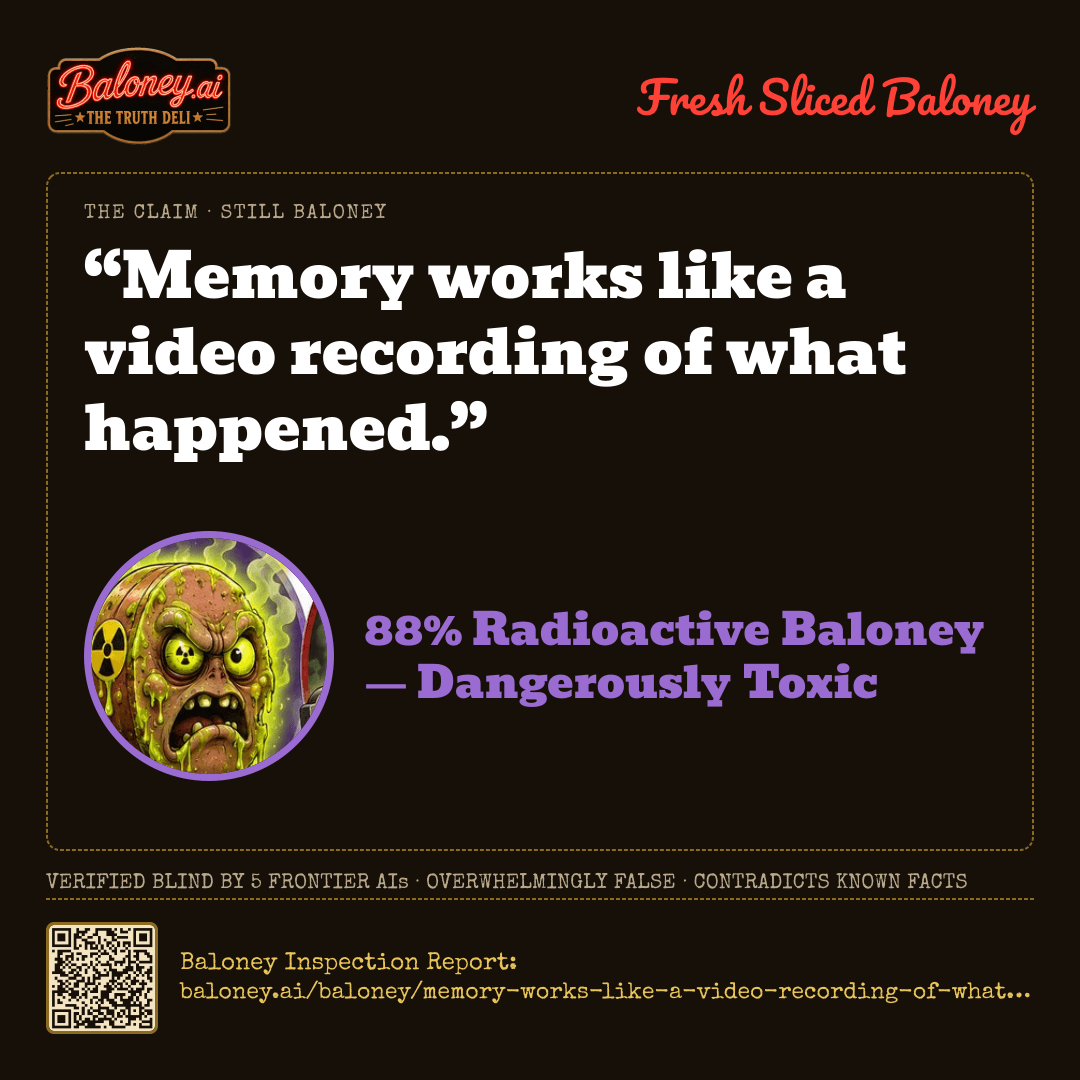
88%“Memory works like a video recording of what happened.”
88%Radioactive Baloney — Dangerously Toxic
Dangerously misleading.
Overwhelmingly falseContradicts known factsPromotes false beliefsPotential for harm
✓ BLIND VALIDATION CONFIRMED THIS SCORE
Serve It Fresh
Ready to Serve17 servings
Serve it the way you want it
The Verdict
 “Memory works like a video recording of what happened.”88% Radioactive Baloney — Dangerously ToxicVerified blind by 5 frontier AIs · Baloney Inspection Report: baloney.ai/baloney/memory-works-like-a-video-recording-of-what-happened
The Baloney Sampler
The claim is false because memory is selective and reconstructive, not a complete, stable recording. The National Academies reports that people can forget, reconstruct, update, and distort what they believe happened; its review also describes fabricated details being planted in memory. The PLOS ONE survey found that the video-camera analogy is widely believed despite conflicting with expert understanding.
The reports found that misleading questions can alter recall, people can confidently remember details that were never presented, and vivid flashbulb memories can become inconsistent over time. The National Academies and Nature evidence also supports the finding that eyewitness memory can be contaminated and that retrieval can make a memory temporarily modifiable. Some memories retain sensory detail or are accurate, but that does not make them recordings.
Resting on National Research Council / National Academies of Sciences · PLOS ONE · Nature · National Institutes of Health, National Library of Medicine
Other ways to slice it — phrasings that might have changed the rating
- “Remembering an event can sometimes feel like replaying a video.” The reports found that episodic, flashbulb, and sensory memories can feel vivid and replay-like without being consistently accurate.
- “Human memory often preserves some central details of an event accurately, especially when attention and encoding conditions are good.” The reports found that people can recall the gist and some details accurately, while attention limits and later information still prevent memory from being a complete recording.
- “Retrieving a memory can make it temporarily susceptible to modification.” The Nature evidence cited in the reports found that reactivated memories can return to a labile state before being stored again.
Written from the panel’s reports by Perplexity · sonar-pro. Nothing here changed the score.
The Order Ticket
18:36:37CLAIM RECEIVED — QUEUED FOR INSPECTION✓
18:36:37claude-opus-5 REPORT CARRIED OVER FROM THE EARLIER RUN — SCORE 88, CONFIDENCE 95✓
18:36:37gpt-5.5 REPORT CARRIED OVER FROM THE EARLIER RUN — SCORE 85, CONFIDENCE 92✓
18:36:37gemini-3.1-pro-preview REPORT CARRIED OVER FROM THE EARLIER RUN — SCORE 95, CONFIDENCE 99✓
18:36:46sonar-pro REPORTED — SCORE 75, CONFIDENCE 98✓
18:36:37grok-4.6 REPORT CARRIED OVER FROM THE EARLIER RUN — SCORE 88, CONFIDENCE 86✓
18:38:43PRIMARY MASTER PERPLEXITY — SCORE 92✓
18:38:27BLIND VALIDATION CLAUDE — SCORE 90✓
18:37:26AGREEMENT CONFIRMED — DELTA 4✓
18:37:26SCORING MODEL V2 — MEDIAN OF 5 COUNTED LAB SCORES: 88, 85, 95, 75, 88 → 88.✓
18:37:26SOURCE RULE — LABS CITED 30 SOURCES: 0 DISCARDED FOR HAVING NO URL, 2 DISCARDED AS DEAD LINKS (404/410), 9 COULD NOT BE OPENED BY US AND ARE MARKED UNVERIFIED.✓
18:37:26SOURCE RULE — PRIMARY MASTER RULED ON 20 SOURCES: 0 DISCARDED FOR HAVING NO URL, 0 DISCARDED AS DEAD LINKS, 6 MARKED UNVERIFIED, 14 VERIFIED.✓
How This One Was Sliced
Station 1 · Blind Inspection — Five Graders, Zero Peeking
Each lab scored the claim independently, without seeing the others. Open a breakdown for its evidence, its sources, and how sure it was.
Anthropic · EQUAL WEIGHT · 39.6s
claude-opus-5
88%BALONEY
ROUND-1 BREAKDOWN
Evidence offered for the claim- Memory is not wholly fabricated: people frequently recall the gist and many central details of events accurately, especially for distinctive, emotionally significant, or frequently rehearsed episodes, which is why eyewitness testimony retains evidentiary value at all.
- Some individuals with Highly Superior Autobiographical Memory (HSAM) can recall the date-by-date details of decades of their personal lives with unusual accuracy, superficially resembling a 'recording' (LePort et al., 2012) — though even HSAM individuals are susceptible to false memories.
- 'Flashbulb' memories of shocking events feel vivid, detailed, and replay-like, giving the subjective impression of a recording; this phenomenology is the main reason the claim is intuitively appealing.
- Recognition memory for pictures can be remarkably large in capacity (people can recognize thousands of previously seen images at high rates), showing that a great deal of visual detail is in fact retained.
- The claim is widely believed: a representative U.S. survey found roughly 63% of respondents agreed that 'human memory works like a video camera, accurately recording the events we see and hear,' and about half agreed memory is permanent and unchanging (Simons & Chabris, 2011) — popularity is not evidence of truth, but it shows the claim is a mainstream intuition rather than a fringe one.
Evidence against the claim- The scientific consensus is that memory is reconstructive, not reproductive: retrieval rebuilds an event from partial traces plus schemas, expectations, and post-event information. Bartlett's 'War of the Ghosts' work (1932) established that recall systematically distorts toward the rememberer's cultural schemas.
- Misinformation effect: Loftus & Palmer (1974) showed that changing a single verb in a question ('smashed' vs. 'hit') altered speed estimates and made witnesses more likely to report broken glass that was never present. Decades of follow-up work show post-event suggestion can insert details into memory.
- Wholly false memories can be implanted — e.g., childhood events that never occurred ('lost in the mall' and later paradigms) — which is impossible for a true recording device.
- The DRM paradigm (Roediger & McDermott, 1995) reliably produces confident false recall of words never presented, demonstrating that memory outputs are generated by inference, not read off a stored file.
- Flashbulb memories are demonstrably unreliable despite high confidence: Neisser & Harsch's Challenger study and Talarico & Rubin (2003) found that consistency of such memories declines like ordinary memory while confidence stays high — 'confidence, not consistency, characterizes flashbulb memories.'
- Neuroscience of reconsolidation shows that reactivating a memory renders it labile and modifiable (Nader, Schafe & LeDoux, 2000), so the act of remembering can itself change the trace — the opposite of a fixed recording.
- Applied consequences: the U.S. National Academies' 2014 report 'Identifying the Culprit' concluded that eyewitness memory is malleable and subject to contamination, and recommended reforms accordingly. The Innocence Project reports that mistaken eyewitness identification contributed to roughly two-thirds of DNA-based exonerations.
- Encoding is highly selective: phenomena like inattentional and change blindness show that much of a scene is never recorded in the first place, so there is no complete 'footage' to replay.
- Simons & Chabris (2011) explicitly framed the 'memory as video camera' belief as a misconception contradicted by expert opinion, noting large gaps between public belief and the views of memory researchers.
How sure this lab was95/100 — the lab’s own confidence in the score above, not a second reading of the claim.
SourcesPLOS ONE — Simons & Chabris, 'What People Believe about How Memory Works: A Representative Survey of the U.S. Population' (2011)journal · 90 · National Research Council / National Academies of Sciences, 'Identifying the Culprit: Assessing Eyewitness Identification' (2014)gov · 96 · Nature — Nader, Schafe & LeDoux, 'Fear memories require protein synthesis in the amygdala for reconsolidation after retrieval' (2000)journal · 93 · Psychological Science — Talarico & Rubin, 'Confidence, Not Consistency, Characterizes Flashbulb Memories' (2003)journal · 88 · Journal of Experimental Psychology: Learning, Memory, and Cognition — Roediger & McDermott, 'Creating False Memories' (1995)journal · 90 · Journal of Verbal Learning and Verbal Behavior — Loftus & Palmer, 'Reconstruction of Automobile Destruction' (1974)journal · 85 · Neurobiology of Learning and Memory — LePort et al., 'Behavioral and neuroanatomical investigation of Highly Superior Autobiographical Memory (HSAM)' (2012)journal · 85 · American Psychological Association — eyewitness memory reliabilityedu · 85
OpenAI · EQUAL WEIGHT · 29.7s
gpt-5.5
85%BALONEY
ROUND-1 BREAKDOWN
Evidence offered for the claim- Human episodic memory can include temporally organized, first-person sensory details, so remembering can sometimes feel like mentally replaying an experienced event; Tulving described episodic memory as involving conscious re-experiencing of past events.
- Very short-lived sensory memory can preserve relatively rich visual information for a fraction of a second, as in Sperling’s iconic-memory experiments, which is superficially similar to a brief visual snapshot.
- Neuroscience studies show that patterns of neural activity related to prior experience can be reactivated or 'replayed,' especially in hippocampal research; this supports a limited sense in which brains can reinstate traces of experience.
- Under good encoding and retrieval conditions, people can accurately remember some event details, which gives the video-recording analogy a small kernel of truth.
Evidence against the claim- The literal claim is strongly contradicted: memory is reconstructive, selective, and influenced by attention, expectations, later information, and retrieval context; it is not a continuous, objective recording of experience.
- Loftus and Palmer’s classic study showed that changing a single verb in a question about a car crash affected speed estimates and reports of broken glass, demonstrating that post-event wording can alter memory reports.
- False-memory research, including Roediger and McDermott’s DRM paradigm, shows people can confidently remember items that were never presented, unlike a video recording.
- Flashbulb memories can remain highly vivid and confidently held while becoming inconsistent over time, showing that vividness is not the same as recorded accuracy.
- Inattentional-blindness experiments show that people may fail to notice salient events directly in front of them when attention is elsewhere, meaning many details are never encoded in the first place.
- The National Academies’ eyewitness-identification report emphasizes that eyewitness memory is malleable and can be contaminated by lineup procedures, feedback, and questioning, again inconsistent with a fixed video-like record.
How sure this lab was92/100 — the lab’s own confidence in the score above, not a second reading of the claim.
SourcesNational Academies / NCBI Bookshelfgov · 95 · Journal of Verbal Learning and Verbal Behaviorjournal · 92 · Journal of Experimental Psychology: Learning, Memory, and Cognitionjournal · 92 · Psychological Sciencejournal · 90 · Perceptionjournal · 89 · American Psychologistjournal · 91 · Sciencejournal · 92 · Psychological Monographsjournal · 88 · Annual Review of Psychologyjournal · 90
Google · EQUAL WEIGHT · 22.7s
gemini-3.1-pro-preview
95%BALONEY
ROUND-1 BREAKDOWN
Evidence offered for the claim- People often experience 'flashbulb memories'—highly vivid, detailed, and emotionally charged recollections of momentous events that subjectively feel like replaying a video recording in the mind.
- Sensory memory, specifically iconic memory, temporarily captures a highly accurate, snapshot-like visual representation of an individual's surroundings, though this recording-like state decays within a fraction of a second.
- A very small number of individuals possess Highly Superior Autobiographical Memory (HSAM) or eidetic (photographic) memory, allowing them to recall vast amounts of visual or sequential details with startling accuracy, which can mimic a video-like playback.
Evidence against the claim- Decades of cognitive psychology research establish that memory is reconstructive, not reproductive. Rather than playing back a literal recording, the brain pieces together fragments of information, filling in gaps with logic, biases, and post-event information.
- The 'misinformation effect,' extensively studied by cognitive psychologist Dr. Elizabeth Loftus, demonstrates that memories can be significantly altered or entirely fabricated by exposure to misleading questions or new information after an event has occurred.
- Neuroscience shows that the act of recalling a memory makes it malleable. Through a process called reconsolidation, a memory can be unconsciously modified before it is stored again, meaning memories change over time.
- Large-scale surveys comparing public belief to scientific consensus show that while nearly two-thirds of the general public believe memory works like a video camera, cognitive psychology experts unanimously reject this analogy as scientifically inaccurate.
How sure this lab was99/100 — the lab’s own confidence in the score above, not a second reading of the claim.
SourcesPLoS ONE (Public Library of Science)journal · 90 · Journal of Verbal Learning and Verbal Behaviorjournal · 95
Perplexity · EQUAL WEIGHT · 9.3s
sonar-pro
75%BALONEY
ROUND-1 BREAKDOWN
Evidence offered for the claim- Memory can preserve sensory and contextual details of experienced events, and neuroimaging studies find that remembering can involve reactivation of sensory brain regions associated with the original experience.[1]
- In some circumstances, memory reports can be highly detailed and accurate, particularly when attention, encoding, retention, and retrieval conditions are favorable.[2]
Evidence against the claim- Human memory is generally understood as reconstructive rather than reproductive: people reconstruct what happened from stored remnants rather than replaying an exact recording.[3]
- Post-event misinformation can alter memory for an earlier event, causing people to report misleading details as part of the original experience.[1][4]
- People can develop confident memories for events or details that did not occur, and confidence is not a reliable guarantee of accuracy.[2][5]
- Memory is affected by encoding, consolidation, forgetting, interference, retrieval processes, prior knowledge, and social influence, all of which are inconsistent with a fixed video-like record.[3][6]
How sure this lab was98/100 — the lab’s own confidence in the score above, not a second reading of the claim.
SourcesNational Institutes of Health, National Library of Medicinejournal · 96 · National Library of Medicine, PubMedjournal · 96 · National Institutes of Health, National Library of Medicinejournal · 95 · National Institutes of Health, National Library of Medicinejournal · 94 · National Institutes of Health, National Library of Medicinejournal · 94 · National Institutes of Health, National Library of Medicinejournal · 95
xAI · EQUAL WEIGHT · 98.2s
grok-4.6
88%BALONEY
ROUND-1 BREAKDOWN
Evidence offered for the claim- Recalling events often produces vivid visual and sensory imagery that subjectively resembles replaying a scene.
- Some people with highly superior autobiographical memory report extremely detailed, date-linked recollections that can feel recording-like.
- Hippocampal sequence replay during rest/sleep provides a limited neural analogy to reviewing experienced events (not a conscious video file).
Evidence against the claim- Memory is reconstructive, not a faithful recording: details are omitted, filled in from schemas, and altered by later information and current beliefs.
- Post-event suggestion and question wording systematically change what people later report having seen (classic Loftus eyewitness work).
- Entirely false memories of events that never occurred can be created via misinformation, imagination, or suggestion.
- Even vivid 'flashbulb' memories of shocking public events distort and fade similarly to ordinary memories despite high confidence.
- The brain does not store analog video traces: encoding is selective, representations are distributed, retrieval reconstructs rather than plays back, and reconsolidation can modify a memory when it is recalled.
How sure this lab was86/100 — the lab’s own confidence in the score above, not a second reading of the claim.
SourcesStanford Encyclopedia of Philosophyedu · 95 · American Psychological Associationother · 92 · Scientific Americannews · 80
Station 2 · The Masters
Primary Master · drawn at random
sonar-pro
92% BALONEY
The statement is false as written because it presents memory as a complete, stable recording, whereas the evidence describes memory as selective, reconstructive, and continuously vulnerable to distortion. The panel's reports strongly agree on this central point: post-event misinformation can alter recall, false memories can be confidently produced, vivid flashbulb memories can be inaccurate, and attention limits what is encoded in the first place. The score is slightly below the maximum because the analogy has a limited kernel of truth: people can retain sensory and contextual details, recognition memory can be extensive, some recollections are accurate, and remembering can involve reactivation of neural patterns associated with prior experience. I weighted the peer reports by the quality and directness of the evidence they cited, not by their recommended scores or by source identity. The research articles, National Academies material, and survey evidence were accepted as mutually convergent; broad or potentially overstated claims about eidetic memory, exceptional HSAM accuracy, and unanimous expert rejection were treated cautiously because they are less necessary to the verdict and were not uniformly established in the reports. The independently supplied scores ranged from 75 to 95, but all five reports judged the claim substantially false; the higher scores appropriately reflect that the literal wording is strongly contradicted by the evidence.
All five evaluators agreed that memory is not a literal, fixed video recording and that it is reconstructive, selective, and susceptible to misinformation or false recollection. They also agreed that some memories can be vivid, detailed, and accurate enough to make the recording analogy superficially appealing. They differed mainly in emphasis and severity: one report gave more weight to the limited accurate-retention evidence, while others emphasized the decisive contradiction from reconstructive memory, false memories, attention limits, and reconsolidation. The reports also varied in how strongly they characterized HSAM, sensory memory, neural replay, and the extent of expert consensus.
Blind Validation Master · never saw the Primary’s work
claude-opus-5
90% BALONEY
All five evaluators converge on the same verdict: the video-recording analogy is contradicted by the scientific consensus that memory is reconstructive rather than reproductive. The evidence against is broad, replicated, and drawn from multiple independent lines: the misinformation effect (Loftus & Palmer's verb-wording study altering speed estimates and producing reports of nonexistent broken glass), implantation of wholly false autobiographical memories, the DRM paradigm's confident recall of never-presented items, Bartlett's schema-driven distortions, flashbulb-memory studies showing consistency declines while confidence stays high (Talarico & Rubin; Neisser & Harsch), reconsolidation research showing that retrieval itself makes a trace labile and modifiable (Nader et al.), and inattentional/change blindness showing much of a scene is never encoded at all, so there is no complete 'footage' to replay. The National Academies' 'Identifying the Culprit' and the Innocence Project's exoneration data show the real-world harm: mistaken eyewitness memory is implicated in roughly two-thirds of DNA exonerations, and this specific misconception inflates jurors' trust in confident testimony. Simons & Chabris (2011) found ~63% of the U.S. public endorses the video-camera analogy while memory experts reject it — a textbook case of a persistent, repeatedly debunked popular belief. The points 'for' are weak on inspection: vivid phenomenology, iconic memory lasting a fraction of a second, hippocampal replay, HSAM, and large picture-recognition capacity all describe partial retention or the subjective feeling of replay, not a faithful fixed recording; even HSAM individuals are susceptible to false memories. The claim as written is an unqualified assertion of a mechanism that the field unanimously rejects, and it carries demonstrable potential for harm in legal and clinical settings. That places it firmly in Radioactive Baloney, near the top of the band; I reserve 99 for the strictest zombie cases, though this borders on it.
AGREEMENT TEST PASSED — MASTERS SCORED 92% AND 90% · BLIND VALIDATION CONFIRMED THIS SCORE · NO RE-EVALUATION REQUIRED
How the number was reached · scoring model v2 · how our models work
- Median of 5 counted lab scores: 88, 85, 95, 75, 88 → 88.
The Evidence
Evidence offered for the claim
- Accurate details can be retained People can sometimes remember central, sensory, and contextual details accurately, especially when attention, encoding, retention, and retrieval conditions are favorable. This supports only a limited kernel of truth, not a complete recording model.
- Vivid replay-like experiences DEBUNKED — Flashbulb memories and other episodic recollections can feel like detailed mental replays of events. Their vividness and subjective realism do not establish that they are exact recordings.
- Sensory traces and neural reactivation DEBUNKED — Iconic sensory memory can briefly preserve rich visual information, and remembering can reactivate neural patterns associated with prior experience. These are limited biological analogies, not evidence of a durable conscious video file.
- Exceptional autobiographical recall DEBUNKED — Some people with highly superior autobiographical memory recall unusually detailed, date-linked personal events. The reports also note that even these individuals remain susceptible to false memories, so exceptional recall does not validate the general claim.
- Large visual recognition capacity DEBUNKED — People can recognize many previously seen images, showing that substantial visual information may be retained. Recognition capacity does not imply complete, continuous, or unaltered recording of every experienced event.
Evidence against the claim
- Memory is reconstructive The central scientific account is that retrieval rebuilds an event from partial traces together with schemas, expectations, prior knowledge, and later information, rather than reading an unchanged file.
- Misinformation changes recall Classic eyewitness research found that changing the wording of post-event questions altered later reports, including estimates and reports of details that were not present. The National Academies likewise describes eyewitness memory as malleable and vulnerable to contamination.
- False memories can be confident Research using implanted-event methods and the DRM paradigm shows that people can confidently remember events or words that were never experienced or presented, which a faithful recording could not produce.
- Vividness does not ensure accuracy Flashbulb memories can remain highly confident and vivid while becoming inconsistent over time; confidence is therefore not a dependable measure of recorded accuracy.
- Attention limits encoding Inattentional blindness and change blindness show that people may fail to encode salient details in a scene, so there may be no complete footage available for later replay.
- Recall can modify memory Reconsolidation research indicates that reactivating a memory can make it temporarily labile and open to modification, which is incompatible with a permanently fixed recording.
Sources · Reliability · Why Accepted or Discounted
| Source | Type | Reliability | Ruling |
|---|
| National Institutes of Health, National Library of Medicine | journal | 96 | ACCEPTED — The evaluator identified it as a scholarly source supporting reconstructive memory, misinformation effects, and false memories. |
| National Library of Medicine, PubMed | journal | 96 | ACCEPTED — A peer-reviewed source was cited for the reconstructive nature and limitations of memory. |
| National Institutes of Health, National Library of Medicine | journal | 95 | ACCEPTED — The report used this scholarly source for evidence that memory can be distorted and confidently inaccurate. |
| National Institutes of Health, National Library of Medicine | journal | 94 | ACCEPTED — The source was cited as relevant evidence concerning memory construction and post-event influence. |
| National Institutes of Health, National Library of Medicine | journal | 94 | ACCEPTED — The source was cited for established findings on memory distortion and false recollection. |
| National Institutes of Health, National Library of Medicine | journal | 95 | ACCEPTED — The evaluator cited it as a scholarly source supporting the reconstructive-memory account. |
| PLOS ONE | journal | 90 | ACCEPTED — This representative survey directly measured belief in the video-camera analogy and reported that it conflicts with expert understanding. |
| National Research Council / National Academies of Sciences | gov | 96 | ACCEPTED — An authoritative evidence review directly addresses eyewitness memory's malleability, contamination, and vulnerability across encoding, storage, and retrieval. |
| Nature | journal | 93 | ACCEPTED — The cited reconsolidation study supports the claim that retrieval can render memory susceptible to modification. |
| Psychological Scienceunverified | journal | 88 | ACCEPTED — The cited study directly supports the distinction between high confidence and declining consistency in flashbulb memories. |
| Journal of Experimental Psychology: Learning, Memory, and Cognitionunverified | journal | 90 | ACCEPTED — The DRM false-memory study provides direct experimental evidence that people can confidently recall nonpresented material. |
| Journal of Verbal Learning and Verbal Behaviorunverified | journal | 85 | ACCEPTED — The classic Loftus–Palmer study directly supports the misinformation effect and the reconstructive account of eyewitness memory. |
| Neurobiology of Learning and Memory | journal | 85 | ACCEPTED — The HSAM study supports the limited point that some individuals have unusually detailed autobiographical recall, while not establishing literal recording. |
| American Psychological Association | edu | 85 | ACCEPTED — The source was cited for the applied consensus that eyewitness memory can be unreliable and influenced by later information. |
| National Academies / NCBI Bookshelf | gov | 95 | ACCEPTED — The report cited this authoritative review for the malleability and contamination of eyewitness memory. |
| Journal of Experimental Psychology: Learning, Memory, and Cognition | journal | 92 | ACCEPTED — The cited publication is the primary false-memory study supporting confident recall of material that was never presented. |
| Perceptionunverified | journal | 89 | ACCEPTED — The evaluator cited this source for attention-related failures such as inattentional blindness, relevant to what is never encoded. |
| American Psychologist | journal | 91 | ACCEPTED — The source was cited as a scholarly review relevant to reconstructive memory and eyewitness reliability. |
| Scienceunverified | journal | 92 | ACCEPTED — The evaluator cited this high-reliability journal source for foundational memory research relevant to the reconstruction account. |
| Psychological Monographsunverified | journal | 88 | ACCEPTED — The source was cited for foundational work showing systematic reconstruction and schema-based distortion in recall. |
Every link was opened when this claim was inspected. A dead link was discarded before publication; “unverified” means the site refused our automated check and the link is the one the panel cited. A source without a URL was never kept.
Serve It Fresh
Ready to Serve17 servings
Serve it the way you want it
The Verdict
“Memory works like a video recording of what happened.”88% Radioactive Baloney — Dangerously ToxicVerified blind by 5 frontier AIs · Baloney Inspection Report: baloney.ai/baloney/memory-works-like-a-video-recording-of-what-happened