Baloney Inspection Report: Claim #1043 · Inspected Sep 30, 2026, 12:01 PM PDT · Scoring model v2
 99%
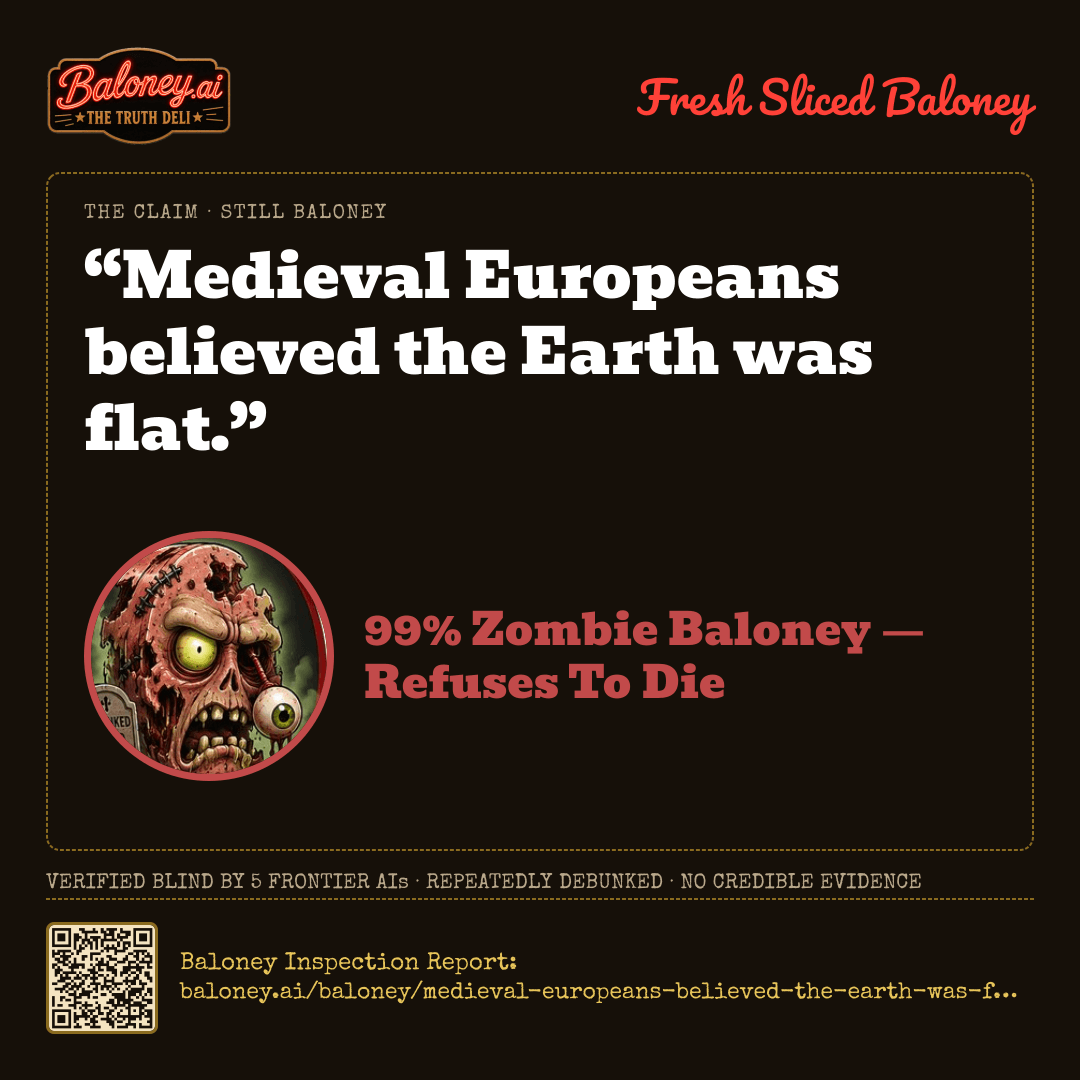
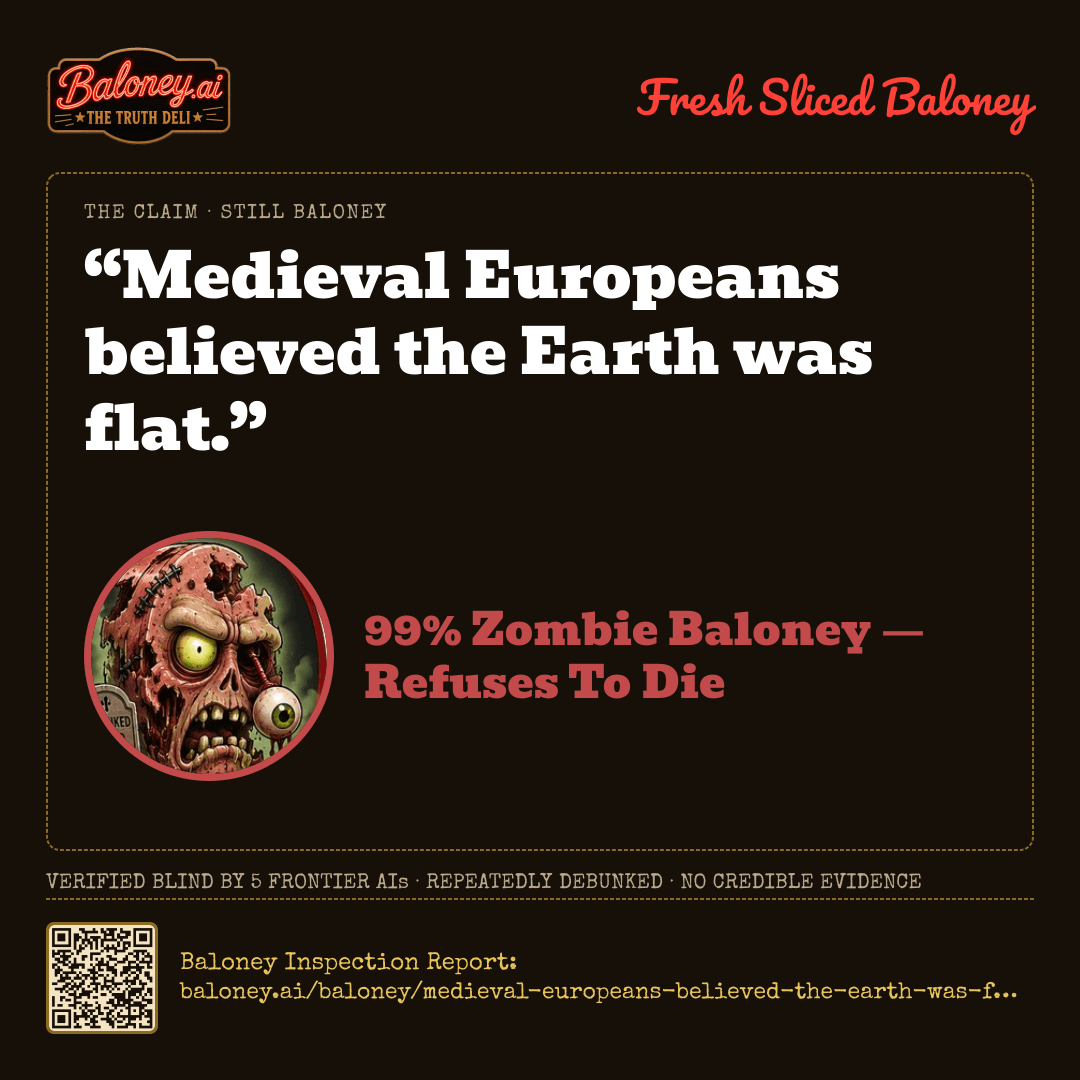
99%“Medieval Europeans believed the Earth was flat.”
99%Zombie Baloney — Refuses To Die
DEAD. BURIED. STILL SHAMBLING AROUND.
Repeatedly debunkedNo credible evidenceRefuses to dieLives on in delusion
✓ BLIND VALIDATION CONFIRMED THIS SCORE
Serve It Fresh
Ready to Serve10 servings
Serve it the way you want it
The Verdict
 “Medieval Europeans believed the Earth was flat.”99% Zombie Baloney — Refuses To DieVerified blind by 5 frontier AIs · Baloney Inspection Report: baloney.ai/baloney/medieval-europeans-believed-the-earth-was-flat
The Baloney Sampler
The reports found that medieval Europeans did not generally believe the Earth was flat. Greek knowledge of a spherical Earth was never lost in the Latin West. Universities taught a globe using Johannes de Sacrobosco's De sphaera mundi. Bede, Thomas Aquinas, Roger Bacon and Dante treated a spherical Earth as ordinary knowledge. Lactantius and Cosmas Indicopleustes were isolated exceptions, not the medieval consensus.
National Geographic, Encyclopaedia Britannica, the University of Delaware and the Australian Broadcasting Corporation describe the idea as a later myth, not medieval belief. The reports found Columbus's opponents disputed Earth's size, not its shape, and that Washington Irving's 1828 biography popularized a false story of flat-Earth clerics. Schematic disc maps were not cosmological models, and the undocumented views of illiterate peasants do not support the generalisation.
Resting on National Geographic · Encyclopaedia Britannica · University of Delaware · Australian Broadcasting Corporation
Other ways to slice it — phrasings that might have changed the rating
- “A few late-antique Christian writers rejected a spherical Earth.” The reports identify Lactantius and Cosmas Indicopleustes as real but isolated exceptions, not a description of medieval Europeans generally.
- “Illiterate medieval European peasants believed the Earth was flat.” The reports state that the beliefs of the non-literate majority are essentially unrecorded, so this names a different population from the documented clerical and university culture.
- “Educated medieval Europeans knew the Earth was spherical.” The reports found sphericity was ordinary learned knowledge, taught from Sacrobosco's university textbook and assumed by Bede, Aquinas and Dante.
Written from the panel’s reports by xAI · grok-4.6. Nothing here changed the score.
The Order Ticket
19:01:31CLAIM RECEIVED — QUEUED FOR INSPECTION✓
19:02:18claude-opus-5 REPORTED — SCORE 95, CONFIDENCE 93✓
19:02:32gpt-5.5 REPORTED — SCORE 92, CONFIDENCE 91✓
19:02:08gemini-3.1-pro-preview REPORTED — SCORE 99, CONFIDENCE 95✓
19:01:38sonar-pro REPORTED — SCORE 78, CONFIDENCE 92✓
19:03:14grok-4.6 REPORTED — SCORE 99, CONFIDENCE 90✓
19:05:05PRIMARY MASTER GROK — SCORE 96✓
19:03:23BLIND VALIDATION GEMINI — SCORE 99✓
19:06:24AGREEMENT CONFIRMED — DELTA 3✓
19:06:24SCORING MODEL V2 — MEDIAN OF 5 COUNTED LAB SCORES: 95, 92, 99, 78, 99 → 95. ZOMBIE RULE: THE PRIMARY MASTER FLAGS A LONG DEBUNK HISTORY, THE BLIND MASTER SCORES 99, THE COUNTED MEDIAN IS 95 — PUBLISHED AS 99.✓
19:06:24SOURCE RULE — LABS CITED 24 SOURCES: 0 DISCARDED FOR HAVING NO URL, 1 DISCARDED AS DEAD LINKS (404/410), 4 COULD NOT BE OPENED BY US AND ARE MARKED UNVERIFIED.✓
19:06:24SOURCE RULE — PRIMARY MASTER RULED ON 20 SOURCES: 0 DISCARDED FOR HAVING NO URL, 0 DISCARDED AS DEAD LINKS, 4 MARKED UNVERIFIED, 16 VERIFIED.✓
How This One Was Sliced
Station 1 · Blind Inspection — Five Graders, Zero Peeking
Each lab scored the claim independently, without seeing the others. Open a breakdown for its evidence, its sources, and how sure it was.
Anthropic · EQUAL WEIGHT · 47.4s
claude-opus-5
95%BALONEY
ROUND-1 BREAKDOWN
Evidence offered for the claim- A handful of identifiable late-antique and early medieval Christian writers did reject or ignore sphericity: Lactantius (c. 300, Divine Institutes) ridiculed the antipodes, and the 6th-century Alexandrian/Byzantine author Cosmas Indicopleustes described the cosmos in his 'Christian Topography' as a flat, rectangular, tabernacle-shaped world. Severian of Gabala expressed similar views.
- Documented cosmological knowledge in the Middle Ages is overwhelmingly the knowledge of a literate clerical minority. What the illiterate peasant majority (over 90% of the population) believed about the Earth's shape is essentially unrecorded, so a claim about 'medieval Europeans' generally cannot be strictly falsified for that group — though there is likewise no evidence they held a systematic flat-earth doctrine rather than no view at all.
- Some medieval imagery — mappae mundi such as T-O maps and the Hereford Mappa Mundi — depicts the world as a disc, which is frequently (though, scholars argue, wrongly) read as evidence of flat-earth belief; these were schematic/devotional representations of the inhabited land surface, not cosmological models.
- 19th- and 20th-century textbooks, encyclopedias and popular histories repeatedly asserted the claim, which is why it remains widely believed today — a fact about the claim's circulation, not its truth.
Evidence against the claim- The sphericity of the Earth was established in Greek science by the 4th century BC (Aristotle, 'On the Heavens') and measured by Eratosthenes, and this knowledge was never lost in the Latin West; Ptolemy's and Aristotle's cosmology was the framework of medieval astronomy.
- Leading medieval authorities explicitly taught a spherical Earth: Bede ('The Reckoning of Time', c. 725) calls the Earth a globe 'like a ball', Isidore of Seville, Hrabanus Maurus, Thomas Aquinas, Albertus Magnus, Roger Bacon and Nicole Oresme all assume sphericity.
- Johannes de Sacrobosco's 'De sphaera mundi' (c. 1230), which begins by proving the Earth is a sphere, was the standard astronomy textbook in every European university from the 13th century to the 17th — i.e., every university-educated medieval European was taught a round Earth.
- Dante's 'Divine Comedy' (c. 1320) is built on a spherical Earth: the pilgrim climbs through the planet's centre and emerges in the southern hemisphere, where he sees different stars and reversed time.
- Royal and imperial regalia from the early Middle Ages onward used the 'globus cruciger' — a sphere surmounted by a cross — as a symbol of dominion over the (spherical) world.
- Columbus's 1492 opponents did not dispute that the Earth was round; they disputed his badly underestimated figure for its circumference, and they were correct. The story of Columbus battling flat-earth clerics was largely invented by Washington Irving in his 1828 fictionalised 'Life and Voyages of Christopher Columbus'.
- Historians of science regard the claim as a documented myth. Jeffrey Burton Russell's 'Inventing the Flat Earth: Columbus and Modern Historians' (1991) traces it to 19th-century anti-clerical polemics by John William Draper and Andrew Dickson White; Stephen Jay Gould and David C. Lindberg ('The Beginnings of Western Science') concur that essentially all educated medieval people knew the Earth was a sphere.
- Even the 'flat earth' exceptions cited (Lactantius, Cosmas) were marginal: Cosmas wrote in Greek, was unknown in the Latin West throughout the Middle Ages, and was writing against the prevailing spherical consensus of his own time.
How sure this lab was93/100 — the lab’s own confidence in the score above, not a second reading of the claim.
SourcesWikipediaother · 72 · Wikipediaother · 72 · Wikipediaother · 70 · Wikipediaother · 68 · Encyclopaedia Britannicaother · 85 · American Scientific Affiliation — Jeffrey Burton Russell, 'The Myth of the Flat Earth'edu · 84 · History.com (A&E)news · 68 · Library of Congress (Washington Irving, Life and Voyages of Christopher Columbus)gov · 88 · Project Gutenberg — Aristotle-derived classical cosmology / Homer's Iliad host (classical text archive)other · 55 · Digital Dante, Columbia University (Inferno XXXIV — passage through Earth's centre)edu · 88
OpenAI · EQUAL WEIGHT · 61.3s
gpt-5.5
92%BALONEY
ROUND-1 BREAKDOWN
Evidence offered for the claim- A few writers in or near the medieval Christian tradition did reject a spherical Earth or the existence of antipodes; Britannica and JSTOR Daily discuss Lactantius and Cosmas Indicopleustes as minority exceptions, so the claim has limited truth for some individuals rather than for medieval Europeans generally.
- Some medieval visual culture used schematic circular world maps, such as T-O or mappaemundi-style representations of the inhabited world; read out of context, these can look like flat-Earth images and help explain why the misconception became plausible later.
- The beliefs of most ordinary, illiterate medieval Europeans are poorly documented, so it is possible that some non-elite people held flat-Earth notions or had no clear cosmological model.
Evidence against the claim- The mainstream learned view in medieval Europe was that Earth is spherical, inherited from Greek and Roman astronomy and taught through medieval scholastic and astronomical texts.
- Thomas Aquinas, writing in the 13th century, casually used the proposition that the Earth is round as an example of a conclusion that could be demonstrated by different sciences, showing that sphericity was treated as ordinary learned knowledge.
- Johannes de Sacrobosco's 13th-century De sphaera, a standard medieval university astronomy text, presented a spherical Earth and spherical heavens, contradicting the idea that medieval European education taught a flat Earth.
- The famous Columbus-era version of the myth is especially false: the dispute was mainly over Earth's size and the distance to Asia, not whether Earth was round.
- Modern summaries by Britannica, JSTOR Daily, and History.com describe the 'medieval flat Earth' idea as a later myth popularized after the Middle Ages, not an accurate description of medieval European belief.
How sure this lab was91/100 — the lab’s own confidence in the score above, not a second reading of the claim.
SourcesEncyclopaedia Britannicaother · 88 · History.comnews · 74 · New Advent / Summa Theologiae textother · 76 · Linda Hall Libraryother · 85
Google · EQUAL WEIGHT · 37.7s
gemini-3.1-pro-preview
99%BALONEY
ROUND-1 BREAKDOWN
Evidence offered for the claim- A few isolated early Christian writers, such as Lactantius and Cosmas Indicopleustes, did argue for a flat Earth based on highly literal interpretations of certain biblical passages.
- The modern belief in this claim largely stems from 19th-century literature, most notably Washington Irving's 1828 fictionalized biography 'A History of the Life and Voyages of Christopher Columbus', which falsely depicted Columbus as valiantly trying to prove the Earth was round to ignorant, flat-Earth-believing clerics.
Evidence against the claim- Historical records show that the vast majority of educated Europeans during the Middle Ages recognized that the Earth was a sphere, a fact preserved from ancient Greek astronomy (such as the works of Ptolemy and Aristotle).
- Prominent medieval scholars and theologians, including the Venerable Bede, Thomas Aquinas, and Roger Bacon, explicitly wrote about the Earth's spherical shape.
- The standard astronomy textbook used in medieval European universities was Johannes de Sacrobosco's 13th-century 'De sphaera mundi' (Treatise on the Sphere), which mathematically detailed a spherical Earth.
- Medieval royal and religious iconography frequently featured the 'globus cruciger' (an orb surmounted by a cross), which symbolized Christ's dominion over a spherical globe.
- Modern historians of science refer to this misconception as the 'Myth of the Flat Earth,' universally agreeing that educated people in the Middle Ages did not believe the Earth was flat.
How sure this lab was95/100 — the lab’s own confidence in the score above, not a second reading of the claim.
SourcesWikipediaother · 85
Perplexity · EQUAL WEIGHT · 7.4s
sonar-pro
78%BALONEY
ROUND-1 BREAKDOWN
Evidence offered for the claim- Some medieval Europeans may have held non-spherical or flat-Earth views, particularly among non-educated populations, and a small number of Christian authorities are identified in historical discussions as arguing for a flat Earth. However, the evidence does not establish that this was the general European belief.
- Medieval art and symbolic imagery sometimes depict the world as a disk, but such imagery is not by itself reliable evidence of a prevailing cosmological belief. The claim also gains limited support from the persistence of the modern historical tradition that portrayed medieval society as flat-Earth believing.
Evidence against the claim- The statement is misleading because it generalizes about medieval Europeans. National Geographic describes the belief that medieval Europeans thought Earth was flat as a persistent myth and states that people knew Earth was spherical well before the Middle Ages.[https://www.nationalgeographic.com/history/article/what-life-in-medieval-europe-was-really-like]
- The University of Delaware explains that, among educated Europeans from at least the ninth century onward, Earth was generally understood to be round.[https://www1.udel.edu/researchmagazine/issue/vol3_no1_humanities/first_person.html]
- Historical scholarship summarized by the Australian Broadcasting Corporation reports tens of thousands of Christian theologians, poets, artists, and scientists who accepted a spherical Earth, compared with only five Christian authorities identified as flat-Earth believers.[https://www.abc.net.au/listen/programs/greatmomentsinscience/the-flat-earth-was-always-a-minority-view/11813566]
- Medieval university astronomy commonly taught a spherical Earth; the influential thirteenth-century textbook On the Sphere of the World described the world as a sphere and was required reading at Western European universities.[https://dlab.epfl.ch/wikispeedia/wpcd/wp/f/Flat_Earth.htm]
- The medieval theologians and scholars Bede, Thomas Aquinas, Roger Bacon, John Buridan, Nicholas Oresme, and others are documented as accepting a spherical Earth, contradicting the idea that flatness was the dominant learned view.[https://www.umsl.edu/~gradyf/medieval/The%20Flat%20Earth.htm]
- The flat-Earth misconception is widely characterized as a later historical myth rather than an accurate description of medieval European intellectual culture.[https://www.nationalgeographic.com/history/article/what-life-in-medieval-europe-was-really-like]
How sure this lab was92/100 — the lab’s own confidence in the score above, not a second reading of the claim.
SourcesNational Geographicnews · 93 · University of Delaware Research Magazineedu · 88 · Australian Broadcasting Corporationnews · 89 · École polytechnique fédérale de Lausanneedu · 78 · University of Missouri–St. Louisedu · 82
xAI · EQUAL WEIGHT · 103.2s
grok-4.6
99%BALONEY
ROUND-1 BREAKDOWN
Evidence offered for the claim- A few late-antique/early Christian writers (Lactantius, Cosmas Indicopleustes) described a flat or tabernacle-shaped Earth; they were not mainstream in Latin medieval Europe.
- 19th-century popularizers (Washington Irving’s Columbus biography and later conflict-thesis writers) asserted medieval flat-Earth belief, creating a modern impression that the claim has historical support.
Evidence against the claim- Medieval cathedral schools and universities taught a spherical Earth drawn from Aristotle, Pliny, Ptolemy and Martianus Capella.
- Johannes de Sacrobosco’s De sphaera mundi (c. 1230), a standard European textbook for centuries, demonstrates that the Earth is a sphere.
- Bede, Thomas Aquinas, Roger Bacon and essentially all surviving medieval natural-philosophical texts treat the Earth as spherical.
- Dante’s Divine Comedy and medieval astronomical diagrams, instruments and commentaries presuppose a globe.
- Historians of science have documented that the ‘medieval flat Earth’ is a 19th-century invention, not a medieval consensus.
How sure this lab was90/100 — the lab’s own confidence in the score above, not a second reading of the claim.
SourcesWikipediaother · 85 · Wikipediaother · 85 · Encyclopædia Britannicaother · 90
Station 2 · The Masters
Primary Master · drawn at random
grok-4.6
96% BALONEY
The five reports converge on the same core facts: Greek sphericity was never lost in the Latin West, university astronomy (especially Sacrobosco’s De sphaera mundi) taught a globe, and major medieval authors from Bede to Aquinas to Dante treated a spherical Earth as ordinary knowledge. The claim as written is a sweeping generalisation that matches the 19th-century ‘myth of the flat Earth’ rather than the documentary record. Isolated late-antique exceptions, schematic mappaemundi, and the silence of the illiterate majority do not convert that myth into a true description of medieval Europeans. Weight is therefore given to the scholarly and textbook evidence over residual possibility, producing a high radioactive/zombie score.
All five evaluators agreed that educated medieval Europeans knew the Earth was spherical, that Sacrobosco, Aquinas, Bede and Dante presuppose a globe, and that the popular story is a later invention. They differed only on numerical score (78–99), mainly over how much weight to assign undocumented peasant views and a handful of non-Latin exceptions.
ZOMBIE FLAG: TRUE — DEBUNK HISTORY ON RECORD
Blind Validation Master · never saw the Primary’s work
gemini-3.1-pro-preview
99% BALONEY
The claim is a widespread and repeatedly debunked historical misconception, commonly known as the 'Myth of the Flat Earth.' Evidence across all reports unanimously indicates that educated medieval Europeans, including prominent theologians, scholars, and university students, knew the Earth was spherical. This knowledge was preserved from ancient Greek astronomy and actively taught using standard medieval textbooks such as Johannes de Sacrobosco's 'De sphaera mundi'. The misconception that medieval society believed in a flat Earth was largely invented and popularized in the 19th century by writers like Washington Irving. Because it is a thoroughly debunked falsehood that continues to circulate widely today, it perfectly fits the criteria for Zombie Baloney.
AGREEMENT TEST PASSED — MASTERS SCORED 96% AND 99% · BLIND VALIDATION CONFIRMED THIS SCORE · NO RE-EVALUATION REQUIRED
How the number was reached · scoring model v2 · how our models work
- Median of 5 counted lab scores: 95, 92, 99, 78, 99 → 95.
- Zombie rule: the Primary Master flags a long debunk history, the Blind Master scores 99, the counted median is 95 — published as 99.
The Evidence
Evidence offered for the claim
- A few late-antique Christian writers rejected sphericity Lactantius ridiculed the antipodes and Cosmas Indicopleustes described a flat, tabernacle-shaped world; they remain the main named exceptions.
- Peasant beliefs are essentially unrecorded The illiterate majority left no cosmological treatises, so a general claim about ‘medieval Europeans’ cannot be strictly disproved for that group.
- Medieval maps show the world as a disk DEBUNKED — T-O maps and mappaemundi such as the Hereford map depict a circular inhabited world and have been read as flat-Earth images, but scholars treat them as schematic pictures of known lands, not planetary models.
Evidence against the claim
- University astronomy taught a sphere Johannes de Sacrobosco’s De sphaera mundi (c. 1230) proves the Earth is a sphere and was the standard required astronomy text in Western European universities for centuries.
- Leading medieval scholars assumed a globe Bede called the Earth a ball, Thomas Aquinas used its roundness as a routine example, and Albertus Magnus, Roger Bacon and Nicole Oresme all treat sphericity as established.
- Literature, art and regalia presuppose a sphere Dante’s Divine Comedy has the pilgrim pass through the Earth’s centre into the southern hemisphere; the globus cruciger symbolised dominion over a spherical world.
- The Columbus story is a later invention Opponents in 1492 disputed the size of the Earth, not its shape; Washington Irving’s 1828 biography and 19th-century conflict-thesis writers created the clerics-versus-Columbus legend.
- Historians of science classify the claim as a myth Jeffrey Burton Russell, Stephen Jay Gould and David C. Lindberg document that essentially all educated medieval people knew the Earth was spherical; Cosmas was unknown in the Latin West.
Sources · Reliability · Why Accepted or Discounted
| Source | Type | Reliability | Ruling |
|---|
| National Geographic | news | 93 | ACCEPTED — Directly characterises the medieval flat-Earth idea as a persistent myth and aligns with the panel’s scholarly sources. |
| University of Delaware Research Magazine | edu | 88 | ACCEPTED — States that educated Europeans understood a round Earth from at least the ninth century, matching textbook evidence. |
| Australian Broadcasting Corporation | news | 89 | ACCEPTED — Summarises the imbalance between thousands of spherical-Earth authorities and a handful of flat-Earth exceptions. |
| École polytechnique fédérale de Lausanne | edu | 78 | ACCEPTED — Confirms De sphaera as required university reading that described a spherical world. |
| University of Missouri–St. Louis | edu | 82 | ACCEPTED — Documents Bede, Aquinas, Bacon and others accepting a spherical Earth. |
| Encyclopaedia Britannicaunverified | other | 88 | ACCEPTED — Standard reference treating the medieval flat-Earth story as a later myth. |
| History.com | news | 74 | ACCEPTED — Correctly notes that the 1492 dispute was about circumference, not shape. |
| New Advent | other | 76 | ACCEPTED — Primary-text witness that Aquinas treated a round Earth as ordinary knowledge. |
| Linda Hall Library | other | 85 | ACCEPTED — Confirms Sacrobosco’s De sphaera as the standard medieval astronomy textbook. |
| Wikipedia | other | 80 | ACCEPTED — Tertiary but consistent with Russell, Britannica and the other reports on the 19th-century origin of the myth. |
| Wikipedia | other | 72 | ACCEPTED — Supports continuity of Greek spherical cosmology into the Middle Ages. |
| Wikipedia | other | 70 | ACCEPTED — Corroborates the textbook’s content and university use. |
| Wikipedia | other | 68 | ACCEPTED — Places Cosmas as a Greek, non-Latin, minority voice against the spherical consensus of his own time. |
| Encyclopaedia Britannicaunverified | other | 85 | ACCEPTED — Aligns with the panel on the rarity of medieval flat-Earth belief. |
| American Scientific Affiliation | edu | 84 | ACCEPTED — Jeffrey Burton Russell’s documented tracing of the myth to 19th-century polemics. |
| Library of Congressunverified | gov | 88 | ACCEPTED — Locates Washington Irving’s fictionalised Columbus biography as a vector of the myth. |
| Project Gutenberg | other | 55 | DISCOUNTED — The linked file is Homer’s Iliad and does not document medieval European cosmology. |
| Digital Dante, Columbia University | edu | 88 | ACCEPTED — Primary literary evidence that Dante’s cosmos is built on a spherical Earth. |
| Wikipedia | other | 85 | ACCEPTED — Consistent with the other Wikipedia and Britannica entries on the myth versus medieval practice. |
| Encyclopædia Britannicaunverified | other | 90 | ACCEPTED — High-reliability reference confirming the claim is not an accurate picture of medieval belief. |
Every link was opened when this claim was inspected. A dead link was discarded before publication; “unverified” means the site refused our automated check and the link is the one the panel cited. A source without a URL was never kept.
Serve It Fresh
Ready to Serve10 servings
Serve it the way you want it
The Verdict
“Medieval Europeans believed the Earth was flat.”99% Zombie Baloney — Refuses To DieVerified blind by 5 frontier AIs · Baloney Inspection Report: baloney.ai/baloney/medieval-europeans-believed-the-earth-was-flat