Baloney Inspection Report: Claim #1177 · Inspected Oct 31, 2026, 8:15 AM PDT · Scoring model v2
 65%
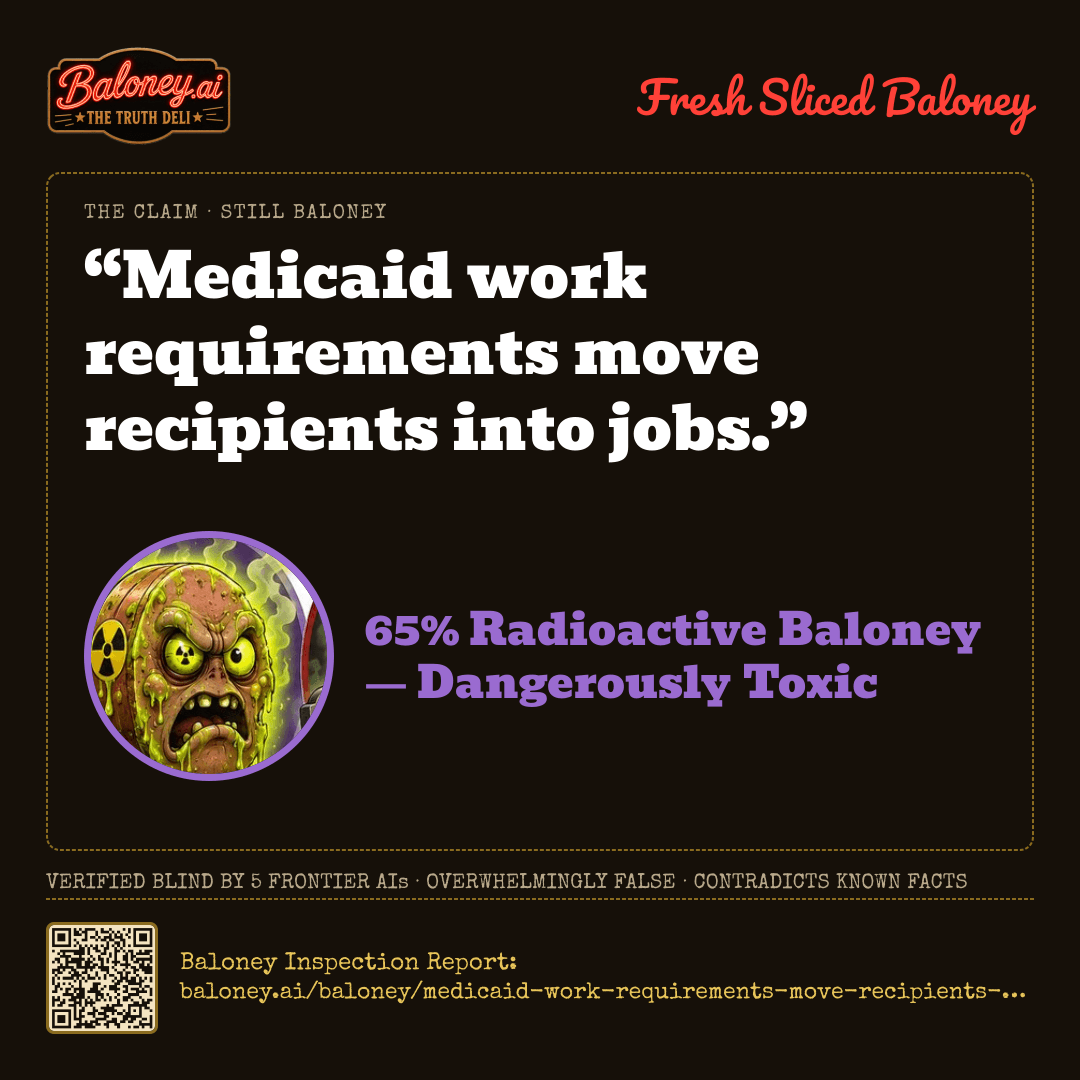
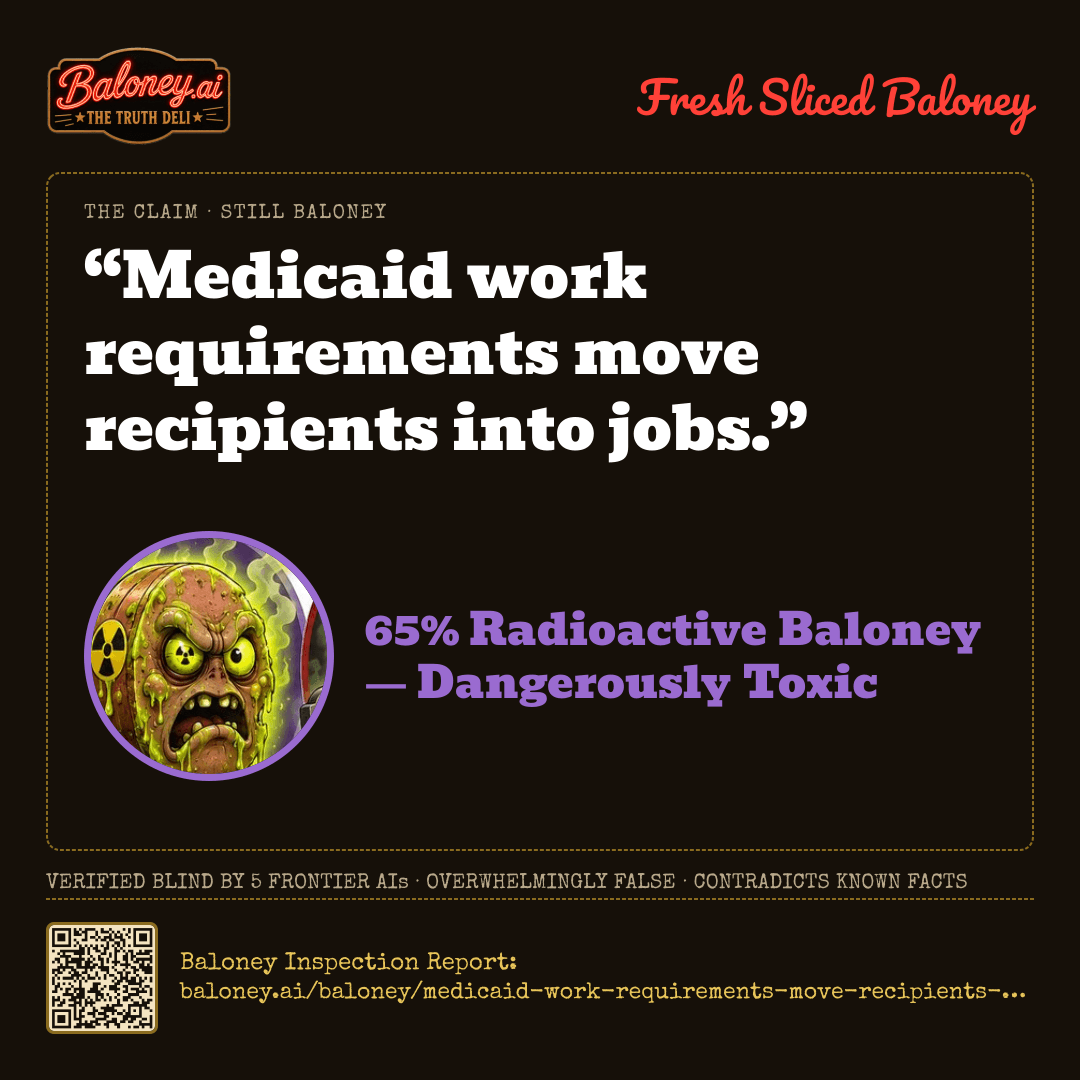
“Medicaid work requirements move recipients into jobs.”
65%Radioactive Baloney — Dangerously Toxic
Dangerously misleading.
Overwhelmingly falseContradicts known factsPromotes false beliefsPotential for harm
Serve It Fresh
Ready to Serve10 servings
Serve it the way you want it
The Verdict
 “Medicaid work requirements move recipients into jobs.”65% Radioactive Baloney — Dangerously ToxicVerified blind by 5 frontier AIs · Baloney Inspection Report: baloney.ai/baloney/medicaid-work-requirements-move-recipients-into-jobs
The Baloney Sampler
Medicaid work requirements have not been shown to move recipients into jobs. Arkansas in 2018, the only large fully implemented Medicaid test, produced no statistically significant employment increase while more than 18,000 people lost coverage, the New England Journal of Medicine and Health Affairs found. The Congressional Budget Office concluded that work requirements for means-tested benefits cut enrollment without raising employment.
Most non-elderly, non-disabled adult Medicaid enrollees already work or report caregiving, illness, or school, KFF analyses find, leaving little room for large job gains. Arkansas coverage losses were driven by reporting failures, not refusal to work. Theory and TANF analogies are the main case for the claim and are contradicted by the Medicaid evidence. The Government Accountability Office found high administrative costs without demonstrated employment gains.
Resting on New England Journal of Medicine · Health Affairs · Congressional Budget Office · KFF
Original Claim Source https://www.sarahforgovernor.com/2026/09/29/governor-sanders-launches-new-tv-ad-work/
Other ways to slice it — phrasings that might have changed the rating
- “Medicaid work requirements reduce coverage without increasing employment.” The Arkansas evaluations and the Congressional Budget Office found coverage and caseload losses with no statistically significant employment gain.
- “Some people subject to Medicaid work requirements document jobs or other qualifying activities.” Reports note that some Arkansas and Georgia enrollees reported work or hours, which is not the same as a net increase in jobs caused by the policy.
- “Work requirements in the 1990s TANF welfare reform increased employment among single mothers.” Proponents in the reports extrapolate from that TANF analogy, which is indirect and not a test of Medicaid work rules.
Written from the panel’s reports by xAI · grok-4.6. Nothing here changed the score.
The Order Ticket
15:15:12CLAIM RECEIVED — QUEUED FOR INSPECTION✓
15:16:20claude-opus-5 REPORTED — SCORE 58, CONFIDENCE 85✓
15:16:06gpt-5.5 REPORTED — SCORE 72, CONFIDENCE 90✓
15:15:40gemini-3.1-pro-preview REPORTED — SCORE 65, CONFIDENCE 95✓
15:15:17sonar-pro REPORTED — SCORE 68, CONFIDENCE 97✓
15:17:26grok-4.6 REPORTED — SCORE 48, CONFIDENCE 82✓
15:19:21PRIMARY MASTER GROK — SCORE 70✓
15:17:28BLIND VALIDATION PERPLEXITY — SCORE 85✓
15:20:49AGREEMENT MODERATE DISAGREEMENT — DELTA 20✓
15:20:49SCORING MODEL V2 — MEDIAN OF 5 COUNTED LAB SCORES: 58, 72, 65, 68, 48 → 65.✓
15:20:49SOURCE RULE — LABS CITED 22 SOURCES: 0 DISCARDED FOR HAVING NO URL, 2 DISCARDED AS DEAD LINKS (404/410), 11 COULD NOT BE OPENED BY US AND ARE MARKED UNVERIFIED.✓
15:20:49SOURCE RULE — PRIMARY MASTER RULED ON 15 SOURCES: 0 DISCARDED FOR HAVING NO URL, 0 DISCARDED AS DEAD LINKS, 7 MARKED UNVERIFIED, 8 VERIFIED.✓
How This One Was Sliced
Station 1 · Blind Inspection — Five Graders, Zero Peeking
Each lab scored the claim independently, without seeing the others. Open a breakdown for its evidence, its sources, and how sure it was.
Anthropic · EQUAL WEIGHT · 67.7s
claude-opus-5
58%BALONEY
ROUND-1 BREAKDOWN
Evidence offered for the claim- Proponents (e.g., the 2018 Council of Economic Advisers report 'Expanding Work Requirements in Non-Cash Welfare Programs') argue that conditioning benefits on work raises labor force participation by changing incentives, citing historical TANF welfare-reform-era employment increases among single mothers in the 1990s.
- Some quasi-experimental work on SNAP's ABAWD work requirements (e.g., Harris, Economic Inquiry 2021, and related state studies) has found small positive employment effects for some subgroups, suggesting work requirements are not uniformly inert.
- Work-requirement programs typically pair the mandate with 'qualifying activities' (job training, volunteering, schooling) and some enrollees do report entering jobs or training; Georgia's 'Pathways to Coverage' did enroll several thousand people who documented 80 hours/month of qualifying activity.
- Mechanically, anyone who gains coverage only by working is, by definition, employed — so officials can point to enrollees meeting the hours threshold as evidence the policy is 'working,' even absent a net change in employment.
- CBO and most analysts agree the policies do change behavior at the margin; disagreement is about magnitude, not whether any individual ever takes a job in response.
Evidence against the claim- The best direct test — Arkansas's 2018 Medicaid work requirement — found no statistically significant increase in employment. Sommers et al. (NEJM 2019) reported that more than 18,000 adults lost coverage in the first year while employment among the target group did not rise; follow-up (Health Affairs 2020) found employment actually fell slightly and the decline was not attributable to the policy's intended mechanism.
- Most adult Medicaid enrollees subject to such rules already work. KFF analyses of Census/MEPS data consistently find roughly 6 in 10 non-elderly, non-disabled adult Medicaid enrollees are employed, and most of the rest report caregiving, illness/disability, or school — leaving little room for large employment gains.
- Coverage losses in Arkansas were driven overwhelmingly by reporting/paperwork failures, not by people refusing to work; most of those who lost coverage were already working or should have been exempt but failed to navigate the online reporting system.
- CBO's assessment of work requirements for means-tested benefits concluded they primarily reduce enrollment and federal spending, with negligible effects on aggregate employment and earnings.
- Georgia's Pathways to Coverage — the only active Medicaid work requirement in recent years — enrolled a small fraction of projected participants (tens of thousands short of the ~100,000 projected) while spending the large majority of program funds on administration and consultants rather than benefits, undercutting claims of a job-placement engine.
- GAO found CMS had not adequately accounted for the administrative costs of work-requirement demonstrations, which ran into the tens or hundreds of millions per state — resources not spent on employment services.
- Rigorous SNAP evidence (Gray et al., NBER/AEJ: Economic Policy) found work requirements sharply cut program participation with no detectable increase in employment, the closest analogue to Medicaid rules.
- Medicaid work requirements have never been shown to produce a measurable net increase in employment in any evaluated state program; losing health coverage can itself impede work for people managing chronic conditions or substance use disorder.
How sure this lab was85/100 — the lab’s own confidence in the score above, not a second reading of the claim.
SourcesNew England Journal of Medicine (Sommers et al., 2019)journal · 96 · Health Affairs (Sommers et al., 2020)journal · 93 · U.S. Government Accountability Officegov · 94 · Congressional Budget Officegov · 92 · National Bureau of Economic Research (Gray, Leive, Prager, Pukelis, Zaki)journal · 88 · KFF (Kaiser Family Foundation)other · 88 · White House Council of Economic Advisers (2018)gov · 60
OpenAI · EQUAL WEIGHT · 53.6s
gpt-5.5
72%BALONEY
ROUND-1 BREAKDOWN
Evidence offered for the claim- The main support is theoretical and indirect: conditioning benefits on work can create an incentive for some nonworking recipients to seek work or increase hours. CBO’s review of means-tested programs found work requirements can increase employment for some groups in the short term, but the evidence is mixed and not specific to Medicaid.
- Arkansas’s Medicaid work-requirement rollout showed that some recipients reported employment or other qualifying activities, but this is weak evidence for the claim because many were already working or should have been exempt, and reporting a job is not the same as being moved into one by the policy.
Evidence against the claim- The best direct evidence comes from Arkansas, the first state to implement Medicaid work requirements. A New England Journal of Medicine study found the policy caused substantial Medicaid coverage losses but no significant increase in employment.
- A later Health Affairs two-year analysis of Arkansas likewise found no significant employment gains from the work requirement, while documenting confusion, reporting barriers, and coverage disruption.
- Most nonelderly adults on Medicaid already work or have common reasons for not working, such as illness, disability, caregiving, school attendance, or inability to find work. That limits the pool of people plausibly movable into jobs by a Medicaid work rule.
- Government oversight reporting has emphasized administrative costs and implementation problems with Medicaid work-requirement demonstrations, not demonstrated employment gains.
- Overall, the claim is phrased as a causal generalization, but the strongest real-world Medicaid evidence shows coverage loss rather than job gains.
How sure this lab was90/100 — the lab’s own confidence in the score above, not a second reading of the claim.
SourcesNew England Journal of Medicinejournal · 95 · Health Affairsjournal · 93 · Congressional Budget Officegov · 95 · KFFother · 88 · Government Accountability Officegov · 94
Google · EQUAL WEIGHT · 27.7s
gemini-3.1-pro-preview
65%BALONEY
ROUND-1 BREAKDOWN
Evidence offered for the claim- Proponents of Medicaid work requirements argue from economic theory that making government benefits conditional on employment reduces welfare dependency and incentivizes able-bodied adults to enter the workforce.
- Advocates often extrapolate from the 1996 welfare reform of the Temporary Assistance for Needy Families (TANF) program, where work requirements were associated with short-term increases in employment among single mothers.
- In 2018, the Trump administration's Centers for Medicare and Medicaid Services (CMS) issued guidance supporting these waivers, asserting that employment and community engagement correlate with improved health outcomes and could transition recipients to employer-sponsored commercial insurance.
Evidence against the claim- Empirical evidence from Arkansas, the only state to fully implement Medicaid work requirements before court interventions, contradicts the claim. A major study published in the New England Journal of Medicine found that the policy led to roughly 18,000 people losing Medicaid coverage but produced no statistically significant increase in employment.
- A 2022 report by the Congressional Budget Office (CBO) analyzing means-tested benefit programs concluded that while work requirements in Medicaid reduce the number of people receiving benefits, they do not increase employment.
- Data shows that the vast majority (over 60%) of non-elderly, non-disabled Medicaid adults are already working. Those who are not employed often face severe barriers, such as illness, caregiving responsibilities, or school attendance.
- Researchers found that coverage losses in Arkansas were primarily driven by administrative hurdles and a lack of awareness of the complex reporting requirements, meaning individuals lost health insurance because they failed to report their status, not because they refused to work.
How sure this lab was95/100 — the lab’s own confidence in the score above, not a second reading of the claim.
SourcesNew England Journal of Medicinejournal · 95 · Congressional Budget Officegov · 95
Perplexity · EQUAL WEIGHT · 4.8s
sonar-pro
68%BALONEY
ROUND-1 BREAKDOWN
Evidence offered for the claim- The policy is intended to increase employment by requiring covered adults to work, participate in community engagement, or qualify for an exemption. However, the strongest available evaluations do not show that it achieved that outcome in Arkansas.[1][4]
- Some Medicaid adults already work or engage in caregiving, education, or activities that can qualify for exemptions, indicating that work requirements may formalize or document existing work rather than create new employment.[3]
Evidence against the claim- A peer-reviewed New England Journal of Medicine study found no significant employment change during the first six months of Arkansas's Medicaid work requirement, while Medicaid coverage fell and uninsurance increased.[1]
- A peer-reviewed two-year evaluation found that Arkansas's work requirements did not increase employment over 18 months.[4]
- The Arkansas policy caused more than 18,000 people to lose coverage, primarily because they failed to report work or document an exemption; this indicates substantial administrative and coverage effects without demonstrated employment gains.[3]
- A later peer-reviewed analysis using American Community Survey data found no significant change in employment or work effort and estimated a 4.4-percentage-point increase in uninsurance associated with the policy.[5]
How sure this lab was97/100 — the lab’s own confidence in the score above, not a second reading of the claim.
SourcesNew England Journal of Medicinejournal · 99 · PubMed / peer-reviewed study recordjournal · 98 · KFFother · 94 · Health Services Research / Wileyjournal · 96
xAI · EQUAL WEIGHT · 134.0s
grok-4.6
48%BALONEY
ROUND-1 BREAKDOWN
Evidence offered for the claim- Supporters argue work requirements similar to those in TANF can raise labor-force participation among able-bodied adults without dependents by changing incentives. Arkansas officials reported that some enrollees began documenting work or job-search hours after the 2018 rules took effect. Economic theory holds that conditioning benefits on work can reduce non-work among those able to work.
Evidence against the claim- The only large-scale, fully implemented Medicaid work requirement (Arkansas 2018) produced no statistically significant rise in employment relative to comparison states, per a New England Journal of Medicine study, while roughly 18,000 people lost coverage, often from paperwork failures rather than refusal to work. KFF analyses show most non-elderly, non-disabled Medicaid adults already work or have qualifying exemptions (caregiving, school, illness); the policy mainly added reporting burdens. Later reviews of Arkansas, planned programs in other states, and Georgia's limited Pathways program likewise found coverage losses without net job gains.
How sure this lab was82/100 — the lab’s own confidence in the score above, not a second reading of the claim.
SourcesNew England Journal of Medicinejournal · 96 · KFFother · 90
Station 2 · The Masters
Primary Master · drawn at random
grok-4.6
70% BALONEY
The claim is a causal generalization. All five reports treat Arkansas 2018 as the only large, fully implemented Medicaid work-requirement test; peer-reviewed evaluations there found coverage losses of roughly 18,000 people and no statistically significant employment gain. CBO’s review of means-tested work rules likewise concluded they cut enrollment without raising employment. Most non-elderly, non-disabled Medicaid adults already work or have standard exemptions, so the eligible pool for ‘moving into jobs’ is small. Theoretical labor-supply arguments, TANF analogies, and a few SNAP subgroup findings supply the only affirmative case; they are indirect, mixed, and contradicted by the Medicaid-specific evidence. Scores from the five evaluators (48–72) therefore sit in the contradicted-to-overwhelmingly-false range; 70 reflects that the statement as written is false, not merely overstated.
All five agreed that the Arkansas NEJM and Health Affairs studies showed no employment increase amid large coverage losses, that most target adults already work or are exempt, and that CBO found no employment effect. They differed mainly on how much residual weight to give economic theory, TANF precedents, and SNAP analogs, producing scores from 48 to 72.
Blind Validation Master · never saw the Primary’s work
sonar-pro
85% BALONEY
The statement is a broad causal claim that Medicaid work requirements move recipients into jobs. Across the reports, the strongest direct evidence—Arkansas, the only large-scale fully implemented Medicaid work-requirement program evaluated—found no statistically significant employment increase, while more than 18,000 people lost coverage, largely because of reporting and administrative barriers. Most potentially affected adults already work or face exemptions and barriers such as illness, caregiving, or school, further limiting the plausible employment effect. Economic theory, evidence from TANF or SNAP, and reports that some individuals documented work or qualifying activities provide only indirect or subgroup-level support and do not establish a net Medicaid employment gain. The claim therefore reverses the weight of the evidence: Medicaid work requirements have demonstrably reduced coverage but have not been shown to move recipients into jobs at the aggregate level.
AI EVALUATORS SHOWED MODERATE DISAGREEMENT — MASTERS SCORED 70% AND 85% · REVIEW THE EVIDENCE CAREFULLY
How the number was reached · scoring model v2 · how our models work
- Median of 5 counted lab scores: 58, 72, 65, 68, 48 → 65.
The Evidence
Evidence offered for the claim
- Incentive theory Conditioning benefits on work can, in principle, induce some able-bodied nonworkers to seek jobs or raise hours.
- TANF 1996 precedent DEBUNKED — Work rules in cash welfare were associated with short-term employment rises among single mothers; advocates extrapolate that result to Medicaid. Refuted: Medicaid is a different program, the eligible population already works at high rates, and the only Medicaid test showed no employment effect.
- Arkansas reporting of work hours DEBUNKED — Officials noted some enrollees began documenting work or job-search after 2018. Refuted: many were already working or should have been exempt; documenting hours is not the same as the policy creating new jobs, and net employment did not rise.
- Georgia Pathways enrollments DEBUNKED — A later, limited program enrolled several thousand people who documented 80 hours of qualifying activity. Refuted: take-up was a small fraction of projections, most spending went to administration, and no net employment gain was shown.
Evidence against the claim
- Arkansas NEJM evaluation Sommers et al. found the 2018 work requirement associated with ~18,000 coverage losses and no significant employment increase in the first six months.
- Two-year Health Affairs follow-up No significant employment or hours gains over 18 months; losses were driven by reporting failures, not refusal to work.
- Most adults already work KFF analyses of Census/MEPS data show roughly 60% of non-elderly, non-disabled Medicaid adults are employed; most of the rest report caregiving, illness, disability, or school.
- CBO on means-tested work rules Work requirements reduce the number of people receiving benefits but do not increase employment or earnings.
- SNAP ABAWD analog Gray et al. found work requirements sharply cut SNAP participation with no detectable employment increase—the closest large-scale parallel.
Sources · Reliability · Why Accepted or Discounted
| Source | Type | Reliability | Ruling |
|---|
| New England Journal of Medicineunverified | journal | 96 | ACCEPTED — Primary peer-reviewed evaluation of the Arkansas demonstration; cited by every evaluator. |
| New England Journal of Medicineunverified | journal | 99 | ACCEPTED — Same Sommers et al. 2019 study; URL variant only. |
| New England Journal of Medicineunverified | journal | 95 | ACCEPTED — Same paper (DOI suffix variant); still the core Arkansas employment result. |
| Health Affairsunverified | journal | 93 | ACCEPTED — Peer-reviewed two-year follow-up confirming no employment gain. |
| Health Affairsunverified | journal | 93 | ACCEPTED — Same 2020 Sommers et al. article; URL variant. |
| Congressional Budget Officeunverified | gov | 95 | ACCEPTED — Nonpartisan review concluding work requirements cut caseloads without raising employment. |
| KFF | other | 88 | ACCEPTED — Standard Census/MEPS tabulations of work status among Medicaid adults. |
| KFF | other | 90 | ACCEPTED — Same underlying work-and-Medicaid data series. |
| KFF | other | 94 | ACCEPTED — Summary of coverage-loss and exemption facts consistent with the journal studies. |
| KFF | other | 88 | ACCEPTED — Additional KFF data brief on the same employment-share facts. |
| Government Accountability Office | gov | 94 | ACCEPTED — Oversight report on administrative costs and lack of demonstrated employment gains. |
| PubMed | journal | 98 | ACCEPTED — Index record for a peer-reviewed two-year Arkansas evaluation. |
| Health Services Researchunverified | journal | 96 | ACCEPTED — Peer-reviewed ACS analysis finding no employment change and a rise in uninsurance. |
| National Bureau of Economic Research | journal | 88 | ACCEPTED — SNAP ABAWD study used as the closest analog; it found participation drops without employment gains. |
| White House Council of Economic Advisers | gov | 60 | DISCOUNTED — Advocacy report from the administration that issued the waivers; not an independent evaluation of Medicaid outcomes. |
Every link was opened when this claim was inspected. A dead link was discarded before publication; “unverified” means the site refused our automated check and the link is the one the panel cited. A source without a URL was never kept.
Serve It Fresh
Ready to Serve10 servings
Serve it the way you want it
The Verdict
“Medicaid work requirements move recipients into jobs.”65% Radioactive Baloney — Dangerously ToxicVerified blind by 5 frontier AIs · Baloney Inspection Report: baloney.ai/baloney/medicaid-work-requirements-move-recipients-into-jobs