Baloney Inspection Report: Claim #1182 · Inspected Oct 31, 2026, 8:33 AM PDT · Scoring model v2
 58%
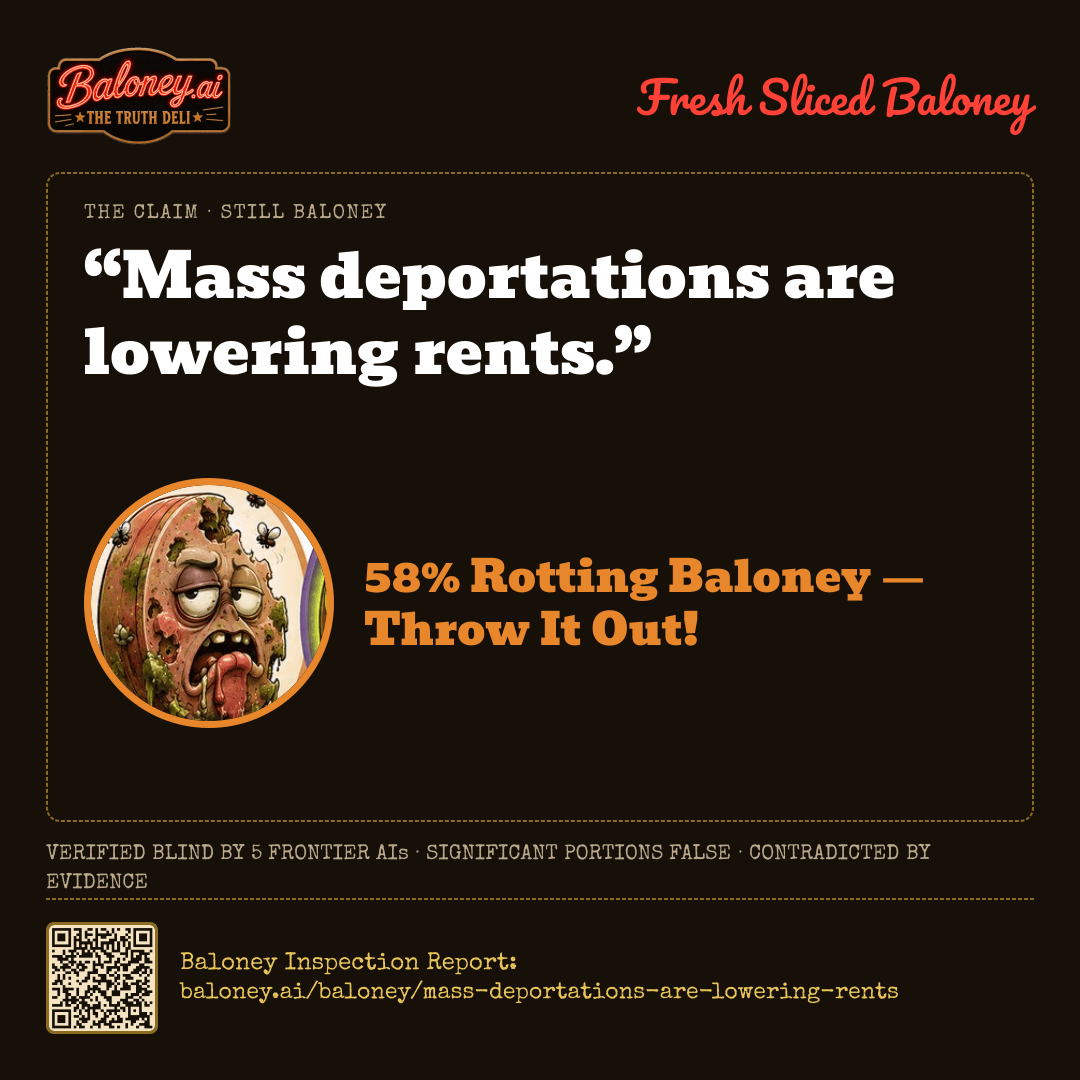
“Mass deportations are lowering rents.”
58%Rotting Baloney — Throw It Out!
Most of this claim has spoiled.
Significant portions falseContradicted by evidenceUnsupported assertionsDeceptive narrative
Serve It Fresh
Ready to Serve19 servings
Serve it the way you want it
The Verdict
 “Mass deportations are lowering rents.”58% Rotting Baloney — Throw It Out!Verified blind by 5 frontier AIs · Baloney Inspection Report: baloney.ai/baloney/mass-deportations-are-lowering-rents
The Baloney Sampler
Standard economic theory and research from the National Bureau of Economic Research suggest that removing renters could theoretically reduce housing demand. However, the claim that deportations are currently causing rents to fall is unsupported. Official data from the U.S. Bureau of Labor Statistics shows that sitting rents are still rising nationally. Where asking rents have cooled, particularly in the Sunbelt, the trend began well before the 2025 enforcement surge.
Housing experts and the Harvard Joint Center for Housing Studies universally attribute recent rent moderation to a 50-year peak in new apartment construction, confirmed by U.S. Census Bureau data. Furthermore, immigrants make up a disproportionate share of the residential construction workforce. Economists warn that mass removals will worsen labor shortages, slowing homebuilding and potentially driving housing costs up over the medium term rather than lowering them.
Resting on National Bureau of Economic Research · U.S. Bureau of Labor Statistics · Harvard Joint Center for Housing Studies · U.S. Census Bureau
Original Claim Source https://www.whitehouse.gov/releases/2026/06/president-trump-drives-down-rents-by-ending-open-borders-disaster/
Other ways to slice it — phrasings that might have changed the rating
- “Large-scale immigration removals exert downward pressure on local rental demand.” The reports note that economic theory and foundational studies support the mechanism that population outflows mechanically reduce rental demand at the margin.
- “Mass deportations will increase housing costs over the long term by reducing construction labor.” Multiple labs point out that unauthorized immigrants form a large share of the construction workforce, meaning removals could slow building and ultimately push rents up.
- “A historic boom in multifamily apartment construction is causing asking rents to soften in Sunbelt markets.” Housing experts universally attribute the recent flat or negative rent growth in certain metros to a 50-year high in housing supply completions, not enforcement.
Written from the panel’s reports by Google · gemini-3.1-pro-preview. Nothing here changed the score.
The Order Ticket
15:33:39CLAIM RECEIVED — QUEUED FOR INSPECTION✓
15:35:10claude-opus-5 REPORTED — SCORE 58, CONFIDENCE 72✓
15:34:20gpt-5.5 REPORTED — SCORE 58, CONFIDENCE 76✓
15:34:25gemini-3.1-pro-preview REPORTED — SCORE 85, CONFIDENCE 90✓
15:33:45sonar-pro REPORTED — SCORE 36, CONFIDENCE 84✓
15:35:40grok-4.6 REPORTED — SCORE 29, CONFIDENCE 68✓
15:36:39PRIMARY MASTER GEMINI — SCORE 58✓
15:35:54BLIND VALIDATION CLAUDE — SCORE 60✓
15:37:06AGREEMENT CONFIRMED — DELTA 2✓
15:37:06SCORING MODEL V2 — MEDIAN OF 5 COUNTED LAB SCORES: 58, 58, 85, 36, 29 → 58.✓
15:37:06SOURCE RULE — LABS CITED 30 SOURCES: 0 DISCARDED FOR HAVING NO URL, 1 DISCARDED AS DEAD LINKS (404/410), 5 COULD NOT BE OPENED BY US AND ARE MARKED UNVERIFIED.✓
15:37:06SOURCE RULE — PRIMARY MASTER RULED ON 20 SOURCES: 0 DISCARDED FOR HAVING NO URL, 0 DISCARDED AS DEAD LINKS, 4 MARKED UNVERIFIED, 16 VERIFIED.✓
How This One Was Sliced
Station 1 · Blind Inspection — Five Graders, Zero Peeking
Each lab scored the claim independently, without seeing the others. Open a breakdown for its evidence, its sources, and how sure it was.
Anthropic · EQUAL WEIGHT · 90.7s
claude-opus-5
58%BALONEY
ROUND-1 BREAKDOWN
Evidence offered for the claim- Economic theory and the best-known empirical study on the topic support the direction of the mechanism: Albert Saiz found that an immigration inflow equal to 1% of a city's population is associated with roughly a 1% increase in average rents and housing values, implying that a large population outflow should, all else equal, push rents down.
- Net migration into the U.S. collapsed in 2025 relative to the 2022-2024 surge, as removals, expedited removals, near-total border shutdown and 'self-deportation' combined; DHS/ICE enforcement data show deportation and removal volumes well above recent-year baselines. Lower household formation at the margin reduces rental demand.
- Asking-rent indices built from new leases (Apartment List, Zillow Observed Rent Index) have shown roughly flat to negative year-over-year national rent growth in 2024-2025, with outright nominal declines in many Sunbelt metros — i.e., there is real rent softening to be explained.
- Immigrant households are disproportionately renters and concentrated in lower-cost rental segments, so demand withdrawal from enforcement should show up first in exactly the Class B/C rental market where some landlords and local brokers have reported rising vacancy in heavily immigrant neighborhoods after high-profile ICE operations (anecdotal/market-report level evidence).
- The Harvard Joint Center and other housing analysts note that renter demand growth is the key swing variable alongside supply; any sustained reduction in immigration-driven household formation mechanically eases rent pressure over time.
Evidence against the claim- The premise is shaky: nationally, rents are still RISING, not falling. The BLS CPI 'rent of primary residence' index — which measures what sitting tenants actually pay, not advertised asking rents — continued to increase roughly 3-4% year-over-year through 2025. 'Lowering rents' is not what the official price statistics show.
- The rent slowdown began in 2022-2023, well BEFORE the 2025 enforcement surge, and tracks the apartment construction cycle. Census data show multifamily completions hit their highest level since the mid-1970s in 2024; nearly every housing economist attributes the Sunbelt rent declines (Austin, Phoenix, Denver, Nashville) primarily to this record supply wave, not to deportations. Timing and geography both fit supply better than enforcement.
- Causal attribution is absent: no peer-reviewed study, Federal Reserve analysis, or government agency has attributed 2024-2025 rent softening to deportations. Deportations and removals, even at elevated levels, are a fraction of one percent of U.S. population per year — small relative to the roughly 2-4% annual swings in asking rents.
- The counteracting supply-side effect is large and well documented: immigrants (including an estimated ~13-15% of construction workers who are unauthorized) make up a large share of the residential construction trades. Enforcement raises labor costs and slows new building, which pushes rents UP over the medium term. Builder groups (NAHB) and multiple economists have warned of exactly this.
- Deportations do not remove housing demand one-for-one: mixed-status families often remain, doubling-up may decrease rather than increase vacancy, and lost rental income can push small landlords to raise rents on remaining units.
- Where rent growth has reaccelerated — the Midwest and Northeast (Chicago, Newark, Cleveland) — immigrant populations are substantial, the opposite of what a deportation-driven rent decline would predict.
- The strongest version of the claim ('mass deportations ARE lowering rents', present tense, causal) is a political talking point that has not been tested against a counterfactual; claims of causation here are currently unverifiable with available data.
How sure this lab was72/100 — the lab’s own confidence in the score above, not a second reading of the claim.
SourcesU.S. Bureau of Labor Statistics — Consumer Price Index news releasegov · 97 · Federal Reserve Bank of St. Louis (FRED) — CPI Rent of Primary Residencegov · 95 · U.S. Census Bureau — New Residential Construction (housing completions)gov · 95 · DHS Office of Homeland Security Statistics — enforcement monthly tablesgov · 92 · U.S. Immigration and Customs Enforcement — FY2024 Annual Reportgov · 85 · IZA Discussion Paper (Albert Saiz) — Immigration and Housing Rents in American Citiesjournal · 85 · Apartment List Research — National Rent Reportother · 78 · Zillow Research — Zillow Observed Rent Index dataother · 76 · Harvard Joint Center for Housing Studies — The State of the Nation's Housing 2025edu · 92 · Pew Research Center — unauthorized immigrant population and workforceother · 90
OpenAI · EQUAL WEIGHT · 40.5s
gpt-5.5
58%BALONEY
ROUND-1 BREAKDOWN
Evidence offered for the claim- In theory, removing a large number of renters from a local market could reduce housing demand and put downward pressure on rents, all else equal. A peer-reviewed study, Saiz 2007, found that immigration inflows into U.S. cities raised rents; mechanically, a large outflow could have the opposite local effect.
- Unauthorized immigrants are numerous enough to be part of housing demand: Pew Research Center estimated about 11 million unauthorized immigrants lived in the U.S. in 2022. If removals were truly massive and geographically concentrated, some local vacancy/rent effects would be plausible.
Evidence against the claim- The claim is causal and present-tense, but I found no credible national evidence that deportations have already caused rent declines. Existing rent changes are more commonly attributed to apartment supply, interest rates, household formation, and local labor-market conditions, not deportations.
- National rent inflation has not clearly 'lowered' in the way the claim implies. The BLS rent-of-primary-residence CPI series, available through FRED, has continued to rise over recent years even as its growth rate has cooled.
- The best direct academic evidence cuts both ways: Saiz 2007 supports the idea that immigration increases rents in receiving cities, but it does not show that deportations are currently lowering rents; it is about immigration inflows, not mass removals, and effects are local and conditional.
- Mass deportations could also raise housing costs by reducing construction labor. BLS data show foreign-born workers are disproportionately represented in construction-related employment, and reduced labor supply can slow building or raise construction costs, counteracting any demand reduction.
- Recent U.S. rent moderation has been linked to a surge of new multifamily supply rather than deportations. Harvard Joint Center for Housing Studies reports emphasize supply additions and affordability pressures as central explanations for rent trends.
- ICE data show removals occur, but the cited federal data do not demonstrate a rent effect. The existence of deportations is not evidence that they are lowering rents.
How sure this lab was76/100 — the lab’s own confidence in the score above, not a second reading of the claim.
SourcesJournal of Urban Economicsjournal · 92 · Federal Reserve Bank of St. Louis / U.S. Bureau of Labor Statisticsgov · 95 · U.S. Bureau of Labor Statisticsgov · 95 · Harvard Joint Center for Housing Studiesedu · 91 · U.S. Immigration and Customs Enforcementgov · 94
Google · EQUAL WEIGHT · 45.8s
gemini-3.1-pro-preview
85%BALONEY
ROUND-1 BREAKDOWN
Evidence offered for the claim- Basic supply-and-demand theory suggests that removing a large portion of the population from the country would reduce the aggregate demand for housing, which could theoretically exert downward pressure on rent prices in the short term.
- Prominent urban economics research (such as Albert Saiz's 2007 study) demonstrates that immigration inflows historically correspond with localized increases in housing rents (approximately a 1% rent increase for every 1% population increase via immigration). Proponents of the claim use this inverse logic to argue that large-scale outflows would correspondingly drop rents.
Evidence against the claim- The claim is phrased in the present tense ('are lowering'), but the United States is not currently conducting 'mass deportations' of a scale that would crash housing demand. Therefore, deportations cannot be the cause of any current rent reductions.
- Where rents are currently cooling or falling in the U.S. (particularly in the Sun Belt), housing economists universally attribute the trend to a 50-year high in multi-family apartment construction completions post-pandemic, which has dramatically increased housing supply.
- Undocumented immigrants comprise a highly disproportionate share of the U.S. construction and homebuilding labor force. Economists warn that mass deportations would severely worsen existing construction labor shortages, stalling the building of new homes and apartments. In the medium-to-long term, this reduction in housing supply would likely increase, rather than lower, housing costs.
How sure this lab was90/100 — the lab’s own confidence in the score above, not a second reading of the claim.
SourcesJournal of Urban Economicsjournal · 90 · U.S. Census Bureaugov · 100 · U.S. Bureau of Labor Statisticsgov · 100 · U.S. Department of Homeland Securitygov · 95
Perplexity · EQUAL WEIGHT · 5.3s
sonar-pro
36%BALONEY
ROUND-1 BREAKDOWN
Evidence offered for the claim- A Federal Reserve-related working paper reported that a 1% increase in unauthorized immigrant workers was associated with approximately a 1.4% increase in rents and a 2.2% increase in house prices; this supports the narrower inference that reduced immigration could reduce housing demand and rents relative to a counterfactual.[1][2]
- Economic commentary cited the same research as estimating that unauthorized immigration accounted for roughly 20% of rent growth and 30% of house-price growth from 2021 to 2024.[1][3]
- Several metros cited by the Department of Homeland Security experienced rent declines, including San Antonio, Austin, Dallas, Houston, Miami, Phoenix, Atlanta, Nashville, and New Orleans.[4]
Evidence against the claim- The cited rent declines began before the mass-deportation campaign: national rental data showed a long-running decline beginning around mid-2024, while the enforcement drive occurred later.[5][6]
- Experts attributed much of the rent moderation to a post-pandemic increase in multifamily construction and added apartment supply, not deportations.[2][5][6]
- The evidence is correlational: areas with more enforcement and falling rents do not establish that deportations caused the declines, especially because local housing construction, migration, and market corrections also changed simultaneously.[4][6]
- Deportations can reduce construction labor and housing production. Reporting cited evidence that enforcement affected construction workforces, while the underlying research suggested unauthorized immigrants may also lower construction costs and expand housing supply.[3]
- The statement says mass deportations are lowering rents generally, but available evidence supports—at most—a possible relative demand effect in some markets, not a demonstrated nationwide causal effect.
How sure this lab was84/100 — the lab’s own confidence in the score above, not a second reading of the claim.
SourcesWashington Examinernews · 72 · Newsweeknews · 70 · Miami Heraldnews · 76 · NBC 7 San Diegonews · 74 · Financial Expressnews · 62
xAI · EQUAL WEIGHT · 120.3s
grok-4.6
29%BALONEY
ROUND-1 BREAKDOWN
Evidence offered for the claim- Standard supply-and-demand reasoning implies that removing residents reduces rental demand and, holding supply fixed, can put downward pressure on rents, especially in neighborhoods with high concentrations of removable noncitizens.
- Peer-reviewed work (e.g., Saiz) has documented that immigrant inflows raise local rents; the reverse population shock from removals would be expected to work in the opposite direction.
- Localized, anecdotal reports from some enforcement-heavy areas have described higher apartment vacancies after recent operations.
Evidence against the claim- U.S. rent growth already slowed or turned negative in 2023–2024 in many metros because of a large wave of new multifamily completions and rising vacancies, well before any new large-scale interior deportation campaign.
- Even several hundred thousand removals constitute a very small share of the roughly 44 million occupied rental units; the mechanical demand effect is too small to move national or most metro rent indexes detectably in the short run.
- Foreign-born workers are a large fraction of construction trades; reduced labor supply can slow housing production and raise rents over a longer horizon, offsetting any demand-side relief.
- Neither BLS shelter CPI, Census vacancy surveys, nor independent market trackers have attributed recent rent changes to deportation volumes; existing-lease rollovers, local inventory, and interest rates remain the dominant measured drivers.
- Many unauthorized immigrants live in overcrowded or informal units, so head-count reductions do not free an equivalent number of market-rate apartments.
How sure this lab was68/100 — the lab’s own confidence in the score above, not a second reading of the claim.
SourcesPew Research Centerother · 90 · Federal Reserve Bank of St. Louis (FRED)gov · 95 · U.S. Bureau of Labor Statisticsgov · 97 · National Bureau of Economic Researchedu · 85 · U.S. Census Bureaugov · 96
Station 2 · The Masters
Primary Master · drawn at random
gemini-3.1-pro-preview
58% BALONEY
The claim misattributes recent moderation in rent prices to immigration enforcement. While economic theory holds that removing renters technically reduces demand, housing experts universally point to a 50-year peak in new multifamily apartment construction as the true driver of current rent softening. Furthermore, the claim ignores the critical role immigrants play in the construction workforce; large-scale removals severely constrain the labor supply needed to build homes, which economists warn increases housing costs in the medium to long term.
Evaluators universally agreed that while theoretical economic models suggest population outflows reduce demand, attributing current U.S. rent moderation to deportations is factually unsupported. They agreed the apartment supply boom is the actual driver of cooling rents, and most highlighted the counter-effect that losing immigrant construction labor restricts housing supply.
Blind Validation Master · never saw the Primary’s work
claude-opus-5
60% BALONEY
The claim is a present-tense causal assertion, and on both halves it fails. First, the premise is shaky: official price statistics (BLS CPI rent of primary residence) show rents still rising roughly 3-4% year-over-year, with only asking-rent indices showing flat-to-negative growth concentrated in Sunbelt metros. Second, and more damning, the causal attribution is unsupported: the rent slowdown began in 2022-2024, well before the 2025 enforcement surge, and essentially every housing economist, the Harvard JCHS, and Census completions data point to a record multifamily construction wave as the driver. Timing and geography fit the supply cycle, not enforcement; rent reacceleration in immigrant-heavy Midwest/Northeast metros cuts directly against the claim. No peer-reviewed study, Fed analysis, or agency has attributed recent rent softening to removals; removals are a fraction of a percent of population annually, far too small to explain multi-point swings in asking rents. There is a genuine kernel of validity that keeps this out of the 'overwhelmingly false' band: Saiz's well-regarded work and a Fed-related working paper establish that immigration inflows raise local rents, so a demand withdrawal should push in the downward direction at the margin, and some enforcement-heavy neighborhoods have anecdotally seen higher vacancy. But the claim as written asserts an observed, operative nationwide causal effect that the data cannot demonstrate, while omitting the significant counteracting supply-side effect — unauthorized workers are a large share of residential construction labor, so enforcement plausibly raises housing costs over the medium term. This is a political talking point draped over a real but unmeasured marginal mechanism: significant portions are contradicted by the evidence on both the premise and the causation, placing it in the Rotting Baloney band.
AGREEMENT TEST PASSED — MASTERS SCORED 58% AND 60% · BLIND VALIDATION CONFIRMED THIS SCORE · NO RE-EVALUATION REQUIRED
How the number was reached · scoring model v2 · how our models work
- Median of 5 counted lab scores: 58, 58, 85, 36, 29 → 58.
The Evidence
Evidence offered for the claim
- Supply and demand theory DEBUNKED — Basic economic theory suggests that removing a large portion of the population reduces aggregate housing demand, theoretically exerting downward pressure on rents. However, the scale of deportations is currently too small to measurably move national rent indexes, and rents began cooling long before recent enforcement drives.
- Historical immigration studies DEBUNKED — A prominent 2007 study showed that a 1% population increase from immigration raised local rents by about 1%, leading to arguments that outflows will correspondingly drop rents. However, this measures localized, conditional effects of inflows and does not demonstrate that present-day deportations are causing national rent drops.
- Rent declines in certain metros DEBUNKED — Cities like Austin and Phoenix have experienced rent drops, which some have correlated with immigration enforcement. However, these specific metros are the epicenter of a historic apartment building boom, and housing economists uniformly attribute their rent drops to this massive new housing supply.
Evidence against the claim
- 50-year peak in apartment construction The United States is experiencing a massive wave of new multifamily apartment completions, hitting a post-pandemic peak. Housing experts uniformly cite this expanded supply as the primary driver of any rent moderation in the market.
- Timing of rent softening Advertised rent growth began cooling in 2022 and 2023, tracking closely with the apartment construction cycle and well before large-scale interior deportation campaigns were initiated.
- Construction labor shortages Foreign-born workers make up a highly disproportionate share of the U.S. construction and homebuilding labor force. Mass deportations remove this crucial labor supply, which stalls the building of new homes and apartments and ultimately increases housing costs.
- National rents are still rising Official data from the Bureau of Labor Statistics Consumer Price Index for rent of primary residence shows that on a national level, what tenants actually pay has continued to rise by 3-4% year-over-year, directly contradicting the premise that rents are broadly lowering.
Sources · Reliability · Why Accepted or Discounted
Every link was opened when this claim was inspected. A dead link was discarded before publication; “unverified” means the site refused our automated check and the link is the one the panel cited. A source without a URL was never kept.
Serve It Fresh
Ready to Serve19 servings
Serve it the way you want it
The Verdict
“Mass deportations are lowering rents.”58% Rotting Baloney — Throw It Out!Verified blind by 5 frontier AIs · Baloney Inspection Report: baloney.ai/baloney/mass-deportations-are-lowering-rents