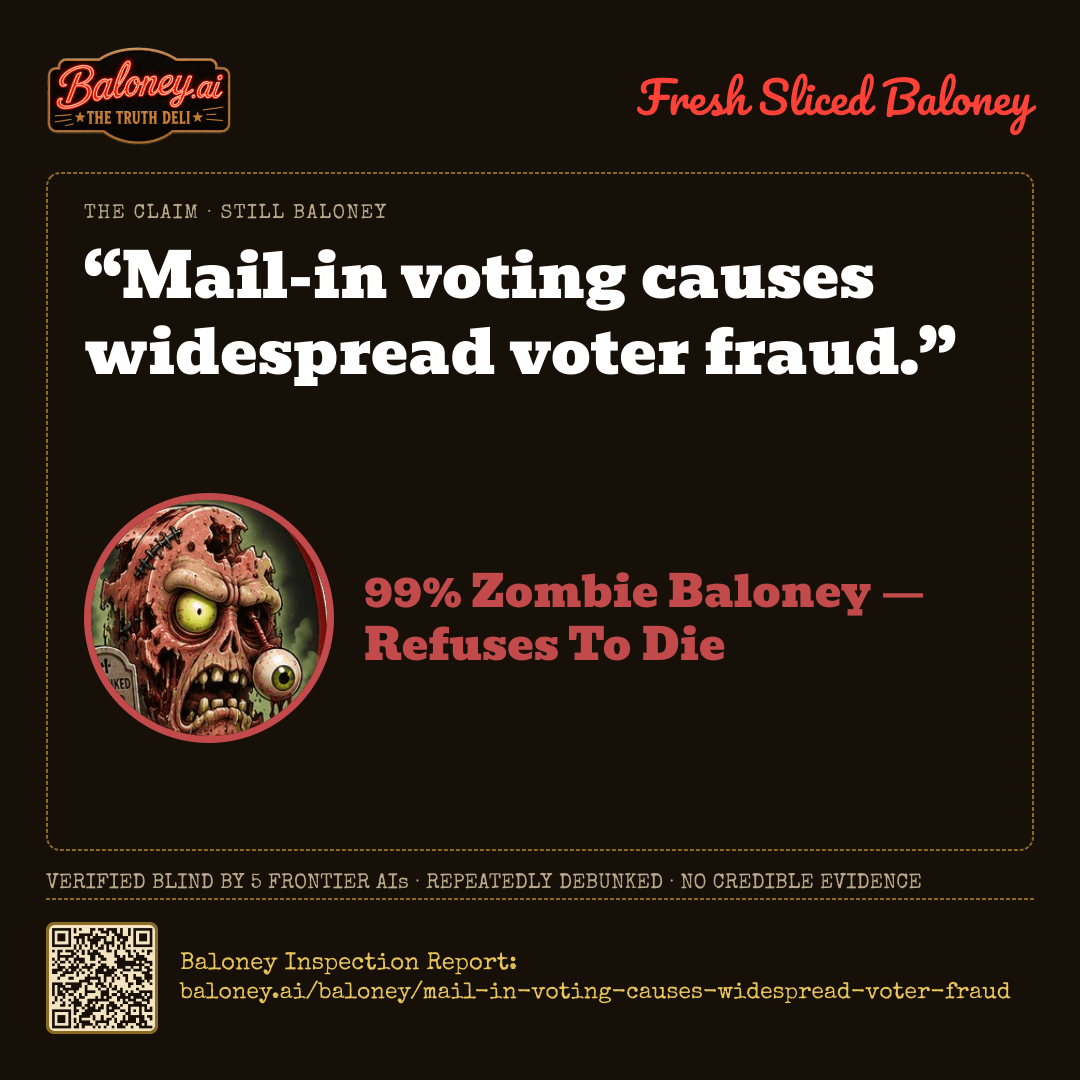
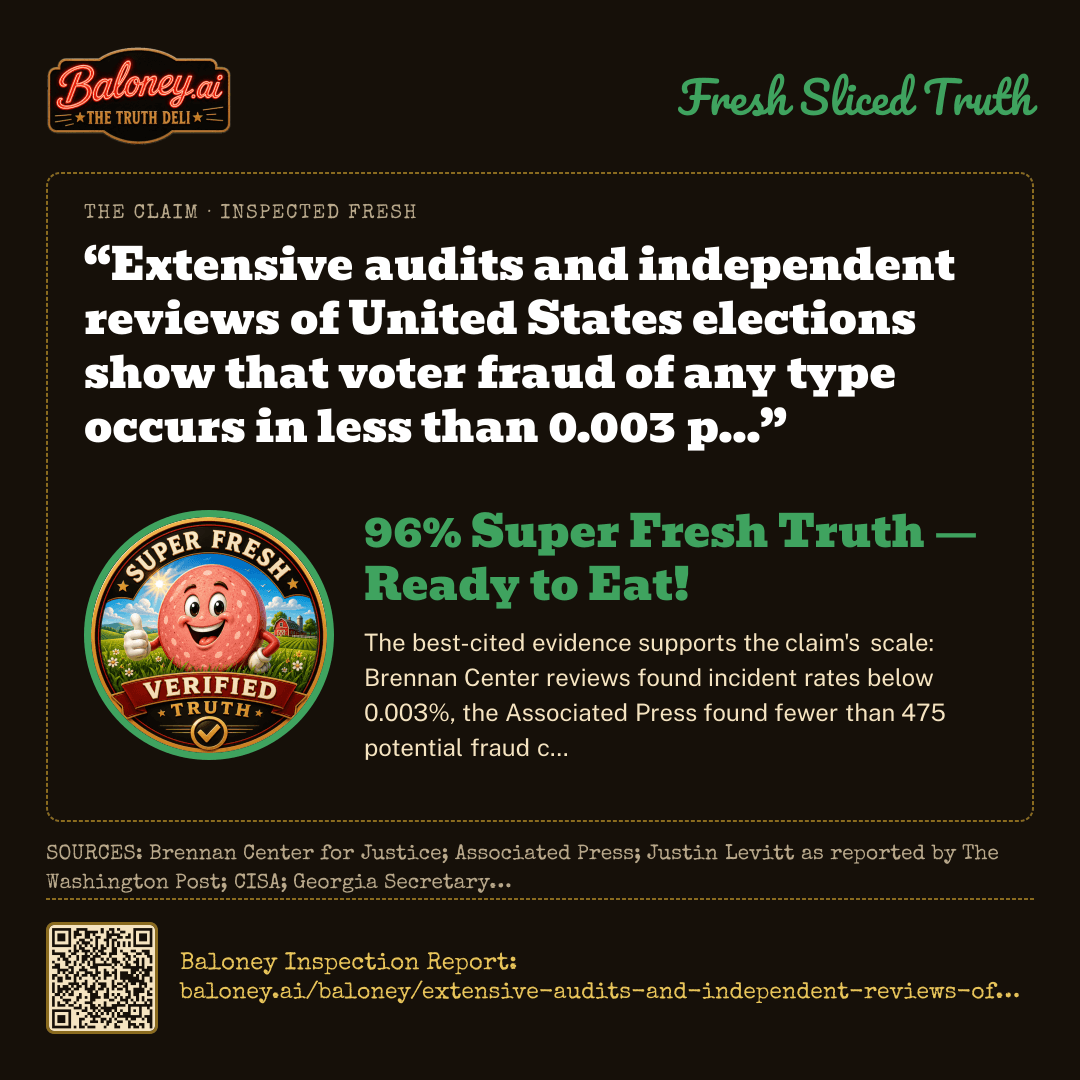
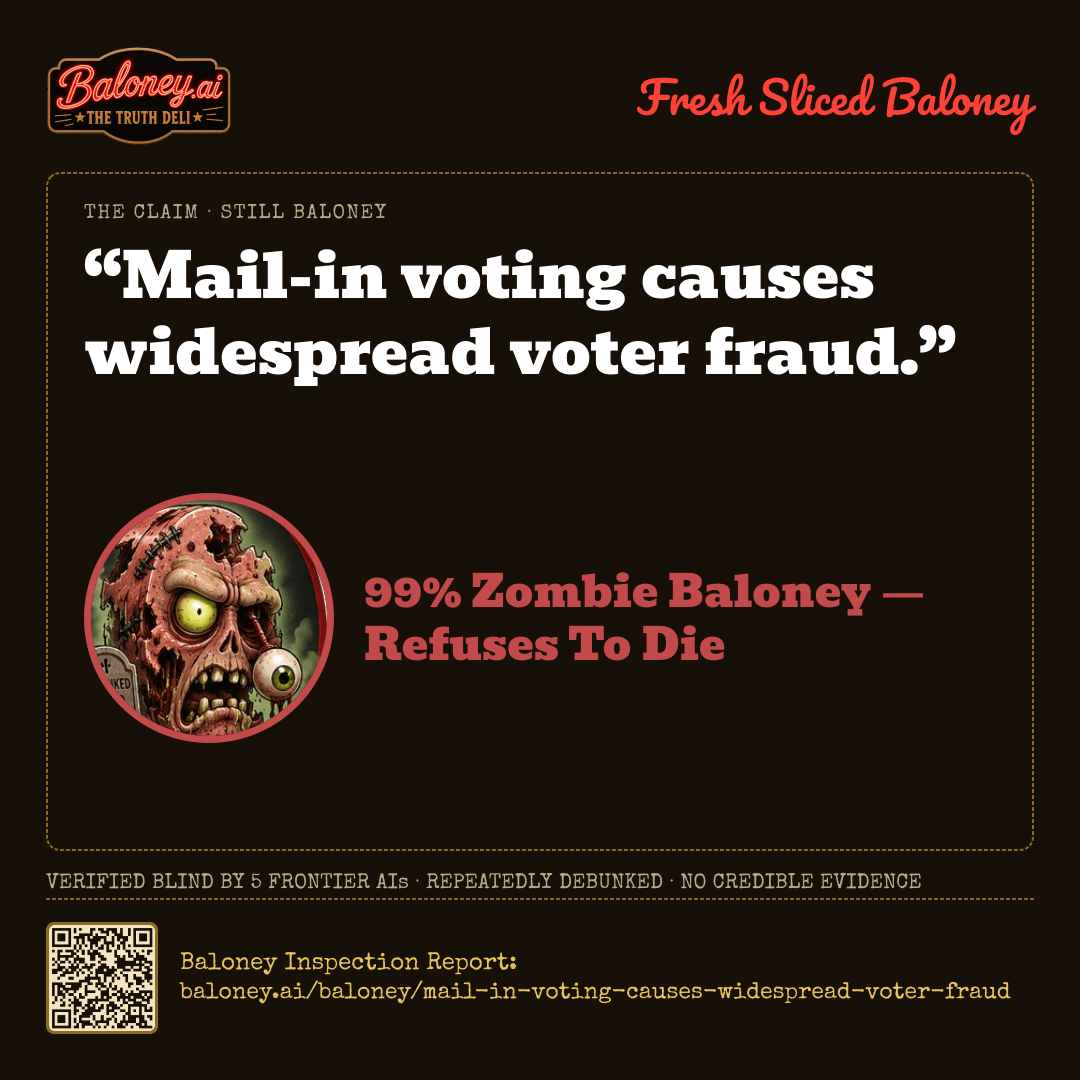
The claim that mail-in voting causes widespread fraud is false. While mail ballots are cast outside controlled polling places and isolated cases of fraud do occur—such as an overturned 2018 congressional race in North Carolina—election data proves these instances are exceptionally rare. Reviews by the MIT Election Data and Science Lab and the Brennan Center for Justice find mail voting fraud rates generally range from 0.00004% to 0.0025%, which is nowhere near enough to systematically affect elections.
Decades of data from states with universal vote-by-mail systems reveal no systemic issues. During the 2020 election, which saw record mail-in voting, the Cybersecurity and Infrastructure Security Agency and the Associated Press found no evidence of widespread, outcome-changing fraud. Instead, multiple safeguards like signature verification and ballot tracking routinely prevent abuse. Even the Heritage Foundation’s database catalogs only roughly 1,500 fraud cases across decades, a microscopic fraction of the billions of mail votes successfully cast.
Other ways to slice it — phrasings that might have changed the rating
“Mail-in voting is vulnerable to isolated incidents of ballot harvesting and voter fraud.” The reports document specific prosecuted cases, such as the 2018 North Carolina congressional race, where unmonitored mail ballots were exploited by political operatives.
“Mail-in voting presents chain-of-custody vulnerabilities that do not exist with in-person voting.” The labs note that because mail ballots leave the controlled environment of a polling place, they inherently rely on post-submission security measures like signature verification rather than real-time ID checks.
“Among documented instances of U.S. election fraud, absentee and mail-in ballots are the most common method used.” Multiple labs cited the 2005 Carter-Baker Commission and election experts who acknowledge that, relative to in-person voting, absentee ballots are historically the vector where most detected fraud occurs.
Written from the panel’s reports by Google · gemini-3.1-pro-preview. Nothing here changed the score.
16:00:09SCORING MODEL V2 — MEDIAN OF 5 COUNTED LAB SCORES: 97, 99, 99, 88, 87 → 97. ZOMBIE RULE: THE PRIMARY MASTER FLAGS A LONG DEBUNK HISTORY, THE BLIND MASTER SCORES 99, THE COUNTED MEDIAN IS 97 — PUBLISHED AS 99.✓
16:00:09SOURCE RULE — LABS CITED 30 SOURCES: 0 DISCARDED FOR HAVING NO URL, 7 DISCARDED AS DEAD LINKS (404/410), 10 COULD NOT BE OPENED BY US AND ARE MARKED UNVERIFIED.✓
16:00:09SOURCE RULE — PRIMARY MASTER RULED ON 20 SOURCES: 0 DISCARDED FOR HAVING NO URL, 0 DISCARDED AS DEAD LINKS, 9 MARKED UNVERIFIED, 11 VERIFIED.✓
How This One Was Sliced
Station 1 · Blind Inspection — Five Graders, Zero Peeking
Each lab scored the claim independently, without seeing the others. Open a breakdown for its evidence, its sources, and how sure it was.
Anthropic · EQUAL WEIGHT · 67.9s
claude-opus-5
97%BALONEY
ROUND-1 BREAKDOWN
Evidence offered for the claim
Absentee/mail ballots are, relative to in-person voting, the method where most documented U.S. election fraud has occurred, because the ballot leaves the controlled environment of a polling place (noted by the 2005 Carter-Baker Commission and echoed in MIT Election Lab summaries).
Real, prosecuted cases exist: the 2018 North Carolina 9th Congressional District absentee-ballot harvesting scheme led the state board to throw out the result and order a new election — the only modern U.S. congressional race overturned for fraud.
In 2020, four officials in Paterson, New Jersey (including a sitting city councilman) were charged with mail-ballot fraud after an all-mail municipal election; the result was invalidated and rerun.
The Heritage Foundation's election fraud database catalogs roughly 1,500 proven cases across several decades, a substantial share of them involving absentee or mail ballots, showing the vector is not purely theoretical.
Voter rolls are demonstrably inaccurate — a 2012 Pew Center on the States study found about 24 million U.S. registrations invalid or significantly inaccurate and roughly 1.8 million deceased people still listed — which creates a theoretical pathway for misdirected mail ballots.
Signature-verification and ballot-rejection processes vary widely by state and are imperfect, meaning detection of forged or improperly cast mail ballots is uneven.
Evidence against the claim
Rates of documented mail-ballot fraud are minuscule. Oregon, which has voted by mail since 2000, has referred roughly a dozen cases out of more than 100 million ballots cast; comparable audits in Washington and Colorado find fraud rates on the order of 0.0001%–0.0025%.
An Associated Press review of every potential fraud case in the six contested 2020 battleground states found fewer than 475 questionable ballots out of more than 25 million cast — nowhere near enough to affect any outcome, and most were individual errors, not schemes.
Attorney General William Barr, a Trump appointee, told the AP in December 2020 that the Justice Department had found no evidence of fraud on a scale that would change the election outcome.
The federal Cybersecurity and Infrastructure Security Agency and the election infrastructure coordinating councils jointly called the November 2020 election 'the most secure in American history,' with 'no evidence that any voting system deleted or lost votes, changed votes, or was in any way compromised.'
More than 60 lawsuits alleging fraud (many centered on mail ballots) were rejected by state and federal courts, including judges appointed by Trump, overwhelmingly for lack of evidence.
Peer-reviewed research (Thompson, Wu, Yoder & Hall, PNAS 2020) found universal vote-by-mail has no partisan turnout or vote-share effect, undercutting the premise that mail voting is a tool for systematic manipulation.
The Heritage database itself — the most-cited source for fraud cases — amounts to roughly 1,500 cases across decades against billions of ballots cast, i.e., a rate far below any reasonable definition of 'widespread.'
Mail-ballot systems include multiple safeguards: unique barcodes, signature matching, ballot-tracking, bipartisan canvass boards, and post-election audits. Large-scale fraud would require forging thousands of verified signatures of real registered voters who did not otherwise vote — detectable by design.
The verb 'causes' is unsupported: states that expanded mail voting (including red states like Utah) did not experience measurable increases in fraud prosecutions.
How sure this lab was
95/100 — the lab’s own confidence in the score above, not a second reading of the claim.
Documented absentee/mail-ballot fraud has occurred in isolated elections. For example, North Carolina officials ordered a new 2018 election in the 9th Congressional District after finding a coordinated unlawful absentee-ballot collection scheme; this shows mail ballots can be abused in particular cases, not that fraud is widespread.
Election experts and fact-checkers generally acknowledge that mail ballots can present different risks than in-person voting, such as improper ballot collection, coercion, or forged signatures, because ballots leave the controlled polling-place environment.
Databases and prosecutions contain individual cases involving absentee ballots, which supports the narrower claim that mail-voting fraud is possible and sometimes happens.
Evidence against the claim
The claim says mail-in voting causes widespread voter fraud. That broader causal and scale claim is not supported by the best available evidence. FactCheck.org, PolitiFact, MIT Election Lab, and election-security agencies describe voter fraud, including mail-ballot fraud, as rare, with safeguards such as signature verification, ballot tracking, identity checks, cure processes, and audits.
The 2020 election involved a historically large amount of mail voting, yet federal and state election-security officials reported no evidence that voting systems were compromised or that fraud changed outcomes on a widespread scale.
The best-known serious mail-ballot fraud cases, such as North Carolina’s 2018 9th District race, are notable precisely because they were detected and led to enforcement or new elections; they are evidence against the idea that such fraud is routine, undetectable, or widespread.
Research on vote-by-mail systems has not found evidence that universal mail voting produces large partisan distortions or systemic fraudulent outcomes; peer-reviewed work has found modest turnout effects and no major partisan advantage from universal vote-by-mail policies.
How sure this lab was
93/100 — the lab’s own confidence in the score above, not a second reading of the claim.
Isolated instances of absentee or mail-in ballot fraud do occur. For example, in the 2018 North Carolina 9th Congressional District election, a political operative illegally collected and tampered with absentee ballots, which ultimately resulted in the results being tossed out and a new election being held.
Unlike in-person voting, mail-in ballots are cast outside the direct supervision of election workers. This lack of a controlled environment removes traditional in-person ID verification, relying instead on signature matching, witness signatures, or notary requirements, which critics argue presents a theoretical vulnerability.
The Heritage Foundation maintains a Voter Fraud Database that has cataloged specific criminal convictions related to the fraudulent use of absentee ballots over the past few decades, demonstrating that the rate of fraud, while extremely small, is not absolute zero.
Evidence against the claim
Decades of electoral data from states that have used universal vote-by-mail for years (such as Oregon, Washington, Colorado, Utah, and Hawaii) show no evidence of widespread or systemic voter fraud.
Comprehensive reviews by nonpartisan organizations, including the Brennan Center for Justice, have calculated the rate of voter fraud in U.S. elections to be infinitesimally small, generally ranging between 0.00004% and 0.0009%.
Following the 2020 U.S. elections, which saw a massive surge in mail-in voting due to the COVID-19 pandemic, a coalition of federal and state election officials (including the Cybersecurity and Infrastructure Security Agency) issued a joint statement declaring the election 'the most secure in American history' with no evidence of deleted, lost, or altered votes.
Mail-in voting systems incorporate multiple layers of security to prevent systemic fraud, including unique barcodes to track ballots, signature verification software, identity affirmation oaths, and severe criminal penalties for voter fraud.
Dozens of post-election audits and court cases following the 2020 election uniformly dismissed allegations of widespread mail-in ballot fraud due to a total lack of credible evidence.
How sure this lab was
99/100 — the lab’s own confidence in the score above, not a second reading of the claim.
Mail-in voting has a somewhat higher risk of certain fraud types than in-person voting, such as ballot interception, coercion, or fraudulent completion, because voting occurs outside a supervised polling place.[https://www.factcheck.org/2025/08/factchecking-trumps-claims-about-mail-in-ballots-voting-machines-and-states-role/]
Isolated cases of ballots being sent in error or fraudulent ballot activity do occur, and election officials use safeguards such as signature verification to detect or prevent impersonation.[https://factcheck.afp.com/mail-ballot-errors-spark-voter-fraud-claims-us]
The existence of these vulnerabilities supports a claim that mail voting is not risk-free, but does not establish widespread fraud.[https://factcheck.afp.com/voting-mail-us-poses-little-risk-fraud]
Evidence against the claim
Fact-checkers report that fraud in mail voting remains rare and that there is no evidence of widespread fraud or fraud sufficient to change the outcome of a national election.[https://www.factcheck.org/2025/08/factchecking-trumps-claims-about-mail-in-ballots-voting-machines-and-states-role/]
A review summarized by BBC found about 325 convictions involving fraudulent use of postal ballots over roughly 20 years, and studies of multiple elections indicate postal-vote fraud is extremely rare.[http://www.bbc.com/news/articles/ckeq3vezxlx1o]
A study of eight states that mail ballots to all eligible voters found no evidence that voting by mail increased the overall risk of voter fraud.[http://www.bbc.com/news/articles/ckeq3vezxlx1o]
FactCheck.org reports that mail ballots, like other voting methods, are largely secure and that studies and analyses find illegal voting to be extremely rare.[https://www.factcheck.org/2022/11/counting-mail-in-ballots-delays-results-but-doesnt-denote-fraud/]
States using large-scale or universal mail voting have experienced negligible rates of documented problems relative to ballots cast, with signature verification and other procedures providing safeguards.[https://factcheck.afp.com/voting-mail-us-poses-little-risk-fraud]
How sure this lab was
94/100 — the lab’s own confidence in the score above, not a second reading of the claim.
Isolated, prosecuted cases of absentee/mail ballot fraud exist, including the 2018 North Carolina 9th Congressional District race (overturned after a consultant illegally collected and altered ballots) and scattered Heritage Foundation database entries involving forged or improperly obtained mail ballots.
Some election-integrity advocates contend mail ballots can have weaker real-time ID checks or chain-of-custody risks than in-person voting, creating theoretical opportunities for harvesting, coercion, or signature issues in poorly administered jurisdictions.
Evidence against the claim
Peer-reviewed research, government audits, and comprehensive reviews (Brennan Center, MIT Election Data + Science Lab, multiple state audits) find voter fraud of any type, including mail-in, occurs at rates of roughly 0.0003%–0.0025% of ballots—orders of magnitude too small to be 'widespread.'
Longstanding all-mail states (Oregon, Washington, Colorado, Utah) show no elevated fraud rates; official canvass and post-election audits treat their results as secure.
The 2020 election (record mail volume) produced no evidence of widespread fraud: CISA/DHS called it the most secure in U.S. history, 60+ lawsuits were dismissed (including by Trump-appointed judges), and Arizona/Georgia hand audits confirmed certified outcomes.
DOJ (including then-AG Barr) and federal/state election officials stated there was no fraud on a scale that could affect results. Fact-checkers have repeatedly rated the 'widespread mail fraud' claim False/Pants-on-Fire.
How sure this lab was
91/100 — the lab’s own confidence in the score above, not a second reading of the claim.
The claim asserts that mail-in voting causes 'widespread' voter fraud. Multiple independent evaluators highlighted that while isolated, prosecuted instances of mail-ballot fraud exist (such as the 2018 North Carolina 9th Congressional District race), there is absolutely no evidence that the practice causes systemic or widespread fraud. Studies spanning decades from states with universal vote-by-mail systems, alongside sweeping federal reviews and state audits, demonstrate that fraud rates are microscopic (generally under 0.003%). The most comprehensive database of voter fraud—maintained by the conservative Heritage Foundation—catalogues approximately 1,500 cases over several decades, a negligible fraction of the billions of votes cast. This is a textbook 'zombie' claim that has been repeatedly and comprehensively debunked by fact-checkers, courts, and election officials, yet continues to be widely circulated.
The evaluators were in complete agreement. They unanimously noted that while the controlled environment of in-person voting is absent for mail-in ballots—making it theoretically susceptible to distinct types of fraud—the implementation of strict safeguards (like signature verification and tracking) successfully prevents widespread fraud. All agreed the claim is overwhelmingly false.
ZOMBIE FLAG: TRUE — DEBUNK HISTORY ON RECORD
Blind Validation Master · never saw the Primary’s work
gpt-5.5
99% BALONEY
The reports consistently show that mail-in voting can be abused in isolated cases, such as the 2018 North Carolina 9th Congressional District scheme and other scattered prosecutions, and that mail ballots have some distinct vulnerabilities because they are cast outside polling places. But the statement as written claims that mail-in voting causes widespread voter fraud, and the evidence presented overwhelmingly contradicts that. Multiple fact-checkers, election-security officials, audits, peer-reviewed studies, and experience from long-running vote-by-mail states find fraud to be extremely rare, not widespread, and not shown to increase systematically because of mail voting. The 2020 election, despite historically high mail voting, produced no credible evidence of widespread fraud or outcome-changing fraud, and numerous lawsuits and audits failed to substantiate such claims. The claim conflates isolated, detectable incidents and theoretical vulnerabilities with systemic fraud. Because this is a repeatedly debunked claim that remains in circulation, it fits Zombie Baloney.
AGREEMENT TEST PASSED — BOTH MASTERS SCORED 99% · BLIND VALIDATION CONFIRMED THIS SCORE · NO RE-EVALUATION REQUIRED
Median of 5 counted lab scores: 97, 99, 99, 88, 87 → 97.
Zombie rule: the Primary Master flags a long debunk history, the Blind Master scores 99, the counted median is 97 — published as 99.
The Evidence
Evidence offered for the claim
Isolated fraud casesDEBUNKED — Actual prosecuted cases of absentee ballot fraud exist, most notably a coordinated ballot-harvesting scheme in the 2018 North Carolina 9th Congressional District that resulted in a new election.
Theoretical vulnerabilitiesDEBUNKED — Mail ballots leave the controlled environment of a polling place, meaning they lack real-time, in-person ID checks and rely instead on signature verification and witness requirements.
Heritage Foundation databaseDEBUNKED — A database maintained by the Heritage Foundation has cataloged roughly 1,500 proven cases of voter fraud across the United States over the past several decades.
Inaccurate voter rollsDEBUNKED — A 2012 Pew Center on the States study found roughly 24 million invalid or significantly inaccurate registrations, which critics argue creates a pathway for misdirected mail ballots.
Evidence against the claim
Minuscule fraud rates State audits, peer-reviewed research, and independent evaluations consistently demonstrate that voter fraud of any kind, including mail-in, occurs at rates between 0.0001% and 0.0025%—orders of magnitude too small to affect national outcomes.
Longstanding mail states States that have conducted elections almost entirely by mail for decades, such as Oregon, Washington, Utah, and Colorado, report no elevated rates of fraud.
Robust safeguards Mail-in voting is secured through layers of checks including unique tracking barcodes, signature verification software, identity affirmation oaths, and rigorous post-election canvassing.
2020 election security Despite a massive surge in mail voting due to the pandemic, a coalition of federal and state officials, including CISA, called the 2020 election the most secure in history, finding no evidence of deleted, lost, or altered votes.
Court and DOJ dismissals Former Attorney General William Barr reported that the DOJ found no evidence of widespread fraud, and over 60 post-election lawsuits alleging systemic fraud were dismissed by courts for lack of evidence.
Sources · Reliability · Why Accepted or Discounted
ACCEPTED — Reliable reporting on election procedures and voting rights.
Every link was opened when this claim was inspected. A dead link was discarded before publication; “unverified” means the site refused our automated check and the link is the one the panel cited. A source without a URL was never kept.
Veritate Libertas — Latin for “Through Truth, Liberty.”
Democracy is what makes America great. But without truth — honest, real, scientifically validated truth — democracy fails. The baloney slicer is on: feeding fresh sliced truth to protect what makes America great. Democracy.