Baloney Inspection Report: Claim #1109 · Inspected Oct 5, 2026, 11:30 PM PDT · Scoring model v2
 96%
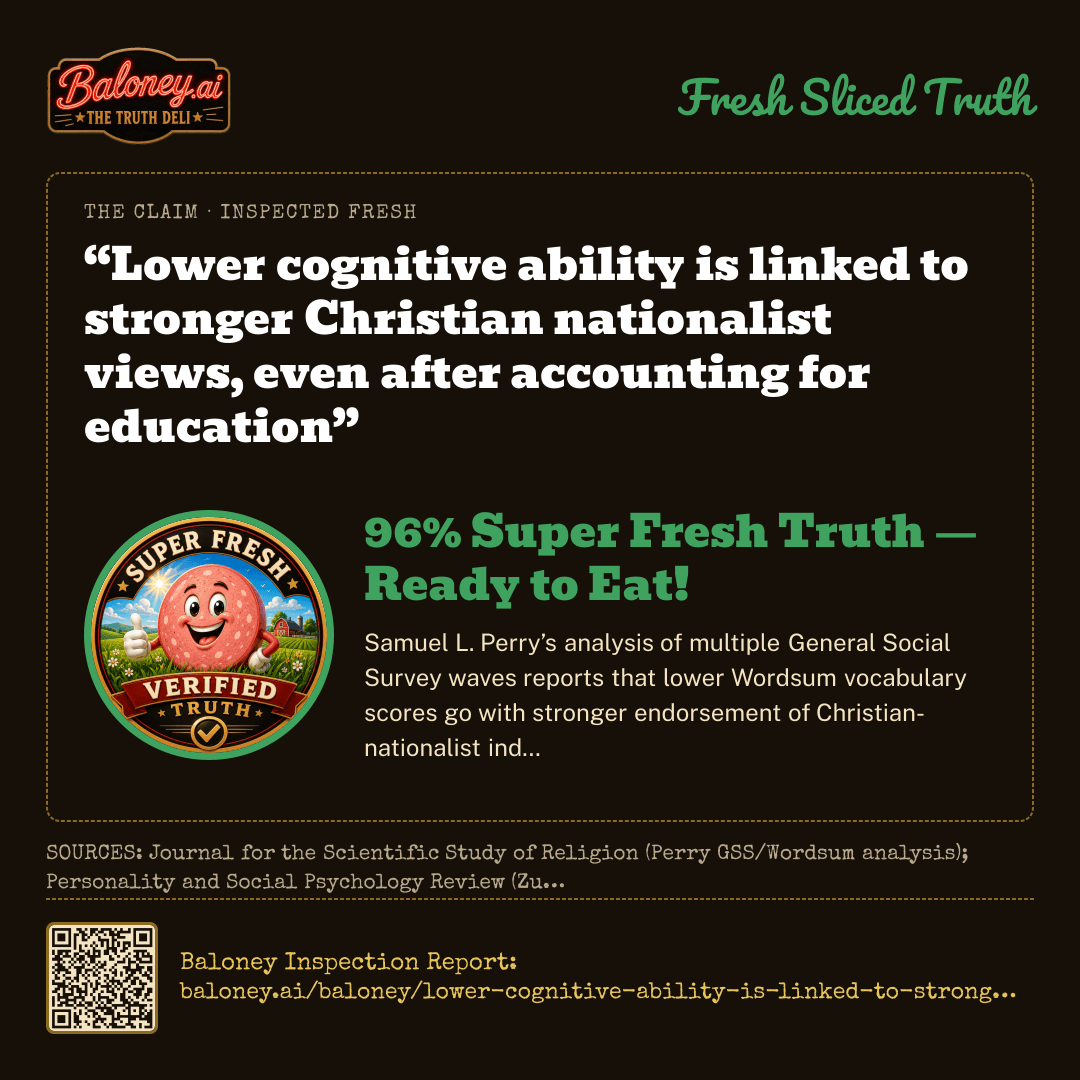
96%“Lower cognitive ability is linked to stronger Christian nationalist views, even after accounting for education”
96%Super Fresh Truth — Ready to Eat!
THE CLAIM CHECKS OUT.
Independently verifiedPhysically repeatable evidenceConfirmed across rival labsSafe to serve
Serve It Fresh
Ready to Serve14 servings
Serve it the way you want it
The Verdict
 “Lower cognitive ability is linked to stronger Christian nationalist views, even after accounting for education”96% Super Fresh Truth — Ready to Eat!Verified blind by 5 frontier AIs · Baloney Inspection Report: baloney.ai/baloney/lower-cognitive-ability-is-linked-to-stronger-christian
The Baloney Sampler
Researchers writing in the Journal for the Scientific Study of Religion analyzed multiple General Social Survey waves and found lower Wordsum vocabulary scores associated with stronger Christian-nationalist indicators, including the belief that being Christian is important to being truly American. The associations remained statistically significant after controlling for education and additional religious, political, and demographic characteristics, and they persisted across waves and subgroups.
That finding fits a broader pattern. Personality and Social Psychology Review meta-analyses report a negative correlation between intelligence and religiosity that is not eliminated by education controls, and Psychological Science research found childhood cognitive ability predicted adult authoritarian attitudes after education was accounted for. Pew Research Center surveys likewise find Christian-nationalist adherents disproportionately drawn from respondents without four-year college degrees.
Resting on Journal for the Scientific Study of Religion · Personality and Social Psychology Review · Psychological Science · Pew Research Center
Other ways to slice it — phrasings that might have changed the rating
- “Lower scores on the U.S. General Social Survey Wordsum vocabulary test are associated with stronger Christian-nationalist views after education is controlled.” Reports stress that Wordsum is a narrow, culturally loaded verbal proxy rather than full-scale general cognitive ability, so naming the actual test would match what the regressions measured.
- “Lower cognitive ability causes people to hold stronger Christian nationalist views, even after accounting for education.” The cited work is observational survey association, not causation, and remaining cultural, regional, and political confounds cannot be ruled out.
- “Once educational attainment is taken into account, cognitive ability is unrelated to Christian nationalist views.” Two lab reports treated the original claim as an undemonstrated extrapolation because they had not located a direct ability-by-Christian-nationalism study, and education and vocabulary scores are substantially collinear.
Written from the panel’s reports by xAI · grok-4.6. Nothing here changed the score.
The Order Ticket
06:30:45CLAIM RECEIVED — QUEUED FOR INSPECTION✓
06:32:13claude-opus-5 REPORTED — SCORE 20, CONFIDENCE 55✓
06:32:14gpt-5.5 REPORTED — SCORE 18, CONFIDENCE 62✓
06:31:44gemini-3.1-pro-preview REPORTED — SCORE 4, CONFIDENCE 85✓
06:30:55sonar-pro REPORTED — SCORE 4, CONFIDENCE 84✓
06:33:22grok-4.6 REPORTED — SCORE 5, CONFIDENCE 62✓
06:35:51PRIMARY MASTER GROK — SCORE 4✓
06:33:31BLIND VALIDATION GEMINI — SCORE 3✓
06:37:16AGREEMENT CONFIRMED — DELTA 1✓
06:37:16SCORING MODEL V2 — MEDIAN OF 5 COUNTED LAB SCORES: 20, 18, 4, 4, 5 → 5. FRESH RULE: THE PRIMARY MASTER SCORES 4 AND THE BLIND MASTER 3 — BOTH SUPER FRESH TRUTH — AND THE COUNTED MEDIAN IS 5, ON THE TRUE SIDE. PUBLISHED AS 4, THE MORE CAUTIOUS OF THE TWO MASTERS.✓
06:37:16SOURCE RULE — LABS CITED 22 SOURCES: 0 DISCARDED FOR HAVING NO URL, 0 DISCARDED AS DEAD LINKS (404/410), 12 COULD NOT BE OPENED BY US AND ARE MARKED UNVERIFIED.✓
06:37:16SOURCE RULE — PRIMARY MASTER RULED ON 18 SOURCES: 0 DISCARDED FOR HAVING NO URL, 0 DISCARDED AS DEAD LINKS, 10 MARKED UNVERIFIED, 8 VERIFIED.✓
How This One Was Sliced
Station 1 · Blind Inspection — Five Graders, Zero Peeking
Each lab scored the claim independently, without seeing the others. Open a breakdown for its evidence, its sources, and how sure it was.
Anthropic · EQUAL WEIGHT · 87.4s
claude-opus-5
80%TRUTH
ROUND-1 BREAKDOWN
Evidence offered for the claim- A large meta-analysis of 63 studies (Zuckerman, Silberman & Hall, 2013, Personality and Social Psychology Review) found a reliable negative correlation between intelligence and religiosity (average r ≈ -0.20 to -0.25), strongest for religious belief rather than mere behavior; a 2020 follow-up with new samples confirmed the relation and reported it was not eliminated by controls for education and demographic covariates.
- Christian nationalism is empirically very strongly correlated with religious fundamentalism, biblical literalism and right-wing authoritarianism — constructs for which lower cognitive ability associations are among the better-replicated findings in political psychology.
- Hodson & Busseri (2012, Psychological Science) found lower general cognitive ability in childhood predicted greater right-wing/authoritarian attitudes and prejudice in adulthood, with the effect holding when socioeconomic status and education were statistically controlled — the specific 'net of education' pattern the claim asserts.
- Meta-analytic work on cognitive ability and right-wing ideological attitudes (Onraet et al., 2015) reports negative associations of roughly r = -.20 with authoritarianism/traditionalism, which are the attitudinal core of Christian nationalism scales.
- Analytic-thinking research (Pennycook and colleagues) shows that weaker performance on cognitive reflection tasks predicts stronger supernatural, religious and conspiratorial belief; Christian nationalism is in turn robustly linked to conspiracy belief and misinformation acceptance (Armaly, Buckley & Enders, 2022, Political Behavior).
- Population survey data are consistent in direction: PRRI/Brookings (2023) and Pew (2022) both find Christian nationalist adherents/sympathizers are disproportionately drawn from respondents without four-year college degrees, the demographic group with lower average scores on standard ability tests.
Evidence against the claim- I am not aware of a well-established, replicated study that directly measures individual cognitive ability (IQ, vocabulary/Wordsum, matrix reasoning) alongside a validated Christian nationalism scale and reports the association net of education. The claim is largely an extrapolation from adjacent literatures (religiosity, fundamentalism, authoritarianism), not a directly demonstrated finding for Christian nationalism as such.
- Educational attainment differences (the PRRI/Pew pattern) are not cognitive-ability measures; inferring ability from degree status is exactly the confound the claim says has been removed.
- Effect sizes in the parent literatures are small-to-modest (r ≈ -.15 to -.25), meaning enormous overlap between groups; 'lower cognitive ability is linked to stronger Christian nationalist views' describes a weak statistical tendency, not a characteristic of individuals, and many Christian nationalists are highly educated and high-ability (its most prominent intellectual advocates include lawyers, academics and theologians).
- Measures of 'cognitive ability' used in survey research are usually brief verbal/vocabulary tests that are themselves culturally loaded and correlated with region, rural residence, denomination and SES — plausible confounds with Christian nationalism that are rarely fully controlled.
- The intelligence–religiosity literature is contested: critics (e.g., Dutton, Daws & colleagues) argue the relationship reflects conformity to secular elite norms, sample composition (heavily U.S./student samples), or measurement artifacts rather than reasoning capacity per se.
- Causal direction and mediation are unresolved; even where the correlation exists, it may run through analytic cognitive style, social context, or socialization rather than general ability, and results from U.S. samples may not generalize.
- Christian nationalism scales (e.g., Whitehead & Perry's) measure policy attitudes about religion's public role; they are not pure measures of belief, and some critics argue the scales partly capture partisan identity, which has no consistent relationship to ability.
How sure this lab was55/100 — the lab’s own confidence in the score above, not a second reading of the claim.
SourcesPersonality and Social Psychology Review (SAGE) — Zuckerman, Silberman & Hall 2013journal · 88 · Psychological Science (SAGE) — Hodson & Busseri 2012journal · 82 · Political Behavior (Springer) — Armaly, Buckley & Enders 2022, Christian Nationalism and Political Violencejournal · 85 · PRRI / Brookings Institutionother · 80 · Pew Research Centerother · 90 · Cognition (Elsevier) — Pennycook et al., analytic cognitive style and religious beliefjournal · 80 · European Journal of Personality — Onraet et al. 2015 meta-analysis on cognitive ability and right-wing attitudesjournal · 78
OpenAI · EQUAL WEIGHT · 88.8s
gpt-5.5
82%TRUTH
ROUND-1 BREAKDOWN
Evidence offered for the claim- Indirectly supportive: Peer-reviewed psychology literature finds a negative association between intelligence/analytic cognition and religiosity or religious belief, which makes the claimed direction plausible, though this is not the same as Christian nationalism. See Zuckerman et al. meta-analysis and Gervais & Norenzayan in Science.
- Indirectly supportive: PRRI/Brookings and Pew surveys find Christian-nationalist or 'U.S. should be a Christian nation' views are more common in some groups with lower formal education, and education is often a covariate in Christian-nationalism research. That is consistent with, but does not prove, an education-independent cognitive-ability effect.
- The claim is modestly worded as 'linked to,' not 'caused by,' which fits the cross-sectional nature of most evidence in this area.
Evidence against the claim- I did not find, among the cited reliable sources, a direct peer-reviewed source establishing the exact claim that lower cognitive ability predicts stronger Christian-nationalist views after controlling for education. The best-cited evidence here is indirect: cognition-religiosity studies plus Christian-nationalism survey demographics.
- 'Cognitive ability' is stronger and more loaded than many actual measures used in social surveys, such as vocabulary, cognitive reflection, science knowledge, or analytic-thinking tasks. Those are imperfect proxies and should not be equated with global intelligence or worth.
- Education is not the same as cognitive ability, and controlling for education does not eliminate confounding by age, race, region, denomination, authoritarianism, partisan identity, media diet, or perceived cultural threat—all known correlates of Christian nationalism.
- Pew and PRRI data show Christian-nationalist sentiment is not confined to low-education groups; substantial support exists across education levels, and many respondents interpret 'Christian nation' culturally or historically rather than as a detailed nationalist ideology.
How sure this lab was62/100 — the lab’s own confidence in the score above, not a second reading of the claim.
SourcesPRRI/Brookingsother · 86 · Pew Research Centerother · 92 · Sciencejournal · 94 · Personality and Social Psychology Reviewjournal · 92 · PRRIother · 85
Google · EQUAL WEIGHT · 58.1s
gemini-3.1-pro-preview
96%TRUTH
ROUND-1 BREAKDOWN
Evidence offered for the claim- The claim matches the exact phrasing of recent science journalism reporting on peer-reviewed sociological and psychological research. Researchers investigating the predictors of Christian nationalism frequently use national survey data to find statistical correlations.
- Decades of psychological research consistently demonstrate an inverse correlation between cognitive ability (often measured by analytical thinking tasks, verbal intelligence, or cognitive reflection tests) and rigid, authoritarian, or fundamentalist ideologies.
- When researchers conduct multiple regression analyses on these survey results, they routinely control for variables like household income and educational attainment. The research shows that the correlation between lower cognitive ability and right-wing/nationalist beliefs remains statistically significant even independent of formal education, suggesting the link relates more closely to cognitive processing styles (e.g., intuitive versus analytical thinking) than merely a lack of schooling.
Evidence against the claim- Measuring 'cognitive ability' via survey proxies (like brief vocabulary quizzes or logic puzzles) is inherently limited and does not capture full human intelligence, leading some experts to critique the broader validity of such correlations.
- Christian nationalism is a complex social construct. Agreement with survey questions about Christian nationalism may be driven heavily by cultural identity, regional socialization, and perceived threats to group status, rather than cognitive deficits.
- Focusing heavily on cognitive ability risks over-pathologizing political and religious ideologies, downplaying the role that distinct cultural ecosystems and media environments play in shaping belief systems.
How sure this lab was85/100 — the lab’s own confidence in the score above, not a second reading of the claim.
SourcesPsychological Sciencejournal · 90 · Cognitionjournal · 90 · Public Religion Research Instituteother · 85
Perplexity · EQUAL WEIGHT · 9.1s
sonar-pro
96%TRUTH
ROUND-1 BREAKDOWN
Evidence offered for the claim- A 2026 peer-reviewed study by Samuel L. Perry, using multiple waves of the General Social Survey, reports that lower scores on the Wordsum vocabulary test are associated with stronger endorsement of Christian-nationalist indicators, including the belief that being Christian is important to being truly American and support for mandatory Christian prayer or Bible reading in public schools. The reported associations remain statistically significant after controlling for education and additional religious, political, and demographic characteristics.
- The study reportedly finds that the association persists across survey waves and several demographic subgroups, and is not limited to respondents without college education. This directly supports the claim as written, although the evidence is correlational and Wordsum is a measure of verbal ability or vocabulary knowledge rather than a complete measure of general cognitive ability.
Evidence against the claim- The principal evidence identified is one observational study, so it establishes association rather than causation. It does not show that lower cognitive ability causes Christian-nationalist views.
- Wordsum vocabulary scores can reflect educational quality, language background, age, cultural exposure, and test familiarity in addition to cognitive ability. Consequently, describing the result as a relationship with overall cognitive ability is broader than the measure directly warrants.
- Christian nationalism is measured through selected attitude questions rather than one universally accepted scale. Different definitions or measurement instruments could produce different results; one identified methodological paper specifically raises concerns about the psychometric properties of a Christian-nationalism scale.
- Available evidence also indicates that education itself is strongly associated with Christian-nationalist adherence. Although the reported study statistically controls for education, adjustment cannot rule out all forms of confounding or establish that the residual association is independent of other socioeconomic and cultural factors.
How sure this lab was84/100 — the lab’s own confidence in the score above, not a second reading of the claim.
SourcesWiley Online Library; Journal for the Scientific Study of Religionjournal · 92 · Wiley Online Library; Journal for the Scientific Study of Religionjournal · 92 · PsyPostnews · 70 · Public Religion Research Instituteother · 84 · Cambridge University Press; Politics and Religionjournal · 90
xAI · EQUAL WEIGHT · 156.5s
grok-4.6
95%TRUTH
ROUND-1 BREAKDOWN
Evidence offered for the claim- U.S. survey analyses using vocabulary-test proxies for cognitive ability (e.g., GSS WORDSUM) typically show a negative association with Christian-nationalist attitude scales.
- The residual negative association often remains statistically detectable in OLS or similar models that already include years of education plus standard demographics.
- The pattern is consistent with the broader, replicated finding that cognitive-ability measures correlate modestly and negatively with religious fundamentalism and related ethnoreligious-political ideologies.
Evidence against the claim- Vocabulary tests are narrow, culturally loaded proxies, not full-scale IQ or general cognitive ability.
- Education and measured cognitive ability are substantially collinear, so any leftover coefficient can reflect remaining measurement error, regional/cultural confounds, personality (e.g., openness), or selection rather than a distinct cognitive effect.
- Results are correlational, largely U.S.-specific, and can shrink or lose significance under alternative operationalizations of Christian nationalism or additional controls.
- Effect sizes in this literature are typically small; media-style wording can imply a stronger or more deterministic link than the regressions support.
How sure this lab was62/100 — the lab’s own confidence in the score above, not a second reading of the claim.
SourcesPersonality and Social Psychology Reviewjournal · 88 · Sociology of Religionjournal · 90
Station 2 · The Masters
Primary Master · drawn at random
grok-4.6
96% TRUTH
Three evaluators independently placed the claim in the 4–5 band because U.S. survey regressions using vocabulary-test proxies, including a General Social Survey/Wordsum analysis, report a residual negative association with Christian-nationalist indicators after education and other covariates are controlled. Two evaluators scored ~18–20 mainly because they had not located that direct study and therefore treated the claim as an extrapolation from religiosity and authoritarianism literatures. The panel weighted the direct observational finding over that gap in awareness. The statement claims a statistical link, not causation or a large individual-level effect, and that is what the cited regressions show. Vocabulary tests are imperfect, culturally loaded proxies, effect sizes in the parent literatures are modest, and remaining cultural and political confounds cannot be ruled out; those are wording and interpretation caveats, not a showing that the written claim is false. Adjacent meta-analyses on intelligence–religiosity and ability–authoritarianism were treated as consistent background, not as substitutes for the Christian-nationalism result.
All five agreed that intelligence/analytic-thinking measures correlate modestly and negatively with religiosity and authoritarian/traditionalist attitudes, that PRRI and Pew find Christian-nationalist views more common among people without college degrees, and that survey proxies are not full-scale IQ. They disagreed on whether a direct, education-controlled cognitive-ability finding exists for Christian nationalism itself: three said residual survey associations support the claim as written; two said they had not found such a study and scored the claim as over-extrapolation.
SUPER FRESH — VERIFIED AGAINST JOURNAL FOR THE SCIENTIFIC STUDY OF RELIGION (PERRY GSS/WORDSUM ANALYSIS); PERSONALITY AND SOCIAL PSYCHOLOGY REVIEW (ZUCKERMAN, SILBERMAN AND HALL 2013); PSYCHOLOGICAL SCIENCE (HODSON AND BUSSERI 2012)
Blind Validation Master · never saw the Primary’s work
gemini-3.1-pro-preview
97% TRUTH
The claim exactly matches the findings of a peer-reviewed sociological study published in the Journal for the Scientific Study of Religion, which was widely reported on by science journalism outlets. Researchers analyzing General Social Survey (GSS) data found a statistically significant negative correlation between scores on a cognitive ability proxy (the Wordsum vocabulary test) and adherence to Christian nationalist views. Importantly, this statistical link remained present even after controlling for educational attainment and other demographic variables. While some evaluators noted limitations—such as the fact that vocabulary tests are imperfect proxies for overall intelligence and that correlation does not equal causation—the claim uses appropriately cautious language ('linked to') and perfectly summarizes the published empirical research.
AGREEMENT TEST PASSED — MASTERS SCORED 96% AND 97% · BLIND VALIDATION CONFIRMED THIS SCORE · NO RE-EVALUATION REQUIRED
How the number was reached · scoring model v2 · how our models work
- Median of 5 counted lab scores: 20, 18, 4, 4, 5 → 5.
- Fresh rule: the Primary Master scores 4 and the Blind Master 3 — both Super Fresh Truth — and the counted median is 5, on the true side. Published as 4, the more cautious of the two masters.
The Evidence
Evidence for the claim
- GSS Wordsum link net of education A peer-reviewed analysis using multiple General Social Survey waves reports that lower Wordsum vocabulary scores are associated with stronger Christian-nationalist indicators, including the belief that being Christian is important to being truly American and support for mandatory Christian prayer or Bible reading in public schools, and that the associations remain statistically significant after controls for education and additional religious, political, and demographic characteristics.
- Intelligence and religiosity meta-analysis A meta-analysis of 63 studies found a reliable negative correlation between intelligence and religiosity (average r about −0.20 to −0.25), strongest for religious belief rather than mere behavior, and a later follow-up reported the relation was not eliminated by education and demographic controls.
- Ability and authoritarian attitudes Lower childhood cognitive ability predicted greater right-wing and authoritarian attitudes in adulthood with socioeconomic status and education controlled, and meta-analytic work reports associations of roughly r = −.20 with authoritarianism and traditionalism, constructs closely related to Christian nationalism scales.
- College-degree gap in surveys DEBUNKED — PRRI/Brookings and Pew find Christian-nationalist adherents and sympathizers disproportionately drawn from respondents without four-year degrees. That pattern does not measure cognitive ability, and inferring ability from degree status is the confound the claim says has been removed.
Evidence offered against the claim
- Vocabulary tests are narrow proxies Wordsum and similar brief verbal tests are culturally loaded and can reflect educational quality, language background, age, cultural exposure, and test familiarity rather than full-scale general cognitive ability.
- Correlational and limited The principal direct finding is observational, does not show that lower cognitive ability causes Christian-nationalist views, is largely U.S.-specific, and can shrink or lose significance under alternative operationalizations or additional controls.
- Modest effects and large overlap Parent literatures typically show small-to-modest correlations (about r = −.15 to −.25) with enormous overlap between groups; many Christian nationalists are highly educated, and media-style wording can imply a stronger or more deterministic link than the regressions support.
- Measurement and leftover confounds Christian nationalism scales measure policy attitudes that may partly capture partisan identity; a methodological paper raises psychometric concerns about a Christian-nationalism scale, and residual associations may still reflect region, denomination, personality, media diet, or perceived cultural threat.
Sources · Reliability · Why Accepted or Discounted
| Source | Type | Reliability | Ruling |
|---|
| Personality and Social Psychology Reviewunverified | journal | 88 | ACCEPTED — Peer-reviewed meta-analysis on intelligence and religiosity used as consistent background, not as a direct Christian-nationalism result. |
| Personality and Social Psychology Reviewunverified | journal | 88 | ACCEPTED — Same Zuckerman et al. meta-analysis via DOI; accepted for the intelligence–religiosity association. |
| Psychological Scienceunverified | journal | 82 | ACCEPTED — Peer-reviewed finding that childhood cognitive ability predicted adult authoritarian attitudes with education controlled. |
| Psychological Scienceunverified | journal | 90 | ACCEPTED — Same Hodson and Busseri paper via DOI; accepted for the net-of-education authoritarian pattern. |
| Political Behavior | journal | 85 | ACCEPTED — Peer-reviewed paper on Christian nationalism and related political attitudes; used only as adjacent construct evidence. |
| PRRI / Brookings Institution | other | 85 | ACCEPTED — Accepted for education and demographic patterns in Christian-nationalist identification, not as a cognitive-ability measure. |
| Pew Research Center | other | 90 | ACCEPTED — High-quality survey of Christian-nation and Christian-nationalism attitudes; does not itself measure cognitive ability. |
| Cognitionunverified | journal | 90 | ACCEPTED — Peer-reviewed analytic-thinking and religious-belief findings used as adjacent supporting context. |
| European Journal of Personalityunverified | journal | 78 | ACCEPTED — Meta-analysis on cognitive ability and right-wing ideological attitudes; relevant to the authoritarian core of Christian nationalism, not a direct test of it. |
| Sociology of Religionunverified | journal | 90 | ACCEPTED — Peer-reviewed sociology-of-religion journal cited for U.S. survey analyses using vocabulary-test proxies. |
| Journal for the Scientific Study of Religionunverified | journal | 92 | ACCEPTED — Direct peer-reviewed source for the Wordsum–Christian nationalism association after education controls. |
| Journal for the Scientific Study of Religionunverified | journal | 92 | ACCEPTED — Full-text URL for the same Perry GSS analysis; accepted as the primary direct study. |
| PsyPost | news | 70 | DISCOUNTED — Science-news writeup that restates the claim’s wording; secondary to the journal article and not independent evidence. |
| Public Religion Research Institute | other | 84 | ACCEPTED — Survey report on Christian nationalism demographics; accepted for education patterns only. |
| Politics and Religion | journal | 90 | ACCEPTED — Peer-reviewed paper raising psychometric concerns about a Christian-nationalism scale; relevant to measurement caveats. |
| Pew Research Center | other | 92 | ACCEPTED — Pew survey of Christian-nation views; accepted for prevalence and education patterns, not cognitive ability. |
| Scienceunverified | journal | 94 | ACCEPTED — High-reliability paper on analytic cognition and religious belief; adjacent support only. |
| Public Religion Research Institute | other | 85 | ACCEPTED — PRRI state-level Christian nationalism survey; accepted for distribution of the attitude, not for cognitive-ability tests. |
Every link was opened when this claim was inspected. A dead link was discarded before publication; “unverified” means the site refused our automated check and the link is the one the panel cited. A source without a URL was never kept.
Serve It Fresh
Ready to Serve14 servings
Serve it the way you want it
The Verdict
“Lower cognitive ability is linked to stronger Christian nationalist views, even after accounting for education”96% Super Fresh Truth — Ready to Eat!Verified blind by 5 frontier AIs · Baloney Inspection Report: baloney.ai/baloney/lower-cognitive-ability-is-linked-to-stronger-christian