Baloney Inspection Report: Claim #1137 · Inspected Oct 7, 2026, 1:23 PM PDT · Scoring model v2
 18%
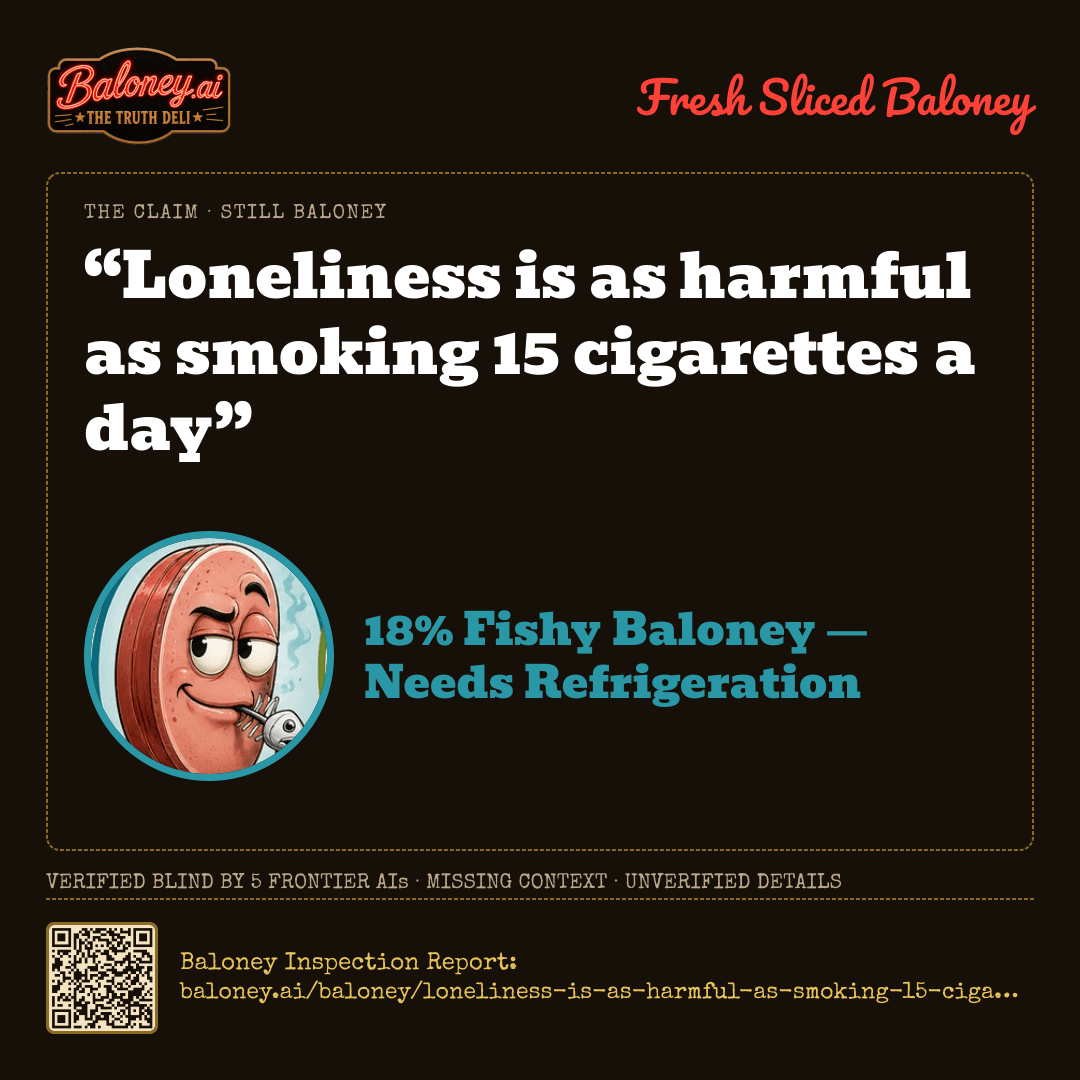
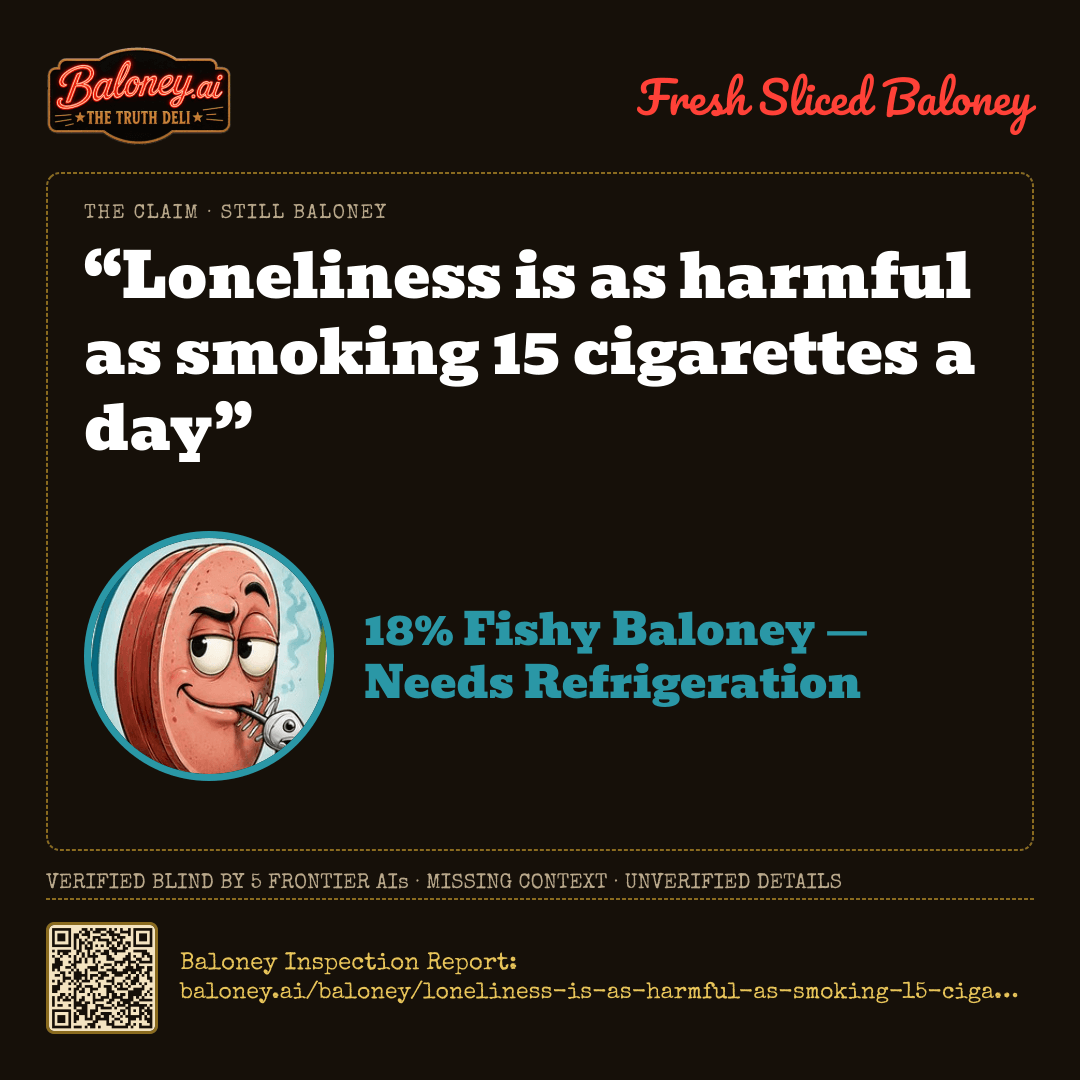
18%“Loneliness is as harmful as smoking 15 cigarettes a day”
18%Fishy Baloney — Needs Refrigeration
Something smells off…
Missing contextUnverified detailsSuspicious framingMay be exaggerated
Serve It Fresh
Ready to Serve20 servings
Serve it the way you want it
The Verdict
 “Loneliness is as harmful as smoking 15 cigarettes a day”18% Fishy Baloney — Needs RefrigerationVerified blind by 5 frontier AIs · Baloney Inspection Report: baloney.ai/baloney/loneliness-is-as-harmful-as-smoking-15-cigarettes-a-day
The Baloney Sampler
The claim stems from a 2010 PLOS Medicine meta-analysis, echoed by the U.S. Surgeon General and the National Institute on Aging, which compared the mortality risk of lacking social connections to smoking up to 15 cigarettes daily. Studies show strong social relationships improve survival odds by 50%, while a later Perspectives on Psychological Science review found subjective loneliness specifically increases mortality risk by about 26%.
However, this statement turns a rough public health analogy into a false biological equivalence. The original comparison measured broader social integration, not just subjective loneliness. Furthermore, the harms are not mathematically equivalent: major studies in the BMJ and New England Journal of Medicine show smoking 15 cigarettes a day triples mortality rates, a far heavier burden. Finally, while smoking directly causes disease, loneliness associations are observational and often shrink when adjusting for pre-existing health issues.
Resting on PLOS Medicine · U.S. Department of Health and Human Services · BMJ · New England Journal of Medicine
Original Claim Source https://www.julianneholtlunstad.com/15-cigarettes
Other ways to slice it — phrasings that might have changed the rating
- “The mortality risk associated with lacking social connection is comparable in effect size to some estimates for light smoking.” This formulation reflects the actual statistical analogy used by researchers regarding broad social integration, avoiding the implication of literal biological equivalence or isolating subjective loneliness.
- “Subjective loneliness is associated with a 26% increased risk of premature death.” This uses the precise statistical finding from the 2015 meta-analysis on subjective loneliness, dropping the inaccurate analogy to a daily cigarette count.
- “Smoking 15 cigarettes a day carries a significantly higher mortality risk than chronic loneliness.” This reflects the epidemiological reality that smoking roughly triples mortality rates (a 200–300% increase), which is a vastly larger mathematical harm than the 26% increase associated with loneliness.
Written from the panel’s reports by Google · gemini-3.1-pro-preview. Nothing here changed the score.
The Order Ticket
20:23:28CLAIM RECEIVED — QUEUED FOR INSPECTION✓
20:24:35claude-opus-5 REPORTED — SCORE 30, CONFIDENCE 82✓
20:24:17gpt-5.5 REPORTED — SCORE 18, CONFIDENCE 84✓
20:24:02gemini-3.1-pro-preview REPORTED — SCORE 4, CONFIDENCE 95✓
20:23:38sonar-pro REPORTED — SCORE 24, CONFIDENCE 95✓
20:24:47grok-4.6 REPORTED — SCORE 5, CONFIDENCE 72✓
20:25:55PRIMARY MASTER GEMINI — SCORE 24✓
20:24:54BLIND VALIDATION PERPLEXITY — SCORE 24✓
20:26:29AGREEMENT CONFIRMED — DELTA 6✓
20:26:29SCORING MODEL V2 — MEDIAN OF 5 COUNTED LAB SCORES: 30, 18, 4, 24, 5 → 18.✓
20:26:29SOURCE RULE — LABS CITED 27 SOURCES: 0 DISCARDED FOR HAVING NO URL, 0 DISCARDED AS DEAD LINKS (404/410), 13 COULD NOT BE OPENED BY US AND ARE MARKED UNVERIFIED.✓
20:26:29SOURCE RULE — PRIMARY MASTER RULED ON 19 SOURCES: 0 DISCARDED FOR HAVING NO URL, 0 DISCARDED AS DEAD LINKS, 9 MARKED UNVERIFIED, 10 VERIFIED.✓
How This One Was Sliced
Station 1 · Blind Inspection — Five Graders, Zero Peeking
Each lab scored the claim independently, without seeing the others. Open a breakdown for its evidence, its sources, and how sure it was.
Anthropic · EQUAL WEIGHT · 67.1s
claude-opus-5
30%BALONEY
ROUND-1 BREAKDOWN
Evidence offered for the claim- The comparison traces to a real peer-reviewed meta-analysis: Holt-Lunstad, Smith & Layton (2010, PLOS Medicine), pooling 148 studies and ~308,000 participants, found a 50% increased likelihood of survival for people with stronger social relationships (OR 1.50), and explicitly benchmarked that effect size against established mortality risks including smoking (the paper's comparison figure uses 'smoking less than 15 cigarettes a day'), obesity and physical inactivity.
- A follow-up meta-analysis (Holt-Lunstad et al., 2015, Perspectives on Psychological Science; 70 studies, >3.4 million participants) found statistically significant increases in odds of death: loneliness OR 1.26, social isolation OR 1.29, living alone OR 1.32 — confirming that subjective loneliness itself, not only objective isolation, predicts mortality.
- The claim is endorsed by a national health authority: the 2023 U.S. Surgeon General's Advisory 'Our Epidemic of Loneliness and Isolation' states that the mortality impact of being socially disconnected is 'similar to that caused by smoking up to 15 cigarettes a day.'
- The U.S. National Institute on Aging and the World Health Organization both treat social isolation and loneliness as serious mortality and morbidity risk factors (cardiovascular disease, stroke, dementia, depression), giving the underlying health message substantial institutional support.
- Plausible biological mechanisms exist — chronic stress-axis activation, inflammation, poorer sleep and reduced health-protective behaviours — so the association is not merely statistical noise.
Evidence against the claim- The claim swaps the exposure. The 15-cigarette benchmark came from a meta-analysis of social relationships/social integration, not of self-reported loneliness. When loneliness alone is isolated, the effect is smaller (OR ~1.26 vs OR ~1.50 for social integration), so the headline figure overstates loneliness specifically.
- The magnitudes are not actually equivalent. A ~26–50% increase in odds of death is far smaller than the mortality burden of smoking 15/day: the British Doctors Study (Doll et al., BMJ 2004) and Jha et al. (NEJM 2013) show cigarette smokers have roughly 2–3x all-cause mortality and lose about 10 years of life expectancy. A 30% increase in odds is not the same as a 200% increase in rate.
- The comparison converts odds ratios drawn from heterogeneous studies with different outcomes, follow-up periods, covariates and populations into a single 'equivalence,' which is methodologically loose — effect sizes from separate literatures are not directly interchangeable units of harm, and nothing in the original paper established a dose-matched equivalence.
- Causality is not established. Unlike smoking, where randomised-equivalent and dose-response evidence is overwhelming, loneliness studies are observational and vulnerable to reverse causation (illness, disability and frailty cause isolation) and residual confounding.
- When those confounders are adjusted for, the effect often shrinks or disappears. Steptoe et al. (PNAS 2013) found loneliness was no longer significantly associated with mortality after adjustment for demographic factors and baseline health, while social isolation remained. Elovainio et al. (Lancet Public Health 2017, UK Biobank) found most of the excess mortality in lonely/isolated people was explained by pre-existing risk factors and health status.
- Julianne Holt-Lunstad, the author of the source research, has repeatedly noted the cigarette line is a rough illustrative comparison that has been detached from its caveats and over-literalised in public messaging.
- Stated flatly, the claim implies a quantified equivalence of harm ('as harmful as') that no study has tested; the defensible version is 'the mortality risk associated with social disconnection is comparable in effect size to some estimates for light smoking.'
How sure this lab was82/100 — the lab’s own confidence in the score above, not a second reading of the claim.
SourcesPLOS Medicine (Holt-Lunstad, Smith & Layton 2010)journal · 92 · Perspectives on Psychological Science (Holt-Lunstad et al. 2015)journal · 90 · U.S. Surgeon General / HHSgov · 85 · National Institute on Aging (NIH)gov · 90 · PNAS (Steptoe et al. 2013)journal · 92 · The Lancet Public Health (Elovainio et al. 2017)journal · 92 · BMJ (Doll et al. 2004, 50-year British Doctors Study)journal · 95 · New England Journal of Medicine (Jha et al. 2013)journal · 95 · World Health Organizationgov · 85
OpenAI · EQUAL WEIGHT · 48.7s
gpt-5.5
18%BALONEY
ROUND-1 BREAKDOWN
Evidence offered for the claim- A major 2010 PLOS Medicine meta-analysis of 148 studies and 308,849 participants found that stronger social relationships were associated with about a 50% higher likelihood of survival. The authors explicitly said the mortality effect was comparable with well-established risk factors, including smoking, which is the main scientific root of the '15 cigarettes a day' comparison.
- A 2015 meta-analysis in Perspectives on Psychological Science found that loneliness, social isolation, and living alone were each associated with increased mortality risk: about 26%, 29%, and 32% respectively. This supports the broader claim that loneliness/social disconnection is a serious health risk, not merely an unpleasant feeling.
- The U.S. Surgeon General's 2023 advisory states that lacking social connection can increase the risk of premature death as much as smoking up to 15 cigarettes a day. That gives the claim strong institutional backing, though the advisory uses the broader phrase 'lacking social connection,' not loneliness alone.
Evidence against the claim- The statement is too broad as written. The best-supported comparison is about relative risk of premature death or all-cause mortality, not overall 'harmfulness' across all diseases, quality of life, cancer risk, respiratory disease, or addiction.
- 'Loneliness' is not identical to 'social isolation,' 'living alone,' or 'poor social connection.' The 15-cigarette comparison usually refers to broader social-connection deficits, while the mortality estimate for loneliness alone in the 2015 meta-analysis was smaller than the broad 2010 social-relationships estimate.
- Most evidence behind the comparison is observational. Researchers adjust for many confounders, but poor health can also cause loneliness or isolation, and residual confounding is hard to eliminate. That weakens a literal causal equivalence to smoking.
- Smoking has a very well-established causal relationship with cancer, cardiovascular disease, respiratory disease, and premature death, and its risk depends on intensity, duration, and lifetime exposure. A single conversion such as 'loneliness equals 15 cigarettes a day' is a public-health analogy, not a precise risk equation.
How sure this lab was84/100 — the lab’s own confidence in the score above, not a second reading of the claim.
SourcesPLOS Medicinejournal · 95 · Perspectives on Psychological Science / PubMedjournal · 93 · U.S. Department of Health and Human Services / Office of the Surgeon Generalgov · 92 · National Academies of Sciences, Engineering, and Medicineedu · 90 · National Cancer Institutegov · 91 · U.S. Surgeon General / NCBI Bookshelfgov · 94
Google · EQUAL WEIGHT · 33.6s
gemini-3.1-pro-preview
4%BALONEY
ROUND-1 BREAKDOWN
Evidence offered for the claim- In 2023, U.S. Surgeon General Dr. Vivek Murthy issued a public health advisory on the epidemic of loneliness and isolation, explicitly stating that the mortality impact of being socially disconnected is similar to smoking up to 15 cigarettes a day.
- The comparison originates from a highly cited 2010 meta-analysis by Julianne Holt-Lunstad and colleagues in PLOS Medicine, which analyzed 148 studies involving over 300,000 participants.
- The meta-analysis found that a lack of social connection carries a mortality risk comparable to well-established risk factors like smoking and alcohol consumption, and actually exceeds the mortality risks associated with physical inactivity and obesity.
- Chronic loneliness and social isolation are empirically linked to severe physical health consequences, including a 29% increased risk of heart disease, a 32% increased risk of stroke, and heightened risks for dementia and premature death.
Evidence against the claim- The original 2010 meta-analysis primarily measured objective social integration and isolation rather than just the subjective feeling of 'loneliness', though public health messaging often combines the two terms for simplicity.
- The '15 cigarettes' figure is a statistical comparison of mortality odds ratios, not a measure of identical physiological damage. Smoking causes direct cellular, carcinogenic, and respiratory damage, whereas loneliness largely operates through chronic stress pathways (elevated cortisol, inflammation) and a lack of behavioral support.
- Some epidemiologists note that translating complex hazard ratios for social variables into a specific daily cigarette count is a rhetorical public health simplification meant to convey the severity of the issue to the general public, rather than a strict biological equivalency.
How sure this lab was95/100 — the lab’s own confidence in the score above, not a second reading of the claim.
SourcesU.S. Department of Health and Human Services (HHS)gov · 95 · PLOS Medicinejournal · 95
Perplexity · EQUAL WEIGHT · 9.4s
sonar-pro
24%BALONEY
ROUND-1 BREAKDOWN
Evidence offered for the claim- The U.S. Surgeon General’s 2023 advisory states that the mortality impact of being socially disconnected is similar to that caused by smoking up to 15 cigarettes a day.[https://www.hhs.gov/sites/default/files/surgeon-general-social-connection-advisory.pdf]
- The advisory reports that loneliness is associated with a 26% greater risk of premature death and social isolation with a 29% greater risk.[https://www.hhs.gov/sites/default/files/surgeon-general-social-connection-advisory.pdf]
- Reputable coverage by PBS/AP and NPR accurately reports that the Surgeon General compared the premature-death risk associated with lacking social connection with smoking up to 15 cigarettes daily.[https://www.pbs.org/newshour/health/loneliness-poses-health-risks-as-deadly-as-smoking-u-s-surgeon-general-says][https://www.npr.org/2023/05/02/1173418268/loneliness-connection-mental-health-dementia-surgeon-general]
Evidence against the claim- The claim conflates loneliness with the broader category of social disconnection or social isolation. The Surgeon General’s wording was about being socially disconnected, while the advisory separately reports a smaller association for loneliness than for social isolation.[https://www.hhs.gov/sites/default/files/surgeon-general-social-connection-advisory.pdf]
- A 2023 American Journal of Epidemiology article cautions that the comparison is based on associations drawn from different studies and measures, making a direct equivalence difficult to establish.[https://pubmed.ncbi.nlm.nih.gov/37204190/]
- A 2024 response in the American Journal of Epidemiology reports more recent meta-analytic estimates of approximately 1.26 for loneliness and 1.29 for social isolation, and states that smoking up to 15 or 20 cigarettes per day may have larger mortality effects.[https://academic.oup.com/aje/article/193/10/1497/7664338?searchresult=1]
- A cohort-study analysis found mortality associations increasing from loneliness to social isolation to cigarette smoking, concluding that poor social integration was less strongly linked to total mortality than smoking.[https://discovery.ucl.ac.uk/id/eprint/10128770/1/1-s2.0-S2666535221000653-main.pdf]
- The comparison concerns population-level relative mortality risk, not a finding that one person's loneliness has the same physiological toxicity or causes the same diseases as smoking 15 cigarettes. It also does not establish that every lonely person faces the same risk as a smoker of that amount.
How sure this lab was95/100 — the lab’s own confidence in the score above, not a second reading of the claim.
SourcesU.S. Department of Health and Human Services, Office of the Surgeon Generalgov · 98 · American Journal of Epidemiology / PubMedjournal · 94 · American Journal of Epidemiologyjournal · 94 · University College London repository; Public Health in Practice studyjournal · 90 · PBS NewsHour / Associated Pressnews · 91 · NPRnews · 92
xAI · EQUAL WEIGHT · 78.6s
grok-4.6
5%BALONEY
ROUND-1 BREAKDOWN
Evidence offered for the claim- Holt-Lunstad et al. meta-analyses (2010, 2015) found lacking social connection, isolation, and loneliness associated with ~26-50% higher premature mortality; researchers equated the effect size to smoking ~15 cigarettes/day.
- The 2023 U.S. Surgeon General advisory on loneliness and isolation states the mortality impact of social disconnection is similar to smoking up to 15 cigarettes a day and cites the same research tradition.
- The comparison has been repeated by HHS, NIA, and other public-health authorities as a population-level risk analogy based on those meta-analytic relative risks.
Evidence against the claim- The claim is an analogy of observational all-cause mortality associations, not a demonstration that loneliness produces the same causal, dose-dependent harms (cancer, COPD, etc.) as smoking 15 cigarettes a day.
- Loneliness (subjective) and social isolation (objective) are distinct constructs often conflated in popular restatements; residual confounding and reverse causation remain possible in the underlying studies.
- The precise '15 cigarettes' figure is a rounded effect-size comparison, not a direct experimental result, and estimates vary by included studies and adjustment.
How sure this lab was72/100 — the lab’s own confidence in the score above, not a second reading of the claim.
SourcesPLOS Medicinejournal · 95 · Perspectives on Psychological Sciencejournal · 92 · U.S. Department of Health and Human Servicesgov · 90 · National Institute on Aginggov · 88
Station 2 · The Masters
Primary Master · drawn at random
gemini-3.1-pro-preview
24% BALONEY
While the U.S. Surgeon General and major health organizations frequently use this comparison to emphasize the severe health risks of social disconnection, the statement as written takes a rough public health analogy and treats it as a literal biological equivalence. The original 2010 meta-analysis that generated the '15 cigarettes' benchmark examined objective social integration (a 50% increase in odds of survival), not subjective loneliness alone (which a 2015 meta-analysis found increases mortality odds by about 26%). Furthermore, smoking 15 cigarettes a day increases mortality rates by roughly 200–300%, meaning the strict mathematical harms are not equivalent. The claim is an illustrative rhetorical device that conflates distinct terms and overstates the specific quantifiable risk of loneliness.
All evaluators agreed that the claim originates from legitimate, highly cited meta-analyses by Holt-Lunstad et al. and has been adopted by public health authorities like the U.S. Surgeon General. They disagreed primarily on scoring philosophy: Evaluators 1 and 5 viewed the statement as a valid, institutionally backed public health simplification (scoring 4–5), while Evaluators 2, 3, and 4 penalised the claim for conflating loneliness with broader social isolation and for mathematically overstating the mortality effect compared to actual smoking (scoring 18–30).
Blind Validation Master · never saw the Primary’s work
sonar-pro
24% BALONEY
The claim has a real evidentiary basis: major meta-analyses link stronger social relationships with lower mortality, and the U.S. Surgeon General explicitly described the mortality impact of being socially disconnected as similar to smoking up to 15 cigarettes a day. However, as written, it overstates and blurs the evidence. The original comparison concerned broad social connection or integration, not loneliness alone; the 2015 meta-analysis estimated a smaller association for loneliness specifically—about a 26% higher mortality likelihood, compared with roughly 29% for social isolation and 32% for living alone. These are observational associations, vulnerable to confounding and reverse causation, and they do not establish that loneliness causes the same diseases or physiological damage as smoking. Nor can odds ratios from different research literatures be converted into a precise cigarette-equivalent dose. Thus, the statement is a useful population-level warning but misleading when interpreted as a literal or causal equivalence. Under the supplied scale, it belongs in Stinky Baloney rather than the True band.
AGREEMENT TEST PASSED — BOTH MASTERS SCORED 24% · BLIND VALIDATION CONFIRMED THIS SCORE · NO RE-EVALUATION REQUIRED
How the number was reached · scoring model v2 · how our models work
- Median of 5 counted lab scores: 30, 18, 4, 24, 5 → 18.
The Evidence
Evidence offered for the claim
- U.S. Surgeon General advisory The 2023 public health advisory explicitly states that the mortality impact of being socially disconnected is similar to smoking up to 15 cigarettes a day.
- 2010 meta-analysis benchmark A PLOS Medicine meta-analysis of over 300,000 participants found that strong social relationships improve survival odds by 50%, explicitly benchmarking the effect size against major factors like smoking.
- Broad physical health risks Chronic loneliness and social isolation are empirically linked to severe physical health consequences, including increased risks for heart disease, stroke, dementia, and premature death.
- Quantified equivalence of harm DEBUNKED — The statement implies a verified biological equivalence where loneliness is exactly as deadly as smoking 15 cigarettes a day. (Refutation: The comparison is an illustrative public health analogy based on observational odds ratios. A 26% increase in mortality odds for loneliness is mathematically far smaller than the 200–300% mortality rate increase seen in regular smokers.)
Evidence against the claim
- Conflation of terms The original '15 cigarettes' benchmark applied to overall social integration. When isolated as a standalone variable, subjective loneliness carries a smaller mortality effect size (OR ~1.26) than broad social integration (OR ~1.50).
- Exaggerated statistical comparison A 26–50% increase in odds of premature death from social disconnection is mathematically much smaller than the roughly two-to-three-times (200–300%) overall mortality rate increase caused by smoking 15 cigarettes a day.
- Observational vs. causal evidence Smoking has an overwhelming, dose-dependent causal link to disease. Loneliness studies are observational and vulnerable to residual confounding and reverse causation, where pre-existing illness or disability causes the isolation.
Sources · Reliability · Why Accepted or Discounted
Every link was opened when this claim was inspected. A dead link was discarded before publication; “unverified” means the site refused our automated check and the link is the one the panel cited. A source without a URL was never kept.
Serve It Fresh
Ready to Serve20 servings
Serve it the way you want it
The Verdict
“Loneliness is as harmful as smoking 15 cigarettes a day”18% Fishy Baloney — Needs RefrigerationVerified blind by 5 frontier AIs · Baloney Inspection Report: baloney.ai/baloney/loneliness-is-as-harmful-as-smoking-15-cigarettes-a-day