Overwhelmingly falseContradicts known factsPromotes false beliefsPotential for harm
Serve It Fresh
Ready to Serve17 servings
Serve it the way you want it
The Verdict
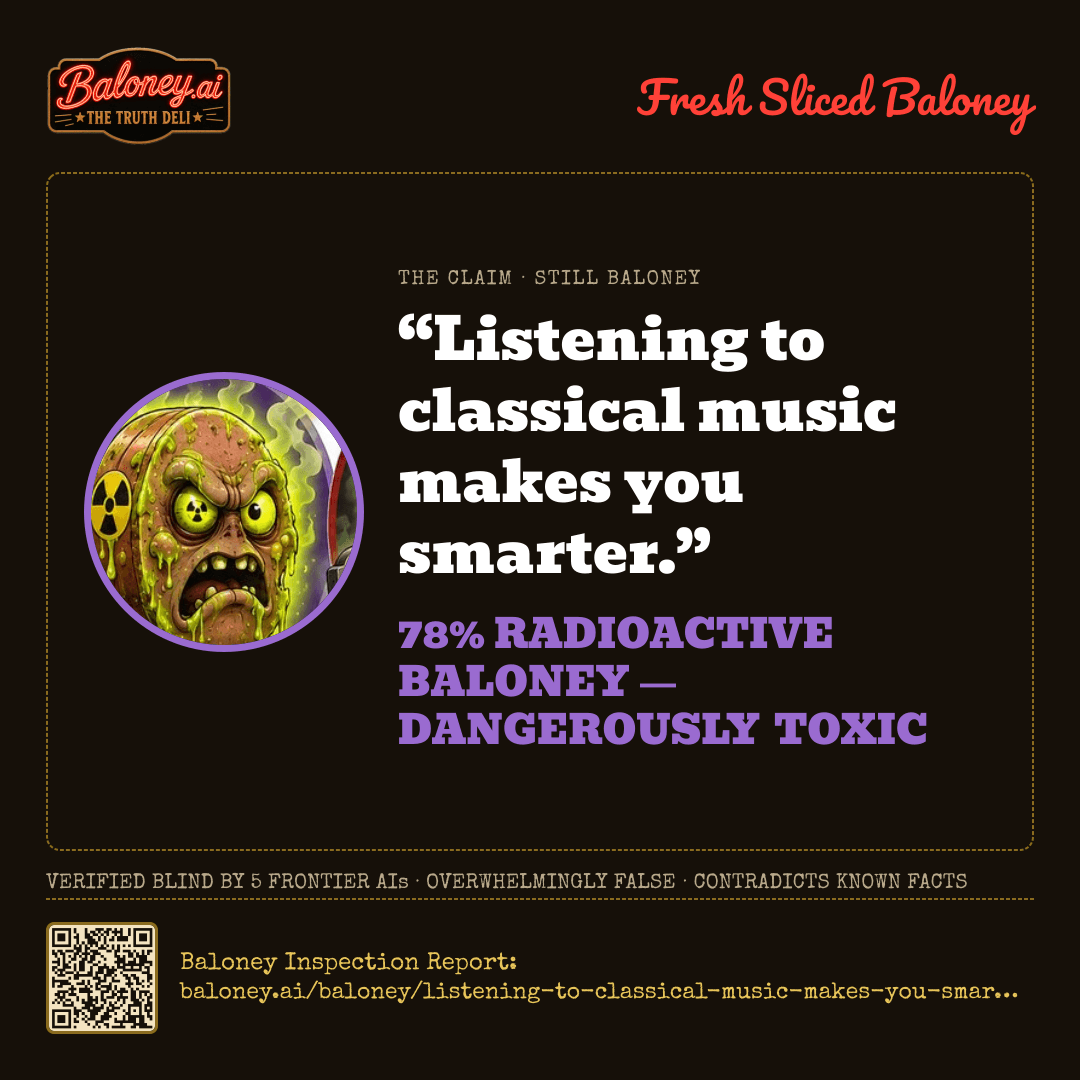
“Listening to classical music makes you smarter.” 78% RADIOACTIVE BALONEY — DANGEROUSLY TOXIC Verified blind by 5 frontier AIs · Baloney Inspection Report: baloney.ai/baloney/listening-to-classical-music-makes-you-smarter
Station 1 · Blind Inspection — Five Graders, Zero Peeking
Each lab scored the claim independently, without seeing the others. Open a breakdown for its evidence, its sources, and how sure it was.
Anthropic · EQUAL WEIGHT · 41.2s
claude-opus-5
78%BALONEY
ROUND-1 BREAKDOWN
Evidence offered for the claim
Rauscher, Shaw & Ky (1993, Nature) reported that college students who listened to ~10 minutes of Mozart's Sonata for Two Pianos in D major (K.448) scored higher on a spatial-temporal reasoning subtest (paper folding/cutting) than after silence or relaxation instructions — the origin of the 'Mozart effect'.
Some subsequent studies and small meta-analyses did find a small, statistically detectable short-term improvement on specific spatial-temporal tasks after music listening, so the effect is not purely invented — it is small and narrow.
Music listening can reliably improve arousal and mood, and improved arousal/mood measurably improves performance on some cognitive tests; so pleasant classical music can indirectly boost test performance in the short term (Thompson, Schellenberg & Husain, 2001).
Some clinical literature reports that listening to Mozart K.448 reduces epileptiform discharges and seizure frequency in some epilepsy patients, indicating music listening can have real, measurable neurophysiological effects (though this is not 'intelligence').
Actively learning music (lessons) — as distinct from passive listening — was associated with a small IQ gain (~2.7 points over a year) in a randomized trial of 6-year-olds (Schellenberg, 2004, Psychological Science), which is often conflated with the listening claim.
Evidence against the claim
The original 1993 finding was a temporary (~10–15 minute) boost on one narrow spatial task, not a change in general intelligence or IQ. The authors themselves never claimed listening 'makes you smarter'.
Chabris (1999, Nature) meta-analyzed the literature and concluded the effect size was negligible and insufficient to reflect any change in IQ or reasoning ability generally.
Steele and colleagues (1999) failed to replicate the Mozart effect in a large, carefully controlled study, publishing 'Prelude or requiem for the Mozart effect?' in Nature alongside Chabris.
Pietschnig, Voracek & Formann (2010, Intelligence), a meta-analysis of ~40 studies and 3,000+ participants, found the effect essentially disappears once publication bias is accounted for, and that labs affiliated with the original authors reported larger effects than independent labs.
The small effects that do appear are better explained by 'arousal and mood' — comparable boosts occur from listening to Schubert, Stephen King audiobooks, or anything the listener enjoys, showing nothing special about Mozart or classical music (Thompson, Schellenberg & Husain, 2001; Nantais & Schellenberg, 1999).
Randomized trials of music enrichment in preschoolers found no consistent transfer to nonmusical cognitive abilities (Mehr et al., 2013, PLOS ONE).
Meta-analyses of music training (a stronger intervention than listening) also find little to no far-transfer to general cognitive ability once study quality and controls are accounted for (Sala & Gobet, 2020).
There is no credible evidence that playing classical music to infants or fetuses raises intelligence, despite a large commercial 'Baby Mozart' industry; the State of Georgia's 1998 program distributing classical CDs to newborns was based on this misreading of the science.
Bangerter & Heath (2004) documented how the Mozart effect spread through media and policy as a 'legend' far exceeding what the data supported, particularly in U.S. states with weaker education outcomes.
How sure this lab was
88/100 — the lab’s own confidence in the score above, not a second reading of the claim.
A small 1993 Nature study reported that college students performed better on certain spatial-reasoning tasks for about 10-15 minutes after listening to Mozart's Sonata for Two Pianos in D major, K.448, compared with silence or relaxation instructions. This is the main empirical basis of the so-called 'Mozart effect,' but it was narrow and temporary, not evidence of a lasting rise in intelligence.
A later Psychological Science study found that the apparent benefit could be linked to arousal and mood: enjoyable, stimulating music improved performance more than slow/sad music, suggesting music can sometimes temporarily help task performance by putting listeners in a better mental state.
Evidence against the claim
The claim is usually overstated: the original finding concerned a short-lived improvement on specific spatial tasks, not general intelligence, IQ, learning ability, or long-term 'smartness.'
A 1999 Nature meta-analysis concluded that any Mozart effect was very small and did not support the idea that listening to Mozart improves IQ or general intelligence.
A 2010 meta-analysis in Intelligence concluded that evidence for a meaningful Mozart effect was weak and likely inflated by publication bias; the authors found little support for claims that listening to Mozart makes people smarter.
Benefits found in some studies are not specific to classical music; they appear better explained by temporary changes in mood, arousal, attention, or preference. Music someone enjoys may briefly improve performance on some tasks, but that is different from becoming smarter.
Evidence for cognitive benefits is stronger, though still limited and context-dependent, for active musical training than for passive listening. For example, music lessons have been studied in relation to IQ changes, but that does not support the claim that simply listening to classical music makes a person smarter.
Randomized trials of brief preschool music enrichment found no consistent evidence of broad nonmusical cognitive benefits, further weakening generalized claims that simple exposure to music boosts intelligence.
How sure this lab was
90/100 — the lab’s own confidence in the score above, not a second reading of the claim.
A foundational 1993 study published in the journal Nature (often credited with starting the 'Mozart Effect' craze) found that college students who listened to a Mozart sonata for 10 minutes showed a temporary improvement in spatial-temporal reasoning tasks.
Listening to classical music (or any music a person enjoys) can increase arousal, alertness, and positive mood. This psychological state has been shown to yield a short-term, temporary boost in performance on specific cognitive tasks.
Evidence against the claim
The authors of the original 1993 study explicitly noted that the spatial reasoning improvement was highly specific and temporary (lasting only 10-15 minutes), and they never claimed it equated to a permanent increase in general intelligence.
A comprehensive 2010 meta-analysis by Pietschnig et al. reviewed nearly 40 independent studies and found no significant evidence that listening to Mozart or classical music improves general cognitive abilities.
Subsequent research has proven the 'arousal and mood hypothesis', demonstrating that any engaging stimulus (such as listening to upbeat pop music or a compelling audiobook) produces the exact same temporary cognitive effect as classical music.
Neurological and psychological consensus draws a strict line between actively learning to play a musical instrument (which requires sustained discipline and has been linked to actual cognitive and developmental benefits) and passively listening to music (which does not alter brain structure or permanent intelligence).
How sure this lab was
95/100 — the lab’s own confidence in the score above, not a second reading of the claim.
Short-term improvements in specific cognitive tasks have been reported after listening to classical music, especially Mozart, compared with silence or other sounds; these effects are typically small and limited to particular forms of **spatial-temporal reasoning** or working memory rather than broad intelligence.[1][2][5]
A meta-analysis of the so‑called generalized Mozart effect found that classical music produces a **small but statistically significant facilitative effect on cognitive performance** (effect size around g ≈ 0.36), suggesting modest, short-term performance benefits on certain tasks.[2][4]
Several experimental studies summarized in reviews report that classical music can improve **concentration and task performance** across different participant groups, consistent with a modest cognitive benefit (though not an IQ increase).[2][13]
Some studies in healthy older adults have found that listening to classical music before or during testing **enhanced working memory performance** compared with no music or noise, supporting a context-dependent boost in specific cognitive functions.[5]
Mechanistic reviews argue that music, including classical, can influence **arousal and mood**, which in turn can improve performance on certain cognitive tasks; this is sometimes framed as one explanation for observed Mozart-effect-type benefits.[1][2][9]
Evidence against the claim
The originator of the Mozart effect research has explicitly stated that any observed benefits are limited to **spatial-temporal reasoning** and that there is **no enhancement of general intelligence**, contradicting the broad claim that classical music makes you smarter.[1][3]
A major meta-analysis from the University of Vienna found **no evidence for specific cognitive enhancements due to listening to Mozart**, concluding that there is no support for gains in spatial ability or intelligence from merely listening to his music; the popular Mozart effect was described as a **legend**.[1][12][15]
Reviews of replication studies report **little or no evidence** for a specific, reliable Mozart effect beyond minor, short-lived boosts, and emphasize that general intelligence is **not affected** by listening to Mozart or other classical music.[1][3][8][9][12]
Scientific and popular-science critiques, including coverage in outlets like Scientific American and McGill University’s Office for Science and Society, describe the belief that classical music (especially for babies or children) makes people smarter as a **myth**, noting that any effects are small, task-specific, and transient.[3][7][10][12]
A comprehensive review of 40 independent studies involving roughly 3,000 participants concluded there is **no support for the idea that listening to Mozart improves intelligence**, reinforcing that the broad claim of becoming smarter from classical music exposure is not empirically supported.[11][12][15]
Conceptual reviews argue that observed performance changes can be explained by **general arousal/mood effects** rather than any unique intelligence-boosting property of classical music, and state that direct benefits of music listening on cognition are "more of a fantasy than a reality" when framed as making people smarter.[1][9]
Experts interviewed in major science outlets state that there is **no compelling evidence** that children who listen to classical music gain improved cognitive abilities or higher IQ, and that the widely publicized baby-boosting claims are unfounded.[3][7][10]
How sure this lab was
93/100 — the lab’s own confidence in the score above, not a second reading of the claim.
A 1993 Nature study (Rauscher, Shaw & Ky) found college students who listened to 10 minutes of a Mozart piano sonata showed a short-term rise on spatial-temporal reasoning tasks (on the order of several IQ-equivalent points) that lasted about 10–15 minutes.
Some later work supports an arousal-mood account: music a listener enjoys can briefly raise alertness and mood and thereby produce small, temporary gains on some cognitive tests, which can include classical pieces.
Evidence against the claim
The original finding was brief, task-specific (spatial-temporal reasoning), and not a lasting rise in general intelligence or IQ; it does not support the unqualified claim that listening makes you smarter.
Multiple replication attempts failed or found much smaller effects; a 2010 meta-analysis (Pietschnig, Voracek & Formann) concluded the overall Mozart effect is negligible and not unique to Mozart or classical music.
Popular extensions (e.g., Baby Mozart / lasting IQ gains in infants and children from passive listening) are not supported by the evidence; any bump is better explained by enjoyment and arousal than by classical music per se.
Passive listening is not equivalent to music training, which has a separate and still-debated literature on cognitive correlates.
How sure this lab was
82/100 — the lab’s own confidence in the score above, not a second reading of the claim.
I weighted the peer-reviewed experimental studies and meta-analyses most heavily, especially Nature, Intelligence, Psychological Science, PLOS ONE, Memory & Cognition, and related academic sources. The evidence consistently shows a small kernel behind the claim: some studies reported brief improvements on narrow cognitive tasks after listening to Mozart or other enjoyable music. But the statement as written says classical music “makes you smarter,” which implies a broader or lasting increase in intelligence. The panel evidence does not support that. The original 1993 Nature result was short-lived and task-specific; later meta-analyses and replication work found the effect to be small, unreliable, inflated by publication bias, or better explained by mood and arousal. I discounted lower-quality or indirect sources such as blogs, general educational articles, and Wikipedia as primary evidence, though some are useful for documenting the public myth. The final score is high because the popular claim substantially overstates the science and has been repeatedly corrected for decades, while still leaving room for the narrow truth that music can briefly improve performance in some contexts.
All five evaluators agreed on the central point: the claim is an overgeneralization of the Mozart-effect literature. They all cited the 1993 Nature study as the main evidence for a temporary spatial-task boost and all emphasized that this is not evidence of higher general intelligence or lasting smartness. They also broadly agreed that arousal, mood, enjoyment, and attention explain many reported short-term effects better than classical music itself. The evaluators differed mostly in emphasis: Reports 1, 4, and 5 leaned strongly on the major meta-analyses and replication failures; Report 2 gave somewhat more space to small positive effects and broader cognitive-performance claims; Report 3 assigned the highest baloney score, stressing that later evidence undermines the popular interpretation. None treated passive listening as equivalent to active musical training.
ZOMBIE FLAG: TRUE — DEBUNK HISTORY ON RECORD
Blind Validation Master · never saw the Primary’s work
sonar-pro
92% BALONEY
The statement is broadly false as written. The reports consistently show that the best-supported finding is a small, short-lived improvement on certain spatial or task-performance measures after listening to some music, especially Mozart, but not a lasting increase in general intelligence, IQ, or overall "smartness." Multiple meta-analyses and replication attempts reported little to no reliable effect once publication bias and methodological issues are considered, and several reports emphasize that the apparent benefit is better explained by temporary arousal, mood, or preference rather than any classical-music-specific intelligence boost. The claim is therefore an exaggerated and misleading simplification of a narrow, transient effect, not a true statement about becoming smarter.
AI EVALUATORS SHOWED MODERATE DISAGREEMENT — MASTERS SCORED 80% AND 92% · REVIEW THE EVIDENCE CAREFULLY
The Evidence
Evidence offered for the claim
Original Mozart-effect findingDEBUNKED — A 1993 Nature study found that college students performed better on a spatial-temporal reasoning task for about 10–15 minutes after listening to Mozart’s Sonata for Two Pianos in D major, K.448. The panel treated this as a real but narrow finding, not evidence of a lasting IQ or intelligence increase.
Short-term task boostsDEBUNKED — Some later studies and reviews reported small, short-term improvements on specific cognitive tasks after music listening. These effects are limited to performance under particular conditions and do not establish that classical music broadly increases intelligence.
Mood and arousal effectsDEBUNKED — Enjoyable or stimulating music can improve mood, alertness, and attention, which can briefly help with some tests. That mechanism is not specific to classical music and does not amount to becoming smarter.
Older-adult working memory findingsDEBUNKED — Some studies in healthy older adults have reported better working-memory performance after or during classical music listening compared with no music or noise. The panel treated this as context-dependent task performance, not proof of increased general intelligence.
Music training sometimes conflatedDEBUNKED — A randomized study of music lessons in children found a small IQ gain after active musical training, and other training studies have explored cognitive transfer. This is a different intervention from passive listening and does not support the claim as written.
Measurable brain effectsDEBUNKED — Some clinical literature reports neurophysiological effects from listening to Mozart K.448 in epilepsy patients. That may show music can affect the brain, but it is not evidence that listening to classical music increases intelligence.
Evidence against the claim
The original claim was narrow The 1993 Nature study concerned a brief improvement on a specific spatial-reasoning task in college students, lasting roughly 10–15 minutes. It did not show improved general intelligence, IQ, learning ability, or permanent smartness.
Meta-analyses found little support A 1999 Nature meta-analysis concluded that any Mozart effect was very small and did not support claims about IQ or general intelligence. A 2010 Intelligence meta-analysis of roughly 40 studies found weak evidence and suggested publication bias inflated positive findings.
Replication problems Subsequent replication attempts, including work discussed in Nature, failed to reproduce a robust Mozart effect or found effects too small and inconsistent to support the broad popular claim.
No classical-music specificity The same kinds of brief improvements can occur after other enjoyable or engaging stimuli, including other music or even compelling spoken material. This supports an arousal-and-mood explanation rather than a unique intelligence-boosting property of classical music.
Passive listening differs from lessons The evidence base for active music lessons is separate from passive listening. Even for training, later analyses and controlled studies report limited or inconsistent transfer to general cognitive ability.
Children and infants are not boosted The popular Baby Mozart-style claim that playing classical music to babies, children, or fetuses produces lasting intelligence gains is not supported by the cited evidence.
Public myth outgrew the science Academic and science-communication sources describe the Mozart effect as a media and policy legend that expanded far beyond the original data, including commercial and political claims unsupported by the research.
Sources · Reliability · Why Accepted or Discounted
Source
Type
Reliability
Ruling
Nature
journal
95
ACCEPTED — Accepted as a high-quality peer-reviewed source for the original 1993 Mozart-effect finding and later Nature discussion, including the 1999 meta-analysis and replication concerns.
Psychological Science
journal
90
ACCEPTED — Accepted for peer-reviewed evidence on the arousal-and-mood explanation and for the separate literature on active music lessons.
Intelligence
journal
92
ACCEPTED — Accepted as a central peer-reviewed meta-analysis source assessing the Mozart effect across many studies and publication-bias concerns.
PLOS ONE
journal
89
ACCEPTED — Accepted for randomized preschool music-enrichment evidence relevant to broad claims of nonmusical cognitive transfer.
National Library of Medicine / PubMed-indexed article
journal
95
ACCEPTED — Accepted as a reliable index or venue for peer-reviewed biomedical and psychological literature, though primary conclusions were drawn from the underlying studies rather than the index itself.
Chinaxiv preprint server
other
80
DISCOUNTED — Discounted as primary support because it was identified as a preprint source and the panel had stronger peer-reviewed meta-analytic evidence available.
Wikipedia
other
75
DISCOUNTED — Discounted as a mutable tertiary source; useful for orientation only, not for the verdict.
Acta Psychologica Sinica
journal
90
ACCEPTED — Accepted as peer-reviewed evidence that some small short-term cognitive-performance effects have been reported, while not overriding the stronger consensus that intelligence is not increased.
PubMed-indexed journal article on music and cognitive performance in older adults
journal
90
ACCEPTED — Accepted for the limited point that some context-dependent task-performance improvements have been studied in older adults.
Neurosity educational article on the Mozart effect
other
70
DISCOUNTED — Discounted because it is an educational or commercial-style secondary source and was not needed given the peer-reviewed literature.
Scientific American
news
90
ACCEPTED — Accepted for reputable science-communication context about the public myth, not as primary empirical evidence.
Open Book Publishers
edu
85
ACCEPTED — Accepted as academic secondary context on music and cognition, while weighted below primary peer-reviewed studies and meta-analyses.
Oxford University Press
edu
90
ACCEPTED — Accepted as a reputable academic source for conceptual review material on music and cognition.
McGill University Office for Science and Society
edu
90
ACCEPTED — Accepted for science-communication context describing the Mozart-effect belief as a myth, not as the main empirical basis.
Heart and Harmony music therapy blog
other
65
DISCOUNTED — Discounted because it is a blog summary with lower evidentiary weight than peer-reviewed journals and academic reviews.
ScienceDaily
news
80
ACCEPTED — Accepted only as news coverage of the University of Vienna meta-analysis and public debunking history; the underlying study carried the evidentiary weight.
Memory & Cognition
journal
85
ACCEPTED — Accepted for meta-analytic evidence on music training and limited far-transfer, relevant to distinguishing training from passive listening.
British Journal of Social Psychology
journal
82
ACCEPTED — Accepted for documenting how the Mozart effect spread as a public and policy legend beyond what the evidence supported.
American Psychological Association
edu
85
ACCEPTED — Accepted as reputable professional context, weighted below primary studies and meta-analyses.
NPR
news
80
ACCEPTED — Accepted for public-facing coverage of the Mozart-effect meta-analysis and debunking history, not as primary scientific evidence.
Serve It Fresh
Ready to Serve17 servings
Serve it the way you want it
The Verdict
“Listening to classical music makes you smarter.” 78% RADIOACTIVE BALONEY — DANGEROUSLY TOXIC Verified blind by 5 frontier AIs · Baloney Inspection Report: baloney.ai/baloney/listening-to-classical-music-makes-you-smarter