SUBMITTED ANONYMOUSLY · INSPECTED 2026-09-13T20:38:30.249Z · STATUS: PUBLISHED
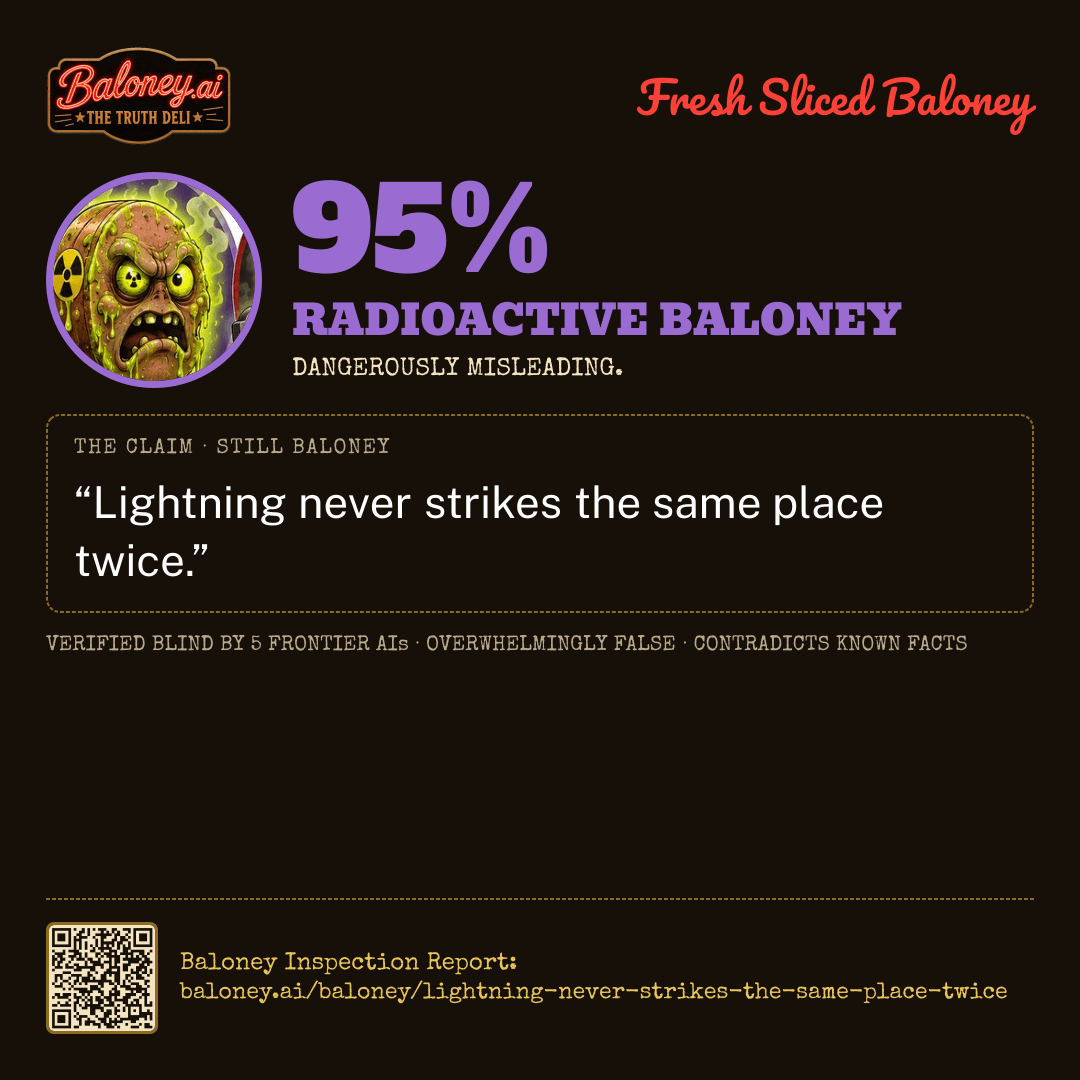
95%
95%
RADIOACTIVE BALONEY — DANGEROUSLY TOXIC
Dangerously misleading.
Overwhelmingly falseContradicts known factsPromotes false beliefsPotential for harm
✓ BLIND VALIDATION CONFIRMED THIS SCORE
Serve It Fresh
Ready to Serve19 servings
Serve it the way you want it
The Verdict
95% RADIOACTIVE BALONEY — DANGEROUSLY TOXIC “Lightning never strikes the same place twice.” Verified blind by 5 frontier AIs · Baloney Inspection Report: baloney.ai/baloney/lightning-never-strikes-the-same-place-twice
Station 1 · Blind Inspection — Five Graders, Zero Peeking
Each lab scored the claim independently, without seeing the others. Open a breakdown for its evidence, its sources, and how sure it was.
Anthropic · EQUAL WEIGHT · 33.8s
claude-opus-5
93%BALONEY
ROUND-1 BREAKDOWN
Evidence offered for the claim
The saying has a kernel of statistical truth for any *specific, arbitrary* small patch of ground: for a given square meter of open terrain, the annual probability of a lightning strike is very low (global average flash densities are on the order of a few flashes per square kilometer per year), so a repeat strike on that exact spot within a human timescale is genuinely unlikely.
A lightning strike can physically alter its target — vaporizing a tree's sap, splitting the trunk, melting a metal point, or destroying an antenna — so a particular object that was struck may no longer exist or may no longer be the tallest/most conductive point, marginally reducing the chance of a repeat strike at that precise object.
As a figure of speech rather than a physical claim (i.e., 'the same rare misfortune won't befall you twice'), the phrase is idiomatic and is not usually intended as a literal meteorological statement.
Evidence against the claim
Tall, isolated, conductive structures are struck repeatedly and predictably. The Empire State Building is struck roughly 20–25 times per year, and Toronto's CN Tower is struck on the order of dozens of times per year; both have been filmed being struck multiple times in a single storm.
A single visible lightning 'flash' typically consists of several return strokes (commonly 3–4, sometimes more) that travel down the same ionized channel within a fraction of a second — so lightning literally strikes the same place several times in one flash, which is why flashes appear to flicker.
The U.S. National Weather Service lists 'Lightning never strikes the same place twice' explicitly as a myth on its official lightning-safety page, stating that lightning often strikes the same place repeatedly, especially tall, pointy, isolated objects.
Lightning protection engineering is built on the opposite premise: lightning rods, air terminals and strike-protection standards exist precisely because certain locations (towers, wind turbines, aircraft, mountain summits, launch pads) are struck over and over. Rocket-triggered lightning research facilities deliberately induce repeated strikes at the same fixed point.
Documented human cases contradict the folk claim: U.S. park ranger Roy Sullivan is recognized by Guinness World Records as having survived being struck by lightning seven times between 1942 and 1977.
Physics research shows recurrence is built into the mechanism: studies of positive leader 'needles' (Hare et al., Nature, 2019) demonstrate that charge can be replenished along an existing channel, allowing discharges to re-use the same path — work summarized in press coverage under the headline 'lightning often strikes twice.'
Lightning-mapping networks (e.g., NLDN, GLM on GOES satellites) routinely record multiple flashes terminating at the same geographic point during a single storm, and lightning-density maps show persistent hotspots (e.g., Lake Maracaibo, Venezuela; central Africa) that are struck night after night.
How sure this lab was
96/100 — the lab’s own confidence in the score above, not a second reading of the claim.
The saying has a limited intuitive basis only if interpreted figuratively: for any arbitrary, small, low, non-isolated spot over a short time window, a repeat lightning strike is statistically unlikely because lightning strikes are relatively rare at any one exact location.
Lightning risk to a given individual in a given year is very low, which helps explain why people may perceive repeat strikes at the same place as improbable.
Evidence against the claim
Taken literally, the claim is false. NOAA/National Weather Service explicitly identifies 'Lightning never strikes the same place twice' as a myth and says lightning often strikes the same place repeatedly, especially tall, pointed, isolated objects.
NOAA's National Severe Storms Laboratory states that lightning can strike the same place twice and notes that tall structures are struck repeatedly.
A single lightning flash can include multiple return strokes that follow the same or very similar channel, meaning even one visible lightning event may involve repeated electrical discharges along the same path.
Real-world examples include tall buildings, towers, trees, mountaintops, and launch structures that are struck many times because they provide favorable conductive/geometry conditions for lightning attachment.
How sure this lab was
94/100 — the lab’s own confidence in the score above, not a second reading of the claim.
From a strictly statistical perspective over a vast, perfectly flat landscape, the absolute probability of a lightning bolt hitting the exact same square inch of ground twice in a short timeframe is mathematically low due to the sheer surface area of the Earth.
The phrase is primarily utilized as a cultural idiom or metaphor to provide comfort that a highly improbable, catastrophic event is unlikely to happen to the same person or in the same way twice, rather than functioning as a literal scientific statement.
Evidence against the claim
Tall, isolated structures are struck repeatedly by design and proximity; for example, the Empire State Building in New York City is struck by lightning an average of 25 times per year.
The entire purpose of a lightning rod is rooted in the scientific reality that lightning will strike the same place twice. They are designed to repeatedly attract strikes to protect the surrounding building.
Lightning is essentially a massive electrostatic discharge seeking the path of least resistance to the ground, meaning the highest conductive points in any given area (tall trees, mountain peaks, skyscrapers) are regular and repeat targets.
There are well-documented cases of individual people being struck multiple times. Most notably, former US park ranger Roy Sullivan was struck by lightning seven times over his lifetime.
How sure this lab was
99/100 — the lab’s own confidence in the score above, not a second reading of the claim.
The saying is sometimes used metaphorically to express that highly unusual or unlucky events are unlikely to recur in exactly the same way, which can be loosely interpreted as support for the idiom in everyday, non‑literal contexts.
For an average person or a specific small object, the probability of personally being struck by lightning twice is extremely low, which can make the statement feel intuitively true in casual conversation, even though it is scientifically inaccurate.
Evidence against the claim
Lightning preferentially strikes tall, conductive, and exposed structures, so places like skyscrapers, TV towers, and lightning rods are struck many times, often dozens or hundreds of times per year; this directly contradicts the claim that lightning never strikes the same place twice.
The Empire State Building in New York City is struck by lightning multiple times a year, with estimates commonly in the range of 20–25 or more strikes annually, demonstrating repeated strikes on the same structure.
The U.S. National Weather Service and NOAA explicitly state that the phrase 'lightning never strikes the same place twice' is a myth and emphasize that lightning often strikes the same place repeatedly, especially high structures and exposed areas.
Fact‑checking organizations and science communicators regularly debunk this claim as a well‑known myth, explaining that it is not supported by physics or observational data.
Documented cases exist of individual people being struck by lightning multiple times over their lifetimes, showing that even at the level of a person, lightning can strike the same place (or individual) more than once, albeit rarely.
How sure this lab was
95/100 — the lab’s own confidence in the score above, not a second reading of the claim.
The statement is a long-standing English proverb/idiom, not a scientific law, and is sometimes loosely invoked to mean that a rare event is unlikely to repeat in identical circumstances.
For an arbitrarily chosen tiny, unremarkable, non-elevated patch of ground, the unconditional probability of two independent cloud-to-ground strikes coinciding exactly can be low on short timescales.
Evidence against the claim
Lightning preferentially attaches to tall, isolated, pointed, or electrically conductive objects, so the same structures are struck repeatedly.
The Empire State Building is struck on the order of 20–25 times per year; other tall towers (e.g., CN Tower) are struck hundreds of times annually.
The U.S. National Weather Service and NOAA explicitly list “lightning never strikes the same place twice” as a myth and state that lightning often strikes the same place repeatedly.
Lightning rods and surge-protection design assume (and observational data confirm) repeated strikes to the same points.
How sure this lab was
90/100 — the lab’s own confidence in the score above, not a second reading of the claim.
The statement as written is an absolute universal claim and is false. All five evaluators independently reached that conclusion with high confidence (recommended scores 92–99). Weight was given first to repeated, high-reliability government statements (NWS/NOAA/NSSL explicitly calling the phrase a myth) and to well-documented repeat strikes on the same structures (Empire State Building ~20–25 times per year; other towers far more often). Lightning-rod engineering, multi-stroke flashes down the same channel, lightning-mapping networks, and the Roy Sullivan case further contradict ‘never.’ The ‘evidence for’ items are only statistical unlikelihood for an arbitrary tiny patch of flat ground, or the fact that the words are sometimes used as an idiom; none of those make the literal claim true, so they were treated as refuted. No evaluator offered any observational or physical support for the absolute wording.
All five agreed the literal claim is false, that NOAA/NWS list it as a myth, and that tall isolated structures (especially the Empire State Building) are struck repeatedly. They differed only on exact numeric scores (92–99) and on which extra details to emphasize (multi-stroke flashes, Roy Sullivan, Nature 2019 leader-channel physics, or lightning-density hotspots).
ZOMBIE FLAG: TRUE — DEBUNK HISTORY ON RECORD
Blind Validation Master · never saw the Primary’s work
sonar-pro
99% BALONEY
All five reports agree that, taken literally, the statement “Lightning never strikes the same place twice” is scientifically false and is explicitly identified as a myth by authoritative meteorological agencies such as NOAA and the U.S. National Weather Service. They present multiple, converging lines of strong evidence against the claim: tall, conductive, isolated structures (skyscrapers, towers, lightning rods) are struck repeatedly; the Empire State Building is reported as being struck on the order of 20–25 times per year; the CN Tower and other tall towers are struck dozens or hundreds of times annually; lightning‑protection engineering and lightning rods are explicitly designed on the assumption that lightning will hit the same location over and over; and lightning‑mapping networks and climatology show recurrent strikes at the same geographic points across many storms. Several reports also note that a single “flash” commonly consists of multiple return strokes along the same ionized channel, meaning even one visible event often involves lightning striking the same path multiple times in fractions of a second. There are documented human cases of multiple strikes to the same individual, such as Roy Sullivan’s seven recorded lightning strikes. The only “evidence for” the statement concerns its status as an idiom or metaphor, or the low statistical likelihood that a randomly chosen, small, non‑elevated patch of ground or a typical person will experience repeat strikes in a short time. However, the Baloney Scale instructions specify that the statement must be scored as written. As written, it is an absolute, literal claim (“never strikes”) that is flatly contradicted by extensive observational data, physical theory, engineering practice, and official myth‑busting by expert agencies. The repeated use of this phrase as a debunked myth, along with the strong consensus across all five evaluators and their high recommended scores (92–99), supports placing it in the highest category, “Zombie Baloney,” for a repeatedly debunked, widely circulating falsehood. The tiny kernel of statistical intuition for arbitrary patches or metaphorical usage is far too weak to mitigate the categorical literal falsity of the claim, so a score of 99 best reflects the overwhelming weight of the evidence and the evaluators’ own recommendations.
AGREEMENT TEST PASSED — BOTH MASTERS SCORED 99% · BLIND VALIDATION CONFIRMED THIS SCORE · NO RE-EVALUATION REQUIRED
The Evidence
Evidence offered for the claim
Used as a comforting idiomDEBUNKED — The phrase is sometimes invoked figuratively to mean a rare misfortune is unlikely to repeat in identical form; that cultural usage does not make the literal physical claim true.
Low odds on a random tiny patchDEBUNKED — For an arbitrary square metre of open flat ground the chance of two strikes in a short period is low, yet ‘never’ is absolute and preferred targets are struck over and over.
A strike can destroy the targetDEBUNKED — Vaporising a tree or melting an antenna may slightly change local geometry, but remaining tall conductive points and rebuilt structures continue to be struck; the claim is universal.
Evidence against the claim
Famous buildings hit dozens of times a year The Empire State Building is struck roughly 20–25 times annually; the CN Tower and similar towers are struck dozens to hundreds of times a year, often several times in one storm.
Official agencies call it a myth The U.S. National Weather Service and NOAA explicitly list ‘lightning never strikes the same place twice’ as a myth and state that lightning often strikes the same place repeatedly, especially tall, pointed, isolated objects.
Lightning rods assume repeats The entire purpose of lightning rods, air terminals and strike-protection standards is that the same points will be hit again; rocket-triggered lightning research deliberately re-strikes a fixed location.
One flash already strikes twice A typical cloud-to-ground flash contains several return strokes (commonly 3–4) that travel down the same ionised channel within a fraction of a second, so lightning literally strikes the same place more than once in a single event.
People and mapping networks show repeats Park ranger Roy Sullivan survived seven lightning strikes; lightning-mapping networks routinely record multiple flashes terminating at the same geographic point.
Sources · Reliability · Why Accepted or Discounted
Source
Type
Reliability
Ruling
National Weather Service (NOAA)
gov
97
ACCEPTED — Primary U.S. meteorological authority; multiple evaluators cite its explicit listing of the phrase as a myth.
NOAA National Severe Storms Laboratory
gov
96
ACCEPTED — Specialist lightning-research lab confirming repeated strikes on the same structures.
ACCEPTED — Widely cited record of Roy Sullivan’s seven strikes; corroborated by other sources.
Nature (Hare et al. 2019)
journal
95
ACCEPTED — Peer-reviewed physics showing charge replenishment that allows re-use of the same channel.
Empire State Building official site
other
70
ACCEPTED — Strike-frequency figure is independently corroborated by NOAA and multiple evaluators.
Serve It Fresh
Ready to Serve19 servings
Serve it the way you want it
The Verdict
95% RADIOACTIVE BALONEY — DANGEROUSLY TOXIC “Lightning never strikes the same place twice.” Verified blind by 5 frontier AIs · Baloney Inspection Report: baloney.ai/baloney/lightning-never-strikes-the-same-place-twice