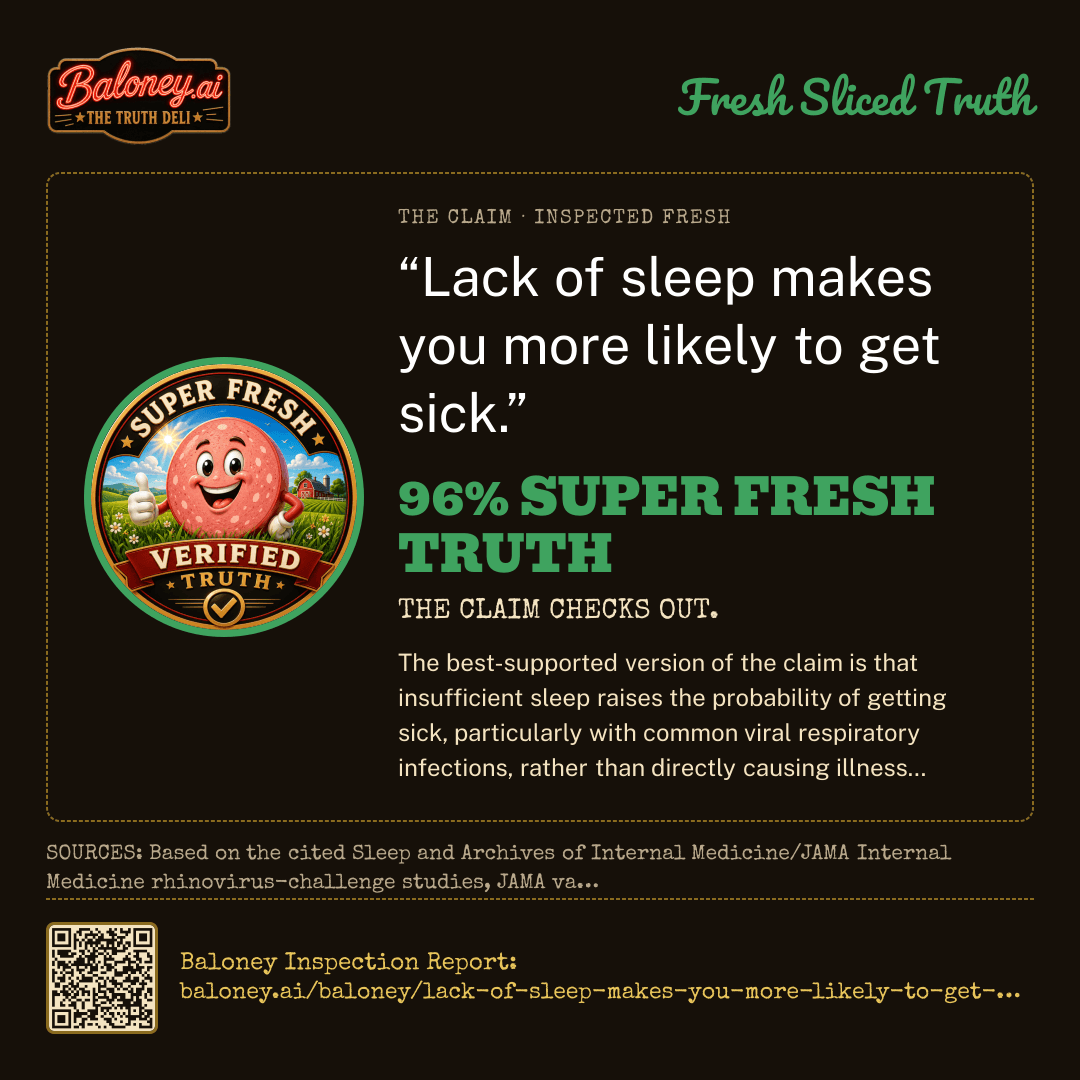
“Lack of sleep makes you more likely to get sick.”
SUBMITTED ANONYMOUSLY · INSPECTED 2026-09-14T18:07:49.396Z · STATUS: PUBLISHED
96%
96%
SUPER FRESH TRUTH — READY TO EAT!
THE CLAIM CHECKS OUT.
Independently verifiedPhysically repeatable evidenceConfirmed across rival labsSafe to serve
✓ BLIND VALIDATION CONFIRMED THIS SCORE
Serve It Fresh
Ready to Serve14 servings
Serve it the way you want it
The Verdict
“Lack of sleep makes you more likely to get sick.” 96% SUPER FRESH TRUTH — READY TO EAT! Verified blind by 5 frontier AIs · Baloney Inspection Report: baloney.ai/baloney/lack-of-sleep-makes-you-more-likely-to-get-sick
Station 1 · Blind Inspection — Five Graders, Zero Peeking
Each lab scored the claim independently, without seeing the others. Open a breakdown for its evidence, its sources, and how sure it was.
Anthropic · EQUAL WEIGHT · 41.7s
claude-opus-5
97%TRUTH
ROUND-1 BREAKDOWN
Evidence offered for the claim
Experimental viral-challenge studies show a dose-response relationship: in Prather et al. (2015, Sleep), healthy adults whose sleep was objectively measured by wrist actigraphy for a week and who were then inoculated with rhinovirus were substantially more likely to develop a clinical cold if they slept less than 6 hours per night (roughly 4x the odds compared with those sleeping more than 7 hours).
An earlier rhinovirus-challenge study (Cohen et al., 2009, Archives of Internal Medicine) found that shorter sleep duration and lower sleep efficiency in the weeks before viral exposure predicted higher rates of developing a cold, independent of pre-existing antibody levels, BMI, smoking, stress and season.
Sleep restriction blunts vaccine response, a direct marker of adaptive immune function: Spiegel, Sheridan & Van Cauter (2002, JAMA) found that people restricted to 4 hours of sleep for several nights around influenza immunization produced less than half the antibody titer of rested controls ten days later; similar findings were reported for hepatitis B vaccination in actigraphy-based studies.
There is a plausible, well-described biological mechanism: sleep supports T-cell function, antigen presentation, immunological memory formation and the nocturnal peak in pro-inflammatory cytokines (IL-12, growth hormone, prolactin) and low cortisol/catecholamine environment that favors Th1 responses. Sleep loss instead raises cortisol and catecholamines and elevates low-grade systemic inflammation (Besedovsky, Lange & Haack, Physiological Reviews, 2019).
Large observational cohorts and surveillance data associate habitual short sleep (<6-7 h) with higher self-reported rates of upper respiratory infection, pneumonia, and worse outcomes after infection; short sleep is also linked to reduced natural killer cell activity in laboratory studies.
Major health authorities and clinical bodies (CDC, NHLBI/NIH, Mayo Clinic) state that insufficient sleep weakens immune defenses and increases susceptibility to infections such as the common cold.
Evidence against the claim
Most of the strongest causal evidence concerns one narrow outcome, the experimental common cold, plus vaccine antibody titers. Extrapolating to 'getting sick' in general (bacterial infections, cancer, COVID-19 severity) is less firmly established.
Effect sizes in real life are modest and probabilistic, not deterministic: many chronically short sleepers do not get sick more often, and a single bad night is unlikely to meaningfully change infection risk. The claim is often overstated in popular media.
Much of the supporting literature is observational and vulnerable to confounding: short sleep clusters with stress, shift work, poverty, smoking, obesity, alcohol use and crowding, all of which independently raise infection risk.
Reverse causality and reporting bias are real problems: infection and inflammation themselves disrupt sleep, and people who feel unwell may both under-report sleep and over-report illness. Self-reported sleep duration is a weak predictor compared with objectively measured sleep, which weakens some of the literature.
Vaccine-response studies are small (often 10-30 subjects per arm), and some have found no significant association between sleep and antibody titers; laboratory sleep-deprivation protocols (e.g., 4 h for 6 nights) are also more extreme than typical real-world sleep loss.
The relationship is not linear: long sleep duration (>9 h) is also associated with worse health outcomes in cohort studies, indicating that sleep duration partly acts as a marker of underlying illness rather than purely a cause.
Immune biomarker changes after sleep loss (cytokine shifts, NK activity) do not always translate into measurable differences in clinical infection rates.
How sure this lab was
92/100 — the lab’s own confidence in the score above, not a second reading of the claim.
Controlled human rhinovirus-challenge evidence supports the claim: in Cohen et al. 2009, adults with shorter sleep duration and poorer sleep efficiency before viral exposure were more likely to develop a clinical cold, even after adjustment for multiple covariates.
A later study using objective sleep measurement found a similar pattern: Prather et al. 2015 reported that people sleeping under 6 hours per night in the week before rhinovirus exposure had substantially higher odds of developing a cold than those sleeping more than 7 hours.
Biological plausibility is strong: reviews of sleep-immune interactions conclude that sleep helps regulate innate and adaptive immune function, while sleep disruption can impair immune defense and alter inflammatory signaling.
Government health guidance also states that sleep deficiency can weaken immune function and that the immune system relies on adequate sleep to function well.
Evidence against the claim
The claim should be read probabilistically, not deterministically: lack of sleep increases risk but does not mean a person will necessarily get sick.
Much of the strongest direct human evidence concerns experimentally induced common-cold infection; it does not prove the same size of effect for every infectious disease or every kind of illness.
Some real-world associations between short sleep and sickness may be partly influenced by confounding factors such as stress, work schedule, underlying health, socioeconomic status, or pathogen exposure.
Getting sick still requires exposure to pathogens or other disease processes; sleep loss alone is not usually a sufficient cause of infectious illness.
How sure this lab was
92/100 — the lab’s own confidence in the score above, not a second reading of the claim.
Scientific research consistently shows that sleep deprivation impairs the immune system. During sleep, the immune system releases proteins called cytokines, which help fight infections and inflammation. Lack of sleep reduces the production of these protective cytokines.
A 2015 study published in the journal 'Sleep' objectively tracked participants' sleep duration and then exposed them to a rhinovirus (common cold). Participants who slept less than 6 hours per night were 4.2 times more likely to develop a clinical cold compared to those sleeping more than 7 hours.
Clinical studies indicate that chronic sleep restriction reduces the body's response to vaccines. Sleep-deprived individuals produce fewer infection-fighting antibodies and cells after receiving vaccines compared to well-rested individuals.
Evidence against the claim
Lack of sleep does not spontaneously create illness; an individual must still be exposed to a pathogen (virus or bacteria) to get sick. Sleep simply modulates the body's susceptibility to those pathogens.
While chronic sleep deprivation weakens the immune system, acute short-term sleep loss (like a single missed night of sleep) can sometimes trigger a temporary spike in certain non-specific immune markers as part of the body's acute stress response.
Sleep is only one variable in immune health. Other factors like diet, age, underlying health conditions, genetics, and hand hygiene can significantly offset or compound the effects of sleep deprivation on susceptibility to illness.
How sure this lab was
99/100 — the lab’s own confidence in the score above, not a second reading of the claim.
Larger experimental and observational studies find that **short sleep duration is associated with substantially higher risk of developing common viral illnesses**, especially colds and other upper‑respiratory infections. In an experimental rhinovirus challenge study using actigraphy, people sleeping less than about 5–6 hours per night in the week before exposure were roughly 4–4.5 times more likely to develop a clinical cold than those sleeping more than 7 hours.[1][9][14]
Self‑reported sleep habits show similar patterns: participants reporting under 7 hours of sleep were about 3 times more likely to develop a cold than those with 8 hours or more, with poorer sleep efficiency (more fragmented sleep) associated with about a 5‑fold increased risk.[2][3][6]
Recent reviews of sleep and immunity conclude that **habitual short sleep (≤5–6 hours) is consistently linked to greater vulnerability to respiratory infections** in cross‑sectional, prospective, and experimental viral challenge studies, in both adults and adolescents.[7][11]
A 2025 analysis of self‑reported sleep and infectious disease risk found that both short sleepers (≤6 h) and long sleepers (≥9 h) were more likely to report a recent cold than average sleepers (7–8 h), indicating that inadequate sleep (too little or too much) is associated with increased infection risk.[12]
Mechanistic reviews describe that **chronic sleep restriction alters immune function** (e.g., natural killer cell suppression, low‑grade inflammation, and circadian dysregulation of immune‑related genes), which plausibly increases susceptibility to infections and worsens disease outcomes.[5][7][10][11]
Authoritative physiological reviews state that adequate sleep is associated with **reduced infectious‑disease risk and better infection and vaccination outcomes**, whereas chronic sleep deficiency disrupts immune homeostasis, supporting a causal role for sleep in host defense.[11][6][8][15]
Evidence against the claim
Most of the strong evidence is **associational rather than fully causal**: many studies rely on self‑reported sleep and self‑reported infections, which can be affected by recall bias, unmeasured confounders (stress, socioeconomic status, existing health conditions), and reverse causality (early, subclinical illness disturbing sleep before symptoms are recognized).[2][3][12][15]
Some analyses indicate that **sleep fragmentation or efficiency does not always independently predict infection risk** once sleep duration and other factors are controlled. For example, in at least one experimental cold study, sleep fragmentation was not significantly related to developing a cold.[9]
The relationship between sleep and infection appears **non‑linear**: one large survey found that not only short sleep (≤6 h) but also long sleep (≥9 h) was associated with increased cold risk relative to 7–8 h, suggesting that other underlying health problems or behaviors (rather than sleep alone) might be driving some of the association.[12]
Experimental studies often involve **small, selected samples under artificial conditions** (e.g., deliberate rhinovirus inoculation), which may not generalize perfectly to broader populations or to other pathogens beyond common cold viruses.[1][2][3][9][14]
Reviews emphasize that sleep is one factor among many affecting infection risk; **adequate sleep reduces risk but does not guarantee health**, and some individuals with short sleep do not get sick, while some well‑rested individuals still develop infections, indicating that the effect, though real, is probabilistic rather than deterministic.[7][11][15]
How sure this lab was
94/100 — the lab’s own confidence in the score above, not a second reading of the claim.
Controlled human challenge studies find shorter sleep duration associated with higher rates of developing clinically verified colds after rhinovirus exposure.
Sleep restriction measurably impairs innate and adaptive immunity (reduced NK-cell activity, T-cell function, and vaccine antibody titers).
U.S. public-health agencies (CDC, NHLBI) list insufficient sleep as increasing susceptibility to infection.
Biological pathways are established: sleep regulates inflammatory cytokines and immune-cell trafficking; deprivation dysregulates them.
Evidence against the claim
Much everyday-illness evidence is observational and confounded by stress, socioeconomic status, BMI, and other health behaviors that co-occur with poor sleep.
Effects are probabilistic and modest; one or two nights of short sleep do not reliably produce clinical illness in healthy adults.
Causality is bidirectional—infection and inflammation themselves fragment sleep—so reverse causation can inflate associations.
Large individual differences exist (including rare genetic short-sleepers) and ‘lack of sleep’ is not a precisely quantified exposure.
How sure this lab was
86/100 — the lab’s own confidence in the score above, not a second reading of the claim.
The statement is substantially true as written. I gave the greatest weight to the controlled human rhinovirus-challenge studies described across the reports, because they measured sleep before deliberate viral exposure and then assessed clinically verified colds. Those studies directly support the wording "more likely to get sick," especially for common viral respiratory illness. I also gave substantial weight to vaccine-response studies and mechanistic reviews of sleep-immune interactions, because they provide biologically plausible support that insufficient sleep can weaken host defenses. Government and clinical guidance from CDC, NIH/NHLBI, and Mayo Clinic was accepted as consistent secondary support, not as the primary proof. I discounted student-level or insufficiently identified sources where the reports did not specify enough to verify them, but those sources were not necessary for the verdict. The main caveats are that the effect is probabilistic, strongest direct evidence concerns common colds and vaccine antibody response, and real-world associations can be confounded by stress, socioeconomic status, health behaviors, and early illness disrupting sleep. Those caveats do not make the statement false; they keep it from being a perfect, context-free 1.
All five evaluators agreed that insufficient sleep is linked to impaired immune function and higher susceptibility to at least some infections, especially common colds after rhinovirus exposure. They also agreed that the claim should be read probabilistically rather than deterministically, and that sleep is only one factor among many affecting illness risk. The disagreement was mainly scoring: Reports 2, 3, and 4 placed the claim clearly in the true range, while Reports 1 and 5 recommended higher fishy scores despite presenting largely the same supportive evidence and caveats. I treated those higher scores as over-penalizing normal scientific qualifications for a broadly accurate claim.
SUPER FRESH — VERIFIED AGAINST BASED ON THE CITED SLEEP AND ARCHIVES OF INTERNAL MEDICINE/JAMA INTERNAL MEDICINE RHINOVIRUS-CHALLENGE STUDIES, JAMA VACCINE-RESPONSE EVIDENCE, PHYSIOLOGICAL REVIEWS ON SLEEP-IMMUNE MECHANISMS, AND CDC/NIH/NHLBI GUIDANCE.
Blind Validation Master · never saw the Primary’s work
claude-opus-5
97% TRUTH
All five reports agree the claim is supported by strong, convergent evidence: controlled rhinovirus-challenge experiments (Cohen et al. 2009; Prather et al. 2015) showing ~3-4.5x higher odds of developing a clinical cold among short sleepers with objectively measured sleep, blunted vaccine antibody responses under sleep restriction (Spiegel et al.), well-described immunological mechanisms (NK-cell suppression, cytokine and circadian dysregulation; Besedovsky et al., Physiological Reviews), and endorsement by CDC, NIH/NHLBI and Mayo Clinic. The claim is phrased probabilistically ('more likely'), which is exactly how the evidence reads — it does not assert certainty or that sleep loss alone causes illness. The caveats raised (observational confounding, reverse causality, non-linear duration effects, generalization beyond the common cold, modest real-world effect sizes) are refinements of scope rather than contradictions; they do not undercut the core assertion. The two higher recommendations (10, 12) appear to penalize ordinary scientific caveats rather than any inaccuracy in the wording. This belongs firmly in the 'Super Fresh Truth' band, with a 3 rather than a 1 to reflect that the strongest causal evidence is concentrated on experimentally induced upper-respiratory infection rather than 'getting sick' in every sense.
AGREEMENT TEST PASSED — BOTH MASTERS SCORED 97% · BLIND VALIDATION CONFIRMED THIS SCORE · NO RE-EVALUATION REQUIRED
The Evidence
Evidence for the claim
Human cold-challenge evidence Controlled rhinovirus-exposure studies found that people who slept less before exposure were more likely to develop clinically verified colds. Reports cited findings that sleeping under about 6 hours was associated with several-fold higher odds of a clinical cold compared with sleeping more than 7 hours.
Dose-response pattern The cited cold-challenge studies reported that shorter sleep duration and poorer sleep efficiency before viral exposure predicted higher cold risk, including after adjustment for factors such as antibody levels, BMI, smoking, stress, and season.
Vaccine-response evidence Small clinical studies cited by the evaluators found that sleep restriction around vaccination can reduce antibody responses, including influenza and hepatitis B vaccine studies. That supports the idea that poor sleep can weaken adaptive immune protection.
Immune mechanisms Reviews described plausible biological pathways: sleep supports immune-cell trafficking, T-cell function, antigen presentation, immunological memory, cytokine regulation, and a hormonal environment favorable to immune defense. Sleep loss can alter cytokines, raise stress hormones, reduce natural killer cell activity, and promote low-grade inflammation.
Public-health guidance CDC, NIH/NHLBI, and Mayo Clinic materials cited by the evaluators state that insufficient sleep can weaken immune function and increase susceptibility to infections such as the common cold.
Observational consistency The reports cited broader observational and surveillance evidence associating habitual short sleep with more upper-respiratory infections, pneumonia, recent colds, and worse infection-related outcomes. This evidence is less decisive than the challenge studies but points in the same direction.
Evidence offered against the claim
Not deterministic Sleep loss does not guarantee illness. People still generally need exposure to a pathogen or another disease process, and many short sleepers will not get sick after a particular poor night or week of sleep.
Scope is strongest for colds The most direct causal human evidence cited concerns experimental common-cold infection and vaccine antibody titers. It does not prove the same size of effect for every infection, bacterial illness, cancer, or all forms of being sick.
Confounding remains Real-world short sleep is entangled with stress, shift work, socioeconomic status, smoking, obesity, alcohol use, crowding, and other health behaviors that can independently affect infection risk.
Reverse causality Illness and inflammation can themselves fragment sleep. Early, subclinical infection may make people sleep poorly before they realize they are sick, which can inflate some associations.
Study limitations Some vaccine-response studies are small, some immune-biomarker findings do not translate directly into clinical illness, and laboratory sleep-restriction protocols may be more extreme than ordinary sleep loss.
Individual variation The reports noted large differences among individuals, including rare people who may function well on shorter sleep, and the phrase "lack of sleep" does not specify a precise dose or duration.
Nonlinear associations Some cohort or survey evidence finds that long sleep is also associated with worse health outcomes or higher reported cold risk, suggesting that sleep duration can sometimes be a marker of underlying illness rather than a simple one-way cause.
Sources · Reliability · Why Accepted or Discounted
Source
Type
Reliability
Ruling
Centers for Disease Control and Prevention
gov
93
ACCEPTED — Accepted as a reliable public-health source for general guidance that insufficient sleep can affect immune function and infection susceptibility.
National Heart, Lung, and Blood Institute / National Institutes of Health
gov
94
ACCEPTED — Accepted as reliable government health guidance on sleep deficiency and immune health.
National Institutes of Health
gov
98
ACCEPTED — Accepted as a high-reliability government source for general biomedical information, though the primary evidentiary weight comes from the cited studies.
U.S. National Library of Medicine / PubMed / PubMed Central
gov
95
ACCEPTED — Accepted as a reliable indexing and access platform for biomedical literature; it is not treated as an independent study source.
Archives of Internal Medicine / JAMA Internal Medicine
journal
93
ACCEPTED — Accepted as a peer-reviewed journal source for the Cohen et al. sleep-habits and common-cold challenge evidence.
Sleep
journal
94
ACCEPTED — Accepted as a peer-reviewed sleep-medicine journal source for the Prather et al. actigraphy and rhinovirus-challenge evidence.
JAMA
journal
88
ACCEPTED — Accepted for the cited sleep-deprivation and immunization-response study, while noting that vaccine-response studies were described as small and not identical to clinical infection outcomes.
Physiological Reviews
journal
96
ACCEPTED — Accepted as a high-quality peer-reviewed review source for mechanisms of sleep-immune crosstalk.
Mayo Clinic
other
90
ACCEPTED — Accepted as a reputable clinical-information source summarizing the mainstream conclusion that lack of sleep can increase sickness risk; used as secondary support.
Washington State University book chapter on Sleep and Host Defense
edu
85
ACCEPTED — Accepted only as supplemental educational background on mechanisms, not as a primary basis for the verdict.
Philosophical Transactions of the Royal Society B
journal
97
ACCEPTED — Accepted as a peer-reviewed journal source relevant to broader sleep, immunity, and infection-risk discussion.
Wiley peer-reviewed journal
journal
90
DISCOUNTED — Discounted for this published verdict because the evaluator did not identify the specific journal article clearly enough to verify or describe it independently.
Nature Reviews-style journal via PubMed Central
journal
95
DISCOUNTED — Discounted because the report’s description is too vague to identify the exact source; the same mechanistic point is already supported by named peer-reviewed reviews.
National High School Journal of Science
edu
70
DISCOUNTED — Discounted because it is a student-level source and unnecessary given the availability of peer-reviewed journals and government health sources.
Serve It Fresh
Ready to Serve14 servings
Serve it the way you want it
The Verdict
“Lack of sleep makes you more likely to get sick.” 96% SUPER FRESH TRUTH — READY TO EAT! Verified blind by 5 frontier AIs · Baloney Inspection Report: baloney.ai/baloney/lack-of-sleep-makes-you-more-likely-to-get-sick