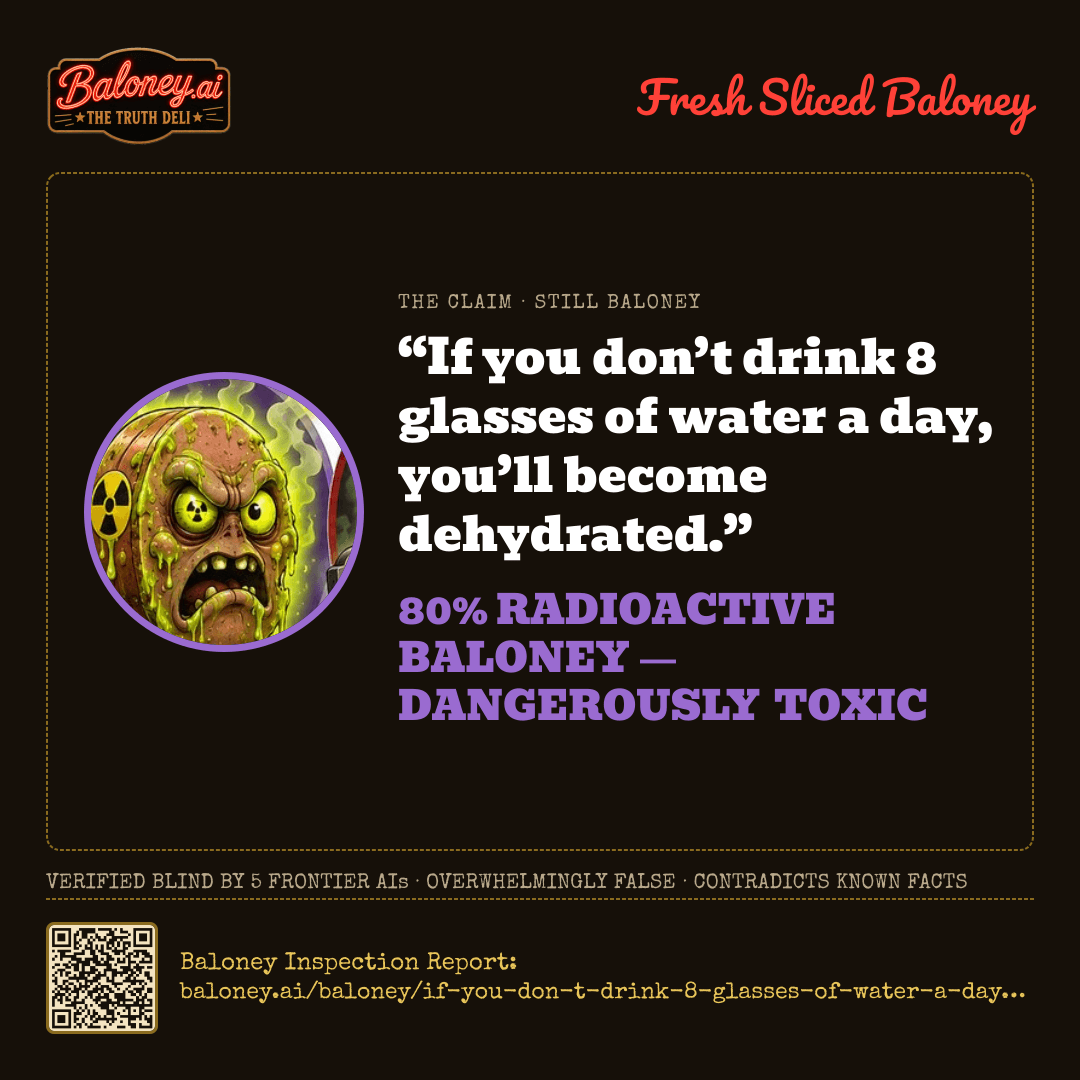
“If you don’t drink 8 glasses of water a day, you’ll become dehydrated.”
80%RADIOACTIVE BALONEY — DANGEROUSLY TOXIC
Dangerously misleading.
Overwhelmingly falseContradicts known factsPromotes false beliefsPotential for harm
✓ BLIND VALIDATION CONFIRMED THIS SCORE
Serve It Fresh
Ready to Serve11 servings
Serve it the way you want it
The Verdict
“If you don’t drink 8 glasses of water a day, you’ll become dehydrated.” 80% RADIOACTIVE BALONEY — DANGEROUSLY TOXIC Verified blind by 5 frontier AIs · Baloney Inspection Report: baloney.ai/baloney/if-you-don-t-drink-8-glasses-of-water-a-day-you-ll-become
Station 1 · Blind Inspection — Five Graders, Zero Peeking
Each lab scored the claim independently, without seeing the others. Open a breakdown for its evidence, its sources, and how sure it was.
Anthropic · EQUAL WEIGHT · 48.3s
claude-opus-5
80%BALONEY
ROUND-1 BREAKDOWN
Evidence offered for the claim
Adequate total water intake is genuinely necessary: the U.S. Institute of Medicine (2004) set Adequate Intakes of about 3.7 L/day total water for men and 2.7 L/day for women, and roughly 80% of that typically comes from beverages — so a habitual intake far below ~2 L of fluid can, in some people, fall short.
Eight 8-ounce glasses (~1.9 L) is not wildly off the mark as a rough beverage target for an average adult woman, so the number itself is a plausible ballpark rather than an absurd figure.
Some public health bodies do issue glass-count guidance: the UK NHS advises drinking 6–8 cups/glasses of fluid a day, which is close to the '8 glasses' figure (though it counts milk, tea, coffee, and other drinks, not just water).
Dehydration is a real and clinically meaningful condition, and certain groups — older adults with blunted thirst, infants, people with fever, vomiting, diarrhea, diabetes insipidus, high heat exposure, or heavy exercise — genuinely can become hypohydrated without deliberate fluid intake.
Mild hypohydration (~1–2% body mass loss) has been associated in some studies with reduced cognitive performance, headache, and fatigue, which gives some rationale for prompting people to drink regularly.
Evidence against the claim
The '8x8' rule has no identified scientific origin. Physiologist Heinz Valtin's 2002 review in the American Journal of Physiology searched the literature and found no scientific evidence that healthy adults in temperate climates need 8 glasses of water per day, and found evidence that such intake is unnecessary.
The rule is widely believed to stem from a 1945 U.S. Food and Nutrition Board statement recommending ~1 mL water per calorie (~2.5 L/day), which explicitly added that 'most of this quantity is contained in prepared foods' — a sentence commonly dropped when the advice is repeated.
Food contributes roughly 20% of total water intake, and all beverages — including coffee, tea, milk, juice, and soft drinks — count toward hydration. Caffeinated drinks are not net dehydrating at ordinary doses. So total daily water intake is much larger than the plain water one consciously drinks.
The IOM/National Academies concluded that 'the vast majority of healthy people adequately meet their daily hydration needs by letting thirst be their guide.' Human osmoregulation (thirst and vasopressin/ADH) maintains plasma osmolality within ~1–2%, making spontaneous dehydration in healthy people with free access to fluids unusual.
The claim was listed among 'medical myths even doctors believe' in a BMJ review (Vreeman & Carroll, 2007), which found no supporting evidence for the eight-glasses requirement.
A large 2022 Science study of water turnover using doubly labelled water in >5,600 people across 26 countries found requirements vary enormously by body size, activity, climate, and age, and the authors stated that a universal eight-glasses recommendation is not supported.
The CDC does not issue a specific daily plain-water quantity for adults, and the EFSA adequate intakes (2.0 L/day women, 2.5 L/day men total water, food included) again do not translate into a fixed eight-glass rule.
The claim's causal framing is the biggest problem: 'dehydration' is a clinical state of negative water balance with measurable signs (rising plasma osmolality, concentrated urine, weight loss), not the default outcome of drinking seven glasses instead of eight.
Over-drinking is not risk-free: forcing fluids well beyond thirst has caused exercise-associated hyponatremia and, rarely, fatal water intoxication — so the myth is not harmless for everyone.
How sure this lab was
90/100 — the lab’s own confidence in the score above, not a second reading of the claim.
The body does require adequate fluid intake: dehydration is defined as occurring when the body loses more fluid than it takes in, so insufficient intake relative to losses can cause dehydration, especially with heat, exercise, fever, vomiting, diarrhea, or heavy sweating.
Some public-health guidance uses numbers in the neighborhood of 8 glasses: the UK NHS advises 6 to 8 cups or glasses of fluid per day, and EFSA set adequate intakes around 2.0 L/day total water for women and 2.5 L/day for men under moderate conditions. These support the general idea that people need regular daily fluids.
The National Academies dietary reference intakes estimate higher total-water adequate intakes, about 2.7 L/day for women and 3.7 L/day for men, showing that typical hydration needs can be substantial, though these are total water from foods and beverages, not 8 glasses of plain water.
Evidence against the claim
The claim is too absolute: not drinking 8 glasses of plain water does not mean a person will become dehydrated, because total water comes from plain water, other beverages, and foods.
The National Academies report states that most healthy people can meet hydration needs by letting thirst guide them and that all beverages, including caffeinated beverages, contribute to total water intake; roughly 20% of total water commonly comes from food.
A peer-reviewed review by Heinz Valtin found no scientific evidence supporting the universal rule that healthy adults must drink at least eight 8-ounce glasses of water per day to avoid dehydration under ordinary conditions.
Fluid needs vary substantially by body size, diet, climate, activity level, health status, pregnancy/lactation, and losses from illness or sweating; therefore a single 8-glass threshold is not a reliable dehydration cutoff.
Even recommendations close to the 8-glass number, such as the NHS 6-to-8-glasses guidance, refer to fluids generally, not necessarily plain water, and do not say dehydration is inevitable below that amount.
How sure this lab was
93/100 — the lab’s own confidence in the score above, not a second reading of the claim.
The '8x8 rule' (eight 8-ounce glasses of water a day) serves as an easy-to-remember heuristic that encourages generally healthy habits and adequate daily fluid intake.
A 1945 recommendation by the US Food and Nutrition Board suggested about 2.5 liters of daily water intake, which roughly equals 8 glasses, though this guideline originally noted that most of this quantity is contained in prepared foods—a caveat that was lost over time.
Evidence against the claim
Hydration needs vary drastically based on an individual's body size, activity level, metabolism, and environmental factors (such as heat and humidity), making a universal '8 glasses' requirement scientifically inaccurate.
Approximately 20% of daily fluid intake typically comes from food, especially water-rich fruits and vegetables like watermelon, cucumbers, and spinach.
Other beverages such as milk, juice, and even mildly caffeinated drinks like coffee and tea contribute to total daily fluid intake and actively hydrate the body.
In healthy individuals, the body's natural thirst mechanism is a highly sensitive and reliable indicator for maintaining hydration long before clinical dehydration occurs.
Extensive scientific reviews, including a landmark 2002 study by Dr. Heinz Valtin in the American Journal of Physiology, found no scientific evidence supporting the strict requirement of drinking eight 8-ounce glasses of plain water a day.
How sure this lab was
98/100 — the lab’s own confidence in the score above, not a second reading of the claim.
Chronic underconsumption of fluids relative to physiological needs can lead to dehydration, so for some people 8 standard glasses (~2 liters) could be a reasonable *heuristic* target in certain conditions (e.g., high activity, heat) to reduce risk of mild dehydration.[1][10][15]
The U.S. National Academies and related summaries estimate total daily water needs for adults around 2.7 L for women and 3.7 L for men from all sources (food + beverages); for many smaller or less active adults, 8 glasses of fluids can fall within this range and help meet overall requirements.[1][10][13][14][15]
Clinical and public‑health discussions of hydration consistently emphasize that inadequate fluid intake over time can cause symptoms like fatigue, headache, and impaired physical or cognitive performance, which people sometimes interpret as ‘being dehydrated’; 8‑glass rules attempt to prevent this by promoting regular drinking even before thirst.[1][2][8][9][15]
Guidance from health systems notes that people with increased needs (fever, vomiting/diarrhea, intense exercise, hot environments, pregnancy, certain medications) must be more proactive with fluid intake to avoid dehydration, and set‑number rules like 8 glasses are often used in patient education as a simple precautionary message.[1][8][13][15]
Evidence against the claim
Multiple medical reviews have found **no scientific evidence** specifically supporting the rule that everyone must drink at least eight 8‑oz glasses of water per day; surveys of thousands of healthy adults show such large amounts are not universally required, and the original 8×8 advice lacks rigorous proof.[3][7][12]
Harvard Health and other academic sources state that for most people the 8‑glasses‑per‑day advice can be *safely ignored*; if you drink when thirsty, eat a balanced diet, and feel well, you are likely getting all the water you need, without automatically becoming dehydrated from drinking less than 8 glasses.[4][11]
A widely cited physiological review and subsequent commentaries describe the ‘drink at least 8 glasses of water a day’ rule as an **urban myth**, noting that the admonition has become popular without supporting data and that surveyed adults consuming less than 8 glasses were healthy and not overtly dehydrated.[3][5][7][11]
Nutrition and hydration experts explain that individual water needs vary substantially with age, body size, activity level, climate, health status, and diet; many people obtain a significant fraction of water from food and non‑water beverages, so not drinking 8 glasses of *plain water* does not imply dehydration.[1][2][8][10][13][14][15]
Articles summarizing the evidence note that there is **no hard and fast rule** for daily water intake and advise people to listen to thirst and monitor urine color and energy levels, rather than follow a fixed 8‑glass requirement; they explicitly reject the idea that drinking less than 8 glasses will, by itself, make you dehydrated.[2][4][8][9]
Historical analyses trace the 6–8 glasses myth to a misinterpretation of a 1945 U.S. Food and Nutrition Board recommendation of ~2.5 L/day, which included water from food; later popular retellings dropped the ‘from all sources’ caveat, turning it into a rigid ‘8 glasses of water’ rule not grounded in the original science.[11]
Government and clinical guidelines that give numeric intake ranges (e.g., 2.7–3.7 L total water/day) emphasize that these are averages and include water from food; they do **not** state that consuming less than 8 glasses of water automatically causes dehydration, nor do they endorse the specific claim in the question.[1][10][13][14][15]
How sure this lab was
94/100 — the lab’s own confidence in the score above, not a second reading of the claim.
Water is required for essential physiological functions; inadequate replacement of fluid losses can produce dehydration.
Some public-health bodies (e.g., NHS) advise roughly 6–8 glasses of fluid daily as a practical hydration target.
Under high heat, heavy exercise, or illness, failing to consume a volume on the order of eight glasses can contribute to net fluid deficit.
Evidence against the claim
No controlled evidence supports a universal rule that exactly eight 8-oz glasses of plain water are required to avoid dehydration.
A 2002 scientific review found no origin or supporting data for the popular “8 × 8” prescription.
Total water needs (food moisture ~20 % plus all beverages) vary widely by body size, activity, climate and diet; thirst is a reliable cue for most healthy people.
National Academies adequate-intake values are ~3.7 L (men) and ~2.7 L (women) from all sources, not eight glasses of water specifically.
Many people routinely consume less than eight glasses of plain water yet remain euhydrated.
How sure this lab was
82/100 — the lab’s own confidence in the score above, not a second reading of the claim.
All five evaluators independently landed in a tight band (80–86), and the underlying evidence is consistent and one-directional. The claim as written makes two assertions: that there is a fixed universal threshold of eight glasses of water, and that falling below it causes dehydration. Both fail. The panel converged on the same core findings: (1) Heinz Valtin's 2002 review in the American Journal of Physiology searched the literature and found no scientific basis for the '8 x 8' rule; (2) the rule appears to be a garbled retelling of a 1945 US Food and Nutrition Board statement recommending ~2.5 L/day that explicitly added 'most of this quantity is contained in prepared foods' — a caveat dropped in later repetition; (3) roughly 20% of total water intake comes from food and all beverages, including tea and coffee, count toward hydration, so plain-water glasses are the wrong unit of measurement; (4) the Institute of Medicine/National Academies concluded that the vast majority of healthy people meet hydration needs by letting thirst be their guide; (5) requirements vary enormously with body size, age, activity, climate and health status, as the 2022 Science doubly-labelled-water study of over 5,600 people across 26 countries confirmed. The claim is not pure fiction — dehydration is real, fluid intake genuinely matters, and some bodies (NHS) do give 6–8 glasses of *fluid* as a rough target — so it is not at the very top of the scale. But the statement as written is a false causal rule: drinking seven glasses of plain water does not make a person dehydrated, and the framing has real downside, since forcing fluids well beyond thirst has caused exercise-associated hyponatremia. That combination of a false universal threshold, a false causal claim and some potential for harm places it in the low 80s, matching the panel. I did not set the zombie flag: although the 8x8 myth has been debunked repeatedly since 2002, the statement contains a genuine physiological kernel (insufficient fluid relative to losses does cause dehydration) and is not the wholesale, evidence-free fabrication that the 99 band is reserved for.
Agreement was unusually high. All five evaluators scored the claim between 80 and 86 with confidence 82–98, and every one of them cited Valtin's 2002 American Journal of Physiology review as decisive. All five independently raised the same three refutations: food and non-water beverages contribute substantially to total water intake, needs vary widely between individuals and conditions, and thirst is a reliable guide for healthy people with access to fluids. The only real divergence was emphasis. Report 1 scored highest (86) and leaned on the fact that the claim's absolutism, rather than its arithmetic, is the failure. Reports 3 and 5 gave the most thorough case, adding the BMJ 'medical myths' listing, the 2022 Science water-turnover study, and the hyponatremia risk of over-drinking. Report 4 was the least confident (82) but reached the same conclusion. Reports 2, 3 and 5 all traced the myth to the misread 1945 Food and Nutrition Board figure. No evaluator argued the claim was substantially true.
Blind Validation Master · never saw the Primary’s work
sonar-pro
85% BALONEY
All five reports agree that adequate daily fluid intake is necessary and that volumes around 2 liters (roughly 8 glasses) are within a plausible range for many adults, especially under certain conditions, so the *number* itself is not absurd and can function as a simple heuristic. However, the specific statement being evaluated—“If you don’t drink 8 glasses of water a day, you’ll become dehydrated”—is framed as a universal, causal rule about *plain water* that is both too rigid and contradicted by the cited evidence.
Across the reports, multiple high‑reliability sources (National Academies, EFSA, NHS, Mayo Clinic, Harvard, NIH, peer‑reviewed journals) emphasize that:
- Total water intake includes *all beverages* and water in food, with food typically providing about 20% of daily water. Therefore, not drinking 8 glasses of plain water does not equate to inadequate total water intake.
- Adequate intake values (e.g., ~2.7 L for women, ~3.7 L for men) are averages from *all sources* and are not expressed as a strict 8‑glass rule or as a threshold below which dehydration must occur.
- Healthy adults with free access to fluids generally maintain hydration by drinking to thirst; major scientific reviews explicitly state there is no evidence that everyone must drink eight 8‑oz glasses of water daily to avoid dehydration.
- The popular “8×8” rule is traced to a misinterpreted 1945 recommendation that *explicitly* included water from foods; later retellings turned this into an unsupported command to drink 8 glasses of water.
The claim’s strongest problems are its absolutism and its causal guarantee: it implies that consuming less than 8 glasses of water *necessarily* causes dehydration in all people, which is directly at odds with evidence that many people regularly drink less than this amount of plain water and remain euhydrated, and that hydration needs vary widely with body size, activity, climate, health status, and diet. The reports also note that authoritative reviews (e.g., Valtin 2002 in American Journal of Physiology, BMJ’s “medical myths”) explicitly classify the 8‑glasses requirement as a myth lacking supporting data.
Because the statement as written is overwhelmingly false, overgeneralized, and potentially harmful if it leads people to ignore thirst cues or overconsume water in situations where extra intake is unnecessary or risky, it belongs firmly in the “Radioactive Baloney” band. At the same time, it is not maximally egregious (Zombie Baloney) because it is loosely related to a reasonable idea—promoting regular fluid intake—and uses a volume that is not entirely disconnected from typical averages. Balancing the near‑consensus recommended scores (80–86) and the strength of the evidence against the literal claim, an overall score of 85 appropriately reflects that this is a widely debunked, strongly misleading hydration myth rather than a nuanced exaggeration.
AGREEMENT TEST PASSED — MASTERS SCORED 82% AND 85% · BLIND VALIDATION CONFIRMED THIS SCORE · NO RE-EVALUATION REQUIRED
The Evidence
Evidence offered for the claim
Dehydration is real and fluid intake matters Dehydration occurs when the body loses more fluid than it takes in, so chronically inadequate intake relative to losses genuinely can cause it — particularly with heat, heavy exercise, fever, vomiting or diarrhoea. That establishes the need for fluids, not a threshold of eight glasses.
Some health bodies do cite a similar numberDEBUNKED — The NHS advises 6–8 cups or glasses a day, which is close to the figure in the claim. But the NHS guidance counts all fluids — milk, tea, coffee, other drinks — not plain water, and nowhere states that dehydration follows from drinking less.
Official intake figures are substantialDEBUNKED — The National Academies set adequate intakes of about 3.7 L/day total water for men and 2.7 L/day for women, and EFSA about 2.5 L and 2.0 L. These are totals from food and all beverages, and are averages rather than minimums below which dehydration occurs.
The 1945 recommendation of about 2.5 litresDEBUNKED — The US Food and Nutrition Board did recommend roughly 2.5 L of water daily in 1945, which is approximately eight glasses. The same statement added that most of this quantity is contained in prepared foods — the sentence that was dropped as the advice was retold, creating the myth.
A simple rule encourages good habitsDEBUNKED — Eight glasses is an easy-to-remember heuristic, and some groups — older adults with blunted thirst, infants, people with fever or heavy heat exposure — do need prompting to drink. This is an argument for a nudge, not evidence that the number is a physiological requirement.
Evidence against the claim
No evidence for the 8x8 rule Physiologist Heinz Valtin's 2002 review in the American Journal of Physiology searched the literature for the origin and support of the 'eight 8-ounce glasses' prescription and found neither — no scientific evidence that healthy adults in temperate climates need that much, and evidence that they do not.
Food and all drinks count Roughly 20% of total water intake comes from food, especially water-rich fruit and vegetables, and milk, juice, tea and coffee all hydrate. Caffeinated drinks are not net dehydrating at ordinary doses, so plain-water glasses badly understate actual intake.
Thirst is a reliable guide The Institute of Medicine concluded that the vast majority of healthy people adequately meet their daily hydration needs by letting thirst be their guide. Osmoregulation holds plasma osmolality within about 1–2%, making spontaneous dehydration unusual in healthy people with access to fluids.
Needs vary enormously A 2022 Science study measuring water turnover by doubly labelled water in more than 5,600 people across 26 countries found requirements vary widely with body size, age, activity and climate; the authors said a universal eight-glasses recommendation is not supported.
Listed as a medical myth A 2007 BMJ review by Vreeman and Carroll included the eight-glasses rule among medical myths believed even by doctors, finding no supporting evidence. Harvard Health and other academic sources say most people can safely ignore the advice.
The causal framing is wrong Dehydration is a clinical state of negative water balance with measurable signs — rising plasma osmolality, concentrated urine, weight loss — not the automatic consequence of drinking seven glasses instead of eight. Many people drink less and remain euhydrated.
Over-drinking carries its own risk Forcing fluids well beyond thirst has caused exercise-associated hyponatremia and, rarely, fatal water intoxication, so the myth is not harmless for everyone.
Sources · Reliability · Why Accepted or Discounted
ACCEPTED — Large multinational doubly-labelled-water measurement of actual water turnover; the strongest direct empirical test of whether a universal figure exists.
ACCEPTED — National guidance cited by three evaluators; accepted, but read carefully — it says 6–8 glasses of fluid, not water, and sets no dehydration threshold.
ACCEPTED — Reliable general reporting, but used here only as secondary reporting of the scientific findings.
Serve It Fresh
Ready to Serve11 servings
Serve it the way you want it
The Verdict
“If you don’t drink 8 glasses of water a day, you’ll become dehydrated.” 80% RADIOACTIVE BALONEY — DANGEROUSLY TOXIC Verified blind by 5 frontier AIs · Baloney Inspection Report: baloney.ai/baloney/if-you-don-t-drink-8-glasses-of-water-a-day-you-ll-become