








Anthropic · EQUAL WEIGHT · 46.4s
claude-opus-5
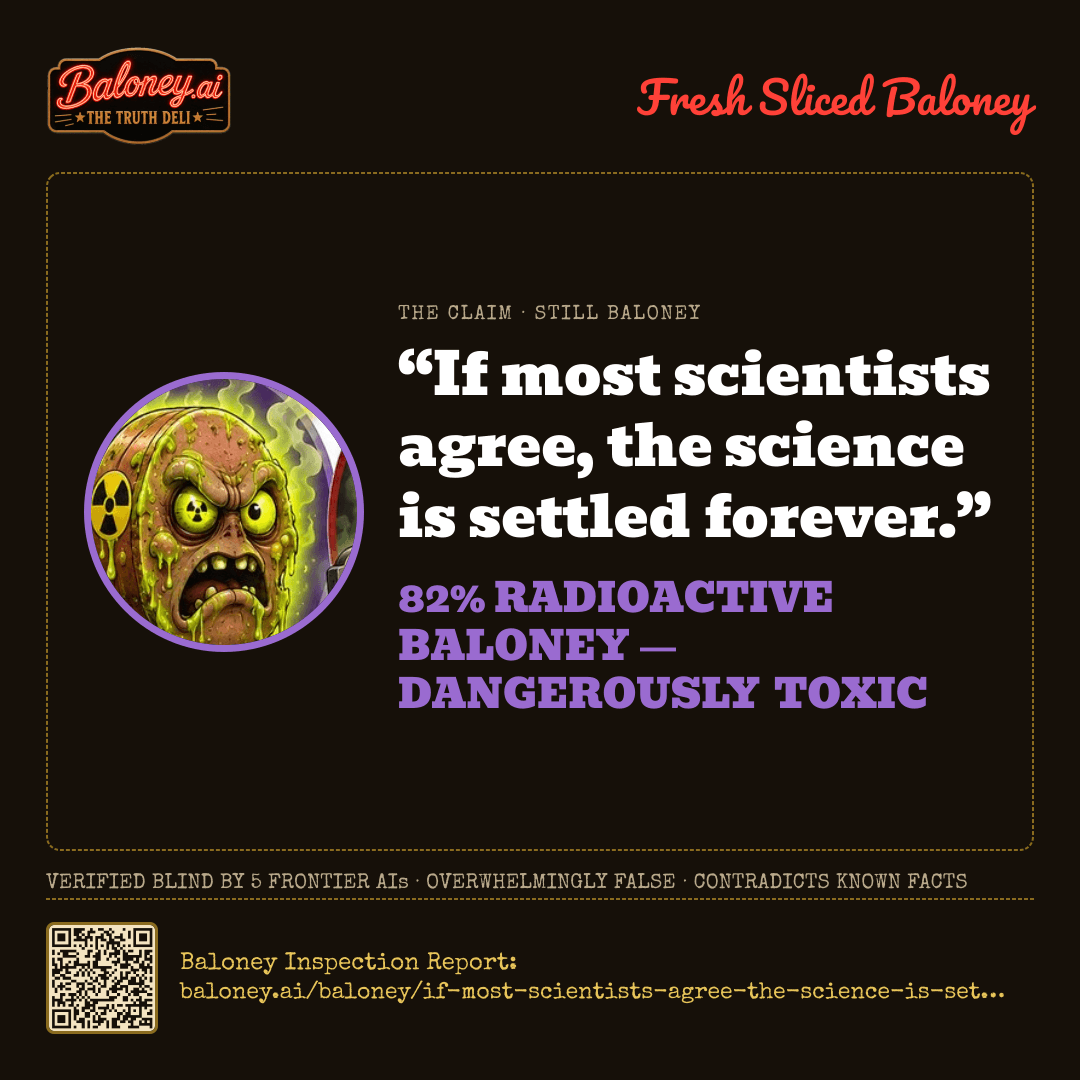
82%BALONEY
ROUND-1 BREAKDOWN
- Broad expert consensus is empirically one of the best available proxies for reliability: on well-tested core theories (germ theory, evolution by natural selection, the laws of thermodynamics, heliocentrism), agreement has held for a century or more without reversal.
- Consensus positions are not mere opinion polls; they typically summarize converging lines of independent evidence. The ~97%+ agreement among publishing climate scientists that recent warming is human-caused (Oreskes 2004; Cook et al. 2013) reflects multiple independent datasets, not deference to authority.
- In practical/policy terms, some questions really are closed for all decision-relevant purposes: that smoking causes lung cancer, that vaccines do not cause autism, or that the Earth is ~4.5 billion years old. Reopening these absent extraordinary new evidence would be unreasonable, so 'settled' is a defensible shorthand.
- Formal assessment bodies (IPCC, National Academies, WHO) exist precisely because aggregated expert judgment outperforms individual or lay judgment, and their high-confidence conclusions have rarely been overturned.
- The costs of treating settled findings as perpetually open are real: manufactured doubt about tobacco, ozone depletion, and climate change delayed protective action for decades.
- The word 'forever' makes the claim false as stated. Science is provisional by construction; every conclusion is held open to revision by new evidence. The Royal Society's founding motto 'Nullius in verba' ('take nobody's word for it') encodes this.
- Documented consensus reversals: peptic ulcers were near-universally attributed to stress and acid until Marshall and Warren showed Helicobacter pylori causation — work initially rejected, later awarded the 2005 Nobel Prize in Physiology or Medicine.
- Continental drift was dismissed by most geologists from 1912 into the 1950s, then became the foundation of plate tectonics once seafloor-spreading evidence arrived (USGS).
- Newtonian mechanics was the near-unanimous consensus for ~200 years and was superseded (as a limiting case) by relativity and quantum mechanics — showing that even extremely well-supported consensus can be bounded or replaced.
- Consensus is not itself evidence; it is a signal about evidence. Treating agreement as proof is an appeal to authority/majority. Kuhn's work on paradigm shifts documents how consensus can entrench assumptions that later collapse.
- Replication problems show consensus can form on weak foundations: the Open Science Collaboration (2015) replicated fewer than half of 100 psychology findings, and a 2016 Nature survey found ~70% of researchers had failed to reproduce another scientist's experiment.
- Ioannidis (2005) argued that in fields with small effect sizes, flexible analysis, and strong incentives, a large share of published (and therefore consensus-forming) findings may be false.
- Scientific bodies themselves avoid 'settled forever' language: the IPCC assigns graded confidence and likelihood levels and revises conclusions across assessment cycles, which is the opposite of permanence.
- The claim conflates degrees of establishment: 'most scientists agree' (e.g., a bare majority on a new preliminary result) is a far weaker condition than the near-total, multi-decade, multi-method agreement that underpins genuinely robust theories.
92/100 — the lab’s own confidence in the score above, not a second reading of the claim.
SourcesThe Nobel Foundationother · 95 · U.S. Geological Survey — 'This Dynamic Earth: The Story of Plate Tectonics'gov · 94 · Environmental Research Letters (Cook et al., 2013)journal · 85 · Science (Oreskes, 2004, 'The Scientific Consensus on Climate Change')journal · 90 · Science (Open Science Collaboration, 2015, 'Estimating the reproducibility of psychological science')journal · 92 · PLoS Medicine (Ioannidis, 2005, 'Why Most Published Research Findings Are False')journal · 85 · Nature (Baker, 2016, '1,500 scientists lift the lid on reproducibility')journal · 90 · Intergovernmental Panel on Climate Change, AR6 Working Group Igov · 93 · NASAgov · 92 · The Royal Society (motto 'Nullius in verba')other · 88