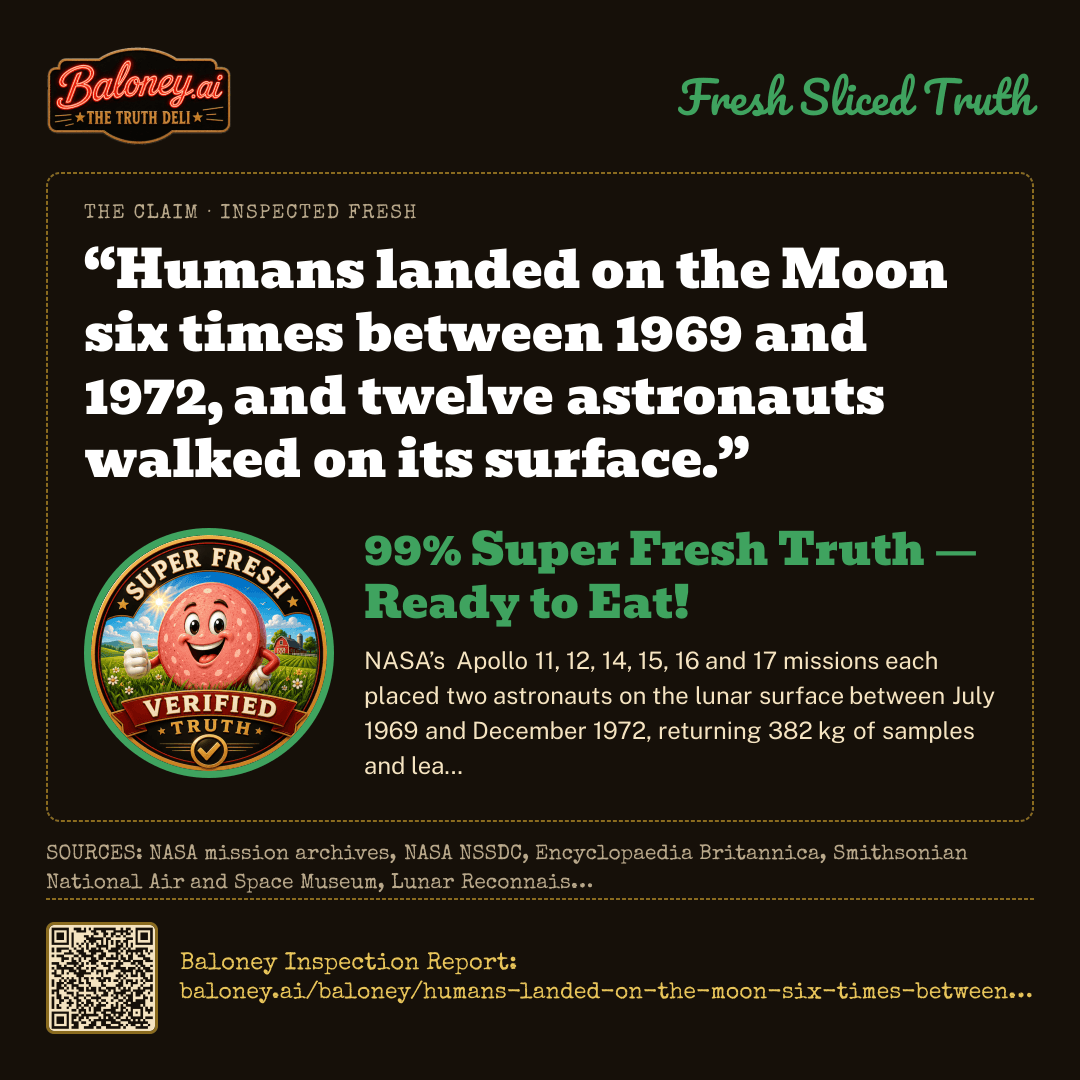
“Humans landed on the Moon six times between 1969 and 1972, and twelve astronauts walked on its surface.”99% Super Fresh Truth — Ready to Eat!Verified blind by 5 frontier AIs · Baloney Inspection Report: baloney.ai/baloney/humans-landed-on-the-moon-six-times-between-1969-and-1972-owy2ng
The Rating Card
The claim this refutes
The Baloney Sampler
Humans did land on the Moon six times from 1969 to 1972, and twelve astronauts walked on its surface. NASA mission archives, NASA NSSDC landing-site records, and the Smithsonian National Air and Space Museum document the six successful Apollo landings and the twelve moonwalkers, two per mission.
The reports rest this on lunar samples from NASA's Astromaterials Acquisition and Curation Office analysed worldwide, laser retroreflectors still used for ranging, and Lunar Reconnaissance Orbiter Camera imagery at Arizona State University showing descent stages and tracks at all six sites. Independent tracking by Jodrell Bank Observatory, plus reviews by Snopes and FactCheck.org, found no credible evidence against the claim.
Other ways to slice it — phrasings that might have changed the rating
“Humans landed on the Moon seven times between 1969 and 1972.” The reports note Apollo 13 as a seventh landing attempt in 1970 that failed and returned without landing, a count the labs treated as a common source of confusion.
“No humans have ever walked on the Moon; the Apollo landings were staged.” Every lab report discusses moon-landing-hoax claims based on photographs, flags, and radiation, which were the only contrary material considered.
“Twenty-four astronauts traveled to the Moon on nine crewed Apollo missions, including orbit-only flights.” The reports distinguish six surface landings from the wider set of crewed lunar missions and from the twenty-four astronauts who reached the Moon while only twelve walked on it.
Written from the panel’s reports by xAI · grok-4.6. Nothing here changed the score.
06:20:09SCORING MODEL V2 — MEDIAN OF 5 COUNTED LAB SCORES: 2, 1, 1, 3, 1 → 1.✓
How This One Was Sliced
Station 1 · Blind Inspection — Five Graders, Zero Peeking
Each lab scored the claim independently, without seeing the others. Open a breakdown for its evidence, its sources, and how sure it was.
Anthropic · EQUAL WEIGHT · 20.5s
claude-opus-5
98%TRUTH
ROUND-1 BREAKDOWN
Evidence offered for the claim
NASA's Apollo program records document six successful crewed lunar landings: Apollo 11 (July 1969), Apollo 12 (November 1969), Apollo 14 (February 1971), Apollo 15 (July-August 1971), Apollo 16 (April 1972), and Apollo 17 (December 1972) — exactly six, all within 1969-1972.
Each landing mission had a two-person surface crew while a third astronaut remained in lunar orbit, yielding 6 x 2 = 12 individuals who walked on the lunar surface: Neil Armstrong and Buzz Aldrin; Pete Conrad and Alan Bean; Alan Shepard and Edgar Mitchell; David Scott and James Irwin; John Young and Charles Duke; Eugene Cernan and Harrison Schmitt. No astronaut walked on the Moon twice, so the count of 12 distinct people is exact.
Physical evidence independent of NASA testimony supports the landings: 382 kg of returned lunar samples distributed to and analyzed by laboratories worldwide and published in peer-reviewed journals (e.g., Proceedings of the Lunar and Planetary Science Conference); retroreflector arrays left by Apollo 11, 14 and 15 are still used today for lunar laser ranging by observatories in the U.S., France and elsewhere.
Independent orbital imaging by NASA's Lunar Reconnaissance Orbiter (from 2009 onward) resolves the Apollo descent stages, equipment and astronaut foot tracks at all six landing sites; India's Chandrayaan-2 orbiter and Japan's SELENE/Kaguya mission have also imaged Apollo site features.
Contemporaneous independent tracking: the Soviet Union, the UK's Jodrell Bank Observatory and Australian stations (Honeysuckle Creek, Parkes) tracked and received Apollo transmissions in real time; no Cold War adversary ever disputed the landings.
Fact-checking organizations including Snopes and AFP Fact Check have repeatedly reviewed and rejected Moon-landing-hoax claims, affirming the six landings and twelve moonwalkers.
Evidence against the claim
No credible evidence contradicts the claim. Moon-landing denial material exists online but has been debunked for decades and rests on misreadings of photographic lighting, flag motion in vacuum, and radiation-belt transit times.
Minor pedantic caveats only, which do not make the statement false: Apollo 13 (1970) was a seventh landing attempt that failed and returned without landing, so 'landed six times' refers to successful landings; and nine crewed Apollo missions reached the Moon in total (including orbit-only Apollo 8, 10 and 13), so 24 astronauts traveled to the Moon while 12 walked on it.
How sure this lab was
99/100 — the lab’s own confidence in the score above, not a second reading of the claim.
NASA's Apollo mission histories identify six crewed lunar landing missions: Apollo 11 and 12 in 1969, Apollo 14 and 15 in 1971, and Apollo 16 and 17 in 1972; Apollo 13 was intended to land but did not.
NASA's list of people who have walked on the Moon names exactly twelve astronauts: Neil Armstrong, Buzz Aldrin, Pete Conrad, Alan Bean, Alan Shepard, Edgar Mitchell, David Scott, James Irwin, John Young, Charles Duke, Gene Cernan, and Harrison Schmitt.
NASA/NSSDCA landing-site records list six Apollo lunar landing sites corresponding to Apollo 11, 12, 14, 15, 16, and 17.
The Apollo Lunar Surface Journal preserves mission records, transcripts, photos, and EVA documentation for the six lunar surface missions, consistent with two moonwalkers per landing mission.
NASA's lunar sample curation records describe Apollo-returned lunar samples from the landing missions, supporting that Apollo crews operated on and returned material from the lunar surface.
FactCheck.org has reviewed and rejected moon-landing-hoax claims, citing physical, photographic, documentary, and third-party evidence that Apollo astronauts landed on the Moon.
Evidence against the claim
No substantive evidence from reliable scientific, government, or fact-checking sources contradicts the statement as written.
A possible source of confusion is that Apollo 13 traveled to the Moon in 1970 but did not land; that does not undermine the claim because the claim counts only successful human landings.
Moon-landing-hoax allegations exist, but reputable fact-checkers and the documentary/physical record do not support them.
How sure this lab was
99/100 — the lab’s own confidence in the score above, not a second reading of the claim.
NASA's official historical and mission archives confirm that six crewed Apollo missions successfully landed on the Moon: Apollo 11, 12, 14, 15, 16, and 17, taking place between July 1969 and December 1972.
Mission logs and historical records document exactly 12 astronauts walking on the lunar surface, with two astronauts descending to the Moon per successful landing (starting with Neil Armstrong and Buzz Aldrin, and ending with Gene Cernan and Harrison Schmitt).
Physical evidence includes 382 kilograms (842 pounds) of lunar rocks and soil brought back to Earth, which have been extensively studied by independent geologists and scientists worldwide, proving their non-terrestrial origin.
Modern independent observation, such as images captured by NASA's Lunar Reconnaissance Orbiter (LRO) and orbiters from other nations (like India's Chandrayaan-2), clearly show the Apollo lunar descent modules, rover tracks, and astronaut footprints left at the landing sites.
Scientists worldwide still bounce lasers off the retroreflector mirrors left on the lunar surface by the Apollo astronauts to measure the distance between the Earth and the Moon.
Evidence against the claim
There is no credible scientific, historical, or empirical evidence against this claim.
Decades of conspiracy theories have alleged the Moon landings were staged in a studio, citing perceived anomalies in photographs (e.g., missing stars, non-parallel shadows, waving flags). However, every one of these claims has been comprehensively debunked by physicists, photographic experts, and independent fact-checkers as misunderstandings of space environments, lighting, and vacuum physics.
How sure this lab was
100/100 — the lab’s own confidence in the score above, not a second reading of the claim.
NASA states that the Apollo program had six successful lunar landing missions and that a total of 12 astronauts walked on the Moon.[10][13]
NASA’s Apollo program page lists the lunar landings from Apollo 11 through Apollo 17, excluding Apollo 13, which was aborted, matching the claim that humans landed on the Moon six times between 1969 and 1972.[10]
NASA’s Moon walkers page says Neil Armstrong and Edwin Aldrin were the first of 12 human beings to walk on the Moon, directly supporting the second half of the claim.[4]
Britannica states that twelve American astronauts walked on the Moon during the six successful lunar landing missions of the Apollo program.[2][6]
Evidence against the claim
The wording ‘Humans landed on the Moon six times between 1969 and 1972’ can be read as six separate human landings, but the accurate historical detail is six successful Apollo missions that landed astronauts on the Moon; Apollo 13 did not land.[10][13]
The claim does not specify ‘American astronauts,’ and all 12 Moon walkers were American Apollo astronauts, so the statement is accurate only in the Apollo context rather than as a broader statement about all humans or all lunar programs.[2][6]
If interpreted to mean six total crewed missions to the Moon of any kind, the phrase is incomplete because Apollo 13 traveled to the Moon but did not land, and Apollo 7/8 were crewed missions in the broader Apollo program that did not land.[10][13]
How sure this lab was
97/100 — the lab’s own confidence in the score above, not a second reading of the claim.
NASA Apollo program records document six successful crewed lunar landings: Apollo 11 (20 July 1969), 12 (19 November 1969), 14 (5 February 1971), 15 (30 July 1971), 16 (21 April 1972) and 17 (11 December 1972).
Twelve astronauts performed EVAs on the surface (two per landing): Armstrong, Aldrin, Conrad, Bean, Shepard, Mitchell, Scott, Irwin, Young, Duke, Cernan and Schmitt.
382 kg of lunar rocks, core samples and soil were returned and independently analyzed by laboratories worldwide; the samples show unique isotopic, mineralogical and cosmic-ray exposure signatures inconsistent with terrestrial or meteoritic material.
Laser retroreflectors deployed by Apollo 11, 14 and 15 remain in use for lunar laser ranging by observatories on multiple continents.
NASA Lunar Reconnaissance Orbiter, ISRO Chandrayaan and CNSA Chang'e imagery resolve descent stages, rover tracks, experiment packages and astronaut paths at the documented coordinates.
The missions were tracked in real time by the Soviet Union, Jodrell Bank, independent radio amateurs and other national facilities during the Cold War.
Evidence against the claim
Conspiracy claims that the landings were filmed on a sound stage, based on misreadings of photographs (no stars, 'waving' flag, non-parallel shadows) and alleged technological impossibility; these have been explained by vacuum physics, camera exposure and contemporary engineering records.
Assertions that Van Allen belt radiation would have been lethal, contradicted by the actual measured crew dosimetry, the chosen high-inclination trans-lunar trajectories and spacecraft shielding.
How sure this lab was
99/100 — the lab’s own confidence in the score above, not a second reading of the claim.
All five evaluators placed the claim in the Super Fresh Truth band (scores 1, 1, 1, 2 and 3), citing NASA mission archives, 382 kg of independently analysed lunar samples, still-functioning laser retroreflectors, and orbital imagery from NASA, ISRO and JAXA that resolve descent stages, tracks and footprints. Official government records and physical/scientific evidence were weighted most heavily. The single score of 3 arose only from pedantic wording notes (nationality of the astronauts, Apollo 13’s flyby); the scale instructions treat such caveats as insufficient to leave the 1-5 band for a substantially true statement. No evaluator found credible contrary evidence.
Evaluators unanimously treated the six landings and twelve moonwalkers as established historical fact and uniformly classified hoax claims as comprehensively debunked. They differed only on whether tiny linguistic caveats justified a 3 rather than a 1; four of five judged those caveats irrelevant to the statement as written.
SUPER FRESH — VERIFIED AGAINST NASA MISSION ARCHIVES, NASA NSSDC, ENCYCLOPAEDIA BRITANNICA, SMITHSONIAN NATIONAL AIR AND SPACE MUSEUM, LUNAR RECONNAISSANCE ORBITER IMAGERY
Blind Validation Master · never saw the Primary’s work
gemini-3.1-pro-preview
99% TRUTH
Historical records and comprehensive scientific evidence confirm that NASA's Apollo program successfully landed crewed missions on the Moon six times between July 1969 (Apollo 11) and December 1972 (Apollo 17). During these six successful missions, a total of twelve astronauts walked on the lunar surface. The claim is corroborated by an overwhelming amount of independent evidence, including 382 kilograms of lunar samples studied by global scientists, modern imaging of the landing sites by various international orbiters, retroreflectors still used today for laser ranging, and contemporaneous tracking by Cold War adversaries.
AGREEMENT TEST PASSED — BOTH MASTERS SCORED 99% · BLIND VALIDATION CONFIRMED THIS SCORE · NO RE-EVALUATION REQUIRED
Median of 5 counted lab scores: 2, 1, 1, 3, 1 → 1.
The Evidence
Evidence for the claim
Six successful crewed landings NASA archives document Apollo 11 (July 1969), 12 (November 1969), 14 (February 1971), 15 (July 1971), 16 (April 1972) and 17 (December 1972) as the only missions that landed astronauts on the Moon.
Exactly twelve moonwalkers Two astronauts descended on each of the six landings: Armstrong & Aldrin, Conrad & Bean, Shepard & Mitchell, Scott & Irwin, Young & Duke, Cernan & Schmitt.
Returned lunar samples 382 kg of rocks and soil were brought back and analysed worldwide; they display unique isotopic, mineralogical and cosmic-ray signatures inconsistent with terrestrial material.
Laser retroreflectors still in use Arrays left by Apollo 11, 14 and 15 continue to be used for lunar laser ranging by observatories on multiple continents.
Independent orbital imagery NASA’s Lunar Reconnaissance Orbiter, India’s Chandrayaan-2 and Japan’s SELENE resolve descent stages, rover tracks and astronaut paths at the documented sites.
Contemporaneous independent tracking The Soviet Union, Jodrell Bank and Australian stations tracked the missions in real time; no Cold-War adversary disputed the landings.
Evidence offered against the claim
Studio-hoax and radiation claims Allegations of missing stars, waving flags, non-parallel shadows and lethal Van Allen radiation have been explained by vacuum physics, camera exposure, measured crew dosimetry and the chosen trajectories; they do not constitute credible contrary evidence.
Sources · Reliability · Why Accepted or Discounted
Source
Type
Reliability
Ruling
NASA
gov
98
ACCEPTED — Primary mission archives, landing-site records, sample curation and astronaut lists are consistent across all evaluators.
NASA NSSDC / National Space Science Data Center
gov
97
ACCEPTED — Authoritative landing-site and mission-data repository cited by multiple evaluators.
NASA Apollo Lunar Surface Journal
gov
97
ACCEPTED — Preserves transcripts, photographs and EVA documentation matching the six surface missions.
NASA Astromaterials Acquisition and Curation Office
gov
96
ACCEPTED — Official lunar-sample records corroborate surface operations and returned material.
Smithsonian National Air and Space Museum
edu
98
ACCEPTED — Independent historical museum confirmation of the Apollo landing record.
Lunar and Planetary Institute
edu
92
ACCEPTED — Scientific analysis of lunar samples supporting non-terrestrial origin.
Lunar Reconnaissance Orbiter Camera, Arizona State University
edu
94
ACCEPTED — Independent high-resolution imagery of all six landing sites.
Jodrell Bank Observatory, University of Manchester
edu
90
ACCEPTED — Contemporaneous independent radio tracking of the missions.
Encyclopaedia Britannica
other
88
ACCEPTED — Reputable secondary source confirming six landings and twelve moonwalkers.
Snopes
factcheck
95
ACCEPTED — Independent fact-check that has repeatedly rejected hoax claims.
FactCheck.org
factcheck
90
ACCEPTED — Reviewed physical, photographic and third-party evidence and rejected hoax allegations.
U.S. Naval Observatory
gov
88
ACCEPTED — Background confirmation of ongoing lunar laser ranging using Apollo retroreflectors.
“Humans landed on the Moon six times between 1969 and 1972, and twelve astronauts walked on its surface.”99% Super Fresh Truth — Ready to Eat!Verified blind by 5 frontier AIs · Baloney Inspection Report: baloney.ai/baloney/humans-landed-on-the-moon-six-times-between-1969-and-1972-owy2ng
Support The Truth Deli
Buy The Truth Deli Merch
“Democracy Makes America Great”
Veritate Libertas — Latin for “Through Truth, Liberty.”
Democracy is what makes America great. But without truth — honest, real, scientifically validated truth — democracy fails. The baloney slicer is on: feeding fresh sliced truth to protect what makes America great. Democracy.