Baloney Inspection Report: Claim #1151 · Inspected Oct 30, 2026, 10:02 PM PDT · Scoring model v2
97%
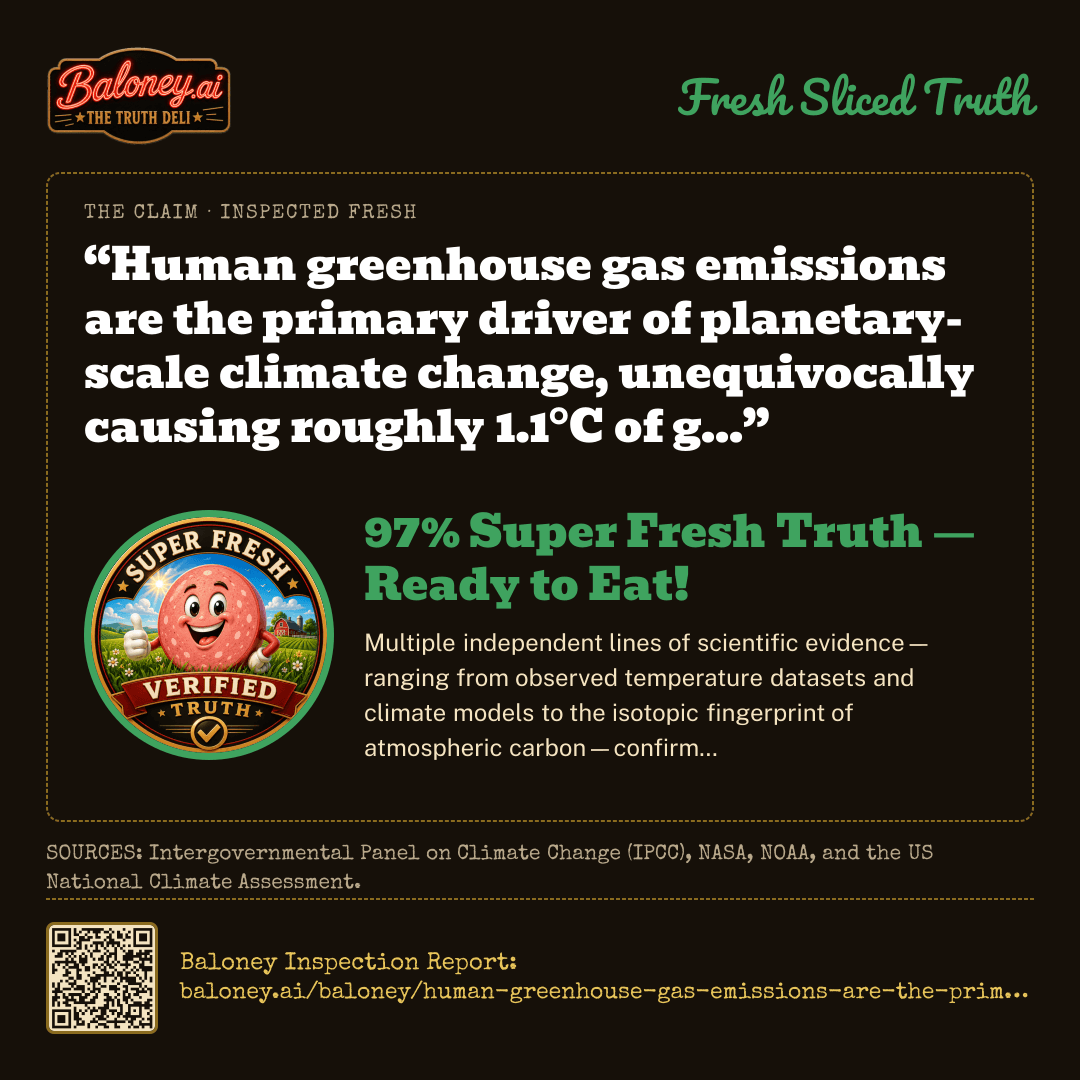
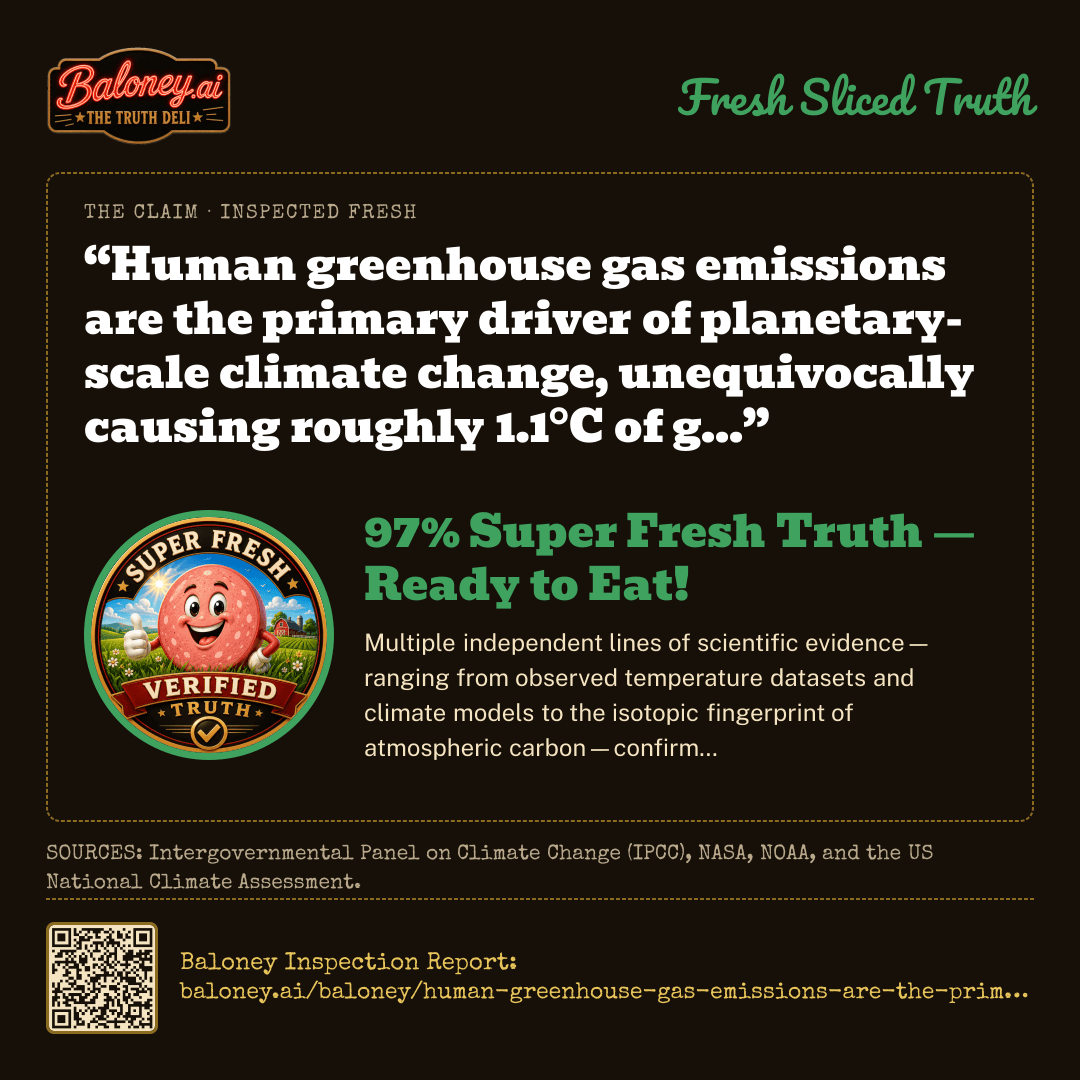
“Human greenhouse gas emissions are the primary driver of planetary-scale climate change, unequivocally causing roughly 1.1°C of global warming since the 19th century.”
97%Super Fresh Truth — Ready to Eat!
THE CLAIM CHECKS OUT.
Independently verifiedPhysically repeatable evidenceConfirmed across rival labsSafe to serve
“Human greenhouse gas emissions are the primary driver of planetary-scale climate change, unequivocally causing roughly 1.1°C of global warming since the 19th century.”97% Super Fresh Truth — Ready to Eat!Verified blind by 5 frontier AIs · Baloney Inspection Report: baloney.ai/baloney/human-greenhouse-gas-emissions-are-the-primary-driver-of
The Rating Card
The claim this refutes
The Baloney Sampler
The claim accurately reflects the overwhelming scientific consensus. The Intergovernmental Panel on Climate Change explicitly states that human influence has unequivocally warmed the planet, quantifying the rise at approximately 1.1°C between 1850–1900 and 2011–2020. This conclusion is endorsed by leading scientific bodies, including the National Academies of Sciences, Engineering, and Medicine.
Independent observational data and physical evidence confirm this attribution. Global temperature datasets from NASA and NOAA verify the warming magnitude, while models demonstrate that natural factors alone would have caused near-zero warming or slight cooling. Furthermore, isotopic analysis proves the excess atmospheric carbon dioxide originates from burning fossil fuels, cementing human emissions as the dominant driver.
Other ways to slice it — phrasings that might have changed the rating
“Human greenhouse gas emissions have unequivocally caused roughly 1.5°C of long-term global warming since the 19th century.” The 1.1°C figure refers to the 2011–2020 decadal average, and while individual recent years have approached 1.5°C, those single-year spikes include short-term internal variability rather than representing the purely human-forced long-term trend.
“Human greenhouse gases are the sole anthropogenic factor altering the climate, causing exactly 1.1°C of warming.” This ignores the complex net effect of human activity, specifically that greenhouse gases actually cause slightly more warming which is partially offset and masked by the cooling effect of human-produced aerosols.
“Natural ocean-atmosphere variability and solar fluctuations are the primary drivers of planetary-scale climate change since the 19th century.” Multiple lab reports note that observational data and advanced attribution models overwhelmingly refute this, showing that natural factors alone would have resulted in near-zero global warming or slight cooling.
Written from the panel’s reports by Google · gemini-3.1-pro-preview. Nothing here changed the score.
05:05:02SCORING MODEL V2 — MEDIAN OF 5 COUNTED LAB SCORES: 2, 3, 1, 3, 3 → 3. FRESH RULE: THE PRIMARY MASTER SCORES 2 AND THE BLIND MASTER 3 — BOTH SUPER FRESH TRUTH — AND THE COUNTED MEDIAN IS 3, ON THE TRUE SIDE. PUBLISHED AS 3, THE MORE CAUTIOUS OF THE TWO MASTERS.✓
05:05:02SOURCE RULE — LABS CITED 28 SOURCES: 0 DISCARDED FOR HAVING NO URL, 0 DISCARDED AS DEAD LINKS (404/410), 9 COULD NOT BE OPENED BY US AND ARE MARKED UNVERIFIED.✓
05:05:02SOURCE RULE — PRIMARY MASTER RULED ON 20 SOURCES: 0 DISCARDED FOR HAVING NO URL, 0 DISCARDED AS DEAD LINKS, 7 MARKED UNVERIFIED, 13 VERIFIED.✓
How This One Was Sliced
Station 1 · Blind Inspection — Five Graders, Zero Peeking
Each lab scored the claim independently, without seeing the others. Open a breakdown for its evidence, its sources, and how sure it was.
Anthropic · EQUAL WEIGHT · 48.5s
claude-opus-5
98%TRUTH
ROUND-1 BREAKDOWN
Evidence offered for the claim
The IPCC Sixth Assessment Report (AR6 WGI, 2021) Summary for Policymakers states verbatim: 'It is unequivocal that human influence has warmed the atmosphere, ocean and land.' This is the exact wording the claim paraphrases, approved line-by-line by 195 member governments.
AR6 WGI quantifies observed warming of 1.09°C [0.95–1.20] for 2011–2020 relative to 1850–1900, and attributes 1.07°C [0.8–1.3] of it to human influence — i.e. essentially all of it. 'Roughly 1.1°C' is an accurate rendering of that figure as of the report's publication.
Independent surface temperature records maintained by separate institutions (NASA GISTEMP, NOAA GlobalTemp, UK Met Office HadCRUT5, Berkeley Earth, and ERA5/Copernicus) agree on the magnitude of warming since the 19th century within their stated uncertainties, using different methods and station selections.
The physical mechanism is established 19th-century radiative physics (Tyndall, Arrhenius) and is confirmed by satellite measurements of outgoing longwave radiation at CO2 absorption bands and by surface measurements of downwelling infrared, both consistent with the rise of atmospheric CO2 from ~280 ppm pre-industrial to ~420+ ppm (NOAA Global Monitoring Laboratory).
Fingerprint evidence distinguishes greenhouse forcing from natural causes: stratospheric cooling alongside tropospheric warming, greater warming of nights than days and of winters than summers, and ocean heat uptake. Solar irradiance has been flat or slightly declining since the 1980s while temperatures rose, ruling out the main natural alternative.
Isotopic evidence (declining 13C/12C and 14C ratios in atmospheric CO2) and the measured decline in atmospheric O2 identify fossil-fuel combustion, not volcanic or oceanic outgassing, as the source of the added CO2.
The US Fifth National Climate Assessment (2023), a congressionally mandated federal report, concludes that human activities are the dominant cause of observed warming and that the evidence is unequivocal.
Every major national academy of science, including the US National Academy of Sciences and the UK Royal Society in their joint publication 'Climate Change: Evidence and Causes,' endorses the attribution. Literature surveys (Cook et al. 2013; Lynas et al. 2021) find 97–99%+ agreement among publishing climate scientists.
Evidence against the claim
The '1.1°C' figure is now dated rather than wrong: it refers to the 2011–2020 decade. WMO put 2023 at about 1.45°C and 2024 at roughly 1.55°C above 1850–1900, so current warming exceeds the number cited. Single years include El Niño and are not the same metric as the long-term human-forced trend, but a reader taking 1.1°C as 'today's warming' would understate it.
The attribution carries a stated uncertainty range (human contribution 0.8–1.3°C), so 'roughly 1.1°C' is a central estimate, not a precisely measured quantity. 'Unequivocal' in IPCC usage attaches to the existence of human-caused warming, not to the exact decimal value.
Natural factors are not zero. Volcanic aerosols, solar variability, and internal variability (ENSO, PDO, AMO) modulate decadal temperatures; IPCC estimates their net contribution over 1850–2020 as approximately -0.1 to +0.1°C, small but nonzero.
Anthropogenic aerosols have masked part of greenhouse warming (cooling of roughly -0.5°C, with the largest uncertainty of any forcing term). A phrasing that credits greenhouse gases with ~1.1°C net slightly simplifies a larger greenhouse-gas warming partly offset by aerosols and land-use change.
Climate sensitivity, cloud feedbacks, and the attribution of specific regional or extreme-event changes remain areas of genuine scientific uncertainty — though none of these undermine the core attribution of the global mean trend.
A small minority of credentialed scientists (e.g. Lindzen, Curry, Koonin) dispute the confidence level attached to attribution or the role of natural variability. Their position is a distinct minority in the peer-reviewed literature and has not displaced the mainstream finding.
How sure this lab was
97/100 — the lab’s own confidence in the score above, not a second reading of the claim.
The IPCC AR6 Synthesis Report states that human activities have unequivocally caused global warming, with global surface temperature in 2011-2020 about 1.1°C above 1850-1900 levels; this closely matches the claim's wording.
Attribution studies find that the human-caused warming estimate overlaps the observed warming, while natural forcings alone cannot explain the post-19th-century temperature rise.
NASA and NOAA report that global temperatures have risen sharply since the late 19th century and identify the rise in human-produced greenhouse gases, especially CO2, as the dominant cause.
The U.S. National Climate Assessment concludes that human-caused greenhouse gas emissions are the primary driver of recent global climate change, with natural factors unable to account for the observed long-term warming trend.
Evidence against the claim
The exact 1.1°C figure is time-window dependent: it is the IPCC's 2011-2020 average relative to 1850-1900, while individual recent years are warmer; WMO reports 2024 at about 1.55°C above the pre-industrial level.
Attribution estimates have uncertainty ranges rather than a single exact number; the core attribution is very strong, but 'roughly 1.1°C' should be read as an approximate benchmark, not a precise current value.
Natural variability and natural forcings such as ENSO, volcanic eruptions, and solar variation affect short-term and regional climate, but they do not provide strong evidence against the claim because they do not explain the long-term global warming trend.
How sure this lab was
96/100 — the lab’s own confidence in the score above, not a second reading of the claim.
The Intergovernmental Panel on Climate Change (IPCC) Sixth Assessment Report (AR6) explicitly concludes that human influence has 'unequivocally' warmed the planet, quantifying the observed global surface temperature increase between 1850-1900 and 2011-2020 at approximately 1.1°C.
Observational datasets from NASA and NOAA independently confirm an average global surface temperature increase of slightly more than 1°C (about 2°F) since the late 19th century, directly correlating with the industrial era's rapid rise in atmospheric greenhouse gas concentrations.
Attribution studies utilizing advanced climate models demonstrate that natural factors (such as solar fluctuations and volcanic activity) alone would have resulted in near-zero warming or slight cooling over the last century. The observed 1.1°C spike can only be replicated when human greenhouse gas emissions are included as the primary driver.
Isotopic analysis of atmospheric carbon (specifically the declining ratio of Carbon-13 to Carbon-12) proves that the excess carbon dioxide driving the greenhouse effect originates primarily from the burning of fossil fuels.
Evidence against the claim
Historically, Earth's climate has changed significantly due to natural drivers, such as orbital variations (Milankovitch cycles), changes in solar irradiance, and massive volcanic events, prompting some to question if current changes are purely anthropogenic.
A small minority of climate skeptics argue that natural internal ocean-atmosphere variability (like El Niño and the Pacific Decadal Oscillation) accounts for a larger fraction of modern warming than recognized by the consensus. However, peer-reviewed scientific literature overwhelmingly refutes this, showing these natural cycles redistribute heat rather than adding to the long-term net global warming trend since the 1800s.
How sure this lab was
99/100 — the lab’s own confidence in the score above, not a second reading of the claim.
The IPCC concludes that human activities, principally greenhouse-gas emissions, have unequivocally caused global warming; global surface temperature reached 1.1°C above the 1850–1900 baseline in 2011–2020.[1]
The IPCC attributes essentially all observed warming between 1850–1900 and 2010–2019 to human influence, with natural variability estimated at only −0.23°C to +0.23°C compared with approximately 1.1°C observed warming.[2][3]
The National Academies explains that human greenhouse gases alter Earth’s energy balance, that CO2 is the largest contributor, and that recent warming cannot be explained by natural causes alone.[4]
Evidence against the claim
No credible evidence in the cited scientific assessments contradicts the claim’s central conclusion. The main qualification is scope: 1.1°C is the IPCC’s 2011–2020 average relative to 1850–1900, not a precise value for every present year or every definition of “since the 19th century.”[1][2]
“Human greenhouse gas emissions” is slightly narrower than the full human influence assessed by the IPCC, which also includes land-use changes and human-caused aerosols; aerosols have partly masked greenhouse-gas warming.[1][4]
“Planetary-scale climate change” encompasses changes beyond global mean temperature, including regional precipitation, extremes, oceans, ice, and ecosystems. The statement is well supported for global warming but does not specify which broader climate changes are meant.
How sure this lab was
99/100 — the lab’s own confidence in the score above, not a second reading of the claim.
IPCC AR6 WG1 finds it unequivocal that human influence warmed atmosphere, ocean and land; observed global surface temperature 1.09°C higher in 2011–2020 than 1850–1900, with human-caused contribution best-estimate 1.07°C (likely 0.8–1.3°C).
Multiple independent lines of evidence (CO2 isotopic fingerprint from fossil fuels, measured radiative forcing, energy-budget constraints, and formal detection-attribution studies) show greenhouse gases from human activity dominate the long-term planetary energy imbalance and the spatial/seasonal pattern of warming.
NASA, NOAA, HadCRUT, Berkeley Earth and Copernicus records all show ~1.1°C warming since the late 19th century, with the rate and pattern inconsistent with solar, volcanic or unforced internal variability alone.
Evidence against the claim
A minority of researchers using certain satellite tropospheric datasets (e.g., UAH) report modestly lower warming rates than surface series, which they interpret as possible surface-record or model bias, though the discrepancy has narrowed with dataset updates.
Residual uncertainties in aerosol forcing magnitude and the precise pre-industrial baseline can shift the attributed human fraction by a few tenths of a degree, without overturning dominance of GHGs.
Decadal-scale internal variability (AMO, PDO, ENSO) modulates short-term trends and can produce brief pauses, but does not explain the multi-decadal global rise or the vertical/latitudinal fingerprint.
How sure this lab was
90/100 — the lab’s own confidence in the score above, not a second reading of the claim.
The statement is a highly accurate reflection of the current scientific consensus. Evaluators universally recognized it as an almost direct paraphrase of the Intergovernmental Panel on Climate Change (IPCC) Sixth Assessment Report. The core facts—that human greenhouse gas emissions are the primary driver of modern climate change and have unequivocally caused a long-term warming trend of roughly 1.1°C—are robustly supported by vast arrays of independent evidence. Minor nuances regarding the exact time window for the 1.1°C figure and the masking effect of aerosols do not detract from the fundamental truth of the claim.
All five evaluators were in complete agreement, granting the claim top accuracy scores. They concurred that multiple independent lines of observational and attribution evidence confirm the statement, noting only minor technical caveats regarding the baseline definition and short-term natural variability.
SUPER FRESH — VERIFIED AGAINST INTERGOVERNMENTAL PANEL ON CLIMATE CHANGE (IPCC), NASA, NOAA, AND THE US NATIONAL CLIMATE ASSESSMENT.
Blind Validation Master · never saw the Primary’s work
grok-4.6
97% TRUTH
All five reports independently confirm the claim is substantially true and aligned with IPCC AR6, NASA/NOAA records, attribution studies, isotopic fingerprints, and energy-budget evidence: human influence (principally GHGs) has unequivocally produced ~1.09–1.1°C of observed warming from 1850–1900 to 2011–2020, with natural forcings and internal variability unable to explain the trend. Minor, consistently noted caveats (the 1.1°C figure is a specific decade average now exceeded in recent years; aerosols/land-use slightly modify net human forcing; “planetary-scale climate change” is broader than GMST) are wording/scope qualifications, not contradictions. Per the scale, such caveats keep the statement in the 1–5 true band rather than fishy.
AGREEMENT TEST PASSED — MASTERS SCORED 98% AND 97% · BLIND VALIDATION CONFIRMED THIS SCORE · NO RE-EVALUATION REQUIRED
Median of 5 counted lab scores: 2, 3, 1, 3, 3 → 3.
Fresh rule: the Primary Master scores 2 and the Blind Master 3 — both Super Fresh Truth — and the counted median is 3, on the true side. Published as 3, the more cautious of the two masters.
The Evidence
Evidence for the claim
IPCC attribution The Intergovernmental Panel on Climate Change (AR6) explicitly states it is 'unequivocal' that human influence has warmed the atmosphere, ocean, and land, assigning a best-estimate contribution of 1.07°C out of the 1.09°C observed for the 2011–2020 decade compared to 1850–1900.
Independent surface records Datasets maintained independently by NASA, NOAA, the UK Met Office, Berkeley Earth, and Copernicus uniformly confirm a global surface temperature increase of slightly more than 1°C since the late 19th century.
Isotopic and fingerprint evidence Declining ratios of Carbon-13 to Carbon-12 in atmospheric CO2 prove the excess carbon originates from fossil fuels. Furthermore, the physical pattern of warming (such as stratospheric cooling alongside tropospheric warming) is consistent only with greenhouse gas forcing, not natural factors.
Evidence offered against the claim
Dated temperature reference The 'roughly 1.1°C' figure is the IPCC's average for the 2011–2020 decade. Individual recent years have been warmer; for example, the WMO estimates 2024 reached approximately 1.55°C above the pre-industrial level.
Aerosol masking Attributing the warming solely to 'greenhouse gas emissions' slightly simplifies the total human influence. Greenhouse gases actually caused more than 1.1°C of warming, but this was partly offset (masked) by the cooling effects of human-caused aerosols.
Natural variability Natural factors such as the El Niño-Southern Oscillation (ENSO), solar variability, and volcanic eruptions modulate short-term temperatures, though models confirm they account for near-zero net warming over the long-term trend.
Sources · Reliability · Why Accepted or Discounted
ACCEPTED — Updated peer-reviewed survey verifying the >99% consensus on human-caused climate change.
Every link was opened when this claim was inspected. A dead link was discarded before publication; “unverified” means the site refused our automated check and the link is the one the panel cited. A source without a URL was never kept.
“Human greenhouse gas emissions are the primary driver of planetary-scale climate change, unequivocally causing roughly 1.1°C of global warming since the 19th century.”97% Super Fresh Truth — Ready to Eat!Verified blind by 5 frontier AIs · Baloney Inspection Report: baloney.ai/baloney/human-greenhouse-gas-emissions-are-the-primary-driver-of
Support The Truth Deli
Buy The Truth Deli Merch
“Democracy Makes America Great”
Veritate Libertas — Latin for “Through Truth, Liberty.”
Democracy is what makes America great. But without truth — honest, real, scientifically validated truth — democracy fails. The baloney slicer is on: feeding fresh sliced truth to protect what makes America great. Democracy.