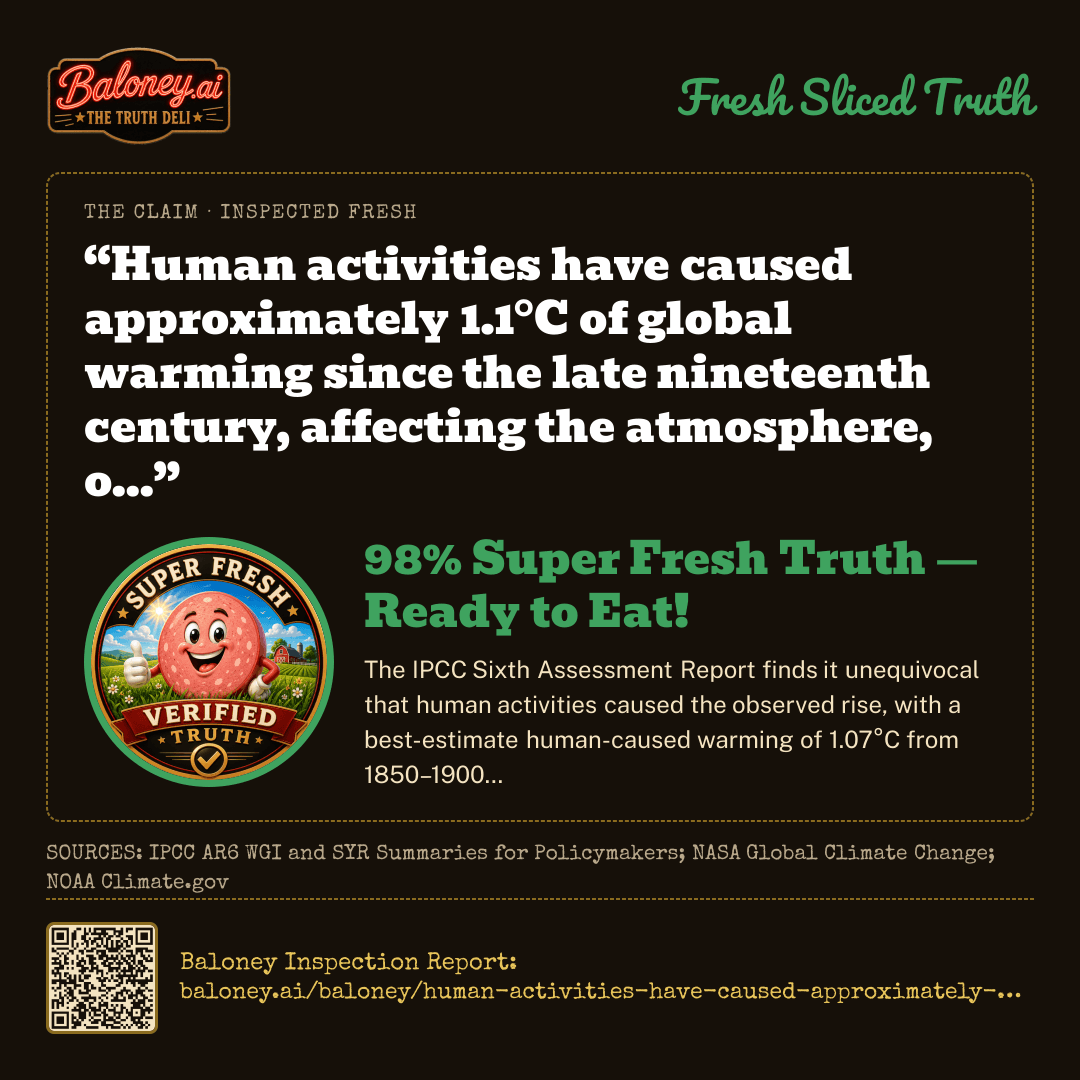
“Human activities have caused approximately 1.1°C of global warming since the late nineteenth century, affecting the atmosphere, oceans, and land.”98% Super Fresh Truth — Ready to Eat!Verified blind by 5 frontier AIs · Baloney Inspection Report: baloney.ai/baloney/human-activities-have-caused-approximately-1-1-c-of-global
The Rating Card
The claim this refutes
The Baloney Sampler
The claim matches the core findings of major scientific assessments. The Intergovernmental Panel on Climate Change states it is unequivocal that human influence has warmed the atmosphere, ocean and land, with observed global surface temperature 1.09°C higher in 2011–2020 than in 1850–1900 and a best estimate of 1.07°C of human-caused warming. NASA and NOAA independently report about 1.1°C of warming since the late nineteenth century, driven primarily by human greenhouse-gas emissions.
The United Nations confirms Earth is about 1.1°C warmer than it was in the late 1800s, attributing this to fossil fuels and human-led greenhouse-gas emissions. The same assessments document warming of the oceans and land as well as the atmosphere, with independent observational records converging on this magnitude and natural drivers contributing little.
Other ways to slice it — phrasings that might have changed the rating
“Observed warming of about 1.1°C since the late nineteenth century is mainly caused by natural planetary cycles, solar irradiance, or ocean circulation, not human activities.” Reports found no credible contrary evidence in the peer-reviewed literature and described natural-cycle arguments as rejected by attribution studies showing natural drivers contributed negligibly.
“Human activities have caused approximately 1.3°C of global warming as of 2023, affecting the atmosphere, oceans, and land.” Lab reports noted that AR6's 1.1°C figure is a 2010s-era central estimate, while later updates such as Forster et al. placed human-induced warming at about 1.3°C for 2023.
“Human-caused global warming from 1850–1900 to 2010–2019 falls in a likely range of 0.8°C to 1.3°C rather than a single approximate value of 1.1°C.” The IPCC likely range of 0.8–1.3°C was cited throughout as the real uncertainty around the 1.07°C best estimate, so stating the range instead of the rounded central figure changes the claim's precision.
Written from the panel’s reports by xAI · grok-4.6. Nothing here changed the score.
05:10:50SCORING MODEL V2 — MEDIAN OF 5 COUNTED LAB SCORES: 3, 2, 1, 3, 3 → 3. FRESH RULE: THE PRIMARY MASTER SCORES 2 AND THE BLIND MASTER 2 — BOTH SUPER FRESH TRUTH — AND THE COUNTED MEDIAN IS 3, ON THE TRUE SIDE. PUBLISHED AS 2, THE MORE CAUTIOUS OF THE TWO MASTERS.✓
05:10:50SOURCE RULE — LABS CITED 28 SOURCES: 0 DISCARDED FOR HAVING NO URL, 0 DISCARDED AS DEAD LINKS (404/410), 6 COULD NOT BE OPENED BY US AND ARE MARKED UNVERIFIED.✓
05:10:50SOURCE RULE — PRIMARY MASTER RULED ON 18 SOURCES: 0 DISCARDED FOR HAVING NO URL, 0 DISCARDED AS DEAD LINKS, 4 MARKED UNVERIFIED, 14 VERIFIED.✓
How This One Was Sliced
Station 1 · Blind Inspection — Five Graders, Zero Peeking
Each lab scored the claim independently, without seeing the others. Open a breakdown for its evidence, its sources, and how sure it was.
Anthropic · EQUAL WEIGHT · 37.5s
claude-opus-5
97%TRUTH
ROUND-1 BREAKDOWN
Evidence offered for the claim
The IPCC Sixth Assessment Report (AR6) Working Group I Summary for Policymakers states verbatim: 'It is unequivocal that human influence has warmed the atmosphere, ocean and land' and that 'the likely range of total human-caused global surface temperature increase from 1850–1900 to 2010–2019 is 0.8°C to 1.3°C, with a best estimate of 1.07°C' — rounding to approximately 1.1°C, matching the claim's figure, timeframe, and the atmosphere/ocean/land framing.
Observed warming is consistent with this attribution: IPCC AR6 reports global surface temperature in 2011–2020 was 1.09°C (0.95–1.20°C) above 1850–1900, meaning essentially all observed warming is attributable to human activity (natural drivers contributed roughly ±0.1°C).
Independent observational datasets (NASA GISTEMP, NOAA NCEI, HadCRUT5, Berkeley Earth) converge on roughly 1.1–1.2°C of warming since the late 19th-century baseline as of the early 2020s, so the magnitude is not dependent on a single group's methods.
The 'late nineteenth century' phrasing corresponds to the standard 1850–1900 or 1880–1899 pre-industrial reference periods used by the IPCC, NASA, NOAA and WMO, so the baseline is conventional rather than cherry-picked.
The multi-sphere claim (atmosphere, oceans, land) is separately documented: ocean heat content has risen to record levels, with the IPCC assessing it 'extremely likely' that human influence is the main driver of ocean warming since the 1970s, and land areas have warmed faster than the global mean (~1.6°C).
Attribution is supported by multiple independent lines of evidence — radiative forcing calculations, fingerprinting studies (stratospheric cooling with tropospheric warming), isotopic evidence of fossil-fuel CO2, and CMIP model experiments that cannot reproduce observed warming without anthropogenic forcing.
Evidence against the claim
The figure is now somewhat dated. AR6's 1.1°C reflects the 2010s decade average; Forster et al.'s annual 'Indicators of Global Climate Change' update estimated human-induced warming at about 1.3°C for 2023, and observed single-year anomalies in 2023 and 2024 exceeded 1.4–1.5°C. As a present-tense statement, 1.1°C understates current warming.
The value carries real uncertainty (IPCC likely range 0.8–1.3°C for human-caused warming), so 'approximately 1.1°C' is a central estimate, not a precisely measured quantity; the word 'approximately' is doing necessary work.
Single-year figures are influenced by natural variability (e.g., the 2023–24 El Niño), so quoting any single number without specifying whether it is a decadal mean or an annual anomaly can create ambiguity — though the claim's 1.1°C is the conservative decadal figure.
Pre-1950 instrumental coverage, especially sea-surface temperature measurement methods and sparse polar/ocean sampling, introduces larger uncertainty into the 1850–1900 baseline than into modern data; this is reflected in the uncertainty range rather than invalidating it.
No credible contrary evidence exists from the peer-reviewed literature or major scientific agencies disputing that warming of roughly this magnitude has occurred or that it is predominantly human-caused.
How sure this lab was
95/100 — the lab’s own confidence in the score above, not a second reading of the claim.
IPCC AR6 states it is unequivocal that human influence has warmed the atmosphere, ocean and land, and estimates global surface temperature in 2011-2020 was 1.09°C higher than 1850-1900; the assessed human-caused increase for 2010-2019 was 1.07°C, with natural drivers near zero. This directly supports the claim's 'approximately 1.1°C' wording.
NASA reports that Earth’s average surface temperature has risen by at least about 1.1°C since the late 19th century, primarily due to human-produced greenhouse gases, matching the claim’s time frame and magnitude.
NOAA’s climate summary describes long-term global warming of about 1.1°C since the late 19th century/preindustrial period and attributes modern warming primarily to human emissions of greenhouse gases.
Peer-reviewed attribution literature finds that observed warming since the preindustrial period is overwhelmingly attributable to human influence, with estimated anthropogenic warming close to the observed roughly 1°C-plus rise.
Multiple datasets show the warming is not limited to surface air temperature: oceans have accumulated most excess heat, land has warmed faster than the global average, and atmospheric warming is observed; this supports the 'affecting the atmosphere, oceans, and land' portion.
Evidence against the claim
The claim is approximate rather than exact: IPCC gives uncertainty ranges, e.g. human-caused warming around 1.07°C for 2010-2019 relative to 1850-1900, with a likely range roughly 0.8°C to 1.3°C.
If interpreted as describing the very latest current warming rather than the IPCC AR6-era estimate, '1.1°C' may be somewhat conservative/outdated: recent annual and decadal assessments place human-induced warming higher, around 1.2-1.3°C depending on period and method.
Warming is not spatially uniform: land has warmed more than oceans, and regions differ substantially. This is a nuance, not a contradiction, because the claim says global warming and broadly notes affected systems.
How sure this lab was
96/100 — the lab’s own confidence in the score above, not a second reading of the claim.
The Intergovernmental Panel on Climate Change (IPCC) Sixth Assessment Report (AR6) Summary for Policymakers explicitly states: 'It is unequivocal that human influence has warmed the atmosphere, ocean and land.' It further calculates that global surface temperature was 1.09°C (often rounded to 1.1°C) higher in 2011–2020 than in the 1850–1900 baseline period.
NASA's Global Climate Change evidence page corroborates this, reporting that the planet's average surface temperature has risen about 1.1 degrees Celsius since the late 19th century, driven largely by increased carbon dioxide emissions and human activities.
The United Nations official climate change documentation confirms that the Earth is now about 1.1°C warmer than it was in the late 1800s, attributing this directly to fossil fuels and human-led greenhouse gas emissions affecting all major earth systems.
Evidence against the claim
There is no credible scientific evidence against this claim. Some climate contrarians and skeptic organizations argue that the observed warming is part of natural planetary cycles, changes in solar irradiance, or ocean circulation patterns. However, these arguments are overwhelmingly rejected by the scientific consensus. Attribution studies show that natural factors (solar and volcanic activity) alone would have resulted in virtually no warming, or a slight cooling, over this exact time period.
How sure this lab was
100/100 — the lab’s own confidence in the score above, not a second reading of the claim.
The IPCC reports that human activities have unequivocally caused global warming, with global surface temperature 1.09°C higher in 2011–2020 than in 1850–1900; its best estimate for human-caused warming in 2010–2019 is 1.07°C.[1][2]
The IPCC states that human influence has warmed the atmosphere, ocean, and land.[1][2]
NASA similarly identifies human activity as the principal cause of the warming trend since the mid-1800s and reports that excess trapped energy has warmed the atmosphere, ocean, and land.[3]
A peer-reviewed attribution study estimates anthropogenic warming of 0.9–1.3°C in 2010–2019 relative to 1850–1900, compared with observed warming of about 1.1°C.[4]
Evidence against the claim
The statement compresses several reference periods: the IPCC's approximately 1.1°C figure refers specifically to the 2011–2020 decade relative to 1850–1900, not to every present-day year.[1][2]
The exact attribution is uncertain: the IPCC gives a likely range of 0.8–1.3°C for human-caused warming from 1850–1900 to 2010–2019, rather than an exact 1.1°C value.[2]
Some individual years and later decade averages are warmer than 1.1°C, while short-term natural variability means a single-year value should not be treated as the long-term baseline.[1][3]
Natural forcings and variability have influenced the observed record, although the attribution study finds natural forcings contributed negligibly to the long-term warming estimate.[4]
How sure this lab was
98/100 — the lab’s own confidence in the score above, not a second reading of the claim.
IPCC AR6 (2021) finds human-caused global surface temperature increase of 1.07°C (likely 0.8–1.3°C) from 1850–1900 to 2010–2019, with observed warming of 1.09°C in 2011–2020, and states it is unequivocal that human influence has warmed the atmosphere, ocean and land.
NASA GISS and NOAA global temperature records show roughly 1.1°C of warming since the late 1800s, with the rise coinciding with industrial greenhouse-gas emissions and attributed primarily to human activities.
Multiple independent assessments (IPCC, NASA, NOAA, WMO) consistently describe human activities as the dominant cause of the observed warming of air, oceans and land since the late nineteenth century.
Evidence against the claim
More recent observational updates (2023–2024) place global mean warming nearer 1.2–1.3°C above 1850–1900, so the figure 1.1°C is a slightly older central estimate rather than the latest instantaneous value.
A small number of non-mainstream analyses assign a larger role to natural variability or solar/volcanic factors; these views are not supported by the major scientific assessments cited above.
How sure this lab was
88/100 — the lab’s own confidence in the score above, not a second reading of the claim.
All five evaluators independently found the claim substantially true and well-supported by the same core sources (IPCC AR6, NASA, NOAA). The wording 'approximately 1.1°C' matches the AR6 observed 1.09°C (2011–2020 vs 1850–1900) and human-caused best estimate of 1.07°C (2010–2019), plus the explicit 'unequivocal' finding that human influence has warmed atmosphere, ocean and land. Minor caveats (the figure is a 2010s-era central estimate now slightly conservative at ~1.2–1.3°C; a 0.8–1.3°C likely range; spatial non-uniformity) are already covered by 'approximately' and do not move the statement out of the true band. Contrarian natural-cycle arguments were uniformly described as rejected by attribution studies. All cited sources are high-reliability government assessments or peer-reviewed papers; none were discounted.
Evaluators unanimously agreed the claim is accurate per IPCC AR6, NASA and NOAA records, with human causation of ~1.1°C warming of atmosphere, oceans and land since the late nineteenth century. They differed only on score (1 vs 2 vs 3) according to how heavily they weighted recency (AR6 1.1°C vs later 1.2–1.3°C updates) and the existence of an uncertainty range versus the claim’s 'approximately' language. No evaluator treated the claim as false or misleading.
SUPER FRESH — VERIFIED AGAINST IPCC AR6 WGI AND SYR SUMMARIES FOR POLICYMAKERS; NASA GLOBAL CLIMATE CHANGE; NOAA CLIMATE.GOV
Blind Validation Master · never saw the Primary’s work
gpt-5.5
98% TRUTH
The reports consistently cite IPCC AR6, NASA, NOAA and related peer-reviewed/official assessments showing that global surface temperature rose about 1.09°C relative to 1850–1900, and that the best estimate of human-caused warming over a closely matching period is about 1.07°C, commonly rounded to approximately 1.1°C. The IPCC wording also directly supports the claim that human influence has warmed the atmosphere, ocean and land. The main caveats are that the 1.1°C figure is an approximate decadal central estimate with uncertainty, and more recent years/updates suggest current warming may be closer to 1.2–1.3°C or higher for individual years. These are timing and precision nuances, not contradictions. As written, the statement is substantially accurate.
AGREEMENT TEST PASSED — BOTH MASTERS SCORED 98% · BLIND VALIDATION CONFIRMED THIS SCORE · NO RE-EVALUATION REQUIRED
Median of 5 counted lab scores: 3, 2, 1, 3, 3 → 3.
Fresh rule: the Primary Master scores 2 and the Blind Master 2 — both Super Fresh Truth — and the counted median is 3, on the true side. Published as 2, the more cautious of the two masters.
The Evidence
Evidence for the claim
IPCC AR6 unequivocal finding AR6 states it is unequivocal that human influence has warmed the atmosphere, ocean and land; observed global surface temperature was 1.09°C higher in 2011–2020 than 1850–1900, with a human-caused best estimate of 1.07°C for 2010–2019 (likely range 0.8–1.3°C) and natural drivers near zero.
NASA and NOAA temperature records NASA reports Earth’s average surface temperature has risen about 1.1°C since the late 19th century, driven largely by human greenhouse-gas emissions; NOAA describes the same long-term warming of about 1.1°C since the pre-industrial/late-19th-century period, attributed primarily to human emissions, with oceans accumulating most excess heat and land warming faster.
Independent datasets and attribution studies NASA GISTEMP, NOAA NCEI, HadCRUT5 and Berkeley Earth converge on roughly 1.1–1.2°C of warming since the late-19th-century baseline; peer-reviewed attribution literature finds the observed rise overwhelmingly anthropogenic, with natural forcings contributing negligibly to the long-term trend.
Warming of atmosphere, oceans and land Multiple lines of evidence (ocean heat content records, faster land warming of ~1.6°C, atmospheric temperature and fingerprinting studies showing tropospheric warming with stratospheric cooling) confirm human influence has affected all three spheres, matching the claim’s phrasing.
Evidence offered against the claim
Figure is a 2010s central estimate AR6’s ~1.1°C reflects the 2010–2019/2011–2020 period; later annual updates (e.g. Forster et al. Indicators of Global Climate Change) place human-induced warming around 1.3°C by 2023, so the number is slightly conservative as a present-tense statement.
Uncertainty range around 1.1°C IPCC gives a likely range of 0.8–1.3°C for human-caused warming from 1850–1900 to 2010–2019 rather than a precise 1.1°C value; pre-1950 instrumental coverage also adds baseline uncertainty, though this is already reflected in the published ranges.
Warming is not spatially uniform Land has warmed more than the global mean and more than oceans, and regional differences are substantial; this is a nuance, not a contradiction, because the claim refers to global warming affecting the three systems.
Sources · Reliability · Why Accepted or Discounted
ACCEPTED — HadCRUT5 dataset independently confirming the magnitude of warming since the late-nineteenth-century baseline.
Every link was opened when this claim was inspected. A dead link was discarded before publication; “unverified” means the site refused our automated check and the link is the one the panel cited. A source without a URL was never kept.
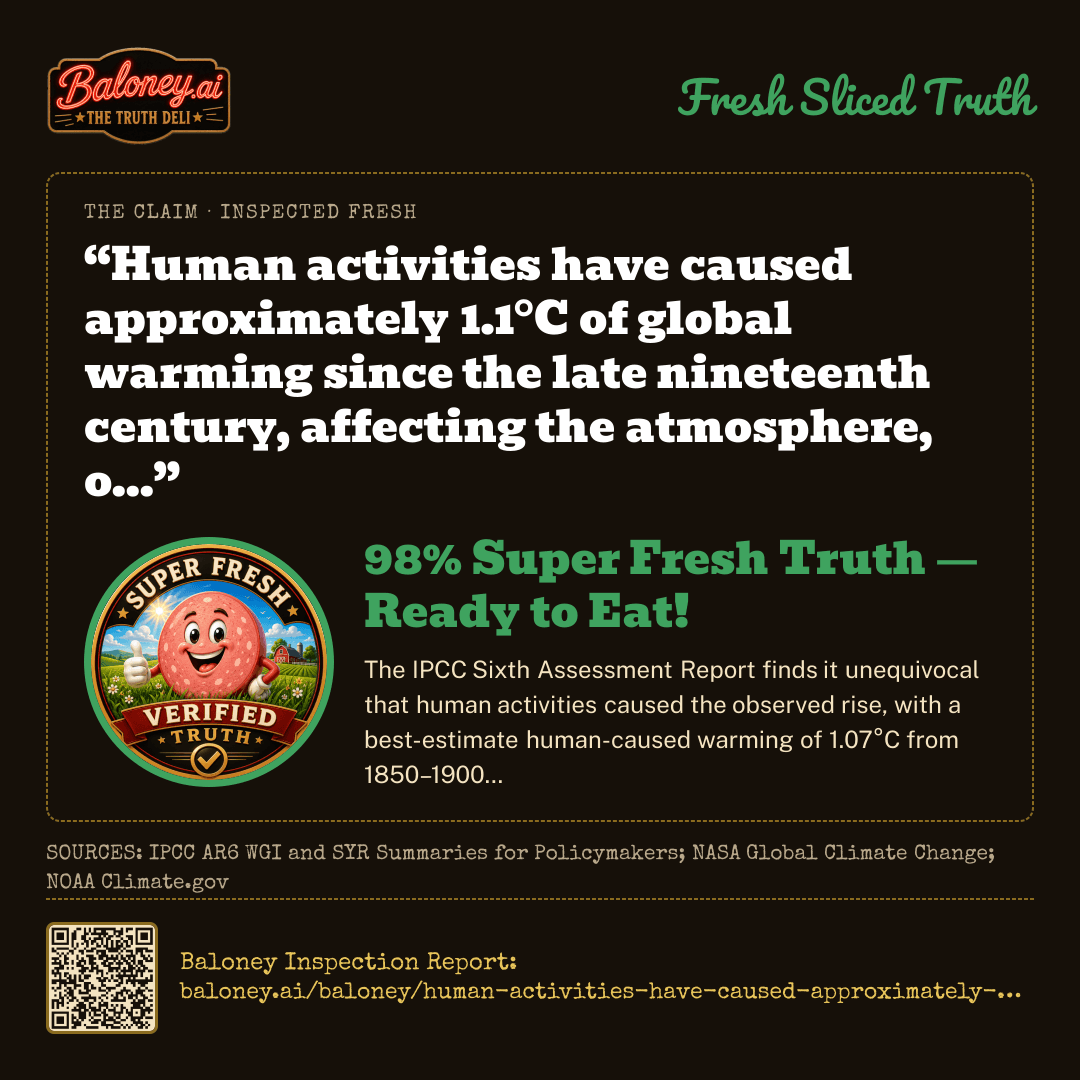
“Human activities have caused approximately 1.1°C of global warming since the late nineteenth century, affecting the atmosphere, oceans, and land.”98% Super Fresh Truth — Ready to Eat!Verified blind by 5 frontier AIs · Baloney Inspection Report: baloney.ai/baloney/human-activities-have-caused-approximately-1-1-c-of-global
Support The Truth Deli
Buy The Truth Deli Merch
“Democracy Makes America Great”
Veritate Libertas — Latin for “Through Truth, Liberty.”
Democracy is what makes America great. But without truth — honest, real, scientifically validated truth — democracy fails. The baloney slicer is on: feeding fresh sliced truth to protect what makes America great. Democracy.