Baloney Inspection Report: Claim #1096 · Inspected Sep 30, 2026, 3:46 PM PDT · Scoring model v2
 96%
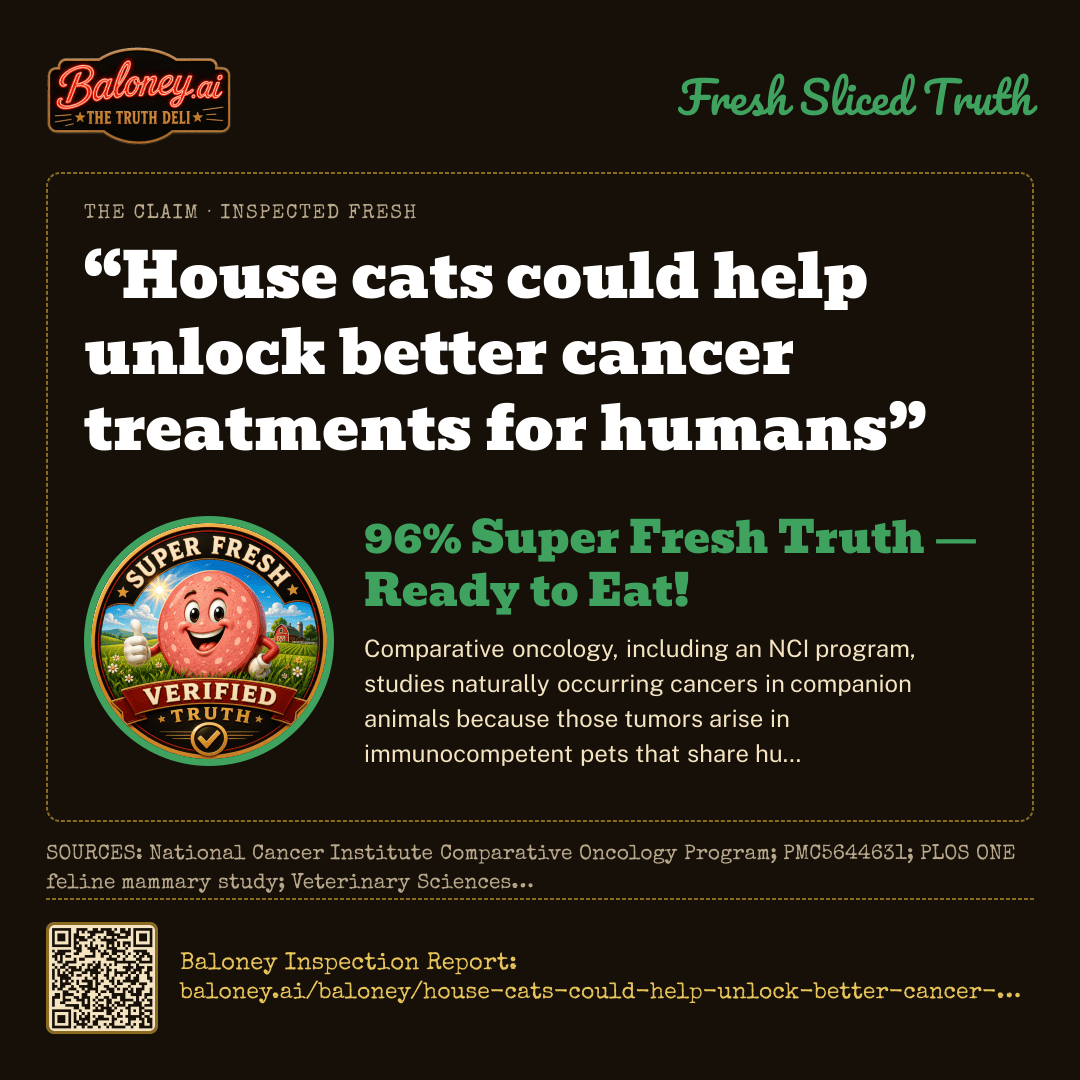
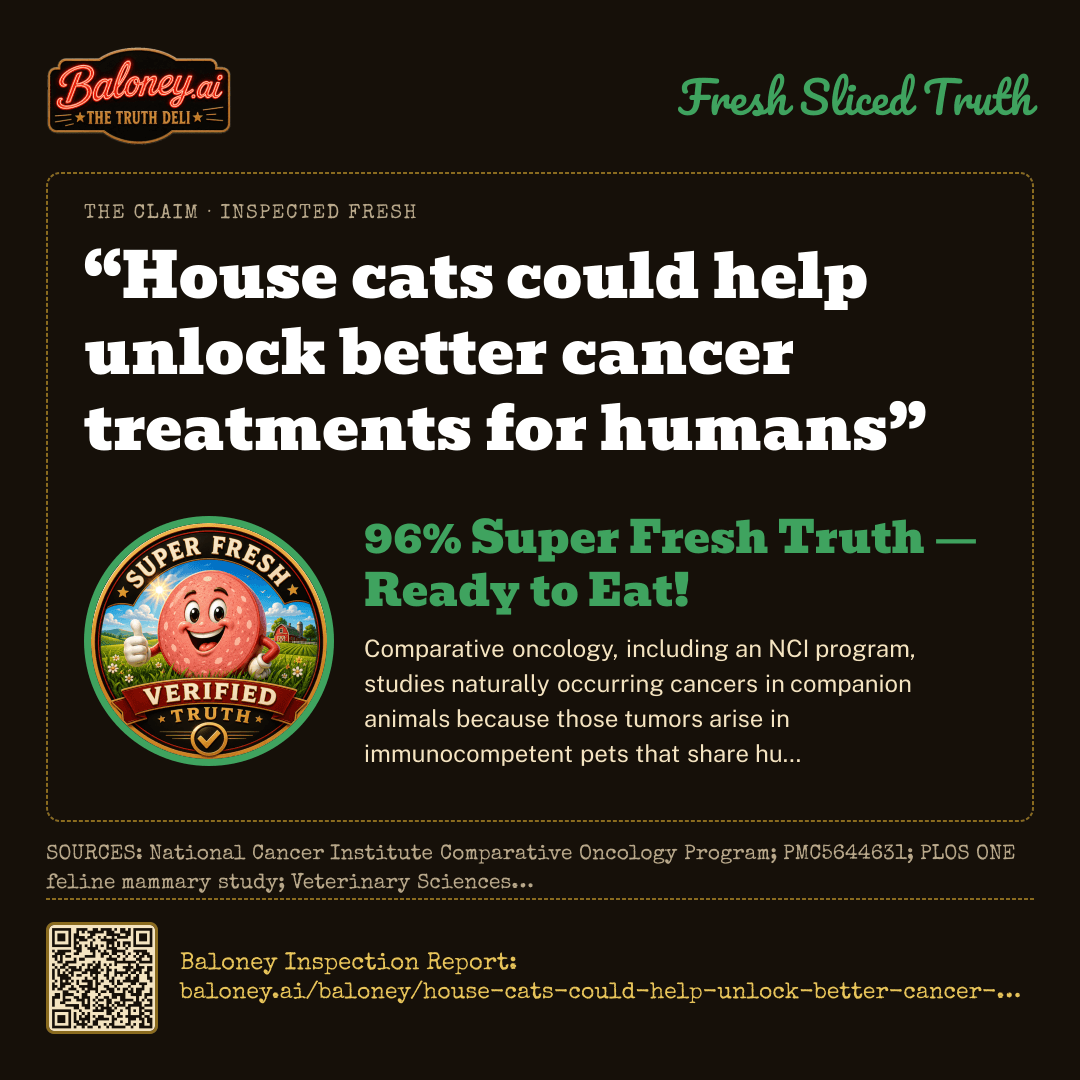
96%“House cats could help unlock better cancer treatments for humans”
96%Super Fresh Truth — Ready to Eat!
THE CLAIM CHECKS OUT.
Independently verifiedPhysically repeatable evidenceConfirmed across rival labsSafe to serve
✓ BLIND VALIDATION CONFIRMED THIS SCORE
Serve It Fresh
Ready to Serve10 servings
Serve it the way you want it
The Verdict
 “House cats could help unlock better cancer treatments for humans”96% Super Fresh Truth — Ready to Eat!Verified blind by 5 frontier AIs · Baloney Inspection Report: baloney.ai/baloney/house-cats-could-help-unlock-better-cancer-treatments-for
The Baloney Sampler
House cats could help unlock better human cancer treatments because they spontaneously develop tumors in shared households with intact immune systems. The National Cancer Institute Comparative Oncology Program uses companion-animal cancers, including feline tumors, to study biology and test therapies closer to human practice than mouse models. NIH reviews and a PLOS ONE study show feline oral squamous-cell carcinoma resembles human head-and-neck cancer and feline mammary carcinoma can model aggressive HER2-overexpressing breast cancer.
These findings rest on the National Cancer Institute, National Center for Biotechnology Information / NIH, PLOS ONE, and Colorado State University Flint Animal Cancer Center. Cats receive real anticancer therapy and can be enrolled in veterinary trials that generate translational safety and efficacy data. Work on feline leukemia and sarcoma viruses also helped establish that retroviruses can cause cancer and contributed to identifying viral oncogenes.
Resting on National Cancer Institute · National Center for Biotechnology Information / NIH · PLOS ONE · Colorado State University Flint Animal Cancer Center
Other ways to slice it — phrasings that might have changed the rating
- “House cats have already unlocked better cancer treatments now used in people.” The reports found no human cancer therapy currently in clinical use can be traced primarily to feline tumor research, so any benefit remains prospective.
- “Feline mammary carcinoma and oral squamous-cell carcinoma could help unlock better treatments for aggressive human breast cancer and head-and-neck cancer.” The reports found the strongest feline evidence is concentrated in those two cancers and cannot automatically be generalized to all human cancers.
- “House cats will unlock better cancer treatments for humans.” The original claim is only a hedged possibility, and the reports stress that cats are a minor contributor next to dogs and that human clinical trials are still required.
Written from the panel’s reports by xAI · grok-4.6. Nothing here changed the score.
The Order Ticket
22:46:52CLAIM RECEIVED — QUEUED FOR INSPECTION✓
22:47:51claude-opus-5 REPORTED — SCORE 3, CONFIDENCE 80✓
22:47:59gpt-5.5 REPORTED — SCORE 3, CONFIDENCE 84✓
22:47:22gemini-3.1-pro-preview REPORTED — SCORE 3, CONFIDENCE 95✓
22:47:00sonar-pro REPORTED — SCORE 4, CONFIDENCE 82✓
22:48:45grok-4.6 REPORTED — SCORE 5, CONFIDENCE 68✓
22:50:14PRIMARY MASTER GROK — SCORE 4✓
22:48:49BLIND VALIDATION CHATGPT — SCORE 3✓
22:51:41AGREEMENT CONFIRMED — DELTA 1✓
22:51:41SCORING MODEL V2 — MEDIAN OF 5 COUNTED LAB SCORES: 3, 3, 3, 4, 5 → 3. FRESH RULE: THE PRIMARY MASTER SCORES 4 AND THE BLIND MASTER 3 — BOTH SUPER FRESH TRUTH — AND THE COUNTED MEDIAN IS 3, ON THE TRUE SIDE. PUBLISHED AS 4, THE MORE CAUTIOUS OF THE TWO MASTERS.✓
22:51:41SOURCE RULE — LABS CITED 19 SOURCES: 0 DISCARDED FOR HAVING NO URL, 2 DISCARDED AS DEAD LINKS (404/410), 4 COULD NOT BE OPENED BY US AND ARE MARKED UNVERIFIED.✓
22:51:41SOURCE RULE — PRIMARY MASTER RULED ON 15 SOURCES: 0 DISCARDED FOR HAVING NO URL, 0 DISCARDED AS DEAD LINKS, 4 MARKED UNVERIFIED, 11 VERIFIED.✓
How This One Was Sliced
Station 1 · Blind Inspection — Five Graders, Zero Peeking
Each lab scored the claim independently, without seeing the others. Open a breakdown for its evidence, its sources, and how sure it was.
Anthropic · EQUAL WEIGHT · 59.4s
claude-opus-5
97%TRUTH
ROUND-1 BREAKDOWN
Evidence offered for the claim- Comparative oncology — studying naturally occurring cancers in companion animals to inform human medicine — is an established field funded by the U.S. National Cancer Institute, and cats are one of the species studied because their tumors arise spontaneously, share the human environment, and progress in an intact immune system, unlike induced mouse-model tumors.
- Feline oral squamous cell carcinoma (the most common feline oral tumor) is widely described in the peer-reviewed veterinary and pathology literature as a naturally occurring model for human head and neck squamous cell carcinoma, sharing histology, aggressive local invasion, p53/EGFR-pathway alterations and poor response to conventional therapy.
- Feline mammary carcinoma is frequently cited as a model for aggressive human breast cancer, including hormone-receptor-negative/HER2-overexpressing and inflammatory subtypes, with similar metastatic patterns and short survival — a comparative resource human-only research lacks.
- Historical precedent: work on feline leukemia virus and feline sarcoma virus in cats in the 1960s–70s helped establish that retroviruses can cause cancer and contributed to the identification of viral oncogenes (e.g., v-fes, v-fms), directly feeding human cancer biology; FIV in cats likewise became a model for lentivirus-associated disease.
- Genomic infrastructure now supports this: high-quality domestic cat reference assemblies (Felis catus 9.0 and successors) and feline genomic medicine tools make cross-species comparison of tumor mutations practical.
- Cats function as environmental sentinels sharing human households, so feline cancers have been used to probe exposures (tobacco smoke, flame retardants, other household chemicals) relevant to human cancer risk.
- Cats receive real anticancer therapy from veterinary oncologists, so feline patients can be enrolled in clinical trials of drugs, radiotherapy protocols and immunotherapies at doses and endpoints closer to human practice than rodent studies allow — a genuine translational pipeline.
- The claim is hedged ("could help"), which matches the state of the evidence: the potential is documented and actively pursued, not asserted as an accomplished fact.
Evidence against the claim- Comparative oncology is overwhelmingly dog-centric: the NCI's Comparative Oncology Trials Consortium and most published trials use canine patients, because dogs are larger, more numerous in trials, and have more human-like common cancers (osteosarcoma, lymphoma, bladder cancer). Cats are a minor contributor by volume.
- No human cancer therapy currently in clinical use can be traced primarily to feline tumor research; the benefit remains prospective rather than demonstrated in the modern era.
- Important biological differences limit extrapolation: cats have distinct tumor spectra (e.g., injection-site sarcomas, FeLV-associated lymphoma), different drug metabolism (notably glucuronidation deficiencies affecting drug tolerance), and smaller body size constraining pharmacokinetic and imaging studies.
- Feline cancers are often diagnosed late and cats tolerate aggressive surgery/radiation poorly, so feline trial cohorts are small, heterogeneous and statistically underpowered; dedicated feline oncology trial infrastructure and funding are limited.
- Feline tumor genomic datasets are far smaller than human or even canine datasets, limiting the power of cross-species mutational comparison at present.
- The statement is a possibility claim, so it is easy to defend but says little about magnitude of likely benefit; headlines built on it can overstate how close any such advance is.
How sure this lab was80/100 — the lab’s own confidence in the score above, not a second reading of the claim.
SourcesNational Cancer Institute, Center for Cancer Researchgov · 96 · Veterinary Sciences (Cannon CM, "Cats, Cancer and Comparative Oncology", 2015)journal · 80 · Pathology Research International (Wypij JM, "A Naturally Occurring Feline Model of Head and Neck Squamous Cell Carcinoma")journal · 75 · PLOS Genetics (Buckley RM et al., cat genome assembly and feline genomic medicine)journal · 88 · Viruses (Hartmann K, "Clinical Aspects of Feline Retroviruses: A Review")journal · 78
OpenAI · EQUAL WEIGHT · 66.9s
gpt-5.5
97%TRUTH
ROUND-1 BREAKDOWN
Evidence offered for the claim- The claim is plausible because domestic/house cats develop spontaneous cancers while living in normal human environments, unlike induced tumors in lab animals; comparative-oncology programs use naturally occurring cancers in companion animals to study cancer biology and test treatments that may inform human medicine.
- The U.S. National Cancer Institute’s Comparative Oncology Program explicitly treats cancers in pet animals as models that can improve understanding of cancer and evaluation of new therapies for people; cats are among the companion animals included, though dogs dominate the field.
- There is cat-specific scientific evidence: a PLOS ONE study concluded that feline mammary carcinoma can serve as a model for aggressive HER2-overexpressing human breast cancer, suggesting cats may help test or understand therapies for some breast-cancer subtypes.
- Older and newer comparative-oncology literature supports the broader premise that spontaneous tumors in companion animals can bridge gaps between mouse studies and human trials because tumors arise naturally in immunocompetent animals and can share clinical/pathologic features with human cancers.
- Cornell’s Feline Health Center documents that cancer is a significant disease in cats, supporting the practical premise that naturally occurring feline cancers are available for ethically designed veterinary clinical studies that could generate human-relevant insights.
Evidence against the claim- The statement says 'could,' not 'will'; there is no guarantee that studies in cats will produce better human cancer treatments, and any candidate therapy still requires human clinical trials before claims of human benefit can be made.
- The evidence is strongest for particular feline cancers, such as mammary carcinoma and some squamous-cell/lymphoma models, not for cancer treatment in general. Cats are not a universal model for all human cancers.
- Cats are a less-developed translational platform than mice and, in comparative oncology, generally less central than dogs; smaller study populations, fewer standardized reagents, genetic diversity, owner-consent logistics, and veterinary-care variation can limit reproducibility and translation.
- Ethical constraints appropriately limit research in client-owned pets: studies generally must be designed around veterinary benefit, informed owner consent, and animal welfare, so cats cannot simply be used as unrestricted experimental models.
- Animal and veterinary findings are preclinical or translational evidence, not proof of human efficacy. FDA drug-development guidance shows that human clinical research is still necessary to establish safety and effectiveness in people.
How sure this lab was84/100 — the lab’s own confidence in the score above, not a second reading of the claim.
SourcesNational Cancer Institute / Center for Cancer Researchgov · 96 · PLOS ONEjournal · 88 · Cancer Investigationjournal · 82 · U.S. Food and Drug Administrationgov · 95 · American Veterinary Medical Associationother · 86
Google · EQUAL WEIGHT · 30.7s
gemini-3.1-pro-preview
97%TRUTH
ROUND-1 BREAKDOWN
Evidence offered for the claim- Comparative oncology is a well-established scientific field that studies naturally occurring cancers in companion animals (like cats and dogs) to inform and advance human cancer research.
- Unlike laboratory mice, which often have artificially induced tumors and live in sterile environments, pet cats share the same environments as humans. Their spontaneously occurring cancers reflect complex environmental risk factors more accurately.
- Certain feline cancers are biologically and genetically highly similar to human cancers. For example, feline mammary carcinoma is widely studied as a model for human breast cancer (specifically aggressive triple-negative breast cancer), and feline oral squamous cell carcinoma shares key characteristics with human head and neck cancers.
- Veterinary clinical trials that test novel therapies on pet cats provide vital real-world data on drug safety, toxicity, and efficacy in an animal with a natural, intact immune system. This data helps accelerate and de-risk human drug development.
Evidence against the claim- Cats have distinct physiological, metabolic, and genetic differences from humans (such as a lack of certain liver enzymes like glucuronyltransferase). Because of these metabolic differences, drugs that are safe and effective in felines might not translate perfectly to human patients.
- Due to their larger body sizes (which makes standardized dosing easier) and more thoroughly mapped genetics, dogs have historically been utilized far more frequently than cats in comparative oncology.
How sure this lab was95/100 — the lab’s own confidence in the score above, not a second reading of the claim.
SourcesNational Cancer Institutegov · 98 · Colorado State University Flint Animal Cancer Centeredu · 90
Perplexity · EQUAL WEIGHT · 8.4s
sonar-pro
96%TRUTH
ROUND-1 BREAKDOWN
Evidence offered for the claim- Domestic cats naturally develop cancers while retaining intact immune systems and sharing human environmental exposures, making them potentially informative comparative-oncology models.[https://pmc.ncbi.nlm.nih.gov/articles/PMC5644631/]
- Feline oral squamous-cell carcinoma shares clinical and molecular features with human head-and-neck squamous-cell carcinoma, while feline mammary tumors are commonly aggressive and often resemble triple-negative human breast cancer.[https://pmc.ncbi.nlm.nih.gov/articles/PMC5644631/]
- A 2026 study of 493 tumor samples from 13 cancer types reported genetic similarities between feline and human cancers, including similarities involving FBXW7 in feline mammary tumors and some human breast cancers.[https://news.cornell.edu/stories/2026/02/landmark-study-finds-striking-parallels-feline-human-cancers]
- Comparative-oncology reviews describe cats as useful for investigating therapeutic targets and treatment responses in naturally occurring tumors, potentially benefiting both veterinary and human medicine.[https://www.thno.org/v11p3882.htm]
Evidence against the claim- The evidence establishes biological similarity and research potential, not that cats have already produced a better cancer treatment for humans; the wording could therefore overstate the current practical impact.
- Cats are not interchangeable with humans: cancer biology, drug metabolism, tumor incidence, and treatment responses can differ by species, so findings in feline tumors require validation in human models and clinical trials.
- The strongest feline evidence is concentrated in particular cancers, especially oral squamous-cell carcinoma and mammary carcinoma, and cannot automatically be generalized to all human cancers.[https://pmc.ncbi.nlm.nih.gov/articles/PMC5644631/]
- Comparative oncology is a translational research strategy rather than proof of therapeutic success; reviews describe opportunities and limitations, while definitive human treatment benefits remain to be demonstrated.[https://www.thno.org/v11p3882.htm]
How sure this lab was82/100 — the lab’s own confidence in the score above, not a second reading of the claim.
SourcesNational Center for Biotechnology Information / NIHjournal · 96 · Theranosticsjournal · 92 · Cornell University Chronicleedu · 88
xAI · EQUAL WEIGHT · 112.9s
grok-4.6
95%TRUTH
ROUND-1 BREAKDOWN
Evidence offered for the claim- Cats spontaneously develop cancers (mammary carcinoma, lymphoma, oral squamous cell carcinoma) with histopathological, molecular, and clinical features similar to counterpart human cancers, making them useful spontaneous models in comparative oncology.
- NCI and veterinary research programs treat naturally occurring cancers in companion animals as a translational bridge that can generate safety, dosing, and efficacy data relevant to human drug development.
- Research on feline injection-site sarcomas and retrovirus-associated cancers (FeLV/FIV) has supplied mechanistic insights into inflammation-driven and virus-associated oncogenesis that apply to some human cancers.
Evidence against the claim- Most funded comparative-oncology trials and translational successes involve dogs, not cats; feline studies are fewer, smaller, and less well resourced.
- No major approved human cancer therapy has originated primarily from house-cat research; any contribution remains prospective and incremental rather than a demonstrated 'unlock.'
- Rodent models, human cell/organoid systems, and human trials remain the dominant paths to new treatments; 'house cats could unlock better treatments' is typical science-journalism framing that slightly overstates current impact.
How sure this lab was68/100 — the lab’s own confidence in the score above, not a second reading of the claim.
SourcesNational Cancer Institutegov · 95 · Wikipediaother · 70
Station 2 · The Masters
Primary Master · drawn at random
grok-4.6
96% TRUTH
All five evaluators placed the claim in the 3–5 Super Fresh Truth band. The statement is a hedged possibility claim (“could help”), which matches the evidence: comparative oncology is an established NCI-backed field, house cats spontaneously develop cancers (especially mammary carcinoma and oral squamous-cell carcinoma) that share clinical and molecular features with counterpart human tumors, they share human environments and intact immune systems, and veterinary trials can generate translational safety and efficacy data. Caveats—dogs dominate the field, no major approved human therapy has originated primarily from cats, species differences in metabolism and tumor spectrum, and human trials remain required—mean the wording slightly overstates current practical impact, which is why the score is 4 rather than 1. Those caveats do not make the “could” claim false.
Evaluators unanimously treated the claim as substantially true (recommended scores 3, 3, 3, 4, 5). They agreed on the existence of comparative oncology, on feline–human similarities for mammary and oral cancers, on shared environments and intact immunity, and on the same main limits: dog-centric research volume, no demonstrated modern human therapy from cats, metabolic and species differences, and the prospective rather than proven nature of benefit. Disagreement was of emphasis only—one report scored 5 citing retrovirus insights and NCI bridging; others scored 3 stressing limited feline trial infrastructure and journalism-style framing.
SUPER FRESH — VERIFIED AGAINST NATIONAL CANCER INSTITUTE COMPARATIVE ONCOLOGY PROGRAM; PMC5644631; PLOS ONE FELINE MAMMARY STUDY; VETERINARY SCIENCES (CANNON 2015); PATHOLOGY RESEARCH INTERNATIONAL FELINE ORAL SCC MODEL.
Blind Validation Master · never saw the Primary’s work
gpt-5.5
97% TRUTH
The statement is substantially supported as written because it is cautious: 'could help' describes a plausible translational research role, not a proven cure or existing treatment. The reports consistently indicate that domestic cats naturally develop spontaneous cancers in shared human environments with intact immune systems, making them useful in comparative oncology. Several feline cancers have documented similarities to human cancers, especially feline oral squamous-cell carcinoma with human head-and-neck squamous-cell carcinoma and feline mammary carcinoma with aggressive human breast-cancer subtypes. Comparative-oncology programs, including those referenced by the National Cancer Institute, use companion-animal cancers to generate safety, dosing, biology, and treatment-response insights that may inform human drug development. However, the claim should not be read as saying cats have already produced major improved human cancer treatments. The evidence is strongest for particular cancer types, feline studies are less developed than canine comparative oncology, and species differences in biology and drug metabolism mean findings still require human validation. Overall, the wording is appropriately hedged and the central idea checks out, with caveats about scope and current practical impact.
AGREEMENT TEST PASSED — MASTERS SCORED 96% AND 97% · BLIND VALIDATION CONFIRMED THIS SCORE · NO RE-EVALUATION REQUIRED
How the number was reached · scoring model v2 · how our models work
- Median of 5 counted lab scores: 3, 3, 3, 4, 5 → 3.
- Fresh rule: the Primary Master scores 4 and the Blind Master 3 — both Super Fresh Truth — and the counted median is 3, on the true side. Published as 4, the more cautious of the two masters.
The Evidence
Evidence for the claim
- Spontaneous feline cancers resemble some human tumors Cats develop mammary carcinoma, oral squamous-cell carcinoma and lymphoma with histopathological, molecular and clinical features similar to counterpart human cancers, including aggressive triple-negative-like breast cancer and head-and-neck squamous-cell carcinoma.
- Comparative oncology is an established translational field The U.S. National Cancer Institute’s Comparative Oncology Program and veterinary centers treat naturally occurring cancers in companion animals, including cats, as a bridge that can generate safety, dosing and efficacy data relevant to human drug development.
- Cats share human environments and intact immune systems Unlike induced mouse tumors, pet cats live in the same households as people and develop spontaneous cancers in immunocompetent animals, better reflecting environmental exposures and real-world treatment responses.
- Historical feline virus work informed cancer biology Research on feline leukemia and sarcoma viruses in the 1960s–70s helped establish that retroviruses can cause cancer and contributed to identification of viral oncogenes, feeding human cancer biology; FIV likewise became a lentivirus model.
- Veterinary trials can supply translational data Cats receive real anticancer therapy from veterinary oncologists and can be enrolled in trials of drugs, radiotherapy and immunotherapies at doses and endpoints closer to human practice than rodent studies allow.
Evidence offered against the claim
- Dogs dominate comparative oncology Most funded trials and published translational work use canine patients because dogs are larger, more numerous in studies, and have more thoroughly mapped genetics; cats remain a minor contributor by volume.
- No major human therapy has originated primarily from cats Reviews describe opportunities rather than proven therapeutic success; any contribution is prospective and incremental, not a demonstrated unlock of better treatments already in clinical use.
- Species differences limit direct translation Cats have distinct drug metabolism (including glucuronidation deficiencies), different tumor spectra, smaller body size, and often late diagnosis, so feline findings require validation in human models and clinical trials.
- Evidence is concentrated in particular cancers The strongest feline models are oral squamous-cell carcinoma and mammary carcinoma and cannot automatically be generalized to all human cancers.
Sources · Reliability · Why Accepted or Discounted
| Source | Type | Reliability | Ruling |
|---|
| National Center for Biotechnology Information / NIH | journal | 96 | ACCEPTED — Peer-reviewed comparative-oncology review documenting feline–human tumor similarities. |
| Theranostics | journal | 92 | ACCEPTED — Peer-reviewed review of comparative oncology opportunities and limits. |
| Cornell University Chronicle | edu | 88 | ACCEPTED — University report of a multi-cancer feline–human genomic comparison; used as supporting, not sole, evidence. |
| National Cancer Institute | gov | 98 | ACCEPTED — Primary U.S. government program page defining comparative oncology and companion-animal models. |
| Colorado State University Flint Animal Cancer Center | edu | 90 | ACCEPTED — Established veterinary cancer-center description of comparative oncology practice. |
| Wikipedia | other | 70 | DISCOUNTED — Tertiary overview; lower reliability and unnecessary given NCI and journal sources covering the same field. |
| Veterinary Sciencesunverified | journal | 80 | ACCEPTED — Peer-reviewed review specifically on cats in comparative oncology. |
| Pathology Research Internationalunverified | journal | 75 | ACCEPTED — Peer-reviewed description of feline oral squamous-cell carcinoma as a natural model of human head-and-neck cancer. |
| PLOS Genetics | journal | 88 | ACCEPTED — Peer-reviewed cat genome assembly supporting cross-species tumor comparison. |
| Virusesunverified | journal | 78 | ACCEPTED — Peer-reviewed review of feline retroviruses relevant to historical oncogene and virus-associated cancer insights. |
| National Cancer Institute | gov | 96 | ACCEPTED — Same NCI program cited with alternate URL capitalization; government primary source. |
| PLOS ONE | journal | 88 | ACCEPTED — Peer-reviewed study concluding feline mammary carcinoma can model aggressive HER2-overexpressing human breast cancer. |
| Cancer Investigationunverified | journal | 82 | ACCEPTED — Peer-reviewed comparative-oncology literature supporting spontaneous companion-animal tumors as a translational bridge. |
| U.S. Food and Drug Administration | gov | 95 | ACCEPTED — Official FDA description of why human clinical research is still required after animal findings. |
| American Veterinary Medical Association | other | 86 | ACCEPTED — Professional guidelines explaining ethical limits on research in client-owned animals. |
Every link was opened when this claim was inspected. A dead link was discarded before publication; “unverified” means the site refused our automated check and the link is the one the panel cited. A source without a URL was never kept.
Serve It Fresh
Ready to Serve10 servings
Serve it the way you want it
The Verdict
“House cats could help unlock better cancer treatments for humans”96% Super Fresh Truth — Ready to Eat!Verified blind by 5 frontier AIs · Baloney Inspection Report: baloney.ai/baloney/house-cats-could-help-unlock-better-cancer-treatments-for