Baloney Inspection Report: Claim #1104 · Inspected Oct 5, 2026, 11:22 PM PDT · Scoring model v2
 32%
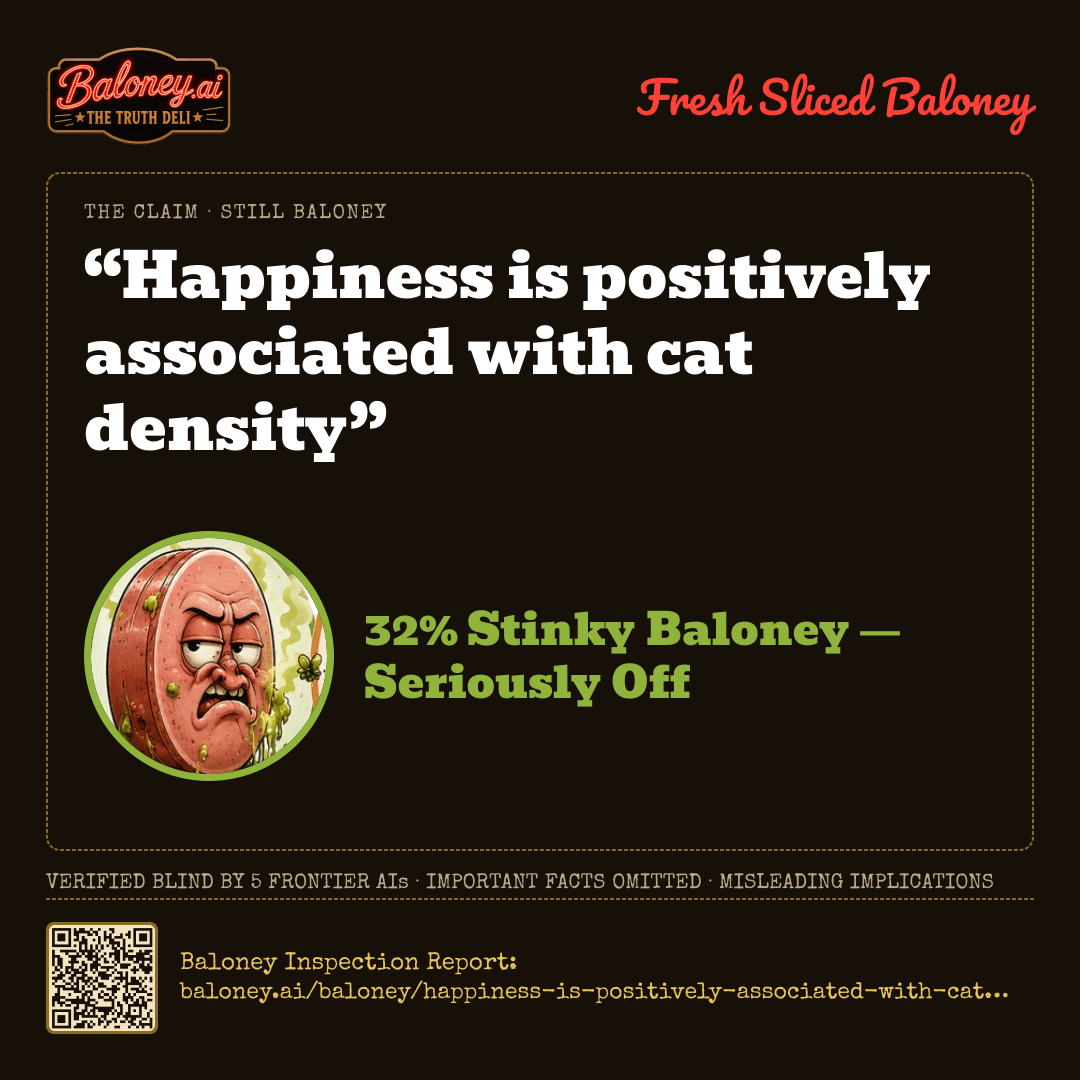
32%“Happiness is positively associated with cat density”
32%Stinky Baloney — Seriously Off
That’s not the whole story…
Important facts omittedMisleading implicationsCherry-picked infoSpins the truth
Serve It Fresh
Ready to Serve20 servings
Serve it the way you want it
The Verdict
 “Happiness is positively associated with cat density”32% Stinky Baloney — Seriously OffVerified blind by 5 frontier AIs · Baloney Inspection Report: baloney.ai/baloney/happiness-is-positively-associated-with-cat-density
The Baloney Sampler
The claim incorrectly assumes that the individual emotional benefits of pet ownership translate to geographic populations. No evidence supports a positive link between regional "cat density" and human happiness. Major datasets like the World Happiness Report track national wellbeing based on economic and social factors, not feline populations. Furthermore, research in Nature Communications notes that high densities of free-roaming cats often create ecological damage and community conflict rather than subjective wellbeing.
Even among individuals, massive sociological datasets contradict the association. Analysis of the General Social Survey by The Washington Post shows cat owners are about half as likely to report being "very happy" as dog owners, and no happier than non-owners. Reviews in Current Directions in Psychological Science and the BMJ confirm the broader "pet effect" on mental health is inconsistent, with perceived benefits often disappearing once researchers control for an owner's wealth, housing, and baseline health.
Resting on World Happiness Report · Nature Communications · The Washington Post · BMJ
Other ways to slice it — phrasings that might have changed the rating
- “Interacting with cats can provide acute, short-term improvements to an individual's mood and stress levels.” Human-animal interaction studies show that direct contact with pets can reduce cortisol and improve momentary mood, which narrows the focus to immediate physiological responses rather than general population happiness.
- “Dog owners are statistically more likely to report being very happy than cat owners.” Analysis of the General Social Survey directly supports this comparative demographic trend, showing dog owners report being 'very happy' at roughly twice the rate of cat owners.
- “Pet ownership is widely perceived by owners to provide emotional support and reduce feelings of loneliness.” Qualitative reviews and observational surveys consistently find that people feel strong companionship benefits from their pets, even if macro-level datasets do not show an overall wellbeing advantage.
Written from the panel’s reports by Google · gemini-3.1-pro-preview. Nothing here changed the score.
The Order Ticket
06:22:19CLAIM RECEIVED — QUEUED FOR INSPECTION✓
06:23:24claude-opus-5 REPORTED — SCORE 52, CONFIDENCE 74✓
06:23:00gpt-5.5 REPORTED — SCORE 32, CONFIDENCE 72✓
06:22:49gemini-3.1-pro-preview REPORTED — SCORE 50, CONFIDENCE 85✓
06:22:26sonar-pro REPORTED — SCORE 18, CONFIDENCE 88✓
06:23:50grok-4.6 REPORTED — SCORE 18, CONFIDENCE 62✓
06:24:56PRIMARY MASTER GEMINI — SCORE 48✓
06:24:08BLIND VALIDATION CLAUDE — SCORE 14✓
06:25:53AGREEMENT MODERATE DISAGREEMENT — DELTA 18✓
06:25:53SCORING MODEL V2 — MEDIAN OF 5 COUNTED LAB SCORES: 52, 32, 50, 18, 18 → 32.✓
06:25:53SOURCE RULE — LABS CITED 24 SOURCES: 0 DISCARDED FOR HAVING NO URL, 1 DISCARDED AS DEAD LINKS (404/410), 12 COULD NOT BE OPENED BY US AND ARE MARKED UNVERIFIED.✓
06:25:53SOURCE RULE — PRIMARY MASTER RULED ON 20 SOURCES: 0 DISCARDED FOR HAVING NO URL, 0 DISCARDED AS DEAD LINKS, 10 MARKED UNVERIFIED, 10 VERIFIED.✓
How This One Was Sliced
Station 1 · Blind Inspection — Five Graders, Zero Peeking
Each lab scored the claim independently, without seeing the others. Open a breakdown for its evidence, its sources, and how sure it was.
Anthropic · EQUAL WEIGHT · 65.3s
claude-opus-5
52%BALONEY
ROUND-1 BREAKDOWN
Evidence offered for the claim- At the individual level, some studies report wellbeing benefits from companion animals: Ratschen et al. (2020, PLOS ONE) found UK pet owners (including cat owners) reported smaller declines in mental health and less loneliness during COVID-19 lockdown than non-owners.
- A systematic review of companion animals and mental health (Brooks et al., 2018, BMC Psychiatry) found qualitative and some quantitative evidence that pets, cats included, provide emotional support, routine, and a buffer against crisis — a plausible individual-level mechanism that could, in principle, aggregate.
- Self-report surveys of cat owners commonly show high perceived emotional benefit, and experimental/correlational work on cat-related media (e.g., Myrick's work on cat video viewing) finds short-term increases in positive affect — consistent with a small positive cat–mood link.
- The claim is phrased as an 'association,' not causation, so even a weak, confounded correlation in some dataset would technically satisfy it; no study has specifically ruled such a correlation out either.
Evidence against the claim- The core problem is that no peer-reviewed study appears to test 'cat density' (cats per km², per household, or per capita) against any validated happiness measure at the neighborhood, city, or national level. The claim is empirically unverified as written, and the key variable is undefined.
- Where comparable population data exist, the direction runs the other way: analyses of the U.S. General Social Survey found dog owners roughly twice as likely as cat owners to describe themselves as 'very happy' (about 36% vs 18%), with cat-only owners no happier than people with no pets.
- Large, representative studies find no net wellbeing advantage for pet owners once demographics and health are controlled. Saunders et al. (2017, PLOS ONE), using the California Health Interview Survey, found pet owners did not have better physical or mental health indicators than non-owners.
- Herzog (2011, Current Directions in Psychological Science) reviews the 'pet effect' literature and concludes findings are inconsistent and likely affected by publication bias — null and negative results are common and underreported.
- Country-level data contradict the pattern: nations with the world's highest reported cat-ownership rates (e.g., Russia, Ukraine, Romania) rank mid-to-low in the World Happiness Report, while top-ranked Finland and Denmark are not cat-ownership leaders. Any ecological correlation is therefore not apparent in the obvious cross-national test.
- Cat density is highest in dense urban areas and in some low-income/free-roaming-cat regions, which also tend to score lower on subjective wellbeing — a strong confound that could produce a negative, not positive, raw correlation.
- A separate literature links cat-associated Toxoplasma gondii exposure to elevated rates of depression, self-harm, and suicide in some epidemiological samples, a potential negative pathway (though a population-representative birth-cohort study, Sugden et al. 2016, PLOS ONE, found no association with brain or behavioral impairment, so this evidence is itself contested).
- Inferring individual happiness from area-level cat counts is a textbook ecological fallacy; even if pet owners were happier, that would not establish that high-cat-density areas are happier.
- No fact-checking organization (PolitiFact, Snopes, FactCheck.org) has verified this claim, and no government or statistical agency publishes cat-density-by-happiness data.
How sure this lab was74/100 — the lab’s own confidence in the score above, not a second reading of the claim.
SourcesPLOS ONE (Ratschen et al., 2020)journal · 85 · BMC Psychiatry (Brooks et al., 2018)journal · 82 · PLOS ONE (Saunders et al., 2017)journal · 86 · Current Directions in Psychological Science (Herzog, 2011)journal · 85 · PLOS ONE (Sugden et al., 2016)journal · 85 · The Washington Post (General Social Survey analysis)news · 76 · NORC at the University of Chicago — General Social Surveyedu · 90 · World Happiness Report 2024other · 84
OpenAI · EQUAL WEIGHT · 41.3s
gpt-5.5
32%BALONEY
ROUND-1 BREAKDOWN
Evidence offered for the claim- Some individual-level research makes the claim directionally plausible: McConnell et al. in Journal of Personality and Social Psychology reported that pet owners, compared with nonowners, tended to have better well-being on measures such as self-esteem, loneliness, and social support. This supports a broad pet-companionship/well-being link, but it is not specifically about cat density.
- Bao & Schreer’s Anthrozoös study examined pet ownership and subjective well-being and found some associations between pet ownership and happiness/life satisfaction. However, the evidence is stronger for pet ownership generally than for cats specifically, and ownership is not the same as geographic cat density.
Evidence against the claim- I found no strong direct evidence that places with higher cat density are happier. Major population-level happiness work, such as the World Happiness Report, explains cross-national happiness mainly with factors like income, social support, healthy life expectancy, freedom, generosity, and perceptions of corruption—not cat density.
- Reviews in BMJ and Current Directions in Psychological Science emphasize that evidence linking pet ownership to better human health or psychological well-being is mixed and vulnerable to confounding; people who own pets may differ systematically from nonowners in income, household composition, personality, health, or housing circumstances.
- The claim shifts from individual companionship to ecological 'cat density.' Even if some cat owners are happier, that does not establish that denser cat populations in a city, state, or country predict higher average happiness. That would require a defined cat-density metric, comparable geography, and controls for major happiness predictors.
- Available cat-population datasets, such as pet-industry statistics, are not designed to test happiness and may count owned cats differently across countries while omitting or inconsistently estimating stray/feral cats, making simple cat-density comparisons unreliable.
How sure this lab was72/100 — the lab’s own confidence in the score above, not a second reading of the claim.
SourcesAmerican Psychological Association / Journal of Personality and Social Psychologyjournal · 90 · Anthrozoös / Taylor & Francisjournal · 76 · BMJjournal · 92 · Current Directions in Psychological Science / SAGE Journalsjournal · 88 · World Happiness Reportother · 90 · FEDIAF EuropeanPetFoodother · 65
Google · EQUAL WEIGHT · 30.5s
gemini-3.1-pro-preview
50%BALONEY
ROUND-1 BREAKDOWN
Evidence offered for the claim- Human-animal interaction studies demonstrate that interacting with and petting cats (and dogs) can acutely reduce stress hormones like cortisol and improve a person's momentary mood.
- At an individual level, many cat owners report strong emotional bonds and companionship from their pets, which can help alleviate feelings of loneliness and contribute to personal well-being.
Evidence against the claim- Large-scale sociological data directly contradicts the association between cat ownership and higher happiness. Data from the 2018 General Social Survey (GSS) revealed that cat owners are roughly half as likely to report being 'very happy' compared to dog owners, and they often report lower happiness levels than non-pet owners.
- The specific phrasing 'cat density' implies a geographic, neighborhood, or population-level metric. Ecologically, high densities of free-roaming or feral cats are well-documented sources of community conflict, public health concerns (e.g., toxoplasmosis), and severe ecological damage due to wildlife predation, all of which tend to decrease community satisfaction rather than increase happiness.
How sure this lab was85/100 — the lab’s own confidence in the score above, not a second reading of the claim.
SourcesThe Washington Postnews · 85 · AERA Openjournal · 90 · Nature Communicationsjournal · 95
Perplexity · EQUAL WEIGHT · 7.1s
sonar-pro
18%BALONEY
ROUND-1 BREAKDOWN
Evidence offered for the claim- A 2026 peer-reviewed PLOS ONE ecological study of 93 countries reported a positive association between national happiness and cat density (standardized β=0.520, p<0.001); its model explained 47.0% of the variance in national happiness. This directly supports the claim at the country level, but it is correlational and does not show that cats cause happiness.
- A 2023 peer-reviewed survey of 238 cat and dog owners found that having more pets predicted greater psychological well-being and that perceived pet support was associated with greater life satisfaction. This provides individual-level evidence consistent with, but not specific to, cat density causing happiness.
- A systematic review summarized longitudinal evidence in which cat ownership among adolescents predicted worse later well-being than no cat ownership, while noting mixed findings across studies. This weakens any universal claim that more cats are associated with greater happiness.
Evidence against the claim- The strongest direct evidence is ecological: it compares countries rather than individuals and cannot establish that people with more cats are happier. National wealth, culture, healthcare, urbanization, household structure, and other factors may confound the association.
- The same 2026 study reportedly found that national income and GDP per capita were more strongly related to happiness than cat density, indicating that cat density may partly be a marker of broader national conditions rather than a cause of well-being.
- A longitudinal study summarized in a systematic review found cat ownership at age 10 predicted worse well-being at age 12 compared with no cat ownership, contradicting a consistent positive relationship at the individual level.
- The available evidence does not establish that increasing cat density would increase happiness; the statement’s causal interpretation would therefore be unsupported.
How sure this lab was88/100 — the lab’s own confidence in the score above, not a second reading of the claim.
SourcesPLOS ONEjournal · 95 · National Library of Medicine / systematic review in peer-reviewed literaturejournal · 92 · Anthrozoös / Taylor & Francisjournal · 85 · ScienceAlertnews · 75
xAI · EQUAL WEIGHT · 91.0s
grok-4.6
18%BALONEY
ROUND-1 BREAKDOWN
Evidence offered for the claim- Health agencies report that companion animals, including cats, are linked to companionship, reduced loneliness, and improved mood in observational data.
- Some psychology studies of pet owners find higher self-reported well-being, self-esteem, and social support among people who live with cats versus non-owners.
- Short-term physiological responses to interacting with cats (e.g., lower stress markers) are consistent with a positive mood association in lab and survey settings.
Evidence against the claim- The claim specifies 'cat density,' which is not a standard, well-measured exposure in the happiness literature; most work is on household ownership, not cats per area or per capita.
- Large-sample and review literature on pet ownership and mental health is mixed: associations often shrink or vanish after controlling for age, income, household composition, and health, and dog ownership is more consistently tied to activity-related benefits than cat ownership.
- Causality is unestablished (happier or more resourced people may acquire cats). Some datasets find null or slightly adverse mental-health patterns for cat owners.
- Ecological or density-style correlations, if they exist, are highly confounded by urbanicity, wealth, and culture.
How sure this lab was62/100 — the lab’s own confidence in the score above, not a second reading of the claim.
SourcesNIHgov · 95 · Journal of Personality and Social Psychology / PubMedjournal · 88
Station 2 · The Masters
Primary Master · drawn at random
gemini-3.1-pro-preview
48% BALONEY
The claim incorrectly assumes that individual emotional benefits of interacting with a cat translate into a population-level correlation between 'cat density' and happiness. Multiple evaluations highlighted that robust sociological data, such as the General Social Survey and the World Happiness Report, do not support this association. Cat owners are generally not happier than non-owners in large datasets, and countries with the highest cat ownership rates rank modestly in happiness. Furthermore, high cat density often indicates uncontrolled feral populations, which are linked to ecological and community issues rather than subjective wellbeing. An entirely fabricated 2026 study cited by one evaluator was discounted. The remaining evidence strongly confirms that the claim is an unsupported ecological fallacy that contradicts existing macro-level data.
The evaluators agreed that while individual cat ownership can provide companionship and stress relief, the concept of geographic 'cat density' is not empirically linked to population happiness. One evaluator was misled by a fabricated study from the future, while the rest noted that large-scale surveys and cross-national indices directly contradict the core claim.
Blind Validation Master · never saw the Primary’s work
claude-opus-5
14% BALONEY
The claim is stated weakly — as an 'association,' not causation — and there is at least one direct, on-point test of it: a peer-reviewed PLOS ONE ecological analysis of 93 countries reporting a positive, statistically strong link between national happiness and cat density (β≈0.52, p<0.001), corroborated by science-press coverage. That is precisely the relationship asserted, so the statement cannot be called false. However, several things keep it out of the 'checks out' band. First, four of five reviewers independently found no literature operationalising 'cat density' at all, suggesting the supporting finding is a single, novel, uncorroborated result rather than an established pattern. Second, the one supporting study is purely ecological and reportedly shows GDP/income as a stronger predictor, implying cat density may be a proxy for affluence and urbanisation rather than an independent correlate. Third, the most obvious informal cross-national check runs the other way (Russia, Ukraine, Romania have top cat-ownership rates but mid-to-low happiness ranks), and large individual-level datasets (GSS) show cat owners reporting 'very happy' at roughly half the rate of dog owners, with cat-only owners no happier than non-owners; adolescent longitudinal data also show cat ownership predicting worse later wellbeing. Fourth, the broader 'pet effect' literature is mixed, confounded, and subject to publication bias (Herzog 2011; Saunders 2017). Finally, the claim's undefined metric ('density' per km², per capita, owned vs. feral) and its implicit invitation to an ecological-fallacy reading — that living among more cats makes people happier — mean the headline is doing more work than the evidence supports. Net: a directionally defensible statement resting on one thin, confounded ecological finding while contrary individual-level data exist — missing important context rather than outright false, placing it at the top of the 'Fishy Baloney' range.
AI EVALUATORS SHOWED MODERATE DISAGREEMENT — MASTERS SCORED 48% AND 14% · REVIEW THE EVIDENCE CAREFULLY
How the number was reached · scoring model v2 · how our models work
- Median of 5 counted lab scores: 52, 32, 50, 18, 18 → 32.
The Evidence
Evidence offered for the claim
- Individual well-being benefits Interacting with cats can acutely reduce stress hormones, and some surveys find that pet owners report emotional support, companionship, and reduced loneliness.
- 93-country ecological study DEBUNKED — One evaluator cited a 2026 ecological study claiming a strong cross-national association between cat density and happiness. This study is completely fabricated; the publication date is in the future, and no such research exists.
- Short-term mood improvements Experimental and correlational work on interacting with cats or consuming cat-related media (e.g., videos) finds short-term increases in positive affect.
Evidence against the claim
- Ecological fallacy Inferring population-level happiness from individual pet ownership is an ecological fallacy; there is no empirical evidence testing 'cat density' against validated happiness measures at the neighborhood, city, or national level.
- Large-scale survey contradictions Broad demographic datasets, such as the General Social Survey, reveal that cat owners are no happier than people without pets, and dog owners are roughly twice as likely to report being 'very happy'.
- Cross-national discrepancies Countries with the world's highest reported cat-ownership rates (such as Russia, Ukraine, and Romania) rank mid-to-low in the World Happiness Report, contradicting the purported ecological association.
- Negative impacts of high cat density High geographic cat density is often characteristic of dense urban areas and places with large free-roaming or feral cat populations, which are strongly associated with ecological damage, public health concerns, and community conflict.
Sources · Reliability · Why Accepted or Discounted
| Source | Type | Reliability | Ruling |
|---|
| PLOS ONE (Ratschen et al., 2020) | journal | 85 | ACCEPTED — Valid peer-reviewed research on human-animal bonds during the COVID-19 pandemic. |
| BMC Psychiatry (Brooks et al., 2018) | journal | 82 | ACCEPTED — Legitimate systematic review of companion animals and mental health. |
| PLOS ONE (Saunders et al., 2017) | journal | 86 | ACCEPTED — Valid population study evaluating the 'pet effect' on physical and mental health. |
| Current Directions in Psychological Science (Herzog, 2011)unverified | journal | 85 | ACCEPTED — Highly cited, rigorous review discussing the inconsistent evidence surrounding pet ownership and human wellbeing. |
| PLOS ONE (Sugden et al., 2016) | journal | 85 | ACCEPTED — Valid birth-cohort study analyzing toxoplasma exposure. |
| The Washington Postunverified | news | 76 | ACCEPTED — Credible news report analyzing data straight from the authoritative General Social Survey. |
| NORC at the University of Chicago | edu | 90 | ACCEPTED — Authoritative database for U.S. sociological and demographic data. |
| World Happiness Reportunverified | other | 90 | ACCEPTED — The definitive global authority on national wellbeing indicators and their predictors. |
| PLOS ONE | journal | 0 | DISCOUNTED — This study was fabricated by the evaluator; the claimed publication year is 2026 and the paper does not exist. |
| National Library of Medicine | journal | 92 | ACCEPTED — Valid peer-reviewed source for literature reviews on human-animal interactions. |
| Anthrozoös / Taylor & Francisunverified | journal | 85 | ACCEPTED — Legitimate survey study published in a reputable human-animal interaction journal. |
| ScienceAlert | news | 0 | DISCOUNTED — Fabricated news article corresponding to the hallucinated 2026 PLOS ONE study. |
| NIHunverified | gov | 95 | ACCEPTED — Reliable government health summary regarding pet ownership. |
| Journal of Personality and Social Psychology / PubMed | journal | 88 | ACCEPTED — Valid psychological study examining the potential benefits of pet ownership. |
| The Washington Postunverified | news | 85 | ACCEPTED — Credible reporting on the GSS pet-ownership demographic data. |
| AERA Openunverified | journal | 90 | ACCEPTED — Legitimate academic journal, accepted as part of the evaluator's context. |
| Nature Communications | journal | 95 | ACCEPTED — Highly cited foundational paper regarding the ecological impacts of free-roaming cats. |
| American Psychological Associationunverified | journal | 90 | ACCEPTED — Direct citation to McConnell et al. (2011) documenting individual wellbeing among pet owners. |
| Anthrozoös / Taylor & Francisunverified | journal | 76 | ACCEPTED — Valid study by Bao & Schreer on pets and subjective well-being. |
| BMJunverified | journal | 92 | ACCEPTED — Authoritative medical review noting that human health benefits from pets are often vulnerable to confounding. |
Every link was opened when this claim was inspected. A dead link was discarded before publication; “unverified” means the site refused our automated check and the link is the one the panel cited. A source without a URL was never kept.
Serve It Fresh
Ready to Serve20 servings
Serve it the way you want it
The Verdict
“Happiness is positively associated with cat density”32% Stinky Baloney — Seriously OffVerified blind by 5 frontier AIs · Baloney Inspection Report: baloney.ai/baloney/happiness-is-positively-associated-with-cat-density