Station 1 · Blind Inspection — Five Graders, Zero Peeking
Each lab scored the claim independently, without seeing the others. Open a breakdown for its evidence, its sources, and how sure it was.
Anthropic · EQUAL WEIGHT · 52.4s
claude-opus-5
93%BALONEY
ROUND-1 BREAKDOWN
Evidence offered for the claim
No peer-reviewed study has ever supported a three-second memory span in goldfish; the strongest 'evidence' is folklore repeated in popular media, pet-care pamphlets and advertising since at least the mid-20th century.
There is a kernel of legitimate science behind the general idea that fish have limited working memory: like most animals, goldfish show decay in very short-term/working memory on some delayed-response tasks, and their memory is not equivalent to a mammal's. Some laboratory delayed-matching tasks with fish show performance dropping off after seconds-to-minutes in specific, artificial paradigms.
Goldfish in bare tanks show highly repetitive swimming patterns that casual observers interpret as evidence the animal has forgotten where it just was — this observational impression is the everyday basis for the belief.
The claim is sometimes defended as an approximation of 'attention span' rather than memory storage, and goldfish do habituate quickly to novel stimuli, which superficially resembles rapid forgetting.
Evidence against the claim
Classical and operant conditioning experiments dating back decades show goldfish retain learned avoidance and feeding responses for weeks to months, not seconds — retention intervals of 30+ days are routinely reported in the fish-learning literature.
Goldfish can be trained to press a lever or approach a feeder only at a specific time of day, and they anticipate the feeding window — behaviour that requires memory spanning many hours (work associated with Phil Gee and colleagues at the University of Plymouth).
Fish, including goldfish and their carp relatives, can learn to discriminate complex auditory stimuli (e.g., different pieces of classical music / different composers) and retain the discrimination across sessions separated by days.
Review work on fish cognition (Culum Brown, Macquarie University, 'Fish intelligence, sentience and ethics', Animal Cognition 2015) concludes fish memory is comparable to that of other vertebrates, with spatial maps, social recognition and tool-use-like behaviours retained over long periods — explicitly rejecting the three-second myth.
Goldfish have been trained to navigate mazes and to recognise individual human faces or coloured cues, and they retain those associations after long breaks in training.
A widely reported 2022 study at Ben-Gurion University trained goldfish to steer a wheeled robotic tank toward a visual target on dry land; the fish improved across sessions and retained the skill, which is impossible without multi-day memory.
A well-publicised Australian school-science experiment (Rory Stokes, 2008) and the Discovery Channel's MythBusters both trained goldfish to respond to cues and found retention over weeks; MythBusters classified the three-second claim as 'busted'.
Fish spatial memory has ecological importance — tidal-pool fish memorise pool layouts and goldfish form spatial maps of tanks — behaviours documented in comparative-cognition research that a three-second memory would preclude.
How sure this lab was
94/100 — the lab’s own confidence in the score above, not a second reading of the claim.
Weak/none: the main support for the claim is its repetition as a popular saying or metaphor for forgetfulness, not a demonstrated biological limit. I found no reliable scientific, government, or fact-checking source establishing that goldfish memory lasts only three seconds.
A narrow kernel that may make the myth sound plausible is that animals can forget some short-lived stimuli quickly in certain experimental contexts; however, that does not support a universal three-second memory span for goldfish.
Evidence against the claim
Snopes assesses the claim that goldfish have only a three-second memory as false, citing evidence that goldfish can learn and retain associations for far longer than seconds.
Scientific American’s fact-check-style science article rejects the broader 'fish have a three-second memory' claim and summarizes evidence that fish, including goldfish in training contexts, can remember cues, routes, and associations for days, weeks, or longer.
A peer-reviewed Animal Cognition review by Culum Brown concludes that fishes show substantial learning and memory abilities, including spatial learning, avoidance learning, social learning, and long-term retention, which is incompatible with a blanket three-second memory limit.
Peer-reviewed goldfish spatial-learning research in Journal of Comparative Psychology reports that goldfish can encode geometric and feature-based spatial information, demonstrating learned memory-guided behavior rather than a moment-to-moment reset after three seconds.
How sure this lab was
91/100 — the lab’s own confidence in the score above, not a second reading of the claim.
There is no credible scientific evidence supporting the claim that goldfish possess a three-second memory span.
The claim exists purely as a pervasive cultural myth. It likely originated from anecdotal observations of goldfish kept in small, unstimulating bowls, where their repetitive swimming behaviors create the illusion of a short attention span.
Historically, this misconception was fueled by an outdated and flawed understanding of fish neurobiology, which falsely assumed that lacking a complex cerebral cortex rendered fish incapable of long-term memory formation.
Evidence against the claim
Scientific research has definitively proven that goldfish (Carassius auratus) can retain memories for weeks, months, and potentially years.
A well-known 2003 study by researchers at Plymouth University demonstrated that goldfish could be trained to press a lever for food. When the lever was restricted to work only during a specific one-hour window each day, the fish learned to approach the lever only at that correct time, demonstrating long-term memory and temporal tracking.
Extensive reviews of fish cognition in peer-reviewed journals show that fish can navigate complex spatial mazes, recognize familiar individuals, and learn from social cues—behaviors impossible with a three-second memory.
In a highly publicized test, the Discovery Channel program 'MythBusters' successfully trained goldfish to navigate a color-coded maze. The fish remembered the correct path to the food after a month of no practice, definitively busting the myth.
How sure this lab was
98/100 — the lab’s own confidence in the score above, not a second reading of the claim.
The claim that goldfish have a three‑second memory is widely repeated in popular culture and media, often used as a metaphor for poor attention or forgetfulness, which helps explain why many people believe it even though it lacks scientific backing.[2][10][12]
Some articles and trivia-style sites assert or assume short memory spans for goldfish or aquarium fish in general; however, when examined closely, these pieces either fail to cite empirical research or trace the claim back only to folklore and pet-keeping practices.[4][5]
Evidence against the claim
Multiple science explainers and popular-science outlets explicitly state that the three‑second memory claim is a **myth** and note there is no scientific study supporting the three‑second figure.[2][3][5][10][11]
Live Science reports that goldfish have memories lasting **weeks, months, and even years**, citing behavioral research and expert commentary from fish cognition researcher Culum Brown, who calls the three‑second memory idea a "complete myth."[2][6]
Discover Magazine explains that although goldfish are commonly said to have a three‑second memory, scientists have known for decades that this claim does not withstand scrutiny, and studies show goldfish memories can span **several months**.[10]
Research summaries and explainers reference controlled experiments in which goldfish learn to press levers for food that is available only at specific times of day, a task that requires remembering temporal contingencies well beyond a few seconds.[8][10]
Fact-style and research-brief sites note that no one has traced the specific "three seconds" figure to any named researcher, study, or date and characterize it as **folklore**, often linked to justifying keeping fish in small bowls rather than evidence-based science.[4][5][8][11]
Educational materials from the American Museum of Natural History describe experiments showing that goldfish can recall learned tasks for at least **one month** and retain spatial memories for at least **six months**, contradicting any three‑second limit.[7]
A widely reported experiment by a school student, covered by ABC News (Australia), showed that goldfish could learn and retain behavior that required memory beyond a few seconds, leading the report to describe the three‑second memory "myth" as "busted."[13]
How sure this lab was
95/100 — the lab’s own confidence in the score above, not a second reading of the claim.
The three-second goldfish memory idea is a long-running piece of popular folklore, casually repeated in media, advertising, and conversation.
Informal watching of goldfish circling small bowls can look consistent with almost no lasting recognition of recent events.
Evidence against the claim
Laboratory training studies show goldfish form and keep associations (feeding cues, levers, locations, visual patterns) for weeks to months, not seconds.
University of Plymouth work widely reported in 2003 found goldfish retained a learned feeding-time/location response for at least three months.
Fish-cognition research documents spatial memory, time-place learning, maze performance, and discrimination of colors/shapes/sounds in goldfish far beyond three seconds.
Major fact-checkers and science outlets treat the specific three-second-span claim as a myth.
How sure this lab was
82/100 — the lab’s own confidence in the score above, not a second reading of the claim.
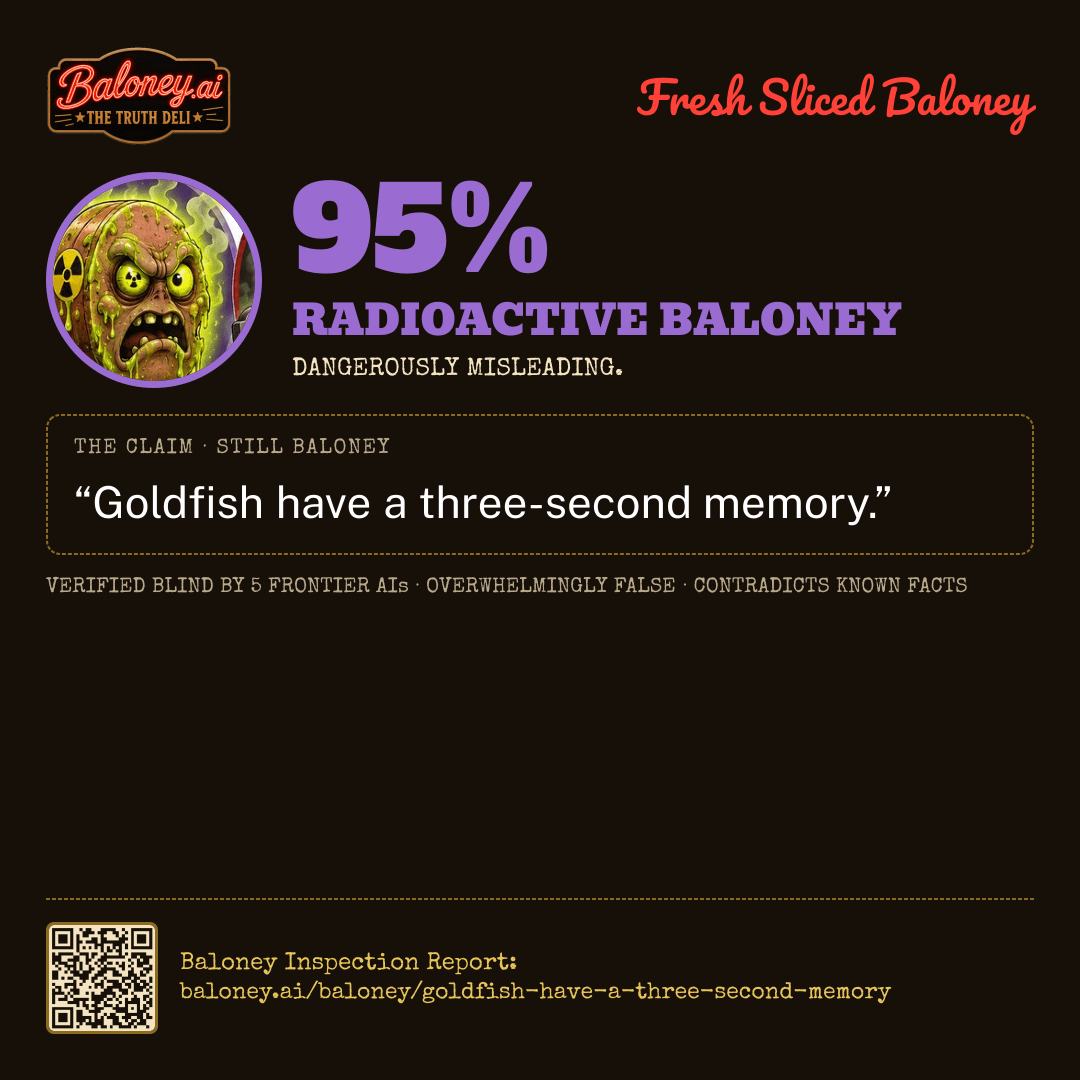
All five evaluators unanimously rejected the claim, citing decades of peer-reviewed animal cognition research. The evidence uniformly demonstrates that goldfish retain memories for weeks, months, and potentially years. The three-second memory idea is a well-documented, pervasive cultural myth with no empirical foundation, originating from superficial observations of fish in bare bowls and outdated assumptions about fish neurobiology. Because it is an extensively debunked falsehood that continues to circulate widely, it warrants a Zombie Baloney score.
The evaluators were in complete agreement that the statement is categorically false. They all cited robust scientific research, peer-reviewed journals, and popular science debunkings to show that goldfish memory spans months rather than seconds.
ZOMBIE FLAG: TRUE — DEBUNK HISTORY ON RECORD
Blind Validation Master · never saw the Primary’s work
claude-opus-5
99% BALONEY
All five independent assessments converge: there is no peer-reviewed study, named researcher, or dataset supporting a three-second memory span in goldfish. The claim's only support is folklore, repetition in media/advertising, and casual observation of fish circling bare bowls — plus a superficially plausible but misapplied point about working-memory decay in artificial delayed-response paradigms, which does not establish a blanket three-second limit. Against it stands a large, convergent body of evidence: classical/operant conditioning studies showing retention of avoidance and feeding responses for 30+ days; University of Plymouth time-of-day lever-pressing work showing retention for months; spatial-learning research in the Journal of Comparative Psychology showing geometric and feature-based encoding; Culum Brown's Animal Cognition review concluding fish memory is comparable to other vertebrates (he calls the three-second figure a 'complete myth'); AMNH educational material citing retention of learned tasks for at least a month and spatial memory for six months; music/stimulus discrimination in carp; the 2022 Ben-Gurion fish-operated-vehicle study requiring multi-day learning; and maze retention after a month in the MythBusters test. Fact-checkers (Snopes) and major science outlets (Live Science, Scientific American, Discover) rate it false. The claim is therefore not merely exaggerated or lacking context — it is flatly contradicted by the evidence, off by roughly six to seven orders of magnitude. Crucially, it has been explicitly and repeatedly debunked across decades — by peer-reviewed reviews, museum education programs, popular-science fact-checks, and televised tests — and yet continues to circulate as common 'knowledge' and as justification for keeping fish in small bowls. That combination of thorough, repeated debunking plus continued wide circulation is the defining signature of Zombie Baloney rather than merely radioactive falsehood.
AGREEMENT TEST PASSED — BOTH MASTERS SCORED 99% · BLIND VALIDATION CONFIRMED THIS SCORE · NO RE-EVALUATION REQUIRED
The Evidence
Evidence offered for the claim
Pervasive popular folkloreDEBUNKED — The claim is widely repeated in popular media, advertising, and casual conversation as a metaphor for forgetfulness, which gives it cultural momentum despite lacking empirical backing.
Superficial observationsDEBUNKED — Goldfish kept in small, bare, unstimulating bowls often display highly repetitive swimming patterns, creating an illusion for casual observers that the animal is constantly forgetting its surroundings.
Misinterpreted short-term decayDEBUNKED — In specific artificial laboratory delayed-matching tasks, fish may show a decay in very short-term working memory or habituate quickly to novel stimuli, which superficially resembles rapid forgetting.
Evidence against the claim
Long-term memory retention Classical and operant conditioning experiments dating back decades demonstrate that goldfish can retain learned avoidance and feeding responses for weeks, months, and even years.
Temporal schedule tracking Research by University of Plymouth scientists showed that goldfish can be trained to press a lever for food during a specific one-hour window each day, which requires multi-hour temporal memory.
Complex spatial and navigational skills Goldfish form spatial maps of their tanks, successfully navigate color-coded mazes, and have even been trained to steer a wheeled robotic vehicle toward a target, skills requiring long-term multi-session memory.
Sensory discrimination Cognitive research confirms goldfish can learn to distinguish complex auditory stimuli (such as different music), colored cues, and individual human faces, retaining these specific associations over long periods.
Sources · Reliability · Why Accepted or Discounted
Source
Type
Reliability
Ruling
Live Science
news
90
ACCEPTED — Reliable science news outlet.
Discover Magazine
news
88
ACCEPTED — Established and respected science magazine.
ABC News (Australia)
news
90
ACCEPTED — Major national news broadcaster.
American Museum of Natural History
edu
92
ACCEPTED — Highly respected scientific and educational institution.
Indiana University (SciU blog)
edu
80
ACCEPTED — University-backed science blog.
Pennsylvania State University (course blog)
edu
75
DISCOUNTED — Student course blogs are not peer-reviewed or professionally edited.
ResearchToolBench
other
80
DISCOUNTED — Unverified tool/blog site without clear editorial standards.
TrueSeeker
factcheck
82
DISCOUNTED — Not a recognized major fact-checking organization.
West: EamAhead
edu
78
DISCOUNTED — Obscure nonprofit blog without scientific authority.
Inkl
news
80
DISCOUNTED — News aggregator, not an original source of science reporting.
ScienceABC
other
78
DISCOUNTED — General infotainment site; better primary sources are available.
Shortform Explainers
other
70
DISCOUNTED — Summary service rather than a primary science publisher.
Animal Cognition
journal
95
ACCEPTED — Peer-reviewed scientific journal specializing in the field.
Animal Learning & Behavior
journal
85
ACCEPTED — Peer-reviewed academic journal.
Behavioural Brain Research
journal
85
ACCEPTED — Peer-reviewed academic journal.
BBC Science Focus
news
78
ACCEPTED — Reliable popular science publication.
RSPCA Australia Knowledgebase
other
75
ACCEPTED — Reputable animal welfare and veterinary organization.
University of Plymouth
edu
80
ACCEPTED — Academic research institution conducting primary studies.
Discovery Channel / MythBusters
other
80
ACCEPTED — Popular science testing that accurately demonstrated the underlying biological facts.