Baloney Inspection Report: Claim #1037 · Inspected Sep 30, 2026, 2:37 PM PDT · Scoring model v2
 99%
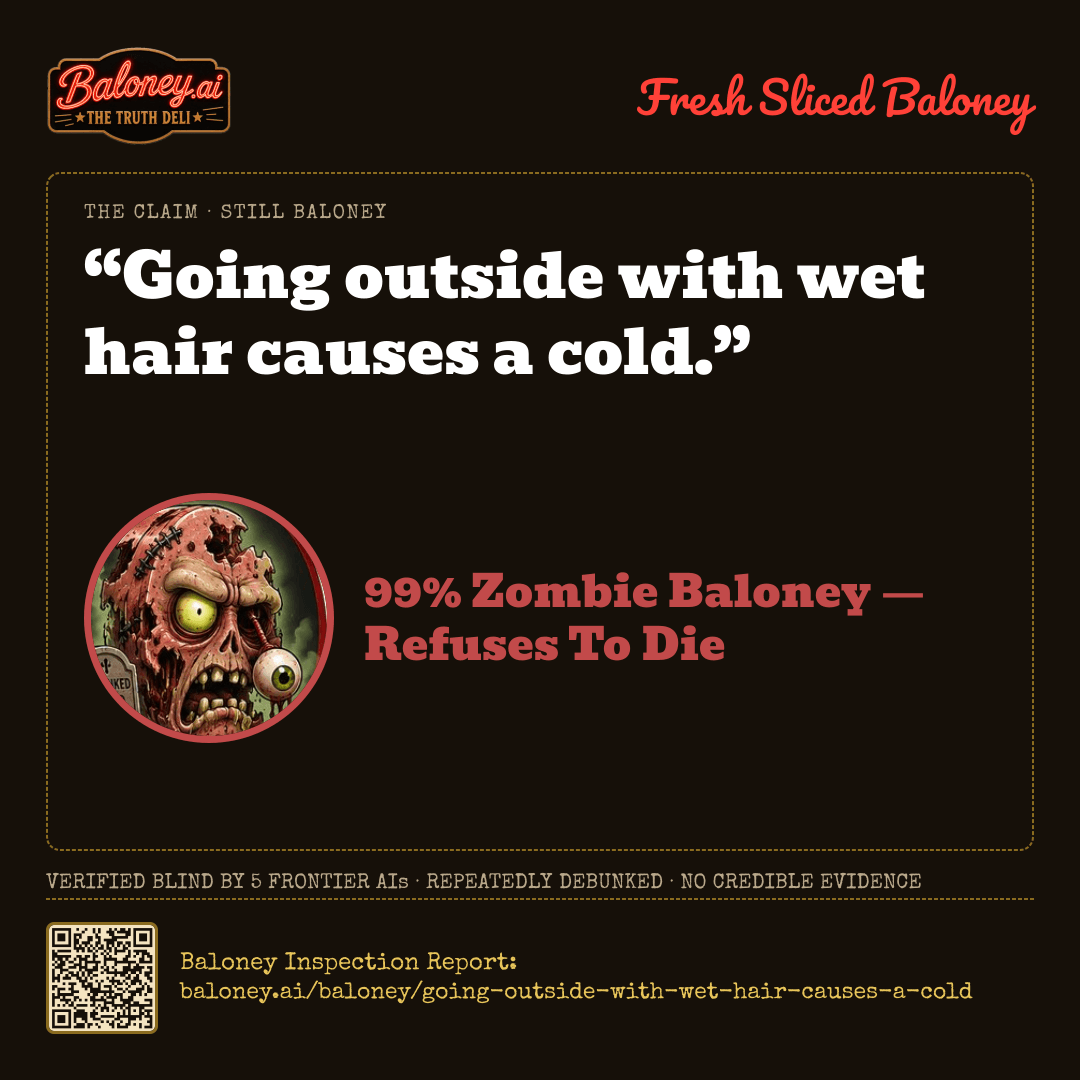
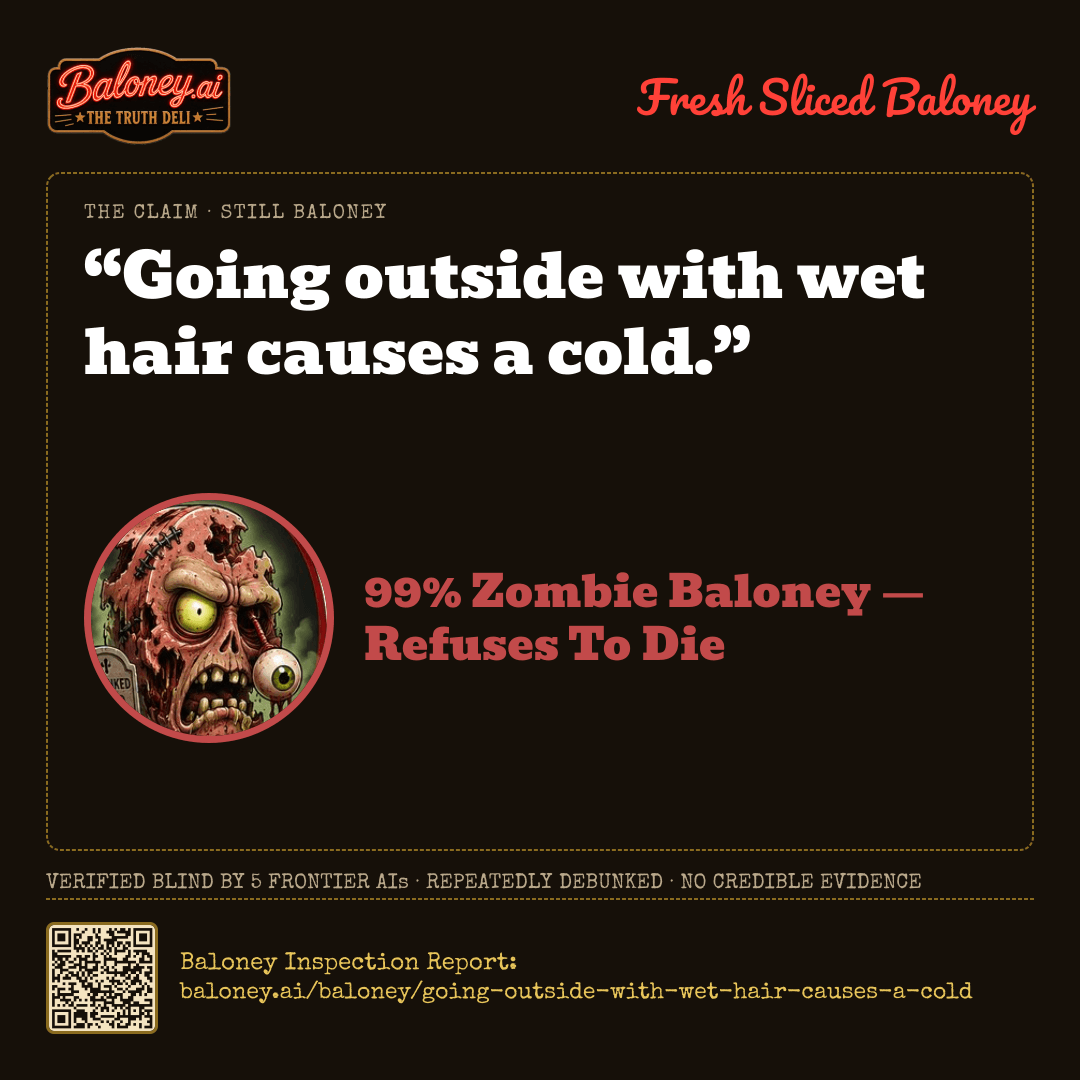
99%“Going outside with wet hair causes a cold.”
99%Zombie Baloney — Refuses To Die
DEAD. BURIED. STILL SHAMBLING AROUND.
Repeatedly debunkedNo credible evidenceRefuses to dieLives on in delusion
✓ BLIND VALIDATION CONFIRMED THIS SCORE
Serve It Fresh
Ready to Serve17 servings
Serve it the way you want it
The Verdict
 “Going outside with wet hair causes a cold.”99% Zombie Baloney — Refuses To DieVerified blind by 5 frontier AIs · Baloney Inspection Report: baloney.ai/baloney/going-outside-with-wet-hair-causes-a-cold
The Baloney Sampler
The reports found the claim false as written: common colds are viral infections, not something wet hair or cold air creates. CDC, MedlinePlus/National Library of Medicine, NHS, and Mayo Clinic describe colds as caused by respiratory viruses and spread through infectious exposure; Mayo Clinic and other clinical sources directly treat the wet-hair idea as a myth.
There is a small kernel of plausibility: peer-reviewed work cited by the panel suggests cooler airway conditions or acute chilling could affect local antiviral defenses or bring out symptoms in someone already infected. But human-challenge and review evidence did not show wet hair causing infection, and seasonality is better explained by viral transmission, indoor crowding, humidity, ventilation, and school terms.
Resting on CDC · MedlinePlus / National Library of Medicine · NHS · Mayo Clinic
Other ways to slice it — phrasings that might have changed the rating
- “Going outside with wet hair can make a person feel chilled or uncomfortable, but it does not by itself cause a common cold.” The reports distinguish discomfort from infection and state that a respiratory virus is required for a cold.
- “In people already harboring a cold virus, acute chilling may trigger or worsen reported cold symptoms.” The panel accepted limited indirect evidence from chilling studies and reviews as possibly affecting symptoms after viral exposure, not creating infection.
- “Cold-season conditions such as indoor crowding, low humidity, reduced ventilation, and school terms increase transmission of common-cold viruses.” The reports explain seasonal colds mainly through transmission conditions rather than heat loss from wet hair.
Written from the panel’s reports by OpenAI · gpt-5.5. Nothing here changed the score.
The Order Ticket
21:37:39CLAIM RECEIVED — QUEUED FOR INSPECTION✓
21:38:14claude-opus-5 REPORTED — SCORE 95, CONFIDENCE 93✓
21:38:13gpt-5.5 REPORTED — SCORE 72, CONFIDENCE 88✓
21:38:11gemini-3.1-pro-preview REPORTED — SCORE 99, CONFIDENCE 100✓
21:37:55sonar-pro REPORTED — SCORE 85, CONFIDENCE 95✓
21:39:01grok-4.6 REPORTED — SCORE 86, CONFIDENCE 84✓
21:39:49PRIMARY MASTER CHATGPT — SCORE 99✓
21:39:07BLIND VALIDATION PERPLEXITY — SCORE 96✓
21:39:59AGREEMENT CONFIRMED — DELTA 3✓
21:39:59SCORING MODEL V2 — MEDIAN OF 5 COUNTED LAB SCORES: 95, 72, 99, 85, 86 → 86. ZOMBIE RULE: THE PRIMARY MASTER FLAGS A LONG DEBUNK HISTORY, THE BLIND MASTER SCORES 96, THE COUNTED MEDIAN IS 86 — PUBLISHED AS 99.✓
21:39:59SOURCE RULE — LABS CITED 24 SOURCES: 0 DISCARDED FOR HAVING NO URL, 0 DISCARDED AS DEAD LINKS (404/410), 9 COULD NOT BE OPENED BY US AND ARE MARKED UNVERIFIED.✓
21:39:59SOURCE RULE — PRIMARY MASTER RULED ON 17 SOURCES: 0 DISCARDED FOR HAVING NO URL, 1 DISCARDED AS DEAD LINKS, 6 MARKED UNVERIFIED, 10 VERIFIED.✓
How This One Was Sliced
Station 1 · Blind Inspection — Five Graders, Zero Peeking
Each lab scored the claim independently, without seeing the others. Open a breakdown for its evidence, its sources, and how sure it was.
Anthropic · EQUAL WEIGHT · 35.3s
claude-opus-5
95%BALONEY
ROUND-1 BREAKDOWN
Evidence offered for the claim- Chilling of the body surface has been associated in at least one controlled study with increased reporting of cold symptoms: Johnson & Eccles (Family Practice, 2005) found that subjects whose feet were immersed in cold water reported significantly more cold symptoms over the following days than controls, suggesting acute chilling may trigger symptoms in people already harboring a virus (this study used cold feet, not wet hair, and did not show new infections were caused).
- Laboratory work has shown that lowering the temperature of the nasal epithelium impairs local innate antiviral defenses (reduced extracellular-vesicle/interferon responses), providing a plausible mechanism by which being cold could make an existing viral exposure more likely to take hold. Evaporative cooling from wet hair could in principle lower head/nasal temperature.
- Colds are genuinely seasonal in temperate climates, and cold, dry conditions favor rhinovirus and other respiratory virus transmission and stability — so cold exposure is correlated (though not causally in the way the folk claim implies) with catching colds.
- Extreme or prolonged chilling causes physiological stress (vasoconstriction, possible transient immune suppression), which is the kernel of truth behind the folk belief.
Evidence against the claim- A cold is an infectious disease: it requires exposure to one of ~200 respiratory viruses (rhinoviruses most commonly). No virus, no cold — wet hair cannot generate a pathogen. CDC, NHS, Mayo Clinic, Johns Hopkins and MedlinePlus all state colds are caused by viruses spread person-to-person or via contaminated surfaces.
- Classic human-challenge experiments (notably at the UK Common Cold Unit, Salisbury) exposed volunteers to cold, damp conditions — including wet clothing, wet hair and drafts — and found no increase in infection rates compared with controls; chilling did not cause infection in people not exposed to virus.
- Public-health and major medical institutions explicitly list 'going outside with wet hair / cold weather' as a myth: NHS, Mayo Clinic, Cleveland Clinic and Johns Hopkins all note that being cold or wet does not itself cause a cold.
- The seasonal pattern is better explained by indoor crowding, low humidity aiding virus survival and transmission, reduced ventilation, and school terms — not by heat loss from wet hair.
- Even the strongest supporting study (Eccles' cold-feet work) is interpreted by its own authors as possibly converting a pre-existing subclinical infection into symptoms, not as chilling creating a cold; it is small, self-reported, and not replicated for wet hair specifically.
- The claim as written asserts direct causation ('causes a cold'), which no public health agency endorses.
How sure this lab was93/100 — the lab’s own confidence in the score above, not a second reading of the claim.
SourcesU.S. Centers for Disease Control and Preventiongov · 96 · UK National Health Servicegov · 95 · Mayo Clinicedu · 93 · MedlinePlus, U.S. National Library of Medicinegov · 94 · Johns Hopkins Medicineedu · 92 · Cleveland Clinicedu · 90 · Johnson C, Eccles R., Family Practice (via PubMed)journal · 85 · NIH News in Healthgov · 90
OpenAI · EQUAL WEIGHT · 33.8s
gpt-5.5
72%BALONEY
ROUND-1 BREAKDOWN
Evidence offered for the claim- There is limited indirect evidence that chilling could affect susceptibility after viral exposure: a randomized trial in Family Practice found that participants whose feet were chilled reported more common-cold symptoms over the next several days than controls, but the study did not confirm viral infection and did not test wet hair.
- Laboratory evidence suggests cooler airway temperatures can reduce innate antiviral defenses against rhinovirus and allow more viral replication, which could help explain why cold conditions may influence respiratory infections. This is not evidence that wet hair itself causes colds.
- Wet hair can increase heat loss and make a person feel chilled, so it is biologically plausible that in some circumstances it could contribute slightly to conditions that favor symptoms if a respiratory virus is already present.
Evidence against the claim- Common colds are caused by respiratory viruses, most often rhinoviruses; wet hair or cold air alone cannot create a cold infection without viral exposure.
- Government medical sources describe colds as spreading through virus-containing droplets, close contact, or contaminated surfaces—not from having wet hair outdoors.
- The strongest support for cold/chilling effects is indirect, inconsistent, or symptom-based; it does not show that going outside with wet hair causes a cold as written.
- A more accurate statement would be: going outside with wet hair may make you cold or uncomfortable, and cold conditions may modestly affect susceptibility, but viruses cause colds.
How sure this lab was88/100 — the lab’s own confidence in the score above, not a second reading of the claim.
SourcesCenters for Disease Control and Preventiongov · 95 · MedlinePlus / U.S. National Library of Medicinegov · 94 · Family Practice / PubMedjournal · 74 · Proceedings of the National Academy of Sciencesjournal · 87 · Rhinology / PubMedjournal · 72
Google · EQUAL WEIGHT · 32.5s
gemini-3.1-pro-preview
99%BALONEY
ROUND-1 BREAKDOWN
Evidence offered for the claim- While wet hair itself does not cause a cold, exposure to cold environments can cause vasoconstriction (narrowing of blood vessels) in the respiratory tract. Some research suggests this may slightly inhibit local immune responses, potentially allowing a dormant virus already present in the nasal cavity to replicate faster.
- People tend to spend more time indoors in close proximity to others during cold, wet weather, which increases the likelihood of viral transmission and creates a strong seasonal correlation between cold weather and illness.
Evidence against the claim- The common cold is an infectious viral disease primarily caused by rhinoviruses, adenoviruses, or coronaviruses. It is not caused by environmental factors like temperature or moisture.
- Without the physical presence of a respiratory virus, it is biologically impossible to develop a cold merely by going outside with wet hair or being exposed to freezing temperatures.
- Major medical institutions and public health agencies universally categorize the idea that wet hair or cold weather directly causes a cold as a thoroughly debunked myth.
How sure this lab was100/100 — the lab’s own confidence in the score above, not a second reading of the claim.
SourcesNational Library of Medicine (MedlinePlus)gov · 98 · Mayo Clinicother · 95 · Johns Hopkins Medicineedu · 95
Perplexity · EQUAL WEIGHT · 16.3s
sonar-pro
85%BALONEY
ROUND-1 BREAKDOWN
Evidence offered for the claim- Cold exposure from wet hair can make someone feel chilled and uncomfortable, but that is not the same as causing a viral cold.[https://newsnetwork.mayoclinic.org/discussion/mayo-clinic-q-and-a-myths-about-catching-a-cold/]
- A review hypothesized that acute cooling might trigger symptoms in someone who already has a subclinical viral infection, although it found no demonstrated effect of cold exposure on susceptibility to infection.[https://pubmed.ncbi.nlm.nih.gov/12357708/]
- A small 2005 study found that participants whose feet were chilled in cold water reported approximately twice as many cold symptoms several days later; this suggests a possible effect on symptom onset, not proof that wet hair causes infection.[https://pubmed.ncbi.nlm.nih.gov/16286445/]
Evidence against the claim- The common cold is caused by respiratory viruses, not by wet hair or cold air alone.[https://newsnetwork.mayoclinic.org/discussion/mayo-clinic-q-and-a-myths-about-catching-a-cold/]
- Mayo Clinic states directly that going outside with wet hair does not increase the chance of getting sick.[https://newsnetwork.mayoclinic.org/discussion/mayo-clinic-q-and-a-myths-about-catching-a-cold/]
- Cleveland Clinic likewise says that wet hair cannot make someone sick by itself; a microorganism such as a virus must be involved.[https://health.clevelandclinic.org/can-wet-hair-make-you-sick]
- A peer-reviewed review reports that experiments involving cold-virus inoculation and cold exposure failed to show increased susceptibility to infection, while noting that chilling might theoretically affect symptoms in someone already infected.[https://pubmed.ncbi.nlm.nih.gov/12357708/]
- A 2023 medical review states that laboratory experiments have failed to demonstrate an effect of chilling on susceptibility to common-cold infection.[https://pmc.ncbi.nlm.nih.gov/articles/PMC10324571/]
How sure this lab was95/100 — the lab’s own confidence in the score above, not a second reading of the claim.
SourcesMayo Clinicother · 95 · Cleveland Clinicother · 92 · PubMed; review article indexed by the U.S. National Library of Medicinejournal · 94 · Peer-reviewed review article hosted by PubMed Centraljournal · 90
xAI · EQUAL WEIGHT · 82.4s
grok-4.6
86%BALONEY
ROUND-1 BREAKDOWN
Evidence offered for the claim- Some lab studies show cooler nasal temperatures can weaken local innate antiviral defenses, allowing rhinoviruses to replicate more readily if already present.
- Colds peak in colder months, creating a perceived link with going outside while wet or chilled.
- Anecdotes and a few older chilling experiments have been interpreted as mild immune or circulatory effects that could raise susceptibility after viral exposure.
Evidence against the claim- Colds are caused by viruses (mainly rhinoviruses), not by wet hair, cold air, or being chilled; infection requires exposure to the virus.
- Major health authorities state that getting wet or cold does not cause a cold.
- Human challenge studies (including historic Common Cold Unit work) did not find that chilling or similar exposure produces colds without the virus.
- No clinical evidence specifically shows that going outside with wet hair causes colds.
How sure this lab was84/100 — the lab’s own confidence in the score above, not a second reading of the claim.
SourcesMayo Clinicother · 95 · NHSgov · 95 · PNASjournal · 92 · MedlinePlus (NIH)gov · 94
Station 2 · The Masters
Primary Master · drawn at random
gpt-5.5
99% BALONEY
I scored the statement as written: it says going outside with wet hair causes a cold. The panel evidence overwhelmingly supports that the common cold is a viral respiratory infection, not an illness generated by wet hair, cold air, or being chilled. I gave greatest weight to CDC, MedlinePlus, NHS, Mayo Clinic, Johns Hopkins, and Cleveland Clinic because they directly describe causes and transmission of common colds and, in several cases, directly address the wet-hair myth. I accepted the peer-reviewed sources as useful but narrower: they support possible mechanisms by which cold conditions might affect local antiviral defenses or symptom expression after viral exposure, not the claim that wet hair causes a cold. I discounted malformed or inconsistent citations where the URL could not be relied on as given. The limited pro-claim evidence is a kernel of plausibility about chilling and susceptibility, but it does not rescue the direct folk claim. Because this is a familiar, repeatedly debunked public-health myth that still circulates, it falls in Zombie Baloney.
All five evaluators agreed that wet hair does not directly cause a cold and that viruses are required; they differed mainly on how much weight to give indirect evidence that chilling might modestly influence susceptibility or symptoms when a virus is already present.
ZOMBIE FLAG: TRUE — DEBUNK HISTORY ON RECORD
Blind Validation Master · never saw the Primary’s work
sonar-pro
96% BALONEY
The statement is overwhelmingly false as written. A common cold requires infection with a respiratory virus; wet hair and going outside do not create the infection, and medical authorities explicitly identify this belief as a myth. Evidence that chilling might affect nasal immune defenses or bring on symptoms from an already-existing, subclinical infection is indirect, limited, and does not show that wet hair causes a cold. Seasonal increases in colds are better explained by viral transmission, indoor crowding, ventilation, and related factors. Because the claim asserts direct causation and omits the essential requirement of viral exposure, it belongs in the Radioactive Baloney range, though not quite the maximum score because cold exposure may have modest effects on symptoms or susceptibility after viral exposure.
AGREEMENT TEST PASSED — MASTERS SCORED 99% AND 96% · BLIND VALIDATION CONFIRMED THIS SCORE · NO RE-EVALUATION REQUIRED
How the number was reached · scoring model v2 · how our models work
- Median of 5 counted lab scores: 95, 72, 99, 85, 86 → 86.
- Zombie rule: the Primary Master flags a long debunk history, the Blind Master scores 96, the counted median is 86 — published as 99.
The Evidence
Evidence offered for the claim
- Chilling may affect defenses Several evaluators cited laboratory evidence that cooler nasal or airway temperatures can weaken local innate antiviral responses and allow rhinoviruses to replicate more readily if a virus is already present. That supports only a possible susceptibility mechanism, not wet hair creating a cold.
- Symptom-trigger hypothesis A small cold-feet study and review discussion suggest acute chilling might trigger symptoms in people already carrying a subclinical viral infection. The study did not test wet hair, did not confirm new viral infection, and does not show that chilling causes colds by itself.
- Seasonal association DEBUNKED — Colds are more common in colder months, which makes the folk belief feel plausible. The panel treated this as a misleading correlation: indoor crowding, ventilation, humidity, and viral transmission better explain seasonality than wet hair.
Evidence against the claim
- Viruses cause colds The common cold is an infectious disease caused by respiratory viruses, especially rhinoviruses. Without exposure to a virus, wet hair or cold air cannot produce a cold.
- Medical authorities debunk it Major medical and public-health sources cited by the panel describe colds as spreading through virus-containing droplets, close contact, or contaminated surfaces, and several explicitly say wet hair or being cold does not by itself cause illness.
- Human evidence is weak for chilling Reviews and challenge-study evidence cited by the evaluators do not show that cold exposure increases infection rates in the absence of viral exposure. Supportive studies are indirect, symptom-based, or mechanistic.
- Wet hair not specifically proven No evaluator found clinical evidence that going outside with wet hair specifically causes common colds. At most, wet hair can make a person feel chilled or uncomfortable.
Sources · Reliability · Why Accepted or Discounted
| Source | Type | Reliability | Ruling |
|---|
| National Library of Medicine (MedlinePlus) | gov | 98 | ACCEPTED — High-reliability government medical source describing the common cold as a viral infection; directly relevant to causation. |
| Mayo Clinicunverified | other | 95 | ACCEPTED — Major clinical source explaining symptoms and causes of the common cold; supports viral causation rather than wet hair. |
| Johns Hopkins Medicineunverified | edu | 95 | ACCEPTED — Reputable academic medical source cited for the viral nature and transmission of colds. |
| NHS | gov | 95 | ACCEPTED — Government health source explaining common-cold transmission and treatment; consistent with the panel consensus. |
| PNASunverified | journal | 60 | DISCOUNTED — Cited for a mechanistic cold-temperature point, but the panel record contains an apparent DOI inconsistency; I did not rely on this URL when a more specific PNAS citation was also provided. |
| Centers for Disease Control and Prevention | gov | 96 | ACCEPTED — Authoritative public-health source identifying common-cold causes and transmission routes. |
| MedlinePlus / U.S. National Library of Medicine | gov | 94 | ACCEPTED — Government medical reference supporting that colds are viral and spread through infectious exposure. |
| Family Practice / PubMed | journal | 85 | ACCEPTED — Relevant peer-reviewed study on chilling and reported cold symptoms, accepted only as limited indirect evidence, not proof of wet-hair causation. |
| Proceedings of the National Academy of Sciencesunverified | journal | 87 | ACCEPTED — Peer-reviewed mechanistic evidence that cooler airway conditions can affect antiviral defenses; relevant to plausibility but not direct causation. |
| Rhinology / PubMed | journal | 72 | ACCEPTED — Relevant to the narrower question of chilling and respiratory symptoms; accepted as indirect and lower-weight evidence. |
| Mayo Clinicunverified | other | 95 | ACCEPTED — Directly addresses the wet-hair myth and is from a major clinical institution. |
| PubMed; review article indexed by the U.S. National Library of Medicine | journal | 94 | ACCEPTED — Peer-reviewed review useful for weighing cold exposure experiments and the hypothesis that chilling may affect symptoms rather than cause infection. |
| Cleveland Clinic | other | 92 | ACCEPTED — Directly addresses whether wet hair can make someone sick and explains that a microorganism such as a virus is required. |
| Peer-reviewed review article hosted by PubMed Central | journal | 90 | ACCEPTED — Useful peer-reviewed review evidence on chilling and susceptibility; supports the conclusion that chilling alone has not been shown to cause common-cold infection. |
| Cleveland Clinic | other | 90 | ACCEPTED — Reputable clinical source on common-cold causes and transmission, consistent with the public-health sources. |
| NIH News in Healthunverified | gov | 90 | ACCEPTED — Government health source useful for distinguishing viral respiratory illness from other causes of symptoms. |
Every link was opened when this claim was inspected. A dead link was discarded before publication; “unverified” means the site refused our automated check and the link is the one the panel cited. A source without a URL was never kept.
Serve It Fresh
Ready to Serve17 servings
Serve it the way you want it
The Verdict
“Going outside with wet hair causes a cold.”99% Zombie Baloney — Refuses To DieVerified blind by 5 frontier AIs · Baloney Inspection Report: baloney.ai/baloney/going-outside-with-wet-hair-causes-a-cold