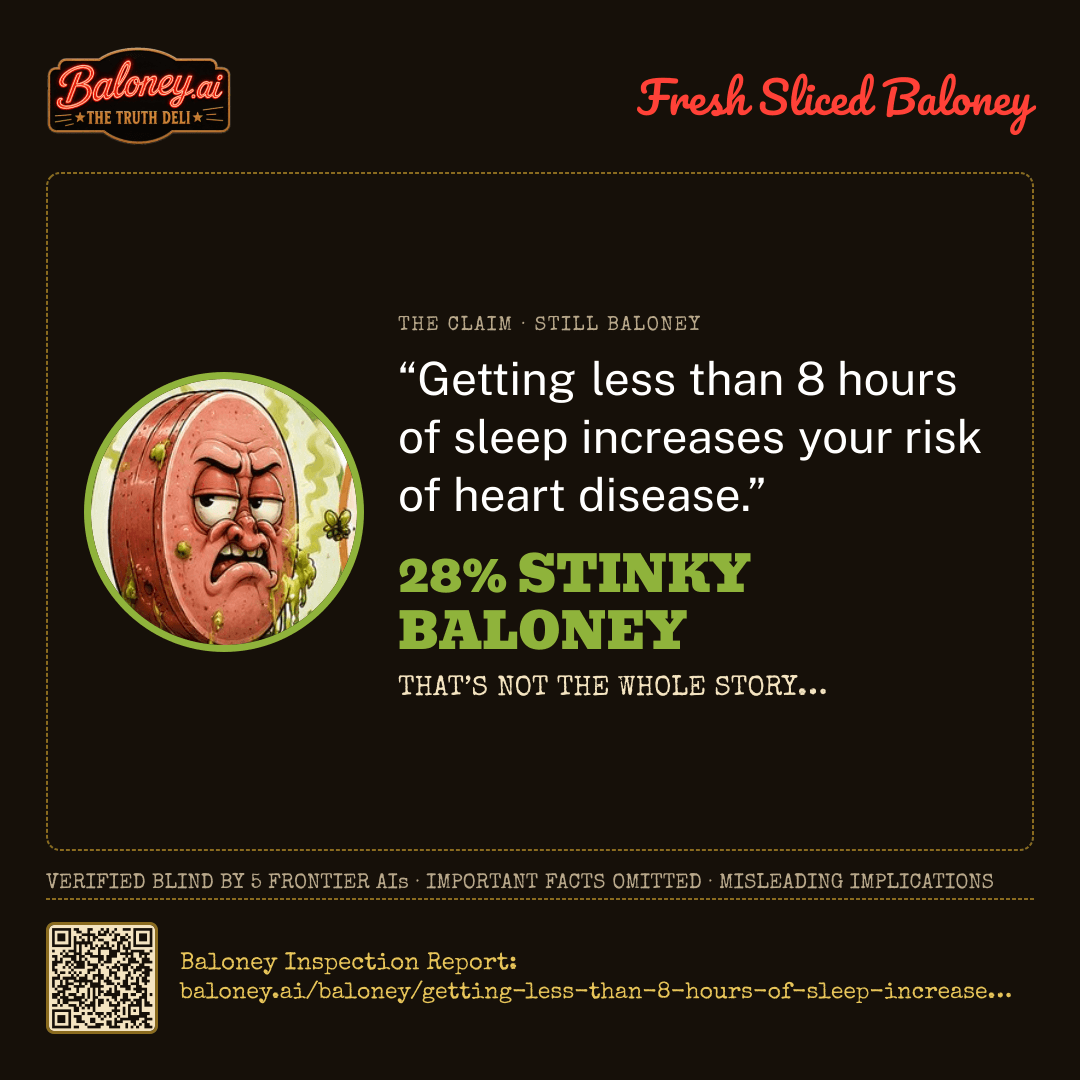
“Getting less than 8 hours of sleep increases your risk of heart disease.”
SUBMITTED ANONYMOUSLY · INSPECTED 2026-09-14T06:34:39.523Z · STATUS: PUBLISHED
28%
28%
STINKY BALONEY — SERIOUSLY OFF
That’s not the whole story…
Important facts omittedMisleading implicationsCherry-picked infoSpins the truth
✓ BLIND VALIDATION CONFIRMED THIS SCORE
Serve It Fresh
Ready to Serve20 servings
Serve it the way you want it
The Verdict
“Getting less than 8 hours of sleep increases your risk of heart disease.” 28% STINKY BALONEY — SERIOUSLY OFF Verified blind by 5 frontier AIs · Baloney Inspection Report: baloney.ai/baloney/getting-less-than-8-hours-of-sleep-increases-your-risk-of
Station 1 · Blind Inspection — Five Graders, Zero Peeking
Each lab scored the claim independently, without seeing the others. Open a breakdown for its evidence, its sources, and how sure it was.
Anthropic · EQUAL WEIGHT · 32.4s
claude-opus-5
22%BALONEY
ROUND-1 BREAKDOWN
Evidence offered for the claim
Large prospective meta-analyses find short sleep duration is associated with higher incidence of coronary heart disease and stroke. Cappuccio et al. (European Heart Journal, 2011), pooling 15 prospective studies (~475,000 participants), reported a relative risk of roughly 1.48 for CHD and 1.15 for total CVD in short sleepers versus normal sleepers.
Genetic (Mendelian randomization) evidence supports causality rather than mere correlation: Daghlas et al. (JACC, 2019) using UK Biobank found genetically predicted short sleep duration was associated with ~20% higher odds of myocardial infarction, independent of other risk factors, and that long sleep also carried elevated risk.
The American Heart Association formally added 'healthy sleep duration' as the eighth component of cardiovascular health in 'Life's Essential 8' (Circulation, 2022), citing evidence that insufficient sleep contributes to hypertension, obesity, type 2 diabetes and adverse cardiovascular outcomes.
Plausible mechanisms are documented: sleep restriction raises sympathetic activity and blood pressure, impairs glucose tolerance and insulin sensitivity, increases inflammatory markers, and promotes weight gain — all established cardiovascular risk pathways (NHLBI, CDC).
Government health agencies (CDC, NHLBI) explicitly list heart disease, high blood pressure, stroke, obesity and diabetes as conditions linked to chronic insufficient sleep.
Evidence against the claim
The numeric threshold in the claim is wrong. Expert consensus (AASM/Sleep Research Society, Sleep 2015; AHA Life's Essential 8) defines healthy adult sleep as 7–9 hours per night, with risk elevation generally observed below ~7 hours — not below 8. By the claim's logic, the roughly 7.0–7.9-hour sleepers who make up a large share of the population would be 'at increased risk,' which the evidence does not show.
The dose–response relationship is U- or J-shaped, not monotonic: long sleep (>9 hours) is associated with equal or greater cardiovascular risk in most meta-analyses, so 'more sleep is always better' is not supported and the framing of the claim is incomplete.
Most of the evidence is observational and vulnerable to confounding and reverse causation — shift work, sleep apnea, depression, chronic pain, socioeconomic stress and undiagnosed illness both shorten sleep and raise cardiac risk. Self-reported sleep duration is also poorly correlated with objectively measured sleep.
Individual sleep need varies; a minority of people function without measurable harm on less than 7 hours, and consensus statements explicitly note that 'appropriate' duration is a range, not a single cutoff.
The claim states an individual causal effect ('increases your risk') from population-average associations; absolute risk increase for any given healthy individual is modest compared with smoking, hypertension, or lipid levels.
Randomized controlled trials proving that extending sleep reduces hard cardiovascular endpoints (heart attack, cardiac death) do not exist; trials have only shown improvements in intermediate markers such as blood pressure and insulin sensitivity.
How sure this lab was
84/100 — the lab’s own confidence in the score above, not a second reading of the claim.
Prospective epidemiology generally supports that chronically short sleep is associated with higher cardiovascular risk. A European Heart Journal systematic review/meta-analysis reported that short sleep duration was associated with higher risk of developing or dying from coronary heart disease, with risk estimates around 1.5 versus reference sleep durations.
CDC public-health guidance states that adults who sleep less than 7 hours per night are more likely to report health problems including heart attack, heart disease, high blood pressure, diabetes, and stroke risk factors.
An American Heart Association scientific statement concludes that insufficient sleep duration and poor sleep quality are linked to adverse cardiometabolic factors such as hypertension, obesity, diabetes, and cardiovascular disease risk.
Evidence against the claim
The claim uses an 8-hour cutoff, but major sleep-medicine guidance does not say every adult needs at least 8 hours. The AASM/Sleep Research Society consensus recommends 7 or more hours for healthy adults, so 7 to under 8 hours is generally within the recommended range.
A JACC study of UK Biobank and Mendelian-randomization evidence found increased myocardial-infarction risk mainly for short sleep below 6 hours and long sleep above 9 hours, using 6-9 hours as the reference range; this does not support a simple 'less than 8 hours' threshold.
Much of the evidence is observational and often self-reported, so confounding and reverse causation are possible. Also, several studies find a U-shaped pattern where both very short and long sleep are associated with risk, making the blanket wording oversimplified.
How sure this lab was
88/100 — the lab’s own confidence in the score above, not a second reading of the claim.
Numerous epidemiological studies and health organizations, including the American Heart Association, confirm that chronic sleep deprivation significantly increases the risk of cardiovascular diseases, including hypertension, coronary artery disease, and stroke.
The American Heart Association recently added sleep duration to its 'Life's Essential 8' checklist for cardiovascular health, underscoring the critical biological link between adequate sleep and heart health.
Biologically, insufficient sleep can lead to increased inflammation, elevated sympathetic nervous system activity (higher stress hormones), and metabolic disruptions such as insulin resistance, all of which are primary drivers of heart disease.
Evidence against the claim
The specific threshold in the claim ('less than 8 hours') is medically inaccurate. The CDC, National Sleep Foundation, and American Academy of Sleep Medicine recommend 7 to 9 hours of sleep per night for adults. Sleeping 7 to 7.9 hours is considered perfectly healthy and is not associated with increased heart disease risk.
Research typically defines the high-risk 'short sleep' category for cardiovascular disease as less than 7 hours, or in some studies, less than 6 hours per night, rather than less than 8 hours.
The relationship between sleep and heart disease generally follows a U-shaped curve. Oversleeping (consistently getting more than 9 hours of sleep as an adult) is also associated with an increased risk of cardiovascular disease and mortality, meaning more sleep is not universally protective.
How sure this lab was
95/100 — the lab’s own confidence in the score above, not a second reading of the claim.
Multiple large prospective cohort studies and meta-analyses find that **habitual short sleep** (usually defined as ≤5–6 hours per night) is associated with a **significantly higher risk of cardiovascular disease (CVD) and coronary heart disease (CHD)** compared with about 7–8 hours of sleep.[1][2][3][4][6][8][11][13][15]
A 2016 NIH review of sleep duration and cardiovascular disease risk reported pooled relative risk for CHD of **1.48 (95% CI 1.22–1.80) for short sleepers** and **1.38 (1.15–1.66) for long sleepers**, compared with 7–8 hours/night, indicating increased incidence of fatal and non‑fatal CHD at both extremes.[13]
A 2011 systematic review (cited by the American College of Cardiology) found **short sleep duration associated with a 45% increased risk of coronary heart disease**.[8][11]
A meta-analysis on sleep deprivation and CVD reported that sleep deprivation (≤5 or ≤6 h/day) was associated with a **greater risk of CVDs (RR 1.09, 95% CI 1.02–1.16)**.[3]
The Fasa PERSIAN cohort study (Scientific Reports) found that sleeping **<6 hours** was significantly associated with higher prevalence and predicted risk of **CVD (OR 1.23), CHD (OR 1.21), and hypertension (OR 1.37)** after adjustment for confounders.[1]
A dose–response meta-analysis in the Journal of the American Heart Association found that for coronary heart disease, the pooled **relative risk increased by 1.07 (95% CI 1.03–1.12) per 1‑hour reduction in sleep duration**, with risk rising as sleep dropped below the reference range.[6]
Several cohort studies and meta-analyses describe a **U‑shaped association**: both short and long sleep are associated with higher all‑cause and cardiovascular mortality, with **lowest risk at around 7 hours/day** of sleep.[9][13][15] This supports the idea that substantially less than ~7 hours is adverse for cardiovascular health.
Consensus statements by cardiovascular and sleep experts (e.g., joint statements cited in JAHA twin studies) recommend **7–9 hours of nighttime sleep for adults**, explicitly labeling **<7 hours/night** as associated with adverse health outcomes, including cardiovascular risk.[14]
Evidence against the claim
Several analyses suggest that the **greatest and most consistent risk elevation is at ≤5–6 hours**, not at every level below 8 hours, implying that the specific threshold "less than 8" may overstate risk for those sleeping about 7 hours.[6][9][10][13][15]
Some dose–response meta-analyses of self‑reported sleep duration and cardiovascular disease found **no significant difference in risk for self‑reported sleep <7 hours** compared with reference categories, with patterns of risk more pronounced at very short durations (≤5–6 h) and in specific subgroups.[10]
Prospective studies that adjust for baseline health status and comorbidities sometimes find that the association between short sleep and incident CVD is **attenuated or disappears** when people with poor health at baseline are excluded, suggesting residual confounding by illness that both reduces sleep and increases CVD risk.[7]
Certain studies report that **sleep quality and comorbid insomnia** with objectively short sleep drive much of the risk; in some analyses, short sleep alone without poor sleep quality or insomnia symptoms is **not independently associated** with higher incident CVD.[5] This weakens a simple duration‑only causal claim.
Objective measures of sleep (polysomnography or actigraphy) sometimes show **different risk patterns** than self‑reported sleep duration, and one JAHA study noted that very short objective sleep (≤4 hours) markedly increased cardiovascular mortality, but did not show the same pattern for modest reductions below 8 hours.[12]
Several reviews emphasize that the observational evidence cannot fully establish causality, and that factors such as **shift work, socioeconomic status, mental health, obesity, and lifestyle** may partly explain the link between shorter sleep and cardiovascular disease, making the broad claim "less than 8 hours increases risk" potentially oversimplified.[3][6][13][14]
How sure this lab was
88/100 — the lab’s own confidence in the score above, not a second reading of the claim.
Large observational studies and meta-analyses consistently associate short sleep duration (commonly <7 hours) with higher incidence of coronary heart disease, hypertension, stroke, and related risk factors such as obesity and diabetes.
Short-term experimental sleep restriction raises blood pressure, sympathetic activity, inflammation, and insulin resistance—plausible pathways to cardiovascular disease.
CDC, NHLBI, and AHA materials explicitly link insufficient sleep to elevated heart-disease risk.
Evidence against the claim
CDC and AHA guidelines treat 7–9 hours as adequate for adults; 7 hours is therefore below 8 hours yet is not classified as increasing risk.
The sleep–CVD relationship is typically U-shaped, with both short and long sleep showing higher risk and the nadir around 7–8 hours; a hard cutoff at 8 hours is not supported.
Evidence is largely observational, so residual confounding (illness, stress, socioeconomic factors, undiagnosed sleep apnea) limits causal inference.
Individual sleep need varies; some people maintain health on 6–7 hours, and sleep quality/regularity often matter more than an exact 8-hour target.
How sure this lab was
72/100 — the lab’s own confidence in the score above, not a second reading of the claim.
All evaluators agreed that the fundamental relationship described in the claim is grounded in established science: chronic sleep deprivation increases the risk of cardiovascular disease. However, the specific threshold used ('less than 8 hours') makes the claim misleading. Expert consensus from organizations like the CDC, AHA, and American Academy of Sleep Medicine defines the optimal sleep duration for healthy adults as 7 to 9 hours per night. By stating that sleeping less than 8 hours increases risk, the claim incorrectly implies that people sleeping 7 to 7.9 hours—a perfectly healthy duration—are endangering their hearts. Elevated cardiovascular risk is generally observed only when sleep routinely falls below 7 hours, and especially below 6 hours. Furthermore, the claim ignores the U-shaped nature of the risk curve, where consistently oversleeping (more than 9 hours) is also linked to heart disease. Because the statement omits critical context and relies on an inaccurate cutoff that miscategorizes healthy behavior as risky, a score in the 'Stinky Baloney' range is appropriate.
The evaluators unanimously agreed that while the link between short sleep and heart disease is genuine, the strict 8-hour cutoff is incorrect, as 7 to 9 hours is universally recognized as the healthy range for adults.
Blind Validation Master · never saw the Primary’s work
grok-4.6
30% BALONEY
The core association is real: multiple meta-analyses, cohorts, and bodies such as AHA/CDC/NHLBI link habitual short sleep to higher CHD, CVD, hypertension and related pathways (inflammation, sympathetic activation, insulin resistance). AHA even added sleep duration to Life’s Essential 8. However the claim as written is misleading. Expert consensus (AASM/SRS, AHA, CDC) treats 7–9 hours as adequate for adults; risk is concentrated below ~6–7 hours, not below 8. Sleeping 7–7.9 h is within the recommended range and is typically the reference category, not a risk category. The relationship is U-shaped (long sleep also elevates risk), evidence is largely observational with confounding/reverse-causation issues, and individual need varies. The specific 8-hour cutoff therefore omits key facts and implies a false threshold.
AGREEMENT TEST PASSED — MASTERS SCORED 28% AND 30% · BLIND VALIDATION CONFIRMED THIS SCORE · NO RE-EVALUATION REQUIRED
The Evidence
Evidence offered for the claim
Any sleep under 8 hours is harmfulDEBUNKED — The claim asserts a strict 8-hour minimum for heart health, but medical consensus defines 7 to 9 hours as healthy; sleeping 7 to 7.9 hours does not increase risk.
Short sleep raises cardiovascular risk Extensive epidemiological data links chronic short sleep to a higher incidence of heart disease, hypertension, and stroke.
Recognized biological mechanisms Sleep restriction raises blood pressure, inflammation, and insulin resistance, providing plausible biological pathways to heart disease.
Evidence against the claim
Healthy range is 7 to 9 hours Major health organizations, including the CDC, National Sleep Foundation, and American Academy of Sleep Medicine, recommend 7 to 9 hours of sleep per night for healthy adults.
Risk threshold is lower Research typically defines the high-risk 'short sleep' category for cardiovascular disease as less than 7 hours, or sometimes less than 6 hours per night.
U-shaped risk curve The relationship between sleep and heart disease generally follows a U-shaped curve, where consistently oversleeping (more than 9 hours) also increases cardiovascular risk.
Observational confounding The evidence linking sleep and heart disease is largely observational, meaning factors like stress, socioeconomic status, and undiagnosed illness can confound the relationship.
Sources · Reliability · Why Accepted or Discounted
Source
Type
Reliability
Ruling
Centers for Disease Control and Prevention (CDC)
gov
95
ACCEPTED — Authoritative public health agency providing evidence-based sleep guidelines.
American Heart Association / Circulation
journal
94
ACCEPTED — Leading cardiovascular health organization establishing criteria for optimal heart health.
Journal of Clinical Sleep Medicine
journal
91
ACCEPTED — Peer-reviewed journal publishing consensus recommendations from sleep medicine experts.
European Heart Journal
journal
93
ACCEPTED — Major peer-reviewed cardiology journal detailing meta-analyses on sleep duration and cardiovascular outcomes.
Journal of the American College of Cardiology
journal
93
ACCEPTED — Highly reliable peer-reviewed journal providing cohort and genetic evidence on cardiovascular risk.
Serve It Fresh
Ready to Serve20 servings
Serve it the way you want it
The Verdict
“Getting less than 8 hours of sleep increases your risk of heart disease.” 28% STINKY BALONEY — SERIOUSLY OFF Verified blind by 5 frontier AIs · Baloney Inspection Report: baloney.ai/baloney/getting-less-than-8-hours-of-sleep-increases-your-risk-of