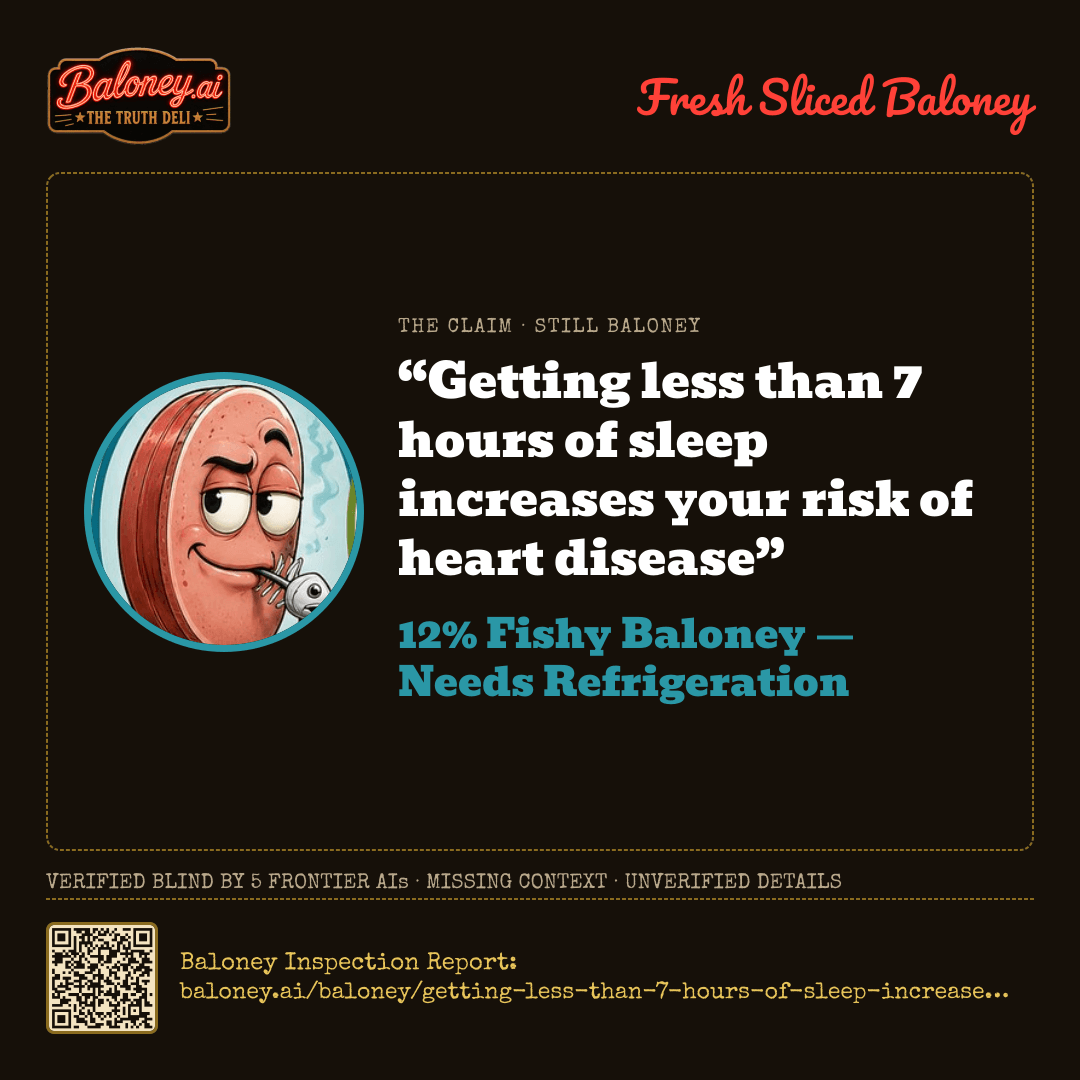
“Getting less than 7 hours of sleep increases your risk of heart disease”
12%Fishy Baloney — Needs Refrigeration
Something smells off…
Missing contextUnverified detailsSuspicious framingMay be exaggerated
✓ BLIND VALIDATION CONFIRMED THIS SCORE
Serve It Fresh
Ready to Serve17 servings
Serve it the way you want it
The Verdict
“Getting less than 7 hours of sleep increases your risk of heart disease” 12% Fishy Baloney — Needs Refrigeration Verified blind by 5 frontier AIs · Baloney Inspection Report: baloney.ai/baloney/getting-less-than-7-hours-of-sleep-increases-your-risk-of
Station 1 · Blind Inspection — Five Graders, Zero Peeking
Each lab scored the claim independently, without seeing the others. Open a breakdown for its evidence, its sources, and how sure it was.
Anthropic · EQUAL WEIGHT · 56.3s
claude-opus-5
10%BALONEY
ROUND-1 BREAKDOWN
Evidence offered for the claim
Large prospective meta-analyses find short sleep duration associated with higher incidence of coronary heart disease and stroke. Cappuccio et al. (European Heart Journal, 2011), pooling 15 prospective studies (~475,000 participants), reported roughly a 48% higher relative risk of developing/dying from coronary heart disease and ~15% higher stroke risk in short sleepers (typically <6 or <7 hours) versus 7–8 hours.
Genetic (Mendelian randomization) evidence supports causality, not just correlation: Daghlas et al. (Journal of the American College of Cardiology, 2019, UK Biobank, ~460,000 participants) found short sleepers had ~20% higher myocardial infarction risk, and a genetic instrument for short sleep duration was also associated with higher MI risk — a design less vulnerable to reverse causation and lifestyle confounding.
The American Heart Association added sleep duration (7–9 hours for adults) as the eighth component of cardiovascular health in 'Life's Essential 8' (2022), explicitly because sleep duration independently predicts cardiovascular outcomes.
Government health agencies state the link directly: CDC and NHLBI both advise adults to get 7 or more hours of sleep and list high blood pressure, coronary heart disease, heart attack, and stroke among the risks of insufficient sleep.
Plausible mechanisms are well documented: short sleep raises nighttime blood pressure and sympathetic activity, worsens insulin resistance and glucose tolerance, increases inflammatory markers (CRP, IL-6), disrupts appetite hormones and promotes weight gain, and is linked to coronary artery calcification — all recognized cardiovascular risk pathways (AHA scientific statement on sleep duration and cardiometabolic health, Circulation, 2016).
Professional sleep bodies (American Academy of Sleep Medicine / Sleep Research Society, 2015 consensus) concluded that sleeping less than 7 hours per night on a regular basis is associated with adverse health outcomes including cardiovascular disease.
Evidence against the claim
Nearly all of the human evidence is observational, so residual confounding remains possible. Short sleepers are more likely to smoke, work shifts, be obese, have depression, use alcohol, be socioeconomically disadvantaged, or have untreated sleep apnea — all independent cardiovascular risk factors.
Reverse causation is a real concern: early/subclinical heart disease, heart failure, nocturia, pain, and anxiety about illness all shorten and fragment sleep, so short sleep can be a symptom rather than a cause.
Most studies rely on self-reported habitual sleep duration, which correlates only moderately with objectively measured (actigraphy/polysomnography) sleep; misclassification weakens the precision of any specific threshold like '7 hours'.
The association is J- or U-shaped: long sleep (>9 hours) is associated with equal or greater cardiovascular risk in most meta-analyses. This asymmetry-free curve suggests some of the signal reflects underlying ill health rather than sleep amount per se, and it means '<7 hours' is not uniquely hazardous.
The risk gradient is not uniform below 7 hours. Elevated risk is most consistently seen at <6 or <5 hours; the increment between 6.5 and 7 hours is small and often statistically indistinguishable from the reference category.
Effect estimates vary widely across cohorts (some report no significant association after adjustment for sleep quality, apnea, or depression), and heterogeneity in these meta-analyses is high.
No randomized controlled trial has extended sleep in short sleepers and demonstrated a reduction in heart attacks or strokes; trials show only improvements in surrogate markers (blood pressure, insulin sensitivity) over short periods.
Sleep need is individually variable. A minority of people are genuinely short sleepers (including rare DEC2/ADRB1 short-sleep variants) without apparent harm, so a universal 7-hour cutoff is a population guideline, not a personal risk threshold.
Sleep quality, timing, regularity, and apnea may matter as much as or more than duration; studies that measure these often find duration's independent contribution attenuates.
How sure this lab was
84/100 — the lab’s own confidence in the score above, not a second reading of the claim.
Major public-health bodies advise that adults should get at least 7 hours of sleep and state that regularly sleeping less than 7 hours is associated with cardiovascular problems, including heart disease, heart attack, high blood pressure, and stroke.
The American Academy of Sleep Medicine/Sleep Research Society consensus statement says adults should sleep 7 or more hours per night and that sleeping less than 7 hours on a regular basis is associated with adverse health outcomes including cardiovascular disease.
A 2011 systematic review and meta-analysis in the European Heart Journal found short sleep duration was associated with higher risk of developing or dying from coronary heart disease, with a pooled relative risk around 1.48 for CHD in short sleepers.
The American Heart Association added sleep duration to its cardiovascular-health framework, recommending 7–9 hours for adults as part of optimal cardiovascular health.
A Mendelian-randomization/observational analysis in Journal of the American College of Cardiology reported that short sleep was associated with increased myocardial infarction risk, supporting the idea that insufficient sleep may be a causal or contributing cardiovascular risk factor.
Evidence against the claim
The claim is probabilistic, not deterministic: sleeping under 7 hours does not mean an individual will develop heart disease, and many other risk factors—smoking, blood pressure, diabetes, cholesterol, diet, activity, genetics—may dominate risk.
Much of the evidence is observational and relies on self-reported sleep duration, so residual confounding and reverse causation are plausible; for example, poor health, stress, depression, shift work, or sleep apnea can reduce sleep and also raise cardiovascular risk.
The exact cutoff is somewhat simplified. Studies define 'short sleep' differently, often as ≤5 or ≤6 hours rather than strictly <7 hours, while guidelines use 7+ hours as a population recommendation rather than a precise biological threshold for every adult.
Some research finds U-shaped patterns in which both short and long sleep are associated with cardiovascular or mortality risk; long sleep associations may be as strong or stronger, suggesting sleep duration can also be a marker of underlying illness rather than only a direct cause.
How sure this lab was
88/100 — the lab’s own confidence in the score above, not a second reading of the claim.
The American Heart Association recently updated its cardiovascular health guidelines to include sleep, noting that adults need 7 to 9 hours of sleep per night for optimal heart health (termed 'Life's Essential 8').
The Centers for Disease Control and Prevention (CDC) warns that adults who sleep less than 7 hours per night are at higher risk for health problems including high blood pressure, type 2 diabetes, and obesity, which are major drivers of heart disease.
Extensive systematic reviews and meta-analyses of prospective cohort studies demonstrate a significant association between short sleep duration and a higher incidence of coronary heart disease and cardiovascular mortality.
Physiological mechanisms support causality: short sleep duration increases sympathetic nervous system activity, elevates blood pressure, decreases insulin sensitivity, and increases systemic inflammation, all of which contribute to cardiovascular disease.
Evidence against the claim
The association between sleep and heart disease is U-shaped rather than strictly linear. Studies show that sleeping too much (e.g., consistently more than 9 hours) is also linked to an increased risk of cardiovascular disease.
Much of the data linking sleep and heart disease is observational. This introduces potential confounding variables, such as demanding work schedules, high stress levels, or underlying undiagnosed illnesses, which could independently cause both poor sleep and heart disease.
A small percentage of the population possesses specific genetic variants (such as mutations in the DEC2 or ADRB1 genes) that classify them as 'natural short sleepers.' These individuals routinely sleep less than 7 hours without apparent adverse health or cardiovascular consequences.
How sure this lab was
95/100 — the lab’s own confidence in the score above, not a second reading of the claim.
Large observational cohort studies and meta-analyses generally find that short sleep duration is associated with higher risk of coronary heart disease and broader cardiovascular outcomes, with one pooled analysis reporting increased risk for short sleepers compared with 7 to 8 hours of sleep.
A dose-response meta-analysis found that each 1-hour reduction in sleep duration was associated with a modest increase in coronary heart disease risk.
A review article summarizing prior cohort evidence reported higher coronary heart disease risk among people sleeping 6 hours or less, compared with those sleeping around 8 hours.
A more recent cardiology review states that sleep shorter than about 6.5 hours in patients with coronary artery disease was linked to higher cardiovascular mortality, supporting the broader association between short sleep and heart risk.
Evidence against the claim
The claim is phrased too strongly: the evidence is mostly observational, so it supports an association rather than proving that sleeping under 7 hours directly causes heart disease.
Some studies suggest the threshold matters and that the strongest risk is seen at substantially shorter sleep durations, such as under 6 or 6.5 hours, rather than every amount below 7 hours.
At least one twin-study analysis reported no statistically significant association for sleep duration under 7 hours with cardiovascular disease, showing that results are not uniform across study designs.
Sleep and heart disease findings can be confounded by factors such as age, illness, sleep disorders, shift work, smoking, obesity, and socioeconomic status, which weakens a simple causal reading of the claim.
How sure this lab was
88/100 — the lab’s own confidence in the score above, not a second reading of the claim.
Multiple prospective cohort studies and meta-analyses associate habitual sleep under ~7 hours (especially ≤5–6 hours) with higher incidence of coronary heart disease, stroke, hypertension, and CVD events/mortality.
U.S. CDC and NHLBI publicly state that sleeping fewer than 7 hours is linked to higher heart-disease risk, alongside obesity, diabetes, and high blood pressure.
AHA includes 7–9 hours of sleep in Life’s Essential 8 and has scientific statements linking short sleep to cardiometabolic risk via blood pressure, inflammation, sympathetic activation, and metabolic effects.
Evidence against the claim
Supporting evidence is overwhelmingly observational; residual confounding, reverse causation (subclinical disease disrupting sleep), and a lack of large RCTs showing that extending sleep reduces hard CVD events limit causal claims.
Many analyses find a U-shaped association: both short and long sleep are linked to higher CVD risk, so risk is not unique to sleeping under 7 hours.
Sleep need varies individually (including rare genetic short-sleep phenotypes); duration cutoffs ignore sleep quality, timing/circadian alignment, and sleep disorders.
Some Mendelian-randomization and residual-confounding analyses yield weaker or mixed evidence for a large direct causal effect of sleep duration on coronary disease versus observational estimates.
How sure this lab was
82/100 — the lab’s own confidence in the score above, not a second reading of the claim.
The statement accurately reflects the explicit consensus of major medical and public health bodies, including the CDC, NIH, and American Heart Association, which all list short sleep duration (less than 7 hours) as an independent risk factor for cardiovascular disease. While much of the human evidence is observational and the risk curve is U-shaped (meaning excessive sleep also carries risk), the underlying physiological mechanisms and Mendelian-randomization data strongly support a causal link. Minor caveats regarding precise cutoffs, genetic short sleepers, and residual confounding do not undermine the fundamental truth of the claim for the general population. Per the evaluation rubric, a substantially true claim with minor wording caveats belongs in the 1-5 'Super Fresh Truth' band.
All five evaluators agree that extensive epidemiological data and major health guidelines link sleeping less than 7 hours to an increased risk of heart disease. They also uniformly recognize that much of the evidence is observational and that individual sleep needs vary. Evaluators diverged on the final score, with four heavily penalizing the claim for being somewhat deterministic or imprecise about exact hour cutoffs (recommending scores of 10-24), while one correctly noted that the statement remains overwhelmingly true as a public health fact.
Blind Validation Master · never saw the Primary’s work
claude-opus-5
4% BALONEY
The statement as written is a probabilistic risk claim, not a deterministic one, and it matches the explicit position of major health authorities: the CDC and NHLBI state that adults sleeping fewer than 7 hours per night are at higher risk of heart disease, heart attack, hypertension and stroke; the AASM/SRS 2015 consensus concluded that habitually sleeping under 7 hours is associated with adverse outcomes including cardiovascular disease; and the AHA formally added 7–9 hours of sleep to 'Life's Essential 8' precisely because sleep duration independently predicts cardiovascular outcomes. Quantitative support is substantial: Cappuccio et al. (European Heart Journal, 2011; ~475,000 participants, 15 prospective cohorts) found roughly a 48% higher relative risk of developing or dying from coronary heart disease in short sleepers, dose-response meta-analyses show incremental risk per hour of lost sleep, and Daghlas et al. (JACC, 2019) added Mendelian-randomization evidence for short sleep raising myocardial infarction risk — a design resistant to reverse causation and lifestyle confounding. Well-documented mechanisms (elevated nocturnal blood pressure, sympathetic activation, insulin resistance, inflammation, coronary calcification) make the association biologically coherent. The caveats raised by all five reports are real but are refinements rather than refutations: most evidence is observational with possible residual confounding and reverse causation; the risk gradient is steepest below 6 hours so the exact 7-hour line is a population guideline rather than a personal biological threshold; the curve is U/J-shaped so long sleep also carries risk (which does not contradict the claim, since the claim says nothing about long sleep being safe); rare genetic short sleepers exist; sleep quality, timing and apnea also matter; and no RCT has shown that extending sleep prevents hard cardiac events. None of these make the statement false or misleading — it is hedged as 'increases your risk,' which is exactly what the evidence and official guidance support. That places it in the Super Fresh Truth band, with a point or two added only for the simplified threshold and the association-versus-causation nuance.
AGREEMENT TEST PASSED — MASTERS SCORED 3% AND 4% · BLIND VALIDATION CONFIRMED THIS SCORE · NO RE-EVALUATION REQUIRED
The Evidence
Evidence offered for the claim
Health organization consensus The CDC, NIH, and American Heart Association all recommend 7 to 9 hours of sleep for adults to maintain optimal cardiovascular health.
Extensive observational data Systematic reviews and meta-analyses of prospective cohort studies consistently show a significant association between short sleep duration and a higher incidence of coronary heart disease.
Physiological mechanisms Short sleep raises nighttime blood pressure, increases sympathetic nervous system activity, worsens insulin resistance, and elevates inflammatory markers, all of which drive cardiovascular disease.
Genetic support Mendelian-randomization studies, which are less vulnerable to lifestyle confounding and reverse causation, link genetic variants for short sleep duration to a higher risk of myocardial infarction.
Evidence against the claim
Observational limitations Much of the data relies on self-reported sleep habits; factors like stress, shift work, depression, or undiagnosed subclinical illnesses could independently cause both poor sleep and heart disease.
U-shaped risk curve The risk is not unique to short sleep. Consistent long sleep (e.g., more than 9 hours per night) is equally or more strongly associated with increased cardiovascular risk in meta-analyses.
Individual variability Sleep needs vary. A small percentage of people possess genetic variants (such as DEC2) that make them natural short sleepers who routinely sleep less than 7 hours without apparent adverse health consequences.
Threshold nuances While public guidelines use a simple 7-hour cutoff, some studies indicate the most pronounced cardiovascular risk appears at shorter durations, such as under 6 or 5 hours per night.
Sources · Reliability · Why Accepted or Discounted
Source
Type
Reliability
Ruling
Centers for Disease Control and Prevention (CDC)
gov
95
ACCEPTED — Major U.S. public health agency providing authoritative, evidence-based guidance.
American Heart Association (AHA)
other
95
ACCEPTED — Leading professional organization dedicated to cardiovascular health.
Circulation
journal
95
ACCEPTED — Highly respected flagship journal of the American Heart Association.
ACCEPTED — Premier peer-reviewed medical journal for cardiovascular disease research.
Journal of Clinical Sleep Medicine
journal
93
ACCEPTED — Official peer-reviewed publication of the American Academy of Sleep Medicine.
National Heart, Lung, and Blood Institute (NHLBI)
gov
95
ACCEPTED — Primary U.S. federal research institute for cardiovascular and sleep disorders.
Sleep Health
journal
86
ACCEPTED — Peer-reviewed journal of the National Sleep Foundation.
UK National Health Service
gov
85
ACCEPTED — Reliable national health authority providing evidence-based public health information.
Journal of the American Heart Association
journal
92
ACCEPTED — Peer-reviewed open access journal publishing high-quality cardiovascular research.
NIH / PMC
journal
88
ACCEPTED — Authoritative federal archive of peer-reviewed biomedical and life sciences literature.
Serve It Fresh
Ready to Serve17 servings
Serve it the way you want it
The Verdict
“Getting less than 7 hours of sleep increases your risk of heart disease” 12% Fishy Baloney — Needs Refrigeration Verified blind by 5 frontier AIs · Baloney Inspection Report: baloney.ai/baloney/getting-less-than-7-hours-of-sleep-increases-your-risk-of