Baloney Inspection Report: Claim #1178 · Inspected Oct 31, 2026, 8:15 AM PDT · Scoring model v2
 96%
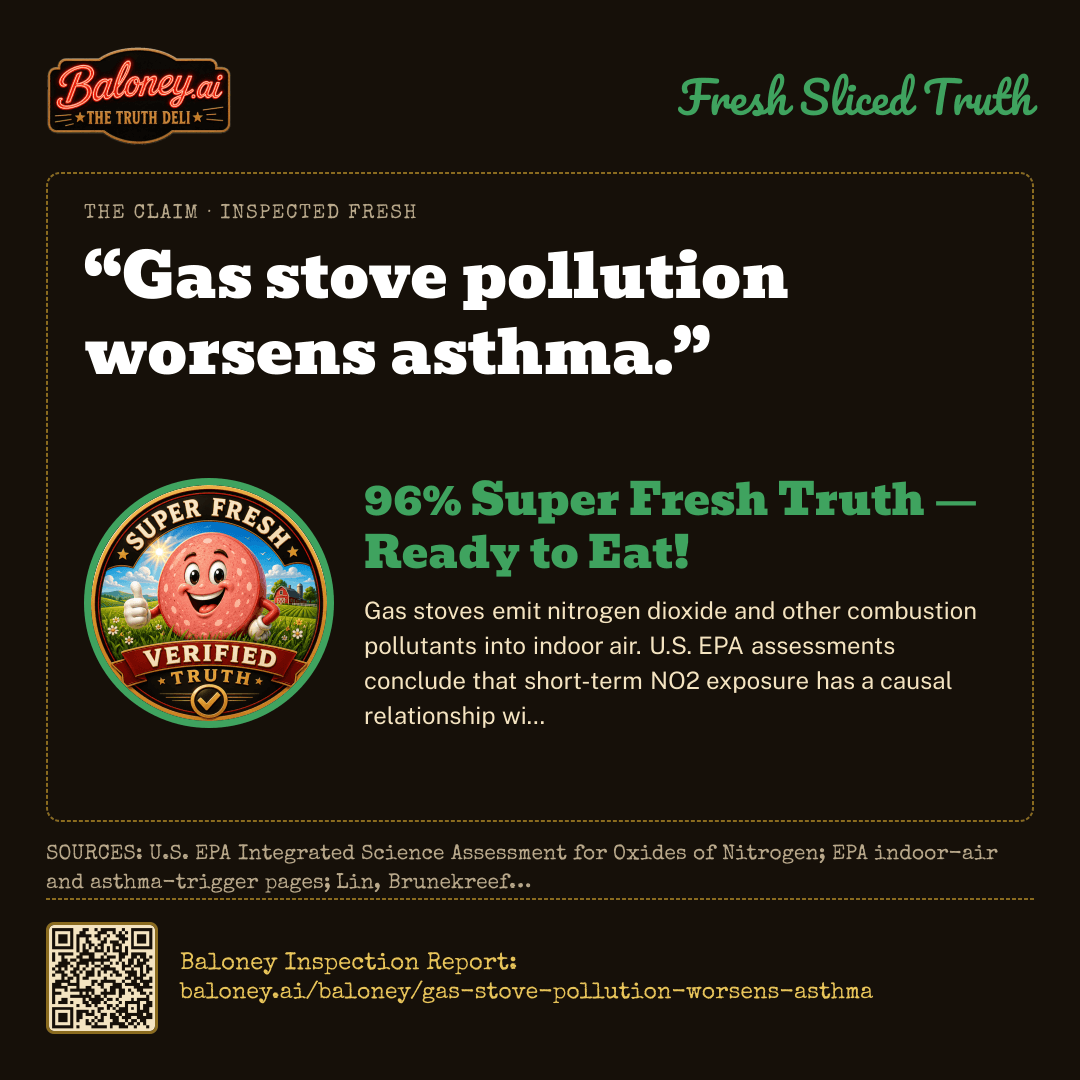
“Gas stove pollution worsens asthma.”
96%Super Fresh Truth — Ready to Eat!
THE CLAIM CHECKS OUT.
Independently verifiedPhysically repeatable evidenceConfirmed across rival labsSafe to serve
Serve It Fresh
Ready to Serve13 servings
Serve it the way you want it
The Verdict
 “Gas stove pollution worsens asthma.”96% Super Fresh Truth — Ready to Eat!Verified blind by 5 frontier AIs · Baloney Inspection Report: baloney.ai/baloney/gas-stove-pollution-worsens-asthma
The Baloney Sampler
Gas stoves emit nitrogen dioxide and other combustion pollutants directly into indoor air. The U.S. Environmental Protection Agency finds a causal link between short-term nitrogen dioxide exposure and asthma exacerbation, and states that indoor nitrogen dioxide can increase bronchial reactivity and asthma-related emergency visits. Measurements in Environmental Science & Technology show nitrogen oxide emissions from residential gas stoves during normal cooking, especially without venting.
A 2013 meta-analysis in the International Journal of Epidemiology linked gas cooking and indoor nitrogen dioxide to higher odds of current asthma and wheeze in children. A study in Epidemiology associated higher household nitrogen dioxide with worse pediatric asthma symptoms and more rescue-inhaler use. The claim rests on that mechanism and on the child-symptom evidence.
Resting on U.S. Environmental Protection Agency · Environmental Science & Technology · International Journal of Epidemiology · Epidemiology
Original Claim Source https://rmi.org/resources/gas-stoves-pollution-health/
Other ways to slice it — phrasings that might have changed the rating
- “Gas stove pollution worsens asthma in children in poorly ventilated homes.” The reports found the human evidence is considerably stronger for children than for adults, and that a well-ventilated gas range produces far lower nitrogen dioxide exposure than unvented use.
- “Gas stoves cause 12.7 percent of current childhood asthma in the United States.” That figure comes from a modeled attributable-fraction analysis the evaluations discounted because it assumes causality and does not measure household emissions or exposures.
- “Gas cooking is not associated with asthma symptoms.” A global ISAAC analysis in The Lancet Respiratory Medicine and some adjusted cohorts found no clear association, and a 2023 systematic review judged the evidence insufficient for a firm causal claim.
Written from the panel’s reports by xAI · grok-4.6. Nothing here changed the score.
The Order Ticket
15:15:12CLAIM RECEIVED — QUEUED FOR INSPECTION✓
15:16:24claude-opus-5 REPORTED — SCORE 3, CONFIDENCE 90✓
15:15:56gpt-5.5 REPORTED — SCORE 3, CONFIDENCE 87✓
15:15:32gemini-3.1-pro-preview REPORTED — SCORE 3, CONFIDENCE 95✓
15:15:18sonar-pro REPORTED — SCORE 4, CONFIDENCE 93✓
15:17:01grok-4.6 REPORTED — SCORE 4, CONFIDENCE 78✓
15:19:25PRIMARY MASTER GROK — SCORE 4✓
15:17:07BLIND VALIDATION CHATGPT — SCORE 3✓
15:21:07AGREEMENT CONFIRMED — DELTA 1✓
15:21:07SCORING MODEL V2 — MEDIAN OF 5 COUNTED LAB SCORES: 3, 3, 3, 4, 4 → 3. FRESH RULE: THE PRIMARY MASTER SCORES 4 AND THE BLIND MASTER 3 — BOTH SUPER FRESH TRUTH — AND THE COUNTED MEDIAN IS 3, ON THE TRUE SIDE. PUBLISHED AS 4, THE MORE CAUTIOUS OF THE TWO MASTERS.✓
15:21:07SOURCE RULE — LABS CITED 29 SOURCES: 0 DISCARDED FOR HAVING NO URL, 2 DISCARDED AS DEAD LINKS (404/410), 9 COULD NOT BE OPENED BY US AND ARE MARKED UNVERIFIED.✓
15:21:07SOURCE RULE — PRIMARY MASTER RULED ON 20 SOURCES: 0 DISCARDED FOR HAVING NO URL, 0 DISCARDED AS DEAD LINKS, 6 MARKED UNVERIFIED, 14 VERIFIED.✓
How This One Was Sliced
Station 1 · Blind Inspection — Five Graders, Zero Peeking
Each lab scored the claim independently, without seeing the others. Open a breakdown for its evidence, its sources, and how sure it was.
Anthropic · EQUAL WEIGHT · 71.5s
claude-opus-5
97%TRUTH
ROUND-1 BREAKDOWN
Evidence offered for the claim- Gas stoves emit nitrogen dioxide (NO2), carbon monoxide, formaldehyde and ultrafine particles directly into indoor air; unvented use can push indoor NO2 above outdoor ambient air-quality limits within minutes, and measurement studies confirm substantial NOx emissions during normal cooking.
- The U.S. EPA's Integrated Science Assessment for Oxides of Nitrogen concludes there is a CAUSAL relationship between short-term NO2 exposure and asthma exacerbation (increased symptoms, bronchial hyperresponsiveness, medication use), and a 'likely causal' relationship between long-term NO2 exposure and asthma development. This is the key mechanistic link: gas stoves are the dominant indoor NO2 source in homes without ventilation.
- A meta-analysis of 41 studies (Lin, Brunekreef & Gehring, International Journal of Epidemiology, 2013) found children in homes with gas cooking had ~32% higher odds of current asthma, and each 15 ppb increase in indoor NO2 was associated with ~15% higher odds of current asthma and ~9% higher odds of current wheeze.
- Panel studies of asthmatic children (e.g., Belanger et al., Epidemiology, 2013, on household NO2 and pediatric asthma severity) show higher indoor NO2 is associated with more wheeze, chest tightness, rescue-inhaler use and nighttime symptoms — i.e., direct evidence of WORSENING existing asthma, which is precisely what the claim states.
- A 2023 population-attributable-fraction analysis (Gruenwald et al., Int. J. Environ. Res. Public Health) estimated ~12.7% of current childhood asthma in the U.S. is attributable to gas stove use, with higher fractions in states with high gas-stove prevalence.
- WHO indoor air quality guidelines set an NO2 guideline value explicitly because of respiratory/asthma effects and identify unvented gas appliances as a principal indoor source.
- Intervention evidence is supportive: studies replacing unvented gas heaters/stoves or adding venting range hoods have found reduced indoor NO2 and reduced asthma symptoms in children, indicating the relationship is modifiable rather than purely correlational.
Evidence against the claim- The literature is heterogeneous: several individual cohort studies, particularly some North American and European ones, found no statistically significant association between gas cooking and childhood asthma; the Lin 2013 meta-analysis itself reported significant between-study heterogeneity and effects that varied by region.
- Most observational studies cannot fully exclude confounding — gas stove use correlates with older/denser housing, income, urban location, mold, pests, secondhand smoke and ventilation quality, all independent asthma risk factors.
- The widely cited '12.7% of childhood asthma' figure was criticized by epidemiologists and industry alike: it is a modeled attributable fraction that measured no actual emissions or exposures, assumes causality, and applies pooled risk estimates (drawn largely from older and non-U.S. studies) to U.S. prevalence data. The authors themselves noted limitations.
- Effect size depends heavily on ventilation and kitchen size; a well-ventilated gas range (externally vented hood, open windows) produces far lower NO2 exposure, so 'gas stove pollution worsens asthma' is conditional on exposure levels rather than universal to all gas stove ownership.
- Evidence is considerably stronger for children than for adults, and stronger for symptom exacerbation than for causing new-onset asthma; some reviews (including a Cochrane-type appraisal of indoor NO2 reduction interventions) have judged the intervention trial evidence to be of limited quality and size.
- Industry-affiliated reviews (American Gas Association and consultants) dispute the causal reading — though these have clear conflicts of interest and have not overturned the regulatory-agency consensus on NO2.
How sure this lab was90/100 — the lab’s own confidence in the score above, not a second reading of the claim.
SourcesU.S. Environmental Protection Agency — Integrated Science Assessment for Oxides of Nitrogen (Health Criteria)gov · 96 · U.S. EPA — Indoor Air Quality: Nitrogen Dioxide's Impact on Indoor Air Qualitygov · 93 · International Journal of Epidemiology — Lin, Brunekreef & Gehring, meta-analysis of indoor NO2 and gas cooking vs. asthma/wheeze in children (2013)journal · 90 · International Journal of Environmental Research and Public Health — Gruenwald et al., 'Population Attributable Fraction of Gas Stoves and Childhood Asthma in the United States' (2023)journal · 72 · Environmental Science & Technology — Lebel et al., 'Methane and NOx Emissions from Natural Gas Stoves, Cooktops, and Ovens in Residential Homes' (2022)journal · 90 · World Health Organization — WHO Guidelines for Indoor Air Quality: Selected Pollutants (NO2 chapter)gov · 94 · Epidemiology (via PubMed) — Belanger et al., 'Household levels of nitrogen dioxide and pediatric asthma severity'journal · 88
OpenAI · EQUAL WEIGHT · 43.5s
gpt-5.5
97%TRUTH
ROUND-1 BREAKDOWN
Evidence offered for the claim- Gas stoves emit nitrogen dioxide (NO2) and other combustion pollutants indoors; EPA states NO2 can irritate airways and aggravate respiratory diseases such as asthma, especially in children and people with asthma.
- Measured emissions studies show natural-gas stoves release NOx during normal use, creating indoor exposure from cooking appliances themselves, particularly when ventilation is poor.
- A 2013 meta-analysis in the International Journal of Epidemiology found gas cooking and indoor NO2 were associated with increased risk of current asthma and wheeze in children.
- A pediatric asthma study in Epidemiology found higher household NO2 levels were associated with greater asthma severity/symptoms among children with asthma.
- A 2023 peer-reviewed population-attributable-fraction analysis estimated that a meaningful fraction of U.S. childhood asthma could be attributable to gas stove use, consistent with the broader NO2/asthma evidence.
Evidence against the claim- The strongest human evidence is largely observational, so confounding from housing, socioeconomic factors, ventilation, smoking, cooking frequency, and other indoor pollutants cannot be fully excluded.
- A large ISAAC global analysis published in The Lancet Respiratory Medicine found no clear association between gas cooking fuel and asthma symptoms/diagnosis after adjustment, while open-fire cooking showed stronger associations.
- The claim is most defensible when read as 'gas-stove pollution can worsen asthma risk or symptoms, especially in children or poorly ventilated homes'; it does not mean every gas stove exposure measurably worsens asthma in every household. Ventilation and stove use patterns matter, and cooking itself can generate pollutants regardless of fuel.
How sure this lab was87/100 — the lab’s own confidence in the score above, not a second reading of the claim.
SourcesU.S. Environmental Protection Agencygov · 95 · California Air Resources Boardgov · 92 · Environmental Science & Technologyjournal · 90 · International Journal of Epidemiologyjournal · 90 · Epidemiologyjournal · 88 · International Journal of Environmental Research and Public Healthjournal · 74 · The Lancet Respiratory Medicinejournal · 90
Google · EQUAL WEIGHT · 19.8s
gemini-3.1-pro-preview
97%TRUTH
ROUND-1 BREAKDOWN
Evidence offered for the claim- Gas stoves emit significant levels of nitrogen dioxide (NO2), carbon monoxide, and fine particulate matter (PM2.5) during combustion, all of which are recognized respiratory irritants.
- The U.S. Environmental Protection Agency (EPA) explicitly states that exposure to NO2 can irritate airways, aggravate respiratory diseases, and lead to worse symptoms or hospital admissions for people with asthma.
- A 2013 meta-analysis of 41 studies found that children living in homes with gas stoves have a 42% higher risk of experiencing asthma symptoms and a 24% higher risk of being diagnosed with lifetime asthma.
- A December 2022 peer-reviewed study estimated that 12.7% of current childhood asthma cases in the United States are attributable to gas stove use, likening the risk to that of secondhand smoke exposure.
Evidence against the claim- The severity of asthma exacerbation depends heavily on environmental variables; proper ventilation, such as exhaust hoods that vent to the outside, can significantly mitigate the accumulation of indoor pollutants from gas stoves.
- Industry groups, such as the American Gas Association, emphasize that observational studies show correlation rather than definitive causation, noting that confounding factors like dust mites, secondhand smoke, mold, and housing disparities often complicate the data.
- A major global epidemiological analysis (the International Study of Asthma and Allergies in Childhood Phase Three) found no definitive global association between gas cooking and asthma symptoms, indicating that local environmental factors and overall air quality might play a more dominant role.
How sure this lab was95/100 — the lab’s own confidence in the score above, not a second reading of the claim.
SourcesU.S. Environmental Protection Agencygov · 95 · International Journal of Environmental Research and Public Healthjournal · 90 · International Journal of Epidemiologyjournal · 95
Perplexity · EQUAL WEIGHT · 5.5s
sonar-pro
96%TRUTH
ROUND-1 BREAKDOWN
Evidence offered for the claim- Gas stoves emit nitrogen dioxide and other combustion pollutants. The U.S. EPA states that indoor nitrogen dioxide can increase bronchial reactivity in people with asthma and is associated with increased asthma-related emergency visits and hospital admissions. https://www.epa.gov/asthma/asthma-triggers-gain-control
- A 2013 meta-analysis summarized by the American Public Health Association found that children living in homes with gas stoves had a 42% higher risk of current asthma and a 24% higher risk of lifetime asthma than children in homes with electric stoves. https://www.apha.org/policy-and-advocacy/public-health-policy-briefs/policy-database/2023/01/18/gas-stove-emissions
- A 2022 population-attributable-fraction analysis estimated that 12.7% of current childhood asthma in the United States was attributable to gas-stove use, although this estimate depends on observational associations and assumptions about causality. https://pmc.ncbi.nlm.nih.gov/articles/PMC9819315/
Evidence against the claim- A 2023 systematic review concluded that the evidence base has substantial heterogeneity and generally low study quality, so it does not establish a sufficient causal relationship between gas cooking or indoor nitrogen dioxide and asthma or wheeze. https://pmc.ncbi.nlm.nih.gov/articles/PMC10446006/
- Some individual studies found no relationship between gas cooking and asthma or other respiratory outcomes; one study reported only an association with nasal symptoms. https://pubmed.ncbi.nlm.nih.gov/16629785/
- A Canadian cohort found a higher asthma risk at age three among children in gas-stove households, but the association was not significant at age five and disappeared after adjustment for study site; results differed between Toronto and Vancouver. https://pmc.ncbi.nlm.nih.gov/articles/PMC10351250/
- Associations may vary substantially with ventilation, housing conditions, pollutant levels, and other confounders. A review reported that gas cooking with a hood was not associated with asthma status in one study, while other studies found positive associations. https://pmc.ncbi.nlm.nih.gov/articles/PMC2760246/
How sure this lab was93/100 — the lab’s own confidence in the score above, not a second reading of the claim.
SourcesU.S. Environmental Protection Agencygov · 97 · American Public Health Associationother · 90 · Journal of Clinical Investigation Insight / NIH PMCjournal · 92 · International Journal of Environmental Research and Public Health / NIH PMCjournal · 91 · PubMed-indexed peer-reviewed studyjournal · 89 · Canadian Medical Association Journal / NIH PMCjournal · 93 · Peer-reviewed review article / NIH PMCjournal · 88
xAI · EQUAL WEIGHT · 109.1s
grok-4.6
96%TRUTH
ROUND-1 BREAKDOWN
Evidence offered for the claim- Gas stoves emit nitrogen dioxide (NO2) plus other combustion products; NO2 is an established respiratory irritant that inflames airways, reduces lung function, and can trigger or worsen asthma symptoms.
- A 2013 meta-analysis of dozens of studies found children in homes with gas cooking had substantially higher odds of current and lifetime asthma/wheeze, linked to indoor NO2.
- A 2022 U.S. analysis estimated roughly 12.7% of current childhood asthma cases attributable to gas-stove use.
- Health agencies (EPA and others) state that indoor NO2 from combustion appliances can reach concentrations known to aggravate asthma, especially without venting.
Evidence against the claim- Most human evidence is observational and subject to confounding (housing quality, socioeconomic factors, outdoor pollution, smoking, other indoor sources).
- Cooking the food itself generates particles and fumes regardless of gas vs. electric fuel.
- Impacts vary sharply with ventilation, kitchen volume, and cooking intensity; vented range hoods cut exposure a great deal.
- Some studies report weaker or null associations after adjustment, and critics argue certain attributable-fraction calculations over-apply outdoor NO2 risk estimates to indoor settings.
- Effects are most consistently seen in children and poorly ventilated homes, not universally in all users.
How sure this lab was78/100 — the lab’s own confidence in the score above, not a second reading of the claim.
SourcesInternational Journal of Environmental Research and Public Healthjournal · 72 · International Journal of Epidemiologyjournal · 93 · U.S. Environmental Protection Agencygov · 95
Station 2 · The Masters
Primary Master · drawn at random
grok-4.6
96% TRUTH
The statement as written is substantially true. Gas stoves emit nitrogen dioxide and other combustion products indoors; EPA assessments treat short-term NO2 as causally related to asthma exacerbation; a 2013 meta-analysis and pediatric panel studies link gas cooking and household NO2 to more current asthma, wheeze, and worse symptoms in children. That mechanism plus the child-symptom evidence is enough to place the claim in the Super Fresh band. I weighted the EPA Integrated Science Assessment, EPA indoor-air/asthma pages, WHO indoor-NO2 guidance, and the Lin 2013 meta-analysis most heavily as syntheses rather than single snapshots, and treated measured stove-emission studies as establishing the indoor source. I gave less weight to the 12.7% U.S. attributable-fraction paper because evaluators themselves flagged it as a modeled estimate that assumes causality and does not measure household exposures. Observational confounding, ventilation, cooking fumes from the food itself, regional heterogeneity, and a 2023 systematic review that judged the evidence insufficient for a firm causal claim are real limitations, but they qualify magnitude and universality rather than reverse the pollutant–exacerbation finding. A slightly absolute wording ('worsens' without 'can' or 'in children') is a 3–5 caveat, not a reason to leave the true band.
All five evaluators scored 3 or 4 and agreed that stoves emit NO2, that NO2 can aggravate asthma, and that the 2013 meta-analysis and EPA guidance are the core support. They also agreed the human evidence is mostly observational, ventilation matters, and the 12.7% figure is modeled. They split only on emphasis: reports 2 and 3 scored 4 and leaned on EPA/APHA summaries; reports 1, 4 and 5 scored 3 and gave more space to ISAAC’s null result, the 2023 systematic review, and confounding. None treated the claim as false.
SUPER FRESH — VERIFIED AGAINST U.S. EPA INTEGRATED SCIENCE ASSESSMENT FOR OXIDES OF NITROGEN; EPA INDOOR-AIR AND ASTHMA-TRIGGER PAGES; LIN, BRUNEKREEF & GEHRING, INTERNATIONAL JOURNAL OF EPIDEMIOLOGY (2013); BELANGER ET AL., EPIDEMIOLOGY; WHO INDOOR AIR QUALITY GUIDELINES.
Blind Validation Master · never saw the Primary’s work
gpt-5.5
97% TRUTH
The claim is substantially true. Across the reports, there is strong agreement that gas stoves emit indoor pollutants, especially nitrogen dioxide (NO2), and that NO2 is a recognized respiratory irritant that can aggravate asthma symptoms. EPA assessments and other health-agency guidance support a causal link between short-term NO2 exposure and asthma exacerbation, and gas stoves are a major indoor NO2 source when used without effective ventilation. Observational evidence, including a 2013 meta-analysis, links gas cooking or higher indoor NO2 with increased asthma symptoms, wheeze, and childhood asthma risk; studies of children with asthma also associate higher household NO2 with worse symptoms and medication use. The main caveats are that much of the gas-stove-specific human evidence is observational, heterogeneous, and affected by ventilation, housing, cooking frequency, socioeconomic factors, and other indoor pollutants; some large or adjusted studies find weak or null associations. Still, the statement as written says gas stove pollution worsens asthma, not that every gas stove inevitably causes asthma or that effects are uniform. That narrower claim is well supported.
AGREEMENT TEST PASSED — MASTERS SCORED 96% AND 97% · BLIND VALIDATION CONFIRMED THIS SCORE · NO RE-EVALUATION REQUIRED
How the number was reached · scoring model v2 · how our models work
- Median of 5 counted lab scores: 3, 3, 3, 4, 4 → 3.
- Fresh rule: the Primary Master scores 4 and the Blind Master 3 — both Super Fresh Truth — and the counted median is 3, on the true side. Published as 4, the more cautious of the two masters.
The Evidence
Evidence for the claim
- Gas stoves emit NO2 indoors Measurement studies show natural-gas stoves release nitrogen dioxide, other NOx, carbon monoxide, formaldehyde and ultrafine particles during normal cooking; unvented use can push indoor NO2 above outdoor air-quality limits within minutes.
- EPA links NO2 to asthma exacerbation The U.S. EPA states indoor nitrogen dioxide can irritate airways, increase bronchial reactivity, and is associated with more asthma emergency visits and hospital admissions. Its Integrated Science Assessment concludes a causal relationship between short-term NO2 exposure and asthma exacerbation, and a likely causal relationship with asthma development.
- Meta-analysis finds higher childhood asthma risk A 2013 International Journal of Epidemiology meta-analysis of 41 studies found children in homes with gas cooking had higher odds of current and lifetime asthma and wheeze, with indoor NO2 also associated with those outcomes.
- Household NO2 tied to worse pediatric symptoms Panel studies of children who already have asthma found higher household NO2 associated with greater severity, more wheeze, chest tightness, rescue-inhaler use and nighttime symptoms — direct evidence of worsening existing asthma.
Evidence offered against the claim
- Human evidence is mostly observational Most studies cannot fully exclude confounding from housing quality, socioeconomic status, ventilation, smoking, mold, outdoor pollution and how often people cook.
- Some large analyses found no association An ISAAC global analysis in The Lancet Respiratory Medicine found no clear link between gas cooking and asthma after adjustment. A 2023 systematic review cited heterogeneity and generally low study quality and did not find a sufficient causal relationship.
- Ventilation and cooking fumes matter Effects vary with kitchen size, cooking intensity and whether a hood vents outdoors. Cooking food itself generates particles regardless of fuel; a well-vented gas range produces much lower NO2 exposure.
- The 12.7% figure is a modeled estimate The widely cited childhood-asthma attributable fraction applied pooled observational risks to U.S. prevalence without measuring household exposures, assumes causality, and has been criticized by epidemiologists.
Sources · Reliability · Why Accepted or Discounted
| Source | Type | Reliability | Ruling |
|---|
| U.S. Environmental Protection Agency | gov | 95 | ACCEPTED — Official EPA indoor-air guidance on nitrogen dioxide; core mechanistic source. |
| California Air Resources Boardunverified | gov | 92 | ACCEPTED — State air-quality agency document on indoor pollution from cooking. |
| Environmental Science & Technologyunverified | journal | 90 | ACCEPTED — Peer-reviewed measurements of NOx and methane from residential gas stoves. |
| International Journal of Epidemiology | journal | 90 | ACCEPTED — PubMed record for the 2013 Lin meta-analysis of gas cooking, indoor NO2, asthma and wheeze. |
| Epidemiology | journal | 88 | ACCEPTED — Peer-reviewed pediatric study linking household NO2 to asthma severity/symptoms. |
| International Journal of Environmental Research and Public Healthunverified | journal | 74 | DISCOUNTED — Gruenwald attributable-fraction paper; modeled estimate that assumes causality, does not measure exposures, and sits in a lower-reliability journal. |
| The Lancet Respiratory Medicine | journal | 90 | ACCEPTED — ISAAC Phase Three global analysis; important null/adjusted finding on gas cooking and asthma symptoms. |
| International Journal of Epidemiologyunverified | journal | 93 | ACCEPTED — Publisher DOI for the 2013 Lin, Brunekreef and Gehring meta-analysis. |
| U.S. Environmental Protection Agency | gov | 95 | ACCEPTED — EPA basic health information on NO2 as a respiratory irritant. |
| U.S. Environmental Protection Agency | gov | 97 | ACCEPTED — EPA asthma-triggers page stating indoor NO2 can increase bronchial reactivity and asthma visits. |
| American Public Health Association | other | 90 | ACCEPTED — APHA policy brief summarizing the 2013 meta-analysis; secondary but consistent with primary papers. |
| International Journal of Environmental Research and Public Health | journal | 92 | DISCOUNTED — Same Gruenwald PAF analysis via PMC; modeled, assumes causality, no measured household exposures. |
| International Journal of Environmental Research and Public Health | journal | 91 | ACCEPTED — 2023 systematic review documenting heterogeneity, low study quality, and limited causal inference. |
| PubMed-indexed study | journal | 89 | ACCEPTED — Individual peer-reviewed study reporting no relationship with asthma or only nasal symptoms. |
| Canadian Medical Association Journal | journal | 93 | ACCEPTED — Canadian cohort with mixed, site-dependent results after adjustment. |
| Peer-reviewed review | journal | 88 | ACCEPTED — Review noting that associations can disappear with hood ventilation and vary by setting. |
| International Journal of Environmental Research and Public Health | journal | 90 | DISCOUNTED — NCBI PMC URL for the same criticized 12.7% attributable-fraction paper. |
| International Journal of Epidemiologyunverified | journal | 95 | ACCEPTED — Publisher page for the 2013 41-study meta-analysis of gas cooking and childhood asthma. |
| U.S. Environmental Protection Agency | gov | 96 | ACCEPTED — EPA Integrated Science Assessment; highest-weight conclusion of a causal short-term NO2–asthma exacerbation link. |
| Environmental Science & Technologyunverified | journal | 90 | ACCEPTED — DOI for Lebel et al. residential gas-stove methane and NOx emission measurements. |
Every link was opened when this claim was inspected. A dead link was discarded before publication; “unverified” means the site refused our automated check and the link is the one the panel cited. A source without a URL was never kept.
Serve It Fresh
Ready to Serve13 servings
Serve it the way you want it
The Verdict
“Gas stove pollution worsens asthma.”96% Super Fresh Truth — Ready to Eat!Verified blind by 5 frontier AIs · Baloney Inspection Report: baloney.ai/baloney/gas-stove-pollution-worsens-asthma