Baloney Inspection Report: Claim #1051 · Inspected Sep 30, 2026, 11:41 AM PDT · Scoring model v2
 55%
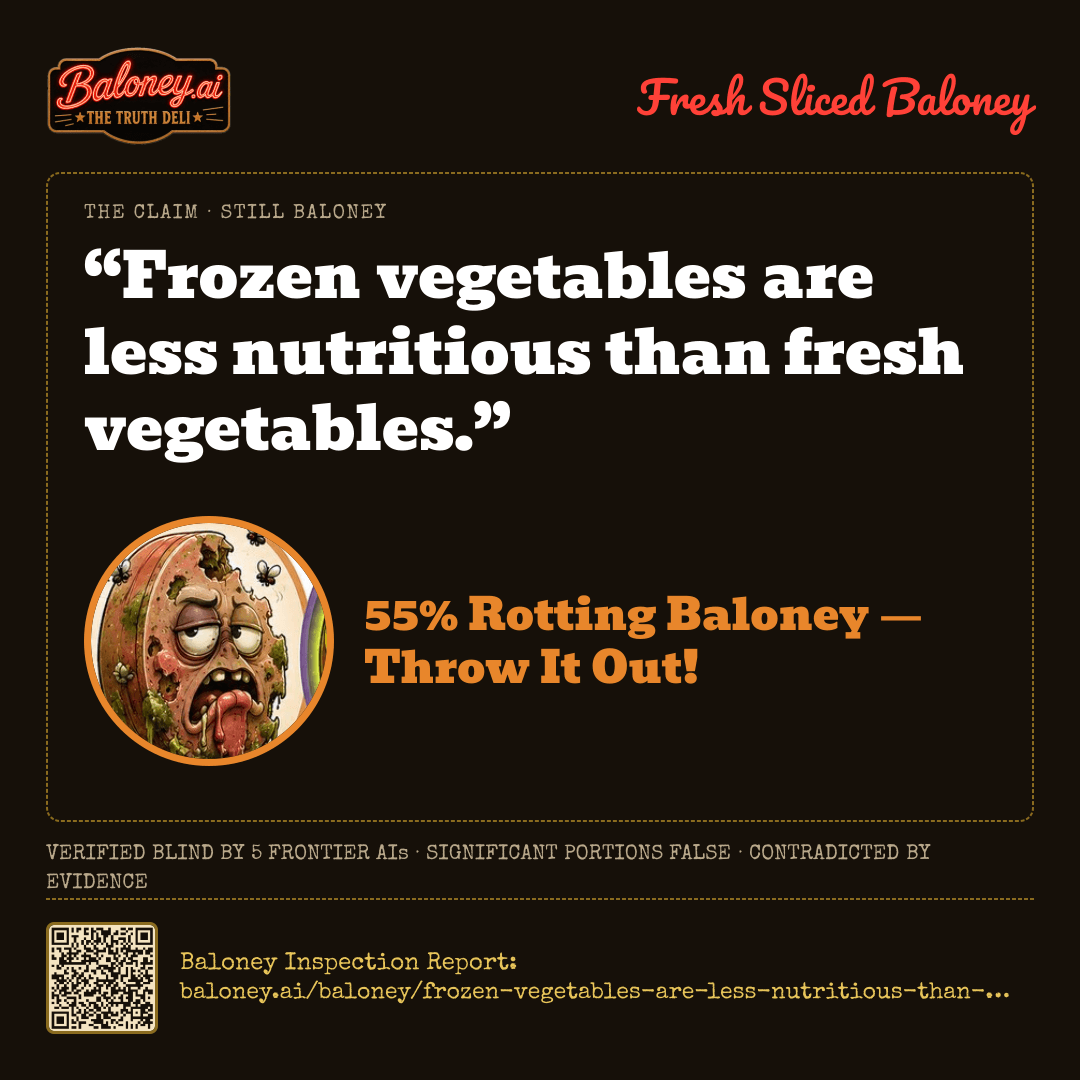
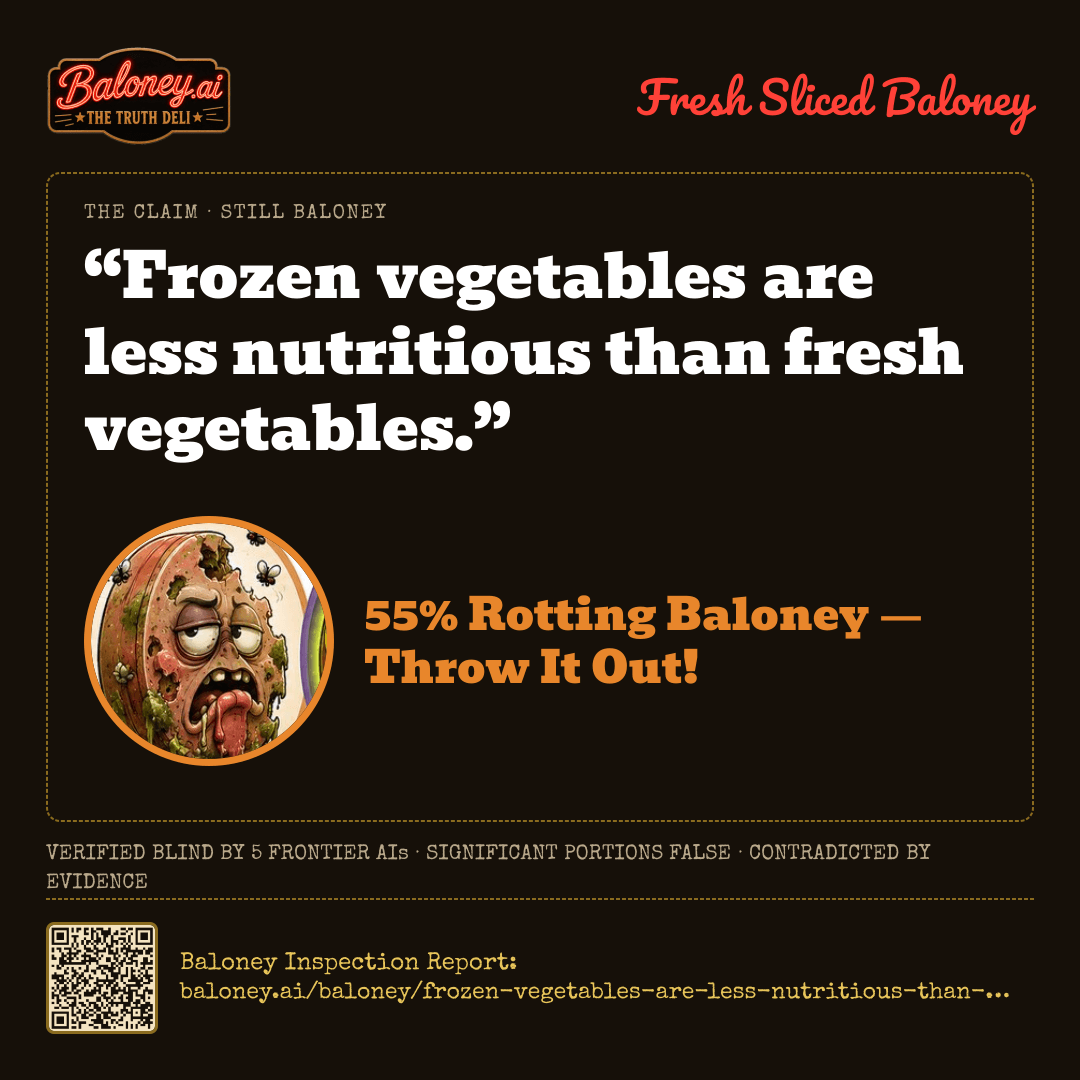
55%“Frozen vegetables are less nutritious than fresh vegetables.”
55%Rotting Baloney — Throw It Out!
Most of this claim has spoiled.
Significant portions falseContradicted by evidenceUnsupported assertionsDeceptive narrative
✓ BLIND VALIDATION CONFIRMED THIS SCORE
Serve It Fresh
Ready to Serve13 servings
Serve it the way you want it
The Verdict
 “Frozen vegetables are less nutritious than fresh vegetables.”55% Rotting Baloney — Throw It Out!Verified blind by 5 frontier AIs · Baloney Inspection Report: baloney.ai/baloney/frozen-vegetables-are-less-nutritious-than-fresh-vegetables
The Baloney Sampler
Controlled comparisons contradict the claim as a blanket statement. The Journal of Agricultural and Food Chemistry study of eight fruits and vegetables (UC Davis) found frozen produce generally matched or exceeded refrigerated 'fresh' produce held for realistic times, and its companion paper found no significant difference for minerals, fibre and phenolics in most items. The Journal of Food Composition and Analysis and the Journal of the Science of Food and Agriculture review reached the same conclusion: fresh, frozen and canned are nutritionally comparable.
There is a narrow kernel of truth. Blanching before freezing leaches some vitamin C, folate and B vitamins, and vegetables eaten within hours of picking carry the highest levels of the most labile vitamins; some reports noted lower beta-carotene in particular frozen items. But supermarket 'fresh' produce loses nutrients over days or weeks in transit and storage, and the USDA, Harvard T.H. Chan School of Public Health and the American Heart Association count frozen vegetables as equivalent.
Resting on Journal of Agricultural and Food Chemistry (Bouzari, Holstege & Barrett, UC Davis) · Journal of Agricultural and Food Chemistry (companion paper: minerals, fibre, phenolics) · Journal of the Science of Food and Agriculture (Rickman, Barrett & Bruhn review) · Harvard T.H. Chan School of Public Health — The Nutrition Source
Other ways to slice it — phrasings that might have changed the rating
- “Vegetables picked from a garden and eaten within hours contain more vitamin C and folate than the same vegetables bought frozen.” The panel accepted that produce eaten within hours of harvest carries the highest levels of the most labile vitamins, and that blanching leaches vitamin C, folate and some B vitamins.
- “Blanching before commercial freezing reduces the vitamin C and B-vitamin content of vegetables.” Every report treated the blanching loss as uncontested, with the National Center for Home Food Preservation documenting the step itself.
- “Frozen vegetables are more nutritious than supermarket fresh vegetables that have spent days in transit, display and home refrigeration.” The UC Davis comparison found frozen produce equalled or exceeded refrigerated 'fresh' produce, with vitamin C higher in frozen samples for three of eight commodities.
Written from the panel’s reports by Anthropic · claude-opus-5. Nothing here changed the score.
The Order Ticket
18:41:05CLAIM RECEIVED — QUEUED FOR INSPECTION✓
18:41:46claude-opus-5 REPORTED — SCORE 55, CONFIDENCE 87✓
18:41:38gpt-5.5 REPORTED — SCORE 55, CONFIDENCE 88✓
18:41:31gemini-3.1-pro-preview REPORTED — SCORE 99, CONFIDENCE 95✓
18:41:13sonar-pro REPORTED — SCORE 35, CONFIDENCE 95✓
18:42:40grok-4.6 REPORTED — SCORE 48, CONFIDENCE 82✓
18:43:43PRIMARY MASTER CLAUDE — SCORE 50✓
18:42:46BLIND VALIDATION CHATGPT — SCORE 55✓
18:44:07AGREEMENT CONFIRMED — DELTA 5✓
18:44:07SCORING MODEL V2 — MEDIAN OF 5 COUNTED LAB SCORES: 55, 55, 99, 35, 48 → 55.✓
18:44:07SOURCE RULE — LABS CITED 23 SOURCES: 0 DISCARDED FOR HAVING NO URL, 2 DISCARDED AS DEAD LINKS (404/410), 13 COULD NOT BE OPENED BY US AND ARE MARKED UNVERIFIED.✓
18:44:07SOURCE RULE — PRIMARY MASTER RULED ON 16 SOURCES: 0 DISCARDED FOR HAVING NO URL, 0 DISCARDED AS DEAD LINKS, 9 MARKED UNVERIFIED, 7 VERIFIED.✓
How This One Was Sliced
Station 1 · Blind Inspection — Five Graders, Zero Peeking
Each lab scored the claim independently, without seeing the others. Open a breakdown for its evidence, its sources, and how sure it was.
Anthropic · EQUAL WEIGHT · 41.0s
claude-opus-5
55%BALONEY
ROUND-1 BREAKDOWN
Evidence offered for the claim- Commercial freezing is preceded by blanching (brief scalding), which leaches some water-soluble nutrients — notably vitamin C, folate and some B vitamins — so certain nutrient levels in frozen vegetables can be lower than in the same vegetable immediately after harvest.
- Vegetables eaten within hours of picking (garden, farmers' market) generally have the highest levels of the most labile vitamins, so for that narrow comparison 'fresh' can beat frozen.
- Some fat-soluble and heat-sensitive compounds behave inconsistently in freezing/thawing; a few studies report lower riboflavin or polyphenol retention in specific frozen items (e.g., certain frozen greens or peas) compared with fresh-harvested samples.
- Texture and some phytochemical bioavailability can change with freezing, and freezer storage beyond ~8–12 months does cause measurable degradation of some vitamins.
Evidence against the claim- Controlled comparisons find few significant differences overall: Bouzari, Holstege & Barrett (UC Davis, J. Agric. Food Chem. 2015) analysed eight fruits and vegetables for vitamin C, riboflavin, α-tocopherol and β-carotene and found frozen produce generally equalled or exceeded refrigerated 'fresh' produce held for typical retail/home times, with frozen higher in several cases.
- The Rickman/Barrett/Bruhn review (J. Sci. Food Agric. 2007) concluded that fresh, frozen and canned products are nutritionally comparable, because blanching losses are offset by the arrest of post-harvest enzymatic and oxidative degradation.
- Freezing occurs within hours of harvest at peak ripeness, whereas 'fresh' supermarket produce may spend days to weeks in transit and storage, during which vitamin C and folate decline substantially — so the realistic comparison often favours frozen.
- Frozen vegetables retain minerals, fibre and most carotenoids essentially unchanged; β-carotene and lycopene can even become more bioavailable after heat treatment.
- Major public-health bodies (USDA MyPlate, Harvard T.H. Chan School's Nutrition Source, American Heart Association) explicitly count frozen vegetables as equivalent to fresh toward vegetable intake and recommend them as convenient, affordable options.
- The claim as written is an unqualified generalisation ('less nutritious'), which the body of evidence does not support for any nutrient class across the board.
How sure this lab was87/100 — the lab’s own confidence in the score above, not a second reading of the claim.
SourcesJournal of Agricultural and Food Chemistry (Bouzari, Holstege & Barrett, UC Davis)journal · 94 · Journal of the Science of Food and Agriculture (Rickman, Barrett & Bruhn review)journal · 90 · Harvard T.H. Chan School of Public Health — The Nutrition Sourceedu · 92 · USDA MyPlategov · 90 · American Heart Associationother · 85 · USDA FoodData Central (nutrient values for fresh vs frozen items)gov · 88
OpenAI · EQUAL WEIGHT · 33.8s
gpt-5.5
55%BALONEY
ROUND-1 BREAKDOWN
Evidence offered for the claim- Frozen vegetables are commonly blanched before freezing; blanching is a heat step that can reduce some water-soluble or heat-sensitive nutrients, especially vitamin C and some B vitamins. Therefore, a very fresh vegetable eaten soon after harvest can be higher in some nutrients than the same vegetable after commercial freezing.
- Nutrition differences vary by vegetable and nutrient. Reviews of processing effects report that frozen products can have lower levels of particular vitamins when blanching losses are large, so the claim has a limited kernel of truth for selected nutrients and comparisons to truly fresh, promptly eaten produce.
Evidence against the claim- The broad claim that frozen vegetables are less nutritious than fresh vegetables is not supported. Peer-reviewed comparisons generally find frozen vegetables to be nutritionally similar to fresh vegetables, and sometimes higher in certain nutrients because freezing occurs soon after harvest and slows nutrient degradation.
- Fresh vegetables are not always 'fresh' nutritionally: they may spend days to weeks in transport, retail display, and home refrigeration, during which labile nutrients such as vitamin C can decline. Frozen vegetables often compare favorably with fresh-stored produce.
- A Journal of Agricultural and Food Chemistry study comparing fresh, refrigerated, and frozen fruits/vegetables found no consistent advantage for fresh; frozen samples were comparable and sometimes higher for vitamins depending on commodity and storage condition.
- A Journal of Food Composition and Analysis study of fresh, fresh-stored, and frozen produce similarly concluded that nutrient levels were generally comparable and that consumers should not assume fresh is nutritionally superior.
- Overall, the statement is misleading as written: 'fresh' only clearly wins in some cases when produce is very recently harvested and quickly eaten, while frozen vegetables are usually a nutritious, comparable option.
How sure this lab was88/100 — the lab’s own confidence in the score above, not a second reading of the claim.
SourcesJournal of Agricultural and Food Chemistry / American Chemical Societyjournal · 94 · Journal of Food Composition and Analysisjournal · 92 · Journal of the Science of Food and Agriculturejournal · 90 · Journal of the Science of Food and Agriculturejournal · 90 · National Center for Home Food Preservation / University of Georgiaedu · 84
Google · EQUAL WEIGHT · 26.3s
gemini-3.1-pro-preview
99%BALONEY
ROUND-1 BREAKDOWN
Evidence offered for the claim- Before being frozen, vegetables are typically blanched (briefly exposed to boiling water or steam) to stop enzyme activity that causes loss of flavor and color. This process can cause a slight reduction in water-soluble nutrients, such as vitamin C and some B vitamins.
- If fresh vegetables are harvested locally and consumed almost immediately (e.g., straight from a home garden), they retain their absolute peak nutritional value, bypassing the minor losses associated with the blanching process used in freezing.
Evidence against the claim- Vegetables destined for the frozen aisle are typically harvested at peak ripeness—when they are most nutrient-dense—and flash-frozen within hours, a process that locks in their nutritional profile.
- Fresh vegetables sold in supermarkets often travel long distances, sit in distribution warehouses, and rest on store shelves for days or weeks. During this time, they continuously lose vital nutrients due to oxidation and exposure to light and heat.
- Numerous scientific studies have shown that the overall nutritional value of frozen vegetables is highly comparable to that of fresh produce. In many cases, frozen vegetables retain significantly higher levels of nutrients over time compared to 'fresh' produce that has been stored in a refrigerator for several days.
How sure this lab was95/100 — the lab’s own confidence in the score above, not a second reading of the claim.
SourcesHealthlinenews · 80 · Journal of Agricultural and Food Chemistryjournal · 95
Perplexity · EQUAL WEIGHT · 8.2s
sonar-pro
35%BALONEY
ROUND-1 BREAKDOWN
Evidence offered for the claim- Freezing commonly involves blanching, which can reduce some heat-sensitive nutrients—especially vitamin C and certain B vitamins—although the magnitude varies by vegetable and processing conditions.[https://healthline.com/nutrition/are-frozen-vegetables-healthy]
- Some studies found lower beta-carotene in frozen peas, carrots, and spinach than in fresh samples, and nutrient retention depends substantially on the specific commodity.[https://pubs.acs.org/doi/10.1021/jf5058793]
- Fresh vegetables can provide more nutrients when they are consumed soon after harvest; comparisons become less favorable to fresh produce after days of refrigerated storage.[https://pubs.acs.org/doi/10.1021/jf5058793]
Evidence against the claim- A peer-reviewed study of eight fruits and vegetables found frozen vitamin content was generally comparable to, and occasionally higher than, refrigerated fresh produce; vitamin C showed no significant difference in five commodities and was higher in frozen samples for the other three.[https://pubs.acs.org/doi/10.1021/jf5058793]
- A companion study found that most commodities showed no significant difference between fresh and frozen samples for minerals, fiber, and total phenolics.[https://pubs.acs.org/doi/10.1021/jf504890k]
- Frozen produce is often frozen soon after harvest, which can preserve nutrients that would otherwise decline during transportation and refrigerator storage; spinach, for example, lost substantially less vitamin C when frozen than when stored at room temperature or refrigerated.[https://www.bbc.com/future/article/20200427-frozen-fresh-or-canned-food-whats-more-nutritious]
- The evidence indicates that there is no consistent overall nutritional disadvantage to plain frozen vegetables; differences vary by nutrient, vegetable, harvest timing, storage duration, and preparation.[https://www.sciencedirect.com/science/article/abs/pii/S0889157517300418]
How sure this lab was95/100 — the lab’s own confidence in the score above, not a second reading of the claim.
SourcesJournal of Agricultural and Food Chemistryjournal · 98 · Journal of Agricultural and Food Chemistryjournal · 98 · BBC Futurenews · 90 · Journal of Food Composition and Analysisjournal · 95 · Healthlineother · 78
xAI · EQUAL WEIGHT · 95.8s
grok-4.6
48%BALONEY
ROUND-1 BREAKDOWN
Evidence offered for the claim- Blanching prior to commercial freezing can reduce water-soluble and heat-sensitive vitamins such as vitamin C and some B vitamins.
- Vegetables eaten immediately after harvest can have higher levels of some nutrients than the same items after industrial processing, freezing, and later storage.
Evidence against the claim- Frozen vegetables are typically harvested at peak ripeness and frozen quickly, which preserves many nutrients better than supermarket 'fresh' produce that often spends days in transit and display.
- Peer-reviewed comparisons of refrigerated storage versus frozen storage find frozen items often match or exceed fresh counterparts for vitamins and other compounds under realistic consumer conditions.
- Health authorities treat frozen vegetables as nutritionally comparable to fresh and a valid way to meet vegetable intake.
How sure this lab was82/100 — the lab’s own confidence in the score above, not a second reading of the claim.
SourcesHealthlineother · 78 · Journal of Agricultural and Food Chemistryjournal · 95 · Academy of Nutrition and Dieteticsother · 88
Station 2 · The Masters
Primary Master · drawn at random
claude-opus-5
50% BALONEY
The claim as written is an unqualified generalisation, and the strongest evidence the panel assembled contradicts it. Controlled peer-reviewed comparisons — principally the UC Davis work in the Journal of Agricultural and Food Chemistry on eight fruits and vegetables, its companion mineral/fibre/phenolics paper, the Journal of Food Composition and Analysis study and the Rickman/Barrett/Bruhn review — consistently find frozen produce nutritionally comparable to, and in several cases higher than, refrigerated 'fresh' produce held for realistic retail and home times. Major public-health bodies count frozen vegetables as equivalent to fresh. Against that, there is a real but narrow kernel of truth the panel documented: blanching before freezing does leach some vitamin C, folate and B vitamins, some studies show lower beta-carotene in specific frozen items, and produce eaten within hours of picking genuinely does carry the highest levels of the most labile vitamins. So the statement is not pure invention — it is true only for a narrow comparison (garden-fresh, promptly eaten) and for selected nutrients, while being false as the blanket comparison a reader would take from it. That places it squarely in the 41-60 band: significant portions false and contradicted by evidence, but with an identifiable factual core. I weighted the four journal-backed reports (35, 48, 55, 55) heavily and discounted the outlier recommendation of 99, which is reserved for statements that are overwhelmingly false with a years-long formal debunk history; this claim is a common consumer misconception with a partial factual basis, not a zombie falsehood. The cluster of the remaining reports centres on the low 50s.
Four of five evaluators landed between 35 and 55 and agreed on the substance: blanching does cause modest losses of heat-sensitive, water-soluble vitamins, but the overall nutritional comparison shows no consistent disadvantage for frozen vegetables, and frozen often wins against supermarket 'fresh' that has spent days in transit and storage. All five cited the same pivotal UC Davis study in the Journal of Agricultural and Food Chemistry. The disagreement was about how much credit the claim's kernel of truth deserves: one evaluator put it as low as 35 (stinky, important omissions), two at 55, one at 48, while a single outlier recommended 99 despite listing evidence essentially identical to the others' — a score the panel majority does not support, since the claim has a genuine narrow basis and no long formal debunk record.
Blind Validation Master · never saw the Primary’s work
gpt-5.5
55% BALONEY
The claim is misleading as written. The reports consistently note a real but limited basis: commercial freezing usually includes blanching, which can reduce some water-soluble or heat-sensitive nutrients such as vitamin C, folate, and some B vitamins, and vegetables eaten very soon after harvest may have higher levels of some nutrients than frozen versions. However, the broader claim that frozen vegetables are generally less nutritious than fresh vegetables is not supported. Multiple peer-reviewed comparisons cited in the reports find frozen vegetables are usually nutritionally comparable to fresh, and sometimes higher in certain vitamins, especially when compared with supermarket produce that has spent days or weeks in transport, retail display, and home refrigeration. Minerals, fiber, and many phytochemicals are generally well retained. Overall, nutrient differences depend on the vegetable, nutrient, storage time, and preparation. So the statement contains a kernel of truth for selected nutrients and truly fresh produce, but as a general claim it omits crucial context and is contradicted by the cited evidence.
AGREEMENT TEST PASSED — MASTERS SCORED 50% AND 55% · BLIND VALIDATION CONFIRMED THIS SCORE · NO RE-EVALUATION REQUIRED
How the number was reached · scoring model v2 · how our models work
- Median of 5 counted lab scores: 55, 55, 99, 35, 48 → 55.
The Evidence
Evidence offered for the claim
- Blanching costs some vitamins Vegetables are briefly scalded in water or steam before freezing to deactivate enzymes, and this leaches some water-soluble and heat-sensitive nutrients, notably vitamin C, folate and certain B vitamins.
- Garden-fresh really is peak Vegetables eaten within hours of picking — from a home garden or farmers' market — carry the highest levels of the most labile vitamins, so for that narrow comparison fresh can beat frozen.
- Some nutrients fare worse frozen Studies have reported lower beta-carotene in frozen peas, carrots and spinach than in fresh samples, and lower riboflavin or polyphenol retention in certain frozen greens; retention varies by commodity and processing conditions.
- Freezer storage degrades nutrients Freezer storage beyond roughly eight to twelve months does cause measurable degradation of some vitamins, and freezing/thawing can alter texture and some phytochemical behaviour.
- Frozen is therefore less nutritious overall DEBUNKED — REFUTED. The panel found no consistent overall nutritional disadvantage for plain frozen vegetables. Controlled comparisons of vitamin C, riboflavin, alpha-tocopherol and beta-carotene found frozen produce generally equalled or exceeded refrigerated fresh produce, with vitamin C showing no significant difference in five of eight commodities and being higher in frozen for the other three; minerals, fibre and total phenolics showed no significant difference in most commodities. Blanching losses are offset by the arrest of post-harvest enzymatic and oxidative decay.
Evidence against the claim
- Frozen is picked ripe and frozen fast Vegetables destined for the freezer aisle are harvested at peak ripeness, when they are most nutrient-dense, and frozen within hours, which locks in the nutritional profile instead of letting it decay.
- 'Fresh' is often weeks old Supermarket fresh produce may travel long distances and sit in warehouses, on display and then in home refrigerators for days to weeks, during which vitamin C and folate decline substantially through oxidation and exposure to light and heat.
- Head-to-head study found no fresh advantage The UC Davis analysis of eight fruits and vegetables in the Journal of Agricultural and Food Chemistry found frozen vitamin content generally comparable to, and occasionally higher than, refrigerated fresh produce held for typical retail and home times.
- Minerals, fibre and phenolics unchanged A companion peer-reviewed study found most commodities showed no significant difference between fresh and frozen for minerals, fibre and total phenolics; carotenoids such as beta-carotene and lycopene can even become more bioavailable after heat treatment.
- Reviews call the categories comparable The Rickman, Barrett and Bruhn review in the Journal of the Science of Food and Agriculture concluded fresh, frozen and canned products are nutritionally comparable, and a Journal of Food Composition and Analysis study likewise advised consumers not to assume fresh is nutritionally superior.
- Spinach keeps vitamin C better frozen Spinach lost substantially less vitamin C when frozen than when held at room temperature or in a refrigerator, illustrating how freezing preserves nutrients that otherwise decline in storage.
- Health authorities treat them as equivalent USDA MyPlate, Harvard's Nutrition Source, the American Heart Association and the Academy of Nutrition and Dietetics all count frozen vegetables toward vegetable intake and recommend them as convenient, affordable and nutritious.
- The wording is an over-generalisation The claim asserts a blanket deficit that the body of evidence does not support for any nutrient class across the board; differences run in both directions and depend on nutrient, vegetable, harvest timing, storage duration and preparation.
Sources · Reliability · Why Accepted or Discounted
| Source | Type | Reliability | Ruling |
|---|
| Journal of Agricultural and Food Chemistry (Bouzari, Holstege & Barrett, UC Davis)unverified | journal | 96 | ACCEPTED — Cited by four of five evaluators as the pivotal controlled comparison of fresh, refrigerated and frozen produce; peer-reviewed and directly on point. |
| Journal of Agricultural and Food Chemistry (companion paper: minerals, fibre, phenolics)unverified | journal | 98 | ACCEPTED — Peer-reviewed companion study covering the nutrient classes the vitamin paper did not; extends the comparison beyond labile vitamins. |
| Journal of Agricultural and Food Chemistry (PubMed record) | journal | 95 | ACCEPTED — Indexed peer-reviewed record of the same body of work; independently verifiable. |
| Journal of the Science of Food and Agriculture (Rickman, Barrett & Bruhn review)unverified | journal | 90 | ACCEPTED — Peer-reviewed review synthesising nutrient retention across fresh, frozen and canned; cited independently by two evaluators. |
| Journal of the Science of Food and Agriculture (companion review)unverified | journal | 90 | ACCEPTED — Peer-reviewed companion review on processing effects on nutrient content; consistent with the rest of the literature cited. |
| Journal of Food Composition and Analysisunverified | journal | 95 | ACCEPTED — Peer-reviewed comparison of fresh, fresh-stored and frozen produce; supports the finding of no consistent fresh advantage. |
| Journal of Food Composition and Analysisunverified | journal | 92 | ACCEPTED — Same peer-reviewed study cited by a second evaluator at a slightly different URL; URL reproduced exactly as given. |
| BBC Future | news | 90 | ACCEPTED — Reputable science journalism summarising the storage-loss evidence, including the spinach vitamin C comparison; consistent with the primary literature. |
| Healthline | other | 79 | ACCEPTED — Consumer-health explainer cited by two evaluators; used only for background framing that the peer-reviewed sources independently support. |
| Healthline | other | 78 | ACCEPTED — Secondary consumer source; accepted for the uncontested point that blanching reduces some heat-sensitive nutrients, which the journal sources corroborate. |
| Academy of Nutrition and Dieteticsunverified | other | 88 | ACCEPTED — Professional dietetics body; relevant evidence of expert consensus treating frozen vegetables as nutritionally comparable. |
| Harvard T.H. Chan School of Public Health — The Nutrition Source | edu | 92 | ACCEPTED — Academic public-health guidance counting frozen vegetables toward intake; credible authority on dietary recommendations. |
| USDA MyPlateunverified | gov | 90 | ACCEPTED — Official dietary guidance explicitly treating frozen vegetables as equivalent to fresh for meeting vegetable intake. |
| American Heart Associationunverified | other | 85 | ACCEPTED — Major health body recommending frozen produce as a nutritious option; corroborates the guidance consensus. |
| USDA FoodData Central | gov | 88 | ACCEPTED — Authoritative nutrient composition database allowing direct fresh-versus-frozen comparison, though it is a general database rather than a specific finding. |
| National Center for Home Food Preservation / University of Georgia | edu | 84 | ACCEPTED — University extension source documenting the blanching step itself — relevant to the claim's kernel of truth. |
Every link was opened when this claim was inspected. A dead link was discarded before publication; “unverified” means the site refused our automated check and the link is the one the panel cited. A source without a URL was never kept.
Serve It Fresh
Ready to Serve13 servings
Serve it the way you want it
The Verdict
“Frozen vegetables are less nutritious than fresh vegetables.”55% Rotting Baloney — Throw It Out!Verified blind by 5 frontier AIs · Baloney Inspection Report: baloney.ai/baloney/frozen-vegetables-are-less-nutritious-than-fresh-vegetables