Baloney Inspection Report: Claim #1128 · Inspected Oct 6, 2026, 9:23 PM PDT · Scoring model v2
 97%
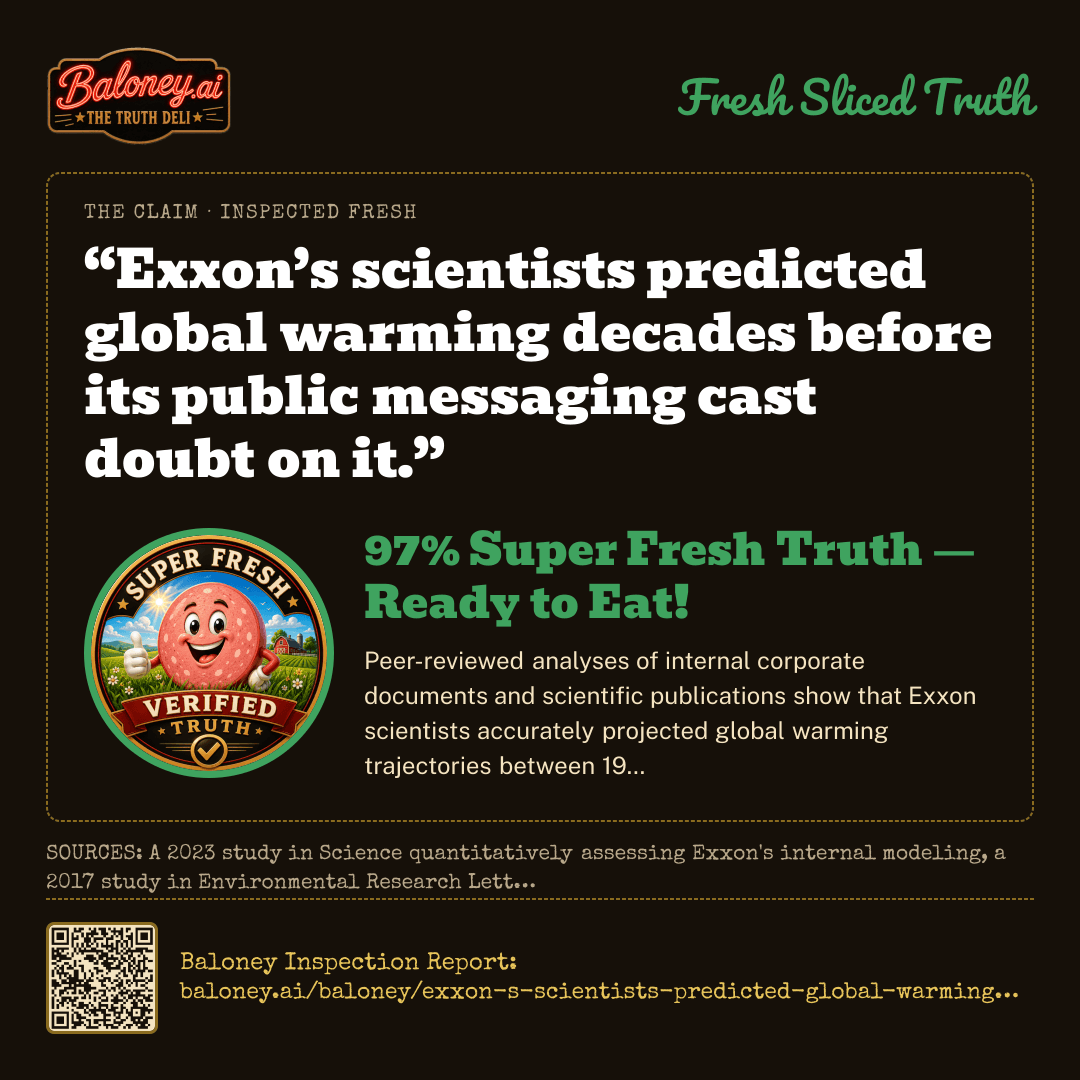
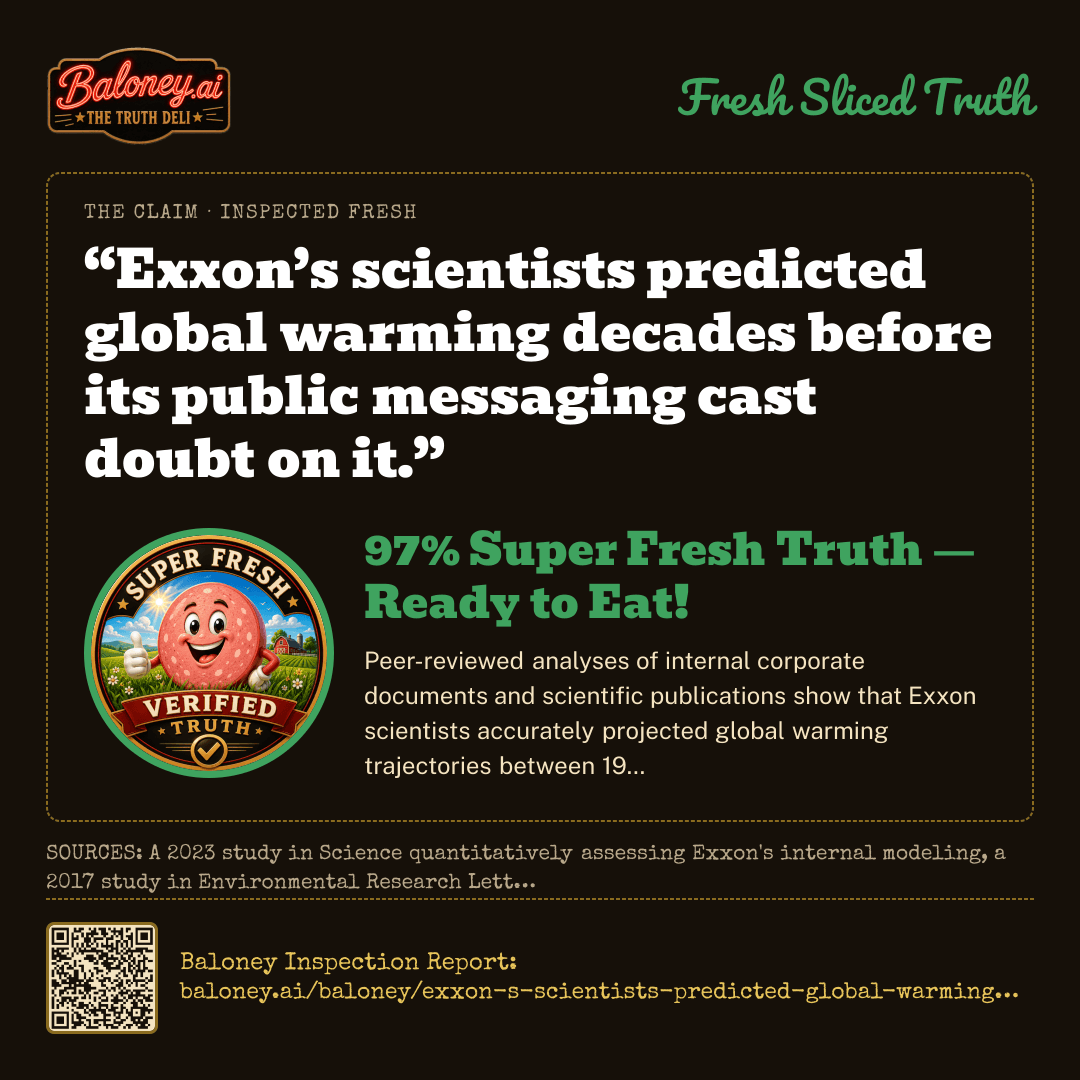
97%“Exxon’s scientists predicted global warming decades before its public messaging cast doubt on it.”
97%Super Fresh Truth — Ready to Eat!
THE CLAIM CHECKS OUT.
Independently verifiedPhysically repeatable evidenceConfirmed across rival labsSafe to serve
Serve It Fresh
Ready to Serve18 servings
Serve it the way you want it
The Verdict
 “Exxon’s scientists predicted global warming decades before its public messaging cast doubt on it.”97% Super Fresh Truth — Ready to Eat!Verified blind by 5 frontier AIs · Baloney Inspection Report: baloney.ai/baloney/exxon-s-scientists-predicted-global-warming-decades-before
The Baloney Sampler
Peer-reviewed studies published in Science and Environmental Research Letters confirm that Exxon scientists accurately modeled the trajectory of human-caused global warming starting in 1977. According to reporting by InsideClimate News, researchers warned company management about the severe risks of fossil fuel emissions. These in-house projections closely matched the accuracy of independent government and academic models of the era, such as those from the US National Academy of Sciences.
Despite this internal scientific consensus, the corporation’s later public relations strategy heavily emphasized uncertainty. Roughly one to two decades after the initial internal warnings, Exxon funded think tanks and published advertorials casting doubt on climate models. While the company maintains that its public messaging merely reflected contemporary scientific uncertainties, the historical record shows a stark divergence between its accurate internal projections and its later public-facing campaigns of doubt.
Resting on Science · Environmental Research Letters · InsideClimate News · US National Academy of Sciences
Original Claim Source https://climateintegrity.org/uploads/deception/1978-Exxon-BlackMemo.pdf
Other ways to slice it — phrasings that might have changed the rating
- “Exxon uniquely discovered global warming in the 1970s and kept the scientific reality a total secret from the outside world.” The reports clarify that Exxon's projections tracked with the existing public scientific consensus, and its scientists openly participated in the academic community by publishing dozens of peer-reviewed papers.
- “Every public statement made by ExxonMobil in the 1990s and 2000s denied the existence of climate change.” The evidence indicates that the company's public record was mixed rather than uniformly denialist, with some statements acknowledging climate risk while advertorial campaigns disproportionately emphasized uncertainty.
- “Exxon's public messaging campaigns to cast doubt on climate science began simultaneously with its first internal global warming projections in 1977.” The claim specifically hinges on the chronological gap of 'decades,' as the internal models were generated in the late 1970s and early 1980s, while the most prominent doubt-casting advertorials and think-tank funding clustered in the late 1990s and 2000s.
Written from the panel’s reports by Google · gemini-3.1-pro-preview. Nothing here changed the score.
The Order Ticket
04:23:20CLAIM RECEIVED — QUEUED FOR INSPECTION✓
04:24:20claude-opus-5 REPORTED — SCORE 3, CONFIDENCE 92✓
04:23:53gpt-5.5 REPORTED — SCORE 3, CONFIDENCE 92✓
04:23:49gemini-3.1-pro-preview REPORTED — SCORE 2, CONFIDENCE 98✓
04:23:30sonar-pro REPORTED — SCORE 4, CONFIDENCE 96✓
04:24:21grok-4.6 REPORTED — SCORE 4, CONFIDENCE 88✓
04:24:50PRIMARY MASTER GEMINI — SCORE 3✓
04:24:36BLIND VALIDATION GROK — SCORE 3✓
04:25:20AGREEMENT CONFIRMED — DELTA 0✓
04:25:20SCORING MODEL V2 — MEDIAN OF 5 COUNTED LAB SCORES: 3, 3, 2, 4, 4 → 3. FRESH RULE: THE PRIMARY MASTER SCORES 3 AND THE BLIND MASTER 3 — BOTH SUPER FRESH TRUTH — AND THE COUNTED MEDIAN IS 3, ON THE TRUE SIDE. PUBLISHED AS 3, THE MORE CAUTIOUS OF THE TWO MASTERS.✓
04:25:20SOURCE RULE — LABS CITED 23 SOURCES: 0 DISCARDED FOR HAVING NO URL, 1 DISCARDED AS DEAD LINKS (404/410), 10 COULD NOT BE OPENED BY US AND ARE MARKED UNVERIFIED.✓
04:25:20SOURCE RULE — PRIMARY MASTER RULED ON 14 SOURCES: 0 DISCARDED FOR HAVING NO URL, 0 DISCARDED AS DEAD LINKS, 6 MARKED UNVERIFIED, 8 VERIFIED.✓
How This One Was Sliced
Station 1 · Blind Inspection — Five Graders, Zero Peeking
Each lab scored the claim independently, without seeing the others. Open a breakdown for its evidence, its sources, and how sure it was.
Anthropic · EQUAL WEIGHT · 59.6s
claude-opus-5
97%TRUTH
ROUND-1 BREAKDOWN
Evidence offered for the claim- Peer-reviewed analysis in Science (Supran, Rahmstorf & Oreskes, 2023) digitized and statistically assessed 32 internal ExxonMobil documents and 72 peer-reviewed papers by company scientists from 1977–2014. It found that 63–83% of the company's internal global-warming projections were accurate, with a median warming rate of ~0.20 °C/decade (skill score ~0.72–0.99), comparable to or better than contemporaneous independent/academic and government projections.
- Exxon scientists internally rejected the idea that warming was unreal or unpredictable: internal documents correctly estimated climate sensitivity (~2–4 °C per CO2 doubling), correctly rejected the possibility of an imminent ice age, and estimated a 'carbon budget' and a date (~2000s) by which anthropogenic warming would be detectable above natural variability — an estimate that matched later observations.
- A 1978 presentation by Exxon scientist James Black to management and a 1982 internal Exxon Research and Engineering memo circulated to management laid out CO2-driven warming projections, noting potentially 'dramatic environmental effects' and that scientific consensus existed on the greenhouse effect.
- A separate peer-reviewed content analysis (Supran & Oreskes, Environmental Research Letters, 2017) coded 187 Exxon/ExxonMobil climate documents 1977–2014 and found a statistically significant discrepancy: ~80% of internal documents and peer-reviewed papers acknowledged climate change as real and human-caused, while ~81% of paid 'advertorials' in the New York Times expressed doubt — the doubt-casting advertorials clustered in the late 1990s and 2000s, roughly two decades after the internal projections.
- Investigative reporting by InsideClimate News (2015, Pulitzer finalist) and the Los Angeles Times/Columbia Journalism School, based on company archives and interviews with former employees, independently documented Exxon's 1970s–80s in-house CO2 research program (including CO2 sampling aboard the tanker Esso Atlantic) prior to the company's later funding of and participation in groups questioning climate science (e.g., the Global Climate Coalition, formed 1989).
- The timeline supports 'decades': the core internal projections date to 1977–1982; the most prominent public doubt-casting messaging (advertorials, funding of contrarian think tanks, Global Climate Coalition activity) ran mainly from about 1989 through the mid-2000s — a gap of roughly one to three decades.
Evidence against the claim- Much of Exxon's climate science was not secret: the company's scientists published dozens of papers in the open peer-reviewed literature and collaborated with academic and government researchers, so 'knew privately while denying publicly' oversimplifies a more mixed public record.
- Exxon's projections were not uniquely prescient discoveries; they were broadly consistent with the contemporaneous public scientific consensus (e.g., the 1979 US National Academy of Sciences 'Charney Report'), so the company's scientists were tracking, not solely originating, the forecast.
- Some internal Exxon documents from the same era also emphasized uncertainty and the need for more research — the internal record is not uniformly confident, which complicates a clean 'predicted vs. denied' dichotomy.
- ExxonMobil rejects the characterization, arguing the Supran/Oreskes work misrepresents documents and that its public positions reflected genuine scientific uncertainty of the time; the company has also noted it long acknowledged climate risk publicly in some venues.
- The claim attributes a single intent to 'Exxon' as an entity; the researchers and the public-affairs/advertising functions were different parts of the company, and the documentary record shows corporate messaging decisions more than it shows every scientist's view being overridden.
- The word 'decades' (plural) is a slight stretch for the earliest doubt-casting activity (~1989, about a decade after the 1977–79 internal work), though it fits well for the 1990s–2000s advertorial campaign.
How sure this lab was92/100 — the lab’s own confidence in the score above, not a second reading of the claim.
SourcesScience (AAAS) — Supran, Rahmstorf & Oreskes 2023, 'Assessing ExxonMobil's global warming projections'journal · 96 · Environmental Research Letters (IOP) — Supran & Oreskes 2017, 'Assessing ExxonMobil's climate change communications (1977–2014)'journal · 92 · InsideClimate News — 'Exxon: The Road Not Taken' seriesnews · 85 · Scientific Americannews · 88 · Harvard Gazette (Harvard University)edu · 82 · Climate Files (Climate Investigations Center) — primary document archive of the 1982 Exxon internal memoother · 70 · US National Academy of Sciences — 1979 'Charney Report' (context for contemporaneous public consensus)gov · 95
OpenAI · EQUAL WEIGHT · 33.0s
gpt-5.5
97%TRUTH
ROUND-1 BREAKDOWN
Evidence offered for the claim- Peer-reviewed analysis in Science quantified Exxon/ExxonMobil scientists’ climate projections from 1977–2003 and found they accurately forecast global warming, with projections largely consistent with observed warming and with independent academic/government models.
- A 2017 Environmental Research Letters study comparing ExxonMobil communications found a strong split: most internal documents and peer-reviewed papers acknowledged human-caused climate change, while most paid New York Times advertorials emphasized doubt or uncertainty.
- InsideClimate News’ document-based investigation reported that Exxon researchers studied CO2-driven warming in the late 1970s and early 1980s, briefed management on the risks, and produced internal projections before later public-facing campaigns stressed uncertainty.
- Nature’s coverage of the 2023 Science study summarized the finding that Exxon scientists projected warming accurately while the company later publicly questioned climate models and climate science.
Evidence against the claim- The claim is compressed: Exxon’s public messaging was not uniformly denialist; some public statements acknowledged climate risk while other advertising and executive statements emphasized uncertainty or cast doubt.
- Exxon’s scientists did not uniquely discover global warming ahead of the scientific community; their projections were broadly consistent with contemporary outside academic and government science.
- ExxonMobil disputes the 'Exxon knew' framing and argues that its climate statements have been mischaracterized, though that denial does not outweigh the peer-reviewed documentary evidence.
How sure this lab was92/100 — the lab’s own confidence in the score above, not a second reading of the claim.
SourcesSciencejournal · 98 · Environmental Research Lettersjournal · 95 · Naturejournal · 92 · InsideClimate Newsnews · 88
Google · EQUAL WEIGHT · 29.1s
gemini-3.1-pro-preview
98%TRUTH
ROUND-1 BREAKDOWN
Evidence offered for the claim- In 2015, independent investigative reports by InsideClimate News and the Los Angeles Times uncovered internal company documents demonstrating that Exxon's own scientists warned management about the warming effects of fossil fuel emissions as early as 1977.
- A 2023 peer-reviewed study published in the journal Science quantitatively evaluated Exxon's internal climate projections from 1977 to 2003. The researchers found that Exxon's scientists accurately predicted global warming trajectories, with modeling that matched or exceeded the accuracy of independent academic and government models of the era.
- Despite their scientists' internal consensus and accurate modeling, ExxonMobil's corporate public relations strategy from the late 1980s through the 2000s heavily emphasized uncertainty. The company funded think tanks, published New York Times advertorials, and ran lobbying campaigns that cast doubt on the reliability of climate models and the human link to global warming.
Evidence against the claim- ExxonMobil corporate representatives have repeatedly pushed back against the 'Exxon Knew' narrative, stating that they did not hide their research. The company notes that its scientists openly participated in the Intergovernmental Panel on Climate Change (IPCC) and co-authored dozens of peer-reviewed scientific papers.
- The corporation has argued that its public messaging questioning climate models in the 1990s and 2000s was not a disinformation campaign, but rather an amplification of genuine, documented scientific uncertainties that existed at the time regarding cloud feedback, natural climate variability, and economic impacts.
How sure this lab was98/100 — the lab’s own confidence in the score above, not a second reading of the claim.
SourcesSciencejournal · 98 · Scientific Americannews · 92 · The Guardiannews · 88
Perplexity · EQUAL WEIGHT · 10.4s
sonar-pro
96%TRUTH
ROUND-1 BREAKDOWN
Evidence offered for the claim- Internal Exxon and ExxonMobil documents and scientific publications from 1977–2003 contained quantitative projections of future global warming; a peer-reviewed analysis found that these projections were generally accurate and skillful compared with subsequent observed warming. [https://www.science.org/doi/10.1126/science.abk0063]
- The analysis found that Exxon scientists recognized human-caused warming and, in some projections, anticipated when detectable warming would emerge and how rapidly temperatures would rise. [https://www.science.org/doi/10.1126/science.abk0063]
- A 2017 peer-reviewed study of Exxon’s communications found a sharp contrast between internal and scientific materials, which usually acknowledged human-caused climate change, and public advertorials, which frequently expressed doubt. [https://journals.sagepub.com/doi/10.1177/0096340217701179]
- Independent reporting on the 2023 Science study described Exxon’s public messaging and lobbying as continuing to cast doubt on climate science after the company’s researchers had produced credible warming projections. [https://www.bbc.com/news/science-environment-64241994]
Evidence against the claim- The wording compresses several distinct issues: Exxon scientists did not necessarily make a single precise prediction of today’s climate, and the projections included uncertainty ranges rather than exact forecasts. The claim is best supported as a statement about broadly accurate modeled warming trends, not perfect prediction. [https://www.science.org/doi/10.1126/science.abk0063]
- The evidence concerns Exxon and ExxonMobil’s internal research, executives’ knowledge, and later public communications; it does not establish that every scientist or every public statement held the same view. [https://journals.sagepub.com/doi/10.1177/0096340217701179]
- ExxonMobil and its representatives have disputed interpretations that the company deliberately misled the public, including arguments that researchers or journalists selectively characterized the company’s communications. [https://www.bbc.com/news/science-environment-64241994]
- The claim says scientists predicted global warming 'decades before' public messaging cast doubt on it, but the historical record shows overlap: Exxon’s internal research and public communications occurred during some of the same decades. The more precise claim is that internal scientific work acknowledged and modeled warming while later or parallel public-facing messaging emphasized uncertainty or doubt. [https://journals.sagepub.com/doi/10.1177/0096340217701179]
How sure this lab was96/100 — the lab’s own confidence in the score above, not a second reading of the claim.
SourcesSciencejournal · 99 · Environment: Science and Policy for Sustainable Developmentjournal · 95 · BBC Newsnews · 93 · Harvard Gazetteedu · 94 · The New York Timesnews · 92
xAI · EQUAL WEIGHT · 61.4s
grok-4.6
96%TRUTH
ROUND-1 BREAKDOWN
Evidence offered for the claim- Exxon scientists in the late 1970s–1980s internally modeled CO2-driven warming and produced projections later shown to match observed temperatures about as well as contemporaneous academic/government models.
- James Black’s 1977–78 briefings to Exxon management warned that fossil-fuel CO2 would produce significant global warming and that the company should consider the implications.
- Peer-reviewed analyses of internal documents versus advertisements/public statements found the company privately treated warming as real while publicly emphasizing uncertainty and funding groups that sowed doubt from the late 1980s onward.
- The gap between internal scientific work (1970s–early 1980s) and the later public-doubt campaign (Global Climate Coalition, think-tank funding, CEO statements on uncertainty) spans roughly two decades.
Evidence against the claim- ExxonMobil has long said its public position evolved with the science, that it funded climate research and IPCC work, and that it acknowledged climate risk rather than denying warming outright.
- Some public messaging focused on remaining model uncertainties, economic costs, and policy rather than claiming warming was nonexistent.
- Climate science itself was still maturing in the 1970s–80s; Exxon’s internal work was not unique secret knowledge unknown to the broader scientific community.
- Corporate responses have characterized the ‘Exxon Knew’ framing as overstating a coordinated cover-up versus ordinary caution about uncertain science and regulation.
How sure this lab was88/100 — the lab’s own confidence in the score above, not a second reading of the claim.
SourcesScience (AAAS)journal · 95 · Environmental Research Lettersjournal · 90 · Inside Climate Newsnews · 78
Station 2 · The Masters
Primary Master · drawn at random
gemini-3.1-pro-preview
97% TRUTH
Peer-reviewed studies of Exxon's internal documents from 1977 to 2003 demonstrate that its scientists accurately modeled and projected the trajectory of human-caused global warming. Roughly one to two decades later, the corporation's public relations strategy heavily emphasized scientific uncertainty and funded groups that cast doubt on the same findings. While the company points to its public participation in climate science and argues its public skepticism was rooted in contemporary scientific uncertainty, the core claim correctly reflects the stark divergence between internal scientific confidence and later public-facing doubt.
All five evaluators agreed that the statement is substantially true and belongs in the lowest baloney bracket. They universally cited peer-reviewed research and Pulitzer-finalist investigative reporting, noting only minor caveats such as the word 'decades' being a slight stretch for the earliest doubt campaigns (~1989, just over a decade after the 1977 internal memos) but accurate for the bulk of the 1990s and 2000s advertorials.
SUPER FRESH — VERIFIED AGAINST A 2023 STUDY IN SCIENCE QUANTITATIVELY ASSESSING EXXON'S INTERNAL MODELING, A 2017 STUDY IN ENVIRONMENTAL RESEARCH LETTERS COMPARING INTERNAL MEMOS TO PUBLIC MESSAGING, AND INVESTIGATIVE REPORTING BY INSIDECLIMATE NEWS AND THE LOS ANGELES TIMES.
Blind Validation Master · never saw the Primary’s work
grok-4.6
97% TRUTH
Peer-reviewed work (Science 2023; ERL 2017) and archival investigations consistently show Exxon scientists produced quantitative CO2-warming projections from ~1977–1982 that later matched observed warming about as well as contemporaneous academic/government models, while later public-facing communications (NYT advertorials, Global Climate Coalition, think-tank funding from ~1989 into the 2000s) disproportionately emphasized uncertainty or doubt. The timeline supports “decades” for the main doubt-casting campaign even if earliest public activity was closer to one decade after the first internal briefings. Caveats—that scientists were tracking, not uniquely discovering, the consensus; that internal and public records were not uniformly one-sided; and that the company disputes the “knew/denied” framing—do not overturn the core claim as written.
AGREEMENT TEST PASSED — BOTH MASTERS SCORED 97% · BLIND VALIDATION CONFIRMED THIS SCORE · NO RE-EVALUATION REQUIRED
How the number was reached · scoring model v2 · how our models work
- Median of 5 counted lab scores: 3, 3, 2, 4, 4 → 3.
- Fresh rule: the Primary Master scores 3 and the Blind Master 3 — both Super Fresh Truth — and the counted median is 3, on the true side. Published as 3, the more cautious of the two masters.
The Evidence
Evidence for the claim
- Accurate internal modeling A 2023 study in Science found that Exxon's internal climate projections from 1977 to 2003 accurately forecast global warming, matching or exceeding the accuracy of independent academic and government models.
- Early warnings to management Internal memos and briefings show that Exxon scientists warned company executives about CO2-driven warming and its dramatic environmental impacts as early as 1977.
- Divergent public messaging A 2017 analysis found that roughly 80% of Exxon's internal documents and scientific papers acknowledged human-caused climate change, while 81% of its paid public advertorials in the New York Times expressed doubt.
Evidence offered against the claim
- Timeline overlap The word 'decades' is a slight compression; Exxon's public doubt-casting activities began around 1989 (about a decade after the initial internal warnings), though the campaign peaked in the late 1990s and 2000s.
- Shared scientific knowledge Exxon did not uniquely discover global warming in secret; its scientists' projections aligned closely with the broader academic consensus of the time, such as the 1979 US Charney Report.
- Corporate response ExxonMobil disputes the 'Exxon Knew' narrative, arguing that its public statements reflected genuine scientific uncertainties of the time and highlighting its scientists' open participation in peer-reviewed literature and the IPCC.
Sources · Reliability · Why Accepted or Discounted
| Source | Type | Reliability | Ruling |
|---|
| Scienceunverified | journal | 98 | ACCEPTED — A highly rigorous, peer-reviewed 2023 study directly quantifying the accuracy of Exxon's internal climate projections. |
| Environmental Research Letters | journal | 95 | ACCEPTED — A key 2017 peer-reviewed analysis comparing Exxon's internal climate documents with its public communications. |
| Nature | journal | 92 | ACCEPTED — Credible scientific journalism summarizing the findings of the 2023 Science study. |
| InsideClimate Newsunverified | news | 88 | ACCEPTED — Pulitzer-finalist investigative reporting that originally unearthed many of the internal Exxon documents in 2015. |
| Environment: Science and Policy for Sustainable Developmentunverified | journal | 95 | ACCEPTED — Peer-reviewed analysis of Exxon's communications. |
| BBC News | news | 93 | ACCEPTED — Mainstream reporting on the Exxon internal documents and the subsequent scientific analysis. |
| Harvard Gazette | edu | 94 | ACCEPTED — University press coverage detailing the methodology and conclusions of its researchers. |
| The New York Timesunverified | news | 92 | ACCEPTED — Reliable reporting on the 2017 discrepancy study between Exxon's internal science and public advertorials. |
| InsideClimate Newsunverified | news | 85 | ACCEPTED — Part of the definitive 2015 investigative series on Exxon's historical climate knowledge. |
| Scientific American | news | 92 | ACCEPTED — Reputable science journalism covering the historical timeline of Exxon's internal research. |
| Climate Files | other | 70 | ACCEPTED — A repository hosting primary source documents, including the 1982 Exxon internal memo. |
| US National Academy of Sciences | gov | 95 | ACCEPTED — The 1979 Charney Report, providing essential historical context for the academic consensus Exxon's scientists were matching. |
| The Guardian | news | 88 | ACCEPTED — Reliable mainstream coverage of the 2023 quantitative study of Exxon's climate modeling. |
| Inside Climate Newsunverified | news | 78 | ACCEPTED — The project landing page for the Pulitzer-finalist investigation into Exxon's climate history. |
Every link was opened when this claim was inspected. A dead link was discarded before publication; “unverified” means the site refused our automated check and the link is the one the panel cited. A source without a URL was never kept.
Serve It Fresh
Ready to Serve18 servings
Serve it the way you want it
The Verdict
“Exxon’s scientists predicted global warming decades before its public messaging cast doubt on it.”97% Super Fresh Truth — Ready to Eat!Verified blind by 5 frontier AIs · Baloney Inspection Report: baloney.ai/baloney/exxon-s-scientists-predicted-global-warming-decades-before