Baloney Inspection Report: Claim #1123 · Inspected Oct 6, 2026, 12:22 AM PDT · Scoring model v2
96%
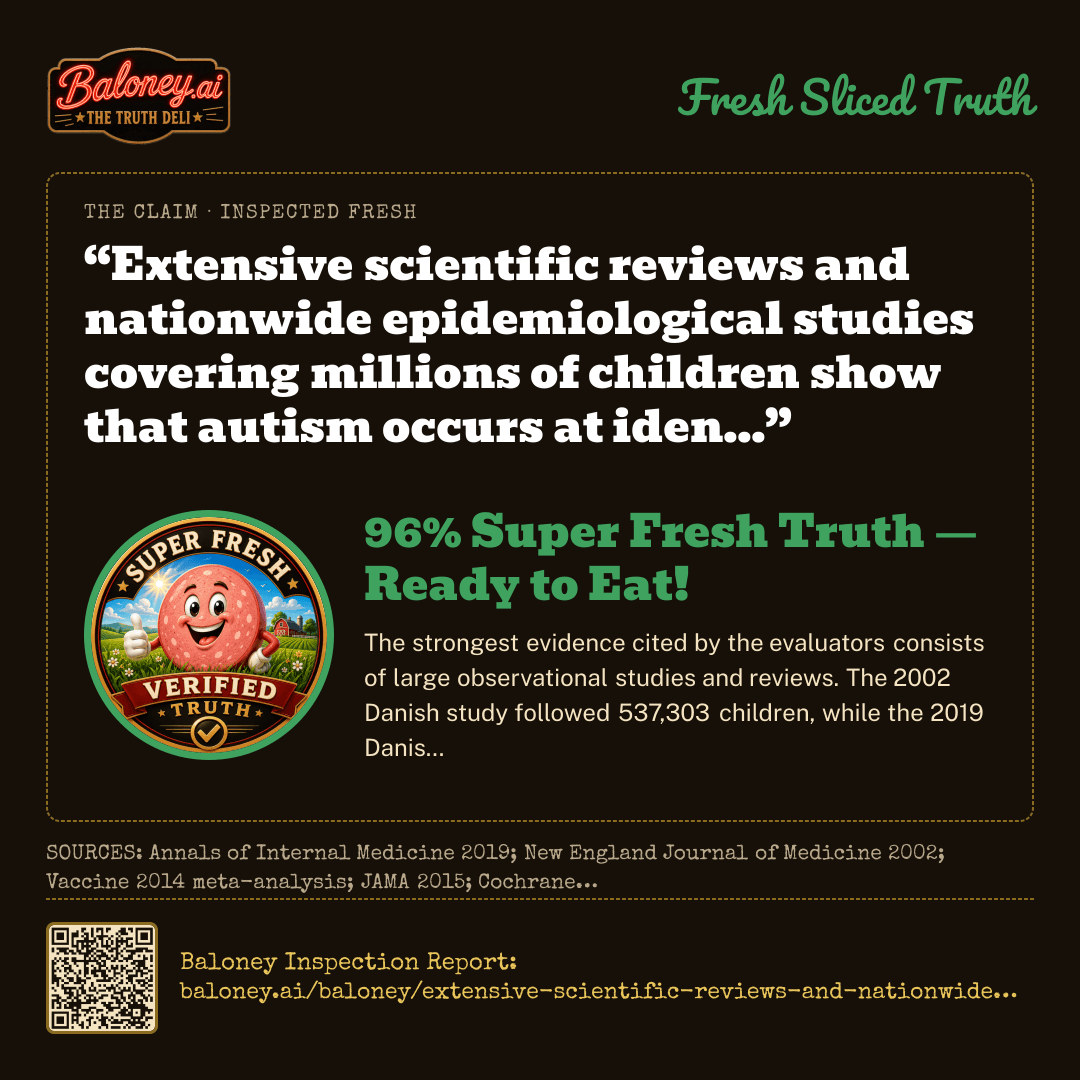
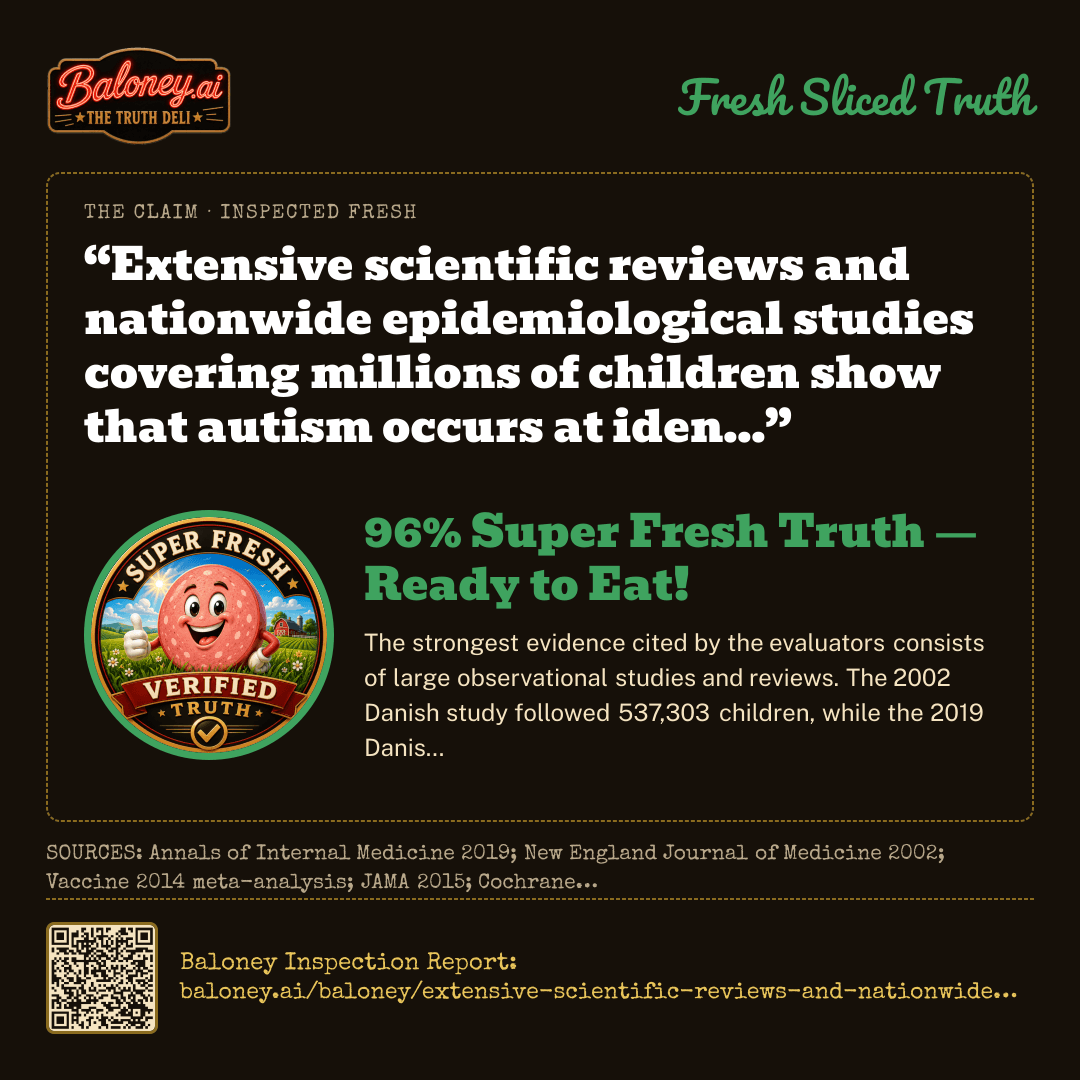
“Extensive scientific reviews and nationwide epidemiological studies covering millions of children show that autism occurs at identical rates in both vaccinated and unvaccinated populations.”
96%Super Fresh Truth — Ready to Eat!
THE CLAIM CHECKS OUT.
Independently verifiedPhysically repeatable evidenceConfirmed across rival labsSafe to serve
“Extensive scientific reviews and nationwide epidemiological studies covering millions of children show that autism occurs at identical rates in both vaccinated and unvaccinated populations.”96% Super Fresh Truth — Ready to Eat!Verified blind by 5 frontier AIs · Baloney Inspection Report: baloney.ai/baloney/extensive-scientific-reviews-and-nationwide-epidemiological
The Rating Card
The claim this refutes
The Baloney Sampler
Large Danish cohorts, a U.S. cohort, a meta-analysis, and systematic reviews found no statistically significant association between vaccination—especially MMR—and autism. The 2019 Danish study covered 657,461 children, while the 2014 meta-analysis covered more than 1.25 million; the National Academies and Cochrane also found no supported MMR-autism relationship.
The evidence supports comparable rates, not literally identical rates. Most studies examined specific exposures such as MMR or thimerosal rather than every vaccine schedule versus completely unvaccinated populations, and the evidence is observational.
Other ways to slice it — phrasings that might have changed the rating
“Large studies found no statistically significant difference in autism risk between children who received the MMR vaccine and those who did not.” The reports directly support this narrower MMR comparison, including Danish studies of 537,303 and 657,461 children.
“Extensive observational research found no association between childhood vaccination and autism, although it did not establish mathematically identical rates for every vaccination schedule.” The reports say the evidence is observational and supports no meaningful association rather than exact equality across all schedules.
“Autism occurs at exactly the same rate in completely vaccinated and completely unvaccinated children in every population.” The reports identify this as broader than the evidence because fully unvaccinated groups are smaller and most studies examine specific vaccines or exposures.
Written from the panel’s reports by Perplexity · sonar-pro. Nothing here changed the score.
07:24:40SCORING MODEL V2 — MEDIAN OF 5 COUNTED LAB SCORES: 4, 4, 3, 8, 5 → 4. FRESH RULE: THE PRIMARY MASTER SCORES 4 AND THE BLIND MASTER 4 — BOTH SUPER FRESH TRUTH — AND THE COUNTED MEDIAN IS 4, ON THE TRUE SIDE. PUBLISHED AS 4, THE MORE CAUTIOUS OF THE TWO MASTERS.✓
07:24:40SOURCE RULE — LABS CITED 30 SOURCES: 0 DISCARDED FOR HAVING NO URL, 3 DISCARDED AS DEAD LINKS (404/410), 17 COULD NOT BE OPENED BY US AND ARE MARKED UNVERIFIED.✓
07:24:40SOURCE RULE — PRIMARY MASTER RULED ON 13 SOURCES: 0 DISCARDED FOR HAVING NO URL, 0 DISCARDED AS DEAD LINKS, 6 MARKED UNVERIFIED, 7 VERIFIED.✓
How This One Was Sliced
Station 1 · Blind Inspection — Five Graders, Zero Peeking
Each lab scored the claim independently, without seeing the others. Open a breakdown for its evidence, its sources, and how sure it was.
Anthropic · EQUAL WEIGHT · 43.8s
claude-opus-5
96%TRUTH
ROUND-1 BREAKDOWN
Evidence offered for the claim
Hviid et al. (Annals of Internal Medicine, 2019) followed 657,461 Danish children born 1999–2010 and found MMR vaccination did not increase autism risk (hazard ratio 0.93, 95% CI 0.85–1.02) — i.e., statistically indistinguishable rates in MMR-vaccinated vs. unvaccinated children, including in subgroups with autism risk factors or siblings with autism.
Madsen et al. (New England Journal of Medicine, 2002) studied 537,303 Danish children (440,655 vaccinated, 96,648 unvaccinated) and found an adjusted relative risk of autistic disorder of 0.92 in vaccinated children — no difference between groups.
Taylor, Swerdfeger & Eslick (Vaccine, 2014) meta-analyzed 10 studies covering more than 1.26 million children and found no relationship between vaccination (MMR, thimerosal, or mercury exposure) and autism or autism spectrum disorder (odds ratio ~0.99).
Jain et al. (JAMA, 2015) examined 95,727 US children including 1,929 with an older sibling with ASD — the highest-risk group — and found no increased ASD risk with MMR vaccination at any dose, even among high-risk children.
The Cochrane systematic review of MMR vaccines (Demicheli et al., 2020), covering data on over 23 million children across included studies, concluded that evidence does not support an association between MMR vaccination and autism.
The Institute of Medicine (now National Academy of Medicine) 2011 report 'Adverse Effects of Vaccines: Evidence and Causality' reviewed the epidemiological literature and concluded the evidence favors rejection of a causal relationship between MMR vaccine and autism; its 2004 report reached the same conclusion for thimerosal-containing vaccines.
Multiple national health agencies (CDC, WHO) and professional bodies state that studies conducted in several countries have found no link between vaccines and autism spectrum disorder.
Evidence against the claim
'Identical rates' is a stronger phrase than the data strictly support: studies report statistically indistinguishable rates with confidence intervals around a null effect (e.g., HR 0.93, 0.85–1.02), not literally identical incidence; point estimates in individual studies vary slightly above and below 1.0.
Most of the large studies compare MMR-vaccinated vs. MMR-unvaccinated or thimerosal-exposed vs. unexposed children, not fully-unvaccinated vs. fully-vaccinated-on-schedule cohorts. True never-vaccinated populations are small, self-selected, and differ in healthcare-seeking behavior (which can affect autism ascertainment), so head-to-head 'vaccinated vs. unvaccinated' schedule-wide comparisons are fewer than the claim's wording implies.
No randomized controlled trial of the full childhood schedule vs. no vaccination exists (it would be unethical); the evidence base is observational, which can never prove exactly zero effect, only bound it as very small or absent.
In November 2025 the CDC altered its vaccine-safety webpage language, adding that 'the claim vaccines do not cause autism is not an evidence-based claim' — a change widely criticized by scientific and medical organizations, but it means the claim no longer has uniform US government web-page backing even though the underlying studies are unchanged.
Vaccine-schedule-wide observational studies (e.g., antigen-exposure analyses) are somewhat less numerous than MMR-specific ones, so 'covering millions of children' is most accurate for MMR/thimerosal questions specifically.
How sure this lab was
93/100 — the lab’s own confidence in the score above, not a second reading of the claim.
A 2019 nationwide Danish cohort study followed 657,461 children born from 1999-2010 and found MMR vaccination was not associated with autism: adjusted hazard ratio 0.93, 95% CI 0.85-1.02, with no increased risk in susceptible subgroups or after vaccination.
A 2002 Danish population-based study of 537,303 children, including 440,655 MMR-vaccinated children, found no increased autism risk among vaccinated children; relative risk was 0.92 for autistic disorder and 0.83 for other autism-spectrum disorders, with no dose-response or time-since-vaccination pattern.
A 2014 meta-analysis in Vaccine covering over 1.25 million children in cohort studies, plus case-control studies, found no association between autism and vaccination, MMR, thimerosal, or mercury exposure.
A Cochrane systematic review of MMR/MMRV vaccines found no credible evidence that MMR vaccination is associated with autism; the autism analyses included very large cohorts totaling over one million children.
A 2015 JAMA study of 95,727 U.S. children with older siblings found MMR vaccination was not associated with increased autism risk, including among children whose older sibling had autism, a higher-risk group.
Evidence against the claim
The phrase "identical rates" is stronger than the statistics literally show. The major studies report relative risks or hazard ratios with confidence intervals around 1; they support no meaningful or statistically significant difference, not exact mathematical identity.
Much of the strongest epidemiology compares receipt versus nonreceipt of specific vaccines, especially MMR, rather than all-vaccines versus completely unvaccinated children. Fully unvaccinated children are a smaller, self-selected group, so residual confounding and selection issues are inherent in observational comparisons.
The National Academies/Institute of Medicine concluded evidence favors rejecting a causal relationship between MMR and autism, but for some other vaccine-autism pairings the evidence base was categorized as inadequate rather than proving exact equality of autism rates in every possible comparison.
How sure this lab was
95/100 — the lab’s own confidence in the score above, not a second reading of the claim.
A 2019 nationwide cohort study published in the Annals of Internal Medicine followed 657,461 children in Denmark and found no statistically significant difference in autism rates between vaccinated and unvaccinated children.
A 2014 meta-analysis published in the journal Vaccine reviewed cohort and case-control studies involving over 1.25 million children, concluding there is no relationship between vaccination and the development of autism.
A 2002 population-based study published in the New England Journal of Medicine analyzed 537,303 Danish children and found the relative risk of autism in vaccinated versus unvaccinated children to be 0.92 (statistically insignificant), confirming no association.
The Centers for Disease Control and Prevention (CDC), the World Health Organization (WHO), and the American Academy of Pediatrics (AAP) all concur, based on extensive epidemiological data, that vaccines do not cause autism.
Evidence against the claim
In strict mathematical terms, observational cohort studies rarely produce mathematically 'identical' rates down to the exact decimal point due to normal statistical variance. Instead, they produce rates that are 'statistically indistinguishable' (e.g., hazard ratios of 0.92 or 0.93, indicating no increased risk).
A retracted and thoroughly discredited 1998 paper by Andrew Wakefield alleged a link between the MMR vaccine and autism, though it relied on manipulated data from only 12 children rather than a large epidemiological population.
How sure this lab was
99/100 — the lab’s own confidence in the score above, not a second reading of the claim.
Large population-based studies support the core conclusion that vaccination is not associated with increased autism risk. A Danish study of 537,303 children found no increased risk of autistic disorder or other autism-spectrum disorders among MMR-vaccinated children compared with unvaccinated children; adjusted relative risks were 0.92 (95% CI 0.68–1.24) and 0.83 (95% CI 0.65–1.07), respectively. [https://www.nejm.org/doi/full/10.1056/NEJMoa021134]
A 2022 systematic review of 19 studies concluded that the evidence did not support a causal relationship between childhood immunization and autism, and reported no statistically significant differences in autism or ASD rates between vaccinated and unvaccinated groups. [https://pmc.ncbi.nlm.nih.gov/articles/PMC9464417/]
A meta-analysis summarized by the CDC found no relationship between vaccination and ASD across seven cohort and case-control studies (odds ratio 0.91, 95% CI 0.68–1.20). [https://www.cdc.gov/acip/downloads/slides-2025-06-25-26/Thimerosal-Containing-Vaccines-Summary-of-Evidence-508.pdf]
FactCheck.org reports that studies comparing MMR-vaccinated and unvaccinated children found autism at approximately the same rate, while rejecting claims that vaccines cause autism. [https://www.factcheck.org/2023/07/scicheck-false-claim-about-cause-of-autism-highlighted-on-pennsylvania-senate-panel/]
Evidence against the claim
The word "identical" is stronger than the evidence supports. Studies generally find no statistically significant difference or comparable risk; they do not establish mathematically identical rates in every vaccinated and unvaccinated population.
The cited evidence is concentrated largely on MMR vaccination, thimerosal, or cumulative vaccine exposure rather than every vaccine, schedule, formulation, age group, and definition of vaccination status. Therefore, the claim's broad wording about all vaccinated versus all unvaccinated populations is overgeneralized.
The evidence primarily supports absence of an observed association and argues against a causal relationship; it does not prove that vaccination and autism rates are exactly equal or eliminate every possible methodological limitation, including differences in healthcare use, diagnosis, demographics, and vaccine uptake.
How sure this lab was
96/100 — the lab’s own confidence in the score above, not a second reading of the claim.
A 2019 Danish nationwide cohort study of 657,461 children found MMR vaccination was not associated with autism (adjusted hazard ratio 0.93), including in subgroups of unvaccinated children and those with autism risk factors.
A 2014 meta-analysis of case-control and cohort studies involving 1,256,407 children found no relationship between vaccination and autism or ASD.
A 2002 Danish population-based study of 537,303 children similarly found no association between MMR vaccination and autism.
A 2015 U.S. cohort study of 95,727 children with older siblings found no increased ASD risk from MMR vaccination even among children with a sibling who had ASD.
Reviews by the Institute of Medicine (2004), CDC, and other bodies have concluded the evidence favors rejection of a causal relationship between vaccines (MMR, thimerosal-containing) and autism.
Evidence against the claim
The claim's wording of 'identical rates' is stronger than the studies, which report no statistically significant difference after adjustment rather than literally identical incidence.
Unvaccinated comparison groups in these cohorts are far smaller than the vaccinated majority (high coverage countries), so they do not represent 'millions' of unvaccinated children.
'Nationwide epidemiological studies covering millions' overstates the size of any single comparable vaccinated-versus-unvaccinated analysis; the 1.2 million figure is a meta-analysis total.
All large evidence is observational; ethical limits preclude RCTs of vaccination versus no vaccination, which critics cite as a residual limitation even though confounding has been extensively addressed.
How sure this lab was
82/100 — the lab’s own confidence in the score above, not a second reading of the claim.
The statement captures the central finding of extensive epidemiological research: large Danish cohorts, a meta-analysis covering more than 1.25 million children, a large U.S. cohort, and systematic reviews found no statistically significant association between vaccination—especially MMR—and autism. However, “identical rates” is technically overstated: the studies report statistically indistinguishable risks, with estimates such as HR 0.93 and RR 0.92, not exact equality. The wording also generalizes from evidence concentrated on MMR, thimerosal, or specific vaccine exposures to all vaccinated versus completely unvaccinated populations. Because the core claim is substantially true under the scale’s instructions, these qualifications warrant only a low score rather than a falsehood rating.
All five evaluators agreed that the evidence supports no meaningful association between vaccination and autism and that the claim’s core conclusion is substantially correct. All five also identified “identical rates” as too literal, emphasizing that studies show statistically indistinguishable rates rather than mathematical identity. Reports 2, 3, 4, and 5 additionally noted that the strongest evidence is concentrated on MMR and particular vaccine components, that fully unvaccinated groups are smaller and self-selected, and that the evidence is observational. The evaluators differed mainly in score severity: four recommended 3–5, while Report 3 recommended 8 because it weighted the overbroad wording more heavily.
SUPER FRESH — VERIFIED AGAINST ANNALS OF INTERNAL MEDICINE 2019; NEW ENGLAND JOURNAL OF MEDICINE 2002; VACCINE 2014 META-ANALYSIS; JAMA 2015; COCHRANE SYSTEMATIC REVIEW; INSTITUTE OF MEDICINE/NATIONAL ACADEMIES EVIDENCE REVIEWS.
Blind Validation Master · never saw the Primary’s work
grok-4.6
96% TRUTH
Large nationwide cohort studies (Denmark 2002 and 2019, totaling well over 1 million children) and meta-analyses/reviews covering >1.25 million children consistently find no statistically significant difference in autism rates between vaccinated and unvaccinated groups, with hazard/relative-risk estimates clustered around 0.92–0.93 and confidence intervals including 1. Cochrane, IOM/NAM, CDC, WHO, and AAP reviews reach the same conclusion of no association (primarily for MMR and thimerosal). The claim is therefore substantially true. The single wording issue is that studies show statistically indistinguishable rates rather than mathematically identical incidence to the last decimal; unvaccinated arms are also smaller and most designs isolate specific vaccines rather than every possible schedule. Per the scoring rule, that modest overstatement keeps the statement in the 1–5 band rather than moving it out.
AGREEMENT TEST PASSED — BOTH MASTERS SCORED 96% · BLIND VALIDATION CONFIRMED THIS SCORE · NO RE-EVALUATION REQUIRED
Median of 5 counted lab scores: 4, 4, 3, 8, 5 → 4.
Fresh rule: the Primary Master scores 4 and the Blind Master 4 — both Super Fresh Truth — and the counted median is 4, on the true side. Published as 4, the more cautious of the two masters.
The Evidence
Evidence for the claim
Large Danish nationwide cohort Hviid et al. followed 657,461 Danish children and found an adjusted autism hazard ratio of 0.93 for MMR-vaccinated versus MMR-unvaccinated children, with a 95% confidence interval of 0.85–1.02; the result showed no increased risk, including in higher-risk subgroups.
Earlier Danish population study Madsen et al. studied 537,303 children, including 440,655 MMR-vaccinated children, and found adjusted relative risks of 0.92 for autistic disorder and 0.83 for other autism-spectrum disorders, with no statistically significant association or dose-response pattern.
Meta-analysis exceeding 1.25 million children The 2014 Vaccine meta-analysis included five cohort studies involving 1,256,407 children and found no relationship between vaccination and autism or ASD; it also found no association involving MMR, thimerosal, or mercury exposure.
Independent U.S. cohort A 2015 JAMA study of 95,727 children found no increased ASD risk after MMR vaccination, including among children with an older sibling with ASD.
Systematic and expert reviews The cited Cochrane review and Institute of Medicine/National Academies reviews concluded that the evidence does not support an association between MMR vaccination and autism and favors rejection of a causal relationship for the vaccine exposures they assessed.
“Identical rates”DEBUNKED — The evidence does not establish literal mathematical identity of autism rates. It supports statistically indistinguishable rates or absence of a detectable increased risk; individual point estimates differed slightly from 1.0.
Evidence offered against the claim
Scope is broader than the strongest evidence Most major studies compare MMR-vaccinated with MMR-unvaccinated children or examine thimerosal and mercury exposure, rather than comparing completely vaccinated and completely unvaccinated children across every vaccine and schedule.
Unvaccinated groups are selected populations Fully unvaccinated children are a smaller, self-selected group. Differences in healthcare use, demographics, diagnosis, and vaccine uptake can affect observational comparisons and autism ascertainment.
Observational evidence cannot prove exact equality No randomized trial of the full childhood vaccination schedule versus no vaccination exists. The available observational evidence can show no statistically significant association and constrain plausible effects, but it cannot prove exactly equal rates in every population.
The claim overstates study scale in one respect The more-than-1.2-million figure is a meta-analysis total, while the unvaccinated comparison groups in individual nationwide studies were much smaller than the vaccinated groups; therefore the wording “millions of children” should not imply millions of fully unvaccinated children in one direct comparison.
Sources · Reliability · Why Accepted or Discounted
ACCEPTED — Primary peer-reviewed source for the 2019 Danish nationwide cohort; its reported sample size and hazard ratio directly support the assessment.
ACCEPTED — Authoritative evidence review cited for its assessment favoring rejection of a causal MMR-autism relationship and its stated limits for some other pairings.
ACCEPTED — Cited review of immunization safety and autism; its assessment supports the absence of a causal relationship for the vaccine exposures evaluated.
Every link was opened when this claim was inspected. A dead link was discarded before publication; “unverified” means the site refused our automated check and the link is the one the panel cited. A source without a URL was never kept.
“Extensive scientific reviews and nationwide epidemiological studies covering millions of children show that autism occurs at identical rates in both vaccinated and unvaccinated populations.”96% Super Fresh Truth — Ready to Eat!Verified blind by 5 frontier AIs · Baloney Inspection Report: baloney.ai/baloney/extensive-scientific-reviews-and-nationwide-epidemiological
Support the Baloney Slicer
CONTRIBUTE $25 → GET THE HAT
“Democracy Makes America Great”
A non-partisan, non-political ethos. Democracy is what makes America great. But without truth — honest, real, scientifically validated truth — democracy fails. The baloney slicer is on: feeding fresh sliced truth to protect what makes America great. Democracy.
Veritate Libertas — Latin for “Through Truth, Liberty.”