SUBMITTED ANONYMOUSLY · INSPECTED 2026-09-14T19:51:59.021Z · STATUS: PUBLISHED
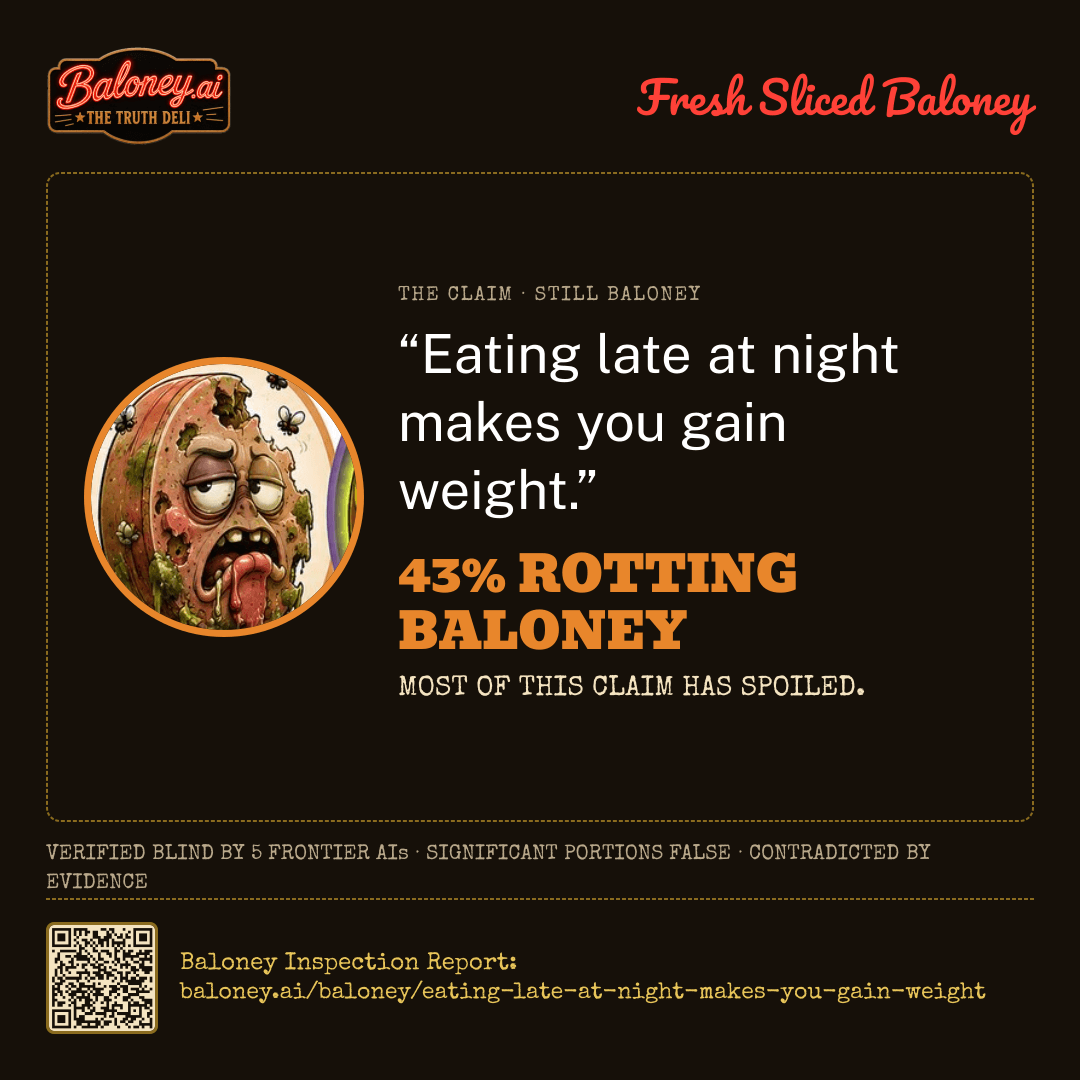
43%
43%
ROTTING BALONEY — THROW IT OUT!
Most of this claim has spoiled.
Significant portions falseContradicted by evidenceUnsupported assertionsDeceptive narrative
✓ BLIND VALIDATION CONFIRMED THIS SCORE
Serve It Fresh
Ready to Serve18 servings
Serve it the way you want it
The Verdict
“Eating late at night makes you gain weight.” 43% ROTTING BALONEY — THROW IT OUT! Verified blind by 5 frontier AIs · Baloney Inspection Report: baloney.ai/baloney/eating-late-at-night-makes-you-gain-weight
Station 1 · Blind Inspection — Five Graders, Zero Peeking
Each lab scored the claim independently, without seeing the others. Open a breakdown for its evidence, its sources, and how sure it was.
Anthropic · EQUAL WEIGHT · 48.6s
claude-opus-5
30%BALONEY
ROUND-1 BREAKDOWN
Evidence offered for the claim
A tightly controlled randomized crossover trial (Vujović et al., Cell Metabolism, 2022) held calories, macronutrients, sleep and activity constant and shifted all meals ~4 hours later. Late eating increased hunger, decreased 24-hour energy expenditure, lowered daytime leptin, and shifted adipose tissue gene expression toward lipogenesis and away from lipolysis — mechanisms that would promote fat gain over time.
Circadian misalignment experiments (Scheer et al., PNAS, 2009) show that eating out of phase with the internal clock degrades glucose tolerance, reduces leptin and raises blood pressure, indicating that the body handles identical food differently at night.
In a weight-loss cohort of ~420 people in Spain (Garaulet et al., International Journal of Obesity, 2013), late lunch eaters lost significantly less weight over 20 weeks than early eaters despite similar reported energy intake, physical activity and sleep duration.
Later circadian timing of calorie intake (relative to melatonin onset) was associated with higher body fat percentage and BMI in young adults (McHill et al., American Journal of Clinical Nutrition, 2017).
Large observational literature links night-eating patterns, night-shift work, and 'night eating syndrome' with higher BMI, obesity and metabolic syndrome risk.
Behaviorally, late-night eating is strongly associated with eating beyond energy needs: evening/night snacks tend to be energy-dense, low-satiety foods (chips, sweets, alcohol), are often eaten passively while screen-watching, and are typically additive to the day's intake rather than displacing earlier calories.
Late eating is coupled with shorter and poorer sleep, which independently increases ghrelin, decreases leptin and raises next-day energy intake, forming a plausible indirect causal route to weight gain.
Evidence against the claim
Energy balance is the dominant determinant of body weight. Isocaloric trials that simply move calories later do not reliably produce weight gain; in Ruddick-Collins et al. (Cell Metabolism, 2022), morning-loaded vs evening-loaded isocaloric diets produced no difference in total energy expenditure or weight change over 4 weeks, though appetite was lower with morning loading.
Systematic reviews of dinner-timing/dinner-size interventions (e.g., Fong, Caterson & Madigan, British Journal of Nutrition, 2017) find the evidence for a weight benefit of eating less at night to be weak and inconsistent, with small effect sizes and high heterogeneity.
Observational associations are heavily confounded: late eaters tend to consume more total calories, skip breakfast, sleep less, exercise less, drink more alcohol, smoke more, and have lower socioeconomic status — all independent predictors of weight gain. Reverse causation is also possible (people with higher adiposity or disordered eating may eat later).
The clock time of eating is often a proxy for circadian phase, not a cause in itself: a 10 p.m. meal for a night-shift worker or a late chronotype is not the same physiological event as a 10 p.m. meal for an early riser, yet epidemiological studies usually can't distinguish them.
Measured effects of late eating on energy expenditure in the strongest trial were modest (on the order of tens of kcal/day); real-world weight change is likely driven far more by how much is eaten late than by the hour itself.
Time-restricted eating trials that compress the eating window (which usually eliminates late eating) generally show modest weight loss that largely disappears when calorie intake is matched to controls — suggesting the benefit comes from eating less, not from the timing per se.
No agency (FDA, NIH, USDA Dietary Guidelines, NHS) asserts that late eating causes weight gain independent of calorie intake; guidance frames it as a behavioral risk factor for overeating.
How sure this lab was
74/100 — the lab’s own confidence in the score above, not a second reading of the claim.
Randomized crossover evidence: Cell Metabolism 2022 found that, with calories, nutrients, activity, and sleep held constant, eating about 4 hours later increased hunger, lowered leptin, reduced waking energy expenditure, and shifted adipose-tissue gene expression toward fat storage in adults with overweight or obesity.
Observational weight-loss evidence: International Journal of Obesity 2013 reported that late lunch eaters lost less weight and had slower weight-loss rates than early lunch eaters, despite broadly similar reported energy intake and expenditure variables.
Late-night eating can cause weight gain indirectly when it increases total daily calories, for example through extra snacks, alcohol, desserts, or a longer eating window; this is consistent with government guidance that weight gain follows from consuming more calories than the body uses.
Evidence against the claim
The strong wording 'makes you gain weight' is too absolute: NIDDK specifically lists eating after 8 p.m. causing weight gain as a myth and says what and how much you eat and your activity level are the main determinants.
Controlled trials show timing is not destiny: a Cell Metabolism 2022 calorie-loading trial found morning-loaded versus evening-loaded diets produced similar weight loss and no meaningful difference in energy expenditure, though morning loading reduced appetite.
JAMA Internal Medicine 2020 TREAT randomized trial found a noon-to-8 p.m. time-restricted eating schedule did not cause weight gain and was not significantly better for weight loss than a consistent meal-timing control; this supports that meal timing alone is not sufficient to predict weight change.
Much of the population evidence linking late eating with higher BMI is observational and can be confounded by sleep duration, shift work, stress, alcohol, food choices, chronotype, and total caloric intake.
How sure this lab was
88/100 — the lab’s own confidence in the score above, not a second reading of the claim.
Recent controlled studies have found that late eating can alter metabolic function. When eating later, individuals often experience decreased leptin (the hormone signaling satiety), reduced energy expenditure, and changes in gene expression that favor adipogenesis (fat storage).
People who eat late at night are statistically more likely to consume calorie-dense, highly processed foods. This behavior is often driven by fatigue, boredom, or emotional distress rather than physical hunger, leading to an overall caloric surplus.
Eating close to bedtime can disrupt circadian rhythms and negatively impact sleep quality. Poor sleep is a recognized risk factor for weight gain because it can alter hormones regulating appetite, making individuals more prone to overeating the next day.
Evidence against the claim
The fundamental driver of weight gain is a caloric surplus. Consuming more calories than the body burns will result in weight gain regardless of the specific time those calories are consumed.
The human metabolism does not shut down at night. The basal metabolic rate continues to burn calories to maintain essential physiological functions, such as breathing and circulation, while sleeping.
Many controlled trials where total daily caloric intake is strictly matched (isocaloric conditions) have historically shown that nutrient timing has minimal, if any, direct impact on overall absolute weight gain, provided the individual does not overeat.
How sure this lab was
95/100 — the lab’s own confidence in the score above, not a second reading of the claim.
Controlled human studies suggest late eating can increase hunger, reduce calorie burn, and promote fat storage, which could contribute to weight gain over time.
A review in the literature found emerging evidence that later meal timing is associated with worse weight regulation and higher adiposity.
Some observational studies and reviews report that people who eat later at night tend to have higher body weight or greater odds of overweight/obesity.
At least one small clinical study found later dinner increased blood sugar and reduced fat oxidation even when the same meal was eaten earlier, suggesting a plausible metabolic mechanism for weight gain.
Evidence against the claim
A systematic review and meta-analysis found that while some observational studies linked larger evening intake with higher BMI, the overall observational association was not clearly significant, and intervention trials found no meaningful difference in weight change between small and large dinner groups.
The strongest evidence does not show that eating late automatically causes weight gain independent of total calorie intake; some sources note that associations may reflect poorer food choices or higher total calories rather than meal timing itself.
Some studies, including pediatric observational work, found no link between eating dinner after 8 p.m. and excess weight.
Expert summaries and reviews emphasize that the evidence is mixed and that later eating is associated with weight gain in some datasets but does not prove causation.
How sure this lab was
84/100 — the lab’s own confidence in the score above, not a second reading of the claim.
Tightly controlled human experiments show late eating (same calories and food) can raise hunger, lower 24-hour energy expenditure, and shift adipose gene expression toward fat storage via circadian/metabolic pathways.
Observational and weight-loss trial data associate later main meals, night eating, and eating when melatonin is high with higher BMI, more body fat, and poorer weight-loss outcomes.
Late eating often clusters with higher total intake, energy-dense snack choices, shorter or poorer sleep, and circadian misalignment, all of which favor positive energy balance.
Animal and shift-work research similarly finds eating during the biological rest phase promotes weight gain independent of calorie amount.
Evidence against the claim
Body-weight change is still governed primarily by cumulative energy balance; timing is a modifier, not a replacement for calories in versus calories out.
Some isocaloric studies report little or no independent effect of clock time on weight when diet composition, activity, and sleep are held constant.
Late-eating–obesity links are partly confounded by overall diet quality, inactivity, short sleep, stress, and socioeconomic factors rather than clock hour alone.
Effects vary by chronotype, total intake, and food quality; a modest late meal in a calorie deficit does not automatically produce gain.
How sure this lab was
72/100 — the lab’s own confidence in the score above, not a second reading of the claim.
The statement is presented as an absolute rule but omits the fundamental biological mechanism of weight management: energy balance. While late-night eating is a significant behavioral risk factor for overeating, and recent studies show it can cause minor metabolic shifts that favor fat storage, clinical trials demonstrate that meal timing alone does not dictate weight gain when total daily calories are controlled.
All evaluators agree that total caloric intake versus energy expenditure is the dominant determinant of weight gain, meaning clock time alone does not inherently cause fat gain. They also agree that late eating is strongly associated with weight gain in observational studies due to behavioral factors like snacking on calorie-dense foods. Evaluators disagreed slightly on how heavily to weigh recent controlled trials showing minor metabolic changes (such as reduced energy expenditure) caused by late eating against the absolute phrasing of the claim.
Blind Validation Master · never saw the Primary’s work
claude-opus-5
40% BALONEY
The claim contains a real kernel of truth but is stated as an absolute causal law, which the evidence does not support. On the supporting side, all five reports converge on the same high-quality experimental finding (Vujovic et al., Cell Metabolism 2022): with calories, macronutrients, sleep and activity held constant, shifting meals ~4 hours later increased hunger, lowered leptin, reduced 24-hour energy expenditure and shifted adipose gene expression toward lipogenesis. Circadian-misalignment work (Scheer 2009), the Garaulet 2013 weight-loss cohort, McHill 2017, and shift-work/night-eating-syndrome epidemiology all point the same direction, and behaviourally late eating is strongly associated with energy-dense, additive snacking and poor sleep. So 'late eating is associated with, and plausibly contributes to, weight gain' would score well.
But the statement as written — 'makes you gain weight' — asserts direct, general causation independent of intake, and that is contradicted by the strongest counter-evidence: NIDDK explicitly lists 'eating after 8 p.m. causes weight gain' as a myth; Ruddick-Collins 2022 found morning- vs evening-loaded isocaloric diets produced no difference in energy expenditure or weight change; the TREAT trial (JAMA IM 2020) found late-window eating did not cause weight gain; systematic reviews of dinner timing/size (Fong 2017) find weak, heterogeneous effects; and TRE benefits largely vanish when calories are matched. The measured isocaloric expenditure effects are modest (tens of kcal/day). Observational links are heavily confounded by total intake, sleep, alcohol, chronotype, shift work and SES, with reverse causation plausible.
So the claim overstates a modest modifier as a deterministic cause and omits the dominant factor (cumulative energy balance) — misleading implications and important omissions rather than outright fabrication. That places it in the upper 'Stinky Baloney' band: 40. It is not 'significant portions false' (the underlying mechanism is real and replicated in a rigorous trial), nor is it merely a wording caveat, since the causal framing is one health agencies specifically flag as a myth.
AGREEMENT TEST PASSED — BOTH MASTERS SCORED 40% · BLIND VALIDATION CONFIRMED THIS SCORE · NO RE-EVALUATION REQUIRED
The Evidence
Evidence offered for the claim
Metabolic changes Recent controlled trials show late eating can slightly decrease daytime energy expenditure, lower satiety hormones like leptin, and shift adipose tissue gene expression toward fat storage.
Observational evidence Population studies consistently associate late meals, night eating syndrome, and eating when melatonin is high with higher body fat percentage and poorer weight-loss outcomes.
Behavioral tendencies People who eat late at night are statistically more likely to consume calorie-dense, low-satiety foods, often using them to cope with fatigue or boredom rather than physical hunger.
Circadian disruption Eating out of phase with the body's internal clock can degrade glucose tolerance and disrupt sleep, which independently alters appetite hormones and promotes next-day overeating.
Evidence against the claim
Energy balance principle Weight gain is fundamentally driven by a caloric surplus; consuming more calories than the body burns will result in weight gain regardless of the specific hour meals are eaten.
Isocaloric trials When total daily caloric intake and activity are strictly matched, intervention trials comparing morning-loaded and evening-loaded diets generally show no meaningful difference in absolute weight change.
Observational confounding Associations between late eating and higher BMI are heavily confounded by total caloric intake, sleep deprivation, lower physical activity, alcohol consumption, and overall poor diet quality.
Official health guidance Agencies like the NIDDK list the claim that late-night eating inherently causes weight gain as a myth, emphasizing total dietary composition and portion sizes over timing.
Sources · Reliability · Why Accepted or Discounted
Source
Type
Reliability
Ruling
National Institutes of Health
gov
95
ACCEPTED — Authoritative national health organization providing reliable evidence on metabolic function.
The Washington Post
news
85
ACCEPTED — Mainstream news outlet offering reliable summaries of health research.
Cleveland Clinic
other
90
ACCEPTED — Reputable medical center providing verified clinical information.
Cell Metabolism
journal
93
ACCEPTED — Highly cited peer-reviewed journal publishing primary research on metabolic pathways.
International Journal of Obesity
journal
90
ACCEPTED — Respected peer-reviewed journal focusing on clinical and observational obesity studies.
National Institute of Diabetes and Digestive and Kidney Diseases
gov
96
ACCEPTED — Official government agency providing evidence-based consumer health guidance.
JAMA Internal Medicine
journal
94
ACCEPTED — Top-tier peer-reviewed medical journal publishing rigorous clinical trials.
CDC
gov
95
ACCEPTED — Leading national public health institute offering reliable baseline health data.
Harvard T.H. Chan School of Public Health
edu
92
ACCEPTED — Prestigious academic institution publishing leading nutritional research.
Mayo Clinic
other
88
ACCEPTED — Trusted clinical authority producing evidence-based health resources.
PubMed
journal
96
ACCEPTED — Standard indexing database for peer-reviewed biomedical literature (accepted as cited).
PubMed Central
journal
92
ACCEPTED — Standard repository for peer-reviewed scientific studies (accepted as cited).
Harvard Medical School
edu
90
ACCEPTED — World-class medical school publishing robust health science.
Harvard Health Publishing
edu
88
ACCEPTED — Consumer-facing publishing arm of a trusted academic institution.
Endocrine Society
other
84
ACCEPTED — Leading professional medical organization specializing in endocrinology.
UCLA Health
edu
87
ACCEPTED — Respected academic medical center providing valid clinical insights.
The Guardian
news
72
ACCEPTED — Mainstream media outlet generally reliable for reporting on published scientific studies.
American Journal of Clinical Nutrition
journal
85
ACCEPTED — Prominent peer-reviewed journal specializing in nutritional science.
ACCEPTED — Reputable peer-reviewed journal publishing systematic reviews and meta-analyses.
Serve It Fresh
Ready to Serve18 servings
Serve it the way you want it
The Verdict
“Eating late at night makes you gain weight.” 43% ROTTING BALONEY — THROW IT OUT! Verified blind by 5 frontier AIs · Baloney Inspection Report: baloney.ai/baloney/eating-late-at-night-makes-you-gain-weight