





Anthropic · EQUAL WEIGHT · 48.3s
claude-opus-5
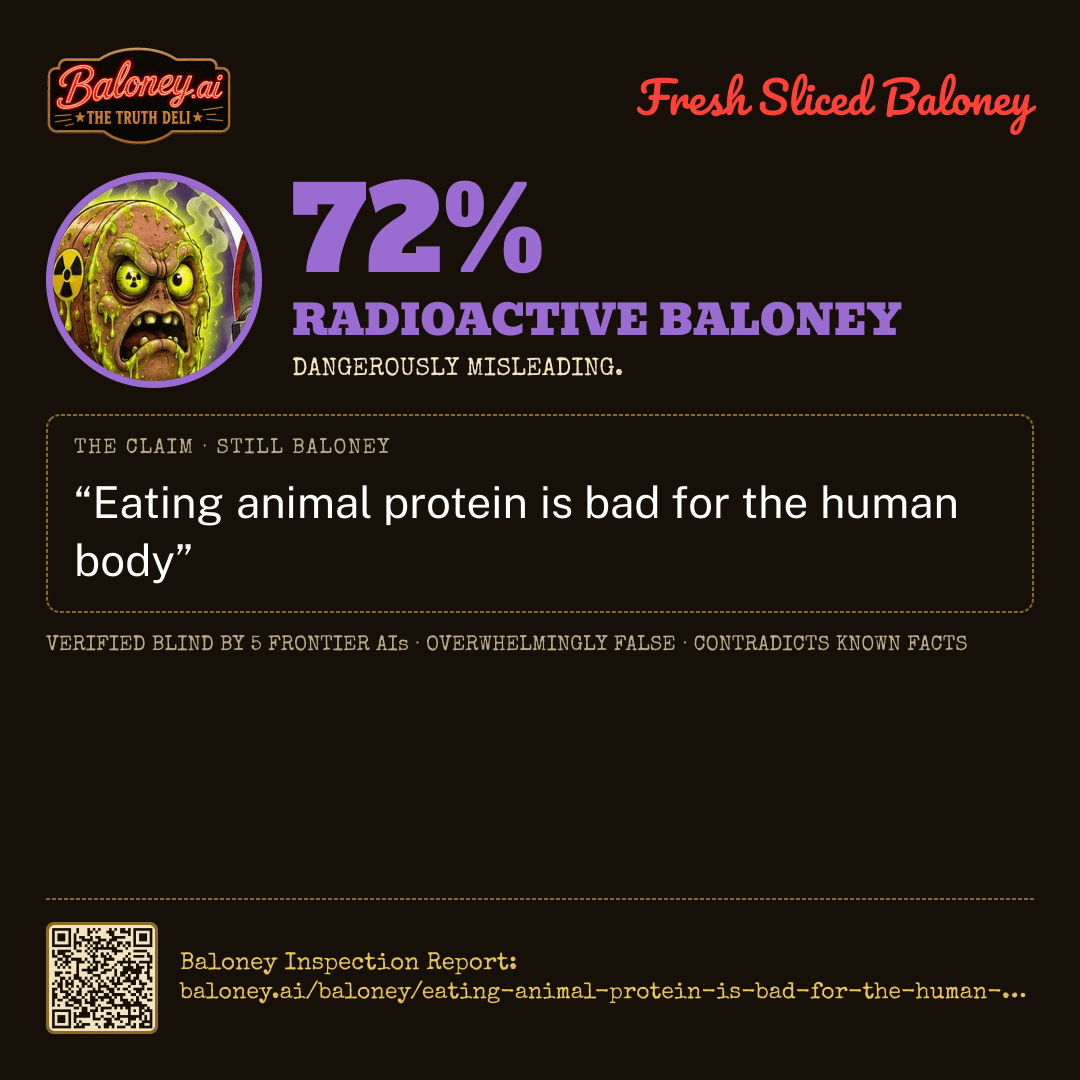
72%BALONEY
ROUND-1 BREAKDOWN
- The International Agency for Research on Cancer (IARC/WHO) classified processed meat as Group 1 (carcinogenic to humans) and red meat as Group 2A (probably carcinogenic), citing roughly an 18% increase in colorectal cancer risk per 50 g/day of processed meat.
- Large prospective cohorts (e.g., Song et al., JAMA Internal Medicine 2016, pooling Nurses' Health Study and Health Professionals Follow-up Study) found higher animal protein intake associated with increased cardiovascular mortality, while substituting plant protein for animal protein — especially processed red meat — was associated with lower mortality.
- Levine et al. (Cell Metabolism, 2014) reported that high protein intake in middle-aged adults, particularly from animal sources, was associated with higher IGF-1 levels and increased cancer and overall mortality in the 50-65 age group.
- Zheng et al. (BMJ, 2019) found that increases in red meat consumption over an 8-year period were associated with higher subsequent all-cause mortality.
- Mechanistic candidates for harm exist: heme iron, N-nitroso compounds, heterocyclic amines and polycyclic aromatic hydrocarbons from high-temperature cooking, sodium and nitrites in processed meats, saturated fat effects on LDL cholesterol, and gut-microbiome-derived TMAO from carnitine/choline.
- Major bodies including the American Heart Association, the World Cancer Research Fund and the Dietary Guidelines for Americans recommend limiting processed and red meat and shifting toward plant proteins, fish and poultry — an implicit acknowledgment that some animal protein patterns carry risk.
- Environmental and infectious-risk arguments (zoonoses, antibiotic resistance) are sometimes folded into health arguments against animal-source foods.
- The claim is a blanket statement about a heterogeneous category. Evidence of harm is concentrated in processed meat and, more weakly, unprocessed red meat; fish, poultry, eggs, yogurt and dairy generally show neutral or favorable associations in cohort studies.
- Animal proteins are complete proteins with high digestible indispensable amino acid scores (DIAAS) and high leucine content, making them particularly effective for muscle protein synthesis — clinically relevant for older adults, athletes and people recovering from illness.
- Animal-source foods are the principal or only reliable dietary sources of vitamin B12, and are important sources of heme iron, zinc, vitamin D, choline and preformed retinol; strict avoidance without supplementation causes documented deficiency states (NIH Office of Dietary Supplements).
- Fish consumption (long-chain omega-3s) is associated with reduced cardiovascular and all-cause mortality in multiple analyses; this is animal protein associated with benefit, directly contradicting the universal claim.
- Nearly all human evidence is observational and subject to confounding: heavy red-meat eaters in Western cohorts also smoke more, exercise less, eat fewer vegetables and have higher BMI. Effect sizes are small (typically relative risks of 1.1-1.2) — within the range where residual confounding can explain results.
- The NutriRECS consortium's GRADE review (Annals of Internal Medicine, 2019) concluded the certainty of evidence linking red/processed meat to cancer and cardiometabolic outcomes is low to very low, and controversially suggested most adults need not reduce intake. The review was heavily criticized but was not retracted, illustrating genuine scientific disagreement.
- Populations with high animal-food intake but different food matrices and lifestyles (e.g., traditional Mediterranean fish/dairy patterns, Japanese and Nordic diets) show excellent longevity outcomes.
- Randomized trials of protein intake have not demonstrated harm from animal protein per se; concerns about kidney damage from high protein are not supported in people with normal renal function.
- Dose and dietary context matter: risk associations appear at relatively high intakes of processed/red meat, not from eating animal protein at all.
82/100 — the lab’s own confidence in the score above, not a second reading of the claim.
SourcesWorld Health Organization / IARCgov · 95 · The Lancet Oncology (Bouvard et al., 2015, IARC Working Group)journal · 93 · JAMA Internal Medicine (Song et al., 2016)journal · 90 · Cell Metabolism (Levine et al., 2014)journal · 82 · The BMJ (Zheng et al., 2019)journal · 90 · Annals of Internal Medicine (Johnston et al., NutriRECS, 2019)journal · 80 · USDA / HHS, Dietary Guidelines for Americans 2020-2025gov · 90 · NIH Office of Dietary Supplementsgov · 93 · Harvard T.H. Chan School of Public Health, The Nutrition Sourceedu · 88 · Cancer Research UKother · 88 · American Heart Associationother · 85 · World Cancer Research Fund Internationalother · 87