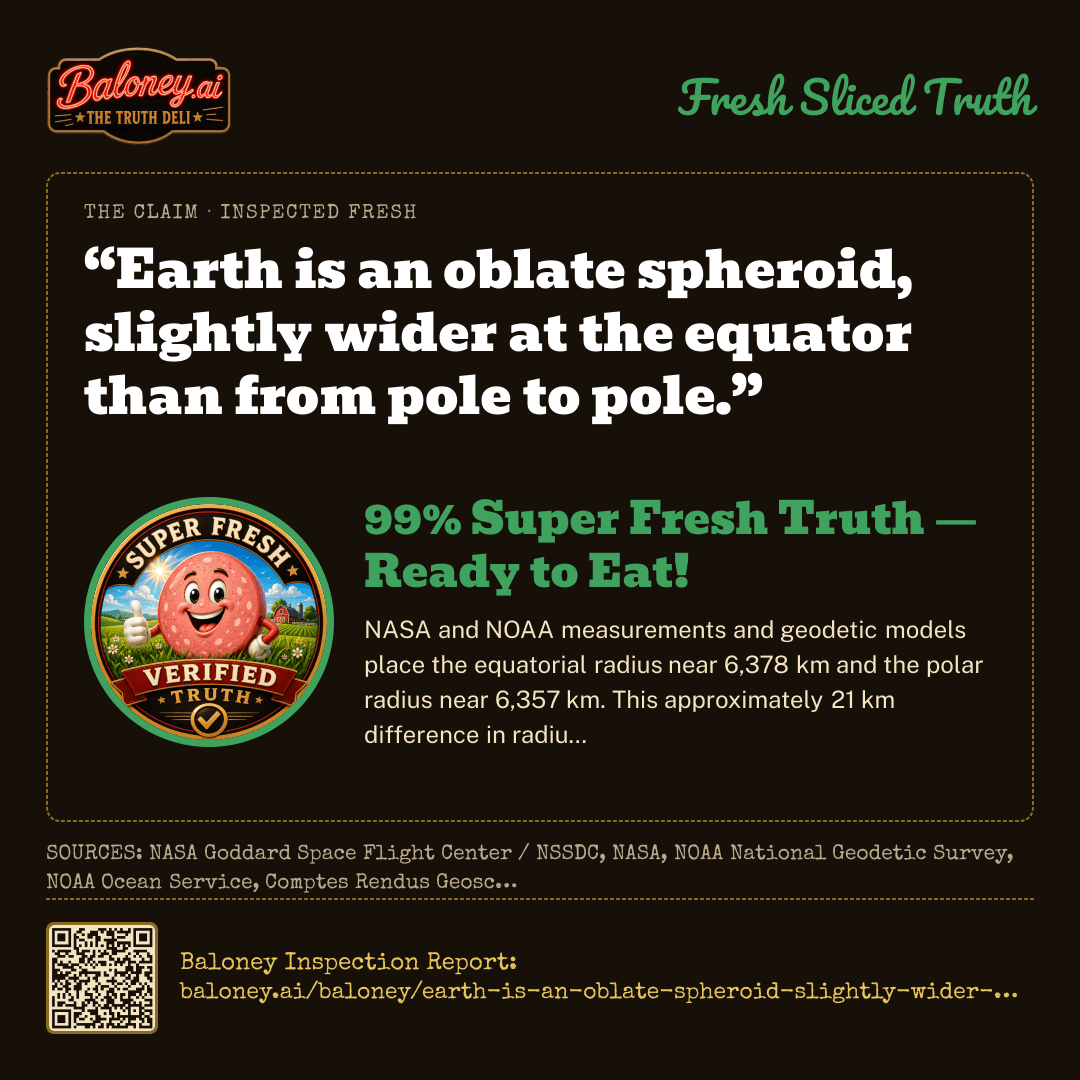
“Earth is an oblate spheroid, slightly wider at the equator than from pole to pole.”99% Super Fresh Truth — Ready to Eat!Verified blind by 5 frontier AIs · Baloney Inspection Report: baloney.ai/baloney/earth-is-an-oblate-spheroid-slightly-wider-at-the-equator
The Rating Card
The claim this refutes
The Baloney Sampler
The claim is supported by direct geodetic and satellite measurements. NASA reports an equatorial radius of about 6,378 km and a polar radius of about 6,357 km, while NOAA describes Earth as an oblate spheroid with a larger equatorial radius.
The reports found that this is an accurate first-order description, with the qualification that Earth’s exact physical surface is an irregular geoid. NASA and NOAA sources support the measured dimensions and the distinction between the simplified spheroid model and the geoid.
Other ways to slice it — phrasings that might have changed the rating
“Earth is a perfect mathematical sphere with equal equatorial and polar radii.” The reports found that Earth’s equatorial radius is about 6,378 km and its polar radius about 6,357 km, so the exact-sphere claim conflicts with the measurements.
“Earth’s exact physical surface is an irregular geoid rather than an oblate spheroid.” The reports distinguish the geoid from the oblate spheroid, noting that the spheroid is an idealized first-order model and that the actual surface has irregularities.
“Earth’s equatorial radius is about 6,400 km and its polar radius is about 6,300 km.” The reports give approximate radii of 6,378 km and 6,357 km, so this alternative changes the measured dimensions substantially.
Written from the panel’s reports by Perplexity · sonar-pro. Nothing here changed the score.
22:10:36SCORING MODEL V2 — MEDIAN OF 5 COUNTED LAB SCORES: 1, 1, 1, 3, 2 → 1. FRESH RULE: THE PRIMARY MASTER SCORES 1 AND THE BLIND MASTER 1 — BOTH SUPER FRESH TRUTH — AND THE COUNTED MEDIAN IS 1, ON THE TRUE SIDE. PUBLISHED AS 1, THE MORE CAUTIOUS OF THE TWO MASTERS.✓
22:10:36SOURCE RULE — LABS CITED 21 SOURCES: 0 DISCARDED FOR HAVING NO URL, 1 DISCARDED AS DEAD LINKS (404/410), 2 COULD NOT BE OPENED BY US AND ARE MARKED UNVERIFIED.✓
22:10:36SOURCE RULE — PRIMARY MASTER RULED ON 15 SOURCES: 0 DISCARDED FOR HAVING NO URL, 0 DISCARDED AS DEAD LINKS, 2 MARKED UNVERIFIED, 13 VERIFIED.✓
How This One Was Sliced
Station 1 · Blind Inspection — Five Graders, Zero Peeking
Each lab scored the claim independently, without seeing the others. Open a breakdown for its evidence, its sources, and how sure it was.
Anthropic · EQUAL WEIGHT · 28.5s
claude-opus-5
99%TRUTH
ROUND-1 BREAKDOWN
Evidence offered for the claim
NASA's planetary fact sheet gives Earth's equatorial radius as 6,378.137 km and polar radius as 6,356.752 km — a difference of about 21.4 km — with a flattening of 0.00335 (≈1/298.26), exactly the oblate-spheroid geometry described in the claim.
The globally adopted geodetic reference frame, WGS 84 (used by GPS), models Earth as an oblate ellipsoid of revolution with semi-major axis 6,378,137 m and inverse flattening 298.257223563; GRS 80 is nearly identical. Satellite navigation would not function to centimeter precision if this shape model were wrong.
The equatorial bulge is the physically expected result of rotation: centrifugal effect at the equator opposes gravity, an argument made by Newton and confirmed in the 18th century by the French geodetic arc-measuring expeditions to Lapland and Peru, which found meridian degrees longer near the pole than near the equator.
Independent modern measurements — satellite laser ranging, GRACE/GOCE gravity missions, VLBI, and direct orbital tracking (the J2 gravitational coefficient) — all converge on the same ~1/298 flattening, i.e., wider across the equator than pole to pole.
NOAA and other geodetic agencies routinely describe Earth's reference shape as an oblate ellipsoid/spheroid, using it as the baseline against which the more irregular geoid is measured.
Consequence checks agree: sea-level points on the equator are ~21 km farther from Earth's center than the poles, which is why Chimborazo/Cayambe (near the equator), not Everest, are the summits farthest from Earth's center.
Evidence against the claim
Strictly speaking, Earth is not a perfect oblate spheroid: the true equipotential surface (the geoid) departs from the best-fit ellipsoid by roughly -100 m to +85 m (e.g., the Indian Ocean low, the New Guinea high), so 'oblate spheroid' is an idealized model rather than an exact description.
Satellite geodesy shows small higher-order asymmetries — the odd zonal harmonic J3 gives a slight 'pear shape' with the South Pole a few tens of meters closer to the reference ellipsoid than the North Pole, and the equator itself is very slightly elliptical (a few hundred meters).
Solid topography adds larger local deviations (Everest ~8.8 km up, ocean trenches ~11 km down), and tides, post-glacial rebound and mass redistribution make the shape slightly time-variable.
None of these refinements contradict the claim's substance; they are second-order corrections to a shape that is, to first order, an oblate spheroid with an equatorial bulge. The word 'slightly' in the claim is well chosen: the ~0.3% flattening means Earth would look round to the eye from space.
How sure this lab was
99/100 — the lab’s own confidence in the score above, not a second reading of the claim.
Direct geodetic/astronomical measurements list Earth's equatorial radius (6,378.137 km) as larger than its polar radius (6,356.752 km), which means Earth is wider around the equator than from pole to pole.
NASA's Earth facts similarly give an equatorial diameter of about 12,756 km and a polar diameter of about 12,714 km, confirming the small equatorial bulge.
The physical explanation is well established: Earth's rotation produces centrifugal effects that make the planet slightly flattened at the poles and bulged at the equator, the defining feature of an oblate spheroid.
Evidence against the claim
The claim is a simplified description: Earth is not a mathematically perfect oblate spheroid. For precise surveying, agencies use reference ellipsoids and the geoid because Earth has irregular mass distribution, topography, ocean variation, and small deviations from a smooth spheroid.
Those refinements do not contradict the statement as written; they only add precision. At planetary scale, 'oblate spheroid, slightly wider at the equator than from pole to pole' is substantially accurate.
How sure this lab was
99/100 — the lab’s own confidence in the score above, not a second reading of the claim.
Geodetic measurements, satellite data, and space observations overwhelmingly confirm that Earth's equatorial radius (approximately 6,378 km) is larger than its polar radius (approximately 6,356 km).
This difference of about 22 kilometers in radius is caused by the centrifugal force generated by Earth's rotation, which pushes matter outward near the equator, creating an equatorial bulge.
Major scientific and governmental organizations, including NASA and NOAA, define the Earth's macroscopic shape as an oblate spheroid (or ellipsoid) based on continuous global positioning system (GPS) and gravity anomaly satellite (GRACE) measurements.
Evidence against the claim
In highly precise pedantic terms, Earth is not a mathematically perfect oblate spheroid. Due to variations in gravitational pull, mass distribution, and topographical features (mountains and ocean trenches), its true exact shape is best described as a 'geoid'—a slightly lumpy, irregular ellipsoid.
Claims completely counter to the oblate spheroid model, such as Flat Earth theories, exist but entirely lack empirical evidence and are contradicted by centuries of established physics, astronomy, and direct observation.
How sure this lab was
100/100 — the lab’s own confidence in the score above, not a second reading of the claim.
Earth is conventionally modeled as an oblate spheroid: NOAA’s National Geodetic Survey states that its equatorial radius is larger than its polar radius.[source 2]
NASA reports an equatorial radius of about 6,378 km and a polar radius of about 6,357 km, meaning Earth is slightly flattened at the poles.[source 7]
NOAA explains that Earth is wider at the equator than at the poles, consistent with the claim.[source 1]
A peer-reviewed study describes the rotating Earth as oblate, with a smaller pole-to-pole dimension and a bulging equatorial region; it gives an equatorial–polar radius difference of roughly 21 km.[source 13]
Evidence against the claim
No credible scientific evidence in the reviewed sources contradicts the claim.
The wording is an approximation: Earth’s actual physical surface is irregular and is more precisely represented by a geoid, while an oblate spheroid is a simplified reference model. This does not make the central statement false.
The phrase “wider at the equator” refers to diameter or radius through Earth’s center, not necessarily to every local surface measurement; topography and the geoid introduce smaller regional deviations.
How sure this lab was
99/100 — the lab’s own confidence in the score above, not a second reading of the claim.
Geodetic and satellite measurements show Earth's equatorial radius is ~6378.137 km versus polar radius ~6356.752 km (difference ~21 km in radius, ~43 km in diameter), making it wider at the equator.
Rotation produces a centrifugal effect that is strongest at the equator, producing the well-measured equatorial bulge; this is the defining geometry of an oblate spheroid.
Standard planetary fact sheets and geodesy references (NASA, IERS-derived models) classify Earth's figure as an oblate spheroid to first order.
Evidence against the claim
Earth's actual equipotential surface (the geoid) includes smaller higher-order terms (slight north-south asymmetry sometimes called a pear shape, plus topography and local gravity anomalies), so it is not a mathematically perfect oblate spheroid.
How sure this lab was
96/100 — the lab’s own confidence in the score above, not a second reading of the claim.
The statement is substantially accurate and directly supported by the panel’s evidence. Multiple independent reports agree that geodetic and satellite measurements give an equatorial radius of about 6,378 km and a polar radius of about 6,357 km, a difference of roughly 21 km in radius. NOAA explicitly describes Earth as an oblate spheroid with a larger equatorial radius, and NASA describes it as slightly flattened. The qualification that Earth is an oblate spheroid is an idealized first-order model is accurate but does not undermine the statement. The minor wording issue is that Earth’s exact physical surface is an irregular geoid rather than a perfect mathematical spheroid; under the supplied scale, that warrants no more than a score at the upper end of the true band. The cited governmental and scientific sources were accepted because they directly address Earth’s dimensions and geodetic shape. Wikipedia, Scientific American, and Britannica were retained as corroboration but given less weight than NASA and NOAA.
All five evaluators agreed that the claim is essentially true. Reports 1 and 2 assigned scores of 2 and 3 because the wording simplifies Earth’s exact shape: the geoid includes topography, gravity anomalies, and small higher-order asymmetries. Reports 3, 4, and 5 assigned 1, judging those qualifications non-substantive. All reports agreed on the equatorial bulge, the approximate 21–22 km radius difference, and the use of an oblate spheroid or ellipsoid as the appropriate large-scale model.
SUPER FRESH — VERIFIED AGAINST NASA GODDARD SPACE FLIGHT CENTER / NSSDC, NASA, NOAA NATIONAL GEODETIC SURVEY, NOAA OCEAN SERVICE, COMPTES RENDUS GEOSCIENCE, AND ESA GOCE MATERIALS CITED IN THE PANEL REPORTS.
Blind Validation Master · never saw the Primary’s work
grok-4.6
99% TRUTH
All five reports independently confirm the claim with high-confidence NASA, NOAA, IERS/WGS 84, and satellite-geodesy data: equatorial radius ~6378.137 km versus polar radius ~6356.752 km (~21 km difference, flattening ~1/298), produced by rotation and treated as the first-order figure of Earth. The wording “slightly wider at the equator” matches the measured ~0.3 % bulge. Second-order caveats (geoid undulations of tens to hundreds of metres, tiny pear-shape J3 term, topography) are acknowledged uniformly as refinements that do not falsify the statement as written; an oblate spheroid remains the standard, accurate description at planetary scale.
AGREEMENT TEST PASSED — BOTH MASTERS SCORED 99% · BLIND VALIDATION CONFIRMED THIS SCORE · NO RE-EVALUATION REQUIRED
Median of 5 counted lab scores: 1, 1, 1, 3, 2 → 1.
Fresh rule: the Primary Master scores 1 and the Blind Master 1 — both Super Fresh Truth — and the counted median is 1, on the true side. Published as 1, the more cautious of the two masters.
The Evidence
Evidence for the claim
Measured radii differ Geodetic, satellite, and reference-ellipsoid measurements give an equatorial radius of approximately 6,378.137 km and a polar radius of approximately 6,356.752 km, making Earth wider through the equator by about 21.4 km in radius.
Rotation produces the bulge Earth’s rotation produces the centrifugal effect that is strongest at the equator, explaining the observed equatorial bulge and polar flattening characteristic of an oblate spheroid.
Established geodetic model NASA and NOAA materials describe Earth at planetary scale as an oblate spheroid or ellipsoid, including the statement that its equatorial radius is larger than its polar radius.
Evidence offered against the claim
The exact surface is a geoid Earth is not a mathematically perfect oblate spheroid. Its equipotential surface, or geoid, contains irregularities from uneven mass distribution, gravity anomalies, topography, oceans, and tides.
Small higher-order deviations The reports note slight north–south asymmetry and other higher-order departures from a smooth oblate spheroid, while emphasizing that these are refinements rather than contradictions of the central claim.
Sources · Reliability · Why Accepted or Discounted
ACCEPTED — Relevant geodetic source cited for the reference framework used to model Earth’s shape.
Every link was opened when this claim was inspected. A dead link was discarded before publication; “unverified” means the site refused our automated check and the link is the one the panel cited. A source without a URL was never kept.
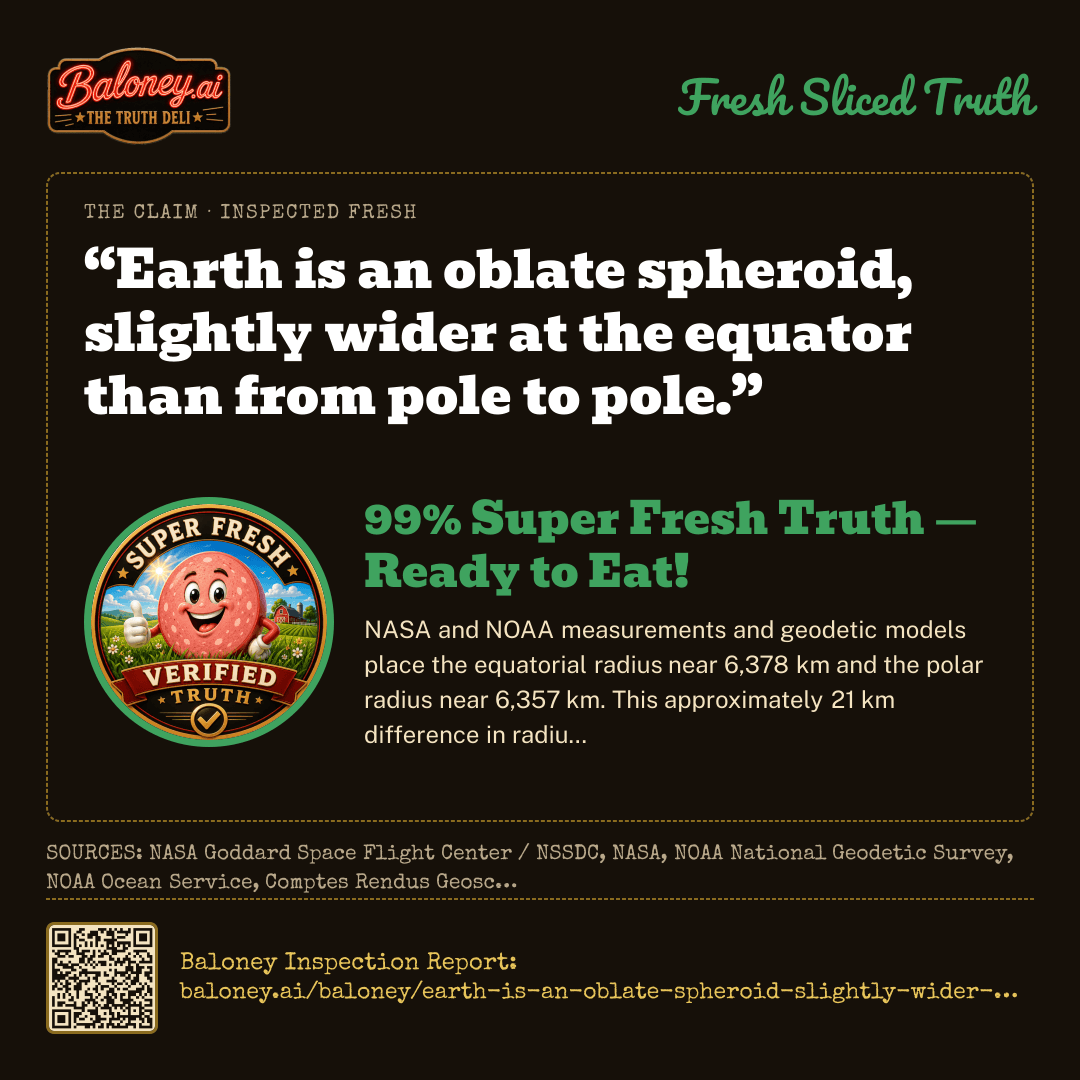
“Earth is an oblate spheroid, slightly wider at the equator than from pole to pole.”99% Super Fresh Truth — Ready to Eat!Verified blind by 5 frontier AIs · Baloney Inspection Report: baloney.ai/baloney/earth-is-an-oblate-spheroid-slightly-wider-at-the-equator