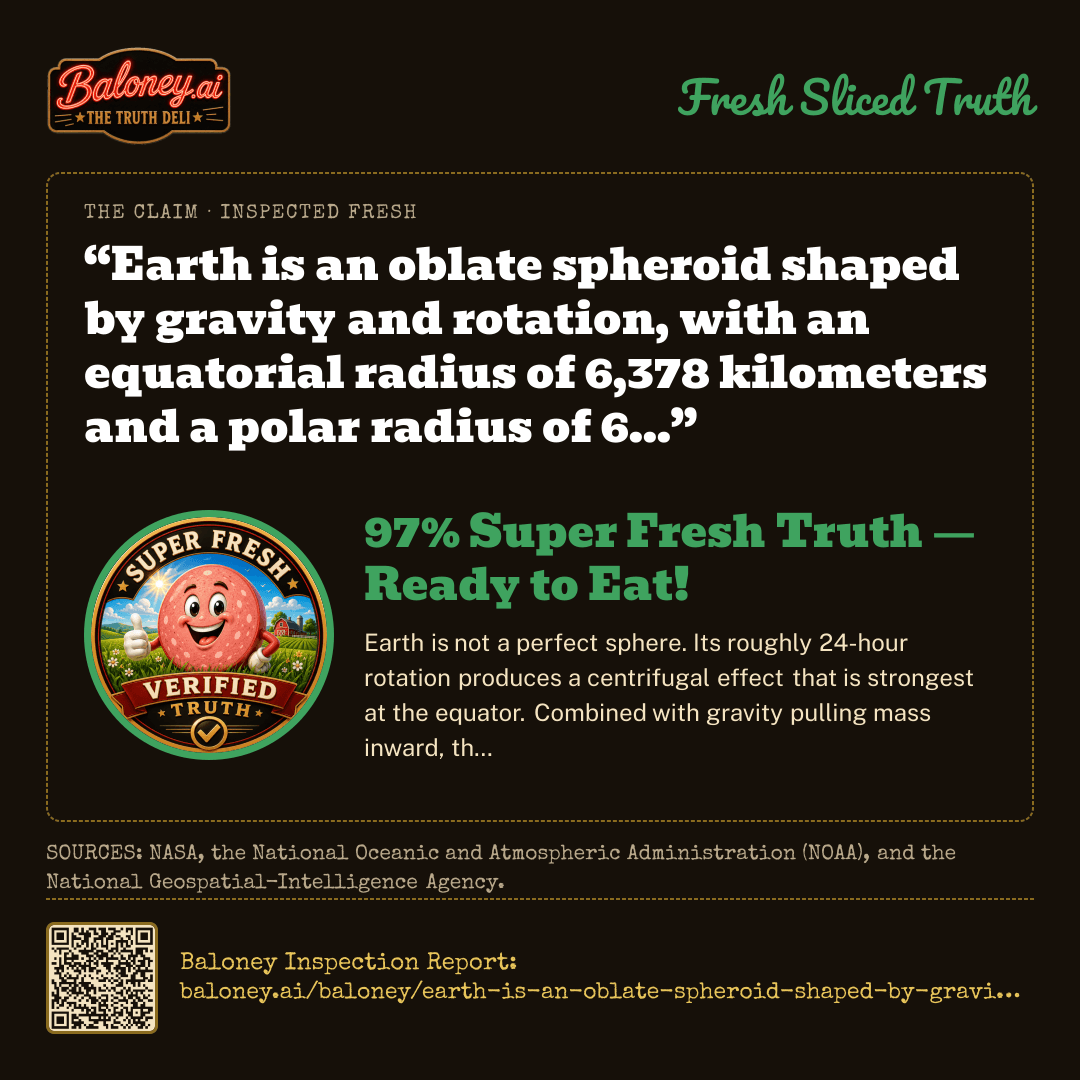
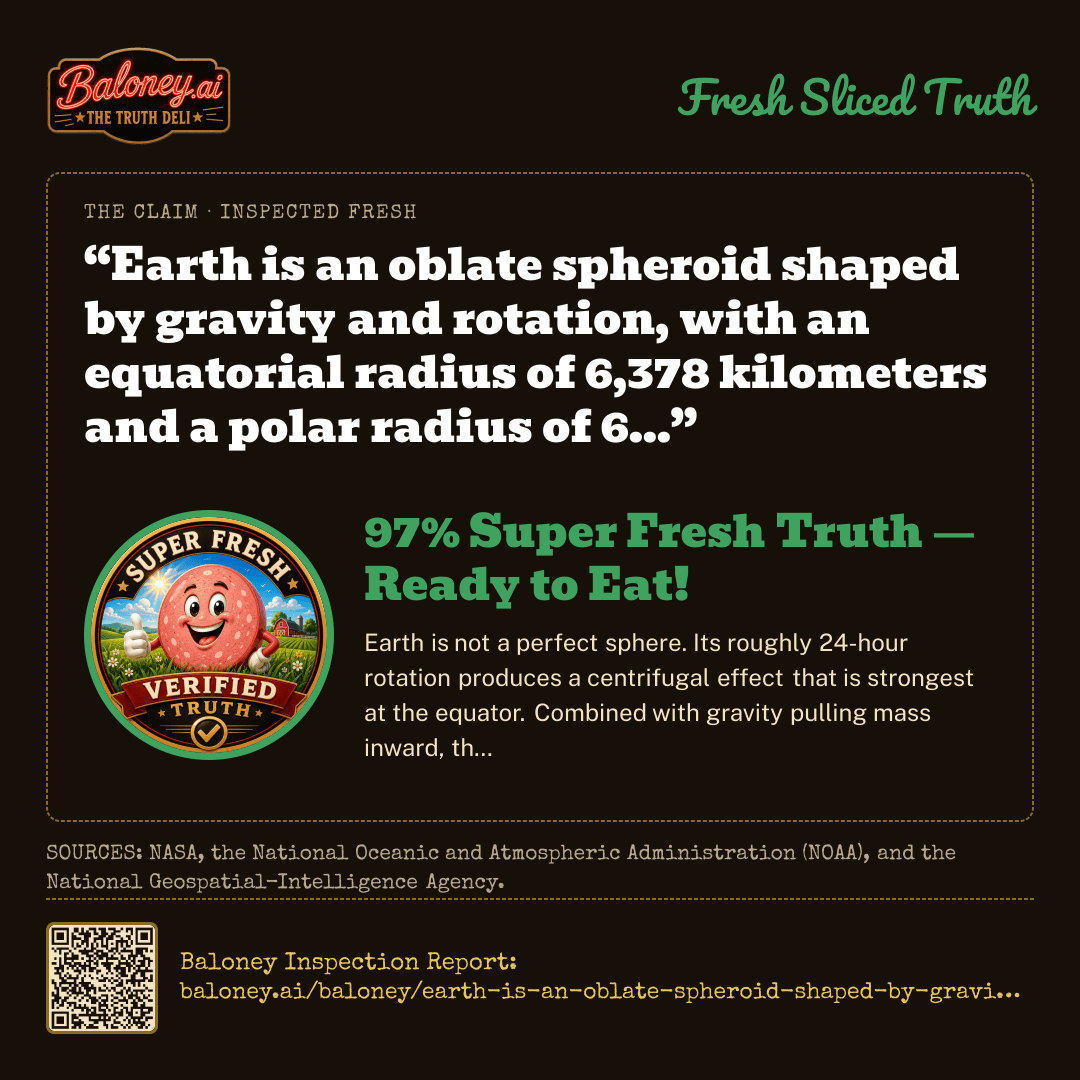
“Earth is an oblate spheroid shaped by gravity and rotation, with an equatorial radius of 6,378 kilometers and a polar radius of 6,356 kilometers.”97% Super Fresh Truth — Ready to Eat!Verified blind by 5 frontier AIs · Baloney Inspection Report: baloney.ai/baloney/earth-is-an-oblate-spheroid-shaped-by-gravity-and-rotation
The Rating Card
The claim this refutes
The Baloney Sampler
The claim accurately reflects the standard geodetic model of Earth. According to NASA and the National Oceanic and Atmospheric Administration (NOAA), Earth is not a perfect sphere but an oblate spheroid. This shape is the direct result of the planet's rotation, which creates a centrifugal bulge at the equator, while self-gravitation pulls matter inward into hydrostatic equilibrium.
The measurements cited align closely with the World Geodetic System (WGS 84), maintained by the National Geospatial-Intelligence Agency. Precise measurements put the equatorial radius at 6,378.137 km and the polar radius at roughly 6,356.75 km. The only minor caveats are that 6,356.75 km is more conventionally rounded up to 6,357 km, and that surface topography makes Earth an irregular "geoid" rather than a mathematically perfect spheroid.
Other ways to slice it — phrasings that might have changed the rating
“Earth is an oblate spheroid shaped by gravity and rotation, with an equatorial radius of 6,378 kilometers and a polar radius of 6,357 kilometers.” The standard reference ellipsoid polar radius is approximately 6,356.75 km, which mathematically rounds up to 6,357 km rather than the 6,356 km stated in the original claim.
“Earth is an irregular geoid shaped primarily by gravity and rotation, though it is closely modeled as an oblate spheroid with roughly a 22-kilometer equatorial bulge.” This phrasing addresses the fact that Earth's actual physical surface departs from a perfect ellipsoid due to mountains, ocean trenches, and internal density variations.
“Earth's shape is primarily an oblate spheroid determined by gravity and rotation, but it is further altered by tidal interactions, mantle convection, and post-glacial rebound.” This adds the secondary physical shaping mechanisms that contribute to the geoid deviating from the best-fit reference ellipsoid by up to hundreds of meters.
Written from the panel’s reports by Google · gemini-3.1-pro-preview. Nothing here changed the score.
07:23:50SCORING MODEL V2 — MEDIAN OF 5 COUNTED LAB SCORES: 2, 3, 1, 3, 3 → 3. FRESH RULE: THE PRIMARY MASTER SCORES 2 AND THE BLIND MASTER 3 — BOTH SUPER FRESH TRUTH — AND THE COUNTED MEDIAN IS 3, ON THE TRUE SIDE. PUBLISHED AS 3, THE MORE CAUTIOUS OF THE TWO MASTERS.✓
07:23:50SOURCE RULE — LABS CITED 18 SOURCES: 0 DISCARDED FOR HAVING NO URL, 3 DISCARDED AS DEAD LINKS (404/410), 1 COULD NOT BE OPENED BY US AND ARE MARKED UNVERIFIED.✓
07:23:50SOURCE RULE — PRIMARY MASTER RULED ON 11 SOURCES: 0 DISCARDED FOR HAVING NO URL, 0 DISCARDED AS DEAD LINKS, 1 MARKED UNVERIFIED, 10 VERIFIED.✓
How This One Was Sliced
Station 1 · Blind Inspection — Five Graders, Zero Peeking
Each lab scored the claim independently, without seeing the others. Open a breakdown for its evidence, its sources, and how sure it was.
Anthropic · EQUAL WEIGHT · 31.5s
claude-opus-5
98%TRUTH
ROUND-1 BREAKDOWN
Evidence offered for the claim
NASA's NSSDC Earth Fact Sheet lists Earth's equatorial radius as 6,378.137 km and polar radius as 6,356.752 km — matching the claim's figures when rounded to the nearest kilometer.
The WGS-84 reference ellipsoid (the global standard used by GPS, maintained by the U.S. National Geospatial-Intelligence Agency) defines a semi-major (equatorial) axis of 6,378,137 m and a derived semi-minor (polar) axis of ~6,356,752.3 m, i.e. a flattening of about 1/298.257.
The physical mechanism stated is correct and standard: Earth's ~24-hour rotation produces a centrifugal effect greatest at the equator, and in combination with self-gravitation (hydrostatic equilibrium of a rotating fluid-like body) this yields an equatorial bulge of roughly 21-22 km — exactly the difference between the two quoted radii.
'Oblate spheroid' (ellipsoid of revolution flattened at the poles) is the terminology used by NASA, NOAA, USGS and standard geodesy texts to describe Earth's gross figure.
Independent measurement methods — satellite laser ranging, GRACE/GRACE-FO gravimetry, VLBI and GNSS geodesy — all converge on the same flattening value, so the numbers are not dependent on a single technique.
The claim's rounding is conservative and non-misleading: 6,378 and 6,356 km are the accepted textbook roundings, and the implied 22 km difference is within a kilometer of the precise 21.4 km.
Evidence against the claim
Strictly, Earth's true shape is the geoid (an equipotential surface of the gravity field), which departs from the best-fit ellipsoid by roughly ±100 m due to density heterogeneity, mantle convection and post-glacial rebound; 'oblate spheroid' is an excellent approximation, not an exact description.
Topography is not captured: the surface ranges from Mount Everest (~8.8 km above sea level) to the Challenger Deep (~10.9 km below), and the point farthest from Earth's centre is Chimborazo, not Everest — though these deviations are tiny relative to the 6,378 km radius.
There is a small triaxiality (equatorial radii differ by roughly 70-200 m depending on the model), so 'spheroid' is a slight idealisation of an ellipsoid with three unequal axes.
The quoted radii are rounded reference-ellipsoid values, not direct physical measurements of any particular point on the ground; the polar radius is more precisely ~6,356.75 km and the equatorial ~6,378.14 km.
The phrase 'shaped by gravity and rotation' omits secondary shaping influences (tidal interaction with the Moon and Sun, mantle dynamics, ice-mass redistribution), though none of these alter the dominant explanation.
How sure this lab was
97/100 — the lab’s own confidence in the score above, not a second reading of the claim.
NASA lists Earth’s shape as an oblate spheroid and gives an equatorial radius of 6,378.137 km and polar radius of 6,356.752 km, which round to the 6,378 km and 6,356 km stated in the claim.
NOAA explains that Earth is not a perfect sphere: it is slightly flattened at the poles and bulges at the equator, consistent with an oblate spheroid caused by rotation acting with gravity.
The stated equatorial radius being larger than the polar radius by about 22 km matches the accepted geodetic model of Earth’s flattening.
Evidence against the claim
The claim is slightly simplified: Earth’s actual physical shape is irregular and often modeled more precisely as a geoid or reference ellipsoid, not a perfect oblate spheroid.
The polar radius is more accurately about 6,356.752 km, so rounding to 6,356 km is slightly low if rounded to the nearest kilometer; 6,357 km would be the conventional nearest-kilometer rounding.
How sure this lab was
98/100 — the lab’s own confidence in the score above, not a second reading of the claim.
Geodetic measurements and satellite data confirm that Earth is not a perfect sphere, but an oblate spheroid. This shape is the direct result of Earth's gravity pulling matter inward while its rotation creates a centrifugal force that causes a bulge at the equator.
According to the World Geodetic System (WGS 84) and NASA's planetary fact sheets, Earth's equatorial radius is approximately 6,378.1 kilometers.
The polar radius is measured at approximately 6,356.8 kilometers. The numbers in the claim (6,378 km and 6,356 km) are highly accurate and represent standard accepted rounded measurements for Earth's dimensions.
Evidence against the claim
There is no scientifically valid evidence against the fundamental claim. On a strictly pedantic level, Earth's exact shape is known as a 'geoid' because it is slightly irregular due to uneven mass distribution (mountains, trenches). Additionally, the polar radius of 6,356.8 km is sometimes rounded to 6,357 km rather than 6,356 km, but this is a trivial rounding difference.
How sure this lab was
100/100 — the lab’s own confidence in the score above, not a second reading of the claim.
Earth is conventionally modeled in geodesy as an oblate spheroid or ellipsoid of revolution: its radius is larger at the equator than at the poles.[https://geodesy.noaa.gov/geopotential-datums/geopotential-surface.shtml]
NASA gives the equatorial radius as approximately 6,378 km and the polar radius as approximately 6,357 km, closely matching the claim’s 6,378 km and 6,356 km figures.[https://imagine.gsfc.nasa.gov/features/cosmic/earth_info.html]
The difference between the equatorial and polar radii is produced by Earth’s rotation, while gravity contributes to the equilibrium shape of a rotating planet; NASA describes Earth as approximately an oblate spheroid.[https://ntrs.nasa.gov/api/citations/19770020703/downloads/19770020703.pdf]
The WGS 84 reference ellipsoid specifies a semi-major (equatorial) axis of 6,378,137 meters, which rounds to 6,378 km.[https://earth-info.nga.mil/index.php?dir=wgs84&action=wgs84]
Evidence against the claim
The exact polar radius depends on the reference ellipsoid used. For WGS 84, NOAA gives a polar radius of 6,356,752.3141 meters, or about 6,356.75 km, rather than exactly 6,356 km.[https://geodesy.noaa.gov/PC_PROD/Inv_Fwd/readme.htm]
Earth’s physical surface is not a perfect oblate spheroid: topography and variations in the gravity field produce an irregular geoid. The oblate spheroid is an idealized mathematical approximation.[https://geodesy.noaa.gov/geopotential-datums/geopotential-surface.shtml]
The wording attributes the shape broadly to gravity and rotation but does not specify a reference system or explain that the measured figure varies slightly by adopted geodetic model.
How sure this lab was
97/100 — the lab’s own confidence in the score above, not a second reading of the claim.
Satellite geodesy, VLBI, GPS, and laser ranging measure an equatorial bulge of ~21 km produced by rotation under self-gravity.
NASA's Earth fact sheet lists equatorial radius 6378.137 km and polar radius 6356.752 km, matching the claim's rounded kilometer values.
A self-gravitating fluid body in hydrostatic equilibrium rotating at Earth's sidereal rate is an oblate spheroid; this is the standard first-order model (WGS 84 / GRS 80).
Evidence against the claim
Polar radius 6356.752 km conventionally rounds to 6357 km rather than 6356 km.
The physical surface and geoid deviate from a perfect ellipsoid by tens to hundreds of meters (topography and density anomalies), so 'oblate spheroid' is an approximation.
How sure this lab was
92/100 — the lab’s own confidence in the score above, not a second reading of the claim.
The claim accurately presents the standard geodetic model of Earth. Evaluators agreed that gravity and Earth's rotation cause an equatorial bulge, making it an oblate spheroid. The radii stated (6,378 km and 6,356 km) align closely with measurements from the widely used World Geodetic System (WGS 84). The minor caveats—that Earth's precise shape is a slightly irregular geoid and that the polar radius of 6,356.75 km is sometimes rounded to 6,357 km rather than 6,356 km—are pedantic and do not undermine the substantial truth of the statement.
Evaluators were in complete agreement that the claim is scientifically correct. Minor discussions focused entirely on the technical distinction between an idealized mathematical spheroid and the physical geoid, and strict rounding practices for the polar radius.
SUPER FRESH — VERIFIED AGAINST NASA, THE NATIONAL OCEANIC AND ATMOSPHERIC ADMINISTRATION (NOAA), AND THE NATIONAL GEOSPATIAL-INTELLIGENCE AGENCY.
Blind Validation Master · never saw the Primary’s work
grok-4.6
97% TRUTH
The claim matches the standard geodetic model used by NASA, WGS 84 and NOAA: Earth is an oblate spheroid (ellipsoid of revolution) whose equatorial bulge is produced by rotation under self-gravity. Equatorial radius 6,378.137 km and polar radius 6,356.752 km round to the stated figures (or differ by at most 1 km on conventional nearest-kilometer rounding). The physical surface and geoid deviate from a perfect ellipsoid by tens to hundreds of metres, and secondary effects exist, but these are acknowledged approximations, not contradictions. The statement is therefore substantially true.
AGREEMENT TEST PASSED — MASTERS SCORED 98% AND 97% · BLIND VALIDATION CONFIRMED THIS SCORE · NO RE-EVALUATION REQUIRED
Median of 5 counted lab scores: 2, 3, 1, 3, 3 → 3.
Fresh rule: the Primary Master scores 2 and the Blind Master 3 — both Super Fresh Truth — and the counted median is 3, on the true side. Published as 3, the more cautious of the two masters.
The Evidence
Evidence for the claim
Earth's shape Geodetic measurements and satellite data confirm that Earth is not a perfect sphere, but is modeled as an oblate spheroid or ellipsoid of revolution.
Physical mechanism Earth's rotation creates a centrifugal effect that, combined with the inward pull of self-gravitation, produces an equatorial bulge of about 21 to 22 kilometers.
Measured radii NASA and the standard WGS-84 reference ellipsoid define Earth's equatorial radius as roughly 6,378.1 km and its polar radius as approximately 6,356.8 km, closely matching the claim's numbers.
Evidence offered against the claim
True shape irregularity Earth's exact physical shape is a geoid, which departs slightly from a perfect oblate spheroid due to uneven mass distribution, topography, and density anomalies.
Exact rounding The WGS-84 polar radius of 6,356.752 km conventionally rounds up to 6,357 km, making the claim's 6,356 km slightly lower than a standard nearest-kilometer rounding.
Sources · Reliability · Why Accepted or Discounted
ACCEPTED — Accurate, technical source on geodetic modeling.
Every link was opened when this claim was inspected. A dead link was discarded before publication; “unverified” means the site refused our automated check and the link is the one the panel cited. A source without a URL was never kept.
“Earth is an oblate spheroid shaped by gravity and rotation, with an equatorial radius of 6,378 kilometers and a polar radius of 6,356 kilometers.”97% Super Fresh Truth — Ready to Eat!Verified blind by 5 frontier AIs · Baloney Inspection Report: baloney.ai/baloney/earth-is-an-oblate-spheroid-shaped-by-gravity-and-rotation
Support the Baloney Slicer
CONTRIBUTE $25 → GET THE HAT
“Democracy Makes America Great”
A non-partisan, non-political ethos. Democracy is what makes America great. But without truth — honest, real, scientifically validated truth — democracy fails. The baloney slicer is on: feeding fresh sliced truth to protect what makes America great. Democracy.
Veritate Libertas — Latin for “Through Truth, Liberty.”