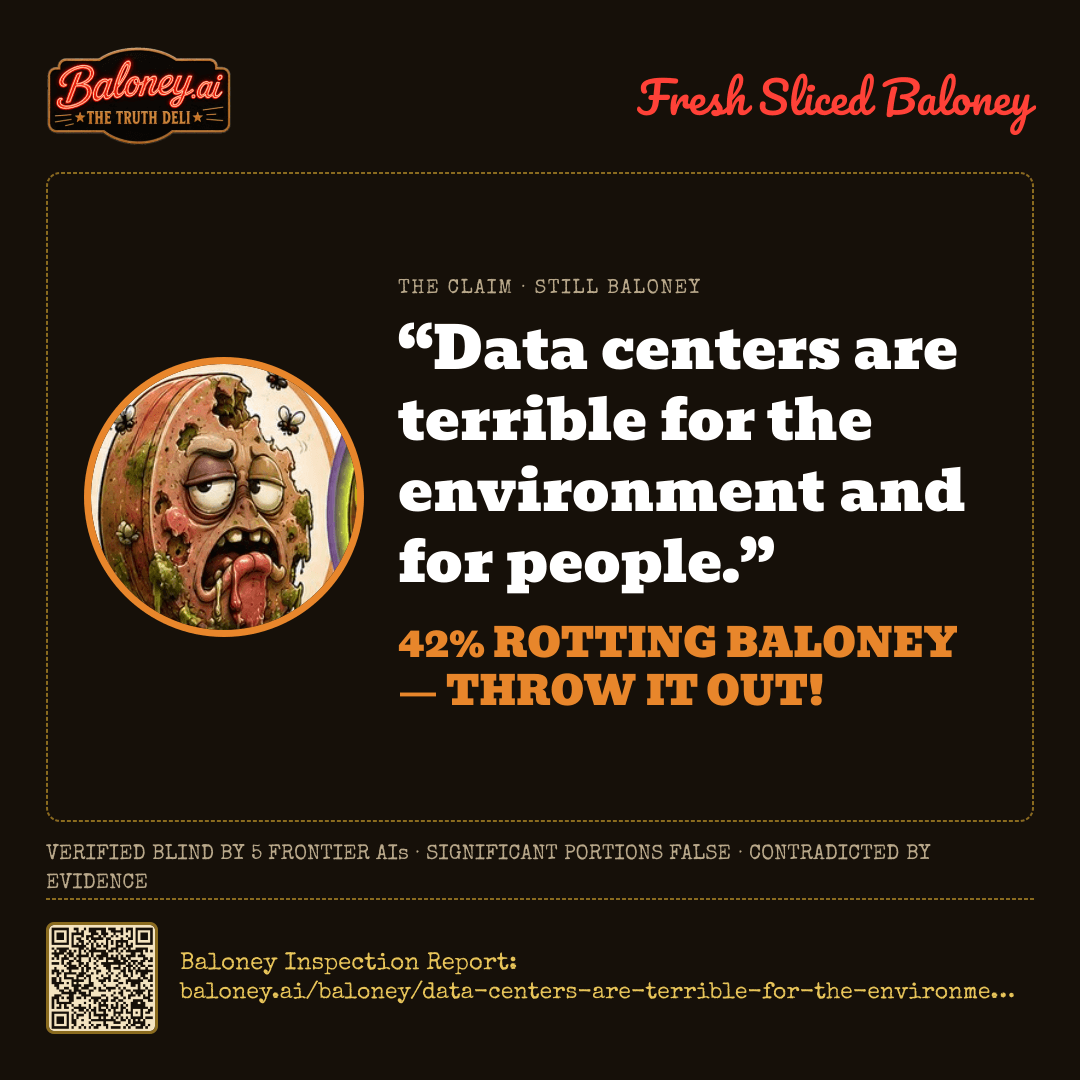
“Data centers are terrible for the environment and for people.”
42%ROTTING BALONEY — THROW IT OUT!
Most of this claim has spoiled.
Significant portions falseContradicted by evidenceUnsupported assertionsDeceptive narrative
✓ BLIND VALIDATION CONFIRMED THIS SCORE
Serve It Fresh
Ready to Serve18 servings
Serve it the way you want it
The Verdict
“Data centers are terrible for the environment and for people.” 42% ROTTING BALONEY — THROW IT OUT! Verified blind by 5 frontier AIs · Baloney Inspection Report: baloney.ai/baloney/data-centers-are-terrible-for-the-environment-and-for-people
Station 1 · Blind Inspection — Five Graders, Zero Peeking
Each lab scored the claim independently, without seeing the others. Open a breakdown for its evidence, its sources, and how sure it was.
Anthropic · EQUAL WEIGHT · 65.3s
claude-opus-5
40%BALONEY
ROUND-1 BREAKDOWN
Evidence offered for the claim
Electricity demand is large and growing fast: the IEA estimates data centres consumed roughly 415 TWh in 2024 (~1.5% of global electricity) and projects that to roughly double by 2030, with AI the main driver. Lawrence Berkeley National Laboratory's 2024 report estimates US data centres used ~176 TWh in 2023 (~4.4% of US electricity) and could reach 6.7–12% of US electricity by 2028.
Much of that electricity still comes from fossil generation, so growth translates into real emissions. Microsoft reported its total (Scope 1–3) emissions rose ~29% from its 2020 baseline, and Google reported emissions up ~48% since 2019, both attributing much of the increase to data centre construction and AI compute.
Water consumption is material and locally concentrated: peer-reviewed work (Siddik, Shehabi & Marston, Environmental Research Letters 2021) estimated US data centres directly consume ~0.66 billion m³ of water per year plus large indirect consumption via electricity generation, and a substantial share is drawn from watersheds already under stress.
Local health and nuisance impacts are documented in specific cases: backup and bridging generators burning diesel or gas emit NOx and PM2.5; xAI's Memphis facility drew formal complaints and litigation threats from the NAACP and the Southern Environmental Law Center over unpermitted gas turbines in a majority-Black neighborhood already burdened by industrial pollution. Noise complaints from cooling equipment have prompted zoning fights in Virginia, Georgia and Arizona.
A 2024 preprint by Ren and colleagues (UC Riverside/Caltech) attempted to quantify public-health costs of AI data centre air pollution in the US, estimating billions of dollars in annual health damages by 2030 if growth continues on trend.
Grid and ratepayer stress: Virginia's legislative watchdog JLARC (2024) concluded data centre demand could roughly double the state's electricity needs within a decade and that, absent rate design changes, non-data-centre customers could bear some transmission and capacity costs. Utilities in PJM and elsewhere have delayed coal retirements or approved new gas plants citing data centre load.
Job benefits are modest relative to footprint and subsidies: large data centres typically employ dozens to a few hundred permanent staff while receiving substantial tax abatements, a pattern documented in multiple state audits and investigative reporting.
Land, construction, and embodied-carbon impacts (concrete, steel, chips, backup batteries) are significant and are often excluded from operational 'carbon neutral' claims that rely on unbundled renewable energy certificates rather than hourly clean power.
Evidence against the claim
The word 'terrible' is an absolute; the measurable aggregate impact is real but bounded. At ~1.5% of global electricity, data centres consume less than, for example, global aluminium production or residential air conditioning, and far less than transport or agriculture.
Efficiency gains have been dramatic: Masanet et al. (Science, 2020) found global data centre compute output rose ~550% from 2010–2018 while energy use rose only ~6%, due to server efficiency, virtualisation and the shift to hyperscale facilities. Average PUE fell from ~2.5 in 2007 to ~1.5–1.6 today, and hyperscale campuses commonly run 1.1–1.2.
Hyperscale operators are among the world's largest corporate buyers of clean energy; Google and Microsoft match (or aim to match) 100% of annual consumption with renewables and are funding new nuclear, geothermal and storage capacity that can benefit the wider grid. Data centre offtake agreements have financed a meaningful share of new US renewable build.
Water context matters: many facilities now use closed-loop or air-cooled designs (most large Northern Virginia campuses are predominantly air-cooled), and some operators report water-positive targets. Total US data centre water consumption is a small fraction of that used by thermoelectric power generation, agriculture, or golf courses; the problem is local siting, not aggregate volume.
Cloud consolidation generally reduces emissions per unit of computing versus the on-premises servers it replaces, and digital services substitute for physically intensive activities (travel, paper, physical media, in-person commerce), producing offsetting benefits that the blanket claim ignores.
'Terrible for people' ignores substantial benefits: data centres underpin hospitals, banking, emergency services, scientific computing, weather forecasting and climate modelling, and generate large local property-tax revenues — Loudoun County, Virginia derives roughly a third of its general fund from data centre taxes, funding schools and services.
Harms are highly site- and design-dependent. A facility on a low-carbon grid with air cooling and no on-site fossil turbines has a very different profile from a gas-turbine-powered site in a polluted neighbourhood. A categorical claim about all data centres is not supportable.
Regulatory tools are being applied: EPA permitting, state rate-design reforms (special data centre tariffs in Ohio, Georgia, Virginia proposals), and EU Energy Efficiency Directive reporting requirements are already changing the cost and impact allocation.
How sure this lab was
76/100 — the lab’s own confidence in the score above, not a second reading of the claim.
Data centers consume large and growing amounts of electricity. IEA reported that data centers, AI and cryptocurrency could roughly double electricity demand from 2022 to 2026, and LBNL estimated U.S. data centers used about 4.4% of U.S. electricity in 2023 with a possible rise to 6.7%-12% by 2028.
If powered by fossil-heavy grids, that electricity demand contributes to greenhouse-gas emissions and conventional air pollution; EPA documents the environmental impacts of electricity generation, especially from fossil fuels.
Data centers can use substantial water for cooling. AP reported large water-use increases by Microsoft and Google during the AI buildout and highlighted community concerns where data centers draw from local water systems.
Local impacts can include noise from cooling equipment and backup generators; WHO finds environmental noise can harm health, so poorly sited or poorly mitigated data centers can negatively affect nearby residents.
Data centers require frequent hardware replacement and large amounts of servers, networking equipment and batteries, contributing to material demand and e-waste pressures, though this is part of the broader digital-technology footprint rather than unique to data centers.
Evidence against the claim
The blanket claim is too broad: data centers are not uniformly 'terrible.' Their impact depends heavily on grid mix, cooling design, water source, siting, utilization rates and whether they displace less efficient computing.
Historically, efficiency gains have greatly moderated energy growth. A 2020 Science paper found global data-center workloads rose sharply from 2010-2018 while data-center energy use rose much more slowly, reaching about 1% of global electricity use.
IEA’s tracking similarly shows data centers and data transmission networks have represented a relatively small share of global electricity use compared with sectors such as transport, industry and building heating/cooling, though growth pressure is increasing.
Large cloud data centers can be more energy-efficient than scattered on-premise servers because they run at higher utilization and invest in advanced cooling and power management; consolidation can reduce computing energy per unit of work.
Data centers provide major social benefits: cloud services, hospitals and research computing, emergency communications, financial systems, remote work, education, AI services and government services. These benefits do not erase environmental costs, but they make the categorical 'for people' claim misleading.
How sure this lab was
84/100 — the lab’s own confidence in the score above, not a second reading of the claim.
Data centers are highly energy-intensive. The International Energy Agency (IEA) estimates they accounted for 1% to 1.5% of global electricity use in 2022, leading to significant greenhouse gas emissions when regional grids rely on fossil fuels.
Evaporative cooling systems used in many data centers consume millions of gallons of fresh water, directly competing with local community needs and exacerbating water stress in drought-prone regions.
Local communities near hyperscale data centers frequently report negative quality-of-life impacts, including persistent low-frequency noise pollution from massive cooling fans and industrial HVAC systems.
The rapid expansion of AI and cloud computing puts immense strain on local electrical grids, which can necessitate grid upgrades, delay the retirement of fossil fuel plants, and potentially increase utility costs for local residents.
The constant need to upgrade server hardware (typically every 3 to 5 years) generates significant electronic waste, which poses environmental and human health hazards if not properly recycled.
Evidence against the claim
Major data center operators (such as Amazon, Google, and Microsoft) are the world's largest corporate purchasers of renewable energy, aggressively funding new wind and solar projects to match their electricity consumption.
Data center energy efficiency has improved dramatically over the last decade. A landmark study published in Science found that while global data center computing instances increased by 550% between 2010 and 2018, their total energy use grew by only 6%.
Data centers provide the foundational infrastructure for the digital economy, enabling remote work, virtual meetings, and smart logistics, all of which substantially reduce global carbon emissions associated with commuting and physical transportation.
Many large tech companies are implementing circular economy practices, refurbishing components, and achieving 'zero waste to landfill' certifications to drastically reduce e-waste.
Operators are increasingly exploring advanced, low-impact cooling technologies, such as closed-loop liquid cooling systems that consume zero water after their initial charge.
How sure this lab was
95/100 — the lab’s own confidence in the score above, not a second reading of the claim.
Global data centers consume a large and rapidly growing share of electricity, making them a significant and fast‑increasing source of greenhouse gas emissions. The International Energy Agency (IEA) estimates data centers used around 415 TWh in 2024 (about 1.5% of global electricity), with emissions from electricity use around 180–300 Mt CO₂ and potentially reaching 500 Mt CO₂ in high‑growth scenarios.[2][6][11][10][14]
Recent analyses suggest that some official estimates may understate the true carbon footprint of data centers, once manufacturing, construction, and other lifecycle impacts are included. One economic analysis projects that overall data‑center emissions could reach around 286 Mt CO₂ by 2025, about 57% higher than IEA’s estimate, and could more than double to 643 Mt CO₂ by 2030 without grid decarbonization, implying large climate damages.[1][8][15]
The scale of electricity and water use by data centers already rivals large countries. A United Nations University report summarized by AP found that global data centers used about 448 TWh of electricity in the previous year—more than all but about 10 countries—and produced ~208 million tons of CO₂, similar to Argentina’s emissions; it estimated water use at ~1.2 trillion gallons for that energy and projected data centers could consume nearly 3% of global electricity by 2030 and emit ~440 Mt CO₂.[12][2][11]
Data centers often rely heavily on fossil‑fuel‑based grids and backup diesel generators, leading to localized air pollution and health risks. Studies of U.S. and global hyperscale data centers report that a majority of their electricity comes from fossil fuels, generating tens of millions of tons of CO₂ per year and elevated levels of nitrogen oxides and fine particulate matter, which increase respiratory, cardiovascular, and cancer risks in nearby communities.[7][9][13][6]
Water use for cooling and for upstream electricity generation can severely strain local water resources. A public health analysis reports that a hyperscale data center can use 3–7 million gallons of water per day, and in some regions data centers account for up to 57% of potable cooling water withdrawals, exacerbating water scarcity and increasing risks of dehydration, poor hygiene, and waterborne disease in stressed communities.[13][4][10]
Waste heat from large urban data centers can noticeably raise local temperatures, worsening urban heat‑island effects that disproportionately affect nearby residents. Research summarized by Yale’s Environment School indicates that a large data center can emit waste heat comparable to tens or hundreds of thousands of households, increasing land surface temperatures by up to about 16°F and air temperatures in adjacent neighborhoods by several degrees.[4]
Lifecycle impacts of data center infrastructure—servers, chips, cooling systems, buildings, backup power, and grid upgrades—carry additional environmental burdens, including embodied carbon, resource extraction, and pollution from manufacturing and construction, beyond operational electricity and water use.[4][8][15]
Rapid expansion driven by AI workloads is expected to accelerate energy demand, emissions, and resource use. IEA and other analyses project that electricity demand for data centers could approximately double or more by 2030, rising to roughly 1,000 TWh or ~3% of global electricity, making data centers among the fastest growing sources of energy‑sector emissions.[2][11][12][14]
In some locations, community impacts are already contentious: data centers can compete with residents and agriculture for limited water and grid capacity, potentially driving up electricity prices or forcing new fossil plants, thereby imposing environmental and economic burdens on nearby people.[10][12][13][4]
Evidence against the claim
Data centers currently account for a relatively small share of total global greenhouse gas emissions compared with major sectors like transportation, buildings, and heavy industry. IEA estimates that data centers contribute around 0.5–1% of global energy‑sector combustion emissions, even under growth scenarios, and remain well below the shares from sectors like road transport or power generation overall.[6][2][11]
Efficiency improvements in hardware, cooling, and software have significantly constrained the growth of data‑center energy use relative to exploding digital demand. Studies of the ICT sector show that between 2010 and 2018, global data‑center energy use rose only modestly (around 6%) despite much higher increases in workloads, due to efficiency gains and optimization.[15][2]
Many large operators are investing heavily in renewable energy, low‑carbon procurement, and more efficient designs, which can substantially reduce the carbon intensity of data centers. Analyses from IEA and EU authorities note that data centers on low‑carbon grids have much lower emissions than those using coal‑ or gas‑heavy electricity, and policy pressure in regions like the EU is pushing operators toward climate‑neutral and energy‑efficient practices.[2][10][11][4][15]
Digital services enabled by data centers can offset environmental impacts by improving efficiency in other sectors (e.g., telecommuting, smart logistics, virtual meetings, digitalization of services) that reduce travel, material use, and other high‑emission activities. While difficult to quantify precisely, ICT and cloud computing are often cited as enabling emissions reductions that could partially counterbalance data‑center footprints.[8][15]
Compared with many industrial facilities, data centers generally do not emit large quantities of direct toxic substances on‑site; their primary direct local impacts are noise, land use, and waste heat, while most harmful pollutants originate upstream at power plants. This means that health harms are often mediated by the broader energy system rather than inherent to data‑center technology itself.[4][6][13]
Policy frameworks and regulations, especially in the EU and some U.S. jurisdictions, are starting to require reporting, efficiency standards, and limits on water and energy use, which can mitigate the worst environmental and community impacts over time if effectively implemented.[10][4][15]
Claims that data centers are uniformly “terrible for people” can be overstated because they also underpin critical services (healthcare data, emergency communications, education platforms, financial infrastructure) that benefit society, including in ways that can improve health, safety, and economic opportunity. The net human impact is mixed and context‑dependent rather than universally negative.[4][8][15]
How sure this lab was
92/100 — the lab’s own confidence in the score above, not a second reading of the claim.
Data centers use large amounts of electricity (on the order of 1–2% of global demand, with faster growth from AI and cloud), adding emissions wherever the grid is fossil-heavy.
Cooling often consumes large volumes of water, which can compete with households and farms in drought-prone regions.
On-site diesel generators for backup power emit NOx, particulates, and other pollutants that affect nearby air quality.
Hardware production, mineral supply chains, and e-waste create additional environmental and occupational-health burdens.
Some host communities report noise from cooling plant, grid strain, higher local power prices, and land/water conflicts.
Evidence against the claim
Efficiency gains (lower PUE, better servers, virtualization) have historically kept energy growth far below growth in data traffic.
Many large operators match a high share of electricity with renewables or PPAs, lowering carbon intensity versus the average grid.
Centralized facilities are typically more efficient than equivalent on-premises or highly distributed computing.
The same infrastructure enables remote work, logistics and energy optimization, telemedicine, education, and climate research that can cut other emissions and improve living standards.
Jobs, taxes, and the economic value of digital services are large; net effects on people are not uniformly negative.
How sure this lab was
72/100 — the lab’s own confidence in the score above, not a second reading of the claim.
The claim is a categorical value judgement, and the panel converged tightly on the same reading: the underlying harms are real and documented, but the blanket word 'terrible' — applied to all data centres and to their effect on 'people' generally — omits decisive context. All five evaluators recommended 35–48 (median 42), and their evidence bases overlap almost entirely, which raises confidence in the cluster. I weighted most heavily the government and peer-reviewed material that both sides cite: the IEA's estimate of ~415 TWh in 2024 (~1.5% of global electricity), Lawrence Berkeley National Laboratory's ~4.4% of US electricity in 2023 with a 6.7–12% range for 2028, and Masanet et al. (Science, 2020), which found compute output rose ~550% from 2010–2018 while data-centre energy use rose only ~6%. Those three findings together establish the shape of the truth: a fast-growing, locally concentrated load that is nonetheless a small single-digit fraction of global energy and emissions, far below transport, industry or buildings, and historically far more efficient per unit of work than what it replaced. The site-specific harms the claim gestures at are genuine — Siddik, Shehabi & Marston (ERL, 2021) on ~0.66 billion m³ of direct US water consumption concentrated in stressed watersheds; documented noise and zoning conflicts in Virginia, Georgia and Arizona; the Memphis gas-turbine dispute; Virginia JLARC's finding on ratepayer cost allocation; and Microsoft's and Google's own reported emissions increases of ~29% and ~48%, disclosed against their own interest. But those are arguments for 'badly sited and badly regulated data centres cause real harm', not for 'data centres are terrible'. The claim also collapses entirely on the 'for people' half: the same facilities run hospital systems, emergency communications, banking, weather forecasting and climate modelling, and in Loudoun County, Virginia supply roughly a third of the general fund. I did not go below 41 because nothing in the claim is straightforwardly false — its failure is omission and overbreadth, which is precisely the 21–40 band. I did not go above 40 because the panel's specific harm findings are well sourced and the claim is not fabricated. 40 sits at the top of Stinky Baloney: important facts omitted, misleading implication of uniform and catastrophic harm.
Unusually strong agreement. All five evaluators recommended 35–48 and all five independently reached the same structural verdict: real, measurable, locally concentrated harms wrapped in an unsupportable absolute. All five cited the IEA share-of-global-electricity figure and four cited Masanet et al. (Science, 2020) on the 550%-compute/6%-energy divergence. All five listed water, and all five listed societal benefit as the main counterweight. Disagreement was confined to emphasis and confidence. The lowest scorer (35) leaned hardest on cumulative lifecycle and public-health literature, including a working paper projecting emissions ~57% above IEA's figure, and treated the aggregate trajectory as the decisive fact. The highest scorer (48) treated the categorical framing itself as the decisive fault and was least confident (72). One evaluator was alone in emphasising e-waste from three-to-five-year hardware refresh cycles; one was alone in raising ratepayer cost-shifting and the modest permanent headcount relative to tax abatements. Confidence ranged widely (72–95), which is itself a signal that the sticking point is the word 'terrible', not the numbers.
Blind Validation Master · never saw the Primary’s work
gemini-3.1-pro-preview
42% BALONEY
The claim relies on absolute language ('terrible') to describe a complex issue with substantial mixed impacts. While it is true that data centers consume large amounts of electricity (approximately 1-1.5% of global demand) and water, and can cause localized issues such as grid strain, noise, and pollution from backup generators, the blanket statement is highly misleading. Environmentally, the claim ignores massive efficiency gains driven by hyperscale consolidation, substantial corporate investments in renewable energy, and the fact that digital services often offset emissions in other sectors (e.g., reducing travel). Furthermore, calling data centers 'terrible for people' contradicts the reality that they form the essential backbone of modern society—powering healthcare data, emergency services, scientific research, remote work, and financial systems. Because the statement presents an overwhelmingly one-sided view that ignores these profound benefits and environmental mitigations, it constitutes a significant distortion of the facts.
AGREEMENT TEST PASSED — MASTERS SCORED 40% AND 42% · BLIND VALIDATION CONFIRMED THIS SCORE · NO RE-EVALUATION REQUIRED
The Evidence
Evidence offered for the claim
Electricity demand is large and rising fast The IEA estimates data centres used roughly 415 TWh in 2024, about 1.5% of global electricity, and projects that to roughly double by 2030 with AI the main driver. Lawrence Berkeley National Laboratory put US data centres at ~176 TWh in 2023, about 4.4% of US electricity, with a range of 6.7–12% by 2028.
Emissions are rising at the biggest operators Microsoft reported total Scope 1–3 emissions up ~29% against its 2020 baseline and Google reported emissions up ~48% since 2019, both attributing much of the rise to data centre construction and AI compute. These are self-disclosures made against the companies' own interest.
Cooling water competes with local users Peer-reviewed work (Siddik, Shehabi & Marston, Environmental Research Letters, 2021) estimated US data centres directly consume ~0.66 billion m³ of water a year, with a substantial share drawn from already-stressed watersheds.
Aggregate water use is enormousDEBUNKED — REFUTED as framed. The panel found total US data-centre water consumption is a small fraction of that used by thermoelectric power generation or agriculture, many large campuses (including most in Northern Virginia) are predominantly air-cooled, and closed-loop designs consume essentially no water after their initial charge. The documented problem is local siting in drought-prone basins, not aggregate volume.
Documented local air-quality and noise harms Backup and bridging generators burning diesel or gas emit NOx and PM2.5. xAI's Memphis facility drew formal complaints and litigation threats over unpermitted gas turbines in a majority-Black neighbourhood already carrying industrial pollution, and cooling-equipment noise has triggered zoning fights in Virginia, Georgia and Arizona. The WHO finds environmental noise can harm health.
Grid strain and ratepayer cost-shifting Virginia's legislative watchdog JLARC concluded in 2024 that data centre demand could roughly double the state's electricity needs within a decade and that, absent rate-design changes, other customers could bear some transmission and capacity costs. Utilities have delayed coal retirements or approved new gas plants citing data centre load.
Embodied carbon and e-waste Concrete, steel, chips and backup batteries carry impacts often excluded from 'carbon neutral' claims that rely on unbundled renewable energy certificates rather than hourly clean power, and three-to-five-year hardware refresh cycles generate significant electronic waste.
Data centres are a major source of global emissionsDEBUNKED — REFUTED as framed. The IEA puts data centres at roughly 0.5–1% of global energy-sector combustion emissions even under growth scenarios — well below road transport, industry or buildings. A working paper projecting figures ~57% above the IEA estimate was treated by the panel as unreviewed and not weight-bearing.
Evidence against the claim
Efficiency broke the link with demand Masanet et al. (Science, 2020) found global data centre compute output rose ~550% from 2010 to 2018 while total energy use rose only ~6%, driven by server efficiency, virtualisation and the shift to hyperscale. Average PUE fell from ~2.5 in 2007 to ~1.5–1.6 today, with hyperscale campuses commonly at 1.1–1.2.
Small share of the global total At roughly 1.5% of global electricity, data centres use less than global aluminium production or residential air conditioning, and far less than transport or agriculture. 'Terrible' is an absolute; the measurable aggregate impact is real but bounded.
Consolidation is cleaner than the alternative Large cloud facilities run at higher utilisation with better cooling and power management than the scattered on-premises servers they replace, reducing energy per unit of computing work.
Largest corporate buyers of clean power Hyperscale operators are among the world's biggest purchasers of renewable energy, match or aim to match annual consumption with renewables, and are funding new nuclear, geothermal and storage. Their offtake agreements have financed a meaningful share of new US renewable build.
Impact depends entirely on siting and design A facility on a low-carbon grid with air cooling and no on-site fossil turbines has a completely different profile from a gas-turbine-powered site in an already-polluted neighbourhood. A categorical claim covering all data centres is not supportable.
The 'for people' half omits the benefits The same infrastructure runs hospitals, banking, emergency services, scientific computing, weather forecasting and climate modelling, and supports remote work and logistics that substitute for physically intensive activity. Loudoun County, Virginia derives roughly a third of its general fund from data centre taxes.
Regulation is already tightening EU Energy Efficiency Directive reporting requirements, EPA permitting, and state rate-design reforms and special data centre tariffs in Ohio, Georgia and Virginia are changing how costs and impacts are allocated.
Sources · Reliability · Why Accepted or Discounted
ACCEPTED — Cited by all five evaluators and used by both sides of the argument; the standard reference for global data-centre electricity consumption and projections.
ACCEPTED — Congressionally mandated US data-centre energy report; the authoritative national figure, and it presents a range rather than a single alarming number.
ACCEPTED — Peer-reviewed in a top-tier journal and cited by four of five evaluators; the decisive finding on the decoupling of compute growth from energy growth.
ACCEPTED — Peer-reviewed public-health literature supporting the mechanism linking fossil generation and backup generators to local respiratory and cardiovascular harm.
ACCEPTED — Authoritative on the environmental consequences of electricity generation, which is the pathway through which most data-centre harm actually occurs.
ACCEPTED — Non-partisan legislative audit body examining the most data-centre-dense jurisdiction in the world; the strongest evidence on grid strain and ratepayer cost allocation.
ACCEPTED — Academic reporting on waste heat and urban heat-island effects; the specific temperature figures are single-study and were not treated as decisive.
ACCEPTED — Accepted only as a hosting platform for technical analyses that corroborate figures independently established by IEA and LBNL; not weight-bearing on its own.
ACCEPTED — Corporate self-reporting, normally weak — but the cited figure is a 29% emissions increase disclosed against the company's own interest, which is the strongest form such a source can take. Its renewable-matching claims were not accepted at face value.
ACCEPTED — Same basis: the 48% emissions rise is an admission against interest. Offset and matching claims discounted, since the panel noted such claims often rely on unbundled certificates rather than hourly clean power.
DISCOUNTED — Non-peer-reviewed preprint projecting billions in future health damages under an extrapolated growth trend. Directionally plausible but methodologically contested and forward-looking; too speculative to carry weight in a verdict.
Serve It Fresh
Ready to Serve18 servings
Serve it the way you want it
The Verdict
“Data centers are terrible for the environment and for people.” 42% ROTTING BALONEY — THROW IT OUT! Verified blind by 5 frontier AIs · Baloney Inspection Report: baloney.ai/baloney/data-centers-are-terrible-for-the-environment-and-for-people