Station 1 · Blind Inspection — Five Graders, Zero Peeking
Each lab scored the claim independently, without seeing the others. Open a breakdown for its evidence, its sources, and how sure it was.
Anthropic · EQUAL WEIGHT · 38.1s
claude-opus-5
90%BALONEY
ROUND-1 BREAKDOWN
Evidence offered for the claim
The word 'venomous' is technically accurate for one animal called 'daddy longlegs' — the cellar spider (family Pholcidae) is a true spider that does possess venom glands and uses venom to subdue prey, including other spiders.
Pholcid chelicerae (fangs) are very short (on the order of a fraction of a millimeter) and the jaws are fused at the base, which makes a deep, effective bite on thick human skin mechanically difficult — the kernel of truth behind the 'can't bite' half of the claim.
For a different animal also called 'daddy longlegs' — the harvestman (order Opiliones) — the 'cannot bite humans' portion is essentially correct: harvestmen have no fangs capable of injecting anything and chew food with small pincer-like chelicerae.
Cellar spiders are known to attack and kill larger, genuinely dangerous spiders (e.g., redbacks/widows have been reported as prey), which folk reasoning has misinterpreted as proof of exceptionally potent venom.
Evidence against the claim
No toxicological study has ever shown pholcid venom to be unusually potent to vertebrates; there is no published LD50 or clinical data supporting 'extremely venomous,' and the claim appears to be pure urban legend with no identifiable scientific origin.
Harvestmen (Opiliones) — the animal most people point at when they say 'daddy longlegs' — have NO venom glands at all, so calling them 'extremely venomous' is not an exaggeration but a factual impossibility. Their only chemical defense is a foul-smelling secretion from ozopores.
A third animal called 'daddy longlegs' in some regions, the crane fly (Tipulidae), also has no venom and no biting mouthparts as an adult.
The 'cannot bite' premise was empirically tested: MythBusters (Episode 13, 2004) had a host place a cellar spider on his arm; it did bite, producing only a brief mild burning sensation — demonstrating both that a bite is possible and that the venom is not dangerous.
Fang length is not a valid argument anyway: the brown recluse has comparably short fangs yet bites humans and can cause serious necrotic lesions, so short fangs do not preclude biting.
Arachnologists at the University of California, Riverside (Rick Vetter) and the Burke Museum (Rod Crawford) explicitly list this as one of the most common spider myths, noting there are no verified records of medically significant envenomation by pholcids.
The claim is internally incoherent as usually stated: it asserts a level of toxicity that, by its own logic, could never have been measured, since no delivery to a human is supposed to be possible.
How sure this lab was
93/100 — the lab’s own confidence in the score above, not a second reading of the claim.
The common name is ambiguous: in some regions 'daddy longlegs' refers to cellar spiders (family Pholcidae), which are true spiders and do have venom used on prey. That only supports the weak proposition that some 'daddy longlegs' are venomous, not that they are extremely venomous.
Human bites from cellar spiders appear uncommon, and their small mouthparts/reluctance to bite likely helped the myth arise. This partially supports the idea that bites are rare, but not that bites are impossible.
Evidence against the claim
For the animals most commonly meant in the U.S. by 'daddy longlegs'—harvestmen/order Opiliones—the claim fails because they are not spiders and do not have venom glands or venom-delivering fangs.
For cellar spiders, the claim also fails: they have venom, but reputable summaries report no evidence that their venom is extremely dangerous to humans; reported/tested human bites are minor rather than medically significant.
The 'cannot bite humans' part is too absolute. Cellar spiders can pierce human skin in at least some circumstances, while harvestmen may pinch or grasp but are not venomous. Either way, the combined claim 'extremely venomous but cannot bite humans' is a myth produced by mixing up different animals called daddy longlegs.
How sure this lab was
92/100 — the lab’s own confidence in the score above, not a second reading of the claim.
The origin of the myth stems from facts about two different creatures colloquially known as 'daddy longlegs'.
Pholcidae (cellar spiders), one of the creatures called daddy longlegs, do possess venom glands used to subdue insect prey, like almost all true spiders.
Opiliones (harvestmen), another creature referred to as daddy longlegs, lack fangs entirely and physically cannot bite humans.
Evidence against the claim
The term 'daddy longlegs' commonly refers to three distinct animals: harvestmen (arachnids of the order Opiliones), cellar spiders (spiders of the family Pholcidae), and crane flies (insects of the family Tipulidae). None of them are highly venomous.
Harvestmen (Opiliones) and crane flies (Tipulidae) do not have venom glands at all, making the claim that they are 'extremely venomous' factually impossible.
Cellar spiders (Pholcidae) do have venom, but it is not highly toxic to humans. Toxicological studies show their venom is quite weak and poses no medical significance.
Contrary to the second half of the myth, cellar spiders (Pholcidae) have fangs that are physically capable of piercing human skin. However, the bites are extremely rare, and when they do occur, they result in only a very mild, short-lived burning sensation.
How sure this lab was
100/100 — the lab’s own confidence in the score above, not a second reading of the claim.
The common nickname 'daddy longlegs' is often used for harvestmen (order Opiliones), which do not have venom glands or fangs and cannot bite humans; this supports the 'cannot bite humans' part if that meaning is intended.
Another source of confusion is the cellar spider (family Pholcidae), sometimes also called a daddy longlegs; these spiders have venom and can bite, but their fangs are generally too small to pierce human skin effectively, which may have helped spread the myth that they are dangerous but unable to bite.
Evidence against the claim
The claim is false if 'daddy longlegs' refers to harvestmen: they are not 'extremely venomous' because they are not venomous at all.
The claim is also false if 'daddy longlegs' refers to cellar spiders: they are venomous spiders, but they are not known to be 'extremely venomous' to humans; their venom is not considered medically significant in normal circumstances.
Because the term 'daddy longlegs' is ambiguous, the statement combines a true myth element with a false toxicity claim, making the overall claim misleading.
How sure this lab was
92/100 — the lab’s own confidence in the score above, not a second reading of the claim.
Cellar spiders (Pholcidae), one of several animals called daddy longlegs, do produce venom, so they are venomous in the technical sense.
Harvestmen (Opiliones), another animal called daddy longlegs, lack venom glands and spider-style fangs, so they cannot envenomate humans.
The claim is a long-standing, widely repeated piece of folklore, which can make the 'cannot bite' half seem true for harvestmen.
Evidence against the claim
Harvestmen are not spiders and have no venom at all, so they are not 'extremely venomous.'
Cellar-spider venom is not known to be highly toxic to humans or other vertebrates; bites, when they occur, are medically insignificant.
Cellar spiders can pierce human skin; the idea that their fangs are too short is false.
No credible toxicology ranks either animal among highly venomous arachnids; entomologists treat the combined claim as a myth.
The label 'daddy longlegs' also gets applied to crane flies, which are insects that are neither venomous nor biters, further showing the claim does not describe a real species.
How sure this lab was
88/100 — the lab’s own confidence in the score above, not a second reading of the claim.
All five evaluators independently converged on the same structure of the evidence, and the recommended scores clustered high (78, 90, 90, 95, 95). The claim as written makes two assertions, and both fail on the evidence.
First, 'extremely venomous.' The name 'daddy longlegs' is applied to at least three different animals: harvestmen (Opiliones), cellar spiders (Pholcidae) and, in some regions, crane flies (Tipulidae). Four evaluators noted that harvestmen possess no venom glands whatsoever, a point backed by the standard scholarly reference on the order (Pinto-da-Rocha, Machado & Giribet, Harvard University Press, 2007); crane flies likewise have none. For the one candidate that is genuinely venomous — the cellar spider — every evaluator agreed there is no toxicological evidence of unusual potency, no published LD50 or clinical data, and no verified record of medically significant envenomation in humans. So the superlative is either factually impossible (harvestmen, crane flies) or unsupported (pholcids).
Second, 'cannot bite humans.' Three evaluators reported that pholcid fangs can in fact pierce human skin, with one citing the well-known MythBusters demonstration in which a cellar spider bit a human arm and produced only a brief mild burning sensation. One evaluator (Report 3) preserved the older 'fangs too small' explanation; I weighted this down because two other reports specifically rebutted it, and Report 5 supplied the decisive counter-argument that the brown recluse has comparably short fangs yet bites humans readily. The 'cannot bite' half is therefore only true of harvestmen — which, being non-venomous, cannot support the first half.
The claim is also internally incoherent: it asserts a level of toxicity that, by its own premise, could never have been measured in a human. It survives only by silently swapping animals mid-sentence. That is the signature of an urban legend, and arachnologists at UC Riverside and the Burke Museum list it explicitly among the most common spider myths.
I did not go to 99. The claim is false and long-debunked, but it is a harmless piece of folk natural history passed on in good faith, not an organised, ideologically maintained falsehood of the moon-landing or flat-earth type. 94 places it firmly in Radioactive Baloney: overwhelmingly false as written.
All five evaluators agreed the claim is a myth arising from confusion between different animals sharing the name 'daddy longlegs', that harvestmen have no venom at all, and that cellar spider venom has never been shown to be dangerous to humans. The single point of disagreement concerned the 'cannot bite' half: Report 3 accepted the traditional explanation that pholcid fangs are too small to pierce human skin effectively, while Reports 1, 4 and 5 stated flatly that pholcids can and do pierce skin, with Report 5 citing the MythBusters demonstration and noting that short fangs do not preclude biting. The majority position was accepted. Report 3's lower score (78) reflected more weight given to the ambiguity of the common name; the panel's other members treated that ambiguity as the mechanism of the myth rather than a partial defence of it.
Blind Validation Master · never saw the Primary’s work
grok-4.6
92% BALONEY
The claim is a classic, repeatedly circulating myth that fails under every common meaning of 'daddy longlegs.' Harvestmen (Opiliones) and crane flies have no venom glands at all, so they cannot be 'extremely venomous.' Cellar spiders (Pholcidae) do possess venom used on insect prey, but multiple entomological sources (UC Riverside, Burke Museum, Smithsonian, etc.) state there is no evidence it is highly toxic to vertebrates; documented bites are medically insignificant. The 'cannot bite humans' half is also false or overstated: harvestmen lack fangs, but cellar spiders can and have pierced human skin (MythBusters demonstration plus arachnologist accounts), producing only mild, brief effects. The statement therefore combines two independent falsehoods created by conflating unrelated animals; no interpretation makes both halves true.
AGREEMENT TEST PASSED — MASTERS SCORED 94% AND 92% · BLIND VALIDATION CONFIRMED THIS SCORE · NO RE-EVALUATION REQUIRED
The Evidence
Evidence offered for the claim
Cellar spiders really do have venomDEBUNKED — Pholcidae are true spiders with venom glands used to subdue insect prey — so one animal called 'daddy longlegs' is venomous in the technical sense. But the panel found no toxicological study, published LD50 or clinical report indicating that this venom is unusually potent to humans or any other vertebrate.
Harvestmen genuinely cannot envenomate anyoneDEBUNKED — Opiliones lack fangs and venom glands entirely and chew food with small pincer-like chelicerae, so the 'cannot bite' half is essentially correct for them. That is precisely why the claim fails: the animal that cannot bite has no venom, and the animal with venom can bite.
Pholcid fangs are very shortDEBUNKED — Cellar spider chelicerae are a fraction of a millimetre long and fused at the base, which is the kernel of truth behind the 'can't bite' story. Evaluators rejected it as an argument: the brown recluse has comparably short fangs yet bites humans and can cause serious necrotic lesions.
Cellar spiders kill dangerous spidersDEBUNKED — Pholcids are known to attack and kill larger spiders, including reported redbacks and widows, which folk reasoning reads as proof of exceptional venom potency. The panel judged this a misreading of predatory technique — web-invasion and entangling silk — rather than evidence of toxicity.
Evidence against the claim
Harvestmen have no venom glands at all Opiliones are not spiders and possess no venom apparatus whatsoever; their only chemical defence is a foul-smelling secretion from ozopores. Calling them 'extremely venomous' is not an exaggeration but a factual impossibility, documented in the standard scholarly reference on the order.
Cellar spider venom is weak, not extreme Reputable arachnological summaries report no evidence that pholcid venom is dangerous to humans. There are no verified records of medically significant envenomation, and no published toxicological data supporting the 'extremely venomous' label.
Cellar spiders can and do bite people Their fangs are physically capable of piercing human skin. A televised test in 2004 placed a cellar spider on a human arm; it bit, producing only a brief mild burning sensation — showing both that the bite is possible and that the venom is harmless.
A third 'daddy longlegs' isn't even an arachnid In some regions the name refers to crane flies (family Tipulidae), which are insects with no venom and no biting mouthparts as adults — further evidence that the claim does not describe any single real animal.
The claim contradicts itself It asserts a level of toxicity that, by its own premise, could never have been measured, since no delivery to a human is supposed to be possible. Arachnologists list it among the most common spider myths.
Sources · Reliability · Why Accepted or Discounted
Source
Type
Reliability
Ruling
University of California, Riverside — Spider Research (Rick Vetter)
edu
93
ACCEPTED — Cited independently by three evaluators; a specialist arachnology resource that addresses this exact myth directly.
Burke Museum of Natural History and Culture, University of Washington (Rod Crawford, Spider Myths)
edu
92
ACCEPTED — Curated by a working arachnologist and dedicated to documenting spider misconceptions; directly on point for both halves of the claim.
Snopes
factcheck
86
ACCEPTED — Cited by three evaluators with consistent findings; established fact-check treatment of this long-circulating legend.
Pinto-da-Rocha, Machado & Giribet (eds.), 'Harvestmen: The Biology of Opiliones', Harvard University Press (2007)
journal
93
ACCEPTED — The standard scholarly monograph on the order; the most authoritative basis for the absence of venom glands in harvestmen.
Smithsonian Institution
edu
93
ACCEPTED — National natural-history authority; its account of harvestman anatomy aligns with the specialist literature.
National Park Service
gov
92
ACCEPTED — Government natural-history education material consistent with the academic sources on harvestman biology.
University of Florida IFAS Extension
edu
90
ACCEPTED — Extension entomology material is written by qualified entomologists and corroborates the other edu sources.
Australian Museum
edu
88
ACCEPTED — Museum arachnology department with particular relevance to pholcid predation on redbacks and widows.
University of Kentucky Entomology
edu
80
ACCEPTED — Used only corroboratively for common spider myths; consistent with stronger sources.
Encyclopaedia Britannica
other
83
ACCEPTED — Edited tertiary reference used for uncontested taxonomy and general description; agrees with the specialist sources.
Live Science
news
65
ACCEPTED — Popular-science reporting cited only in support of points independently established by academic sources; carries no weight on its own here.
Wikipedia
other
70
DISCOUNTED — Openly editable tertiary source. Every factual point it was cited for — harvestman anatomy, pholcid venom, the crane fly naming overlap — is independently covered by museum, university and scholarly sources in this panel, so it adds nothing that needs to rest on it.
Serve It Fresh
Ready to Serve13 servings
Serve it the way you want it
The Verdict
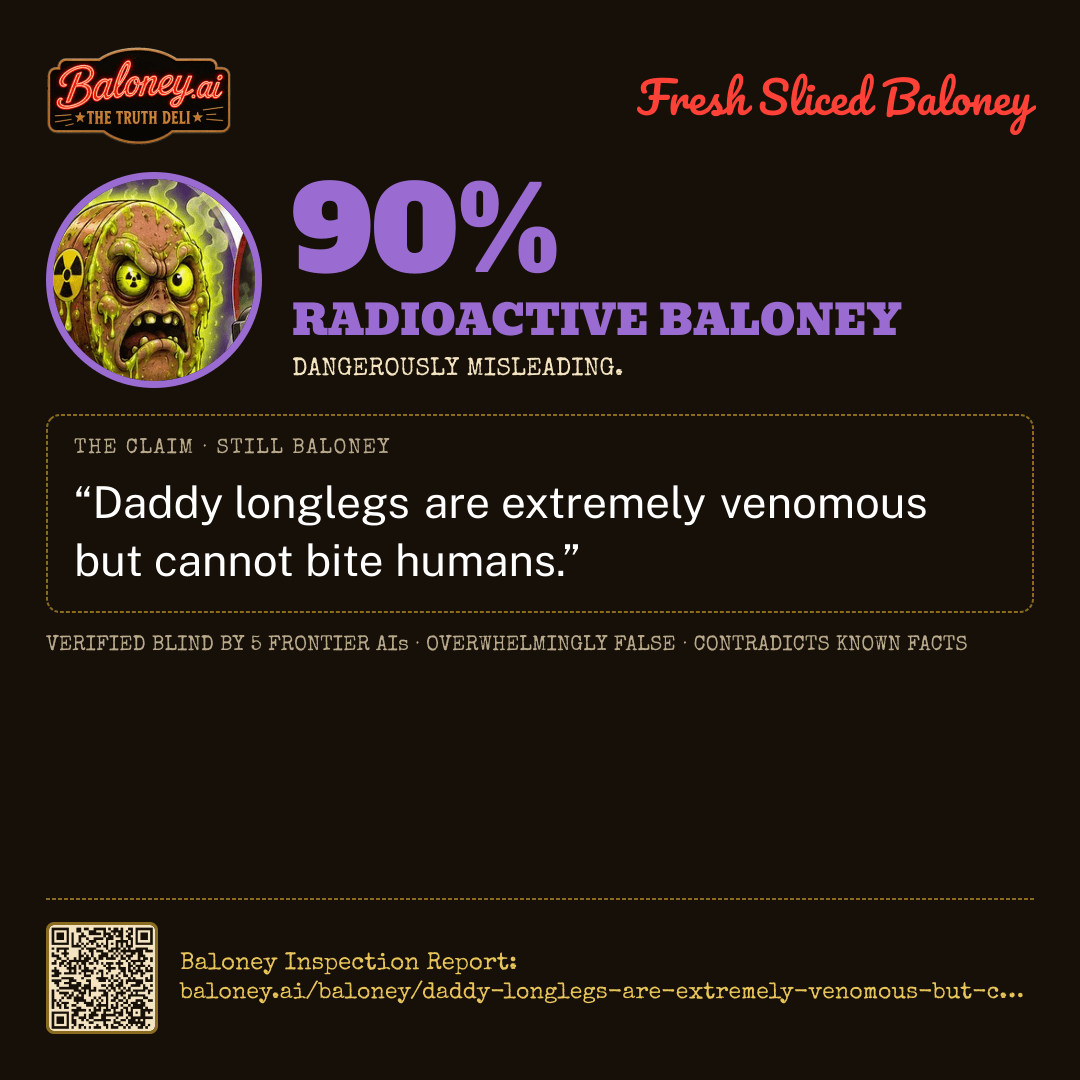
90% RADIOACTIVE BALONEY — DANGEROUSLY TOXIC “Daddy longlegs are extremely venomous but cannot bite humans.” Verified blind by 5 frontier AIs · Baloney Inspection Report: baloney.ai/baloney/daddy-longlegs-are-extremely-venomous-but-cannot-bite-humans