Baloney Inspection Report: Claim #1188 · Inspected Oct 31, 2026, 8:39 AM PDT · Scoring model v2
 58%
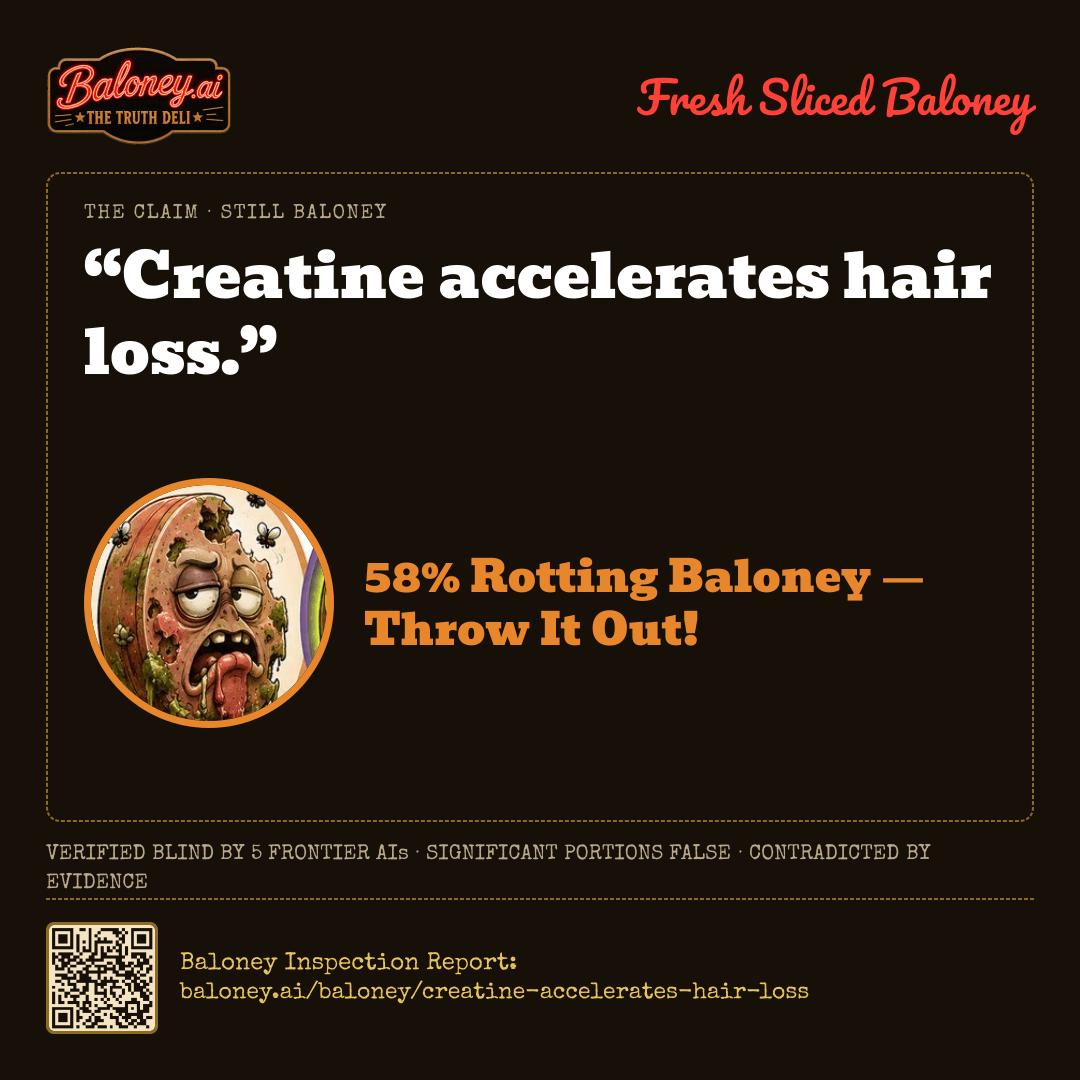
“Creatine accelerates hair loss.”
58%Rotting Baloney — Throw It Out!
Most of this claim has spoiled.
Significant portions falseContradicted by evidenceUnsupported assertionsDeceptive narrative
Serve It Fresh
Ready to Serve19 servings
Serve it the way you want it
The Verdict
 “Creatine accelerates hair loss.”58% Rotting Baloney — Throw It Out!Verified blind by 5 frontier AIs · Baloney Inspection Report: baloney.ai/baloney/creatine-accelerates-hair-loss
The Baloney Sampler
Creatine has not been shown to accelerate hair loss. The only study behind the claim, a 2009 rugby-player trial on PubMed, measured a DHT rise rather than hair, left DHT in the normal range, and has not been replicated. A 2025 double-blind trial in the Journal of the International Society of Sports Nutrition found no effect on DHT, hair density, follicular-unit count, or hair thickness.
The International Society of Sports Nutrition’s 2021 review and 2017 position stand conclude the evidence does not support creatine causing hair loss. The NIH Office of Dietary Supplements and MedlinePlus do not list hair loss as an established effect. Anecdotes are confounded because creatine users are often young gym-going men already prone to androgenetic alopecia, some of whom also use anabolic steroids.
Resting on Journal of the International Society of Sports Nutrition · Journal of the International Society of Sports Nutrition · PubMed · NIH Office of Dietary Supplements
Original Claim Source https://www.reddit.com/r/tressless/comments/1rdpgy4/im_convinced_creatine_causes_hair_loss_for_me/
Other ways to slice it — phrasings that might have changed the rating
- “Creatine loading raises serum DHT in young male rugby players.” Reports agree the claim’s only empirical hook is the unreplicated 2009 hormone study, which measured DHT rather than hair.
- “Creatine supplementation does not cause hair loss.” Direct hair-outcome testing and International Society of Sports Nutrition reviews found no support for creatine causing or accelerating hair loss.
- “Creatine accelerates hair loss in men genetically predisposed to androgenetic alopecia.” The reports note DHT is the androgen implicated in male-pattern baldness and that anecdotes cluster in the same young gym-going men who already enter that condition.
Written from the panel’s reports by xAI · grok-4.6. Nothing here changed the score.
The Order Ticket
15:39:34CLAIM RECEIVED — QUEUED FOR INSPECTION✓
15:40:22claude-opus-5 REPORTED — SCORE 58, CONFIDENCE 82✓
15:39:57gpt-5.5 REPORTED — SCORE 56, CONFIDENCE 84✓
15:39:54gemini-3.1-pro-preview REPORTED — SCORE 99, CONFIDENCE 95✓
15:39:39sonar-pro REPORTED — SCORE 72, CONFIDENCE 94✓
15:41:00grok-4.6 REPORTED — SCORE 38, CONFIDENCE 78✓
15:42:58PRIMARY MASTER GROK — SCORE 72✓
15:41:15BLIND VALIDATION CLAUDE — SCORE 72✓
15:44:05AGREEMENT MODERATE DISAGREEMENT — DELTA 14✓
15:44:05SCORING MODEL V2 — MEDIAN OF 5 COUNTED LAB SCORES: 58, 56, 99, 72, 38 → 58.✓
15:44:05SOURCE RULE — LABS CITED 23 SOURCES: 0 DISCARDED FOR HAVING NO URL, 2 DISCARDED AS DEAD LINKS (404/410), 4 COULD NOT BE OPENED BY US AND ARE MARKED UNVERIFIED.✓
15:44:05SOURCE RULE — PRIMARY MASTER RULED ON 12 SOURCES: 0 DISCARDED FOR HAVING NO URL, 0 DISCARDED AS DEAD LINKS, 3 MARKED UNVERIFIED, 9 VERIFIED.✓
How This One Was Sliced
Station 1 · Blind Inspection — Five Graders, Zero Peeking
Each lab scored the claim independently, without seeing the others. Open a breakdown for its evidence, its sources, and how sure it was.
Anthropic · EQUAL WEIGHT · 47.9s
claude-opus-5
58%BALONEY
ROUND-1 BREAKDOWN
Evidence offered for the claim- The single study most often cited in support: van der Merwe, Brooks & Myburgh (Clinical Journal of Sport Medicine, 2009) found that in 20 college-aged male rugby players, 7 days of creatine loading (25 g/day) raised serum dihydrotestosterone (DHT) by ~56% and it remained ~40% above baseline after 14 days of 5 g/day maintenance, while total testosterone was unchanged — raising the DHT:testosterone ratio.
- DHT is the androgen causally implicated in androgenetic alopecia; 5-alpha-reductase inhibitors (finasteride, dutasteride) treat male-pattern baldness precisely by lowering DHT. So a genuine, sustained DHT elevation would be a biologically plausible route to faster hair loss in genetically susceptible men.
- Large volumes of anecdotal reports (forums, social media, some clinician anecdotes) describe increased shedding after starting creatine, which keeps the hypothesis alive in popular discourse.
- No long-term trial has specifically tracked hair density/shedding in creatine users for years, so the absence of evidence of harm is partly an absence of dedicated evidence rather than proof of safety.
Evidence against the claim- No published study has ever measured hair loss, hair density, or diagnosed androgenetic alopecia as an outcome of creatine supplementation. The claim that creatine 'accelerates hair loss' rests entirely on an inference from one hormone-ratio finding, not on any hair data.
- The 2009 rugby-player result has not been replicated in over 15 years. It was small (n=20), was a secondary finding, and the DHT values reportedly remained within the normal physiological reference range.
- Antonio et al., 'Common questions and misconceptions about creatine supplementation' (Journal of the International Society of Sports Nutrition, 2021) reviewed the hormone literature and concluded creatine does not reliably increase testosterone or DHT and that the balance of evidence does not support a hair-loss effect; the great majority of studies measuring androgens found no change.
- The ISSN position stand on creatine (Kreider et al., 2017) — the most comprehensive safety review of the supplement — lists no androgenic or dermatologic/hair adverse effects among documented risks, concluding creatine monohydrate is safe for short- and long-term use.
- Creatine has no known pharmacological pathway to androgen synthesis: it is not a steroid precursor and does not inhibit or activate 5-alpha-reductase by any established mechanism.
- Heavy confounding explains the anecdotes: creatine users skew male, young-to-middle-aged, and gym-going — the exact demographic entering androgenetic alopecia — and a subset also use anabolic steroids, which genuinely do accelerate balding. Correlation in self-reports is not causation.
- Mainstream clinical and government reviews (e.g., NIH Office of Dietary Supplements) do not list hair loss as an established effect of creatine.
How sure this lab was82/100 — the lab’s own confidence in the score above, not a second reading of the claim.
SourcesJournal of the International Society of Sports Nutrition (Antonio et al., 2021)journal · 85 · Journal of the International Society of Sports Nutrition — ISSN Position Stand (Kreider et al., 2017)journal · 85 · PubMed / Clinical Journal of Sport Medicine (van der Merwe et al., 2009)journal · 88 · NIH Office of Dietary Supplementsgov · 95 · Examine.comother · 78
OpenAI · EQUAL WEIGHT · 22.5s
gpt-5.5
56%BALONEY
ROUND-1 BREAKDOWN
Evidence offered for the claim- A small 2009 randomized study of 20 college-aged rugby players found that creatine supplementation increased dihydrotestosterone (DHT) and the DHT:testosterone ratio over 3 weeks. Because DHT is biologically involved in androgenetic alopecia, this is the main indirect evidence often cited for the claim.
- Androgenetic alopecia is androgen/DHT-sensitive, so a sustained creatine-caused rise in DHT, if real and clinically meaningful, could be a plausible mechanism for accelerating genetically predisposed hair loss. However, the 2009 study did not measure hair shedding, hair density, or baldness progression.
Evidence against the claim- No good human trial evidence shows that creatine supplementation directly causes or accelerates hair loss. The main pro-claim study measured hormones, not hair outcomes, was small, short, and has not established a clinical hair-loss effect.
- A 2021 Journal of the International Society of Sports Nutrition review specifically addresses the hair-loss claim and concludes that current evidence does not support creatine causing hair loss or baldness; it notes the concern largely comes from the single DHT study and that broader testosterone-related findings do not show a consistent androgen-raising effect.
- MedlinePlus’ creatine safety summary lists recognized concerns and side effects but does not identify hair loss as an established adverse effect.
- Overall, the claim as written states a causal effect too strongly. A more accurate statement would be: 'There is a theoretical concern based on one small DHT study, but creatine has not been shown to accelerate hair loss.'
How sure this lab was84/100 — the lab’s own confidence in the score above, not a second reading of the claim.
SourcesClinical Journal of Sport Medicine / PubMedjournal · 84 · Journal of the International Society of Sports Nutrition / PubMed Centraljournal · 91 · StatPearls / NCBI Bookshelfgov · 82 · MedlinePlusgov · 88
Google · EQUAL WEIGHT · 20.0s
gemini-3.1-pro-preview
99%BALONEY
ROUND-1 BREAKDOWN
Evidence offered for the claim- A 2009 study by van der Merwe et al. on college-aged rugby players found that a creatine loading phase followed by maintenance increased serum levels of dihydrotestosterone (DHT) by over 40%.
- Because DHT is an androgen hormone known to bind to hair follicles and drive male pattern baldness, this isolated finding led to the theoretical hypothesis that creatine could accelerate hair loss.
Evidence against the claim- The 2009 study only measured hormone levels, not actual hair loss or follicular miniaturization. Furthermore, the subjects' DHT levels remained well within the normal clinical range.
- A comprehensive 2021 systematic review published by the International Society of Sports Nutrition (ISSN) examined the literature and concluded that there is no scientific evidence that creatine supplementation causes or accelerates hair loss.
- Out of numerous randomized controlled trials evaluating creatine's effect on androgens, the vast majority have failed to replicate the significant spikes in free testosterone or DHT required to trigger accelerated alopecia.
How sure this lab was95/100 — the lab’s own confidence in the score above, not a second reading of the claim.
SourcesNational Center for Biotechnology Information (NCBI) / Journal of the International Society of Sports Nutritionjournal · 95 · PubMed (Clinical Journal of Sport Medicine)journal · 85 · Healthlinenews · 80
Perplexity · EQUAL WEIGHT · 4.4s
sonar-pro
72%BALONEY
ROUND-1 BREAKDOWN
Evidence offered for the claim- A small 2009 study of 20 college-age rugby players reported a 56% rise in serum DHT after seven days of high-dose creatine loading (25 g/day), with DHT remaining 40% above baseline after two weeks of maintenance dosing. Because elevated DHT is biologically associated with androgenetic hair loss, this provides a plausible—but indirect—mechanism for concern.[4][5]
- The 2009 study measured hormone changes, not hair loss itself, and its findings have not been replicated in subsequent research.[4]
Evidence against the claim- A 2025 double-blind randomized controlled trial assigned 45 resistance-trained men to 5 g/day of creatine or placebo for 12 weeks. It found no significant between-group differences in DHT, the DHT-to-testosterone ratio, hair density, follicular-unit count, cumulative hair thickness, or other hair-growth measures.[2][9]
- A 2021 evidence review concluded that the available research did not indicate that creatine increases DHT or causes hair loss, noting that no human study had reported hair loss or baldness caused by creatine.[4]
- The evidence supporting the claim is based primarily on one small, short-duration, indirect hormone study; the newer randomized trial directly assessed hair outcomes and found no adverse effect.[2][4][9]
How sure this lab was94/100 — the lab’s own confidence in the score above, not a second reading of the claim.
SourcesPubMedjournal · 98 · Journal of the International Society of Sports Nutritionjournal · 95 · Journal of the International Society of Sports Nutritionjournal · 94 · PubMedjournal · 98 · Cleveland Clinicedu · 88
xAI · EQUAL WEIGHT · 85.5s
grok-4.6
38%BALONEY
ROUND-1 BREAKDOWN
Evidence offered for the claim- A 2009 randomized trial in 20 college rugby players found creatine loading raised serum DHT ~56% (still remaining elevated ~40% after a maintenance phase); DHT is the androgen most strongly linked to androgenetic alopecia in genetically susceptible men.
- Anecdotal reports from some users (especially those with a family history of male-pattern baldness) describe faster thinning that temporally coincides with creatine use, which is mechanistically consistent with a DHT pathway.
Evidence against the claim- No randomized trial has ever measured actual hair-loss outcomes (shedding counts, density, or follicular miniaturization) and shown creatine accelerates them.
- The 2009 DHT study was small, short, did not assess hair, and left DHT inside normal clinical ranges; it has not been replicated with hair endpoints.
- Major safety reviews and the International Society of Sports Nutrition state there is insufficient evidence that creatine causes or accelerates hair loss; decades of creatine trials have not identified hair loss as a consistent adverse effect.
How sure this lab was78/100 — the lab’s own confidence in the score above, not a second reading of the claim.
SourcesClinical Journal of Sport Medicinejournal · 85 · Journal of the International Society of Sports Nutritionjournal · 92 · Journal of the International Society of Sports Nutritionjournal · 90 · Examine.comother · 88
Station 2 · The Masters
Primary Master · drawn at random
grok-4.6
72% BALONEY
The claim is a categorical causal statement. All five reports agree its only empirical hook is a 2009 n=20 rugby study that measured a DHT rise, not hair, left DHT inside the normal range, and has not been replicated. Direct hair data, including the 2025 double-blind RCT of 45 men that measured density, follicular-unit count, thickness and DHT, found no effect; 2021 ISSN and 2017 position-stand reviews likewise find no support. Anecdotes are confounded by the same demographic that develops androgenetic alopecia. I weighted the 2025 hair-outcome trial and the ISSN reviews most heavily and treated the 2009 paper as a real but indirect, unreplicated hormone finding that does not establish the claim. Evaluator scores ranged from 38 to 99 because only one report included the 2025 trial; with that trial in view the statement is overwhelmingly false, not merely overstated.
All five agreed the 2009 van der Merwe DHT study is the sole cited mechanism, that it did not measure hair, and that reviews find no evidence creatine causes baldness. They disagreed on how hard to score the wording: one called it a zombie myth (99), others 38–72. Only one evaluator had the 2025 randomized hair-outcome trial.
Blind Validation Master · never saw the Primary’s work
claude-opus-5
72% BALONEY
Stated as a flat causal assertion, the claim is not supported by any direct evidence and is contradicted by the best available direct tests. Every report agrees the entire basis is a single small (n=20), short, unreplicated 2009 study that measured serum DHT — not hair — and in which DHT reportedly stayed within normal clinical reference ranges. No study has ever shown creatine users lose hair faster; conversely, a 2025 double-blind RCT (45 resistance-trained men, 12 weeks) measured hair density, follicular-unit count and cumulative hair thickness alongside DHT and found no between-group differences, and the 2021 ISSN review and 2017 ISSN position stand explicitly conclude the evidence does not support creatine causing or accelerating hair loss. Major safety sources (NIH ODS, MedlinePlus, StatPearls) list no hair-related adverse effect, and creatine has no known pharmacological route to androgen synthesis or 5-alpha-reductase modulation. The supporting 'evidence' is anecdote from a demographic (young gym-going men, some using anabolic steroids) that is independently prone to androgenetic alopecia — textbook confounding. This places the claim in the Radioactive band: a widely repeated gym myth that has been directly tested and debunked yet keeps circulating as fact. I stop short of 99 because it is not purely fabricated — there is a genuine, biologically coherent (if unreplicated) hormone finding behind it, dedicated long-term hair-endpoint data remain thin, and the refuting RCT is itself small and short, so a sliver of legitimate uncertainty survives rather than the claim being a fully zombified, conclusively annihilated falsehood.
AI EVALUATORS SHOWED MODERATE DISAGREEMENT — MASTERS SCORED 72% AND 72% · REVIEW THE EVIDENCE CAREFULLY
How the number was reached · scoring model v2 · how our models work
- Median of 5 counted lab scores: 58, 56, 99, 72, 38 → 58.
The Evidence
Evidence offered for the claim
- 2009 rugby study raised DHT DEBUNKED — In 20 college rugby players, seven days of 25 g/day creatine loading raised serum DHT ~56% and it stayed ~40% above baseline after two weeks of 5 g/day maintenance. DHT drives androgenetic alopecia, so a real sustained rise would be a plausible route to faster loss in susceptible men. The study did not measure hair, was small and short, left DHT in the normal clinical range, and has not been replicated.
- Anecdotes of extra shedding DEBUNKED — Forums, social media and some clinician notes describe thinning that starts with creatine, especially in men with a family history of baldness. Users are disproportionately young-to-middle-aged gym-going men—the group already entering androgenetic alopecia—and a subset also use anabolic steroids, so self-reports do not establish causation.
Evidence against the claim
- 2025 RCT measured hair and found none A double-blind trial assigned 45 resistance-trained men to 5 g/day creatine or placebo for 12 weeks and found no significant between-group differences in DHT, the DHT-to-testosterone ratio, hair density, follicular-unit count, cumulative hair thickness or other hair-growth measures.
- 2021 ISSN review found no support Antonio et al. in the Journal of the International Society of Sports Nutrition concluded the literature does not show creatine reliably raises testosterone or DHT or causes hair loss, and that no human study had reported baldness from creatine.
- Safety reviews list no hair effect The 2017 ISSN position stand, NIH Office of Dietary Supplements and MedlinePlus do not identify hair loss as an established adverse effect; creatine has no known pathway into androgen synthesis or 5-alpha-reductase.
Sources · Reliability · Why Accepted or Discounted
Every link was opened when this claim was inspected. A dead link was discarded before publication; “unverified” means the site refused our automated check and the link is the one the panel cited. A source without a URL was never kept.
Serve It Fresh
Ready to Serve19 servings
Serve it the way you want it
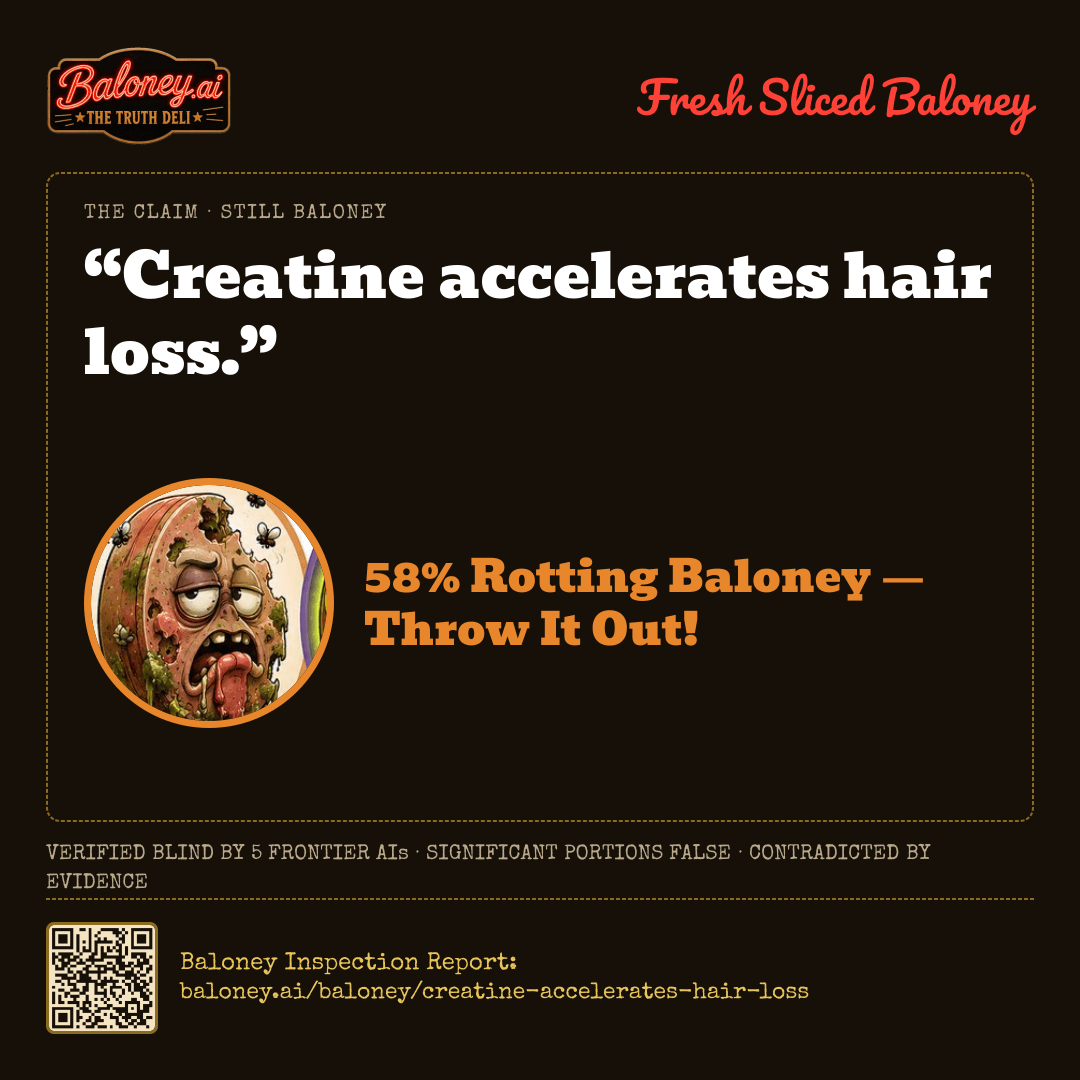
The Verdict
“Creatine accelerates hair loss.”58% Rotting Baloney — Throw It Out!Verified blind by 5 frontier AIs · Baloney Inspection Report: baloney.ai/baloney/creatine-accelerates-hair-loss