Station 1 · Blind Inspection — Five Graders, Zero Peeking
Each lab scored the claim independently, without seeing the others. Open a breakdown for its evidence, its sources, and how sure it was.
Anthropic · EQUAL WEIGHT · 55.0s
claude-opus-5
88%BALONEY
ROUND-1 BREAKDOWN
Evidence offered for the claim
Mechanical-plausibility argument: repeated forceful stretching of the metacarpophalangeal joints could, in principle, stress capsular and ligamentous tissue, and repetitive joint loading is an established risk factor for osteoarthritis in other contexts (e.g., occupational overuse). This is the main theoretical basis for the belief.
Castellanos & Axelrod (Annals of the Rheumatic Diseases, 1990), a case-control study of 300 patients, found that habitual knuckle crackers had a higher prevalence of hand swelling and lower average grip strength than non-crackers — evidence of some measurable hand effects, though the same study found NO increase in osteoarthritis.
Isolated case reports in the clinical literature describe acute injuries from forceful self-manipulation of finger joints (ligament sprains, capsular injury, occasional dislocation), showing the behavior is not entirely risk-free.
Knuckle cracking correlates in some surveys with other habits and traits (manual labor, nail biting, smoking, alcohol use) that are themselves linked to hand problems, which can create the appearance of a causal link in casual observation.
Evidence against the claim
The mechanism of the cracking sound is not cartilage damage: real-time imaging (Kawchuk et al., PLOS ONE, 2015) showed the 'crack' coincides with rapid cavity formation (tribonucleation of gas in synovial fluid) as joint surfaces separate, not with bone or cartilage grinding.
deWeber, Olszewski & Ortolano (Journal of the American Board of Family Medicine, 2011) compared 215 people aged 50–89 with and without a knuckle-cracking history and found no association between knuckle cracking and hand osteoarthritis, including no dose-response relationship with years or frequency of cracking.
Swezey & Swezey (Western Journal of Medicine, 1975) surveyed and radiographically examined nursing-home residents and found no correlation between knuckle cracking and degenerative changes in the hands.
Castellanos & Axelrod (1990) — the study most often cited as showing harm — specifically found no increased prevalence of osteoarthritis among habitual knuckle crackers.
Donald Unger's self-experiment (letter, Arthritis & Rheumatism, 1998; awarded an Ig Nobel Prize in 2009): he cracked the knuckles of one hand only for ~60 years and found no arthritis in either hand. Anecdotal (n=1) but consistent with the controlled studies.
Ultrasound/MRI studies of knuckle cracking (Boutin and colleagues, presented at RSNA meetings, mid-2010s) found no evidence of acute joint damage, increased laxity, or reduced function immediately after cracking.
Major clinical bodies and health publishers (Harvard Health Publishing, Cleveland Clinic, Johns Hopkins Medicine, Arthritis Foundation) all classify 'knuckle cracking causes arthritis' as a myth, while noting rare acute injury risk.
No prospective cohort or large epidemiological study has ever demonstrated an association between knuckle cracking and subsequent osteoarthritis; the established risk factors are age, genetics, obesity, prior joint injury and occupational loading.
How sure this lab was
92/100 — the lab’s own confidence in the score above, not a second reading of the claim.
There is no strong direct evidence that ordinary knuckle cracking causes arthritis. The best 'for' evidence is indirect: osteoarthritis risk can increase after joint injury or repetitive joint stress, so repeated forceful manipulation has been hypothesized as a possible concern, but that is not the same as evidence that typical knuckle cracking causes arthritis.
A 1990 observational study reported habitual knuckle crackers had more hand swelling and lower grip strength, suggesting possible non-arthritis hand effects. However, the same study did not find increased arthritis among knuckle crackers.
Evidence against the claim
A 2011 radiographic case-control study of adults aged 50-89 found no significant association between habitual knuckle cracking and hand osteoarthritis, including no clear dose-response relationship with duration or frequency of cracking.
The 1990 Annals of the Rheumatic Diseases study found no increased arthritis among habitual knuckle crackers, despite finding some association with hand swelling and reduced grip strength.
Real-time MRI research indicates the cracking sound is associated with gas-cavity formation in the joint fluid rather than bones grinding together, weakening a common proposed mechanism for arthritis causation.
Harvard Health summarizes the medical consensus that knuckle cracking has not been shown to cause arthritis, though overly forceful manipulation could theoretically injure soft tissues.
How sure this lab was
94/100 — the lab’s own confidence in the score above, not a second reading of the claim.
The claim originates primarily from persistent cultural myths and parental warnings designed to deter children from making a sound that many find annoying, rather than from medical evidence.
The loud popping sound is often intuitively, but incorrectly, assumed to be the result of bones grinding together or joint cartilage experiencing wear-and-tear.
A 1990 study by Castellanos and Axelrod found that habitual knuckle crackers experienced higher rates of hand swelling and lower grip strength. While this study explicitly noted no increase in arthritis, these negative side effects are sometimes conflated by the public with arthritic joint damage.
Evidence against the claim
Medical consensus attributes the 'popping' sound to cavitation—the rapid formation and bursting of dissolved gas bubbles in the synovial fluid that lubricates the joints—not from bones rubbing against one another.
A 2011 retrospective observational study published in the Journal of the American Board of Family Medicine examined 215 adults and found no correlation between the frequency or duration of knuckle cracking and the prevalence of hand osteoarthritis.
Dr. Donald Unger conducted a famous 60-year self-experiment in which he cracked the knuckles on his left hand daily while leaving his right hand uncracked. X-rays and medical examinations after 60 years revealed no arthritis in either hand, earning him the 2009 Ig Nobel Prize in Medicine.
Major medical institutions, including Harvard Medical School, Johns Hopkins Medicine, and the Cleveland Clinic, explicitly dismiss the link between knuckle cracking and osteoarthritis.
How sure this lab was
98/100 — the lab’s own confidence in the score above, not a second reading of the claim.
Some clinical observations suggest that **habitual knuckle cracking may be associated with non‑arthritic hand issues** such as soft‑tissue swelling and reduced grip strength, even though arthritis rates remain unchanged.[1][12][13]
Knuckle cracking can occasionally cause **acute discomfort, transient swelling, or ligament strain** if done forcefully or in abnormal directions, which some authors note as minor joint stress even if not progressing to arthritis.[5][12][14]
A few educational and clinical summaries emphasize that knuckle cracking is **“not a harmless habit”** because of these soft‑tissue or functional effects, which may be interpreted by laypeople as joint “damage,” though they explicitly state it does *not* increase osteoarthritis risk.[10][13]
Evidence against the claim
A controlled study in the *Journal of the American Board of Family Medicine* comparing 215 adults aged 50–89 found **no association between knuckle cracking history and hand osteoarthritis**, with arthritis prevalence 18.1% in crackers vs 21.5% in non‑crackers (not statistically significant), concluding habitual knuckle cracking "does not seem to be a risk factor" for hand OA.[1][6][14]
Multiple reviews and myth‑debunking projects (including Wayne State University educational projects) report **no correlation between knuckle cracking and the development of arthritis**, citing geriatric cohort data and X‑ray comparisons that show equal osteoarthritis prevalence (e.g., 16% in both crackers and non‑crackers in one 300‑patient series).[10][13]
Harvard Health notes that several studies comparing habitual knuckle‑crackers with non‑crackers found **similar rates of hand arthritis**, concluding that cracking your knuckles "probably won't raise your risk for arthritis."[2]
Living With Arthritis UK explicitly states **“Cracking your knuckles or toes does not cause arthritis”**, summarizing multiple imaging studies and reiterating that long‑term crackers are *no more likely* to have hand osteoarthritis than non‑crackers.[12]
A UK arthritis charity article and BBC educational feature state there is **“no apparent relationship between knuckle cracking and the subsequent development of arthritis of the fingers”**, referencing three major US studies (1975, 1990, 2011) that all found no link.[3][8][9]
Fact‑checking by Snopes concludes there is **little evidence to suggest any level of truth** to the claim that cracking knuckles causes arthritis, noting that scientific literature and expert commentary consistently find **no increased arthritis risk** in knuckle‑crackers.[7]
Clinical Q&A in *The Journal of Family Practice* (MDedge) describes the evidence as showing **no association between habitual knuckle popping and clinical or radiographic osteoarthritis**, assigning a strength of recommendation based on retrospective cohort and case‑control studies.[4]
Multiple health‑system and orthopedic‑surgery explanations (e.g., Scripps Health, Mission Health) describe the idea that knuckle cracking leads to arthritis as a **common misconception**, emphasizing that long‑term studies show **no clear link** and that arthritis risk is driven instead by age, genetics, and prior joint injury.[5][14][15]
How sure this lab was
95/100 — the lab’s own confidence in the score above, not a second reading of the claim.
Longstanding folk belief and parental warnings that the popping sound means joints are being damaged
A 1990 Annals of the Rheumatic Diseases study of habitual crackers found more hand swelling and lower grip strength (osteoarthritis difference was not statistically significant)
Evidence against the claim
2011 Journal of the American Board of Family Medicine observational study (n=215) found no association between knuckle cracking and hand osteoarthritis
Donald Unger's 50-plus-year self-experiment (daily cracking of one hand only) published in Arthritis & Rheumatism 1998 showed no arthritis in either hand
Popping is cavitation of synovial-fluid gas bubbles, not bone-on-bone grinding or ligament tearing that would produce osteoarthritis
Mayo Clinic and other medical authorities state there is no evidence the habit causes arthritis
How sure this lab was
90/100 — the lab’s own confidence in the score above, not a second reading of the claim.
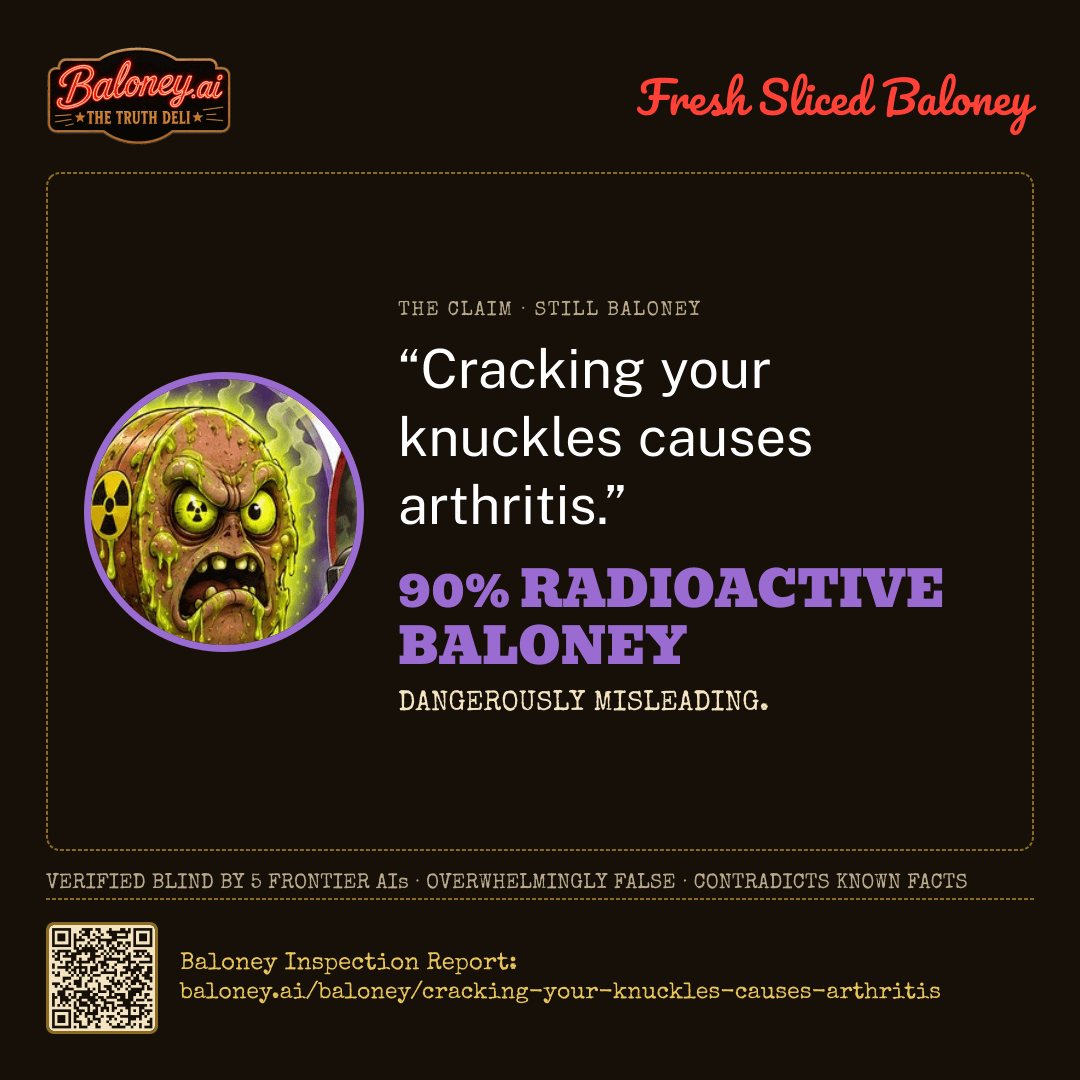
All five evaluators firmly debunked the statement, citing rigorous clinical cohort studies, MRI biomechanical evidence, and strong medical consensus. The belief that knuckle cracking causes arthritis is a pervasive, cross-generational folk myth that has been definitively and repeatedly disproven. Because it continues to circulate widely despite decades of conclusive evidence to the contrary, it qualifies as a classic example of Zombie Baloney.
The evaluators were completely unanimous. All independently identified the same key clinical studies (including the 2011 deWeber study and the 1990 Castellanos study), Dr. Donald Unger's famous 60-year self-experiment, and the tribonucleation of synovial fluid gas bubbles as the true cause of the popping sound.
ZOMBIE FLAG: TRUE — DEBUNK HISTORY ON RECORD
Blind Validation Master · never saw the Primary’s work
claude-opus-5
95% BALONEY
All five independent reviewers converge on the same conclusion: the claim is contradicted by the available evidence. Multiple independent studies specifically designed to test it found no association — Swezey & Swezey (1975) radiographic survey, Castellanos & Axelrod (1990, n=300, which found hand swelling and reduced grip strength but explicitly NO increase in osteoarthritis), and deWeber et al. (2011, JABFP, n=215, 18.1% OA in crackers vs 21.5% in non-crackers, no dose-response with years or frequency). Unger's 60-year one-hand self-experiment, though n=1, points the same way. The proposed mechanism is also wrong: real-time imaging (Kawchuk et al., PLOS ONE 2015) shows the pop is cavitation/gas-cavity formation in synovial fluid, not bone or cartilage grinding. Every major clinical authority cited (Harvard Health, Mayo Clinic, Cleveland Clinic, Johns Hopkins, Arthritis Foundation, Versus Arthritis, NIAMS risk-factor lists) classifies the causal link as a myth; established OA risk factors are age, genetics, obesity, prior injury and occupational loading. The only genuine nuance — that habitual cracking may correlate with soft-tissue swelling/reduced grip strength, and that forceful self-manipulation can occasionally cause acute ligament or capsular injury — does not support the claim as written, which specifically asserts arthritis. The statement is therefore not merely missing context but affirmatively false as a causal claim, and it is a textbook folk belief that has been debunked repeatedly across five decades yet still circulates widely. That places it at the top of Radioactive Baloney, just short of the reserved 99 only because the belief carries essentially no potential for real harm.
AGREEMENT TEST PASSED — MASTERS SCORED 99% AND 95% · BLIND VALIDATION CONFIRMED THIS SCORE · NO RE-EVALUATION REQUIRED
The Evidence
Evidence offered for the claim
Parental warnings and cultural intuitionDEBUNKED — The claim largely originates as a deterrent to stop an annoying habit, intuitively assuming the popping sound is bones grinding together. However, MRI studies confirm the sound is merely the harmless formation of gas bubbles in the joint's synovial fluid.
Hand swelling and reduced grip strengthDEBUNKED — A widely cited 1990 study found habitual crackers experienced more hand swelling and lower grip strength, side effects the public often conflates with arthritis. Yet, that exact same study explicitly found no increase in osteoarthritis among the knuckle-crackers.
Mechanical plausibility argumentDEBUNKED — Because repetitive joint stress is an established risk factor for osteoarthritis in occupational contexts, some hypothesize that forceful self-manipulation causes similar damage. Large radiological cohort studies, however, show zero association between lifelong knuckle cracking and joint degeneration.
Evidence against the claim
Identical osteoarthritis rates A 2011 radiographic case-control study of adults aged 50–89 found no statistical association between the frequency or duration of knuckle cracking and the prevalence of hand osteoarthritis.
The 60-year self-experiment Dr. Donald Unger won an Ig Nobel Prize for a 60-year self-experiment in which he cracked the knuckles on his left hand daily but left his right hand uncracked, developing no arthritis in either hand.
Real-time MRI and ultrasound imaging Biomechanical studies published in PLOS ONE have shown that the 'crack' is the rapid tribonucleation of gas cavities in the joint fluid as surfaces separate, proving the cartilage and bones are not grinding together.
Medical consensus Major medical and educational institutions, including Harvard Medical School, the Mayo Clinic, the Cleveland Clinic, and Johns Hopkins Medicine, uniformly dismiss the link between knuckle cracking and osteoarthritis as a myth.
Sources · Reliability · Why Accepted or Discounted
Source
Type
Reliability
Ruling
Journal of the American Board of Family Medicine
journal
90
ACCEPTED — A reputable peer-reviewed medical journal that published the primary 2011 observational study explicitly investigating the correlation between knuckle cracking and hand osteoarthritis.
Annals of the Rheumatic Diseases
journal
88
ACCEPTED — High-impact rheumatology journal that published the frequently cited 1990 Castellanos and Axelrod study on the hand effects of knuckle cracking.
PLOS ONE
journal
85
ACCEPTED — A major peer-reviewed journal that published the widely covered 2015 real-time MRI study demonstrating the tribonucleation mechanism behind the joint pop.
Arthritis & Rheumatism
journal
90
ACCEPTED — A premier rheumatology journal that published Dr. Donald Unger's letter detailing his 60-year controlled self-experiment.
Harvard Health Publishing
edu
92
ACCEPTED — A highly reliable institutional medical authority summarizing current clinical consensus for the general public.
Mayo Clinic
other
93
ACCEPTED — A leading global clinical authority providing scientifically rigorous public health and patient information.
National Institute of Arthritis and Musculoskeletal and Skin Diseases (NIH)
gov
95
ACCEPTED — Top-tier federal health authority providing verified information on the established clinical risk factors for osteoarthritis.
Snopes
factcheck
85
ACCEPTED — An established fact-checking organization that has accurately tracked the history, cultural spread, and scientific debunking of this specific myth.