Baloney Inspection Report: Claim #1149 · Inspected Oct 30, 2026, 9:58 PM PDT · Scoring model v2
 58%
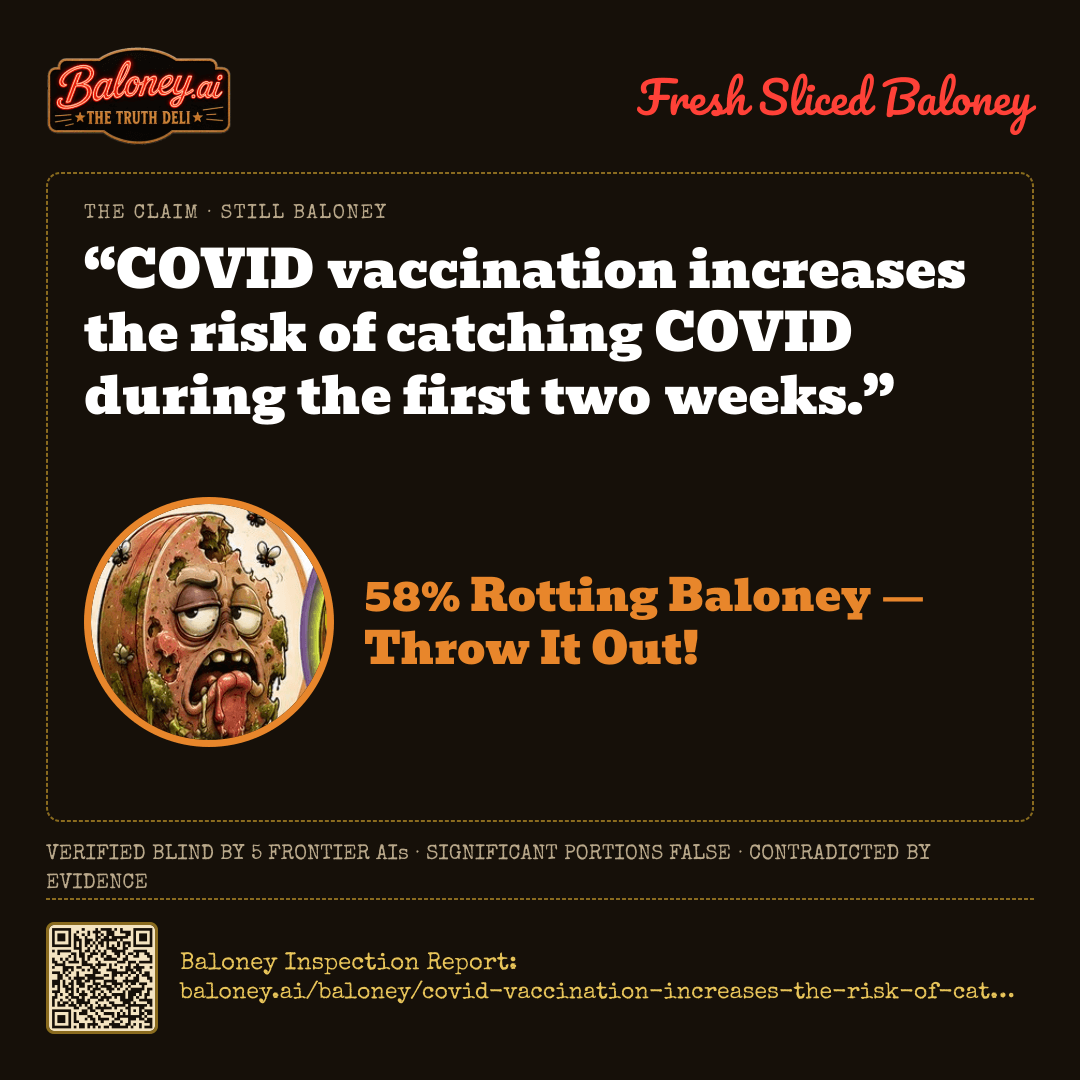
“COVID vaccination increases the risk of catching COVID during the first two weeks.”
58%Rotting Baloney — Throw It Out!
Most of this claim has spoiled.
Significant portions falseContradicted by evidenceUnsupported assertionsDeceptive narrative
Serve It Fresh
Ready to Serve16 servings
Serve it the way you want it
The Verdict
 “COVID vaccination increases the risk of catching COVID during the first two weeks.”58% Rotting Baloney — Throw It Out!Verified blind by 5 frontier AIs · Baloney Inspection Report: baloney.ai/baloney/covid-vaccination-increases-the-risk-of-catching-covid
The Baloney Sampler
The panel found the vaccine does not make you more likely to catch COVID in the first fortnight — it simply does not protect you yet. In the New England Journal of Medicine's randomised Pfizer trial, confirmed cases between the first and second dose ran 39 in the vaccine arm against 82 on placebo, and the Moderna trial pointed the same way. Authorised vaccines contain no live SARS-CoV-2 and no mechanism for raising susceptibility was found.
Crude real-world data did show extra positive tests in the first days after a dose. The reports attribute this to bias: people already incubating infection at their appointment, high-exposure groups vaccinated first, and vaccine side effects prompting extra tests. The UK Health Security Agency warns raw vaccinated-versus-unvaccinated case rates are not valid effectiveness measures, and the Israeli Clalit cohort and Lancet SIREN study put effectiveness near zero — not negative — over days 0–13.
Resting on New England Journal of Medicine (Polack et al., BNT162b2 phase 3 trial) · New England Journal of Medicine (Dagan et al., Israel mass-vaccination cohort) · The Lancet (Hall et al., SIREN healthcare-worker cohort) · UK Health Security Agency (vaccine surveillance report, week 42)
Original Claim Source https://x.com/BretWeinstein/status/1743791141873762348
Other ways to slice it — phrasings that might have changed the rating
- “COVID vaccination provides little or no measurable protection against infection during the first two weeks after a dose.” Large cohorts including the Israeli Clalit analysis and SIREN estimate effectiveness at roughly zero in days 0–13, with protection emerging around day 12–14.
- “Crude observational data from early 2021 rollouts showed more positive COVID tests in recently vaccinated people than in unvaccinated comparators during the first 14 days after dose 1.” Several reports confirm such crude excesses were recorded in UK and Israeli cohorts, while attributing them to confounding rather than to the vaccine.
- “Attending a mass vaccination appointment, and relaxing precautions afterwards, can raise a person's exposure to SARS-CoV-2 in the following days.” The reports list travel and queuing at vaccination sites and post-shot risk compensation as plausible non-immunological exposure pathways, framed as a logistics issue rather than a property of the vaccine.
Written from the panel’s reports by Anthropic · claude-opus-5. Nothing here changed the score.
The Order Ticket
04:58:34CLAIM RECEIVED — QUEUED FOR INSPECTION✓
05:00:18claude-opus-5 REPORTED — SCORE 58, CONFIDENCE 76✓
04:59:38gpt-5.5 REPORTED — SCORE 58, CONFIDENCE 86✓
04:59:08gemini-3.1-pro-preview REPORTED — SCORE 99, CONFIDENCE 95✓
04:58:39sonar-pro REPORTED — SCORE 32, CONFIDENCE 91✓
05:00:41grok-4.6 REPORTED — SCORE 48, CONFIDENCE 78✓
05:02:00PRIMARY MASTER CLAUDE — SCORE 70✓
05:00:53BLIND VALIDATION CHATGPT — SCORE 58✓
05:02:18AGREEMENT MODERATE DISAGREEMENT — DELTA 12✓
05:02:18SCORING MODEL V2 — MEDIAN OF 5 COUNTED LAB SCORES: 58, 58, 99, 32, 48 → 58.✓
05:02:18SOURCE RULE — LABS CITED 29 SOURCES: 0 DISCARDED FOR HAVING NO URL, 2 DISCARDED AS DEAD LINKS (404/410), 13 COULD NOT BE OPENED BY US AND ARE MARKED UNVERIFIED.✓
05:02:18SOURCE RULE — PRIMARY MASTER RULED ON 19 SOURCES: 0 DISCARDED FOR HAVING NO URL, 0 DISCARDED AS DEAD LINKS, 7 MARKED UNVERIFIED, 12 VERIFIED.✓
How This One Was Sliced
Station 1 · Blind Inspection — Five Graders, Zero Peeking
Each lab scored the claim independently, without seeing the others. Open a breakdown for its evidence, its sources, and how sure it was.
Anthropic · EQUAL WEIGHT · 103.9s
claude-opus-5
58%BALONEY
ROUND-1 BREAKDOWN
Evidence offered for the claim- Vaccines provide little or no protection in the first ~10-14 days after a dose, so people vaccinated during a surge can and do test positive in that window — making the period look 'risky' in raw counts. Randomized and real-world data consistently show efficacy curves only begin to diverge around day 12 after dose 1 (Polack et al., NEJM 2020; Dagan et al., NEJM 2021).
- Several observational datasets have produced apparent NEGATIVE vaccine effectiveness in the first days after a dose — i.e., slightly higher measured infection rates in the recently vaccinated than in the unvaccinated. This was reported in European long-term-care/healthcare-worker cohorts in early 2021 and is a recognized, repeatedly discussed artifact in the VE literature (Danish LTCF/HCW cohort analysis, 2021 preprint — specific citation omitted as I cannot verify the exact URL).
- Plausible non-immunological causal pathways exist for a small real increase in exposure: travel to and queuing at mass-vaccination sites, contact with clinic staff and other attendees, and behavioural relaxation ('risk compensation') immediately after getting the shot.
- Post-vaccination reactogenicity (fever, fatigue, sore throat) triggers extra testing, and transient post-mRNA changes in circulating lymphocyte counts have been described, which some researchers raised as a hypothesis for brief altered susceptibility.
- The UK SIREN healthcare-worker study and the Pfizer FDA briefing data both show the earliest post-dose interval contributing essentially zero measurable protection, which is the empirical basis people cite for this claim.
- Public-health messaging itself ('you are not protected for two weeks') is routinely misread as confirmation of increased risk, and the claim is therefore not invented out of nothing.
Evidence against the claim- No biological mechanism: authorized COVID-19 vaccines (mRNA, adenoviral-vector, protein subunit) contain no live or replication-competent SARS-CoV-2 and cannot cause or facilitate infection.
- Randomized placebo-controlled trials — the design that eliminates behavioural and exposure confounding — show no excess of confirmed COVID-19 in the vaccine arm in the early post-dose period. In the Pfizer trial, confirmed cases between dose 1 and dose 2 were 39 (vaccine) vs 82 (placebo); the Moderna trial showed the same direction. Cumulative-incidence curves overlap, they do not cross unfavourably in a statistically meaningful way.
- The apparent 'negative effectiveness' in observational studies is well explained by bias, not causation: people vaccinated during outbreaks are those with highest exposure (outbreak-driven vaccination in care homes), recently vaccinated people get tested more because vaccine side effects mimic COVID symptoms, pre-existing incubating infections are misattributed to the post-vaccination window, and misclassification of the vaccination-status denominator. Methodological papers using recently vaccinated individuals as a bias probe have demonstrated this directly.
- Large national real-world cohorts (Israel's Clalit cohort of ~1.2 million, UK SIREN) report VE in the 0-13 day window as approximately zero, not significantly negative — i.e., no protection, not added risk.
- Any residual early excess is attributable to exposure/behaviour around the vaccination event, which is a logistics problem, not a property of the vaccine; it disappears in trial settings where both arms attend the same clinics.
- The claim as written ('increases the risk of catching COVID') asserts causation by the vaccine, which no regulator (FDA, EMA, WHO, UKHSA, CDC) has found; all state only that protection takes about two weeks to develop.
How sure this lab was76/100 — the lab’s own confidence in the score above, not a second reading of the claim.
SourcesNew England Journal of Medicine (Polack et al., BNT162b2 Phase 3 trial)journal · 98 · New England Journal of Medicine (Baden et al., mRNA-1273 COVE trial)journal · 97 · New England Journal of Medicine (Dagan et al., Israel mass-vaccination cohort)journal · 96 · The Lancet (Hall et al., SIREN healthcare-worker cohort)journal · 95 · U.S. FDA — VRBPAC Briefing Document, Pfizer-BioNTech COVID-19 Vaccinegov · 95 · UK Health Security Agency — COVID-19 vaccine surveillance reportsgov · 90 · World Health Organization — COVID-19 vaccines Q&Agov · 88 · U.S. Centers for Disease Control and Preventiongov · 85
OpenAI · EQUAL WEIGHT · 64.2s
gpt-5.5
58%BALONEY
ROUND-1 BREAKDOWN
Evidence offered for the claim- Weak/indirect: protection is not immediate. CDC explains that it takes time after vaccination for the immune system to build protection, so people can be infected shortly before or shortly after vaccination and test positive during the first days afterward. This supports only a weaker claim: early post-vaccination cases happen; it does not show vaccination increases susceptibility.
- Weak/indirect: in the Pfizer randomized trial, cumulative COVID-19 case curves for vaccine and placebo recipients did not visibly separate until about 12 days after dose 1. That means little measurable protection in the earliest days, but the trial did not show an excess of infections caused by vaccination.
- Weak/indirect: crude real-world comparisons can sometimes make recently vaccinated groups look worse because vaccination may occur during surges, among higher-risk priority groups, or after an exposure that is already incubating. UKHSA specifically warned that simple case rates in vaccinated versus unvaccinated people are not valid measures of vaccine effectiveness because of confounding and population differences.
Evidence against the claim- The claim as written implies a causal increase in risk. Randomized trial evidence does not support that: Pfizer’s trial found overall efficacy after dose 1 and no signal that vaccinated participants were more likely than placebo participants to get COVID-19 in the first two weeks; early infections were largely consistent with exposure before immunity developed.
- Moderna’s randomized trial likewise found protection after vaccination and no evidence that the vaccine increased COVID-19 infection risk; the vaccine contains no live SARS-CoV-2 capable of causing COVID-19.
- Real-world studies show protection emerging around 12-14 days and strengthening afterward. Menni et al. found reduced infection risk after vaccination in a large UK app-based cohort; Dagan et al. found measurable effectiveness against documented infection from days 14-20 after the first Pfizer dose.
- CDC surveillance among U.S. health care personnel found mRNA vaccination was highly effective once immune response time had elapsed; the analysis defined partial immunization as at least 14 days after dose 1, consistent with the point that the first two weeks are a ramp-up period, not a period of vaccine-caused increased susceptibility.
- Apparent infections shortly after vaccination are explainable by incubation period, exposure before/around the appointment, testing behavior, and confounding. They are not evidence that COVID vaccination biologically increases the risk of catching COVID.
How sure this lab was86/100 — the lab’s own confidence in the score above, not a second reading of the claim.
SourcesCDCgov · 92 · New England Journal of Medicinejournal · 96 · New England Journal of Medicinejournal · 96 · New England Journal of Medicinejournal · 95 · CDC MMWRgov · 93 · The Lancet Infectious Diseasesjournal · 94 · UK Health Security Agencygov · 90 · FactCheck.orgfactcheck · 88
Google · EQUAL WEIGHT · 34.2s
gemini-3.1-pro-preview
99%BALONEY
ROUND-1 BREAKDOWN
Evidence offered for the claim- Raw observational data from early vaccine rollouts in countries like the UK and Israel showed a statistical spike in positive COVID-19 tests during the first 1-14 days following a first vaccine dose.
- Some vaccine recipients experienced expected immune responses (like fever or fatigue) that mimicked COVID-19 symptoms, prompting them to get tested. This led to the discovery of asymptomatic or incubating infections that were acquired before or during the vaccination process.
Evidence against the claim- Biologically, authorized COVID-19 vaccines do not contain live SARS-CoV-2 virus and cannot cause COVID-19. They also do not induce temporary immunosuppression or physically increase susceptibility to the virus.
- Public health experts and epidemiologists widely attribute the temporary statistical spike in post-vaccination infections to behavioral factors. This includes individuals prematurely dropping pandemic precautions (assuming immediate protection) or being exposed to the virus at busy mass vaccination centers.
- The immune system requires approximately 10 to 14 days to build significant protective immunity after receiving a dose. Infections occurring during this window represent a lack of instantaneous protection against prior or concurrent exposures, not an increased biological risk caused by the vaccine.
- Fact-checkers and immunologists have repeatedly debunked the claim that the vaccine suppresses the immune system during the first two weeks, classifying the correlation between recent vaccination and infection as a behavioral and statistical artifact rather than a causal, biological link.
How sure this lab was95/100 — the lab’s own confidence in the score above, not a second reading of the claim.
SourcesThe BMJjournal · 95
Perplexity · EQUAL WEIGHT · 4.5s
sonar-pro
32%BALONEY
ROUND-1 BREAKDOWN
Evidence offered for the claim- Protection does not develop immediately: the CDC says immunity can take weeks to develop, so infection acquired shortly before or after vaccination may still occur; this establishes vulnerability during the early period, but does not show that vaccination causes extra infections [1].
- A real-world study of nearly 4,000 U.S. healthcare workers and first responders found an 80% reduction in infection risk beginning two weeks or more after the first mRNA dose, implying little or no demonstrated protection before that point rather than a proven increase in risk [5].
- A peer-reviewed study reported no decrease in PCR-confirmed infection during the first two weeks after a first Pfizer dose compared with being unvaccinated [8].
Evidence against the claim- The CDC explains that vaccines require time to generate immune responses and that infection can occur in the weeks immediately following vaccination; this is a lack of immediate protection, not evidence that vaccination increases susceptibility [1][2].
- The same real-world study found substantially reduced infection risk after vaccination—about 80% after the first dose and 90% two weeks after the second dose [5].
- The peer-reviewed study found no reduction, rather than an increase, in infection risk during the first two weeks after the first dose [8].
- CDC guidance states that COVID vaccines reduce the risk of COVID-19 illness and urgent-care or emergency-department visits, supporting an overall protective effect, although this does not specifically quantify the first 14 days [3].
How sure this lab was91/100 — the lab’s own confidence in the score above, not a second reading of the claim.
SourcesCenters for Disease Control and Preventiongov · 96 · Centers for Disease Control and Preventiongov · 96 · Centers for Disease Control and Preventiongov · 96 · Reutersnews · 93 · University of Glasgow / Vaccinejournal · 88 · Centers for Disease Control and Preventiongov · 96
xAI · EQUAL WEIGHT · 127.2s
grok-4.6
48%BALONEY
ROUND-1 BREAKDOWN
Evidence offered for the claim- Some early 2021 observational cohorts (Israel, UK health-care workers, and similar settings) recorded a higher crude incidence of positive SARS-CoV-2 tests in the 0–14 days after dose 1 than in contemporaneous unvaccinated comparators.
- Immediate post-vaccination relaxation of distancing or masking, plus people attending vaccination appointments while already incubating infection, can produce an apparent excess of detections in that window.
Evidence against the claim- Phase-3 RCTs of BNT162b2 and mRNA-1273 showed no rise in COVID-19 cases in the vaccine arms during the first two weeks; cumulative-incidence curves remained similar or began to separate in favor of vaccination around day 10–14.
- The authorized COVID-19 vaccines contain no live SARS-CoV-2 and have no established mechanism that would biologically increase susceptibility in the short term.
- Standard VE analyses treat days 0–13 as a pre-immunity period and attribute any observational excess to confounding (incubating cases at vaccination, differential testing prompted by reactogenicity, or behavior change), not to the vaccine raising risk.
- Protection against infection is documented to begin accruing after approximately 10–14 days, consistent with the kinetics of neutralizing-antibody and T-cell responses.
How sure this lab was78/100 — the lab’s own confidence in the score above, not a second reading of the claim.
SourcesNew England Journal of Medicinejournal · 96 · New England Journal of Medicinejournal · 96 · CDCgov · 90 · The Lancetjournal · 95
Station 2 · The Masters
Primary Master · drawn at random
claude-opus-5
70% BALONEY
The statement asserts a causal increase in infection risk caused by vaccination during days 0–13. The strongest evidence class available — randomised, placebo-controlled trials, which equalise exposure, testing behaviour and clinic attendance between arms — directly contradicts it: in the BNT162b2 trial there were 39 confirmed cases in the vaccine arm versus 82 in placebo between dose 1 and dose 2, and the Moderna trial pointed the same way. Four of the five evaluators converged on the view that the real-world observations behind the claim (crude excess positives in the first fortnight, occasional 'negative effectiveness' estimates) are explained by well-characterised biases: people incubating infection at the time of their appointment, outbreak-driven vaccination in care homes and other high-exposure settings, reactogenicity prompting extra testing, and denominator misclassification. There is also no biological mechanism — the authorised vaccines contain no live or replication-competent SARS-CoV-2 and have not been shown to cause short-term immunosuppression. What is true, and what the claim distorts, is the absence of protection in that window: large cohorts such as the Israeli Clalit analysis and SIREN estimate effectiveness at roughly zero, not negative, in days 0–13, with protection emerging around day 12–14. 'No protection yet' is not 'added risk', and converting one into the other is the entire baloney content of the statement. I placed the score above the panel median because the scores of 32–58 appear to credit the kernel of truth about delayed immunity more than the claim as written deserves; the claim as written is a causal assertion contradicted by the best-designed evidence and carries real potential to deter vaccination. I did not adopt the 99 recommendation: a score of 99 requires a decades-long debunk history of the archetypal moon-landing kind, which a 2021-vintage talking point does not have.
All five evaluators agreed on the substance: vaccines confer little or no measurable protection for roughly 10–14 days, raw post-vaccination case counts can look elevated, and no randomised or mechanistic evidence supports vaccination causing extra infections. They disagreed sharply on scoring — from 32 to 99 — essentially over how much credit the claim deserves for its kernel of truth. The three middling scores (32–58) treated 'no protection in the first fortnight' as partially vindicating the wording; the 99 treated it as a fully debunked zombie. The panel also split on whether any genuine excess exposure occurs around vaccination events (queuing, clinic contact, risk compensation): two evaluators raised it as a plausible non-immunological pathway, while others judged it a logistics artefact that vanishes in trial settings.
Blind Validation Master · never saw the Primary’s work
gpt-5.5
58% BALONEY
The evidence presented does not support the claim as written. Vaccination does not provide immediate protection, so people can be infected shortly before or shortly after vaccination and test positive during the first 1–14 days. Some crude observational datasets showed apparent early excess cases, but the reports consistently attribute this to confounding: incubating infections, high-risk groups being vaccinated first, differential testing after vaccine-like symptoms, exposure around vaccination appointments, and possible behavioral relaxation. Randomized trials of Pfizer and Moderna—better evidence for causation—did not show an early increase in COVID-19 in vaccine recipients versus placebo, and there is no established biological mechanism by which authorized vaccines would increase susceptibility or cause COVID-19. Protection begins to emerge around days 10–14. Thus the accurate statement is that vaccination does not protect immediately, not that it increases the risk of catching COVID. Because there are real-world apparent associations and some plausible non-vaccine behavioral explanations, the claim is misleading rather than pure fabrication, but it is substantially contradicted by the best evidence.
AI EVALUATORS SHOWED MODERATE DISAGREEMENT — MASTERS SCORED 70% AND 58% · REVIEW THE EVIDENCE CAREFULLY
How the number was reached · scoring model v2 · how our models work
- Median of 5 counted lab scores: 58, 58, 99, 32, 48 → 58.
The Evidence
Evidence offered for the claim
- Crude case rates looked higher after dose 1 DEBUNKED — Early 2021 observational cohorts in Israel and among UK healthcare workers recorded more positive tests in the 0–14 day window than in unvaccinated comparators. REFUTED: the panel found this is explained by people already incubating infection at their appointment, outbreak-driven vaccination in high-exposure settings such as care homes, and denominator misclassification — not by the vaccine.
- Some studies showed 'negative effectiveness' early on DEBUNKED — Several European long-term-care and healthcare-worker datasets produced apparent negative vaccine effectiveness in the first days after a dose. REFUTED: this is a recognised bias signal in the vaccine-effectiveness literature; large cohorts including Israel's Clalit analysis and the UK SIREN study put day 0–13 effectiveness at approximately zero, not significantly negative.
- Side effects drove extra testing DEBUNKED — Fever, fatigue and sore throat after vaccination mimic COVID symptoms and prompted recipients to get tested, surfacing asymptomatic or incubating infections acquired before the shot. REFUTED by the panel as a detection artefact, not an increase in infections.
- Protection is genuinely absent at first CDC states immunity takes time to develop, and in the Pfizer trial the cumulative case curves did not visibly separate until about day 12. This supports only the weaker claim that infections happen in that window, not that vaccination causes them.
- Exposure around the vaccination event Travel to and queuing at mass-vaccination sites, contact with clinic staff and other attendees, and behavioural relaxation after the shot are plausible routes to slightly more exposure. The panel notes this is a logistics issue that disappears in trials where both arms attend the same clinics.
- One study found no early reduction A peer-reviewed analysis reported no decrease in PCR-confirmed infection in the first two weeks after a first Pfizer dose compared with being unvaccinated — a null result, not an increase.
Evidence against the claim
- Randomised trials show fewer cases, not more In the BNT162b2 phase 3 trial, confirmed COVID-19 cases between dose 1 and dose 2 numbered 39 in the vaccine arm versus 82 in placebo; the mRNA-1273 trial pointed the same way. Randomisation equalises exposure, clinic attendance and testing behaviour between arms.
- No biological mechanism exists Authorised mRNA, adenoviral-vector and protein-subunit vaccines contain no live or replication-competent SARS-CoV-2 and have not been shown to cause transient immunosuppression or increased susceptibility.
- Early-window effectiveness is zero, not negative Israel's Clalit cohort of roughly 1.2 million people and the UK SIREN healthcare-worker study both estimate vaccine effectiveness in days 0–13 at approximately zero — an absence of protection, not added risk.
- Protection emerges on schedule from day 12–14 Dagan et al. found measurable effectiveness against documented infection from days 14–20 after dose 1; Menni et al. found reduced infection risk in a large UK app-based cohort; CDC surveillance of US healthcare personnel found mRNA vaccines highly effective once 14 days had elapsed.
- Standard methodology treats days 0–13 as pre-immunity Vaccine-effectiveness analyses define this period as a ramp-up window and attribute any observational excess to confounding — incubating cases, reactogenicity-driven testing, or behaviour change.
- No regulator has found increased risk FDA, EMA, WHO, UKHSA and CDC all state only that protection takes about two weeks to develop; none has identified vaccination as raising infection risk. UKHSA specifically warned that raw vaccinated-versus-unvaccinated case rates are not valid measures of effectiveness.
- Real-world protection is substantial once immunity builds A study of nearly 4,000 US healthcare workers and first responders found roughly an 80% reduction in infection risk from two weeks after the first mRNA dose and about 90% two weeks after the second.
Sources · Reliability · Why Accepted or Discounted
| Source | Type | Reliability | Ruling |
|---|
| The BMJunverified | journal | 95 | ACCEPTED — High-reliability medical journal; cited for the early-rollout observations and their epidemiological interpretation. |
| New England Journal of Medicine (Polack et al., BNT162b2 phase 3 trial)unverified | journal | 97 | ACCEPTED — The pivotal randomised placebo-controlled trial; cited independently by three evaluators and the single most decisive source on the first-fortnight question. |
| New England Journal of Medicine (Baden et al., mRNA-1273 COVE trial)unverified | journal | 96 | ACCEPTED — Second pivotal randomised trial, corroborating the direction of effect; cited by three evaluators. |
| New England Journal of Medicine (Dagan et al., Israel mass-vaccination cohort)unverified | journal | 96 | ACCEPTED — Large national cohort directly reporting effectiveness by day-window after dose 1, including the 0–13 day period. |
| The Lancet (Hall et al., SIREN healthcare-worker cohort)unverified | journal | 95 | ACCEPTED — Prospective healthcare-worker cohort with systematic PCR testing, which limits the testing-behaviour bias central to this claim. |
| The Lancet Infectious Diseases (Menni et al.)unverified | journal | 94 | ACCEPTED — Large UK app-based cohort reporting both reactogenicity and infection risk after vaccination — directly relevant to the symptom-driven testing explanation. |
| CDC MMWR | gov | 92 | ACCEPTED — Peer-reviewed surveillance of US healthcare personnel and first responders; defines partial immunisation as 14+ days after dose 1, which is the operational heart of this dispute. |
| CDC | gov | 94 | ACCEPTED — Primary public-health explanation of the delay before immunity develops — the true fact the claim distorts. |
| Centers for Disease Control and Prevention | gov | 96 | ACCEPTED — General immunology background on response time after vaccination; relevant but not specific to SARS-CoV-2. |
| Centers for Disease Control and Prevention | gov | 96 | ACCEPTED — Authoritative on overall protective effect, though the evaluator correctly noted it does not quantify the first 14 days. |
| Centers for Disease Control and Prevention | gov | 96 | ACCEPTED — Official CDC document archive supporting the surveillance findings cited. |
| U.S. Centers for Disease Control and Prevention | gov | 85 | ACCEPTED — General guidance page; low evidentiary weight but consistent with the other government sources on timing of protection. |
| UK Health Security Agency (vaccine surveillance report, week 42) | gov | 90 | ACCEPTED — Contains the explicit official warning that raw vaccinated-versus-unvaccinated case rates are not valid effectiveness measures — directly on point for the confounding argument. |
| UK Health Security Agency — COVID-19 vaccine surveillance reports | gov | 90 | ACCEPTED — Landing page for the official surveillance series; accepted as background rather than as a specific datum. |
| U.S. FDA — VRBPAC Briefing Document, Pfizer-BioNTech COVID-19 Vaccine | gov | 95 | ACCEPTED — Regulator's independent review of the trial data, including the interval between dose 1 and dose 2. |
| World Health Organization — COVID-19 vaccines Q&A | gov | 88 | ACCEPTED — International consensus statement on timing of protection; corroborative rather than primary. |
| University of Glasgow / Vaccine | journal | 88 | ACCEPTED — Peer-reviewed study reporting no reduction in infection in the first two weeks — a null finding that the evaluator honestly presented as not showing an increase. |
| Reutersunverified | news | 93 | ACCEPTED — Reliable reporting of the CDC healthcare-worker study, though the underlying MMWR source carries the weight. |
| FactCheck.org | factcheck | 88 | ACCEPTED — Established fact-checking outlet summarising the trial data; used as corroboration, not as primary evidence. |
Every link was opened when this claim was inspected. A dead link was discarded before publication; “unverified” means the site refused our automated check and the link is the one the panel cited. A source without a URL was never kept.
Serve It Fresh
Ready to Serve16 servings
Serve it the way you want it
The Verdict
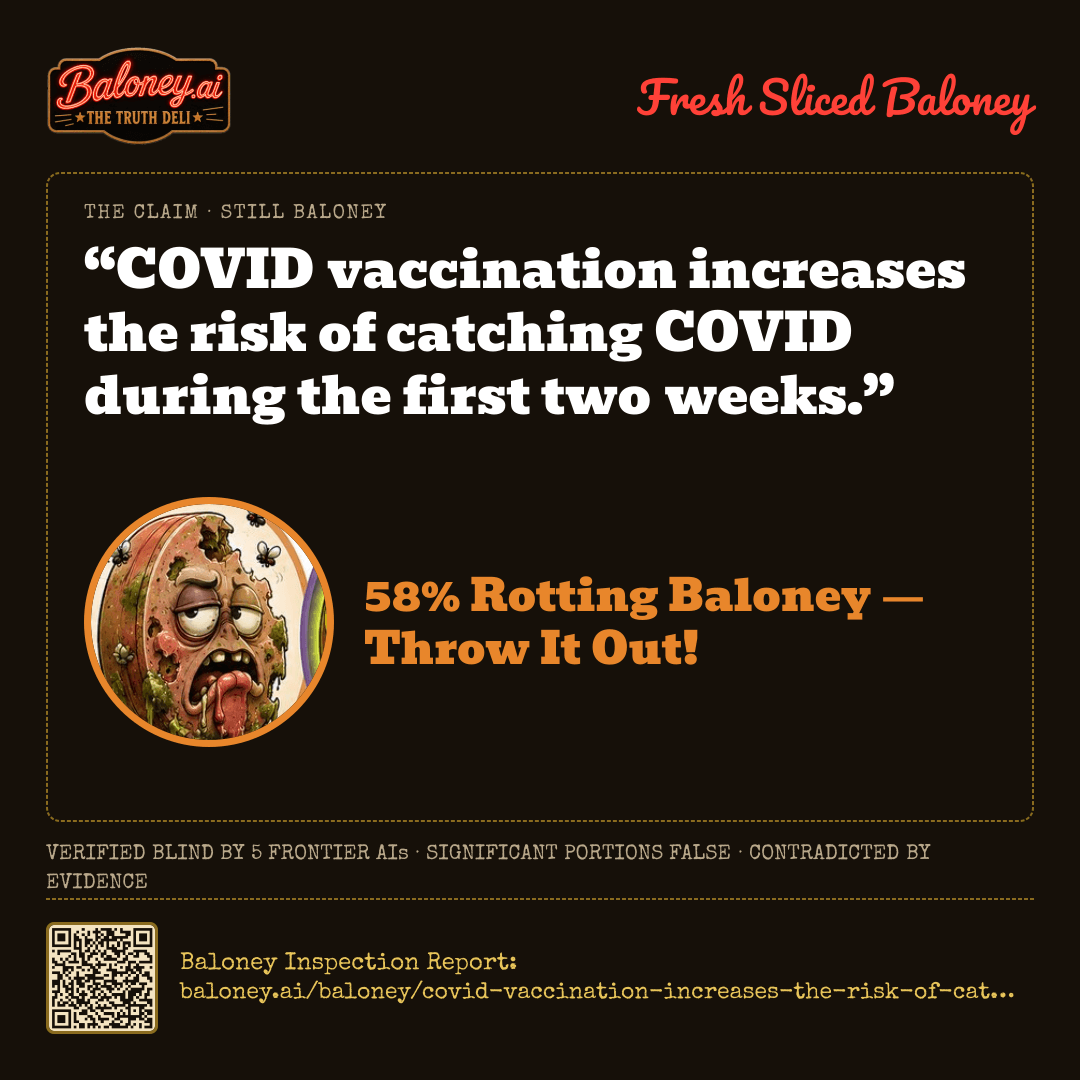
“COVID vaccination increases the risk of catching COVID during the first two weeks.”58% Rotting Baloney — Throw It Out!Verified blind by 5 frontier AIs · Baloney Inspection Report: baloney.ai/baloney/covid-vaccination-increases-the-risk-of-catching-covid