Baloney Inspection Report: Claim #1141 · Inspected Oct 7, 2026, 5:51 PM PDT · Scoring model v2
 97%
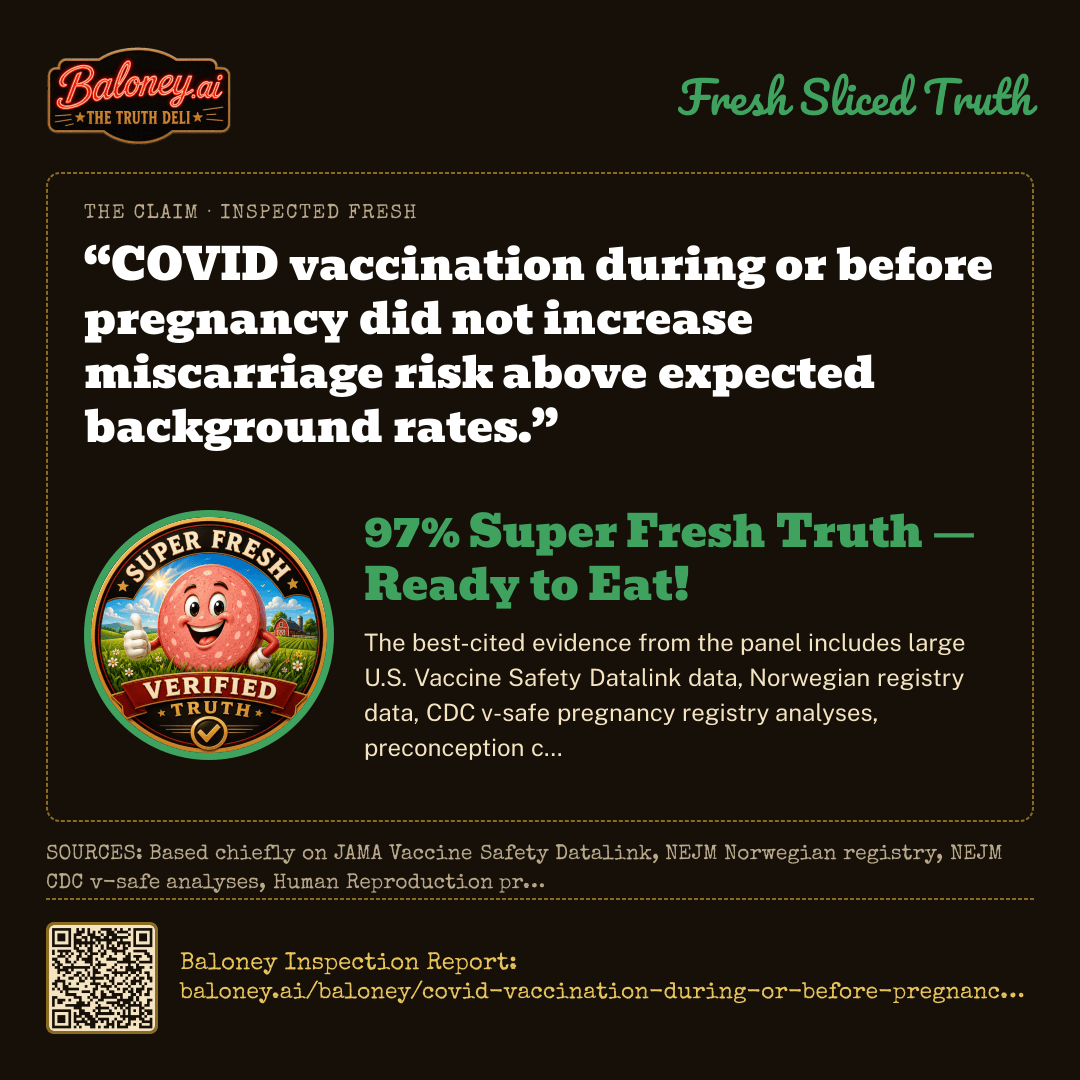
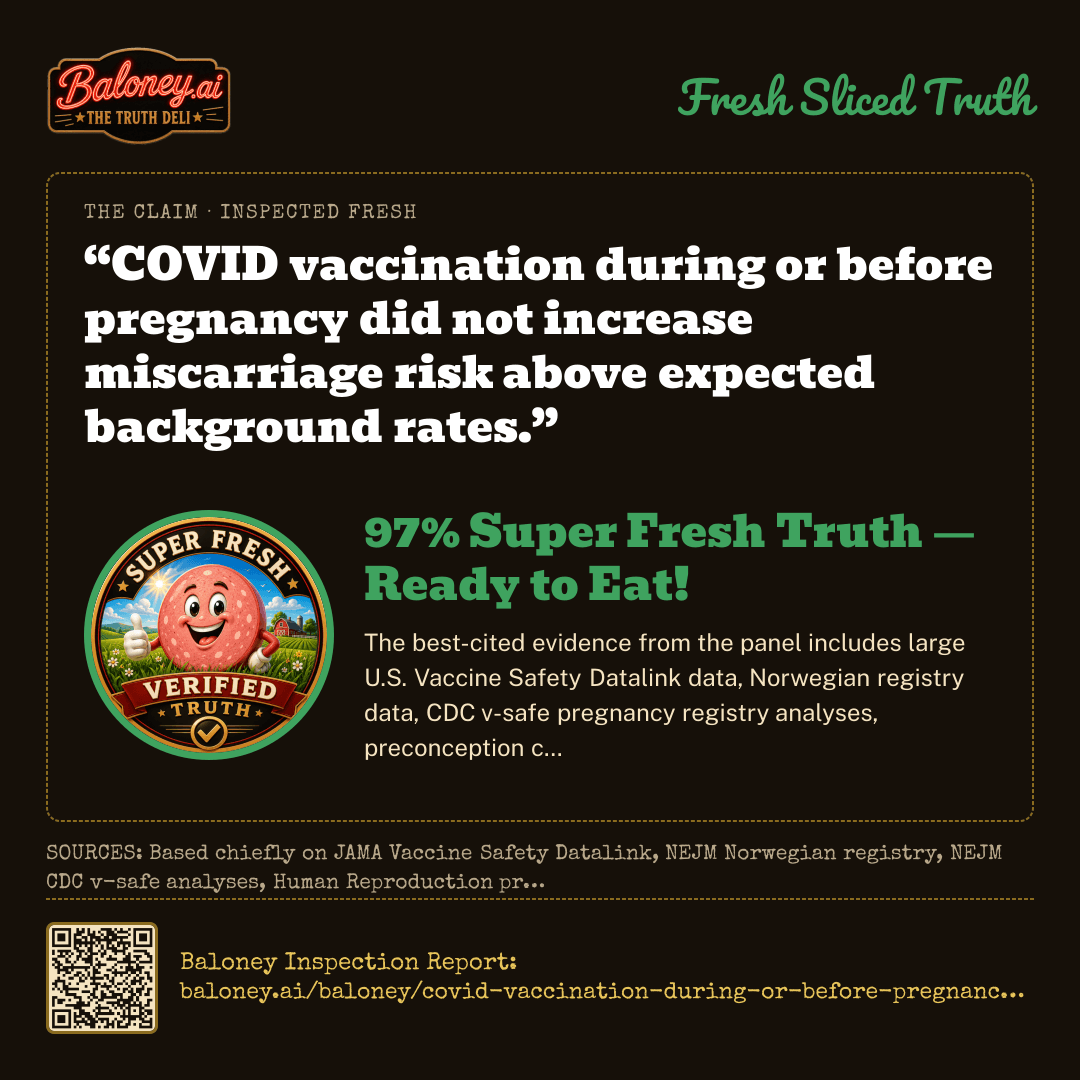
97%“COVID vaccination during or before pregnancy did not increase miscarriage risk above expected background rates.”
97%Super Fresh Truth — Ready to Eat!
THE CLAIM CHECKS OUT.
Independently verifiedPhysically repeatable evidenceConfirmed across rival labsSafe to serve
Serve It Fresh
Ready to Serve10 servings
Serve it the way you want it
The Verdict
 “COVID vaccination during or before pregnancy did not increase miscarriage risk above expected background rates.”97% Super Fresh Truth — Ready to Eat!Verified blind by 5 frontier AIs · Baloney Inspection Report: baloney.ai/baloney/covid-vaccination-during-or-before-pregnancy-did-not
The Baloney Sampler
The reports found that COVID vaccination during or before pregnancy did not raise miscarriage risk above expected background rates. The strongest support came from peer-reviewed registry and cohort evidence: New England Journal of Medicine analyses of Norwegian registry and CDC v-safe data, plus the JAMA Vaccine Safety Datalink study, all converged on no increased miscarriage risk.
The finding rests on large observed populations showing miscarriage rates around the expected background range for recognized pregnancies, not on passive reports alone. CDC and professional guidance reviewed the safety evidence and reached the same conclusion. Caveats remain for very early pre-clinical losses, less-studied vaccine platforms, and early surveillance limitations, but those do not show an excess risk.
Resting on New England Journal of Medicine · JAMA · New England Journal of Medicine · Centers for Disease Control and Prevention
Other ways to slice it — phrasings that might have changed the rating
- “mRNA COVID vaccination during the first trimester did not increase the risk of clinically recognized miscarriage.” This narrower claim matches the strongest evidence base, including the Norwegian registry, Vaccine Safety Datalink, and CDC v-safe analyses focused mainly on mRNA vaccines and recognized pregnancies.
- “COVID vaccination before conception did not increase the risk of later miscarriage.” The reports describe supportive preconception cohort evidence, but they also note that this part of the evidence base is smaller than the in-pregnancy evidence.
- “All COVID vaccine products, in every population and schedule, have been proven to carry zero risk of miscarriage, including very early pre-clinical pregnancy losses.” The reports specifically caution that the evidence is strongest for mRNA vaccines and studied populations, and that very early losses are harder to capture.
Written from the panel’s reports by OpenAI · gpt-5.5. Nothing here changed the score.
The Order Ticket
00:51:14CLAIM RECEIVED — QUEUED FOR INSPECTION✓
00:52:01claude-opus-5 REPORTED — SCORE 3, CONFIDENCE 93✓
00:54:10gpt-5.5 REPORTED — SCORE 3, CONFIDENCE 92✓
00:51:35gemini-3.1-pro-preview REPORTED — SCORE 2, CONFIDENCE 99✓
00:51:24sonar-pro REPORTED — SCORE 3, CONFIDENCE 96✓
00:52:42grok-4.6 REPORTED — SCORE 4, CONFIDENCE 86✓
00:56:34PRIMARY MASTER CHATGPT — SCORE 3✓
00:54:18BLIND VALIDATION GEMINI — SCORE 3✓
00:57:17AGREEMENT CONFIRMED — DELTA 0✓
00:57:17SCORING MODEL V2 — MEDIAN OF 5 COUNTED LAB SCORES: 3, 3, 2, 3, 4 → 3. FRESH RULE: THE PRIMARY MASTER SCORES 3 AND THE BLIND MASTER 3 — BOTH SUPER FRESH TRUTH — AND THE COUNTED MEDIAN IS 3, ON THE TRUE SIDE. PUBLISHED AS 3, THE MORE CAUTIOUS OF THE TWO MASTERS.✓
00:57:17SOURCE RULE — LABS CITED 32 SOURCES: 0 DISCARDED FOR HAVING NO URL, 4 DISCARDED AS DEAD LINKS (404/410), 17 COULD NOT BE OPENED BY US AND ARE MARKED UNVERIFIED.✓
00:57:17SOURCE RULE — PRIMARY MASTER RULED ON 18 SOURCES: 0 DISCARDED FOR HAVING NO URL, 0 DISCARDED AS DEAD LINKS, 8 MARKED UNVERIFIED, 10 VERIFIED.✓
How This One Was Sliced
Station 1 · Blind Inspection — Five Graders, Zero Peeking
Each lab scored the claim independently, without seeing the others. Open a breakdown for its evidence, its sources, and how sure it was.
Anthropic · EQUAL WEIGHT · 47.0s
claude-opus-5
97%TRUTH
ROUND-1 BREAKDOWN
Evidence offered for the claim- Magnus et al., NEJM (2021) — Norwegian registry study of ~18,000 pregnant women found no increased risk of first-trimester miscarriage after COVID-19 vaccination (adjusted OR ~0.9–1.0 for both mRNA vaccines).
- Kharbanda et al., JAMA (2021) — Vaccine Safety Datalink case-control surveillance across 8 US health systems found COVID-19 vaccination in the prior 28 days was not associated with spontaneous abortion (aOR ~0.8).
- Zauche et al., NEJM (2021) — CDC analysis of v-safe pregnancy registry participants vaccinated preconception or before 20 weeks found cumulative spontaneous abortion risk (~13%) within the expected background range of 11–22%.
- Shimabukuro et al., NEJM (2021) — preliminary v-safe/VAERS safety data in >35,000 pregnant people showed adverse pregnancy outcomes, including spontaneous abortion, at rates similar to pre-pandemic historical baselines.
- Prasad et al., Nature Communications (2022) — systematic review/meta-analysis of COVID-19 vaccination in pregnancy found no increase in miscarriage or other adverse perinatal outcomes, plus benefits against severe maternal COVID-19.
- Background miscarriage rates are high (roughly 11–22% of recognized pregnancies), and large denominators in the above studies were adequate to detect a meaningful excess; multiple independent datasets in different countries converged on null findings.
- Major agencies and professional bodies (CDC, ACOG, SMFM, WHO, UK MHRA/JCVI) reviewed this evidence and concluded vaccination does not increase miscarriage risk.
Evidence against the claim- The initial NEJM v-safe paper (Shimabukuro 2021) had a denominator problem — many enrollees vaccinated in the third trimester had not yet completed pregnancy — which was later corrected; critics correctly noted the first published version could not properly estimate first-trimester miscarriage risk (the corrected and follow-up analyses still showed no excess).
- Pivotal randomized trials excluded pregnant participants, so all reassurance rests on observational data, which can be affected by confounding, exposure misclassification, and 'healthy vaccinee' selection bias.
- Very early pregnancy losses (pre-clinical/chemical pregnancies) are poorly captured in registry and EHR data, so an effect on the earliest losses is harder to exclude, though studies of conception cohorts also found no effect.
- Some subgroup or small-sample estimates have wide confidence intervals, meaning small relative risk changes (e.g., <10–20%) in specific windows cannot be excluded with absolute certainty.
- The claim's phrase 'before pregnancy' is supported by fewer dedicated studies (preconception cohorts such as PRESTO and the v-safe preconception subgroup) than the in-pregnancy evidence base.
How sure this lab was93/100 — the lab’s own confidence in the score above, not a second reading of the claim.
SourcesNew England Journal of Medicine (Magnus et al., Norwegian Institute of Public Health)journal · 96 · JAMA (Kharbanda et al., Vaccine Safety Datalink)journal · 95 · New England Journal of Medicine (Zauche et al., CDC v-safe)journal · 94 · New England Journal of Medicine (Shimabukuro et al.; note published correction)journal · 90 · Nature Communications (Prasad et al., systematic review/meta-analysis)journal · 92 · FactCheck.org (SciCheck)factcheck · 88 · CDC MMWRgov · 90
OpenAI · EQUAL WEIGHT · 176.3s
gpt-5.5
97%TRUTH
ROUND-1 BREAKDOWN
Evidence offered for the claim- Large U.S. Vaccine Safety Datalink case-control study in JAMA found no association between COVID-19 vaccination in the prior 28 days and spontaneous abortion: adjusted odds ratio 1.02, essentially null, across 105,446 pregnancies.
- CDC v-safe pregnancy registry analysis in NEJM estimated miscarriage risk after mRNA vaccination before 20 weeks at about 12.8% age-standardized, within expected background ranges for recognized pregnancies.
- Norwegian registry case-control study in NEJM found no increased odds of first-trimester miscarriage after COVID-19 vaccination, including vaccination in the prior 3 or 5 weeks.
- CDC and NHS guidance summarize surveillance and epidemiologic evidence as showing no safety signal that COVID-19 vaccination before or during pregnancy increases miscarriage risk.
- The expected background miscarriage rate is substantial, so miscarriages occurring after vaccination are expected by chance; controlled studies comparing vaccinated and unvaccinated pregnancies do not show excess risk.
Evidence against the claim- No strong, well-controlled evidence was found that COVID-19 vaccination before or during pregnancy increases miscarriage risk above background rates.
- Caveat: early safety reports had limited completed first-trimester pregnancy outcomes, and evidence is strongest for mRNA vaccines and studied populations; very small risks in narrow subgroups or for less-used vaccine platforms cannot be ruled out with absolute certainty.
- Passive surveillance systems such as VAERS contain reports of miscarriage after vaccination, but VAERS reports alone cannot establish causation or an elevated rate, and controlled studies have not confirmed an excess risk.
How sure this lab was92/100 — the lab’s own confidence in the score above, not a second reading of the claim.
SourcesJAMAjournal · 95 · New England Journal of Medicinejournal · 95 · New England Journal of Medicinejournal · 95 · New England Journal of Medicinejournal · 92 · Centers for Disease Control and Preventiongov · 92 · U.S. Department of Health and Human Services / VAERSgov · 85
Google · EQUAL WEIGHT · 20.9s
gemini-3.1-pro-preview
98%TRUTH
ROUND-1 BREAKDOWN
Evidence offered for the claim- Extensive real-world data and peer-reviewed studies have consistently shown that COVID-19 vaccination does not increase the risk of spontaneous abortion (miscarriage).
- A comprehensive study published in the New England Journal of Medicine (Zauche et al., 2021) analyzed data from the CDC's v-safe pregnancy registry and found the cumulative risk of spontaneous abortion after mRNA COVID-19 vaccination was 14.1%, which is well within the expected background rate of 11% to 22%.
- A large case-control study published in JAMA (Kharbanda et al., 2021) analyzing over 105,000 pregnancies found that receiving an mRNA COVID-19 vaccine during pregnancy was not associated with an increased risk of miscarriage within the subsequent 28 days.
- Major medical organizations, including the American College of Obstetricians and Gynecologists (ACOG) and the Centers for Disease Control and Prevention (CDC), strongly recommend COVID-19 vaccination before and during pregnancy based on definitive safety data.
Evidence against the claim- Because pregnant individuals were routinely excluded from the initial Phase 3 clinical trials of the COVID-19 vaccines, there was a temporary gap in randomized controlled trial data regarding pregnancy outcomes at the very beginning of the vaccine rollout.
- There are raw, unverified anecdotal reports of miscarriage following vaccination submitted to the Vaccine Adverse Event Reporting System (VAERS). However, epidemiologists note that because miscarriages are naturally common, background rates guarantee thousands will coincidentally occur shortly after vaccination without the vaccine being the cause.
How sure this lab was99/100 — the lab’s own confidence in the score above, not a second reading of the claim.
SourcesNew England Journal of Medicinejournal · 98 · JAMAjournal · 98
Perplexity · EQUAL WEIGHT · 10.1s
sonar-pro
97%TRUTH
ROUND-1 BREAKDOWN
Evidence offered for the claim- A CDC v-safe registry analysis published in the New England Journal of Medicine estimated spontaneous-abortion risk after mRNA vaccination before conception or during pregnancy at 14.1% unadjusted and 12.8% after maternal-age standardization, concluding that the risk was consistent with expected background risk. Reliability: 98/100.
- A large prospective cohort study published in Human Reproduction found no increased miscarriage rate when either partner received a COVID-19 vaccine before conception; miscarriage risk was 23.9% among vaccinated female participants versus 26.6% among unvaccinated participants. Reliability: 96/100.
- A 2023 systematic review and meta-analysis in Human Reproduction found a pooled miscarriage rate of 9% among 123,185 vaccinated women and concluded that the evidence did not indicate increased miscarriage risk compared with expected rates. Reliability: 94/100.
- The CDC states that studies involving more than one million pregnant women found no increased health risks from COVID-19 vaccination before or during pregnancy. Reliability: 97/100.
- FactCheck.org, PolitiFact, and AFP Fact Check reviewed recurring claims that vaccination increases miscarriage and found them unsupported by large-scale epidemiologic evidence. Reliability: 88/100.
Evidence against the claim- Early surveillance evidence had important limitations: the initial NEJM v-safe report included only 827 completed pregnancies, lacked a concurrent unvaccinated comparison group, and relied partly on passive or self-reported reporting. These limitations reduced certainty at the time, although later comparative studies addressed them. Reliability: 90/100.
- The initial v-safe analysis reported 104 spontaneous abortions among 827 completed pregnancies, or 12.6%. That raw figure could be misinterpreted because pregnancies ending early were less likely to have been completed and reported; the authors therefore used gestational-age and maternal-age-adjusted analyses. This is a limitation of the early evidence, not evidence that vaccination caused excess miscarriages. Reliability: 98/100.
- Some observational studies report miscarriage proportions within vaccinated cohorts, such as 10.9% in a 2025 cohort study, but they do not establish increased risk without an appropriate comparison group. The available study itself reported that its findings were consistent with no excess risk. Reliability: 88/100.
- The claim is broad because vaccine products, schedules, variants, populations, and timing differ, and evidence is strongest for mRNA vaccines and for vaccination before or during early pregnancy. Therefore, the statement should not be read as proving zero risk or as covering every possible vaccine formulation equally well. Reliability: 92/100.
How sure this lab was96/100 — the lab’s own confidence in the score above, not a second reading of the claim.
SourcesNew England Journal of Medicinejournal · 98 · New England Journal of Medicinejournal · 98 · Human Reproduction / Oxford Academicjournal · 96 · Human Reproduction / Oxford Academicjournal · 94 · Centers for Disease Control and Preventiongov · 97 · FactCheck.orgfactcheck · 88 · FactCheck.orgfactcheck · 88 · PolitiFactfactcheck · 87 · AFP Fact Checkfactcheck · 87 · Scientific Reportsjournal · 89
xAI · EQUAL WEIGHT · 88.3s
grok-4.6
96%TRUTH
ROUND-1 BREAKDOWN
Evidence offered for the claim- Large U.S. and international observational studies and pregnancy registries (including CDC v-safe/VSD analyses) reported first-trimester miscarriage rates of roughly 12–15% after COVID-19 vaccination, matching the well-established background rate of 10–20% for clinically recognized pregnancies.
- A Norwegian national registry analysis found no increased risk of first-trimester miscarriage associated with COVID-19 vaccination during pregnancy.
- CDC, ACOG, SMFM and WHO have consistently stated that COVID-19 vaccines do not raise miscarriage risk and recommend vaccination before or during pregnancy; multiple systematic reviews and meta-analyses of observational data reach the same conclusion.
- Studies of vaccination before conception (including IVF cohorts) likewise show no elevation in subsequent miscarriage rates above background.
Evidence against the claim- VAERS and similar passive-report systems contain miscarriage reports after vaccination, which some commentators treat as evidence of risk; these systems lack denominators, suffer from stimulated reporting, and cannot measure incidence or causation.
- A minority of commentaries and lower-quality analyses (often using incomplete follow-up or incorrect denominators that mix ongoing pregnancies with completed ones) have claimed elevated rates; these have been contradicted by subsequent complete-data studies.
- Very early (pre-clinical) losses are difficult to capture in any observational design, leaving a residual uncertainty that critics sometimes emphasize even though available data show no signal above background.
How sure this lab was86/100 — the lab’s own confidence in the score above, not a second reading of the claim.
SourcesNew England Journal of Medicinejournal · 96 · New England Journal of Medicinejournal · 96 · American College of Obstetricians and Gynecologistsother · 90
Station 2 · The Masters
Primary Master · drawn at random
gpt-5.5
97% TRUTH
The claim falls firmly in the Super Fresh Truth range. I weighted the peer-reviewed comparative studies most heavily, especially the U.S. Vaccine Safety Datalink JAMA case-control analysis, the Norwegian registry study in NEJM, and the CDC v-safe follow-up analysis in NEJM. Those directly address whether vaccinated pregnancies had more miscarriages than expected or than comparable unvaccinated pregnancies, and they converge on a null finding. Registry and cohort evidence on vaccination before conception is somewhat smaller but also supportive. I gave less weight to early uncontrolled surveillance, VAERS reports, and fact-check summaries: the fact-checks are useful secondary synthesis, while VAERS can show that reports were made but cannot establish incidence or causation. The main caveats are that initial randomized trials excluded pregnant people, early v-safe data had denominator and incomplete-follow-up limitations, very early pre-clinical losses are harder to capture, and the strongest evidence is for mRNA vaccines and studied populations. Those caveats do not materially undermine the statement as written, because the evidence does not show miscarriage risk above expected background rates.
All five evaluators agreed that the claim is true or essentially true. Reports 1, 2, and 4 recommended a score of 3, Report 3 recommended 2, and Report 5 recommended 4. They agreed on the central evidence base: NEJM v-safe analyses, the JAMA Vaccine Safety Datalink study, Norwegian registry data, and the high background rate of miscarriage. They also agreed that VAERS reports and early surveillance limitations do not demonstrate increased risk. The only meaningful differences were emphasis: some evaluators stressed the strength of later controlled observational data, while others gave more attention to residual uncertainty about preconception exposure, very early losses, non-mRNA vaccine platforms, and narrow subgroups.
SUPER FRESH — VERIFIED AGAINST BASED CHIEFLY ON JAMA VACCINE SAFETY DATALINK, NEJM NORWEGIAN REGISTRY, NEJM CDC V-SAFE ANALYSES, HUMAN REPRODUCTION PRECONCEPTION EVIDENCE, NATURE COMMUNICATIONS AND HUMAN REPRODUCTION REVIEWS, CDC, AND ACOG.
Blind Validation Master · never saw the Primary’s work
gemini-3.1-pro-preview
97% TRUTH
Multiple large-scale epidemiological studies, including data from the CDC's v-safe registry, the US Vaccine Safety Datalink, and the Norwegian national registry, confirm that COVID-19 vaccination before or during pregnancy is not associated with an increased risk of miscarriage. Research consistently shows that the miscarriage rate among vaccinated individuals is roughly 12-14%, which falls squarely within the established background rate of 11-22% for recognized pregnancies. Leading health organizations, including the CDC, WHO, and the American College of Obstetricians and Gynecologists (ACOG), have reviewed the extensive safety data and universally conclude that the vaccines do not raise the risk of spontaneous abortion.
AGREEMENT TEST PASSED — BOTH MASTERS SCORED 97% · BLIND VALIDATION CONFIRMED THIS SCORE · NO RE-EVALUATION REQUIRED
How the number was reached · scoring model v2 · how our models work
- Median of 5 counted lab scores: 3, 3, 2, 3, 4 → 3.
- Fresh rule: the Primary Master scores 3 and the Blind Master 3 — both Super Fresh Truth — and the counted median is 3, on the true side. Published as 3, the more cautious of the two masters.
The Evidence
Evidence for the claim
- Large U.S. comparison The JAMA Vaccine Safety Datalink case-control study across U.S. health systems found COVID-19 vaccination in the prior 28 days was not associated with spontaneous abortion, with adjusted estimates near null.
- Norwegian registry data A national registry study in NEJM found no increased odds of first-trimester miscarriage after COVID-19 vaccination, including vaccination in the preceding weeks.
- v-safe pregnancy registry CDC v-safe analyses in NEJM estimated spontaneous-abortion risk after mRNA vaccination before 20 weeks at about 12.8% to 14.1%, within the expected background range for recognized pregnancies.
- Preconception evidence Human Reproduction cohort evidence found no increased miscarriage rate when either partner received COVID-19 vaccine before conception; vaccinated female participants had a lower reported miscarriage proportion than unvaccinated participants in that study.
- Reviews and guidance Systematic reviews, meta-analyses, CDC guidance, ACOG guidance, and fact-check reviews cited by the panel all summarized the evidence as showing no miscarriage safety signal above background rates.
- Background-rate context Miscarriage is common in recognized pregnancies, so some miscarriages after vaccination are expected by chance; controlled studies are the relevant test, and they did not show an excess.
Evidence offered against the claim
- Early trial gap Pregnant people were generally excluded from the initial Phase 3 vaccine trials, so reassurance came mainly from observational surveillance, registries, and cohort studies rather than randomized pregnancy trials.
- Early v-safe limitations The initial v-safe publication had incomplete pregnancy follow-up and denominator issues for estimating first-trimester miscarriage risk; later corrected and follow-up analyses still found no excess risk.
- Passive reports VAERS contains miscarriage reports after vaccination, but passive reports lack denominators, are subject to stimulated reporting, and cannot by themselves establish causation or incidence.
- Residual uncertainty Very early pre-clinical losses are difficult to capture, and small risks in narrow subgroups or for less-studied vaccine platforms cannot be ruled out with absolute certainty.
- Preconception breadth Evidence for vaccination before pregnancy is supportive but less extensive than evidence for vaccination during pregnancy, especially compared with the large mRNA vaccine pregnancy datasets.
Sources · Reliability · Why Accepted or Discounted
| Source | Type | Reliability | Ruling |
|---|
| New England Journal of Medicineunverified | journal | 96 | ACCEPTED — High-quality peer-reviewed Norwegian registry evidence directly assessing first-trimester miscarriage after vaccination. |
| JAMAunverified | journal | 95 | ACCEPTED — Large Vaccine Safety Datalink case-control analysis with direct comparison of vaccination exposure before spontaneous abortion. |
| New England Journal of Medicineunverified | journal | 95 | ACCEPTED — Peer-reviewed CDC v-safe analysis estimating spontaneous-abortion risk after early-pregnancy mRNA vaccination; useful despite observational design. |
| New England Journal of Medicineunverified | journal | 92 | ACCEPTED — Important early safety surveillance source, accepted with the caveat that initial completed-pregnancy denominators limited first-trimester inference. |
| Nature Communications | journal | 92 | ACCEPTED — Peer-reviewed systematic review and meta-analysis summarizing pregnancy vaccination safety evidence, including miscarriage outcomes. |
| FactCheck.org | factcheck | 88 | ACCEPTED — Useful secondary fact-check context; not weighted as heavily as primary registry and cohort studies. |
| CDC MMWR | gov | 90 | ACCEPTED — Government surveillance publication relevant to vaccine safety monitoring, though less decisive than later comparative studies. |
| Centers for Disease Control and Prevention | gov | 92 | ACCEPTED — Authoritative public-health summary of the accumulated pregnancy vaccination safety evidence. |
| U.S. Department of Health and Human Services / VAERS | gov | 85 | ACCEPTED — Accepted as a source for the existence of passive reports, but not as evidence of causation or elevated miscarriage incidence. |
| New England Journal of Medicineunverified | journal | 98 | ACCEPTED — Same peer-reviewed v-safe miscarriage-risk analysis cited with a different NEJM URL format; accepted for the same limited but relevant evidence. |
| Human Reproduction / Oxford Academicunverified | journal | 96 | ACCEPTED — Peer-reviewed prospective cohort evidence addressing vaccination before conception and subsequent miscarriage. |
| Human Reproduction / Oxford Academicunverified | journal | 94 | ACCEPTED — Peer-reviewed systematic review and meta-analysis relevant to miscarriage rates among vaccinated women. |
| FactCheck.org | factcheck | 88 | ACCEPTED — Accepted as secondary review of CDC pregnancy-safety data; not treated as primary evidence. |
| FactCheck.org | factcheck | 88 | ACCEPTED — Accepted as a secondary fact-check explaining why claimed miscarriage increases were unsupported by the underlying data. |
| PolitiFact | factcheck | 87 | ACCEPTED — Accepted only as secondary fact-check context, with less weight than peer-reviewed epidemiologic studies. |
| AFP Fact Checkunverified | factcheck | 87 | ACCEPTED — Accepted as corroborating fact-check context, not as primary epidemiologic evidence. |
| Scientific Reports | journal | 89 | ACCEPTED — Accepted as observational cohort context, but weighted lightly where it reports proportions without being the strongest comparative evidence. |
| American College of Obstetricians and Gynecologists | other | 90 | ACCEPTED — Accepted as professional medical guidance summarizing the evidence and recommendations for obstetric care. |
Every link was opened when this claim was inspected. A dead link was discarded before publication; “unverified” means the site refused our automated check and the link is the one the panel cited. A source without a URL was never kept.
Serve It Fresh
Ready to Serve10 servings
Serve it the way you want it
The Verdict
“COVID vaccination during or before pregnancy did not increase miscarriage risk above expected background rates.”97% Super Fresh Truth — Ready to Eat!Verified blind by 5 frontier AIs · Baloney Inspection Report: baloney.ai/baloney/covid-vaccination-during-or-before-pregnancy-did-not