


Anthropic · EQUAL WEIGHT · 53.9s
claude-opus-5
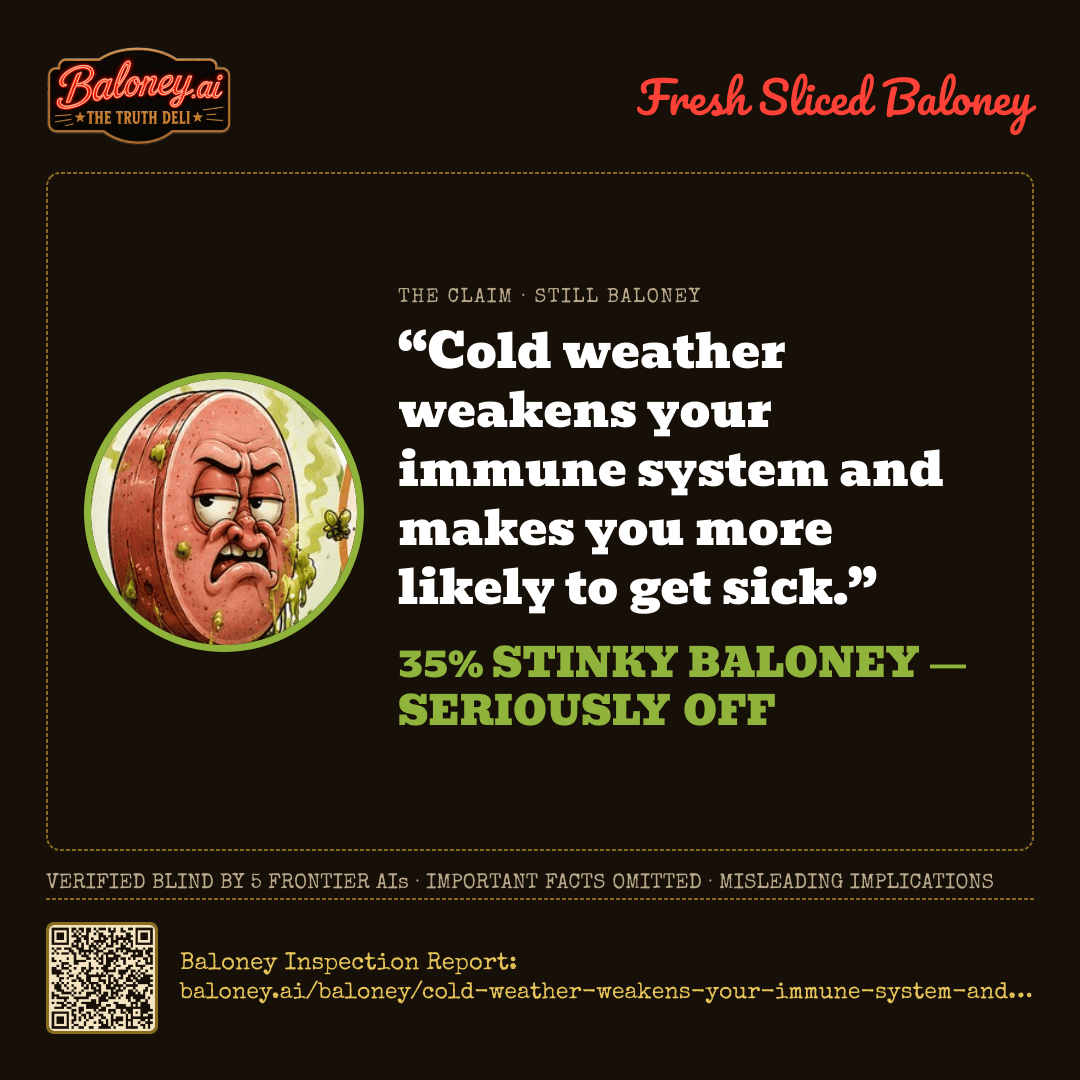
30%BALONEY
ROUND-1 BREAKDOWN
- A 2022 study in the Journal of Allergy and Clinical Immunology (Huang, Bleier and colleagues, Massachusetts Eye and Ear/Northeastern) found that lowering nasal tissue temperature by roughly 5°C — the change produced by breathing cold air — cut the release of antiviral extracellular vesicles from nasal epithelium by about 40% and reduced their ability to bind and neutralize viruses. This is direct mechanistic evidence that cold air blunts the nose's first-line innate immune defense.
- Foxman et al., PNAS 2015, showed that rhinovirus replicates better at 33°C (cooler airway temperature) than at 37°C, largely because the interferon-mediated innate antiviral response of airway cells is weaker at cooler temperatures. Cooling the nasal passages therefore plausibly gives common-cold viruses an advantage.
- Cold air causes vasoconstriction in the nasal mucosa and slows mucociliary clearance, reducing the rate at which inhaled pathogens are physically removed from the airway.
- Cold weather is accompanied by low absolute humidity, and Kudo et al. (PNAS 2019) showed low ambient humidity impairs airway barrier function, mucociliary clearance and interferon-stimulated antiviral responses in mice, increasing susceptibility to influenza.
- Winter reduces sunlight exposure and vitamin D synthesis; meta-analyses of randomized trials (e.g., Martineau et al., BMJ 2017) indicate vitamin D supplementation modestly reduces acute respiratory infections, especially in deficient individuals — a plausible seasonal immune pathway.
- Epidemiologically, influenza, RSV and most common-cold coronaviruses show strong winter peaks in temperate zones, consistent with some cold-related increase in susceptibility and/or transmission.
- A frequently cited 2005 study by Johnson and Eccles (Family Practice) reported that volunteers whose feet were chilled in cold water developed more self-reported cold symptoms over the following days than controls, suggesting chilling may trigger symptomatic infection in people already carrying a virus.
- Cold weather alone cannot make you sick: colds and flu are caused by viruses, and without exposure to a pathogen, being cold produces no infection. The popular version of this claim ('going out with wet hair gives you a cold') is a myth.
- Classic experimental studies contradict the folk version. Douglas and colleagues (New England Journal of Medicine, 1968) inoculated volunteers with rhinovirus and exposed them to cold environments (including near-freezing temperatures and wet conditions) and found no increase in infection rate or illness severity. Similar chilling experiments at the UK Common Cold Unit in Salisbury also failed to show increased susceptibility.
- Most public-health and academic sources attribute winter seasonality primarily to behavior and environment rather than immune weakening: people crowd indoors with poor ventilation, school terms concentrate children, and low humidity plus low temperature increase the survival and aerosol persistence of influenza and other viruses outside the body.
- The demonstrated cold-related immune effect is local (nasal epithelium) and temporary, not a systemic 'weakened immune system.' There is little evidence that ordinary cold exposure suppresses adaptive immunity or leukocyte function in healthy people; severe hypothermia is a different matter.
- The Johnson & Eccles foot-chilling study relied on self-reported symptoms, had no virological confirmation, and has not been robustly replicated, so it is weak evidence.
- Not all respiratory or infectious seasonality follows cold: enteroviruses, some parainfluenza serotypes and many other infections peak in summer, and respiratory viruses also circulate seasonally in warm tropical regions (often tied to rainy seasons), undermining a simple 'cold = sick' model.
- Some evidence points the other way for brief cold exposure: short cold-water immersion transiently increases circulating leukocytes and catecholamines, and a randomized trial of cold showers (Buijze et al., PLOS ONE 2016) found fewer sickness absence days, though not fewer reported illnesses.
78/100 — the lab’s own confidence in the score above, not a second reading of the claim.
SourcesProceedings of the National Academy of Sciences (Foxman et al., Yale)journal · 93 · Journal of Allergy and Clinical Immunology (Huang/Bleier et al., 2022, nasal extracellular vesicles and cold exposure)journal · 88 · Proceedings of the National Academy of Sciences (Kudo et al., low humidity and influenza susceptibility)journal · 92 · The BMJ (Martineau et al., vitamin D and acute respiratory infections meta-analysis)journal · 90 · New England Journal of Medicine (Douglas et al., 1968, cold exposure and rhinovirus colds — no effect demonstrated)journal · 92 · U.S. Centers for Disease Control and Prevention (influenza seasonality)gov · 90 · Harvard Health Publishing, Harvard Medical Schooledu · 85 · Johns Hopkins Medicineedu · 87 · Mayo Clinicedu · 87 · NIH News in Health (National Institutes of Health)gov · 88 · PLOS ONE (Buijze et al., cold shower randomized trial)journal · 78