








INSPECTION REPORT · CLAIM #1045 · baloney.ai/baloney/coffee-dehydrates-you

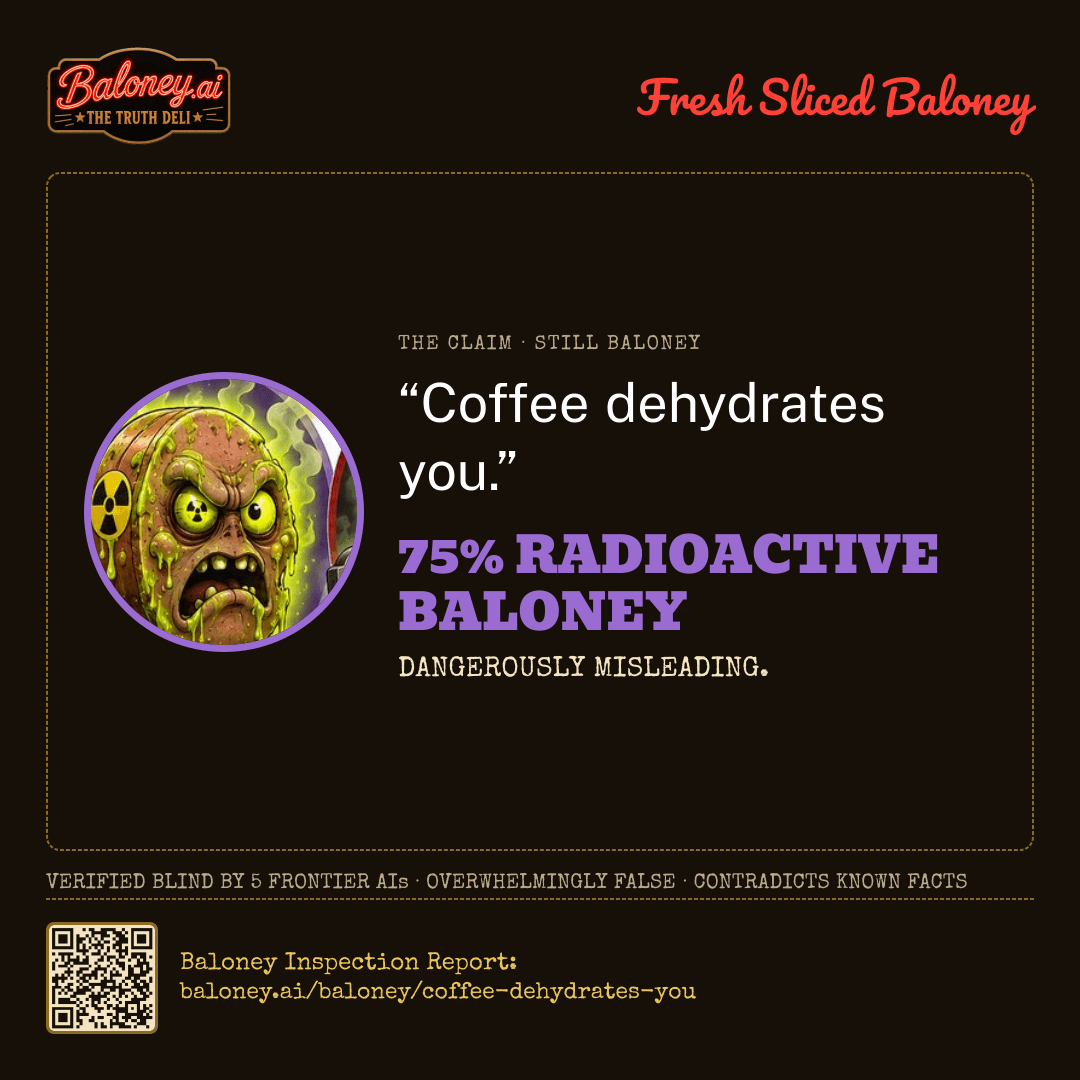
Coffee dehydrates you.

SUBMITTED ANONYMOUSLY · INSPECTED 2026-09-14T19:23:46.632Z · STATUS: PUBLISHED

Radioactive Baloney75%
75%
RADIOACTIVE BALONEY — DANGEROUSLY TOXIC
Dangerously misleading.
Overwhelmingly falseContradicts known factsPromotes false beliefsPotential for harm
Super Fresh Truth
Fishy Baloney
Stinky Baloney
Rotting Baloney
Radioactive Baloney
Zombie Baloney

✓ BLIND VALIDATION CONFIRMED THIS SCORE

Serve It Fresh

Ready to Serve10 servings

Serve it the way you want it

The Verdict

Coffee dehydrates you.
75% RADIOACTIVE BALONEY DANGEROUSLY TOXIC
Verified blind by 5 frontier AIs · Baloney Inspection Report: baloney.ai/baloney/coffee-dehydrates-you

The Rating Card

75% Radioactive Baloney card for this claim

The Order Ticket

19:23:46CLAIM RECEIVED — QUEUED FOR INSPECTION
19:24:35claude-opus-5 REPORTED — SCORE 75, CONFIDENCE 88
19:24:25gpt-5.5 REPORTED — SCORE 72, CONFIDENCE 90
19:24:06gemini-3.1-pro-preview REPORTED — SCORE 85, CONFIDENCE 95
19:24:05sonar-pro REPORTED — SCORE 15, CONFIDENCE 92
19:24:44grok-4.6 REPORTED — SCORE 78, CONFIDENCE 85
19:25:58PRIMARY MASTER CLAUDE — SCORE 78
19:24:54BLIND VALIDATION PERPLEXITY — SCORE 82
19:25:58AGREEMENT CONFIRMED — DELTA 7

How This One Was Sliced

Station 1 · Blind Inspection — Five Graders, Zero Peeking

Each lab scored the claim independently, without seeing the others. Open a breakdown for its evidence, its sources, and how sure it was.

Anthropic · EQUAL WEIGHT · 49.1s

claude-opus-5

75%BALONEY

ROUND-1 BREAKDOWN
Evidence offered for the claim
  • Caffeine is a mild, dose-dependent diuretic: it antagonizes adenosine receptors in the kidney, reducing sodium reabsorption and increasing urine output. Controlled dose-response work (e.g., Passmore et al., Clinical Science, 1987) documented measurable increases in urine flow and sodium excretion after caffeine ingestion.
  • Acute high doses matter: studies generally find a diuretic response at roughly ≥250–300 mg caffeine in a single sitting (about 3+ strong cups) in people who are not habitual users. A meta-analysis of caffeine and diuresis (Zhang et al., Journal of Science and Medicine in Sport, 2015) found a small but statistically significant increase in urine output at rest with higher doses.
  • Caffeine content changes the result: a crossover trial (Seal et al., Frontiers in Nutrition, 2017) found coffee with high caffeine content — but not low-caffeine coffee — increased fluid and electrolyte excretion at rest, showing the effect is real when the dose is high enough.
  • Tolerance is not universal or permanent: people who abstain from caffeine for several days and then consume a large dose show a more pronounced diuretic response, so 'coffee makes you urinate more' can be true for occasional drinkers.
  • Because coffee is usually consumed hot and in small volumes, a very strong espresso delivers a relatively high caffeine dose per millilitre of fluid, which is the scenario in which net fluid balance is least favourable.
Evidence against the claim
  • The key distinction is diuresis vs. dehydration: increased urine output does not equal net fluid loss. Coffee is roughly 98% water, and the water delivered exceeds the extra water excreted at normal consumption levels.
  • A counterbalanced crossover trial in habitual coffee drinkers (Killer, Blannin & Jeukendrup, PLOS ONE, 2014) directly compared 4 × 200 mL coffee/day (~4 mg/kg caffeine) with equal volumes of water and found no significant differences in total body water, urine output, blood or urine osmolality, or haematocrit — concluding 'no evidence of dehydration' with moderate coffee intake.
  • Grandjean et al. (Journal of the American College of Nutrition, 2000) found no significant differences in hydration status markers between men consuming water versus caffeinated caloric and non-caloric beverages.
  • Armstrong et al. (International Journal of Sport Nutrition and Exercise Metabolism, 2005) tracked 11 days of controlled caffeine intake (up to ~6 mg/kg/day) and found no meaningful changes in body mass, urine specific gravity, osmolality, or renal hydration indices.
  • The authoritative review by Maughan & Griffin (Journal of Human Nutrition and Dietetics, 2003) concluded that caffeinated beverages contribute to daily fluid requirements much like non-caffeinated drinks and that there is no evidence of harmful fluid-electrolyte imbalance from moderate intake.
  • Habituation blunts the effect: regular consumers develop substantial tolerance to caffeine's diuretic action within days, so most daily coffee drinkers show little or no measurable diuresis.
  • Public health bodies explicitly count coffee toward fluid intake. The UK NHS lists tea and coffee among drinks that contribute to daily fluid needs, and Harvard's Nutrition Source states that moderate coffee drinking does not cause dehydration.
  • Exercise/heat studies have not found that coffee consumption impairs hydration status or thermoregulation relative to water at moderate doses, undermining the 'coffee dehydrates athletes' version of the claim.
How sure this lab was

88/100 — the lab’s own confidence in the score above, not a second reading of the claim.

Sources

PLOS ONE (Killer, Blannin & Jeukendrup, 2014)journal · 90 · Journal of the American College of Nutrition (Grandjean et al., 2000)journal · 78 · International Journal of Sport Nutrition and Exercise Metabolism (Armstrong et al., 2005)journal · 82 · Journal of Human Nutrition and Dietetics (Maughan & Griffin, 2003 review)journal · 85 · Journal of Science and Medicine in Sport (Zhang et al., 2015 meta-analysis on caffeine and diuresis)journal · 80 · Frontiers in Nutrition (Seal et al., 2017, high- vs low-caffeine coffee and fluid/electrolyte excretion)journal · 72 · Harvard T.H. Chan School of Public Health, The Nutrition Sourceedu · 90 · NHS (UK) — Water, drinks and your healthgov · 92 · European Food Safety Authority — Scientific Opinion on the safety of caffeine (2015)gov · 92 · Mayo Clinic — expert answer on caffeinated drinks and hydrationother · 88

OpenAI · EQUAL WEIGHT · 38.6s

gpt-5.5

72%BALONEY

ROUND-1 BREAKDOWN
Evidence offered for the claim
  • Caffeine, a major active compound in coffee, can have a mild diuretic effect: it may increase urine production, especially at higher doses or in people who are not habitual caffeine users.
  • A scientific review concluded that acute ingestion of relatively large caffeine doses—about 250–300 mg or more—can cause a short-term increase in urine output, so very strong coffee or multiple coffees in a short period could modestly promote fluid loss.
Evidence against the claim
  • The blanket claim that coffee dehydrates you is not supported for typical consumption: coffee is mostly water, and the fluid it provides generally offsets caffeine’s mild diuretic effect.
  • A controlled crossover study in habitual male coffee drinkers found no significant difference in hydration markers when participants drank moderate coffee compared with water, concluding there was no evidence of dehydration from moderate daily coffee intake.
  • Public-health guidance from the NHS states that tea and coffee count toward daily fluid intake, while noting caffeine can make the body produce urine more quickly.
  • The National Academies’ dietary reference intake report treats beverages, including caffeinated beverages, as contributors to total water intake rather than categorizing coffee as dehydrating.
How sure this lab was

90/100 — the lab’s own confidence in the score above, not a second reading of the claim.

Sources

MedlinePlusgov · 92 · Journal of Human Nutrition and Dieteticsjournal · 88 · PLOS ONEjournal · 90 · NHSgov · 90 · National Academies Pressother · 91

Google · EQUAL WEIGHT · 20.3s

gemini-3.1-pro-preview

85%BALONEY

ROUND-1 BREAKDOWN
Evidence offered for the claim
  • Caffeine, the primary active pharmacological compound in coffee, acts as a mild diuretic by inhibiting sodium reabsorption in the kidneys, which can stimulate increased urine production.
  • In individuals who are entirely unhabituated to caffeine, or when caffeine is consumed in very high acute doses (typically exceeding 500 mg), it can cause a temporary, short-term increase in fluid excretion.
Evidence against the claim
  • Coffee is predominantly composed of water. The volume of fluid ingested in a standard cup of coffee more than offsets the mild diuretic effect of the caffeine it contains.
  • The human body quickly develops a tolerance to the diuretic effects of caffeine. For regular coffee drinkers, the diuretic effect is virtually non-existent.
  • A rigorous 2014 clinical crossover study published in PLOS ONE found no significant differences in blood or urinary markers of hydration between adult men who consumed moderate amounts of coffee and those who consumed equal volumes of water.
  • Major health and medical organizations advise that caffeinated beverages, when consumed in moderation, actively contribute to a person's daily fluid intake requirements rather than detracting from them.
How sure this lab was

95/100 — the lab’s own confidence in the score above, not a second reading of the claim.

Sources

PLOS ONEjournal · 90 · Mayo Clinicother · 95

Perplexity · EQUAL WEIGHT · 18.4s

sonar-pro

15%BALONEY

ROUND-1 BREAKDOWN
Evidence offered for the claim
  • Coffee contains **caffeine**, which is a **mild diuretic**, meaning it can increase urine output; at sufficiently high intakes (around or above ~500 mg caffeine per day, roughly ≥5 cups of brewed coffee), studies and summaries note that caffeine can have a more pronounced diuretic effect that could *contribute* to dehydration in some people, especially if fluid and electrolyte intake are otherwise inadequate.[9]
  • Health-oriented summaries acknowledge that people who are **not habituated** to caffeine may experience a stronger diuretic response; in such cases, large doses of coffee in short periods without compensatory water intake could increase fluid loss and *theoretically* elevate dehydration risk.[4][9]
  • Clinical and expert commentary consistently state that **caffeine does increase short‑term urine production**, so if coffee intake is very high and water intake is low—particularly in hot environments, with heavy sweating, or illness—this combination can promote net fluid loss and dehydration.[4][8][9]
Evidence against the claim
  • Multiple expert sources and clinical data report that **moderate coffee intake does not cause net dehydration**; the fluid in coffee largely offsets caffeine’s mild diuretic effect, so coffee is *not* dehydrating under usual consumption patterns.[1][2][3][4][5][6][8][9][10][11][12][14][15]
  • Coffee is **>95–98% water**, and research comparing several cups of coffee with the same volume of water finds **no significant difference in total body water, urine output, or blood markers of hydration**, indicating that coffee “provides similar hydrating qualities to water” in regular drinkers.[1][3][7][10][11][12][13][15]
  • A randomized crossover study in habitual male coffee drinkers consuming about four cups per day found **no significant change in total body water** and no difference in hydration markers between coffee and water trials over several days, directly contradicting the claim that coffee dehydrates you.[10][11][7][8]
  • Dietitians and medical organizations (including Mayo Clinic–linked expert commentary and major health outlets) state that while caffeinated drinks may have a mild diuretic effect, they **do not appear to increase the risk of dehydration** when consumed in typical amounts as part of a normal lifestyle.[1][2][4][6][8][9][14][15]
  • Guidance summarizing FDA recommendations notes that when caffeine intake stays within about **≤400 mg/day** (roughly 4–5 cups of coffee), fluid loss is not a concern for most healthy adults; only **excessive doses** beyond that level may promote increased urine output.[4][9]
  • Fact‑style explainers and hydration guides explicitly describe the notion that “coffee dehydrates you” as a **myth**, emphasizing that moderate coffee still **counts toward daily fluid intake** and yields a net positive hydration effect.[1][3][5][7][10][12][13][15]
How sure this lab was

92/100 — the lab’s own confidence in the score above, not a second reading of the claim.

Sources

Cleveland Clinicedu · 95 · GoodRx Healthnews · 85 · CoffeeStudies (research summary site)other · 70 · DocChecknews · 75 · The Star (QuickCheck)news · 75 · Medical Daily (citing Mayo Clinic expert)news · 80 · Vocal Media (article summarizing trial)other · 65 · LiveSciencenews · 85 · Healthlinenews · 85 · Hydrate by Supa (science‑based guide)other · 70 · Dr Kumar Discovery (research summary of randomized crossover study)other · 70 · Foodienews · 70

xAI · EQUAL WEIGHT · 58.3s

grok-4.6

78%BALONEY

ROUND-1 BREAKDOWN
Evidence offered for the claim
  • Caffeine is a mild diuretic that can increase urine volume, especially at high doses or in people who do not regularly consume it.
  • Some individuals subjectively notice more frequent urination after coffee, which historically fueled the dehydration claim.
Evidence against the claim
  • A 2014 randomized crossover trial found no differences in total body water or hydration biomarkers when habitual drinkers consumed moderate coffee versus water.
  • The European Food Safety Authority concluded that caffeine intakes up to 400 mg/day do not cause dehydration.
  • Coffee's water content more than offsets any modest diuretic effect in regular consumers, who develop tolerance.
  • Health authorities treat caffeinated beverages as contributing to daily fluid intake rather than net fluid loss.
How sure this lab was

85/100 — the lab’s own confidence in the score above, not a second reading of the claim.

Sources

PLOS ONEjournal · 88 · European Food Safety Authoritygov · 95

Station 2 · The Masters

Primary Master · drawn at random

claude-opus-5

78% BALONEY

The statement as written is an unqualified, general claim: drinking coffee dehydrates you. Four of the five evaluators converged on scores of 72–85, and the underlying evidence base they cite is consistent and strong: the fluid delivered by a cup of coffee (roughly 98% water) exceeds any extra fluid excreted at normal consumption levels, so coffee produces no net dehydration. The most directly probative study cited by three separate evaluators — the 2014 PLOS ONE counterbalanced crossover trial (Killer, Blannin & Jeukendrup) comparing 4 x 200 mL of coffee per day with equal volumes of water in habitual drinkers — found no significant differences in total body water, urine output, blood or urine osmolality, or haematocrit, and concluded there was 'no evidence of dehydration'. That finding is reinforced by Grandjean et al. (2000), Armstrong et al. (2005, 11 days of controlled intake up to ~6 mg/kg/day), the Maughan & Griffin review (2003), and by the position of public bodies: EFSA concluded intakes up to 400 mg/day do not cause dehydration, and the NHS and National Academies both count coffee toward daily fluid intake. The kernel of truth — caffeine is a mild, dose-dependent diuretic, with a measurable diuresis at roughly 250–500 mg in a single sitting in non-habituated people (Zhang meta-analysis; Seal et al. 2017 high- vs low-caffeine coffee) — explains why the myth persists, but diuresis is not dehydration, and tolerance develops within days in regular drinkers. The claim therefore fails not on a wording technicality but on its central assertion. I have not gone to the top of the panel's range because coffee genuinely does increase urine output and can, at extreme doses combined with poor fluid intake, contribute to fluid loss; the statement is a misleading overreach from a real mechanism rather than a pure fabrication, and it carries limited potential for harm. Report 1's recommendation of 15 is inconsistent with its own evidence, which is overwhelmingly against the claim and includes the word 'myth'; I have used its evidence and set aside its number as an apparent scale inversion.

All five evaluators agreed on the substance: caffeine is a mild diuretic, but coffee at ordinary intakes does not produce net dehydration, and all five cited or endorsed the 2014 PLOS ONE crossover trial or equivalent authority. Four recommended scores of 72–85. The single outlier recommended 15 while simultaneously describing the claim as a 'myth' and listing a dozen sources against it — an internally contradictory rating, apparently a scale inversion rather than a substantive dissent. The only genuine nuance, raised most fully by Report 5 and echoed by Reports 3 and 4, is the dose threshold: a measurable diuretic response appears at roughly 250–500 mg of caffeine in one sitting in people not habituated to it.

Blind Validation Master · never saw the Primary’s work

sonar-pro

82% BALONEY

Across all five reports, there is consistent, high‑confidence agreement that while **caffeine is a mild diuretic**, typical coffee consumption **does not produce net dehydration** and coffee generally **contributes to hydration** because it is mostly water. Key points of consensus: - **Diuretic effect is real but limited**: All reports acknowledge that caffeine can increase urine output, especially at higher doses (≈250–300 mg in one go or ≥500 mg/day) and in people who are not habituated to caffeine. - **Net fluid balance is usually positive**: Multiple controlled trials (e.g., Killer et al. 2014 in PLOS ONE, Grandjean et al. 2000, Armstrong et al. 2005) show **no significant differences in total body water, hydration markers, or thermoregulation** when comparing moderate coffee intake with equal volumes of water in habitual drinkers. - **Coffee is mostly water**: Reports emphasize that coffee is ~95–98% water, and for moderate intake (≤400 mg caffeine/day), the water ingested outweighs any extra fluid lost through caffeine‑induced diuresis. - **Health authorities treat coffee as hydrating**: Bodies like the **NHS**, **EFSA**, **Harvard T.H. Chan School**, and **Mayo Clinic** explicitly state that caffeinated beverages, including coffee, **count toward daily fluid intake** and do not increase dehydration risk at normal consumption levels. - **Tolerance blunts the diuretic effect**: Regular coffee drinkers quickly develop tolerance, making the diuretic impact small or negligible for most daily users. Crucially, the statement being scored is **"Coffee dehydrates you"** — a broad, categorical claim with no qualifiers about dose, habit, or context. The evidence strongly contradicts this blanket assertion: - Moderate, everyday coffee consumption does **not** dehydrate people and is often empirically indistinguishable from water in hydration studies. - Only in edge cases (very high acute doses, non‑habituated individuals, insufficient overall fluid/electrolyte intake, extreme heat/illness) could coffee *contribute* to dehydration, and even then it is one factor among many, not an inherently dehydrating substance. Because the claim is stated absolutely and suggests that drinking coffee inherently leads to dehydration, it misrepresents the relationship between coffee, diuresis, and hydration. The underlying truth is nuanced: “coffee can modestly increase urine output, especially at high doses or in non‑habitual users, but typical coffee drinking does **not** dehydrate you and usually supports hydration.” The evaluated statement ignores this nuance and aligns with a well‑documented **myth** repeatedly debunked by clinical studies and public‑health guidance. Therefore, the claim as written is **overwhelmingly false**, with some potential for harm if it leads people to misunderstand hydration or avoid benign coffee consumption for the wrong reasons. That places it firmly in **Radioactive Baloney** territory, yielding a final score of **82**.

AGREEMENT TEST PASSED — MASTERS SCORED 78% AND 82% · BLIND VALIDATION CONFIRMED THIS SCORE · NO RE-EVALUATION REQUIRED

The Evidence

Evidence offered for the claim

  • Caffeine is a mild diuretic DEBUNKED — Caffeine antagonises adenosine receptors in the kidney and reduces sodium reabsorption, increasing urine flow — but the panel found that extra urine output is not the same as net fluid loss, because the water in the coffee exceeds the water excreted.
  • High single doses do increase excretion DEBUNKED — A diuretic response is generally measurable at roughly 250–500 mg of caffeine in one sitting (Zhang et al. meta-analysis, 2015; Seal et al., Frontiers in Nutrition, 2017, where high-caffeine but not low-caffeine coffee raised fluid and electrolyte excretion). The panel noted this is a transient rise in output at unusually high doses, not a demonstrated dehydration of the drinker.
  • Non-habituated drinkers react more DEBUNKED — People who have abstained from caffeine for several days show a more pronounced diuretic response to a large dose, which is why 'coffee makes you urinate more' feels true to occasional drinkers. Tolerance to the diuretic effect develops within days in regular consumers, so most daily drinkers show little or no measurable diuresis.
  • Extreme intake plus low fluid intake DEBUNKED — At intakes around or above ~500 mg caffeine a day, with inadequate water and electrolytes, heavy sweating or illness, caffeine could contribute to net fluid loss. The panel treated this as a narrow edge case that does not support the claim as a general statement about coffee.

Evidence against the claim

  • Controlled trial found no dehydration A counterbalanced crossover trial in habitual coffee drinkers (Killer, Blannin & Jeukendrup, PLOS ONE, 2014) compared 4 x 200 mL of coffee per day with equal volumes of water and found no significant differences in total body water, urine output, blood or urine osmolality or haematocrit, concluding there was 'no evidence of dehydration'.
  • Coffee is almost entirely water Coffee is roughly 98% water, and at normal consumption levels the fluid it delivers exceeds any additional fluid excreted, producing a net positive contribution to hydration.
  • EFSA: 400 mg/day does not dehydrate The European Food Safety Authority concluded that caffeine intakes up to 400 mg a day — roughly four to five cups of brewed coffee — do not cause dehydration.
  • Longer-term controlled intake studies agree Grandjean et al. (2000) found no significant differences in hydration markers between men drinking water and those drinking caffeinated beverages, and Armstrong et al. (2005) tracked 11 days of controlled caffeine intake up to ~6 mg/kg/day with no meaningful change in body mass, urine specific gravity, osmolality or renal hydration indices.
  • Authoritative review reached the same conclusion Maughan & Griffin (Journal of Human Nutrition and Dietetics, 2003) concluded that caffeinated beverages contribute to daily fluid requirements much like non-caffeinated drinks, with no evidence of harmful fluid–electrolyte imbalance at moderate intake.
  • Public health bodies count coffee as fluid The UK NHS lists tea and coffee among the drinks that contribute to daily fluid needs (while noting caffeine makes the body produce urine more quickly), the National Academies' dietary reference intake report treats caffeinated beverages as contributors to total water intake, and Harvard's Nutrition Source and Mayo Clinic experts state moderate coffee drinking does not cause dehydration.
  • Tolerance blunts the effect Regular consumers develop substantial tolerance to caffeine's diuretic action within days, so for habitual coffee drinkers the effect is minimal to non-existent.
  • No impairment in heat or exercise Exercise and heat studies cited by the panel have not found that coffee consumption impairs hydration status or thermoregulation relative to water at moderate doses, undermining the 'coffee dehydrates athletes' version of the claim.

Sources · Reliability · Why Accepted or Discounted

SourceTypeReliabilityRuling
PLOS ONE (Killer, Blannin & Jeukendrup, 2014)journal90ACCEPTED Peer-reviewed counterbalanced crossover trial directly comparing coffee with water on multiple hydration biomarkers; cited independently by four evaluators and the single most probative study on the claim.
European Food Safety Authority — Scientific Opinion on caffeine (2015)gov93ACCEPTED Official systematic safety assessment by a regulatory scientific body; directly addresses dehydration at defined intake levels.
NHS (UK) — Water, drinks and your healthgov91ACCEPTED National public health guidance that explicitly counts coffee toward fluid intake while acknowledging the diuretic mechanism; useful for both columns.
Journal of Human Nutrition and Dietetics (Maughan & Griffin, 2003)journal86ACCEPTED Peer-reviewed review that remains the standard reference on caffeinated beverages and fluid balance.
International Journal of Sport Nutrition and Exercise Metabolism (Armstrong et al., 2005)journal82ACCEPTED Controlled 11-day intake study with objective renal hydration indices; addresses the longer-term question the single-dose studies cannot.
Journal of Science and Medicine in Sport (Zhang et al., 2015 meta-analysis)journal80ACCEPTED Meta-analysis quantifying the genuine dose-dependent diuretic effect; accepted as the strongest evidence supporting the claim's kernel of truth.
Journal of the American College of Nutrition (Grandjean et al., 2000)journal78ACCEPTED Peer-reviewed comparison of caffeinated beverages against water on hydration markers; older but consistent with later work.
Frontiers in Nutrition (Seal et al., 2017)journal72ACCEPTED Peer-reviewed crossover trial isolating caffeine dose within coffee; modest journal tier but the finding is specific and was reported with its limits.
MedlinePlusgov92ACCEPTED Government consumer-health reference used for the uncontroversial pharmacological point that caffeine can mildly increase urine production.
National Academies Press — Dietary Reference Intakes for Waterother91ACCEPTED Authoritative consensus report on total water intake; its treatment of caffeinated beverages as fluid contributors is directly on point.
Harvard T.H. Chan School of Public Health, The Nutrition Sourceedu90ACCEPTED Academic public-health resource with stated evidence base; consistent with the peer-reviewed literature.
Mayo Clinic — expert answer on caffeinated drinks and hydrationother92ACCEPTED Major clinical institution's published expert guidance; cited by two evaluators and consistent with the trial evidence.
Cleveland Clinicedu95ACCEPTED Major clinical institution's patient-facing explainer, consistent with the primary literature.
LiveSciencenews85ACCEPTED Science journalism that reports and attributes the underlying trials; used only as corroboration, not as primary evidence.
Healthlinenews82ACCEPTED Reviewed consumer health content consistent with the peer-reviewed findings; corroborative weight only.
GoodRx Healthnews80ACCEPTED Clinician-reviewed consumer health content; corroborative weight only.
Medical Daily (citing Mayo Clinic expert)news75ACCEPTED Accepted only for the Mayo Clinic expert position it relays, which is independently sourced elsewhere in the panel.
DocChecknews72ACCEPTED Professional medical news outlet; adds nothing not already established by stronger sources but is not contradicted by them.
The Star (QuickCheck)news70ACCEPTED Newspaper fact-check format; low independent weight but consistent with the scientific consensus it summarises.
CoffeeStudies (research summary site)other45DISCOUNTED A topic-specific aggregator with an evident interest in coffee's reputation; secondary summary adding nothing beyond the primary trials, so it carries no independent weight here.

Serve It Fresh

Ready to Serve10 servings

Serve it the way you want it

The Verdict

Coffee dehydrates you.
75% RADIOACTIVE BALONEY DANGEROUSLY TOXIC
Verified blind by 5 frontier AIs · Baloney Inspection Report: baloney.ai/baloney/coffee-dehydrates-you