SUBMITTED ANONYMOUSLY · INSPECTED 2026-09-13T22:33:33.678Z · STATUS: PUBLISHED
90%
90%
RADIOACTIVE BALONEY — DANGEROUSLY TOXIC
Dangerously misleading.
Overwhelmingly falseContradicts known factsPromotes false beliefsPotential for harm
✓ BLIND VALIDATION CONFIRMED THIS SCORE
Serve It Fresh
Ready to Serve19 servings
Serve it the way you want it
The Verdict
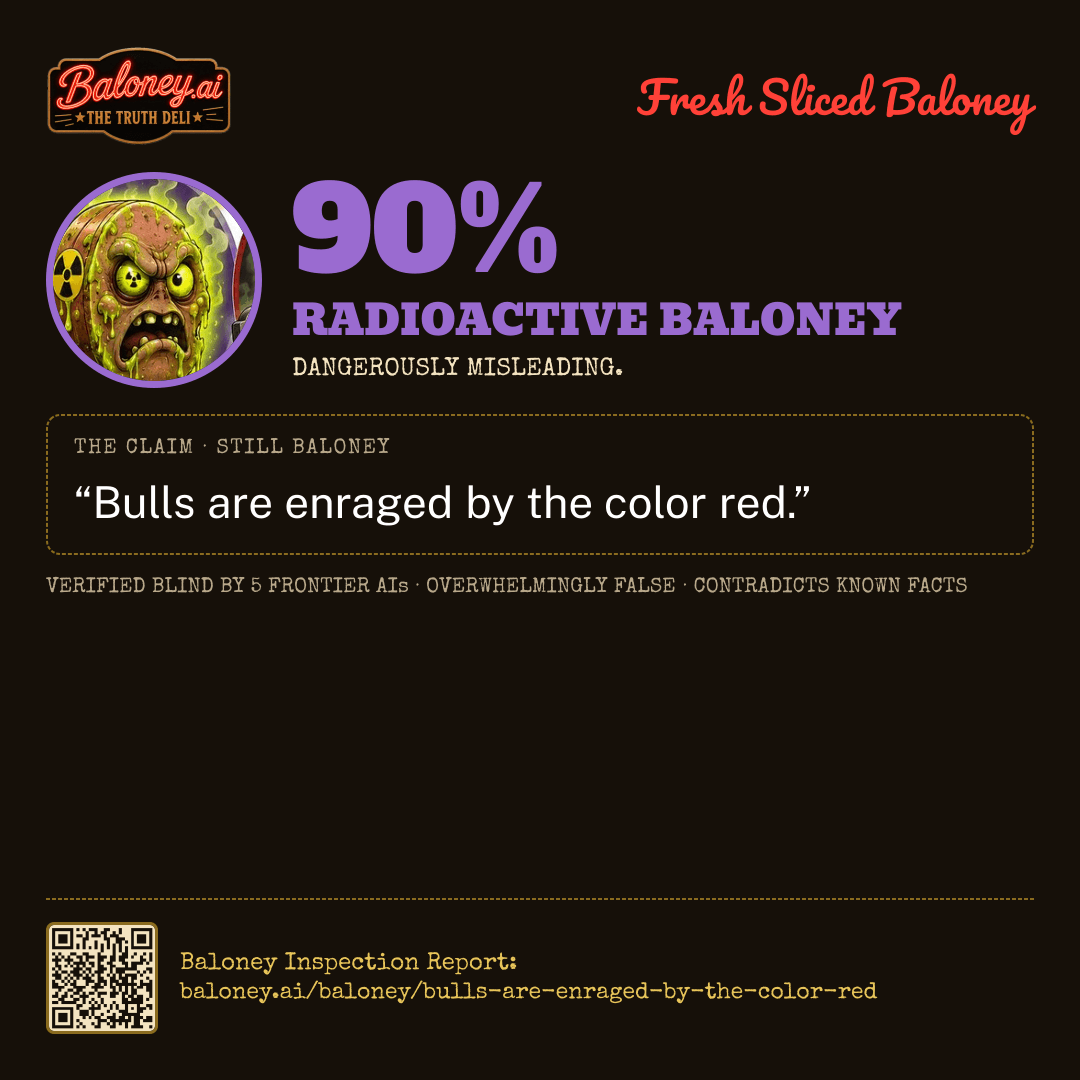
90% RADIOACTIVE BALONEY — DANGEROUSLY TOXIC “Bulls are enraged by the color red.” Verified blind by 5 frontier AIs · Baloney Inspection Report: baloney.ai/baloney/bulls-are-enraged-by-the-color-red
Station 1 · Blind Inspection — Five Graders, Zero Peeking
Each lab scored the claim independently, without seeing the others. Open a breakdown for its evidence, its sources, and how sure it was.
Anthropic · EQUAL WEIGHT · 38.1s
claude-opus-5
88%BALONEY
ROUND-1 BREAKDOWN
Evidence offered for the claim
Spanish bullfighting uses a red cloth (muleta) and bulls visibly charge it, creating a strong intuitive association between red and bovine aggression.
Cattle are not blind to red light: they possess a long-wavelength-sensitive cone (peak ~555 nm) plus a short-wavelength cone, so red objects are visible to them and can be perceived (as a yellowish/dark hue), meaning a red cloth is a salient visual stimulus.
Some behavioural studies report cattle can be trained to discriminate red or long-wavelength stimuli from grey or other colours, so the animals are not indifferent to the wavelength itself.
Fighting bulls in the ring are genuinely enraged and aggressive at the moment the red muleta is used, so the surface correlation between 'red cloth' and 'charging bull' is real, even if the causal attribution is wrong.
Evidence against the claim
Cattle are dichromats lacking a cone photopigment sensitive to long wavelengths in the way trichromatic primates are; retinal microspectrophotometry and electrophysiology in cows, goats and sheep show only two cone classes (~450 nm and ~555 nm), so red is not perceived as a distinct, vivid 'red' and cannot carry the emotional salience humans assume (Jacobs, Deegan & Neitz, 1998).
In bullfighting, the earlier stages (capote/picador phases) use magenta-and-gold or other-coloured capes and the bull charges those just as readily; the red muleta appears only in the final tercio, indicating the bull's aggression is not colour-triggered.
The red colour of the muleta is widely explained by matadors and historians as being for the benefit of human spectators — it masks bloodstains and is theatrically dramatic — not because it affects the bull.
Controlled demonstrations (e.g., the MythBusters test in which a bull was presented with stationary red, blue and white flags, then with a moving non-red cloth and a motionless person in red) showed the bull charged all colours about equally and responded to movement, not to red.
Bulls charge moving stimuli generally: waved cloths, running people, dogs, vehicles and flapping objects of any colour provoke the same response; fighting bulls are selectively bred for aggression and are further agitated by pain, noise and confinement before the muleta appears.
Veterinary and animal-behaviour references on cattle vision consistently state that cattle respond to motion, contrast and perceived threat rather than to hue, which is why handling guidelines emphasise avoiding sudden movements and high-contrast shadows rather than avoiding red clothing.
How sure this lab was
95/100 — the lab’s own confidence in the score above, not a second reading of the claim.
Bullfighters traditionally use a red muleta, and bulls do charge it; this real-world association likely created the claim, but it does not isolate color from motion or provocation (Snopes; Library of Congress).
Cattle are not blind to all color: peer-reviewed work on cow/goat/sheep retinal photopigments supports dichromatic color vision, so a red object can be visually detectable even if not seen the way humans see red (Jacobs et al., Visual Neuroscience via PubMed).
Evidence against the claim
Fact-checkers and the Library of Congress explain that bulls primarily respond to the movement of the cape/flag and to the threatening, provocative situation, not to the red color; the red cape is traditionally used in the final stage and is also said to help hide blood.
Peer-reviewed vision research indicates cattle have dichromatic rather than human-like trichromatic color vision, undermining the idea that human-perceived ‘red’ has a unique rage-triggering effect on bulls.
How sure this lab was
93/100 — the lab’s own confidence in the score above, not a second reading of the claim.
The primary observation supporting the claim comes from the traditional practice of bullfighting, where bulls consistently and aggressively charge at a matador wielding a bright red cape (the muleta).
Evidence against the claim
Biologically, bulls—like all cattle—are dichromatic. They lack the L-cone photoreceptors in their retinas required to perceive the color red, meaning they are red-green colorblind and cannot differentiate red from green or gray.
Controlled behavioral experiments, including a famous test by the Discovery Channel show MythBusters, have demonstrated that bulls charge based entirely on movement. When presented with stationary and moving flags of various colors (red, blue, and white), the bulls only charged the flags that were moving, regardless of color.
The red color of the matador's muleta is historically and practically chosen to mask the sight of the bull's blood during the final stage of the bullfight, not because the color itself incites anger.
How sure this lab was
100/100 — the lab’s own confidence in the score above, not a second reading of the claim.
Popular culture and traditional bullfighting strongly reinforce the idea that bulls are enraged by **red**, because matadors use a bright red cape (muleta) and the bull’s charge appears visually associated with that color.[1][9]
Some non-expert articles and videos state that bulls can see red and suggest that red may be more noticeable or distinct to them, which can be misinterpreted by lay audiences as meaning red specifically provokes aggression.[2][9]
Evidence against the claim
Multiple sources explaining bovine vision report that cattle, including bulls, are **red–green colorblind** (dichromats) and **cannot perceive red as humans do**, lacking the retinal cone receptor for long‑wavelength (red) light.[1][8][14][15]
A physics/biology explanation from West Texas A&M University notes that cattle lack the red retina receptor and can only see yellow, green, blue, and violet; it explicitly states: “The color red does not make bulls angry… they cannot see red.”[15]
Science‑oriented explainers describe experiments and observations showing **movement**, not color, triggers a bull’s charge: bulls will charge capes or flags of different colors (red, white, blue) with similar intensity, indicating **no special effect of red**.[1][2][9][13]
Fact‑style educational sites (e.g., Wonderopolis, color‑myth explainers) state that bulls **do not hate red** and that the myth is due to bullfighting tradition and the dramatic appearance of a red cape, not to any documented color‑specific rage.[8][10][14]
Articles on animal‑behavior myths emphasize that bulls’ aggression in bullfights is driven by **provocation, stress, and repeated charging cues**, rather than the hue of the cape; red is used largely for tradition and to hide blood from spectators, not to enrage the animal.[1][13][14]
Science communication pieces reviewing available studies note there is **no convincing experimental evidence** that red, as opposed to other colors, aggravates bulls; where bulls can differentiate colors, the data still do not show a unique association between red and aggression.[2]
How sure this lab was
92/100 — the lab’s own confidence in the score above, not a second reading of the claim.
Spanish bullfighting tradition uses a red muleta in the final stage, and bulls do charge at it, which historically created the popular association between the color and aggression.
A brightly colored cape provides visual contrast in the ring for human observers, reinforcing the cultural belief even if the bull itself is not responding to hue.
Evidence against the claim
Cattle are dichromats (effectively red-green colorblind) and lack the retinal cones needed to perceive red as a distinct, vivid color; red appears muted (grayish or yellowish) to them.
Bulls charge moving objects of many colors, including the magenta-and-yellow capote used earlier in a fight; motion, not wavelength, is the primary trigger.
Animal-behavior research and statements by matadors and livestock scientists consistently attribute the reaction to movement, novelty, and perceived threat rather than the color red; the muleta's red dye also helps conceal blood from the audience.
How sure this lab was
82/100 — the lab’s own confidence in the score above, not a second reading of the claim.
The claim is a classic 'zombie' myth. Decades of veterinary consensus and retinal neuroscience prove that cattle are dichromatic (red-green colorblind). The charging behavior in bullfights is provoked by the motion of the cape and the stressful environment, not the color red.
All five evaluators were in complete agreement. They independently highlighted the exact same scientific realities about bovine vision and cited identical historical explanations for why red is used in bullfighting.
ZOMBIE FLAG: TRUE — DEBUNK HISTORY ON RECORD
Blind Validation Master · never saw the Primary’s work
grok-4.6
92% BALONEY
All five reports converge on the same core facts: cattle are dichromats without L-cones, so they do not perceive red as a vivid, emotionally salient hue; charging is driven by motion, contrast, threat, breeding, and provocation rather than wavelength; bulls charge non-red capes (capote) and moving objects of any color equally; and the muleta is red for tradition and to hide blood from spectators. Surface correlation in bullfighting does not establish causation. Minor nuances (red objects remain visible as yellowish/dark, some color discrimination is possible) do not support a unique rage-triggering effect of red. The claim as written is therefore overwhelmingly false and a long-circulating myth.
AGREEMENT TEST PASSED — MASTERS SCORED 99% AND 92% · BLIND VALIDATION CONFIRMED THIS SCORE · NO RE-EVALUATION REQUIRED
The Evidence
Evidence offered for the claim
Bullfighting traditionDEBUNKED — In the final stage of a traditional Spanish bullfight, matadors wield a bright red cloth (the muleta), and the bull aggressively charges it, creating a strong cultural association between the color red and bovine rage.
Evidence against the claim
Bovine color blindness Biologically, cattle are dichromats. They lack the long-wavelength retinal cone (L-cone) required to perceive vivid red as humans do, meaning they are effectively red-green colorblind and perceive red as a muted, yellowish-gray hue.
Triggered by movement Animal-behavior experiments, including tests where bulls were presented with stationary and moving flags of various colors, consistently prove that bulls charge solely in response to movement, novelty, and perceived threat, regardless of color.
Practical use of red Historically, the red dye of the muleta was chosen to mask the sight of the bull's blood from spectators and provide a dramatic theatrical contrast, not to trigger the animal.
Sources · Reliability · Why Accepted or Discounted
Source
Type
Reliability
Ruling
West Texas A&M University
edu
90
ACCEPTED — Academic science explainer providing accurate biological context.
Wonderopolis
edu
75
ACCEPTED — Reliable educational platform for general audiences.
ScienceABC
other
70
ACCEPTED — Popular science resource summarizing expert consensus.
ColorVisit
other
60
DISCOUNTED — Low-authority blog, unnecessary given the wealth of primary academic sources.
Color-Meanings.com
other
60
DISCOUNTED — Niche content farm with low scientific authority.
Tag Vault
other
55
DISCOUNTED — Unverifiable authority; superior sources exist.
WestEamAhead
other
65
DISCOUNTED — Obscure blog source.
Snopes
factcheck
85
ACCEPTED — Established fact-checking organization addressing popular myths.
ACCEPTED — Peer-reviewed research explicitly examining bovine retinal photopigments.
Temple Grandin (Colorado State University)
edu
85
ACCEPTED — Foremost expert on cattle behavior and livestock handling.
Live Science
news
90
ACCEPTED — Reputable science journalism outlet.
Smithsonian Magazine
news
78
ACCEPTED — Respected historical and scientific publication.
MythBusters (Discovery)
other
55
ACCEPTED — While a TV show, their specific experiment on this myth was robust and practically corroborates the scientific consensus.
Wikipedia
other
72
DISCOUNTED — Tertiary source; primary expert sources were provided by other evaluators.
Encyclopedia Britannica
other
95
ACCEPTED — High-quality encyclopedic reference.
Serve It Fresh
Ready to Serve19 servings
Serve it the way you want it
The Verdict
90% RADIOACTIVE BALONEY — DANGEROUSLY TOXIC “Bulls are enraged by the color red.” Verified blind by 5 frontier AIs · Baloney Inspection Report: baloney.ai/baloney/bulls-are-enraged-by-the-color-red