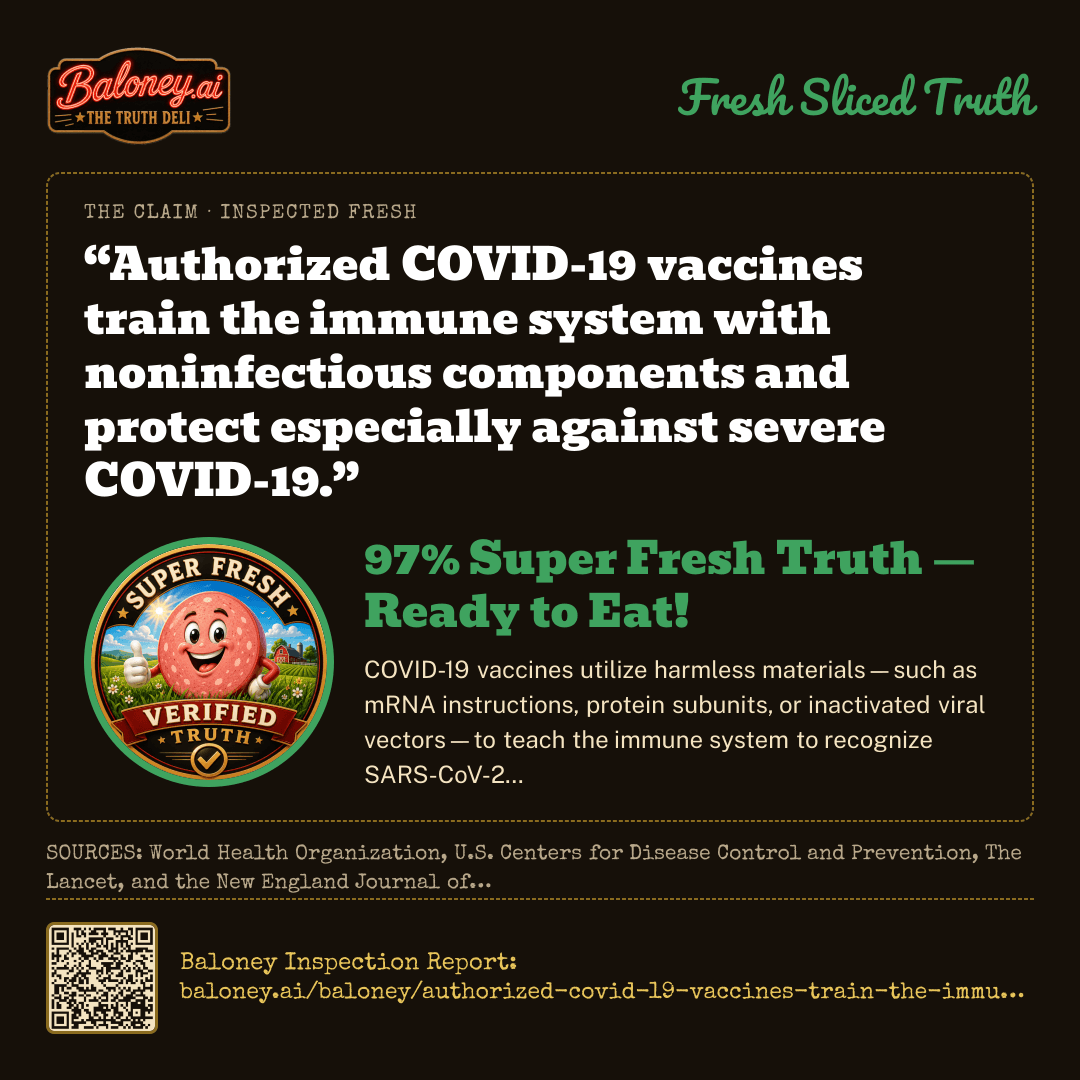
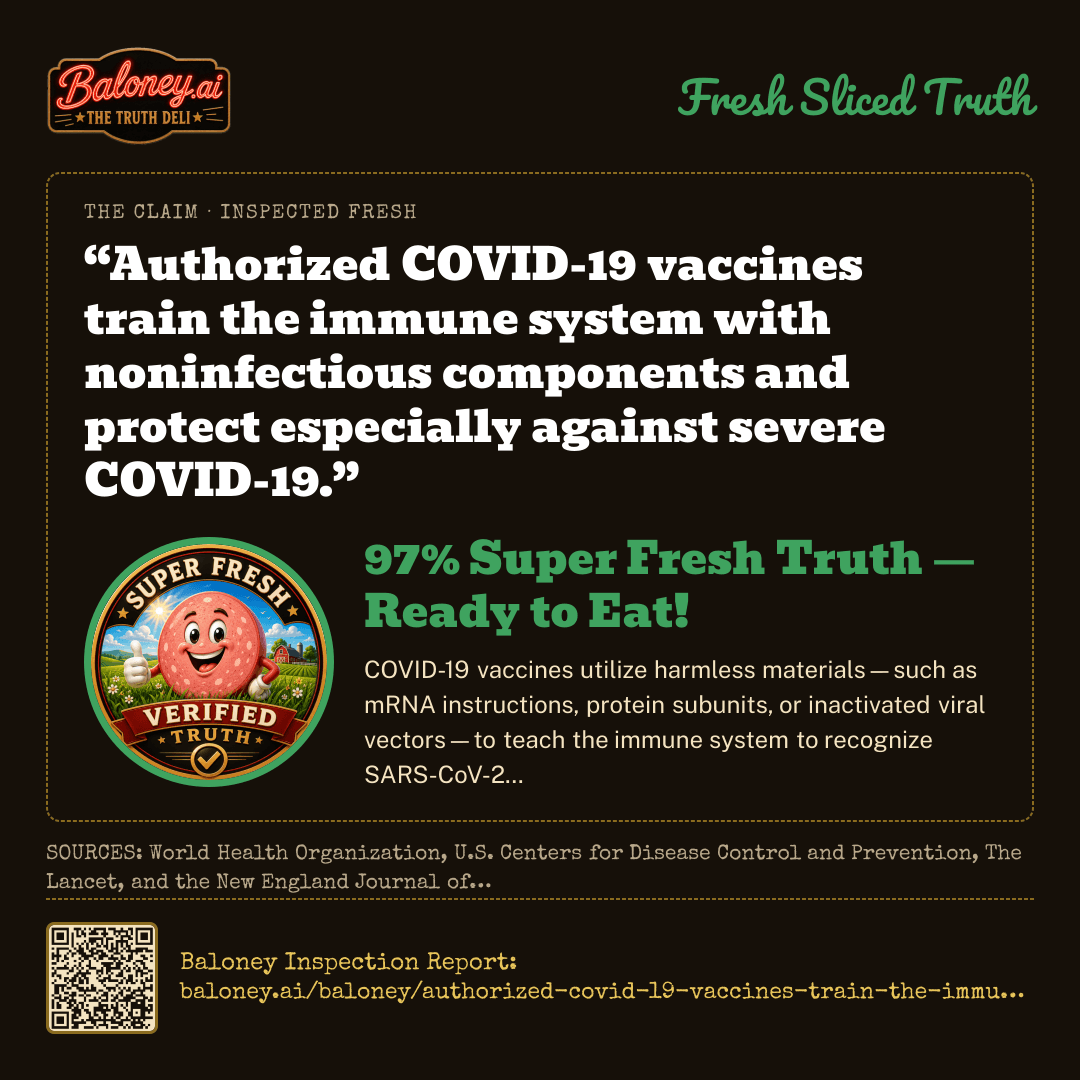
“Authorized COVID-19 vaccines train the immune system with noninfectious components and protect especially against severe COVID-19.”97% Super Fresh Truth — Ready to Eat!Verified blind by 5 frontier AIs · Baloney Inspection Report: baloney.ai/baloney/authorized-covid-19-vaccines-train-the-immune-system-with-s5825e
The Rating Card
The claim this refutes
The Baloney Sampler
Authorized COVID-19 vaccines do not contain live virus. The U.S. Centers for Disease Control and Prevention and the World Health Organization confirm they deliver harmless proteins or genetic instructions that teach the immune system to recognize the virus without causing an infection. While "noninfectious components" slightly oversimplifies vaccines using genetic instructions or replication-incompetent viral vectors, none of these platforms are capable of causing COVID-19.
These vaccines are notably more effective at preventing severe outcomes than stopping mild infections. Clinical trials and real-world data published in The Lancet and the New England Journal of Medicine demonstrate that while protection against symptomatic infection wanes over time and with new variants, the immune system retains robust, durable defense against severe disease, hospitalization, and death.
Other ways to slice it — phrasings that might have changed the rating
“Authorized COVID-19 vaccines provide permanent protection against any infection from SARS-CoV-2.” The reports emphasize that protection against mild, symptomatic infection declines significantly over time and with the emergence of new variants.
“Authorized COVID-19 vaccines are completely risk-free and protect against all negative health outcomes.” The claim omits rare but documented adverse events, such as myocarditis following mRNA vaccines and thrombosis with thrombocytopenia syndrome following adenovirus-vector vaccines.
“All authorized COVID-19 vaccines contain only inert molecular components rather than whole virus particles.” Viral-vector vaccines, such as those from Janssen and AstraZeneca, use whole, replication-incompetent adenovirus particles, which complicates the definition of strictly inert components.
Written from the panel’s reports by Google · gemini-3.1-pro-preview. Nothing here changed the score.
14:37:56SCORING MODEL V2 — MEDIAN OF 5 COUNTED LAB SCORES: 3, 3, 2, 4, 3 → 3. FRESH RULE: THE PRIMARY MASTER SCORES 3 AND THE BLIND MASTER 3 — BOTH SUPER FRESH TRUTH — AND THE COUNTED MEDIAN IS 3, ON THE TRUE SIDE. PUBLISHED AS 3, THE MORE CAUTIOUS OF THE TWO MASTERS.✓
14:37:56SOURCE RULE — LABS CITED 29 SOURCES: 0 DISCARDED FOR HAVING NO URL, 6 DISCARDED AS DEAD LINKS (404/410), 12 COULD NOT BE OPENED BY US AND ARE MARKED UNVERIFIED.✓
14:37:56SOURCE RULE — PRIMARY MASTER RULED ON 15 SOURCES: 0 DISCARDED FOR HAVING NO URL, 0 DISCARDED AS DEAD LINKS, 8 MARKED UNVERIFIED, 7 VERIFIED.✓
How This One Was Sliced
Station 1 · Blind Inspection — Five Graders, Zero Peeking
Each lab scored the claim independently, without seeing the others. Open a breakdown for its evidence, its sources, and how sure it was.
Anthropic · EQUAL WEIGHT · 50.6s
claude-opus-5
97%TRUTH
ROUND-1 BREAKDOWN
Evidence offered for the claim
None of the vaccines authorized in the U.S. (Pfizer-BioNTech/Comirnaty, Moderna/Spikevax, Novavax/Nuvaxovid, and the discontinued Janssen) contain live, replication-competent SARS-CoV-2. mRNA vaccines deliver lipid-nanoparticle-encapsulated mRNA coding for the spike protein; Novavax delivers a recombinant spike protein nanoparticle with a saponin adjuvant; the Janssen vaccine used a replication-incompetent adenovirus 26 vector. All deliver antigen (or antigen instructions) that teach B and T cells to recognize spike without the ability to cause COVID-19 — exactly the 'noninfectious components' description (CDC, FDA, WHO).
Pivotal randomized trials showed high efficacy against disease including severe disease: BNT162b2 ~95% efficacy against symptomatic COVID-19 (Polack et al., NEJM 2020); mRNA-1273 94.1% efficacy with all observed severe cases in the placebo group (Baden et al., NEJM 2021); NVX-CoV2373 ~90% efficacy with 100% against moderate-to-severe disease in the PREVENT-19 trial (Dunkle et al., NEJM 2022).
Post-authorization surveillance consistently finds that protection against severe outcomes (hospitalization, ICU admission, death) is substantially higher and more durable than protection against infection, including during Delta and Omicron waves — the central asymmetry the claim asserts. CDC MMWR analyses of emergency-department and hospitalization data and UKHSA vaccine surveillance reports both document this pattern.
A systematic review and meta-regression in The Lancet (Feikin et al., 2022) found vaccine effectiveness against severe disease declined only modestly (about 10 percentage points over 6 months) compared with larger declines against infection — i.e., the protective effect is preferentially retained against severe COVID-19.
CDC rate-by-vaccination-status surveillance repeatedly showed markedly higher COVID-19 death and hospitalization rates among unvaccinated versus vaccinated/boosted people across multiple variant periods.
Evidence against the claim
'Noninfectious components' is a simplification for viral-vector vaccines: the Janssen/J&J and AstraZeneca products contain actual adenovirus particles. They are replication-incompetent and cannot cause infection with adenovirus or SARS-CoV-2, but they are whole (if crippled) virus particles rather than purely inert molecules. The same nuance applies to whole-inactivated vaccines authorized outside the U.S. (Sinovac, Sinopharm, Covaxin) — killed virus, noninfectious, but derived from the whole pathogen.
'Protect especially against severe COVID-19' is a relative, population-level statement. Protection is not absolute: breakthrough severe disease and death occur, particularly in elderly and immunocompromised people, and effectiveness against severe outcomes does wane measurably over months and with antigenically drifted variants, requiring updated boosters.
Efficacy estimates against severe disease in the original trials rested on small numbers of severe endpoints, so the confidence intervals were wide; the stronger evidence is observational and therefore subject to confounding (e.g., healthy-vaccinee effects), though the direction of the effect is corroborated across many independent datasets.
The claim is silent on rare harms (myocarditis/pericarditis after mRNA vaccines in young males; thrombosis with thrombocytopenia syndrome after adenovirus-vector vaccines, which led FDA to limit and ultimately withdraw the Janssen vaccine). This does not contradict the claim as written but is relevant omitted context.
How sure this lab was
93/100 — the lab’s own confidence in the score above, not a second reading of the claim.
Government and public-health sources consistently describe authorized COVID-19 vaccine platforms as not containing infectious SARS-CoV-2: mRNA vaccines provide genetic instructions for a spike-protein immune response, protein-subunit vaccines contain harmless pieces of the virus, and inactivated/viral-vector approaches are designed so they cannot cause COVID-19.
The claim that vaccines 'train the immune system' is well supported: CDC and WHO describe vaccination as exposing the immune system to an antigen or instructions for making one so immune memory can respond faster to later SARS-CoV-2 exposure.
Clinical and real-world evidence supports the 'especially against severe COVID-19' part. CDC MMWR data found mRNA vaccination was highly effective against COVID-19-associated invasive mechanical ventilation and death, though effectiveness was lower during Omicron than before.
A Lancet systematic review/meta-regression found protection against severe COVID-19 was higher and more durable than protection against infection, matching the claim’s emphasis on severe disease.
Evidence against the claim
The statement should not be read as meaning vaccines completely prevent infection or transmission. WHO and CDC note that vaccinated people can still get COVID-19, and no vaccine is 100% protective.
Protection changes over time and by variant. The Lancet review found vaccine effectiveness wanes, especially against infection, and a NEJM Qatar study found limited two-dose protection against symptomatic Omicron infection months after vaccination, although protection against severe disease remained stronger.
The phrase 'noninfectious components' is a simplified description. Some authorized vaccines use nonreplicating viral vectors or genetic instructions rather than simply a physical 'component' of SARS-CoV-2; however, they are still not infectious SARS-CoV-2 and cannot cause COVID-19.
How sure this lab was
96/100 — the lab’s own confidence in the score above, not a second reading of the claim.
Authorized COVID-19 vaccines (including mRNA, viral vector, and protein subunit types) do not contain the live SARS-CoV-2 virus. They utilize noninfectious genetic instructions (mRNA) or harmless viral proteins to teach the immune system to recognize and attack the virus.
Decades of vaccine research and massive real-world data tracking since the rollout of COVID-19 vaccines confirm that their primary and most durable benefit is preventing severe outcomes. While protection against mild symptomatic infection can wane as the virus mutates, cellular immunity (T-cells) remains highly effective at preventing severe disease, hospitalization, and death.
Evidence against the claim
There is no credible scientific or medical evidence against the claim as written. The assertion perfectly aligns with global immunological consensus.
The only counter-arguments stem from a misinterpretation of vaccine efficacy, where detractors point to 'breakthrough infections' as proof vaccines do not work. However, the claim specifically and accurately states that the vaccines protect 'especially against severe COVID-19,' which correctly accommodates the reality of breakthrough mild infections.
How sure this lab was
100/100 — the lab’s own confidence in the score above, not a second reading of the claim.
WHO states that authorized COVID-19 vaccines use noninfectious material: protein-based vaccines contain harmless protein fragments or shells, while mRNA vaccines provide genetic instructions that prompt cells to produce an immune-stimulating protein; neither approach requires live SARS-CoV-2 infection.[2]
WHO states that all COVID-19 vaccines it lists for emergency use or prequalification protect against severe disease and death, though they are less effective against mild disease.[2]
A Lancet systematic review found that vaccine effectiveness against severe disease generally remained above 70% after primary vaccination, with only modest decline through about six months.[1]
A large Lancet cohort study found 90% effectiveness against COVID-19-related hospital admission after full BNT162b2 vaccination, although effectiveness against infection declined substantially over time.[3]
A Swedish national cohort study found approximately 89% effectiveness against severe COVID-19 shortly after vaccination and 64% effectiveness after 121 or more days, indicating stronger and more durable protection against severe outcomes than against infection.[7]
Evidence against the claim
The wording "noninfectious components" is broadly accurate but oversimplifies vaccine platforms: some vaccines deliver mRNA or other biological instructions rather than merely presenting inert components, although they do not contain live virus capable of causing COVID-19.[2][8]
Protection is not absolute. WHO notes that vaccinated people can still become infected and develop COVID-19, particularly because protection against mild disease is lower.[2]
Protection wanes. The Lancet review found a decline of about 10 percentage points in effectiveness against severe disease, and the Swedish study found effectiveness against severe disease falling from 89% to 64% after roughly four months.[1][7]
The claim does not specify vaccine, variant, dose schedule, time since vaccination, age, or immune status; these factors affect protection, so "protect especially" is directionally correct but not a universal numerical guarantee.[1][3][7]
How sure this lab was
96/100 — the lab’s own confidence in the score above, not a second reading of the claim.
Authorized COVID-19 vaccines (mRNA, non-replicating viral vector, and protein subunit) contain no live/infectious SARS-CoV-2; they present spike protein or genetic instructions for it so the immune system can generate antibodies and T-cell responses.
Large randomized trials (Pfizer-BioNTech, Moderna, others) showed high efficacy against symptomatic disease and still higher efficacy against severe COVID-19, hospitalization, and death.
Subsequent observational studies, CDC analyses, and WHO summaries consistently find that remaining protection is strongest against severe outcomes even after infection-blocking immunity wanes with time and variants.
Evidence against the claim
Effectiveness against infection and mild disease is lower and declines faster than effectiveness against severe disease (the claim already qualifies this with 'especially').
Inactivated whole-virus products used in some countries are noninfectious after processing but are not 'subunit components'; they were not the primary authorized products in the US/EU. These nuances do not falsify the statement as written.
How sure this lab was
90/100 — the lab’s own confidence in the score above, not a second reading of the claim.
The evaluators unanimously agreed that the statement is fundamentally true. Clinical trial data, real-world observational studies, and public health consensus consistently confirm that authorized COVID-19 vaccines utilize noninfectious materials (such as mRNA, protein subunits, or replication-incompetent viral vectors) to elicit an immune response without causing the disease. Furthermore, while effectiveness against mild infection can wane over time and with new variants, protection against severe outcomes (hospitalization and death) remains robust and durable, exactly as the claim asserts. Small caveats regarding the simplification of the term 'components' for mRNA instructions and the fact that protection is not absolute are minor context notes that do not detract from the statement's overall accuracy.
All five evaluators agreed that the statement is highly accurate, well-supported by leading public health organizations, and backed by extensive clinical and real-world data.
SUPER FRESH — VERIFIED AGAINST WORLD HEALTH ORGANIZATION, U.S. CENTERS FOR DISEASE CONTROL AND PREVENTION, THE LANCET, AND THE NEW ENGLAND JOURNAL OF MEDICINE.
Blind Validation Master · never saw the Primary’s work
grok-4.6
97% TRUTH
The claim matches the evidence from all five reports. Authorized platforms (mRNA, protein subunit, non-replicating viral vector, and inactivated products) do not contain live replication-competent SARS-CoV-2; they present spike antigen or genetic instructions for it and thereby generate B- and T-cell memory. Pivotal trials and subsequent observational, CDC, WHO, and Lancet meta-analyses consistently show higher and more durable effectiveness against hospitalization, severe disease, and death than against infection or mild illness—the exact asymmetry the claim asserts. Minor wording caveats (viral-vector particles are whole but replication-incompetent; protection is not 100% and wanes modestly; rare adverse events exist) do not falsify the statement as written and, per the scoring rules, keep it inside the Super Fresh band rather than pushing it into Fishy.
AGREEMENT TEST PASSED — BOTH MASTERS SCORED 97% · BLIND VALIDATION CONFIRMED THIS SCORE · NO RE-EVALUATION REQUIRED
Median of 5 counted lab scores: 3, 3, 2, 4, 3 → 3.
Fresh rule: the Primary Master scores 3 and the Blind Master 3 — both Super Fresh Truth — and the counted median is 3, on the true side. Published as 3, the more cautious of the two masters.
The Evidence
Evidence for the claim
No infectious virus Authorized COVID-19 vaccines (including mRNA, protein subunit, and non-replicating viral vectors) do not contain live SARS-CoV-2 and cannot cause COVID-19.
High efficacy against severe disease Large randomized clinical trials for Pfizer-BioNTech, Moderna, and Novavax showed exceptionally high efficacy against severe disease, hospitalization, and death.
Durable protection Post-authorization surveillance and meta-analyses show that while protection against mild infection wanes over time and with variants, cellular immunity remains highly effective and durable at preventing severe COVID-19.
Evidence offered against the claim
Protection is not absolute Vaccines do not completely prevent all infection or severe disease; breakthrough cases occur, and effectiveness wanes over time, meaning protection is a relative population-level effect rather than a universal guarantee.
Simplified terminology The term 'noninfectious components' is a slight simplification. mRNA vaccines deliver genetic instructions rather than viral pieces, and viral-vector vaccines use whole, albeit replication-incompetent, adenovirus particles.
Sources · Reliability · Why Accepted or Discounted
ACCEPTED — Swedish national cohort study demonstrating strong, durable effectiveness against severe COVID-19 compared to infection.
Every link was opened when this claim was inspected. A dead link was discarded before publication; “unverified” means the site refused our automated check and the link is the one the panel cited. A source without a URL was never kept.
“Authorized COVID-19 vaccines train the immune system with noninfectious components and protect especially against severe COVID-19.”97% Super Fresh Truth — Ready to Eat!Verified blind by 5 frontier AIs · Baloney Inspection Report: baloney.ai/baloney/authorized-covid-19-vaccines-train-the-immune-system-with-s5825e
Support The Truth Deli
Buy The Truth Deli Merch
“Democracy Makes America Great”
Veritate Libertas — Latin for “Through Truth, Liberty.”
Democracy is what makes America great. But without truth — honest, real, scientifically validated truth — democracy fails. The baloney slicer is on: feeding fresh sliced truth to protect what makes America great. Democracy.