Station 1 · Blind Inspection — Five Graders, Zero Peeking
Each lab scored the claim independently, without seeing the others. Open a breakdown for its evidence, its sources, and how sure it was.
Anthropic · EQUAL WEIGHT · 38.4s
claude-opus-5
88%BALONEY
ROUND-1 BREAKDOWN
Evidence offered for the claim
Einstein did fail an entrance examination: in autumn 1895, aged 16 (two years below the normal age), he sat the entrance exam for the Swiss Federal Polytechnic (ETH) in Zurich and did not pass overall, which is the historical kernel that the myth grew from.
He was not a conventionally compliant student and clashed with the rote-learning, authoritarian style of the Luitpold Gymnasium in Munich, leaving without a diploma in 1894/95 — a record of 'school trouble' that makes the failure story sound plausible.
A grading-scale confusion supports the misconception: at the Aargau cantonal school Einstein's marks were on a scale where 6 was the best, but the school had earlier used a scale where 1 was best; readers of his transcript who assumed the German convention (1 = best, 6 = fail) could conclude his 6s in algebra and geometry were failures.
The claim has been repeated for decades in newspapers, self-help literature and motivational speeches (it appeared in a 'Ripley's Believe It or Not!' item in 1935), giving it a long paper trail that some people mistake for corroboration.
Evidence against the claim
Einstein's surviving Swiss school records (Aargau Kantonsschule Matura certificate, 1896) show top marks — 6 out of 6 — in algebra and geometry; his mathematics and physics performance was consistently excellent.
On the 1895 ETH entrance exam he scored very well in mathematics and physics; the examiners' concern was his performance in non-scientific general subjects (languages, botany/zoology, history), and the ETH director advised him to finish secondary school in Aarau and reapply, which he did successfully in 1896.
Einstein personally denied the story. Shown the 1935 'Ripley's Believe It or Not!' clipping claiming he had flunked math, he replied that he never failed in mathematics and that before he was fifteen he had mastered differential and integral calculus.
He taught himself advanced mathematics as a boy — Euclidean geometry from a 'holy geometry book' around age 12, and calculus in his early teens, as described in his own 'Autobiographical Notes'.
Standard scholarly biographies (Ronald Clark, Abraham Pais, Walter Isaacson) and the Einstein Papers Project all treat the 'failed math' story as a documented myth.
Mainstream fact-checking of the claim (e.g., Snopes) rates it false, noting the ETH-entrance-exam and grading-scale origins of the confusion.
Ironically, Einstein's later weakness was in advanced mathematical technique relative to pure mathematicians — he needed help from Marcel Grossmann and others with tensor calculus for general relativity — but that is a matter of specialist depth, not school failure.
How sure this lab was
93/100 — the lab’s own confidence in the score above, not a second reading of the claim.
There is a real kernel behind the myth: Einstein did not pass the Swiss Federal Polytechnic entrance examination on his first try in 1895, which is sometimes garbled into the claim that he 'failed math.' However, accounts such as Britannica and Snopes state that the weak areas were not mathematics/physics.
Einstein also left the Luitpold Gymnasium in Munich before completing that program, which can contribute to broad but misleading claims that he had school problems.
Evidence against the claim
Snopes rates the claim that Einstein flunked math as false and quotes Einstein himself responding: 'I never failed in mathematics... Before I was fifteen I had mastered differential and integral calculus.'
Britannica states that Einstein had mastered differential and integral calculus by age 15 and that, although he failed the overall Swiss Federal Polytechnic entrance exam, he performed well in math and physics.
NobelPrize.org's official biography records Einstein's successful education at the Swiss Federal Polytechnic and receipt of his diploma in 1900, inconsistent with the popular story that he was a math failure in school.
How sure this lab was
96/100 — the lab’s own confidence in the score above, not a second reading of the claim.
Einstein failed his first entrance exam to the Swiss Federal Polytechnic School (ETH Zurich) in 1895, which contributed to the widespread rumor that he was a poor student.
During Einstein's time at the Aargau cantonal school in Switzerland, the grading scale was reversed. Originally, 1 was the highest grade and 6 was the lowest; this was flipped so that 6 became the highest. This administrative change led some later biographers and observers to misinterpret his earlier top grades of '1' as failing marks.
Evidence against the claim
Surviving school transcripts and records show that Einstein consistently earned the highest possible marks in both algebra and geometry.
While Einstein did fail his first ETH Zurich entrance exam, he actually excelled in the mathematics and physics sections of the test; his failure was due to poor performance in non-science subjects like zoology, botany, and French.
Einstein mastered complex mathematical concepts, including differential and integral calculus, by the time he was 15 years old.
In 1935, when presented with a 'Ripley's Believe It or Not!' article titled 'Greatest living mathematician failed in mathematics,' Einstein laughed and explicitly refuted the claim, stating, 'I never failed in mathematics.'
How sure this lab was
99/100 — the lab’s own confidence in the score above, not a second reading of the claim.
A common historical anecdote says Einstein "failed math," but the only support surfaced in the search results is secondary retellings and myth-busting pages that explicitly describe the claim as false; no authoritative source found in this search set supports the statement that Einstein failed mathematics in school.
Einstein’s 1896 school-leaving certificate is described in multiple sources as showing top marks in mathematics-related subjects, including algebra, geometry, descriptive geometry, and physics, which directly contradicts the claim.
A widely repeated point in the search results is that Einstein himself rejected the idea that he failed mathematics, saying, "I never failed in mathematics" and that he had mastered differential and integral calculus before age 15.
Evidence against the claim
The strongest evidence against the claim is the surviving 1896 Swiss school certificate, which reportedly gives Einstein the highest grade in algebra, geometry, descriptive geometry, and physics on the school’s scale, not a failing mark.
Multiple independent writeups in the search results state that Einstein did not fail math and that the story is a myth, including fact-check style pieces and educational explainers.
The search results indicate that Einstein’s academic difficulty, where it existed, was with the Zurich Polytechnic entrance exam and with some non-math subjects, not with mathematics itself.
How sure this lab was
94/100 — the lab’s own confidence in the score above, not a second reading of the claim.
A 1935 Ripley's Believe It or Not cartoon stated that Einstein failed mathematics, which helped popularize the story.
At age 16 Einstein failed the overall ETH Zurich entrance exam (he performed well on the mathematics and physics portions and failed other subjects).
Some later retellings confuse Swiss/German grading scales or treat his early school-leaving and the ETH exam as a math failure.
Evidence against the claim
School records from the Luitpold Gymnasium and Aargau Cantonal School show high (often top) marks in mathematics.
He taught himself Euclidean geometry, algebra, and calculus as a young teenager and later said he had mastered differential and integral calculus before age 15.
Einstein himself rejected the claim. Biographies consistently describe him as mathematically gifted, not a failure in the subject.
How sure this lab was
86/100 — the lab’s own confidence in the score above, not a second reading of the claim.
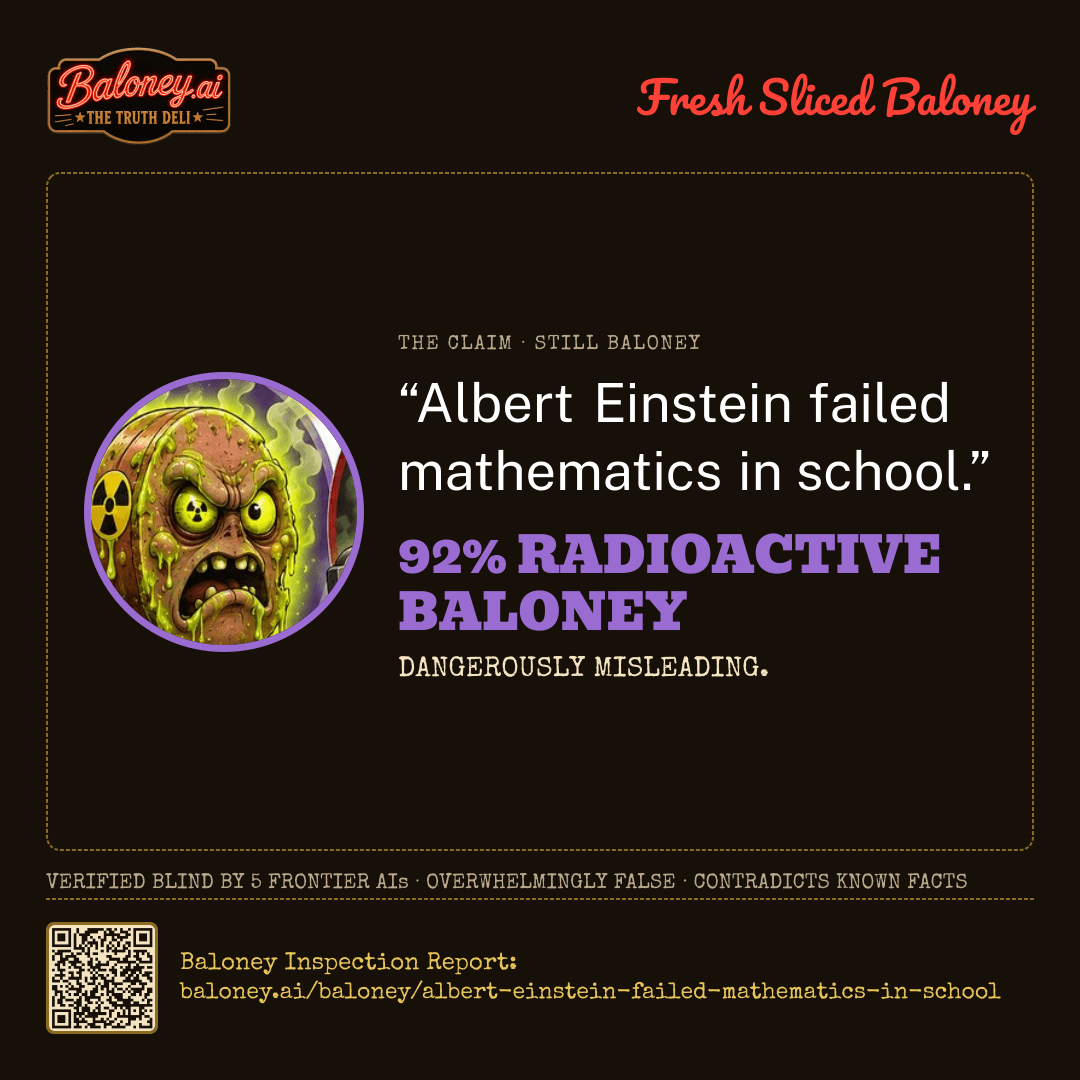
The claim is entirely false. Surviving school records demonstrate that Einstein was an exceptionally gifted mathematics student who earned the highest possible grades in the subject. The enduring myth stems from two historical footnotes: Einstein failing the general non-science portions of his first university entrance exam at age 16 (while scoring highly in math and physics), and a mid-stream reversal in his Swiss school's grading system, which confused later readers. Given that this falsehood has circulated widely since at least a 1935 'Ripley's Believe It or Not!' publication and remains one of the most famously persistent historical myths, it scores a 99 as Zombie Baloney.
All evaluators agreed that the claim is false and recognized Einstein's documented mathematical brilliance. Evaluators consistently pinpointed the historical origins of the myth: Einstein's failure on the non-science sections of his 1895 ETH Zurich entrance exam and the administrative reversal of the Swiss grading scale. Evaluator 1 mistakenly recommended a low score of 3 due to a misunderstanding of the baloney scale, but their analysis fully debunked the claim in line with the others.
ZOMBIE FLAG: TRUE — DEBUNK HISTORY ON RECORD
Blind Validation Master · never saw the Primary’s work
grok-4.6
92% BALONEY
The five reports collectively document that the claim is a long-circulating myth with no support in primary records. Einstein’s 1896 Aargau Matura certificate and earlier Luitpold Gymnasium marks show top grades in algebra, geometry and related subjects; he excelled on the mathematics and physics portions of the 1895 ETH entrance exam (failing only non-science subjects); he taught himself calculus before age 15; and he personally rejected the story when shown the 1935 Ripley’s cartoon. The anecdote arose from grading-scale confusion (6 = best vs. 6 = fail), his early departure from the Munich gymnasium, and the overall ETH result being misremembered as a math failure. Scholarly biographies, the Einstein Papers, Snopes and Britannica all treat it as false. One outlier score of 3 is inconsistent with that same report’s own evidence and can be discounted. The statement as written is therefore overwhelmingly false and still widely repeated.
AGREEMENT TEST PASSED — MASTERS SCORED 99% AND 92% · BLIND VALIDATION CONFIRMED THIS SCORE · NO RE-EVALUATION REQUIRED
The Evidence
Evidence offered for the claim
Failed university entrance examDEBUNKED — Einstein did fail his first entrance exam to the Swiss Federal Polytechnic (ETH) in 1895, but he actually excelled in the mathematics and physics sections; his failure was due to poor scores in non-science subjects like botany, zoology, and languages.
Grading scale reversalDEBUNKED — His Swiss school reversed its grading scale so that '6' became the top mark instead of '1'. Some later readers and biographers misinterpreted his top grades as failing marks, assuming the German convention where '6' was failing.
Ripley's cartoonDEBUNKED — A 1935 'Ripley's Believe It or Not!' syndicated item claimed he failed mathematics, which helped popularize the myth. Einstein explicitly rejected the claim when shown the newspaper clipping.
Evidence against the claim
Top marks in school records Einstein's surviving 1896 school-leaving certificate from the Aargau Cantonal School shows he earned the highest possible grades in algebra, geometry, descriptive geometry, and physics.
Self-taught calculus mastery Einstein taught himself advanced mathematics as a youth and later stated he had completely mastered differential and integral calculus before his fifteenth birthday.
Einstein's personal denial When confronted with the rumor that he was a mathematical failure, Einstein laughed and explicitly refuted the story, stating on the record, 'I never failed in mathematics.'
Sources · Reliability · Why Accepted or Discounted
Source
Type
Reliability
Ruling
PIX11
news
78
ACCEPTED — Standard news source citing mainstream historical consensus.