Baloney Inspection Report: Claim #1116 · Inspected Oct 6, 2026, 12:19 AM PDT · Scoring model v2
97%
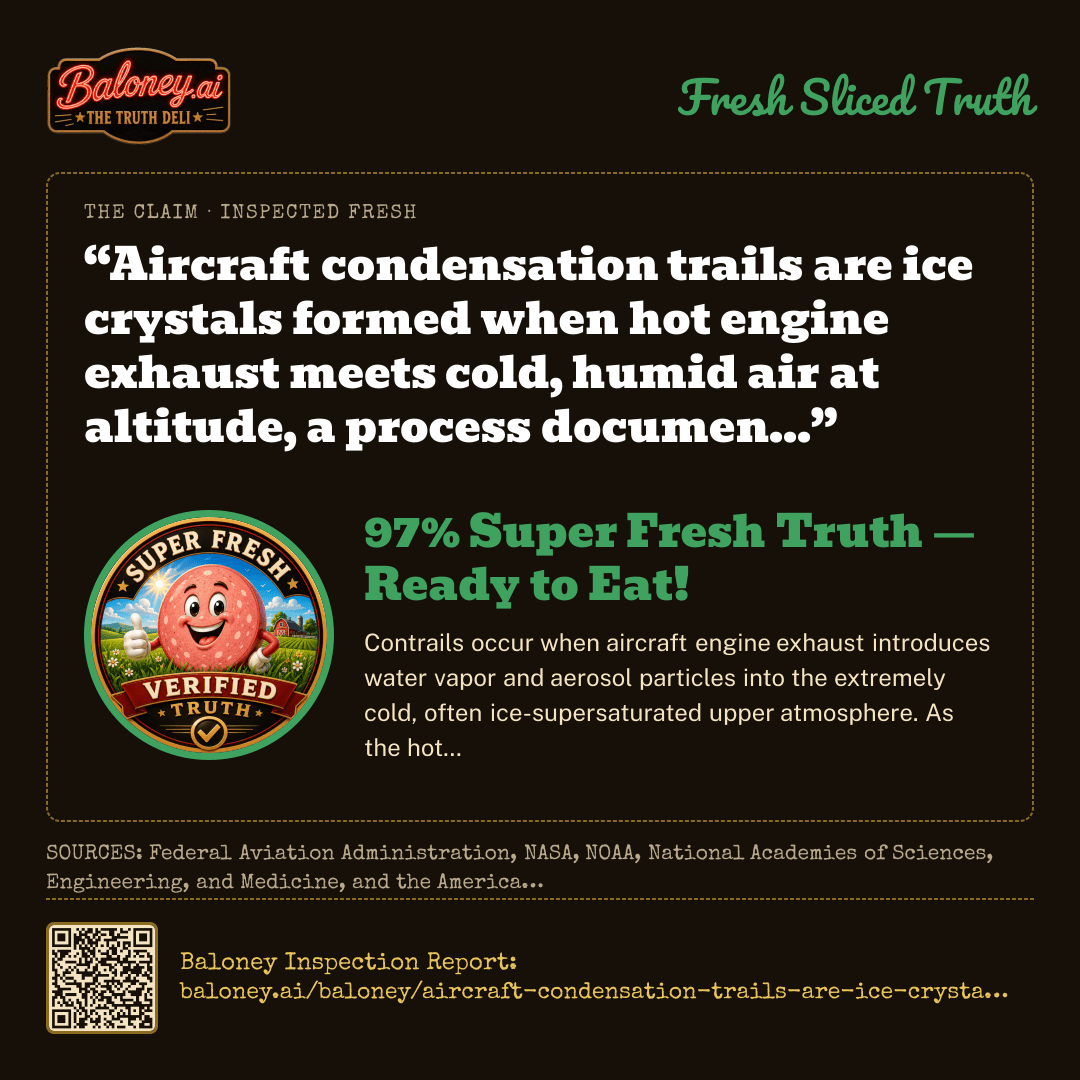
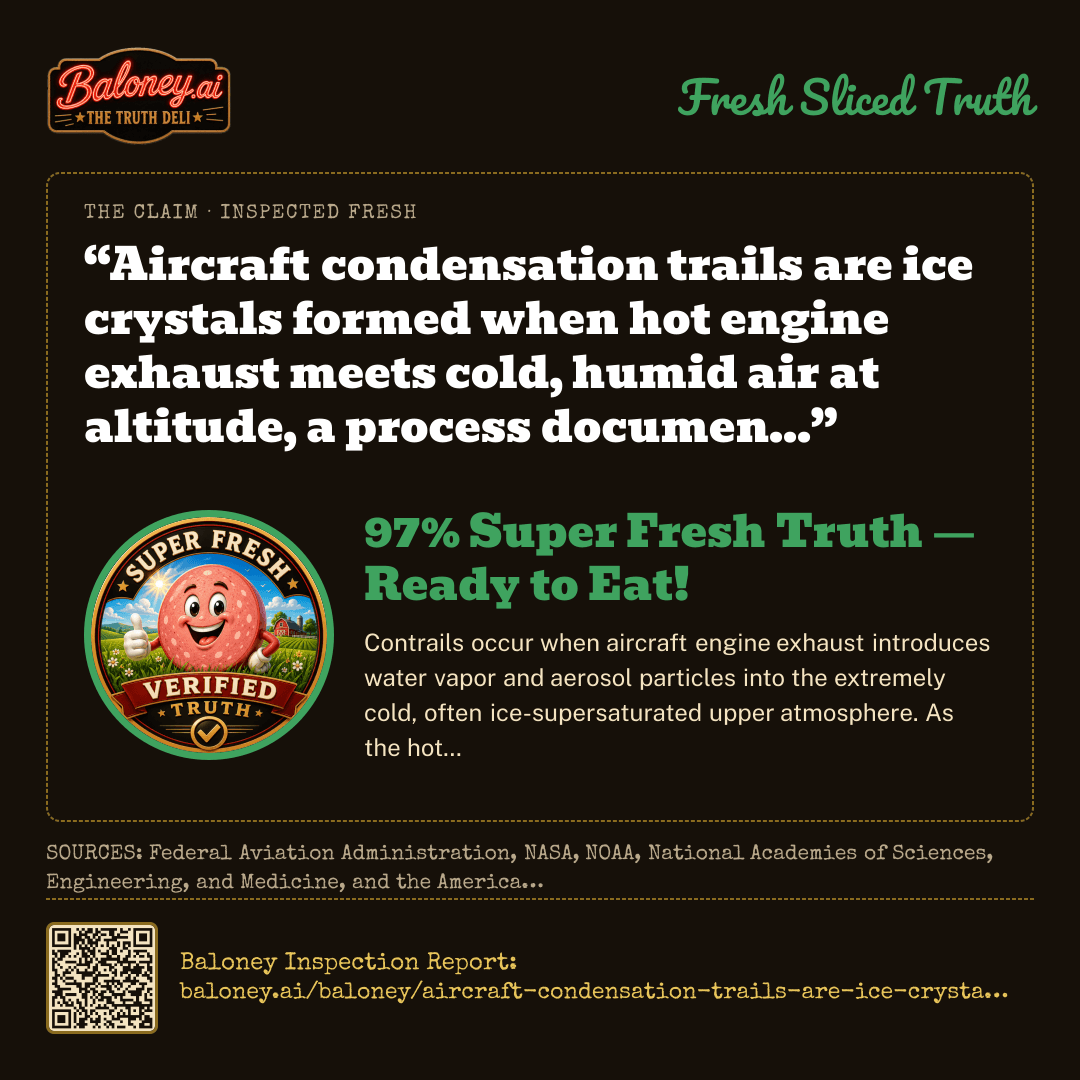
“Aircraft condensation trails are ice crystals formed when hot engine exhaust meets cold, humid air at altitude, a process documented since World War II.”
97%Super Fresh Truth — Ready to Eat!
THE CLAIM CHECKS OUT.
Independently verifiedPhysically repeatable evidenceConfirmed across rival labsSafe to serve
“Aircraft condensation trails are ice crystals formed when hot engine exhaust meets cold, humid air at altitude, a process documented since World War II.”97% Super Fresh Truth — Ready to Eat!Verified blind by 5 frontier AIs · Baloney Inspection Report: baloney.ai/baloney/aircraft-condensation-trails-are-ice-crystals-formed-when
The Rating Card
The claim this refutes
The Baloney Sampler
The claim accurately describes the established science behind condensation trails, or contrails. According to the Federal Aviation Administration, NASA, and the National Academies of Sciences, Engineering, and Medicine, hot, moisture-rich engine exhaust mixes with extremely cold air at high altitudes. This rapid cooling causes the water vapor to condense and instantly freeze into visible ice crystals. While the claim slightly simplifies the thermodynamics—omitting the role of exhaust soot as nucleation points and ambient pressure—it captures the correct core mechanism.
The historical timeline is also accurate. While a few isolated contrails were spotted as early as 1915, the National Academies and the National Oceanic and Atmospheric Administration (NOAA) note that the phenomenon became widely documented during World War II. Large formations of high-altitude bombers inadvertently created massive ice clouds that alerted enemy forces, prompting rigorous scientific research into predicting and preventing their formation.
Other ways to slice it — phrasings that might have changed the rating
“Aircraft condensation trails were first observed and documented by military pilots during World War II.” The reports note that while WWII brought widespread scientific attention to the phenomenon, visible contrails were actually observed and recorded as early as 1915.
“Every visible condensation trail left by an aircraft is the result of hot engine exhaust mixing with cold air.” The evaluators pointed out that short-lived aerodynamic contrails can also form due to sudden pressure drops over wings or propellers, without any involvement of engine exhaust.
“The white trails left by aircraft are undisclosed chemical or biological agents sprayed for nefarious purposes.” Evaluators specifically highlighted that these persistent 'chemtrail' conspiracy theories are thoroughly debunked by atmospheric scientists, meteorologists, and aviation agencies.
Written from the panel’s reports by Google · gemini-3.1-pro-preview. Nothing here changed the score.
07:21:43SCORING MODEL V2 — MEDIAN OF 5 COUNTED LAB SCORES: 3, 3, 2, 4, 3 → 3. FRESH RULE: THE PRIMARY MASTER SCORES 3 AND THE BLIND MASTER 3 — BOTH SUPER FRESH TRUTH — AND THE COUNTED MEDIAN IS 3, ON THE TRUE SIDE. PUBLISHED AS 3, THE MORE CAUTIOUS OF THE TWO MASTERS.✓
07:21:43SOURCE RULE — LABS CITED 23 SOURCES: 0 DISCARDED FOR HAVING NO URL, 6 DISCARDED AS DEAD LINKS (404/410), 9 COULD NOT BE OPENED BY US AND ARE MARKED UNVERIFIED.✓
07:21:43SOURCE RULE — PRIMARY MASTER RULED ON 15 SOURCES: 0 DISCARDED FOR HAVING NO URL, 0 DISCARDED AS DEAD LINKS, 7 MARKED UNVERIFIED, 8 VERIFIED.✓
How This One Was Sliced
Station 1 · Blind Inspection — Five Graders, Zero Peeking
Each lab scored the claim independently, without seeing the others. Open a breakdown for its evidence, its sources, and how sure it was.
Anthropic · EQUAL WEIGHT · 43.7s
claude-opus-5
97%TRUTH
ROUND-1 BREAKDOWN
Evidence offered for the claim
The physical mechanism described is the textbook one: hot, water-vapor-rich jet exhaust mixes with cold ambient air, the mixture briefly becomes supersaturated with respect to water, droplets condense on exhaust soot/aerosol particles and freeze almost instantly into ice crystals. This is the Schmidt–Appleman criterion, standard in atmospheric science.
Government science outreach (NOAA SciJinks) and reference works (Britannica, AMS Glossary of Meteorology) describe contrails explicitly as line-shaped clouds of ice crystals produced by aircraft engine exhaust in cold, moist upper-troposphere air.
Peer-reviewed literature (e.g., Kärcher, Nature Communications 2018, on contrail formation and contrail cirrus) confirms contrails are ice-crystal clouds nucleated on exhaust particles, with persistence governed by ambient ice supersaturation.
The timeline is consistent: contrails became a prominent, heavily documented operational phenomenon during World War II (bomber formations betrayed by visible trails), and the first rigorous theoretical treatment was published by Ernst Schmidt in 1941, with Herbert Appleman's widely used forecasting criterion following in 1953 (BAMS). So the process has indeed been documented continuously since WWII.
Mainstream fact-checkers (Snopes and others addressing 'chemtrail' claims) consistently affirm the water-vapor/ice-crystal explanation of contrails as scientifically established.
Evidence against the claim
Documentation is actually older than WWII: visible aircraft condensation trails were reported as early as 1915 (Ettenreich's observation) and in 1920s–1930s aviation and meteorological literature. The claim's 'since World War II' understates the record, though it does not assert WWII was the first observation.
Slight imprecision on 'cold, humid air': ambient temperature cold enough to satisfy the Schmidt–Appleman criterion is the necessary condition for formation; short-lived contrails can form in relatively dry air, while ambient humidity (ice supersaturation) chiefly determines whether the contrail persists and spreads into contrail cirrus.
The ice does not come solely from engine exhaust water; entrained ambient water vapor contributes, and condensation requires nucleating particles (soot, sulfate aerosols) — detail omitted by the shorthand 'hot exhaust meets cold air.'
Minor physical nuance: it is the rapid cooling and mixing of the plume, not heat per se, that drives condensation; 'hot exhaust' is a simplification of the mixing-line thermodynamics.
How sure this lab was
92/100 — the lab’s own confidence in the score above, not a second reading of the claim.
NASA and NOAA explain the standard mechanism: aircraft engine exhaust adds water vapor and particles to very cold upper-atmosphere air; as the exhaust plume mixes and cools, water condenses/freezes into ice crystals, producing a condensation trail.
Modern atmospheric-science literature describes exhaust contrails as line-shaped ice clouds that form when aircraft exhaust mixes with sufficiently cold ambient air; persistence depends on ambient humidity/ice supersaturation.
UCAR’s science-education material states contrails are made of ice particles and notes they became a common sight during World War II, consistent with the claim’s historical framing.
A foundational peer-reviewed paper by H. Appleman in 1953 documented methods for forecasting aircraft exhaust condensation trails, showing the phenomenon has been formally documented in the scientific/aviation literature since the WWII era and shortly after.
Snopes’ fact-checking on “chemtrails” distinguishes ordinary contrails as water/ice condensation phenomena, supporting the basic physical claim.
Evidence against the claim
The wording is slightly simplified: contrail formation depends on temperature, pressure, exhaust water content, and ambient humidity; persistent contrails require air that is humid enough with respect to ice, not merely generally “humid.”
Not every aircraft-related condensation trail is from hot engine exhaust; short-lived aerodynamic contrails can also form from pressure drops over wings or propellers. However, the common high-altitude exhaust contrail described in the claim is accurately characterized.
Contrails were observed before or around the early high-altitude aviation era, so “since World War II” should be read as “well documented by that era and thereafter,” not as the first possible observation date.
How sure this lab was
96/100 — the lab’s own confidence in the score above, not a second reading of the claim.
Atmospheric thermodynamics dictates that condensation trails (contrails) form when hot, moisture-rich exhaust from jet engines mixes with the extremely cold, low-vapor-pressure environmental air at high cruising altitudes. This rapid mixing causes water vapor to condense and freeze instantly into microscopic ice crystals.
Extensive military and meteorological records demonstrate that contrails were widely documented during World War II. High-altitude strategic bomber formations inadvertently generated massive contrails over Europe, which alerted enemy forces to their presence and prompted intensive scientific research into predicting and preventing their formation.
Evidence against the claim
There is no credible scientific or historical evidence against this claim. Although persistent conspiracy theories allege that these trails are 'chemtrails' consisting of undisclosed chemical or biological agents sprayed for nefarious purposes, these claims have been thoroughly debunked by atmospheric scientists, meteorologists, and government aviation agencies worldwide.
How sure this lab was
98/100 — the lab’s own confidence in the score above, not a second reading of the claim.
Aircraft condensation trails are generally ice crystals produced when water vapor in hot engine exhaust mixes with very cold surrounding air; cooling can produce droplets that freeze, while exhaust and atmospheric particles can provide condensation or ice-nucleation sites. The FAA describes contrails as ice crystals formed from engine-exhaust water vapor at typical cruise altitudes. [https://www.faa.gov/contrails]
The National Academies describes the mechanism as a cooling exhaust plume becoming supersaturated, forming water droplets that freeze into visible ice crystals. [https://www.nationalacademies.org/read/29073/chapter/2]
Contrails were widely observed during World War II, and the National Academies states that they were first observed in 1940 in the historical record it summarizes. [https://www.nationalacademies.org/read/29073/chapter/2]
NASA explains that contrails are ice clouds formed when aircraft water vapor condenses around particles and notes that they became a significant military concern during World War II. [https://www.nasa.gov/wp-content/uploads/2023/06/contrails-k-12.pdf?emrc=9d8066]
Evidence against the claim
The wording is somewhat simplified: contrails are not formed merely because hot exhaust meets cold air. Formation depends on a threshold involving ambient temperature, pressure, humidity, and the aircraft's water and heat emissions; cold, humid conditions are necessary but not sufficient in every case. [https://www.faa.gov/sites/faa.gov/files/regulations_policies/policy_guidance/envir_policy/contrails.pdf]
The visible ice crystals can form around both naturally occurring atmospheric particles and particles emitted by the engine, so saying they are simply exhaust meeting cold humid air omits the role of aerosols and nucleation. [https://www.faa.gov/contrails]
The historical wording is imprecise. The National Academies source says contrails were first observed in 1940 and commonly observed during World War II, while NASA reports observations during the first high-altitude flights in the 1920s. Thus, World War II marks widespread observation and scientific/military attention, not necessarily the first documentation of contrails. [https://www.nationalacademies.org/read/29073/chapter/2] [https://www.nasa.gov/wp-content/uploads/2023/06/contrails-k-12.pdf?emrc=9d8066]
How sure this lab was
96/100 — the lab’s own confidence in the score above, not a second reading of the claim.
Jet fuel combustion produces water vapor; at typical cruise altitudes temperatures are far below freezing (often -40°C or colder), so that vapor freezes into ice crystals that appear as white condensation trails.
Persistent trails form when exhaust mixes with sufficiently cold, ice-supersaturated ambient air—the same hot-exhaust-into-cold-humid-air process described in the claim.
High-altitude bomber operations in World War II produced extensive photographic and operational records of contrails; they were studied because they revealed aircraft, and post-war work (including the Schmidt–Appleman criterion) formalized the formation physics.
Evidence against the claim
A small number of observations and photographs of aircraft condensation trails exist from the 1910s–1920s, so WWII is the era of widespread documentation rather than the absolute first record; the wording “documented since World War II” is still accurate.
The claim is a valid but simplified account: formation also depends on pressure, humidity relative to ice, and exhaust mixing (Schmidt–Appleman); some visible trails are aerodynamic contrails from wing pressure drops rather than exhaust.
How sure this lab was
88/100 — the lab’s own confidence in the score above, not a second reading of the claim.
The claim is overwhelmingly true. Evaluators confirmed that aircraft condensation trails (contrails) are ice crystals formed by hot exhaust mixing with cold atmospheric air, a process grounded in established thermodynamics (the Schmidt-Appleman criterion). The assertion that this has been documented 'since World War II' is factually correct, as WWII marked the era of widespread operational and scientific documentation, even if a few isolated sightings occurred in the 1920s. Any omissions are merely the necessary simplifications of summarising complex physics into a single sentence.
All five evaluators agreed that the statement is fundamentally accurate. The only minor points of divergence involved technical nuance: whether 'since WWII' downplays earlier 1920s observations, and whether describing the process as 'hot exhaust meets cold, humid air' slightly oversimplifies the exact physics of aerosol nucleation and ice-supersaturation.
SUPER FRESH — VERIFIED AGAINST FEDERAL AVIATION ADMINISTRATION, NASA, NOAA, NATIONAL ACADEMIES OF SCIENCES, ENGINEERING, AND MEDICINE, AND THE AMERICAN METEOROLOGICAL SOCIETY.
Blind Validation Master · never saw the Primary’s work
claude-opus-5
97% TRUTH
All five evaluators converge on the claim being substantially true, with recommended scores of 2-4. The physical mechanism described — hot, water-vapor-rich engine exhaust mixing with very cold ambient air at altitude, producing droplets that freeze into ice crystals — is the textbook Schmidt–Appleman account endorsed by FAA, NASA, NOAA, the National Academies, AMS Glossary, and peer-reviewed literature (Kärcher 2018; Appleman 1953). The historical framing is also sound: contrails were extensively documented during WWII bomber operations, Schmidt published the first rigorous theory in 1941, and Appleman's forecasting criterion followed in 1953. Minor caveats keep it from a 1: the phrasing compresses the thermodynamics (it is the rapid mixing/cooling of the plume, plus nucleation on soot and sulfate aerosols, rather than simply 'hot meets cold'); cold air is the necessary condition for formation while ambient ice supersaturation chiefly governs persistence; aerodynamic contrails from wing pressure drops are a separate minor mechanism; and observations predate WWII (e.g., 1915, 1920s–1930s), though 'documented since WWII' does not assert first observation. These are simplifications of a correct explanation, not errors, placing the claim firmly in the Super Fresh Truth band.
AGREEMENT TEST PASSED — BOTH MASTERS SCORED 97% · BLIND VALIDATION CONFIRMED THIS SCORE · NO RE-EVALUATION REQUIRED
Median of 5 counted lab scores: 3, 3, 2, 4, 3 → 3.
Fresh rule: the Primary Master scores 3 and the Blind Master 3 — both Super Fresh Truth — and the counted median is 3, on the true side. Published as 3, the more cautious of the two masters.
The Evidence
Evidence for the claim
Ice crystal formation Hot, moisture-rich exhaust from jet engines mixes with extremely cold air at cruise altitudes, causing water vapor to condense and freeze instantly into microscopic ice crystals.
Historical documentation Contrails were widely documented and scientifically studied during World War II, when high-altitude strategic bomber formations left massive, visible trails over Europe.
Thermodynamic validation The physical mechanism described matches the Schmidt-Appleman criterion, a textbook model used in atmospheric science to forecast contrail formation.
Evidence offered against the claim
Earlier observations While WWII is the era of widespread scientific and military documentation, the first visible aircraft condensation trails were actually observed and recorded in the 1910s and 1920s.
Simplified physics The claim is a slight shorthand. Formation also relies on ambient pressure, aerosol particles from the exhaust acting as nucleation sites, and ice-supersaturation to persist.
Aerodynamic contrails Not all aircraft condensation trails are formed by hot engine exhaust; short-lived trails can also form due to pressure drops over the wings and propellers.
Sources · Reliability · Why Accepted or Discounted
Every link was opened when this claim was inspected. A dead link was discarded before publication; “unverified” means the site refused our automated check and the link is the one the panel cited. A source without a URL was never kept.
“Aircraft condensation trails are ice crystals formed when hot engine exhaust meets cold, humid air at altitude, a process documented since World War II.”97% Super Fresh Truth — Ready to Eat!Verified blind by 5 frontier AIs · Baloney Inspection Report: baloney.ai/baloney/aircraft-condensation-trails-are-ice-crystals-formed-when
Support the Baloney Slicer
CONTRIBUTE $25 → GET THE HAT
“Democracy Makes America Great”
A non-partisan, non-political ethos. Democracy is what makes America great. But without truth — honest, real, scientifically validated truth — democracy fails. The baloney slicer is on: feeding fresh sliced truth to protect what makes America great. Democracy.
Veritate Libertas — Latin for “Through Truth, Liberty.”