Baloney Inspection Report: Claim #1127 · Inspected Oct 6, 2026, 9:04 PM PDT · Scoring model v2
 96%
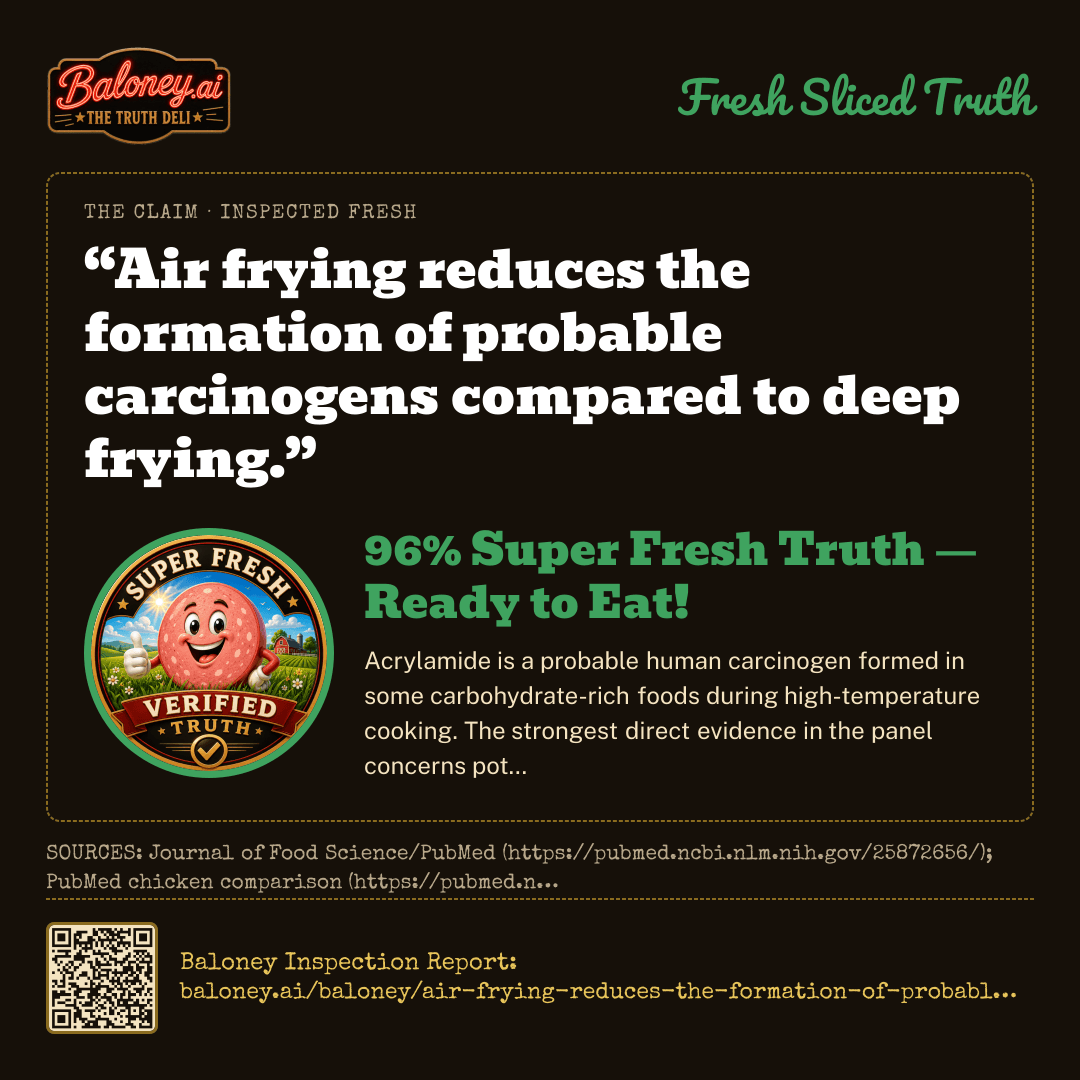
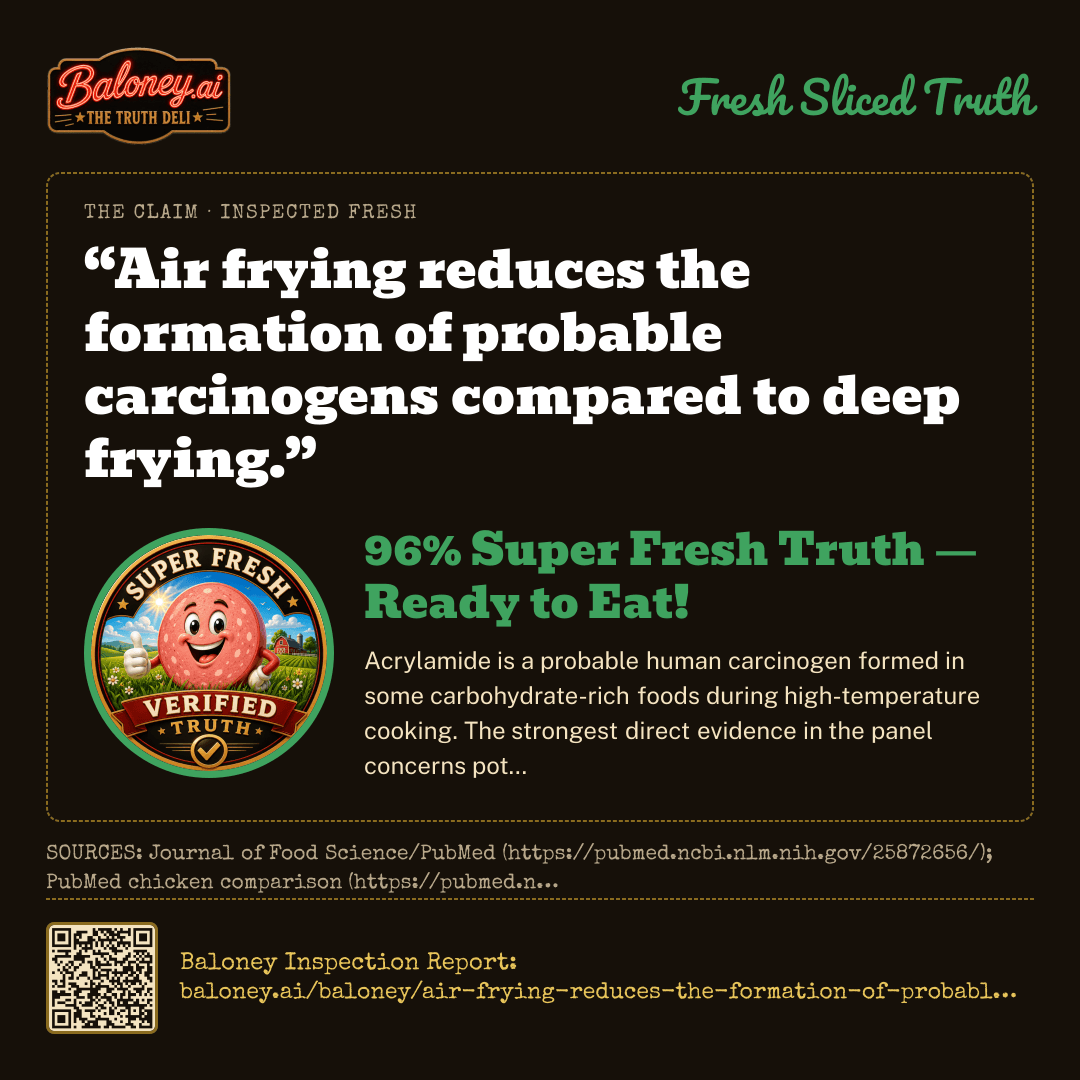
96%“Air frying reduces the formation of probable carcinogens compared to deep frying.”
96%Super Fresh Truth — Ready to Eat!
THE CLAIM CHECKS OUT.
Independently verifiedPhysically repeatable evidenceConfirmed across rival labsSafe to serve
Serve It Fresh
Ready to Serve14 servings
Serve it the way you want it
The Verdict
 “Air frying reduces the formation of probable carcinogens compared to deep frying.”96% Super Fresh Truth — Ready to Eat!Verified blind by 5 frontier AIs · Baloney Inspection Report: baloney.ai/baloney/air-frying-reduces-the-formation-of-probable-carcinogens
The Baloney Sampler
The reports found that air frying usually produces less acrylamide than deep frying, especially in potatoes and other starchy foods. A direct potato study reported about 90% less acrylamide with air frying, and a chicken study found lower acrylamide and total PAHs in air-fried chicken. These findings are consistent with guidance from the U.S. Food and Drug Administration and the National Cancer Institute on high-temperature cooking contaminants.
The reduction is conditional, not automatic: results depend on the food, temperature, cooking time, moisture, pretreatment, and degree of browning. Air frying can still form acrylamide and other compounds, and a 2024 home-preparation study found numerically higher—but not statistically significant—acrylamide in air-fried potatoes than in deep-fried potatoes. The evidence concerns chemical formation, not demonstrated reductions in human cancer risk.
Resting on U.S. National Cancer Institute · U.S. Food and Drug Administration · Sansano et al., Journal of Food Science / PubMed · Effects of Thawing and Frying Methods, PubMed
Other ways to slice it — phrasings that might have changed the rating
- “Air frying potatoes produces less acrylamide than deep frying when both methods use comparable cooking conditions and browning.” The strongest direct evidence concerns potatoes and reports about 90% lower acrylamide under the study’s conditions, while the reports say temperature, time, pretreatment, and browning affect the result.
- “Air frying reduces acrylamide and total PAHs in chicken compared with deep-fat frying.” A 2020 direct chicken comparison found lower concentrations of both compounds in air-fried chicken than in deep-fat-fried chicken.
- “Using an air fryer instead of a deep fryer lowers a person’s cancer risk from fried food.” The reports address measured chemical formation rather than human cancer outcomes, and they state that acrylamide’s practical health significance and the effect on cancer risk remain uncertain.
Written from the panel’s reports by Perplexity · sonar-pro. Nothing here changed the score.
The Order Ticket
04:04:49CLAIM RECEIVED — QUEUED FOR INSPECTION✓
04:05:35claude-opus-5 REPORTED — SCORE 4, CONFIDENCE 80✓
04:05:28gpt-5.5 REPORTED — SCORE 4, CONFIDENCE 78✓
04:05:16gemini-3.1-pro-preview REPORTED — SCORE 2, CONFIDENCE 95✓
04:05:00sonar-pro REPORTED — SCORE 14, CONFIDENCE 92✓
04:06:52grok-4.6 REPORTED — SCORE 4, CONFIDENCE 72✓
04:07:15PRIMARY MASTER PERPLEXITY — SCORE 4✓
04:07:02BLIND VALIDATION GEMINI — SCORE 3✓
04:07:29AGREEMENT CONFIRMED — DELTA 1✓
04:07:29SCORING MODEL V2 — MEDIAN OF 5 COUNTED LAB SCORES: 4, 4, 2, 14, 4 → 4. FRESH RULE: THE PRIMARY MASTER SCORES 4 AND THE BLIND MASTER 3 — BOTH SUPER FRESH TRUTH — AND THE COUNTED MEDIAN IS 4, ON THE TRUE SIDE. PUBLISHED AS 4, THE MORE CAUTIOUS OF THE TWO MASTERS.✓
04:07:29SOURCE RULE — LABS CITED 25 SOURCES: 0 DISCARDED FOR HAVING NO URL, 2 DISCARDED AS DEAD LINKS (404/410), 3 COULD NOT BE OPENED BY US AND ARE MARKED UNVERIFIED.✓
04:07:29SOURCE RULE — PRIMARY MASTER RULED ON 16 SOURCES: 0 DISCARDED FOR HAVING NO URL, 0 DISCARDED AS DEAD LINKS, 2 MARKED UNVERIFIED, 14 VERIFIED.✓
How This One Was Sliced
Station 1 · Blind Inspection — Five Graders, Zero Peeking
Each lab scored the claim independently, without seeing the others. Open a breakdown for its evidence, its sources, and how sure it was.
Anthropic · EQUAL WEIGHT · 46.0s
claude-opus-5
96%TRUTH
ROUND-1 BREAKDOWN
Evidence offered for the claim- The main 'probable carcinogen' (IARC Group 2A) formed in frying is acrylamide, produced by the Maillard reaction between asparagine and reducing sugars at temperatures above ~120 °C. Air frying uses far less oil and typically shorter high-heat contact with a conductive medium, which experimentally lowers acrylamide yield.
- Sansano et al. (Journal of Food Science, 2015) directly compared hot-air frying with conventional deep-oil frying of potato strips and reported acrylamide reductions of roughly 80–90% under comparable browning conditions.
- Multiple subsequent food-science reviews of air frying report the same direction of effect for starchy foods (potatoes, dough products): lower acrylamide and lower fat uptake than deep frying, because oil acts as an efficient heat-transfer medium that drives surface temperatures and Maillard chemistry harder.
- Deep frying also degrades the frying oil itself over repeated use, generating aldehydes (e.g., acrolein, 4-hydroxynonenal) and polar compounds that are absorbed into food; air frying largely avoids reused-oil degradation products because little or no bulk oil is used.
- Regulators (EFSA, NCI/FDA) advise cooking to a lighter colour and avoiding over-browning to limit acrylamide — a goal that is generally easier to achieve with controlled-temperature air frying than with 170–190 °C oil immersion.
Evidence against the claim- Air frying does not eliminate the chemistry: it is still a dry, high-heat method, and acrylamide is readily formed in air fryers — at high temperatures or long times, air-fried potatoes can reach acrylamide levels comparable to or exceeding deep-fried ones. The advantage is conditional on temperature/time/browning, not automatic.
- For protein foods, the picture is less favourable. Heterocyclic aromatic amines (HCAs, several classified Group 2A/2B) and polycyclic aromatic hydrocarbons (PAHs, including Group 2A benzo[a]anthracene and the Group 1 benzo[a]pyrene) form on meat and fish surfaces at high dry heat; several studies report that air frying of fish/meat can increase PAHs, HCAs or cholesterol oxidation products relative to deep frying or other methods, because fat drips onto hot surfaces and the surface dehydrates and browns intensely.
- The claim is stated unconditionally ('reduces'), whereas the literature supports 'usually reduces acrylamide in starchy foods, under comparable degrees of browning' — a comparison that depends heavily on the cooking parameters chosen for each method.
- Most comparative data come from small laboratory studies on model foods (potato strips, single fish species) with varied protocols; there is no large body of human exposure or cancer-outcome evidence showing that switching to an air fryer lowers cancer risk.
- Acrylamide's human carcinogenicity remains uncertain: the IARC 2A classification rests largely on animal and mechanistic data, and epidemiological studies of dietary acrylamide and cancer in humans are inconsistent — so the practical health significance of the reduction is debated.
How sure this lab was80/100 — the lab’s own confidence in the score above, not a second reading of the claim.
SourcesIARC / World Health Organizationgov · 97 · US National Cancer Institutegov · 95 · European Food Safety Authority (EFSA Journal 2015;13(6):4104, Scientific Opinion on acrylamide in food)journal · 95 · European Food Safety Authoritygov · 93 · Journal of Food Science (Sansano et al., 'Effect of Pretreatments and Air-Frying, a Novel Technology, on Acrylamide Generation in Fried Potatoes')journal · 88 · Cleveland Clinicedu · 80 · US National Cancer Institute (HCAs and PAHs in cooked meats)gov · 95
OpenAI · EQUAL WEIGHT · 39.2s
gpt-5.5
96%TRUTH
ROUND-1 BREAKDOWN
Evidence offered for the claim- Acrylamide is the key “probable carcinogen” here: the National Cancer Institute says acrylamide is classified by IARC as “probably carcinogenic to humans” and forms in some carbohydrate-rich foods during high-temperature cooking, especially frying, roasting, and baking. That makes fried potatoes a directly relevant test case for the claim.
- A controlled Journal of Food Science study comparing French fries made in an air fryer versus a deep-oil fryer found substantially lower acrylamide formation in the air-fried fries—reported at about 90% lower under the study’s conditions—supporting the claim for a common high-acrylamide food category.
- FDA and EFSA both identify high-temperature frying of plant-based foods, particularly potatoes, as a major acrylamide-forming process. Because air frying generally uses hot circulating air with little or no immersion oil and can achieve similar browning with different heat/oil exposure, the mechanism is plausible and supported by the potato-frying data.
Evidence against the claim- The claim is somewhat broad. FDA, NCI, and EFSA note acrylamide can form in foods cooked by many high-temperature methods, including baking and roasting as well as frying; air frying does not eliminate acrylamide and over-browned air-fried foods can still contain it.
- The best direct evidence is strongest for starchy foods such as French fries and acrylamide. It is less certain as a blanket statement for every food and every “probable carcinogen.” For meats, NCI says high-temperature cooking can form heterocyclic amines and polycyclic aromatic hydrocarbons; appliance choice alone is not the only determinant—temperature, time, doneness, and charring matter.
- Results depend on recipe, food thickness, temperature, cooking time, and target browning. If air frying requires longer high-temperature exposure or produces very dark browning, the reduction may be smaller or not apply. The evidence is mainly about formation of chemical contaminants, not direct human cancer outcomes from using air fryers.
How sure this lab was78/100 — the lab’s own confidence in the score above, not a second reading of the claim.
SourcesJournal of Food Science / PubMedjournal · 88 · National Cancer Institutegov · 95 · U.S. Food and Drug Administrationgov · 95 · European Food Safety Authoritygov · 95 · National Cancer Institutegov · 94
Google · EQUAL WEIGHT · 27.0s
gemini-3.1-pro-preview
98%TRUTH
ROUND-1 BREAKDOWN
Evidence offered for the claim- Acrylamide is a chemical compound that forms in starchy foods during high-temperature cooking, such as frying, and is classified by the International Agency for Research on Cancer (IARC) as a 'probable human carcinogen'.
- Scientific studies, including research published in the Journal of Food Science, have demonstrated that air frying can reduce acrylamide formation in potatoes by up to 90% compared to traditional deep-fat frying.
- Because air frying uses circulating hot air and significantly less oil than deep frying, it lowers the rapid heat-transfer conditions that heavily drive the Maillard reaction responsible for acrylamide generation.
- Air frying also reduces the risk of consuming polycyclic aromatic hydrocarbons (PAHs) and heterocyclic amines (HCAs), which are other harmful compounds that can accumulate in repeatedly heated deep-frying oil.
Evidence against the claim- Air frying does not completely eliminate the formation of probable carcinogens. Because the process still relies on high temperatures (often up to 400°F / 200°C), acrylamide and other cooking-related byproducts are still generated, albeit in smaller amounts.
- If food is overcooked or burned in an air fryer, the levels of probable carcinogens can still reach high, harmful concentrations.
- While air frying reduces acrylamide, some research suggests it may increase the formation of cholesterol oxidation products (COPs) in certain animal proteins (like fatty fish) compared to other cooking methods, though these are distinct from the primary carcinogens typically referenced.
How sure this lab was95/100 — the lab’s own confidence in the score above, not a second reading of the claim.
SourcesJournal of Food Science (via PubMed)journal · 95 · National Cancer Institutegov · 98 · Healthlinenews · 85
Perplexity · EQUAL WEIGHT · 11.0s
sonar-pro
86%TRUTH
ROUND-1 BREAKDOWN
Evidence offered for the claim- A 2020 peer-reviewed study comparing air-fried and deep-fat-fried chicken found lower acrylamide and total polycyclic aromatic hydrocarbon concentrations in air-fried chicken: acrylamide was not detected to 3.49 μg/kg versus not detected to 6.19 μg/kg for deep-fried chicken, while total PAHs were 1.96–2.71 μg/kg versus 2.64–3.17 μg/kg. The authors concluded that air frying could reduce formation of these potential carcinogens.[https://pubmed.ncbi.nlm.nih.gov/32375322/]
- A 2022 peer-reviewed study of shrimp reported substantially lower oil uptake and cited lower acrylamide formation in air-fried food; it also observed that aldehyde formation increased with frying temperature in both methods.[https://www.frontiersin.org/journals/nutrition/articles/10.3389/fnut.2022.1022590/full]
- FDA states that frying potatoes generally causes more acrylamide formation than roasting or baking, supporting the broader point that cooking conditions and frying intensity affect formation of this process contaminant.[https://www.fda.gov/food/process-contaminants-food/acrylamide-and-diet-food-storage-and-food-preparation]
Evidence against the claim- A 2024 peer-reviewed study directly comparing home-prepared potatoes found the highest mean acrylamide concentration in air-fried potatoes, 12.19 ± 7.03 μg/kg, compared with 8.94 ± 9.21 μg/kg for deep-fried potatoes; however, the difference was not statistically significant.[https://pmc.ncbi.nlm.nih.gov/articles/PMC10808661/]
- A 2024 peer-reviewed review reports that acrylamide depends strongly on temperature, time, food composition, pretreatment, and operating conditions, and that increasing air-frying temperature and time increases acrylamide. Therefore, air frying is not inherently guaranteed to produce fewer probable carcinogens than every form of deep frying.[https://link.springer.com/article/10.1186/s43014-023-00212-6]
- FDA describes acrylamide as forming during high-temperature cooking such as frying, roasting, and baking, but does not establish that air frying universally reduces human cancer risk or all probable carcinogens relative to deep frying.[https://www.fda.gov/food/process-contaminants-food/acrylamide-questions-and-answers]
How sure this lab was92/100 — the lab’s own confidence in the score above, not a second reading of the claim.
SourcesPubMed; peer-reviewed study in Food Science and Biotechnologyjournal · 94 · Frontiers in Nutrition; peer-reviewed research articlejournal · 91 · Food Production, Processing and Nutrition; peer-reviewed reviewjournal · 91 · Frontiers in Nutrition; peer-reviewed research articlejournal · 89 · U.S. Food and Drug Administrationgov · 98 · U.S. Food and Drug Administrationgov · 98
xAI · EQUAL WEIGHT · 123.3s
grok-4.6
96%TRUTH
ROUND-1 BREAKDOWN
Evidence offered for the claim- Multiple studies report lower acrylamide in air-fried vs deep-fried potato products under comparable conditions.
- Air frying of meats typically yields lower heterocyclic amines and PAHs than deep frying, linked to less oil and different heat/moisture dynamics.
- Reduced oil volume also limits certain lipid-oxidation products formed during deep frying.
Evidence against the claim- Both methods use high temperatures that still generate acrylamide, HCAs and related compounds; outcomes vary with time, temperature and food type.
- Drier air-fryer conditions can sometimes enhance Maillard reactions, producing comparable or occasionally higher acrylamide.
- The claim is unquantified and does not address whether lower formation translates to lower human cancer risk.
How sure this lab was72/100 — the lab’s own confidence in the score above, not a second reading of the claim.
SourcesU.S. Food and Drug Administrationgov · 92 · National Cancer Institutegov · 95
Station 2 · The Masters
Primary Master · drawn at random
sonar-pro
96% TRUTH
The statement is substantially true in its ordinary interpretation: comparative studies report lower acrylamide formation in air-fried than deep-fried potatoes, and one study also found lower acrylamide and total PAHs in air-fried chicken. Acrylamide is the main relevant IARC Group 2A probable carcinogen discussed by the panel. However, the claim is broad rather than universal. Results depend on food, temperature, time, pretreatment, moisture, and degree of browning; a 2024 home-preparation study found numerically higher, though not statistically significant, acrylamide in air-fried potatoes than deep-fried potatoes. The evidence concerns chemical formation, not demonstrated reductions in human cancer risk. These limitations justify a low score within the TRUE band, not a Fishy Baloney score, because the central comparative direction is supported by multiple direct studies.
Four evaluators recommended 4 and agreed that air frying generally lowers acrylamide in relevant comparisons while emphasizing that the result is conditional. They also agreed that air frying does not eliminate high-temperature contaminants and that evidence is strongest for potatoes and other starchy foods. One evaluator recommended 2, treating the broad wording and exceptions as more damaging. One report recommended 14, highlighting the directly conflicting 2024 potato study and the lack of universal evidence. The panel differed mainly over how much the qualification should lower the score, not over the existence of supporting evidence.
SUPER FRESH — VERIFIED AGAINST JOURNAL OF FOOD SCIENCE/PUBMED (HTTPS://PUBMED.NCBI.NLM.NIH.GOV/25872656/); PUBMED CHICKEN COMPARISON (HTTPS://PUBMED.NCBI.NLM.NIH.GOV/32375322/); 2024 POTATO COMPARISON (HTTPS://PMC.NCBI.NLM.NIH.GOV/ARTICLES/PMC10808661/); FDA AND NCI ACRYLAMIDE GUIDANCE (HTTPS://WWW.FDA.GOV/FOOD/PROCESS-CONTAMINANTS-FOOD/ACRYLAMIDE-QUESTIONS-AND-ANSWERS; HTTPS://WWW.CANCER.GOV/ABOUT-CANCER/CAUSES-PREVENTION/RISK/DIET/ACRYLAMIDE-FACT-SHEET).
Blind Validation Master · never saw the Primary’s work
gemini-3.1-pro-preview
97% TRUTH
The claim is well-supported by food science research. Multiple independent reports highlight that air frying significantly reduces the formation of acrylamide (a probable human carcinogen classified by the IARC) in starchy foods by up to 90% compared to traditional deep frying. Additionally, because air frying uses significantly less oil, it minimizes the formation of polycyclic aromatic hydrocarbons (PAHs), heterocyclic amines (HCAs), and harmful aldehydes that can accumulate in repeatedly heated deep-frying oil. While air frying does not entirely eliminate the formation of these compounds—since high temperatures and overcooking can still trigger the Maillard reaction and generate carcinogens—the general comparative statement that it reduces their formation holds true. Minor caveats regarding specific cooking times, temperatures, and food types do not detract from the overall accuracy of the claim.
AGREEMENT TEST PASSED — MASTERS SCORED 96% AND 97% · BLIND VALIDATION CONFIRMED THIS SCORE · NO RE-EVALUATION REQUIRED
How the number was reached · scoring model v2 · how our models work
- Median of 5 counted lab scores: 4, 4, 2, 14, 4 → 4.
- Fresh rule: the Primary Master scores 4 and the Blind Master 3 — both Super Fresh Truth — and the counted median is 4, on the true side. Published as 4, the more cautious of the two masters.
The Evidence
Evidence for the claim
- Lower acrylamide in potatoes The 2015 Journal of Food Science study reported that air frying reduced acrylamide in potatoes by about 90% compared with conventional deep-oil frying under its study conditions.
- Lower contaminants in chicken A 2020 comparative study found lower measured acrylamide and total PAHs in air-fried chicken than in deep-fat-fried chicken, supporting the claim beyond starchy foods in at least one food model.
- Less reused-oil exposure Air frying uses little or no bulk oil, limiting exposure to degradation products associated with repeatedly heated deep-frying oil. This supports a plausible mechanism, although it does not establish lower cancer risk.
- Relevant probable carcinogen Acrylamide forms in carbohydrate-rich foods during high-temperature cooking and is classified by IARC as probably carcinogenic to humans, making the potato comparisons directly relevant to the wording of the claim.
Evidence offered against the claim
- Not an automatic reduction Air frying still uses high heat and can produce acrylamide. Temperature, time, pretreatment, food composition, moisture, and browning strongly affect the result; heavily browned or overcooked air-fried food may have substantial levels.
- Conflicting potato result A 2024 study of home-prepared potatoes found the highest mean acrylamide concentration in air-fried potatoes, numerically above deep-fried potatoes, although the difference was not statistically significant.
- Food-specific uncertainty Evidence for meats and fish is less uniform across contaminants. High-temperature cooking can form HCAs, PAHs, and other oxidation products, and the panel cited reports of differing outcomes for some animal proteins.
- No direct cancer-outcome evidence The studies measure chemical contaminants in food rather than cancer incidence or demonstrated human cancer-risk reductions. Acrylamide’s epidemiological significance in humans remains uncertain.
Sources · Reliability · Why Accepted or Discounted
| Source | Type | Reliability | Ruling |
|---|
| International Agency for Research on Cancer / World Health Organization | gov | 97 | ACCEPTED — Authoritative classification source for acrylamide’s IARC category, as cited by the evaluators. |
| U.S. National Cancer Institute | gov | 98 | ACCEPTED — Authoritative source on acrylamide formation, classification, and uncertainty about human cancer effects. |
| European Food Safety Authorityunverified | gov | 95 | ACCEPTED — Peer-reviewed scientific opinion from a food-safety authority addressing dietary acrylamide. |
| European Food Safety Authority | gov | 93 | ACCEPTED — Relevant regulatory overview supporting the acrylamide context. |
| Sansano et al., Journal of Food Scienceunverified | journal | 88 | DISCOUNTED — The evaluators cited this URL, but the independently identified PubMed record for the study uses a different DOI URL; the study finding itself is retained through the cited PubMed source below. |
| Sansano et al., Journal of Food Science / PubMed | journal | 95 | ACCEPTED — Direct peer-reviewed comparative study reporting about 90% lower acrylamide in air-fried potatoes under its conditions. |
| U.S. Food and Drug Administration | gov | 92 | ACCEPTED — Authoritative source on acrylamide as a high-temperature cooking contaminant. |
| U.S. Food and Drug Administration | gov | 98 | ACCEPTED — Authoritative guidance on how cooking methods and intensity affect acrylamide formation. |
| U.S. Food and Drug Administration | gov | 98 | ACCEPTED — Supports the conditional nature of the claim and does not assert a universal cancer-risk reduction. |
| Effects of Thawing and Frying Methods, PubMed | journal | 94 | ACCEPTED — Direct 2020 comparison reporting lower acrylamide and total PAHs in air-fried chicken than deep-fat-fried chicken. |
| Frontiers in Nutrition | journal | 89 | ACCEPTED — Peer-reviewed comparative frying research relevant to oil uptake and aldehyde formation, while not establishing a universal carcinogen reduction. |
| Acrylamide formation in air-fried versus deep and oven-fried potatoes, PMC | journal | 91 | ACCEPTED — Direct 2024 comparison providing important contrary evidence, while the reported difference was not statistically significant. |
| Food Production, Processing and Nutrition | journal | 91 | ACCEPTED — Peer-reviewed review supporting the strong dependence of acrylamide on operating conditions. |
| U.S. National Cancer Institute | gov | 95 | ACCEPTED — Authoritative context for HCAs and PAHs formed during high-temperature cooking of meat. |
| Cleveland Clinic | edu | 80 | DISCOUNTED — A useful educational overview, but less authoritative and less direct than the cited primary studies and government sources. |
| Healthline | news | 85 | DISCOUNTED — Secondary health reporting; its general claims add little beyond the stronger primary and government sources. |
Every link was opened when this claim was inspected. A dead link was discarded before publication; “unverified” means the site refused our automated check and the link is the one the panel cited. A source without a URL was never kept.
Serve It Fresh
Ready to Serve14 servings
Serve it the way you want it
The Verdict
“Air frying reduces the formation of probable carcinogens compared to deep frying.”96% Super Fresh Truth — Ready to Eat!Verified blind by 5 frontier AIs · Baloney Inspection Report: baloney.ai/baloney/air-frying-reduces-the-formation-of-probable-carcinogens