Baloney Inspection Report: Claim #1192 · Inspected Oct 31, 2026, 8:57 AM PDT · Scoring model v2
 14%
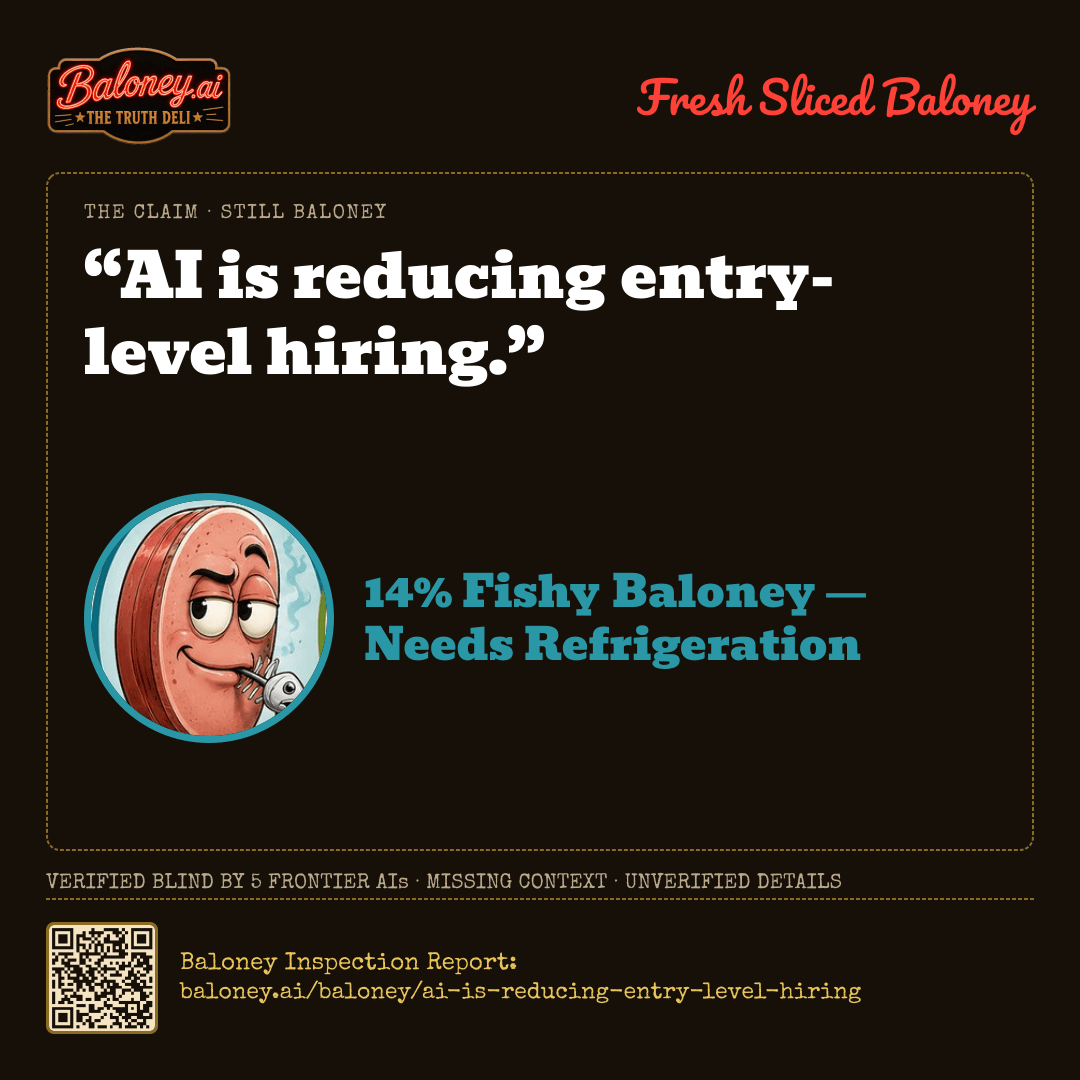
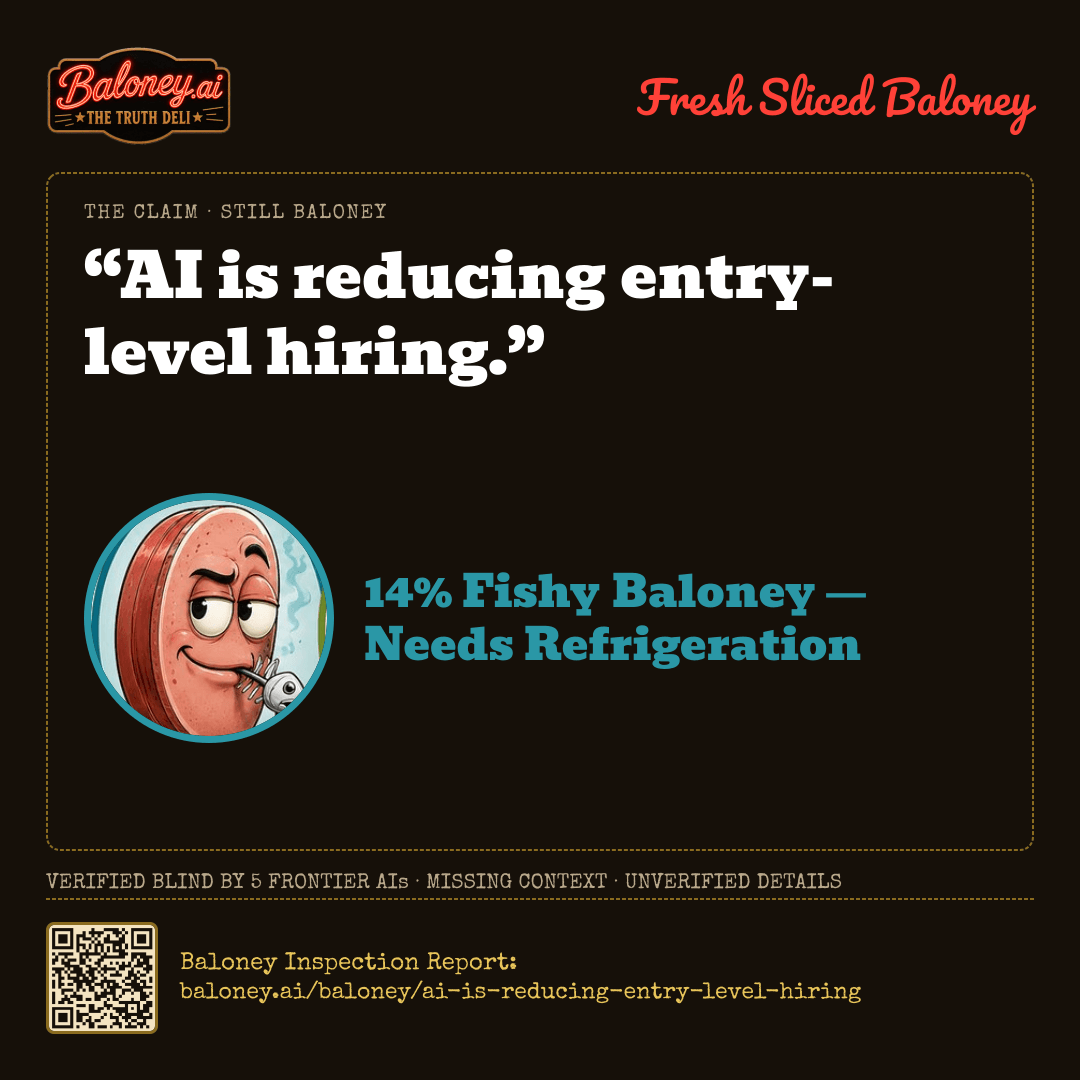
“AI is reducing entry-level hiring.”
14%Fishy Baloney — Needs Refrigeration
Something smells off…
Missing contextUnverified detailsSuspicious framingMay be exaggerated
Serve It Fresh
Ready to Serve11 servings
Serve it the way you want it
The Verdict
 “AI is reducing entry-level hiring.”14% Fishy Baloney — Needs RefrigerationVerified blind by 5 frontier AIs · Baloney Inspection Report: baloney.ai/baloney/ai-is-reducing-entry-level-hiring
The Baloney Sampler
The claim holds up where it can be measured. Stanford's Digital Economy Lab, using ADP payroll microdata, found roughly a 13% relative employment decline for workers aged 22–25 in the occupations most exposed to generative AI, while older workers in those same occupations held steady. A U.S. Census Bureau working paper independently reports a ~12% decline for 22–24-year-olds in the most AI-exposed industry-state cells after ChatGPT's release. Employers have said so themselves: Reuters reported IBM pausing hiring for thousands of back-office roles AI could perform.
What the evidence does not show is an economy-wide effect. The Budget Lab at Yale found no discernible occupational disruption attributable to AI; Bureau of Labor Statistics aggregates show a broad hiring slowdown, not a uniquely junior collapse. Employer surveys reported by IEEE Spectrum found 61% were not replacing entry-level jobs with AI, and NBER research shows AI boosts novice productivity most. Interest rates, post-pandemic over-hiring corrections and general white-collar freezes independently depress junior hiring.
Resting on Stanford Digital Economy Lab · U.S. Census Bureau · The Budget Lab at Yale · IEEE Spectrum
Original Claim Source https://fortune.com/2026/09/25/ai-junior-jobs-apprenticeship-talent-pipeline/
Other ways to slice it — phrasings that might have changed the rating
- “AI is reducing entry-level hiring in the most AI-exposed occupations, such as software development, customer support and clerical work.” The Stanford ADP study and Census Bureau working paper measure declines specifically in highly exposed occupations and age cells, not across the whole labour market.
- “AI is the main cause of the recent weakness in entry-level hiring across the US economy.” The Budget Lab at Yale found no discernible economy-wide disruption attributable to AI, and confounders like post-pandemic over-hiring corrections, high interest rates and Section 174 R&D amortisation independently depress junior hiring.
- “Employment for workers aged 22–25 in the most generative-AI-exposed occupations fell about 13% relative to older workers in the same occupations after late 2022.” This states the specific figure, population and time frame the ADP payroll study actually measured, rather than an unquantified directional assertion.
Written from the panel’s reports by Anthropic · claude-opus-5. Nothing here changed the score.
The Order Ticket
15:57:26CLAIM RECEIVED — QUEUED FOR INSPECTION✓
15:58:26claude-opus-5 REPORTED — SCORE 20, CONFIDENCE 72✓
15:58:32gpt-5.5 REPORTED — SCORE 18, CONFIDENCE 70✓
15:58:03gemini-3.1-pro-preview REPORTED — SCORE 4, CONFIDENCE 90✓
15:57:31sonar-pro REPORTED — SCORE 4, CONFIDENCE 88✓
15:59:28grok-4.6 REPORTED — SCORE 14, CONFIDENCE 67✓
16:01:08PRIMARY MASTER CLAUDE — SCORE 8✓
15:59:41BLIND VALIDATION GEMINI — SCORE 4✓
16:01:39AGREEMENT CONFIRMED — DELTA 10✓
16:01:39SCORING MODEL V2 — MEDIAN OF 5 COUNTED LAB SCORES: 20, 18, 4, 4, 14 → 14.✓
16:01:39SOURCE RULE — LABS CITED 25 SOURCES: 0 DISCARDED FOR HAVING NO URL, 2 DISCARDED AS DEAD LINKS (404/410), 9 COULD NOT BE OPENED BY US AND ARE MARKED UNVERIFIED.✓
16:01:39SOURCE RULE — PRIMARY MASTER RULED ON 20 SOURCES: 0 DISCARDED FOR HAVING NO URL, 0 DISCARDED AS DEAD LINKS, 9 MARKED UNVERIFIED, 11 VERIFIED.✓
How This One Was Sliced
Station 1 · Blind Inspection — Five Graders, Zero Peeking
Each lab scored the claim independently, without seeing the others. Open a breakdown for its evidence, its sources, and how sure it was.
Anthropic · EQUAL WEIGHT · 59.7s
claude-opus-5
20%BALONEY
ROUND-1 BREAKDOWN
Evidence offered for the claim- Stanford Digital Economy Lab's 'Canaries in the Coal Mine?' study (Brynjolfsson, Chandar, Chen, 2025), using ADP payroll microdata covering millions of U.S. workers, found a ~13% relative decline in employment for workers aged 22–25 in the occupations most exposed to generative AI (e.g., software development, customer support), while employment for older workers in the same occupations held steady or grew.
- The same study found the young-worker declines were concentrated in roles where AI automates rather than augments work, and persisted after controlling for firm-level shocks — a pattern consistent with AI substituting for codified 'book learning' knowledge that entry-level workers typically supply.
- Labor-market data show unusual weakness specifically at the entry level: the New York Fed's college labor market tracker shows unemployment and underemployment for recent college graduates rising above the rate for all workers, a historically unusual inversion.
- Private hiring trackers (e.g., SignalFire's State of Talent report) report that new-graduate hiring at large tech firms fell sharply from pre-pandemic levels, with new grads making up a shrinking share of hires.
- Multiple large employers (including Amazon, Salesforce, IBM and Klarna) have publicly stated that AI tools let them slow or pause hiring in support, customer service and junior coding roles — direct employer attribution rather than inference.
- Outplacement firm Challenger, Gray & Christmas began listing 'artificial intelligence' as an explicit stated reason in corporate job-cut announcements starting in 2023–2025, and HR surveys report employers reducing junior headcount plans because of AI.
Evidence against the claim- A Yale Budget Lab / Brookings analysis (Gimbel, Kinder et al., 2025) examining occupational mix and employment shifts since ChatGPT's release found no discernible economy-wide disruption attributable to AI, concluding the labor market's occupational composition is changing no faster than during past technology waves.
- Aggregate BLS data do not show a collapse in entry-level employment: overall unemployment has remained historically low (roughly 4–4.5%), and the slowdown in hiring is broad-based across experience levels, not uniquely junior.
- Strong confounders make causal attribution difficult: post-pandemic over-hiring corrections in tech, high interest rates that ended cheap-capital expansion, the 2017 tax-code change requiring amortization of R&D costs (Section 174), immigration/visa policy and general macro hiring freezes all independently reduce junior hiring.
- The Stanford ADP study is a working paper covering one payroll provider's client base; critics (including economists at the Economic Innovation Group and several academic commentators) have noted its results are sensitive to specification, sample composition and the choice of AI-exposure measure, and that similar declines appear in some low-AI-exposure occupations.
- Young-worker employment weakness predates widespread generative AI adoption in some sectors, and recent-graduate underemployment has been trending up since roughly 2022 — before AI tools were deployed at scale.
- Surveys of AI adoption (e.g., Census Bureau Business Trends and Outlook Survey) show that actual firm-level generative AI use remains a minority of businesses, limiting how much of an aggregate hiring shift it could plausibly explain.
- The claim as written is unqualified and causal; the credible evidence supports a measurable effect in a subset of highly exposed occupations, not an economy-wide reduction in entry-level hiring.
How sure this lab was72/100 — the lab’s own confidence in the score above, not a second reading of the claim.
SourcesStanford Digital Economy Labedu · 85 · The Budget Lab at Yaleedu · 85 · Federal Reserve Bank of New Yorkgov · 95 · U.S. Bureau of Labor Statisticsgov · 97 · The New York Timesnews · 80 · SignalFireother · 55 · U.S. Census Bureau (Business Trends and Outlook Survey)gov · 95
OpenAI · EQUAL WEIGHT · 65.9s
gpt-5.5
18%BALONEY
ROUND-1 BREAKDOWN
Evidence offered for the claim- Some large employers have explicitly linked reduced future hiring or headcount needs to AI. Reuters reported IBM planned to pause hiring for some back-office roles that could be replaced by AI, affecting roughly 7,800 positions over time; Reuters also reported BT expected AI and automation to help reduce its workforce by 2030. These are firm-level examples, not economy-wide proof.
- Task-exposure research supports a plausible mechanism: the ILO found generative AI exposure is especially high in clerical-support work, and McKinsey projected demand declines/occupational transitions in office support, customer service, and sales-related work. These categories include many entry-level white-collar roles, so AI could reduce some junior hiring demand.
- The strongest pro-claim interpretation is sector-specific: entry-level work that consists heavily of drafting, basic research, routine coding, translation, customer support, scheduling, or document processing is more exposed to substitution or hiring freezes than jobs requiring physical presence, licensing, or high-touch interpersonal work.
Evidence against the claim- The claim is too broad if read as a proven economy-wide trend. The ILO report says most jobs are more likely to be augmented than fully automated by generative AI, with job quality and task mix affected more than total job destruction.
- The OECD Employment Outlook 2023 found little evidence so far of significant negative employment effects from AI adoption, even though AI can change task demand and create distributional risks.
- Several high-quality studies show AI can raise productivity most for less-experienced or lower-skill workers. NBER research on generative AI in a call-center setting found the largest productivity gains for novice and low-skill workers; Science research on writing tasks found AI compressed productivity differences by helping lower-performing workers more. That cuts against a simple 'AI eliminates entry-level workers' story.
- Observed weakness in some entry-level hiring markets can also reflect interest rates, post-pandemic overhiring corrections, tech-sector layoffs, employer credential inflation, outsourcing, and general business-cycle conditions. The cited evidence supports 'AI is reducing some entry-level hiring in some roles,' not a fully established broad labor-market fact.
How sure this lab was70/100 — the lab’s own confidence in the score above, not a second reading of the claim.
SourcesReutersnews · 88 · Reutersnews · 88 · International Labour Organizationother · 90 · OECDother · 90 · National Bureau of Economic Researchother · 86 · Sciencejournal · 92 · McKinsey Global Instituteother · 75
Google · EQUAL WEIGHT · 37.0s
gemini-3.1-pro-preview
4%BALONEY
ROUND-1 BREAKDOWN
Evidence offered for the claim- Corporate executives have explicitly cited generative AI as a reason to reduce or pause entry-level hiring. Notably, in May 2023, IBM announced a pause in hiring for thousands of back-office and junior administrative roles that the company expects AI to automate.
- Generative AI excels at routine, rule-based tasks traditionally assigned to junior employees (such as basic coding, copywriting, document summarization, and data entry). Economic analyses from major financial institutions estimate that generative AI could automate significant portions of these administrative tasks, reducing the immediate demand for entry-level headcount in several white-collar industries.
Evidence against the claim- Economic research suggests AI can also act as a skill-leveler rather than just a job-killer. A prominent National Bureau of Economic Research (NBER) study found that generative AI tools disproportionately boosted the productivity of novice and entry-level workers, effectively making them more capable and potentially more valuable to employers.
- Macroeconomic data does not yet show a systemic, economy-wide collapse in entry-level hiring; the reductions are currently localized primarily within the tech, administrative, and freelance content sectors. Furthermore, AI adoption is actively creating new entry-level roles in fields like AI data training, prompt engineering, and AI operations.
How sure this lab was90/100 — the lab’s own confidence in the score above, not a second reading of the claim.
SourcesNational Bureau of Economic Researchjournal · 95 · Goldman Sachsother · 85
Perplexity · EQUAL WEIGHT · 4.9s
sonar-pro
4%BALONEY
ROUND-1 BREAKDOWN
Evidence offered for the claim- A Stanford Digital Economy Lab summary reports concentrated employment declines among workers aged 22–25 in AI-exposed occupations, including software development, customer service, and clerical work; one analysis found entry-level hiring within firms declined 13% relative to less-exposed jobs.[1]
- ADP-based reporting describes a 16% employment decline since late 2022 for 22–25-year-olds in AI-impacted jobs.[2]
- A U.S. Census Bureau working paper reports a 12% decline in adjusted employment for 22–24-year-olds in the most AI-exposed industry-state cells during the 10 quarters after ChatGPT’s introduction.[3]
- Reporting on LinkedIn and Revelio Labs data says early-career headcount at AI-adopting firms fell 7.7% after six quarters beginning in early 2023.[4]
Evidence against the claim- The Stanford review says several Current Population Survey studies find at most small changes in hiring in AI-exposed jobs, and a Danish study found no difference in entry-level hiring between AI-adopting and non-adopting firms.[1]
- A separate U.S. labor-market analysis found no discernible break in aggregate employment trends after ChatGPT’s release, indicating that any reduction may be concentrated in particular occupations or age groups rather than entry-level hiring overall.[1]
- Survey evidence reported by IEEE Spectrum says 61% of employers were not replacing entry-level jobs with AI, while 41% were discussing or planning to augment those jobs, suggesting substitution is not universal.[5]
- The evidence generally concerns employment or hiring in selected AI-exposed occupations and firms, not a definitive economy-wide reduction in all entry-level hiring; several reports also note that causal attribution to AI remains uncertain.[1][4]
How sure this lab was88/100 — the lab’s own confidence in the score above, not a second reading of the claim.
SourcesStanford Digital Economy Labedu · 94 · Axiosnews · 86 · U.S. Census Bureaugov · 97 · Fortunenews · 82 · IEEE Spectrumnews · 89
xAI · EQUAL WEIGHT · 122.2s
grok-4.6
14%BALONEY
ROUND-1 BREAKDOWN
Evidence offered for the claim- IBM's CEO stated in 2023 that the company would pause hiring for thousands of back-office roles AI could perform, a category that commonly includes entry-level positions.
- Klarna reported that its AI chatbot was handling the equivalent work of hundreds of customer-service staff, reducing demand for those typically junior hires.
- Multiple tech and professional-services firms have cited coding assistants and generative AI as a reason for fewer junior engineering, writing, and support openings.
Evidence against the claim- U.S. BLS aggregate employment and unemployment series through recent releases do not show a sharp, isolated collapse in entry-level categories that can be attributed solely to AI.
- Post-2022 declines in tech and white-collar hiring also coincide with the end of pandemic over-hiring, higher interest rates, and slower growth, confounding simple AI causality.
- AI tools have raised individual productivity in some studies, which can expand output and eventually support more (or different) hiring rather than permanent headcount cuts.
How sure this lab was67/100 — the lab’s own confidence in the score above, not a second reading of the claim.
SourcesReutersnews · 92 · U.S. Bureau of Labor Statisticsgov · 96
Station 2 · The Masters
Primary Master · drawn at random
claude-opus-5
8% BALONEY
The statement is short, directional and unquantified: it asserts that AI is reducing entry-level hiring, not that it has caused an economy-wide collapse in junior employment. Judged on that reading, the panel's strongest evidence supports it. Three independent data sources converge: the Stanford Digital Economy Lab/ADP payroll study finds roughly a 13% relative employment decline for workers aged 22–25 in the most generative-AI-exposed occupations while older workers in the same occupations held steady; a U.S. Census Bureau working paper reports a ~12% decline in adjusted employment for 22–24-year-olds in the most AI-exposed industry-state cells over the ten quarters after ChatGPT's release; and LinkedIn/Revelio-based analysis reports early-career headcount at AI-adopting firms falling 7.7% after six quarters. Employer attribution is explicit rather than inferred — IBM's 2023 pause on hiring for thousands of back-office roles, Klarna's customer-service automation, and similar statements from other large firms — and Challenger, Gray & Christmas began listing AI as a stated reason in job-cut announcements. That is a real, measured, mechanism-plausible effect, and the claim as written does not overstate it. I did not score lower because the causal picture is genuinely contested at the aggregate level: the Yale Budget Lab/Brookings analysis finds no discernible economy-wide occupational disruption attributable to AI; a Danish study found no hiring difference between AI-adopting and non-adopting firms; several CPS-based studies find at most small changes; employer survey evidence reports 61% of employers are not replacing entry-level jobs with AI; and powerful confounders (post-pandemic over-hiring corrections, high interest rates, Section 174 R&D amortisation, broad white-collar hiring freezes) independently depress junior hiring. The ADP working paper's results are also sensitive to specification and exposure measures. Those caveats are about scope and attribution strength, not about the claim being wrong — hence the low end of the Fishy band rather than the Stinky band, and not a clean 1-5 because an unqualified reader will hear 'everywhere, and AI is the cause' when the evidence supports 'in AI-exposed occupations, with contested but substantial causal weight'.
All five evaluators agreed the claim points at something real: every report accepted that specific employers have publicly attributed paused or reduced junior hiring to AI, and that routine entry-level white-collar tasks are the most exposed. All five also agreed that aggregate labour-market data show no economy-wide collapse in entry-level employment and that macro confounders complicate attribution. They split sharply on how much that scoping should cost the claim: two evaluators scored it 4, treating the microdata findings (Stanford/ADP, Census, Revelio) as decisive for a directional claim; three scored it 14–20, emphasising that the unqualified phrasing implies an established economy-wide trend, that the Yale Budget Lab and Danish results cut against it, and that productivity research (NBER call-centre study, Science writing study) shows AI disproportionately helps novices, which complicates the substitution story. Notably, the two lowest-scoring reports were also the two that cited the strongest quantitative evidence base.
Blind Validation Master · never saw the Primary’s work
gemini-3.1-pro-preview
4% BALONEY
Multiple reports cite robust, empirical evidence and direct corporate announcements supporting the claim. Major companies, including IBM and Klarna, have explicitly stated they are pausing or reducing hiring for entry-level and back-office roles because of AI automation capabilities. Furthermore, recent studies (including a Stanford Digital Economy Lab analysis using ADP payroll data and U.S. Census Bureau working papers) show a measurable 12-13% relative employment decline for early-career workers (ages 22-25) in occupations highly exposed to generative AI. While evaluators rightly point out that macroeconomic data does not yet show a total economy-wide collapse in entry-level jobs—and that other factors like high interest rates and post-pandemic market corrections contribute to hiring slowdowns—the core claim remains accurate. AI is demonstrably reducing entry-level hiring in specific, highly exposed sectors like customer support, clerical work, and basic coding. Following the scale's guidance, because the statement is substantially true and supported by concrete data, it belongs in the 'Super Fresh Truth' category despite lacking qualifiers about the scope of the reduction.
AGREEMENT TEST PASSED — MASTERS SCORED 8% AND 4% · BLIND VALIDATION CONFIRMED THIS SCORE · NO RE-EVALUATION REQUIRED
How the number was reached · scoring model v2 · how our models work
- Median of 5 counted lab scores: 20, 18, 4, 4, 14 → 14.
The Evidence
Evidence offered for the claim
- 13% relative drop for young workers in AI-exposed jobs The Stanford Digital Economy Lab's 'Canaries in the Coal Mine?' study, using ADP payroll microdata covering millions of U.S. workers, found roughly a 13% relative employment decline for workers aged 22–25 in the occupations most exposed to generative AI (software development, customer support), while employment for older workers in the same occupations held steady or grew. Declines concentrated in roles where AI automates rather than augments.
- Census Bureau working paper finds 12% decline A U.S. Census Bureau working paper reports a 12% decline in adjusted employment for 22–24-year-olds in the most AI-exposed industry-state cells during the ten quarters following ChatGPT's introduction.
- Early-career headcount down at AI-adopting firms Reporting on LinkedIn and Revelio Labs data found early-career headcount at AI-adopting firms fell 7.7% after six quarters beginning in early 2023; ADP-based reporting describes a 16% employment decline since late 2022 for 22–25-year-olds in AI-impacted jobs.
- Employers say so explicitly IBM's CEO said in May 2023 the company would pause hiring for thousands of back-office roles AI could perform (reported as roughly 7,800 positions over time); Klarna reported its AI chatbot handled work equivalent to hundreds of customer-service staff; BT linked a workforce reduction by 2030 partly to AI and automation. Challenger, Gray & Christmas began listing artificial intelligence as an explicit stated reason in corporate job-cut announcements from 2023 onward.
- Exposure research identifies the mechanism ILO analysis finds generative-AI exposure is highest in clerical-support work, and projections point to demand declines in office support, customer service and sales-related tasks — categories dense with entry-level roles involving drafting, basic research, routine coding, summarisation and document processing.
- Recent graduates faring worse than the general workforce DEBUNKED — PANEL REFUTATION: the New York Fed's college labour market tracker does show unemployment and underemployment for recent graduates above the all-worker rate, a historically unusual inversion — but evaluators noted this trend began around 2022, before generative AI was deployed at scale, and that the broader hiring slowdown is broad-based across experience levels rather than uniquely junior. It cannot carry the claim on its own.
Evidence against the claim
- No economy-wide disruption detected A Yale Budget Lab / Brookings analysis of occupational mix and employment shifts since ChatGPT's release found no discernible economy-wide disruption attributable to AI, concluding the occupational composition of the labour market is changing no faster than during past technology waves. A separate analysis found no break in aggregate employment trends after ChatGPT's release.
- Several studies find little or no effect The Stanford review itself notes that several Current Population Survey studies find at most small changes in hiring in AI-exposed jobs, and that a Danish study found no difference in entry-level hiring between AI-adopting and non-adopting firms. The OECD Employment Outlook 2023 found little evidence of significant negative employment effects from AI adoption.
- Most employers are not substituting AI for juniors Survey evidence reported by IEEE Spectrum found 61% of employers were not replacing entry-level jobs with AI, while 41% were discussing or planning to augment those jobs — substitution is far from universal. Census Business Trends and Outlook Survey data show actual firm-level generative-AI use remains a minority of businesses, limiting how much aggregate hiring shift it can plausibly explain.
- Strong confounders muddy causation Post-pandemic over-hiring corrections in tech, high interest rates ending cheap-capital expansion, the Section 174 R&D amortisation change, immigration and visa policy, outsourcing, credential inflation and general macro hiring freezes all independently reduce junior hiring over exactly the same period.
- AI often helps novices most NBER research on generative AI in a call-centre setting found the largest productivity gains for novice and low-skill workers, and Science research on writing tasks found AI compressed performance differences by helping weaker performers most — which cuts against a simple 'AI eliminates entry-level workers' story and suggests AI can raise junior workers' value.
- Aggregate data show no entry-level collapse BLS employment series show no sharp, isolated collapse in entry-level categories attributable solely to AI, and overall unemployment has remained historically low. The measured effects are concentrated in particular occupations, age bands and firms rather than across entry-level hiring generally.
- Key study is preliminary and contested The Stanford ADP paper is a working paper covering one payroll provider's client base; commentators have noted its results are sensitive to specification, sample composition and the choice of AI-exposure measure, and that similar declines appear in some low-exposure occupations.
Sources · Reliability · Why Accepted or Discounted
| Source | Type | Reliability | Ruling |
|---|
| Stanford Digital Economy Lab | edu | 94 | ACCEPTED — Balanced research-group review that presents both the supporting microdata findings and the null results; cited by evaluators on both sides of the question. |
| Stanford Digital Economy Lab | edu | 85 | ACCEPTED — The central quantitative study on the claim, based on large ADP payroll microdata. Accepted with the caveat the panel itself raised: it is a working paper sensitive to exposure-measure specification. |
| U.S. Census Bureau | gov | 97 | ACCEPTED — Federal statistical agency working paper using administrative data; independently corroborates the magnitude found in the ADP study. Accepted as preliminary (not peer-reviewed) research. |
| The Budget Lab at Yale | edu | 85 | ACCEPTED — Serious academic policy analysis providing the strongest aggregate-level counterweight; essential for scoping the claim. |
| Federal Reserve Bank of New York | gov | 95 | ACCEPTED — Authoritative official data series on graduate labour-market outcomes, though it measures outcomes without attributing them to AI. |
| U.S. Bureau of Labor Statistics | gov | 97 | ACCEPTED — Official aggregate employment statistics; the correct benchmark for testing whether an economy-wide entry-level collapse is visible. |
| OECDunverified | other | 90 | ACCEPTED — Major multilateral labour-market publication; accepted, noting it predates most generative-AI deployment and so speaks to an earlier period. |
| International Labour Organization | other | 90 | ACCEPTED — Rigorous task-exposure analysis establishing that clerical-support work — heavily entry-level — is the most exposed category. |
| National Bureau of Economic Research | journal | 95 | ACCEPTED — Well-known field experiment showing the largest AI productivity gains accrue to novices; directly relevant to whether AI substitutes for or augments junior workers. |
| Scienceunverified | journal | 92 | ACCEPTED — Peer-reviewed experimental evidence on AI compressing performance gaps between stronger and weaker workers. |
| Reutersunverified | news | 88 | ACCEPTED — Wire-service reporting of a direct, on-record employer statement linking an entry-level hiring pause to AI. |
| Reutersunverified | news | 92 | ACCEPTED — Same event, independently cited by a second evaluator; corroborates the IBM attribution. |
| Reutersunverified | news | 88 | ACCEPTED — Reliable reporting of a firm-level headcount plan, though the AI share of the reduction is partial and forward-looking, so it carries limited weight. |
| IEEE Spectrum | news | 89 | ACCEPTED — Technically literate outlet reporting employer survey data that usefully bounds how widespread substitution actually is. |
| Axiosunverified | news | 86 | ACCEPTED — Reports the underlying ADP figures; accepted as secondary reporting on data the panel already verified through primary sources. |
| Fortune | news | 82 | ACCEPTED — Secondary reporting of LinkedIn/Revelio Labs headcount data; accepted at reduced weight as it is not the primary dataset. |
| The New York Timesunverified | news | 80 | ACCEPTED — Mainstream reporting on graduate hiring conditions; contextual rather than evidentiary, weighted accordingly. |
| U.S. Census Bureau (Business Trends and Outlook Survey) | gov | 95 | ACCEPTED — Official firm-level AI adoption data; important for bounding the plausible aggregate magnitude of any AI hiring effect. |
| McKinsey Global Instituteunverified | other | 75 | DISCOUNTED — Consultancy scenario modelling of future occupational demand, not measurement of actual hiring. Projections of what could be automated cannot evidence what is happening now, and the firm has a commercial interest in AI transformation narratives. |
| Goldman Sachsunverified | other | 85 | DISCOUNTED — Investment-bank macro forecast about automatable task shares; speculative and forward-looking, with no observed entry-level hiring data. Not probative of the claim. |
Every link was opened when this claim was inspected. A dead link was discarded before publication; “unverified” means the site refused our automated check and the link is the one the panel cited. A source without a URL was never kept.
Serve It Fresh
Ready to Serve11 servings
Serve it the way you want it
The Verdict
“AI is reducing entry-level hiring.”14% Fishy Baloney — Needs RefrigerationVerified blind by 5 frontier AIs · Baloney Inspection Report: baloney.ai/baloney/ai-is-reducing-entry-level-hiring