Baloney Inspection Report: Claim #1195 · Inspected Nov 1, 2026, 6:35 AM PST · Scoring model v2
96%
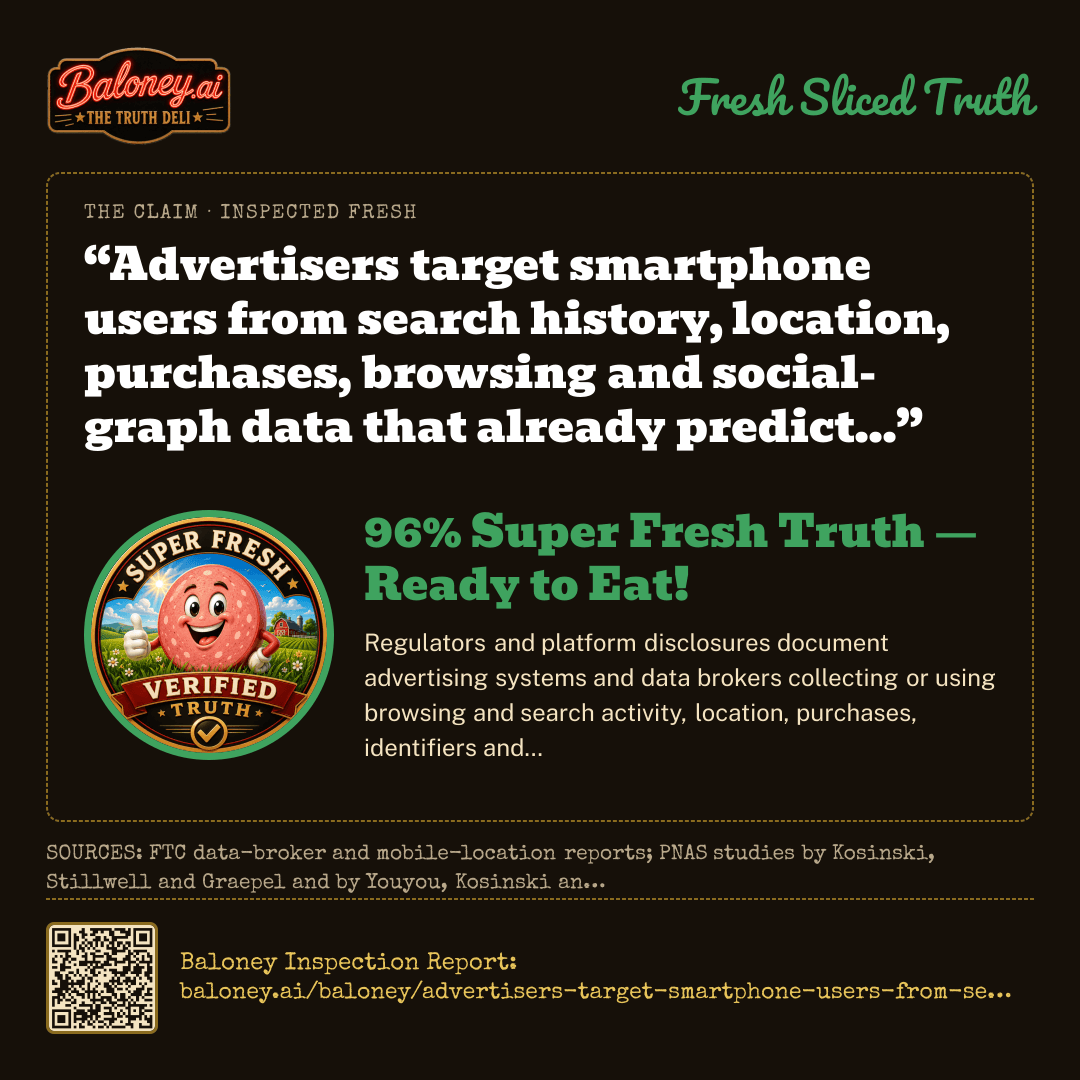
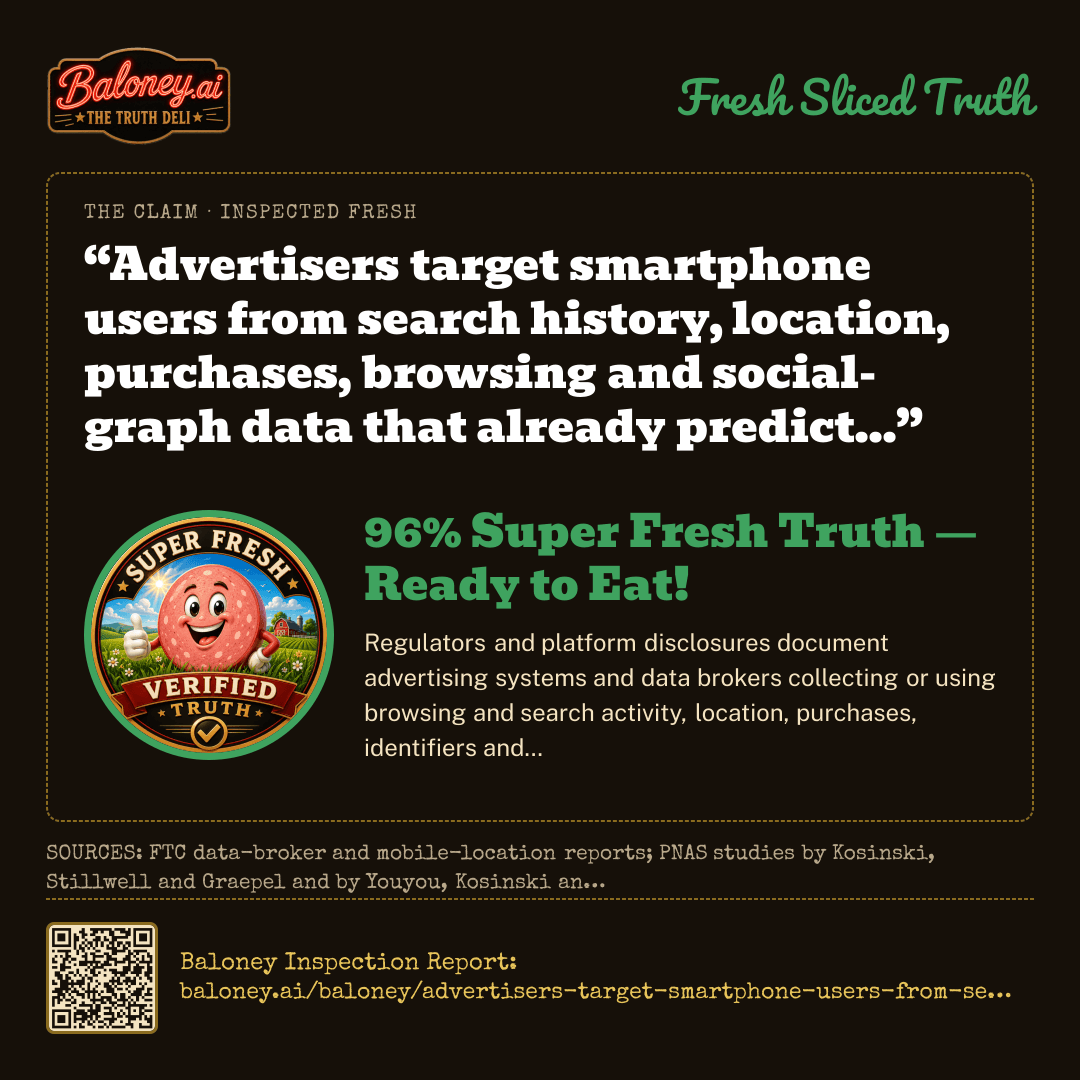
“Advertisers target smartphone users from search history, location, purchases, browsing and social-graph data that already predict interests with striking accuracy.”
96%Super Fresh Truth — Ready to Eat!
THE CLAIM CHECKS OUT.
Independently verifiedPhysically repeatable evidenceConfirmed across rival labsSafe to serve
“Advertisers target smartphone users from search history, location, purchases, browsing and social-graph data that already predict interests with striking accuracy.”96% Super Fresh Truth — Ready to Eat!Verified blind by 5 frontier AIs · Baloney Inspection Report: baloney.ai/baloney/advertisers-target-smartphone-users-from-search-history
The Rating Card
The claim this refutes
The Baloney Sampler
The reports found that advertisers and data brokers use search and browsing activity, location, purchase records, and social signals to build audiences and infer interests. The FTC documented these practices, including mobile-location data sold for advertising, while Google describes using searches, activity, and approximate location for ad personalization.
The strongest support for “striking accuracy” comes from PNAS research showing that Facebook Likes could predict some traits and that computer judgments could outperform human acquaintances. But the reports also found that commercial audience segments and platform interest categories can be inaccurate, stale, or irrelevant, and that privacy controls limit some cross-site and cross-app data.
Other ways to slice it — phrasings that might have changed the rating
“Advertisers use smartphone location, browsing, purchase, and social-activity data to target audiences, but the resulting interest predictions are often inaccurate for individual users.” The reports support the data-collection and targeting mechanism while documenting errors in third-party segments and inferred-interest categories.
“In specific research settings, digital traces such as Facebook Likes can predict selected personal traits with high statistical accuracy.” The PNAS findings support strong prediction for particular traits and datasets, but not uniformly for every smartphone user or commercial interest.
“Advertisers generally do not use smartphone microphones to secretly listen to conversations and serve ads.” The reports note that large app research found no covert audio exfiltration, while the claim under review concerns other forms of data.
Written from the panel’s reports by Perplexity · sonar-pro. Nothing here changed the score.
14:37:25SCORING MODEL V2 — MEDIAN OF 5 COUNTED LAB SCORES: 4, 4, 2, 18, 4 → 4. FRESH RULE: THE PRIMARY MASTER SCORES 4 AND THE BLIND MASTER 4 — BOTH SUPER FRESH TRUTH — AND THE COUNTED MEDIAN IS 4, ON THE TRUE SIDE. PUBLISHED AS 4, THE MORE CAUTIOUS OF THE TWO MASTERS.✓
14:37:25SOURCE RULE — LABS CITED 32 SOURCES: 0 DISCARDED FOR HAVING NO URL, 4 DISCARDED AS DEAD LINKS (404/410), 13 COULD NOT BE OPENED BY US AND ARE MARKED UNVERIFIED.✓
14:37:25SOURCE RULE — PRIMARY MASTER RULED ON 20 SOURCES: 0 DISCARDED FOR HAVING NO URL, 0 DISCARDED AS DEAD LINKS, 8 MARKED UNVERIFIED, 12 VERIFIED.✓
How This One Was Sliced
Station 1 · Blind Inspection — Five Graders, Zero Peeking
Each lab scored the claim independently, without seeing the others. Open a breakdown for its evidence, its sources, and how sure it was.
Anthropic · EQUAL WEIGHT · 54.0s
claude-opus-5
96%TRUTH
ROUND-1 BREAKDOWN
Evidence offered for the claim
The U.S. Federal Trade Commission's September 2024 staff report on nine major social media and video streaming companies found that the firms collected and indefinitely retained vast amounts of user and non-user data — including demographic, behavioral, location and inferred-interest data — and fed it into automated systems used for ad targeting, confirming the core mechanism the claim describes.
The FTC's 2014 data broker study documented brokers compiling billions of data elements per consumer, including purchase transactions, web browsing, and location, and deriving thousands of behavioral/interest 'segments' sold for marketing — i.e., the exact inputs named in the claim.
Peer-reviewed research (Kosinski, Stillwell & Graepel, PNAS 2013) showed that ordinary digital footprints (Facebook Likes — a social-graph signal) predicted sensitive attributes with high accuracy: 95% for race, 93% for gender, 88% for sexual orientation among men. A follow-up (Youyou et al., PNAS 2015) found model-based personality judgments from Likes outperformed judgments by friends and family, supporting 'striking accuracy' for interest/trait inference.
The New York Times' 2019 'One Nation, Tracked' investigation analyzed a leaked dataset of 50 billion location pings from 12 million U.S. phones, collected by location-data firms for advertising/analytics, demonstrating that smartphone location targeting at scale is real and granular enough to identify individuals.
The FTC sued data broker Kochava (2022) over the sale of precise geolocation data derived from mobile devices that could track people to reproductive health clinics, places of worship and shelters — regulatory confirmation that smartphone location data is traded in the ad ecosystem.
The UK Competition and Markets Authority's 2020 digital advertising market study documented in detail how search history, browsing, purchase and profile data underpin personalised advertising, and estimated personalised ads command substantially higher prices than non-targeted ads.
The Norwegian Consumer Council's 'Out of Control' (2020) technical report showed popular smartphone apps transmitting user identifiers, location, IP and behavioural data to dozens of adtech companies in real time.
Evidence against the claim
'Striking accuracy' is the weakest part of the claim: field experiments by Neumann, Tucker & Whitfield (Marketing Science, 2019) found third-party consumer profiling was often poor — gender targeting was correct only about 42–72% of the time depending on vendor, and age+gender combinations fared worse, sometimes no better than chance.
The FTC's own 2014 report and subsequent academic audits noted that broker-derived segments contain substantial errors and stale inferences; Pew (2019) found roughly half of U.S. Facebook users said the platform's listed interest categories did not accurately describe them (about 27% said the listings were not very/at all accurate, and many were surprised by them).
Accuracy is uneven across data types: location and purchase data tend to be reliable, while inferred 'interests' and demographics from probabilistic cross-device graphs are frequently wrong, so a blanket 'striking accuracy' overstates average performance.
The claim can imply a single, seamless profile; in practice data is fragmented across walled gardens (Google, Meta, Amazon, Apple) and brokers, and Apple's App Tracking Transparency (2021) plus GDPR/CCPA-style rules have measurably reduced cross-app identifier availability, degrading some targeting pipelines.
Popular adjacent beliefs — e.g., that phone microphones secretly listen to conversations to serve ads — are not supported by the evidence; researchers (Northeastern's 'Panoptispy' study) found no covert audio exfiltration in a large app sample. The claim as written does not assert this, but it is often read that way.
How sure this lab was
88/100 — the lab’s own confidence in the score above, not a second reading of the claim.
Government and regulatory records show that the ad ecosystem uses the kinds of data named in the claim. The FTC’s data-broker report describes brokers collecting consumer data from purchases, online activity, social media, public records and other sources, then selling marketing segments and inferences to advertisers.
Mobile-location targeting is well documented. The FTC’s InMarket action says a mobile advertising company collected precise location data through apps, used it to infer visits to sensitive and commercial places, and created audience segments for targeted advertising.
Major ad platforms acknowledge use of search/activity/location signals for ad personalization. Google’s ad-technology disclosure says ads may be personalized using searches, videos watched, site/app activity, approximate location and information from advertisers.
Scientific evidence supports the idea that digital traces can predict interests/traits with high accuracy. Kosinski et al. in PNAS found Facebook Likes predicted attributes such as political views, religion, ethnicity, sexual orientation and personality traits; Youyou et al. found computer judgments from Facebook Likes could outperform human acquaintances for personality prediction with enough Likes.
There is experimental evidence that such inferred traits can improve ad effectiveness. Matz et al. in PNAS found psychologically matched Facebook ads produced higher clicks and conversions than mismatched ads.
Adtech regulators have documented real-time bidding and profiling systems that transmit or use browsing/device/location/profile data to select ads, supporting the claim that smartphone users are targeted based on multi-source behavioral data.
Evidence against the claim
The phrase “with striking accuracy” is broadly true in some studies but overstates uniform accuracy. Pew Research found only 59% of Facebook users said the platform’s ad-interest categories reflected their real-life interests very or somewhat accurately, while 27% said they did not accurately reflect them.
FTC reporting also cautions that data-broker inferences may be inaccurate, stale or unverifiable, and consumers often cannot see or correct the profiles used for marketing.
Advertisers often do not receive raw search histories, purchase logs or full social graphs directly; they commonly buy platform-defined audiences, lookalike segments or data-broker categories. So the claim is more accurate as a description of the targeting ecosystem than of every individual advertiser’s direct access.
Scientific studies showing high prediction accuracy usually concern specific datasets, populations and outcomes, such as Facebook Likes predicting traits, not guaranteed precise prediction of every smartphone user’s commercial interests in every context.
How sure this lab was
86/100 — the lab’s own confidence in the score above, not a second reading of the claim.
The digital advertising ecosystem, dominated by companies like Meta (Facebook/Instagram) and Alphabet (Google), is fundamentally built on aggregating user data—including search queries, web browsing behavior, and purchase histories—to build highly specific predictive profiles for targeted advertising.
Data brokers continuously harvest and sell Mobile Ad IDs (MAIDs) linked to precise geolocation data from smartphone apps, allowing advertisers to target users based on their physical movements and real-world behaviors.
Academic research has repeatedly demonstrated that social graph data (such as social media 'likes' and friend networks) can predict highly intimate personal traits, interests, and demographic information with striking statistical accuracy.
Advertisers use offline purchase data (often acquired through data partnerships with credit card networks and loyalty programs) and match it with online profiles using 'onboarding' services, enabling them to predict future buying intent accurately.
Evidence against the claim
While predictive algorithms are statistically powerful across large populations, they frequently make erroneous inferences about individual users, such as serving persistent ads for products a user has already purchased or misinterpreting a brief search as a long-term interest.
Recent privacy initiatives, such as Apple's App Tracking Transparency (ATT) framework in iOS and stricter global privacy regulations (like the GDPR), have somewhat degraded the accuracy and availability of third-party browsing and location data.
How sure this lab was
95/100 — the lab’s own confidence in the score above, not a second reading of the claim.
Advertisers and data brokers demonstrably use smartphone location data linked to mobile-advertising IDs; the FTC said X-Mode/Outlogic sold precise location data to hundreds of clients for advertising and brand analytics.[1]
Academic research documents that Facebook algorithmically infers users’ interests from their activity and offers advertisers targeting based on those inferred interests.[2]
A controlled experiment found that knowing 18 or more randomly selected interests could enable highly specific ad targeting: 8 of 9 campaigns successfully reached the selected person.[3]
These findings support the narrower proposition that behavioral, location, and social-graph signals are used for advertising inference and can sometimes be highly predictive.
Evidence against the claim
The wording overstates accuracy by saying the combined data already predict interests with “striking accuracy” without specifying a metric, population, platform, or prediction task.
North Carolina State researchers found Facebook’s inferred-interest categories were inaccurate or irrelevant about 29.3% of the time among 146 participants, while a controlled account experiment found 33.22% inaccurate or irrelevant.[4]
A peer-reviewed study reports an internal Facebook estimate that U.S. interest-category precision was only 41%, implying that more than half of targeted users could fall outside an advertiser’s intended audience.[2]
The evidence does not establish that advertisers routinely access all five listed data types—search history, location, purchases, browsing, and social-graph data—for every smartphone user, nor that their joint predictions are consistently highly accurate.
The strongest targeting result concerns a specially constructed experiment in which researchers supplied many known interests; it does not demonstrate ordinary advertising performance from passively collected smartphone data.
How sure this lab was
91/100 — the lab’s own confidence in the score above, not a second reading of the claim.
Ad platforms including Google, Meta and Amazon routinely use first-party and partner data covering search queries, device location, purchase records, browsing activity and social connections to build interest profiles and deliver targeted ads, as described in their own ad-product and privacy documentation and confirmed by regulators.
Peer-reviewed work (Kosinski, Stillwell & Graepel, PNAS 2013) showed that digital records such as Facebook likes predict personality, political views and other attributes at levels that often exceed human judges, supporting the 'striking accuracy' phrasing for social-graph and behavioral data.
Investigative reporting has documented commercial location-data brokers obtaining precise, persistent smartphone location histories that are sold for advertising and analytics.
FTC examinations of data brokers and mobile advertising have described the aggregation of search, location, purchase and browsing signals into marketing profiles used to target consumers.
Evidence against the claim
Apple App Tracking Transparency (2021 onward) and the ongoing deprecation of third-party cookies have reduced cross-app and cross-site identifiers for large numbers of users, so some third-party interest predictions are less precise than they were a few years ago.
Meta sharply restricted third-party access to social-graph data after 2018, meaning advertisers no longer obtain the same unrestricted friend-network signals that earlier studies used.
Individual-level predictions remain probabilistic; accuracy is high in aggregate and for many traits but is not uniformly 'striking' for every person or every interest.
Opt-outs, ad blockers, private browsing, VPNs and platform privacy controls degrade the completeness of the data available to many advertisers.
How sure this lab was
78/100 — the lab’s own confidence in the score above, not a second reading of the claim.
The statement’s core proposition is substantially true: the reports consistently document advertising and data-broker systems using search or browsing activity, location, purchases, behavioral profiles, and social signals for audience selection. Peer-reviewed research also shows that digital traces, especially Facebook Likes, can predict some traits with striking accuracy.[1] The score remains above the minimum because the wording overgeneralizes across advertisers and smartphone users, implies that all five data types are routinely combined, and treats prediction accuracy as uniformly strong. Field research found third-party audience segments often inaccurate and economically unattractive, while platform interest categories and inferred profiles can be stale, irrelevant, or wrong.[2] Privacy controls and fragmented platform ecosystems further limit the completeness of targeting data. These are material qualifications, but they do not overturn the claim’s central factual basis, so the statement belongs in the 1–5 True band rather than the Fishy Baloney band.
All five evaluators agreed that the advertising ecosystem uses the named kinds of data and that digital traces can support prediction or targeting. Reports 2–5 independently emphasized that “striking accuracy” is uneven, probabilistic, and often overstated; Report 1 was more favorable but also noted erroneous individual inferences and privacy-related degradation. The panel therefore converged on a substantially true claim with wording and scope limitations. Government and peer-reviewed sources were given the greatest weight; investigative journalism, platform disclosures, and advocacy reports were accepted as corroboration but discounted where they did not directly measure individual-level accuracy.
SUPER FRESH — VERIFIED AGAINST FTC DATA-BROKER AND MOBILE-LOCATION REPORTS; PNAS STUDIES BY KOSINSKI, STILLWELL AND GRAEPEL AND BY YOUYOU, KOSINSKI AND STILLWELL; MARKETING SCIENCE FIELD STUDY OF THIRD-PARTY PROFILING; GOOGLE ADVERTISING DISCLOSURE; PEW RESEARCH CENTER SURVEY; ICO REAL-TIME-BIDDING REPORT.
Blind Validation Master · never saw the Primary’s work
gemini-3.1-pro-preview
96% TRUTH
The claim accurately describes the fundamental mechanisms of the digital advertising ecosystem. Multiple independent reports cite regulatory findings (such as from the FTC) and robust academic research (including studies published in PNAS) confirming that ad platforms and data brokers extensively aggregate search history, precise geolocation, purchase records, web browsing, and social-graph data to target smartphone users. Furthermore, peer-reviewed evidence demonstrates that these digital footprints can predict sensitive personal traits and user interests with high statistical accuracy—often outperforming human judgment—which supports the 'striking accuracy' descriptor. While some reviewers note minor caveats—such as the fact that individual inferences can sometimes be erroneous or stale, and that recent privacy initiatives (like Apple's App Tracking Transparency) have introduced some friction into data collection—these do not negate the fundamental truth of the claim. Because the statement is substantially true and accurately reflects the documented reality of the targeted advertising industry, it firmly belongs in the 'Super Fresh Truth' band.
AGREEMENT TEST PASSED — BOTH MASTERS SCORED 96% · BLIND VALIDATION CONFIRMED THIS SCORE · NO RE-EVALUATION REQUIRED
Median of 5 counted lab scores: 4, 4, 2, 18, 4 → 4.
Fresh rule: the Primary Master scores 4 and the Blind Master 4 — both Super Fresh Truth — and the counted median is 4, on the true side. Published as 4, the more cautious of the two masters.
The Evidence
Evidence for the claim
Adtech uses the listed data FTC reports describe brokers and platforms collecting or deriving information from purchases, online activity, browsing, location, social media and demographic signals, then using marketing segments and inferred interests for advertising. Mobile-location cases document precise device location being collected and used to infer visits and create ad audiences.
Digital traces can be highly predictive The PNAS Facebook Likes study found strong prediction of several attributes, including 88% discrimination of homosexual versus heterosexual men, 95% discrimination of African American versus Caucasian users, and 85% discrimination of Democrat versus Republican users.[1] A related PNAS study found computer personality judgments from Likes could outperform judgments by human acquaintances.[3]
Location targeting is real and granular The reports cite FTC actions and investigative reporting documenting mobile advertising identifiers and precise smartphone location histories being collected, traded, and used for advertising or analytics.
Targeting can improve advertising results The reports cite research finding that psychologically matched Facebook advertisements generated higher clicks and conversions than mismatched advertisements.
Evidence offered against the claim
Accuracy is uneven A field study of more than 90 third-party audience segments across 19 data brokers found that segments varied greatly and were often inaccurate; compared with random selection, identification improvements ranged from 0% to 77%.[2] Other reports cite roughly 41% precision for some Facebook interest categories and substantial user disagreement with assigned interests.
The wording overstates universal access The evidence does not show that every advertiser routinely receives or combines search history, location, purchases, browsing and social-graph data for every smartphone user. Advertisers often buy platform-defined audiences, lookalike segments, or broker categories rather than raw personal records.
Research results have narrower scope The strongest accuracy findings concern specific prediction tasks, datasets, and populations—especially Facebook Likes—not guaranteed prediction of each person’s commercial interests in ordinary smartphone advertising.
Privacy changes reduce some tracking Apple’s App Tracking Transparency, cookie deprecation, privacy controls, ad blockers, VPNs and platform restrictions have reduced some cross-app, cross-site and third-party data flows, while data fragmentation across major platforms limits unified profiles.
Sources · Reliability · Why Accepted or Discounted
ACCEPTED — Useful contextual account of data aggregation and online profiling, though less direct than regulatory or peer-reviewed evidence on accuracy.
ACCEPTED — Corroborates the scale and granularity of smartphone location collection, though it is investigative rather than primary regulatory evidence.
ACCEPTED — Technical advocacy investigation supports real-time transmission of identifiers, location and behavioral data to adtech companies, with less independent methodological authority than government sources.
ACCEPTED — Relevant to the reports’ clarification that covert microphone-based targeting is not established, although that issue is outside the statement itself.
DISCOUNTED — The controlled targeting experiment is relevant but is a preprint and uses specially supplied interests, limiting its value for ordinary advertising performance.
ACCEPTED — Platform disclosure supports the use of searches, activity, location and advertiser information, but is self-reported and not an independent accuracy assessment.
ACCEPTED — Investigative reporting provides contextual support for commercial and political use of social-data profiling, but is less probative than the cited academic and regulatory sources.
Every link was opened when this claim was inspected. A dead link was discarded before publication; “unverified” means the site refused our automated check and the link is the one the panel cited. A source without a URL was never kept.
“Advertisers target smartphone users from search history, location, purchases, browsing and social-graph data that already predict interests with striking accuracy.”96% Super Fresh Truth — Ready to Eat!Verified blind by 5 frontier AIs · Baloney Inspection Report: baloney.ai/baloney/advertisers-target-smartphone-users-from-search-history
Support The Truth Deli
Buy The Truth Deli Merch
“Democracy Makes America Great”
Veritate Libertas — Latin for “Through Truth, Liberty.”
Democracy is what makes America great. But without truth — honest, real, scientifically validated truth — democracy fails. The baloney slicer is on: feeding fresh sliced truth to protect what makes America great. Democracy.